Article
J. Braz. Chem. Soc., Vol. 22, No. 7, 1307-1314, 2011. Printed in Brazil - ©2011 Sociedade Brasileira de Química
0103 - 5053 $6.00+0.00
A
*e-mail: [email protected]
Evolution of the Concentration of Phenolic Compounds in Cachaça during Aging in
an Oak (
Quercus
sp.) Barrel
Jeancarlo P. dos Anjos,a Maria das Graças Cardoso,*,a Adelir A. Saczk,a
Haroldo S. Dórea,b Wilder D. Santiago,a Ana Maria R. Machado,a
Lidiany M. Zacaronia and David Lee Nelsonc
aDepartamento de Química, Universidade Federal de Lavras, CP 3037,
37200-000 Lavras-MG, Brazil
bDepartamento de Química, Universidade Federal de Sergipe, Av. Mal. Rondon, s/n,
49100-000 São Cristóvão-SE, Brazil
cDepartamento de Alimentos, Faculdade de Farmácia, Universidade Federal de Minas Gerais,
Av. Antônio Carlos, 6627, 31270-901 Belo Horizonte-MG, Brazil
A cachaça, tradicional e popular bebida brasileira, é obtida por meio da destilação do mosto fermentado de cana de açúcar. Dentre as etapas do processo de produção da bebida, o envelhecimento natural consiste em armazená-la em recipientes de madeira apropriados por um tempo determinado, onde ocorrem alterações na composição química, aroma, sabor e cor da bebida. Este trabalho teve como objetivo realizar um acompanhamento da composição fenólica em diferentes períodos de envelhecimento da cachaça em tonel de carvalho (Quercus sp.). Foram realizadas coletas periódicas durante o período de envelhecimento da cachaça em tonel de carvalho e realizaram-se análise de treze compostos fenólicos utilizando a técnica de cromatograia líquida de alta eiciência com detector de arranjo de diodos (HPLC-DAD). Foi constatado um aumento progressivo na concentração dos compostos analisados ao longo do período analisado, sendo que os compostos encontrados em maior concentração foram siringaldeído e ácido gálico.
Cachaça is a traditional and popular Brazilian drink obtained by distilling fermented sugar cane juice. Among the steps involved in its production, natural aging in wood containers for a certain period of time can lead to alterations in the chemical composition, aroma, lavor and color of the beverage. The present work sought to determine the concentration of phenolic compounds after different periods of aging of the cachaça in an oak (Quercus sp.) barrel. Periodic collections during the aging period were performed, and thirteen selected phenolic compounds were determined by high performance liquid chromatography with a diode-array detector (HPLC-DAD). A progressive increase in the concentration of the compounds analyzed was observed, with syringaldehyde and gallic acid as the compounds encountered in the highest concentration.
Keywords:cachaça, phenolic compounds, aging, HPLC
Introduction
Cachaça is a traditional popular Brazilian drink obtained by distilling fermented sugar cane. Minas Gerais is considered to be the hub of the production of homemade cachaça in the country, it is estimated that there are approximately 8,500 domestic producers in the state, with 1,516 registered trademarks and a production that can reach 200 million liters per year. It is believed that only 0.3%
of the cachaça produced in the state is exported.1-3 The
expansion of the consumer market has encouraged improvements, implementation of stricter controls, and more detailed studies regarding the production process, as well as improving the chemical quality of the beverage.4
composition, aroma, lavor, and color of the beverage.5,6
Changes in taste and aroma of the aged beverage are the result of changes in the chemical composition that are caused by chemical reactions that occur during the maturation stage.7
During the aging of the drink, the wood is degraded by the action of alcohol and water, and the products of hydrolysis of hemicellulose and lignin are transferred to the distillate.8
The principal compounds extracted from the wood of the barrel are volatile oils, phenols, sugars, glycerol, non-volatile organic acids and tannic substances. These compounds modify the taste, aroma and color of the beverage.9
Among these compounds, phenols are widely studied for participation in processes responsible for the color, lavor, and astringency of various foods and beverages.10
Oak is the wood traditionally used for the aging of distilled spirits. In addition to the favorable physical characteristics of the wood (such as density, color, permeability, mechanical strength, durability and ease of handling), it is able to favorably modify the organoleptic characteristics of wines and spirits submitted to aging.11,12
In this light, the objective of this work was to accompany the phenolic composition during different periods of aging of cachaça in oak barrels (Quercus sp.).
Experimental
Collection of the samples
The cachaça used in this study was produced in a production unit in the municipality of Perdões, MG, Brazil, during the 2008 harvest. For aging the beverage, approximately 100 L of the distilled product corresponding to the “heart” was stored in a 200-liter oak barrel. The barrel was kept in a closed building without control of the temperature and humidity. The barrel was maintained in a horizontal position to enable greater contact of the beverage with the wood and was maintained distant from other barrels to allow gas exchange. The following parameters were adopted at this stage.
Aliquots of 2 L were collected each month for a period of 12 months to monitor the chemical composition of the beverage. According to law, this period represents the minimum period during which the beverage should be stored in wooden containers to be considered aged.13 All
the collected material was kept under refrigeration until the time for analysis.
Reagents and standards
The standards used for analysis of phenolic compounds were gallic acid, catechin, vanillic acid, phenol, syringic acid, vanillin, syringaldehyde, p-coumaric acid, sinapic
acid, coumarin, 4-methylumbeliferone, o-coumaric acid and eugenol. All the standards were purchased from Sigma-Aldrich or Acros Organics Chemical. The solvents for chromatography were of HPLC analytical grade: methanol (Merck), acetic acid (JT Baker), ultrapure water obtained from a Milli-Q system, and ethanol (Merck) was used.
Preparation of the standard and sample solutions
Stock solutions containing 1000 mg L-1 of each of the
phenol standards were prepared in 40% ethyl alcohol. The external standard method was employed for the quantiication of the compounds. Analytical curves were constructed through dilution of the intermediate solution containing a mixture of all the standards, which were obtained by dilution of the stock solutions. The analytical curves were constructed using the following concentration ranges: gallic acid (0.068 to 1.361 mg L-1), catechin (0.116 to 2.322 mg L-1), vanillic
acid (0.067 to 1.345 mg L-1), phenol (0.038-0.753 mg L-1),
syringic acid (0.079 to 1.585 mg L-1), vanillin (0.061 to
1.217 mg L-1), syringaldehyde (0.073 to 1.457 mg L-1),
p-coumaric acid (0.066 to 1.312 mg L-1), sinapic acid
(0.090 to 1.794 mg L-1), coumarin (0.058 to 1.169 mg L-1),
4-methylumbeliferone (0.070 to 1.409 mg L-1), o-coumaric
acid (0.066 to 1.312 mg L-1) and eugenol (0.262 to
1.312 mg L-1). Each analytical curve contained seven points,
and the samples were injected in triplicate.
Samples and standards were iltered through a 0.45 µm polyethylene membrane (Millipore) and injected directly into the chromatograph system. Injections of samples were performed in duplicate, and the identities of the analytes were conirmed by comparison of the retention times and peak proiles of the samples with those of the standards.
Chromatographic conditions
(0% B). The absorbance was measured at 280 nm, the low rate was 0.8 mL min-1, and the injected volume was 20 µL.
Validation of the chromatographic method
To ensure the quality of the analytical results, procedures were performed to validate the method. The selectivity, linearity, precision, limit of detection, limit of quantiication, and accuracy were assessed.14,15
Total phenolic compounds and color intensity
Phenolic compounds were also measured using the modiied Folin-Ciocalteu method, by which 0.5 mL of this solution was added to 1.0 mL of the sample. The reaction was performed using sodium carbonate to guarantee the basicity of this medium.16,17 The concentrations were determined
by the construction of a calibration curve using different concentrations of the standard solutions (10-100 mg L-1) of
gallic acid in 40% ethanol. The concentration of polyphenols was expressed as mg-equivalent of gallic acid per liter .
The absorbance of the samples was measured at 420 nm on a Shimadzu UV-1601 PC spectrophotometer.7,18 A fresh
sample of cachaça that had not been stored in an oak barrel was used as the blank. No pre-treatment of the samples was performed for this analysis, direct readings of the beverages being obtained.
Results and Discussion
Validation method
Selectivity
No interfering substances were observed at the retention times of the phenolic compounds in the samples under
the chromatographic conditions employed. This fact was veriied by comparing the chromatogram of fresh cachaça (free of the compounds analyzed) with that of the same sample spiked with the standards at a concentration of 8.0 × 10⁻⁶ mol L-1 for each standard, thereby conirming
the selectivity of the analytical method.
Linearity
The determination coeficients were obtained from the standard curves for gallic acid (0.9982), catechin (0.9998), vanillic acid (0.9998), phenol (0.9993), syringic acid (0.9998), vanillin (0.9997), syringaldehyde (0.9999),
p-coumaric acid (0.9998), sinapic acid (0.9985), coumarin (0.9998), 4-methylumbeliferone (0.9996), o-coumaric acid (0.9998) and eugenol (0.9900). There was a strong linear correlation of the concentrations of the compounds with the peak areas.
Precision
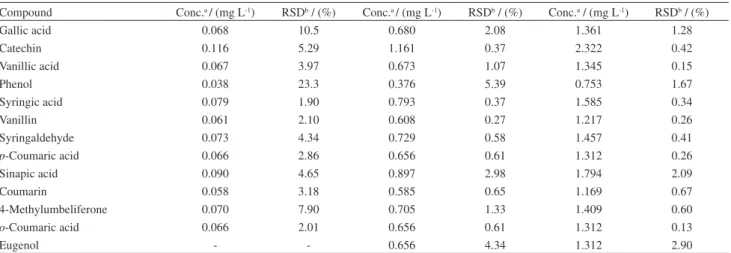
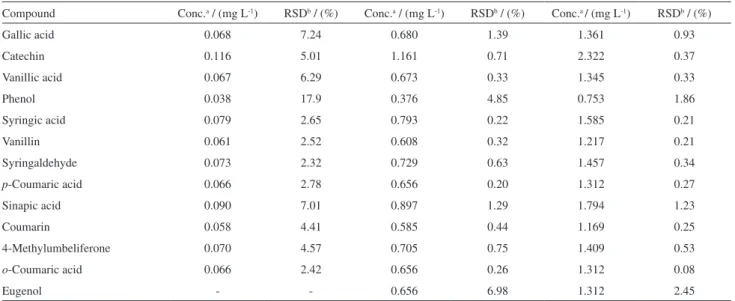
The precision of the analytical method was evaluated from the degrees of repeatability (intra-day) and intermediate precision (inter-day), with estimation of the relative standard deviation (RSD) for each analyte from successive measurements (Tables 1 and 2). The method presented a high degree of precision for most of the compounds analyzed.
Limits of detection and quantiication
The limits of detection and quantification were obtained from the parameters of the analytical curves. They were calculated from the mathematical relationships LOD = 3 SD/m and LOQ = 10 SD/m (SD = the estimation of the standard deviation of the regression line, and m = slope of the calibration line), respectively. The limits of detection and quantiication observed for the phenolic
Table 1. Intra-day precision of the method employed for the analysis of the phenolic compounds
Compound Conc.a / (mg L-1) RSDb / (%) Conc.a / (mg L-1) RSDb / (%) Conc.a / (mg L-1) RSDb / (%)
Gallic acid 0.068 10.5 0.680 2.08 1.361 1.28
Catechin 0.116 5.29 1.161 0.37 2.322 0.42
Vanillic acid 0.067 3.97 0.673 1.07 1.345 0.15
Phenol 0.038 23.3 0.376 5.39 0.753 1.67
Syringic acid 0.079 1.90 0.793 0.37 1.585 0.34
Vanillin 0.061 2.10 0.608 0.27 1.217 0.26
Syringaldehyde 0.073 4.34 0.729 0.58 1.457 0.41
p-Coumaric acid 0.066 2.86 0.656 0.61 1.312 0.26
Sinapic acid 0.090 4.65 0.897 2.98 1.794 2.09
Coumarin 0.058 3.18 0.585 0.65 1.169 0.67
4-Methylumbeliferone 0.070 7.90 0.705 1.33 1.409 0.60
o-Coumaric acid 0.066 2.01 0.656 0.61 1.312 0.13
Eugenol - - 0.656 4.34 1.312 2.90
compounds varied from 0.02 to 0.13 mg L-1 and 0.06 a
0.44 mg L-1, respectively, corresponding to the values
encountered for coumarin and eugenol (Table 3).
Accuracy
The accuracy of the analytical method was evaluated through recovery experiments (Table 4). It is evident that a good recovery was obtained by the method for the compounds, whose values fell within acceptable limits.
Determination of phenolic compounds in cachaça samples
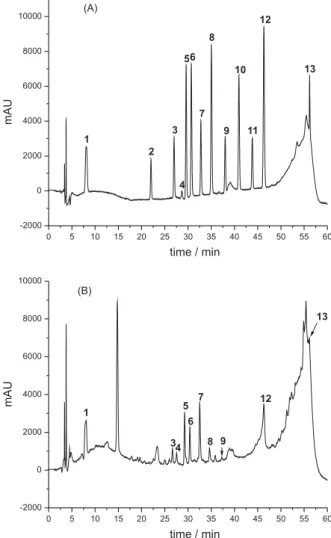
The chromatographic proile of the standard solution (8.0 × 10⁻⁶ mol L-1) of the phenolic compounds and
the proile obtained for the cachaça sample after aging (12 months) in an oak barrel are presented in Figure 1. The separation of all the compounds can be seen. The results obtained for the quantiication of phenolic compounds during the aging period are presented in Table 5.
The evolution of the concentrations of the compounds during the aging period could be observed, since a progressive increase in concentration occurred for most of the compounds. This trend can be veriied from the sum of the concentrations of the phenolic compounds that presented values ranging from 0.994 mg L-1 (for the cachaça
after one month of storage in an oak barrel) to 4.677 mg L-1
(for the cachaça at the end of 12 months of storage). The phenolic compounds that were least signiicant during the storage were 4-methylumbeliferone, catechin, and eugenol since these compounds were not detected in most samples. Syringaldehyde and gallic acid were the principal compounds incorporated into the beverage during the aging period. Anjos19 showed that, among the
compounds analyzed in cachaça aged in oak barrels, those present in the highest concentrations were syringaldehyde and gallic acid. In a study of cachaça aged in barrels made of different woods, Zacaroni20 observed that syringaldehyde,
ellagic acid, and p-coumaric acid were the predominant phenolic compounds in the samples aged in oak, although the author mentioned the diversity of compounds found in cachaças aged in barrels made of the same species of wood.
Table 2. Inter-day precision of the method for the analysis of the phenolic compounds
Compound Conc.a / (mg L-1) RSDb / (%) Conc.a / (mg L-1) RSDb / (%) Conc.a / (mg L-1) RSDb / (%)
Gallic acid 0.068 7.24 0.680 1.39 1.361 0.93
Catechin 0.116 5.01 1.161 0.71 2.322 0.37
Vanillic acid 0.067 6.29 0.673 0.33 1.345 0.33
Phenol 0.038 17.9 0.376 4.85 0.753 1.86
Syringic acid 0.079 2.65 0.793 0.22 1.585 0.21
Vanillin 0.061 2.52 0.608 0.32 1.217 0.21
Syringaldehyde 0.073 2.32 0.729 0.63 1.457 0.34
p-Coumaric acid 0.066 2.78 0.656 0.20 1.312 0.27
Sinapic acid 0.090 7.01 0.897 1.29 1.794 1.23
Coumarin 0.058 4.41 0.585 0.44 1.169 0.25
4-Methylumbeliferone 0.070 4.57 0.705 0.75 1.409 0.53
o-Coumaric acid 0.066 2.42 0.656 0.26 1.312 0.08
Eugenol - - 0.656 6.98 1.312 2.45
aConcentration of solutions prepared (three levels of concentration); bRSD = relative standard deviation for same solution injected in ive different days
in duplicate (n = 10).
Table 3. Retention time (tR), limits of detection (LOD) and limits of quantiication (LOQ) for the phenolic compounds
Compound tR /
mina
LOD / (mg L-1)
LOQ / (mg L-1)
Gallic acid 8.12 ± 0.16 0.06 0.22
Catechin 22.04 ± 0.31 0.04 0.13
Vanillic acid 27.03 ± 0.36 0.02 0.07
Phenol 28.67 ± 0.45 0.02 0.07
Syringic acid 29.63 ± 0.31 0.03 0.09
Vanillin 30.74 ± 0.33 0.02 0.08
Syringaldehyde 32.81 ± 0.29 0.02 0.07
p-Coumaric acid 35.12 ± 0.43 0.02 0.07 Sinapic acid 38.10 ± 0.30 0.08 0.25
Coumarin 41.04 ± 0.26 0.02 0.06
4-Methylumbeliferone 43.96 ± 0.30 0.03 0.11
o-Coumaric acid 46.46 ± 0.35 0.02 0.07
Eugenol 55.97 ± 0.86 0.13 0.44
Dias et al.21 demonstrated the prevalence of ellagic acid
and vanillic acid in cachaça stored in oak barrels over a period of six months.
Therefore, it is important to verify the presence of these compounds in aged cachaça since some studies have shown that the incorporation of compounds from the wood used for the storage and aging of distilled spirits is directly linked to the degradation of lignin. Lignin, which is a polymer composed of aromatic monomers, is narrowly related to the development of aroma and lavor in aged spirits because it releases aromatic aldehydes to the beverage during the maturation period.12,22
Some factors may be determinants in the extraction of wood compounds throughout the storage period of the beverage: the size and pretreatment of the barrel, environmental conditions, aging time, and amount of alcohol, leading to different compositions of phenolic compounds extracted from the wood during the aging process.7 The evolution of the concentration of phenolic
compounds during the aging of cachaça is presented in Figure 2.
Comparison of the results obtained by both analytical techniques showed that the sum of the phenolic compounds obtained by HPLC represented 21.8% of the amount determined by spectrophotometric method for the compounds present in the beverage. Thus, much still needs to be studied with respect to the composition of phenols in aged cachaça. However, the Folin-Ciocalteu method might be the cause of the difference observed in the data because of the low speciicity of this method. In addition to detecting all the phenolic substances present in the sample, undesirable reactions with other reducing substances present in the system may also occur.23
Table 4. Accuracy of the method for the evaluation of recovery
Compound Concentration / (mg L-1)a Recovery / (%) RSD / (%)
Sample Added Found
Gallic acid 1.12 1.36 2.38 96.0 0.36
Catechin < LOD 2.32 2.35 100 1.35
Vanillic acid 0.25 1.35 1.53 96.2 1.06
Phenol 0.57 0.75 0.78 58.7 0.79
Syringic acid 0.55 1.59 2.02 94.3 0.08
Vanillin 0.27 1.22 1.42 95.7 0.33
Syringaldehyde 1.09 1.46 2.30 90.5 0.23
p-Coumaric acid < LOQ 1.31 1.42 104 0.42
Sinapic acid < LOQ 1.79 1.89 98.8 0.33
Coumarin < LOQ 1.17 1.19 97.6 0.12
4-Methylumbeliferone ND 1.41 1.39 98.6 0.39
o-Coumaric acid < LOD 1.31 1.13 84.8 1.61
Eugenol ND 1.31 1.51 115 6.28
aND = not detected; < LOD = below the limit of detection; < LOQ = below the limit of quantiication; RSD = relative standard deviation.
Figure 1. Chromatogram of the standard solution of phenolic compounds (8.0 × 10⁻⁶ mol L-1) (A) and aged cachaça sample (B). Peak identities:
Table 5. Concentrations of the phenolic compounds (mg L-1) during the aging of cachaça in an oak barrel
Compounds Storage time / months Evolution /
times
0 1 2 3 4 5 6 7 8 9 10 11 12
Gallic acid ND 0.293 ±
0.008 0.420 ± 0.005 0.577 ± 0.021 0.678 ± 0.009 0.787 ± 0.011 0.930 ± 0.038 0.927 ± 0.019 1.075 ± 0.061 1.053 ± 0.002 1.121 ± 0.002 0.985 ± 0.169 1.012 ± 0.032 3.83
Catechin < LOQ < LOQ < LOD ND ND ND ND < LOD ND < LOD < LOD < LOQ < LOQ
-Vanillic acid ND < LOQ 0.097 ±
0.001 0.128 ± 0.001 0.151 ± 0.009 0.173 ± 0.010 0.203 ± 0.001 0.204 ± 0.012 0.228 ± 0.002 0.232 ± 0.000 0.245 ± 0.001 0.270 ± 0.009 0.293 ± 0.007 3.02
Phenol ND 0.145 ±
0.004 0.232 ± 0.011 0.273 ± 0.002 0.335 ± 0.004 0.402 ± 0.001 0.480 ± 0.051 0.477 ± 0.025 0.509 ± 0.020 0.541 ± 0.007 0.571 ± 0.017 0.690 ± 0.081 0.825 ± 0.072 5.69
Syringic acid ND 0.154 ±
0.003 0.217 ± 0.001 0.280 ± 0.004 0.332 ± 0.000 0.386 ± 0.005 0.451 ± 0.001 0.461 ± 0.001 0.496 ± 0.009 0.523 ± 0.001 0.552 ± 0.001 0.614 ± 0.008 0.630 ± 0.003 4.09
Vanillin ND 0.084 ±
0.002 0.116 ± 0.001 0.143 ± 0.003 0.171 ± 0.001 0.183 ± 0.006 0.214 ± 0.000 0.215 ± 0.005 0.232 ± 0.003 0.245 ± 0.001 0.265 ± 0.000 0.284 ± 0.010 0.311 ± 0.002 3.70
Syringaldehyde ND 0.318 ±
0.015 0.467 ± 0.006 0.608 ± 0.004 0.711 ± 0.034 0.757 ± 0.007 0.946 ± 0.001 0.920 ± 0.056 1.037 ± 0.003 1.060 ± 0.014 1.090 ± 0.013 1.150 ± 0.026 1.173 ± 0.006 3.69
p-Coumaric acid ND ND < LOD < LOQ < LOQ < LOQ < LOQ < LOQ < LOQ < LOQ < LOQ 0.104 ± 0.003
0.111 ± 0.001
1.07
Sinapic acid ND < LOD < LOD < LOD < LOD < LOQ < LOQ < LOQ < LOQ < LOQ < LOQ < LOQ < LOQ -Coumarin ND ND < LOQ < LOQ < LOQ < LOQ < LOQ < LOQ < LOD 0.055 ±
0.000
< LOQ < LOD < LOD
-4-methylumbeliferone ND ND ND ND ND ND ND ND ND ND ND ND ND
-o-Coumaric acid ND < LOD < LOD < LOD < LOD < LOD < LOD < LOD < LOD < LOD < LOD 0.356 ± 0.224
0.322 ± 0.090
1.11
Eugenol < LOD < LOD < LOD < LOD < LOQ < LOD ND ND ND ND ND ND < LOD
-Sum of the phenolic compounds
ND 0.994 1.549 2.009 2.378 2.688 3.224 3.204 3.577 3.709 3.844 4.453 4.677
-*ND = not detected; < LOD = below the limit of detection; < LOQ = below the limit of quantiication.
Figure 2. Evolution of phenolic composition during the aging of cachaça shown by the data for the total phenolic compounds (spectrophotometric method) and the sum of the phenolic compounds determined by liquid chromatography. *Phenolic compounds = not detected.
For Dias et al.,21 the period of storage lead to a progressive
increase in concentrations of phenolic compounds in the sugar cane spirit stored in different barrels, and, although complex, the mechanism of gradual increase in the levels
of acids and aldehydes seemed to follow the sequence: cinnamaldehydes (coniferaldehyde and sinapaldehyde), benzaldehydes (vanillin and syringaldehyde), and benzoic acids (vanillic acid and syringic acid).
A significant positive linear correlation between the concentration of vanillin and vanillic acid (0.9987) was found, showing that changes that occurred in the concentration of vanillic acid may be related to the concentration of vanillin. In addition to direct extraction of vanillic acid from wood, this compound can be formed by the oxidation of vanillin during the aging process.24
A negative linear correlation between the concentrations of coumarin and o-coumaric acid would be expected. An increase in the concentration of one of these compounds would lead to a decrease in the concentration of the other, because, according to Carvalho et al.,25 coumarin might be
formed by the cyclization of o-coumaric acid (Figure 3). However, it was not possible to establish a correlation coeficient between the concentrations of these compounds because of the low concentrations found for both. It is noteworthy that these compounds are not desirable in the beverage because of the toxicity of coumarin, although this substance has been used as a lavoring in industrialized foods. However, its use is banned in several countries.24
The evolution of the intensity of color of the cachaça stored in the oak barrel is presented in Figure 4. A progressive increase in the yellow color occurred during the maturation period.
The evolution of the color intensity of the aged cachaça is related to the incorporation of components from the wood into the beverage during the storage period. The main factors responsible for progressive darkening or intensiication of the yellow-orange color in aged beverages are the tannins and their oxidation products.26
A significant positive linear correlation (0.8500) between the concentration of total phenols and the color intensity was observed, showing that the increased intensity
of the color of the samples can be explained by the increase in the incorporation of phenolic compounds during the aging of the beverage.
Conclusions
The proposed chromatographic method has been certiied and proved to be eficient for the simultaneous analysis of 13 phenolic compounds in samples of aged cachaça. There was a progressive increase in the incorporation of phenolic compounds into the cachaça during the aging in an oak barrel, the principal compounds incorporated into to beverage were syringaldehyde and gallic acid.
Acknowledgments
The authors thank the REUNI/CAPES program, the Conselho Nacional de Desenvolvimento Cientíico e Tecnológico (CNPq) and the Fundação de Amparo a Pesquisa do Estado de Minas Gerais (FAPEMIG) for inancial support and the Cachaça Artesanal João Mendes for funishing the samples.
References
1. Cardoso, M. G. In Produção de Aguardente de Cana; 2a. ed., Cardoso, M. G., ed., UFLA: Lavras, Brasil, 2006.
2. Cançado Jr., F. L.; Paiva, B. M.; Estanislau, M. L. L.; Inf. Agropec.2009, 30, 7.
3. Oliveira, S. G.; Magalhães, M. A.; Bergerat, P. C.; Inf. Agropec.
2009, 30, 14.
4. Reche, R. V.; Franco, D. W.; Quim. Nova2009, 32, 332. 5. Abreu-Lima, T. L.; Maia, A. B. R. A.; Oliveira, E. S.; B.CEPPA
2005, 23, 347.
6. Mendes, L. M.; Mori, F. A.; Trugilho, P. F.; Inf. Agropec.2009,
30, 41.
7. Miranda, M. B.; Horii, J.; Alcarde, A. R.; Ciênc. Tecnol. Aliment.
2006, 26, 772.
8. Sherev, R. N.; Brink, J. A. In Indústrias de Processos Químicos,
4a. ed., Shreve, R. N., ed.; Guanabara Dois: Rio de Janeiro, Brasil, 1980.
9. Cardello, H. M. A. B.; Faria, J. B.;Ciênc. Tecnol. Aliment. 2000,
20, 32.
10. Mamede, M. E. O.; Pastore, G. M.; B.CEPPA2004, 22, 233. 11. Leão, M. M.; MScDissertation, Escola Superior de Agricultura
Luiz de Queiroz, Brazil, 2006. (http://www.teses.usp.br/teses/ disponiveis/11/11150/tde-11072006-112804/pt-br.php accessed in January 2011).
12. Dias, S. M. B. C.; Inf. Agropec.2009, 30, 32.
13. Brasil;Ministério da Agricultura, Pecuária e Abastecimento (MAPA); Instrução Normativa N.13, June 29, 2005.
Figure 3. Scheme showing the cyclization of o-coumaric acid (1) to form coumarin (2) during the aging of cachaça.
14. Ribani, M.; Bottoli, C. B. G.; Collins, C. H.; Jardim, I. C. S. F.; Melo, L. F. C.; Quim. Nova2004, 27, 771.
15. Harris, D. C.; Quantitative Chemical Analysis, 7th ed., W. H.
Freeman: New York, 2007.
16. Singleton, V. L.; Rossi, J. A.; Amer. J. Enol. Vitic.1965, 20, 144.
17. Lin, Y. T.; Vatten, D.; Labbe, R. G.; Shetty, K.; Process Biochem.
2005, 40, 2059.
18. Faria, J. B.; Cardello, H. M. A. B.; Boscolo, M.; Isique, W. D.; Odello, L.; Franco, D. W.; Eur. Food Res. Technol.2003, 218, 83.
19. Anjos, J. P.; Undergraduate Monography, Universidade Federal de Lavras, Brazil, 2007.
20. Zacaroni, L. M.; MScDissertation, Universidade Federal de Lavras, Brazil, 2009. (http://bdtd.ula.br/tde_busca/arquivo. php?codArquivo=1885 accessed in January 2011).
21. Dias, S.; Maia, A.; Nelson, D.; Ciênc. Tecnol. Aliment.1998,
18, 169.
22. Singleton, V. L.; Am. J. Enol. Vitic.1995, 46, 98.
23. Angelo, P. M.; Jorge, N.; Rev. Inst. Adolfo Lutz2007, 66, 232. 24. Kuster, R. M.; Rocha, L. M. Cumarinas, cromonas e xantonas.
In: Simões, C. M. O.; Schenkel, E. P.; Gosmann, G.; Mello, J. C. P.; Mentz, L. A.; Petrovick, P. R.; Farmacognosia: da Planta ao Medicamento, 6a. ed., UFRGS/ED. UFSC: Porto Alegre, Brasil, 2007.
25. Carvalho, J. C. T.; Gosmann, G.; Schenkel, E. P. In
Farmacognosia: da Planta ao Medicamento; 6a. ed., Simões, C. M. O.; Schenkel, E. P.; Gosmann, G.; Mello, J. C. P.; Mentz, L. A.; Petrovick, P. R., eds., UFRGS/ED. UFSC: Porto Alegre, Brasil, 2007.
26. Miranda, M. B.; Martins, N. G. S.; Belluco, A. E. S.; Horii, J.; Alcarde, A. R.; Ciênc. Tecnol. Aliment.2008, 28, 84.