1Post-graduate Program of Geoscience, Exact and Earth Sciences Institute – ICET, Universidade Federal de Mato Grosso – UFMT, Cuiabá (MT), Brazil. E-mail: [email protected]
2National Institute of Sciences and Geoscience Technology of the Amazon (Instituto Nacional de Ciência e Tecnologia de Geociências da Amazônia – GEOCIAM),
Geosciences Institute of Universidade Federal do Pará – UFPA, Belém (PA), Brazil.
3Department of Mineral Resources, ICET, UFMT, Cuiabá (MT), Brazil. E-mail: [email protected] 4Department of General Geology, ICET, UFMT, Cuiabá (MT), Brazil. E-mail: [email protected]
5Para-Iso Isotope Geology Laboratory – IG, Universidade Federal do Pará – UFPA, Belém (PA), Brazil. E-mail: [email protected]
*Corresponding author.
Manuscript ID: 30231. Received: 01/29/2015. Approved: 06/01/2015. ABSTRACT: he Taquaral Granite is located on southern Amazon Craton in the region of Corumbá, westernmost part of the Brazilian state of Mato Grosso do Sul (MS), near Brazil-Bolivia frontier. his intrusion of batholitic dimensions is partially covered by sedimentary rocks of the Urucum, Tamengo Bocaina and Pantanal formations and Alluvial Deposits. he rock types are classiied as quartz-monzodio-rites, granodioquartz-monzodio-rites, quartz-monzonites, monzo and syenogranites. here are two groups of enclaves genetically and compositionally dif-ferent: one corresponds to maic xenoliths and the second is identiied as felsic microgranular enclave. Two deformation phases are observed: one ductile (F1) and the other brittle (F2). Geochemical data indicate intermediate to acidic composition for these rocks and a medium to high-K, metaluminous to peraluminous calk-alkaline magmatism, su-ggesting also their emplacement into magmatic arc settings. SHRIMP zircon U-Pb geochronological data of these granites reveals a crystalli-zation age of 1861 ± 5.3 Ma. Whole rock Sm-Nd analyses provided ε
Nd(1,86 Ga)values of -1.48 and -1.28 and TDMmodel ages of 2.32 and 2.25 Ga, likely indicating a Ryacian crustal source. Here we conclude that Taquaral Granite represents a magmatic episode generated at the end of the Orosirian, as a part of the Amoguija Magmatic Arc. KEYWORDS: Taquaral Granite; Geochemistry; U-Pb and Sm-Nd Geochronology.
RESUMO: O Granito Taquaral situa-se no sul do Cráton Amazônico, na região de Corumbá, extremo ocidente do estado de Mato Grosso do Sul (MS), próximo à fronteira Brasil-Bolívia. Ocorre como um batóli-to, sendo parcialmente recoberto pelas rochas sedimentares das formações Urucum, Tamengo, Bocaina e Pantanal e pelas aluviões atuais. Seus litotipos são classiicados como quartzo monzodioritos, granodioritos, quartzo-monzonitos, monzogranitos e sienogranitos. Dois tipos de en-claves de natureza e origens diferentes são encontrados, um de composição máica correspondente a xenólito e outro como enclave microgranular félsico. Observam-se duas fases deformacionais, uma de natureza dúctil (F1) e outra rúptil (F2). Os dados geoquímicos indicam composição
in-termediária a ácida para essas rochas e um magmatismo cálcio-alcalino de médio a alto-K, metaluminoso a peraluminoso e sugerem uma colo-cação em ambiente de arco. A análise geocronológica pelo método U-Pb (SHRIMP) em zircão foi realizada em um granodiorito aponta para uma idade de 1861 ± 5,3 Ma para sua cristalização. Análises Sm-Nd em rocha total fornecem valores de ε
Nd(1,86 Ga) de -1,48 e -1,28 e TDM de 2,32
e 2,25 Ga indicando uma provável fonte crustal riaciana. Admite-se que o Granito Taquaral corresponda a um magmatismo desenvolvido no inal do Orosiriano, constituinte do Arco Magmático Amoguijá.
PALAVRAS-CHAVE: Granito Taquaral; Geoquímica; Geocronolo-gia U-Pb e Sm-Nd.
Petrogenesis and U-Pb and Sm-Nd
geochronology of the Taquaral granite:
record of an orosirian continental magmatic
arc in the region of Corumba – MS
Petrogênese e Geocronologia (U-Pb e Sm-Nd) do Granito Taquaral:
Registro de um Arco Magmático Continental Orosiriano na Região
de Corumbá – MS
Letícia Alexandre Redes1,2*, Maria Zélia Aguiar de Sousa1,2,3,
Amarildo Salina Ruiz1,2,4, Jean-Michel Lafon2,5
INTRODUCTION
he basement underlying the Neoproterozoic covers in the region of Corumba has been described as part of the Rio Apa Complex (Rio Apa Terrane) which consists of metagranites, orthognaisses, and subordinate
amphibo-lites (Godoi et al. 2001).
Several papers have shown the occurrence of Orosirian magmatism over an extensive area in southern Amazon Craton being recognized in the Rio Apa Terrane by Correia Filho et al. (1981), Araújo et al. (1982), Godoi et al. (2001),
Lacerda Filho et al. (2006), Cordani et al. (2010), Brittes
et al. (2013) and Plens et al. (2013). Vargas-Mattos (2010) also describe the occurrence of Orosirian calc-alkaline gran-itoids in the San Pablo Terrane in Bolivia.
his work aims the understanding of magmatic and deformational evolution of the Taquaral Granite, and consequently of the Orosirian magmatism in the south-ern Amazon Craton. herefore, geologic and petrographic characterization were carried out as well as SHRIMP zircon U-Pb dating, geochemistry and Sm-Nd isotopic analyses in order to determine the petrogenesis, time of emplacement, and tectonic setting.
MATERIALS AND METHODS
Twenty four samples were collected from the Taquaral Granite; among them four samples of enclaves and eight samples of diabase dikes.
Macroscopic and microscopic studies were carried out for petrographic characterization. Modal analysis by point-counting was performed on medium- to coarse-grained
samples in which the selective staining technique of feldspars was previously applied according to Hutchinson (1974); while microscopic point-counting was performed on ine-grained samples.
he software Open Stereo was used for structural data
analysis (Grohmann et al. 2011) and the shear zone rocks
were classiied according to Sibson (1977).
Geochemical studies were carried out on nine samples of the Taquaral Granite, taking into consideration their spa-tial distribution and mineralogical and grain size diversity. Samples were prepared and then sent to the Acme Analytical
Laboratories (Acmelab) in Vancouver, Canada,for major,
minor and trace elements analyses (Tab. 1) by Inductively Coupled Plasma Emission Spectrometry (ICP-ES) and Inductively Coupled Plasma Mass Spectrometry (ICP-MS). he procedure for (SHRIMP) zircon U-Pb geochronol-ogy of sample RM-07 followed the steps of sieving into 250, 210, 177, 125, 90 and 63 μm size fractions, and separation by magnetic susceptibility and density. A total of 150 zircon crystals were then hand-picked from the 177 – 125 mm size fraction, under a binocular microscope, among which the crystals for analysis were selected. Cathodoluminescence imaging (SEM-CL) and U-Pb geochronology were car-ried out at the Center for Geochronological Research of the University of Sao Paulo (CPGeo-IGC/USP). he ana-lytical procedures for U-Pb zircon dating by SHRIMP II (Sensitive High Resolution Ion Microprobe) are described
in details by Stern (1998), Williams (1998) and Sato et al.
(2008). Age calculations were performed using the software ISOPLOT/EX (Ludwig 2001)
Sm-Nd whole rock analyses were performed on two samples (RM-07 and RM-09A) at the Isotope Geology Laboratory of the Federal University of Para (Para-Iso),
Table 1. Geochronological data available for the granitic rocks from Alumiador Intrusive Suite obtained by SHRIMP U-Pb on zircon, Rb-Sr, Sm-Nd, Ar-Ar and K-Ar.
Lithostratigraphic
Units References
U-Pb Rb-Sr Sm-Nd Ar-Ar K-Ar
Age (Ma)
Age
(Ma) (Sr87/Sr86)t TDM (Ga) εNd(t)
Age (Ma)
Age (Ma)
Alumiador Intrusive Suite
Araújo et al.
(1982) 1600 ± 40 0.707
Cordani
et al. (2005)
1060 1300
Lacerda Filho et al.
(2006) 1867 2.17 -0.68
Cordani
et al. (2010) 1839 ± 33 1674 ± 17
2.38 2.49
-2.86 -4.20
1302 ± 3
according to the analytical procedure described by Oliveira
et al. (2008) and Barreto et al. (2014). Approximately
100 mg of pulverized sample were dissolved into Telon
®
bombs by adding HNO3, HCl e HF and placing them into
a microwave oven. A 149Sm/150Nd tracer was previously
introduced in order to determine the concentrations of Sm and Nd by isotope dilution. Chemical separation was made by ion-exchange chromatography divided into two stages
with resins Biorad DOWEX™ AG50x8 and Ln Eichrom
®
.Isotopic analyses were carried out using inductively plasma mass spectrometry (ICP-MS), hermoFinnigan Neptune. Nd-isotopic ratios were corrected for mass fractionation by
normalizing to 146Nd/144Nd = 0.7219. he decay constant
used was 6.54 x 10⁻¹² year-1 (Lugmair & Marti 1978). Model
ages were calculated according to the depleted mantle curve through time by De Paolo (1981).
REGIONAL GEOLOGIC SETTING
The Amazon Craton represents one of the main Precambrian geotectonic entities located on the north-ern part of South America platform. It consists of two shields divided by the Amazon Basin: he Central Brazilian Shield and the Guyana Shield. his work adopted the pro-posal of Ruiz (2005), who considers the Rio Apa Province as a part of the compartimentation suggested by Tassinari and
Macambira (2004) and revised by Cordani et al. (2009), in
which the Amazon Craton is divided into geochronological provinces formed by successive accretion of juvenile crust to Proterozoic mobile belts (Provinces Maroni-Itacaíunas – 2.20 to 1.95 Ga; Ventuari-Tapajós – 1.95 to 1.80 Ga, Rio Negro-Juruena – 1.80 to 1.55 Ga, Rondonian-San Ignacio – 1.50 to 1.30 Ga and Sunsas-Aguapei – 1.15 to 0.90 Ga) surrounding an Archean proto-craton (Central Amazon Province – > 2.3 Ga).
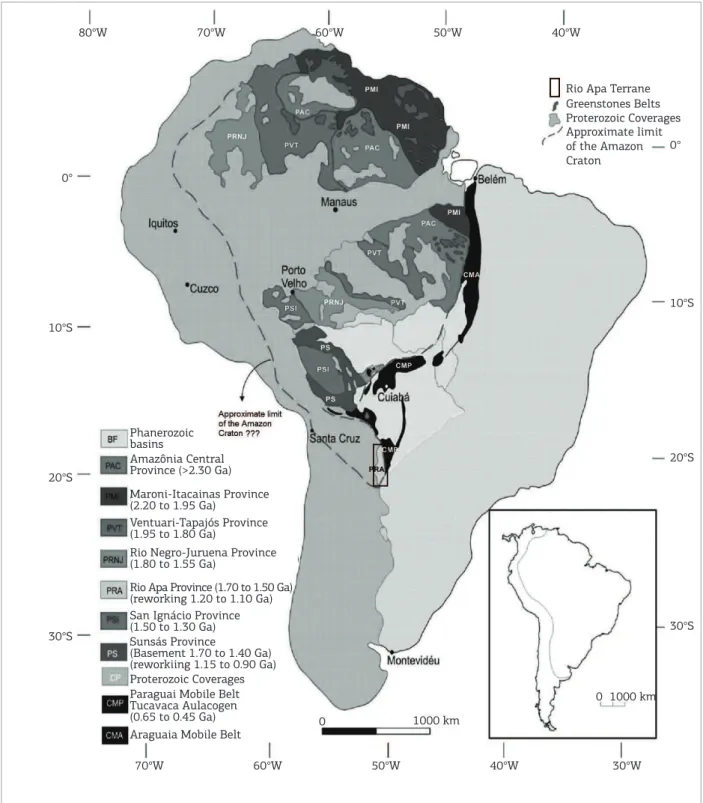
here are two proposals for the geotectonic settings of Rio Apa Terrane. he irst one describes this Terrane as an allochthonous crustal fragment geographically sep-arated from the Amazon Craton by the Tucavaca Belt
(Barros et al. 1982, Del’Arco et al. 1982, Litherland et al.
1986, Alvarenga & Saes1992, Brito Neves et al. 1995,
Trompette et al. 1998, Tassinari & Macambira 1999,
2004, Santos et al. 2000, 2008, Teixeira et al. 2010,
Bettencourt et al. 2010). he second proposal, by Ruiz
et al. (2005), Lacerda Filho et al. (2006) and Cordani
et al. (2010), takes into consideration the previous pro-posal of Almeida (1967) and Amaral (1974), in which the Rio Apa Terrane is described as a prolongation of the Amazon Craton and the basement of Neoproterozoic mobile belts. his work adopted the second proposal thus
considering the Rio Apa Terrane as a southern portion of the Amazon Craton (Fig. 1)
Based on geological and geochronological data, Lacerda
Filho et al. (2006) indicate that rocks from Rio Apa Province
were formed between 1.95 and 1.75 Ga, which are further divided into three geotectonic compartments: Remnant Oceanic Crust (2.2 to 1.95 Ga), Rio Apa Magmatic Arc (1.95 to 1.87 Ga) and Amoguija Magmatic Arc (1.87 to 1.75 Ga). In addition to the units described and chronolog-ically stacked in this work, these authors also describe the Maic Continental Magmatism (1.79 to 1.78 Ga) and the Rio Perdido Maic Dike Swarms (914 ± 9 Ma).
The Amoguija Magmatic Arc is comprised by the Alumiador Intrusive Suite and the Serra da Bocaina Formation. he term Alumiador Intrusive Suite, according to Lacerda
Filho et al. (2006), Godoy et al. (2010) and Manzano et al.
(2012), corresponds to a N-S trending elongated batholith of syeno to monzogranitic composition consisting of gray to
pink leucocratic rocks, isotropic to anisotropic. Plens et al.
(2013) and Nogueira et al. (2013) grouped the granitic
intru-sions of the Amoguija Magmatic Arc into the Alumiador Intrusive Suite.
Lacerda Filho et al. (2006) obtained a SHRIMP U-Pb
zircon crystallization age of 1,867 Ma from a porphyritic
monzogranite and Sm-Nd isotopic data revealed a TDM
model age of 2.17 Ga and ε
Nd around -0.68, indicating a
juvenile arc with some crustal contamination generated in
continental margin settings. Cordani et al. (2010) presented
Ar-Ar and K-Ar data around 1,300 Ma for the volcanic rocks from Serra da Bocaina and plutonic rocks from Alumiador Intrusive Suite. heses authors presented a U-Pb zircon age
of 1,839 ± 33 Ma and Nd TDM model ages between 2.54
and 2.49 Ga. Table 1 summarizes the geochronological data available for the Alumiador Intrusive Suite.
he San Pablo Terrane (Fig. 2) in Bolivia was irst called Crystal Block by Litherland and Klink (1982) and
poste-riorly called San Pablo by Saes and Leite(1993), Saes and
Fragoso Cesar (1994, 1996) and Saes (1999). According to Saes (1999), the lack of Sunsas Group records in the Terrane would justify its individualization. he San Pablo Terrane is bordered by a tectonic discontinuity represented by the
San Diablo Front (Litherland et al. 1986) or San Diablo
Straightening Zone (Pitield et al. 1979, in Saes 1999)
For the Correreca Granite, Vargas-Mattos (2010) obtained Pb-Pb zircon ages between 1,920 and 1,895 Ma, and Sm-Nd
TDM model ages between 2.8 and 2.9 Ga and ε
Nd(t) values
by Saes and Leite (1993). he Correreca Granite is located in the region of Rincon Del Tigre and Santo Corazon. It is a batholit overlain by sedimentary rocks of the Sunsas Group to the north, by the Boqui Group to the west, and by the Murcielago Group to the south. To the east, it is in fault contact with the Santo Corazon Granitoid Complex.
FIELD AND PETROGRAPHIC ASPECTS
he Taquaral Granite crops out as large and small blocks, massive or weakly foliated and, sometimes, as mylonitic trun-cated by cataclastic bands, aplite and diabase dikes and peg-matitic pockets. It also occurs as felsic microgranular enclaves
80°W
0°
10°S
20°S
30°S
0°
10°S
20°S
30°S
70°W 60°W 50°W 40°W
Rio Apa Terrane
Approximate limit of the Amazon Craton
Proterozoic Coverages Greenstones Belts
30°W 0
0
1000 km
1000 km Phanerozoic
basins
San Ignácio Province (1.50 to 1.30 Ga)
Araguaia Mobile Belt Paraguai Mobile Belt Tucavaca Aulacogen (0.65 to 0.45 Ga) Proterozoic Coverages Sunsás Province
(Basement 1.70 to 1.40 Ga) (reworkiing 1.15 to 0.90 Ga) Rio Apa Province (1.70 to 1.50 Ga) (reworking 1.20 to 1.10 Ga) Rio Negro-Juruena Province (1.80 to 1.55 Ga)
Ventuari-Tapajós Province (1.95 to 1.80 Ga)
Maroni-Itacainas Province (2.20 to 1.95 Ga)
Amazônia Central Province (>2.30 Ga)
70°W 60°W 50°W 40°W
and xenoliths of quartz-diorite and amphibolite, respectively, which are rounded to ellipsoidal, centimetric to decametric. his unit is partially and tectonically overlain by sediments of the Urucum, Tamengo, Bocaina and Pantanal formations and by aluvionar deposits. he contact with the Urucum Formation is only tectonic but the Tamengo and Bocaina formations also partially overlain the granite unconformably.
he study of the Taquaral Granite and detailed geolog-ical mapping at a scale of 1:50.000 (Fig. 3) allowed recog-nize three petrographic facies where it is observed in the ield that one facies encompasses another and these are then not discriminated at the mapped scale. he irst facies is gray, medium- to coarse-grained (GMCF); the second facies is pink, coarse-grained (PCF) and the third facies is pink, ine-grained (PFF), all of which are massive or weakly foliated containing biotite and amphibole as the major maic minerals.
Macroscopically, these facies are classified as horn-blende-biotite-granitoids and plotted in QAP diagram (Streckeisen 1976; Fig. 4) as quartz-monzodiorites, gran-odiorites, quartz-monzonites, monzo and syenogranites.
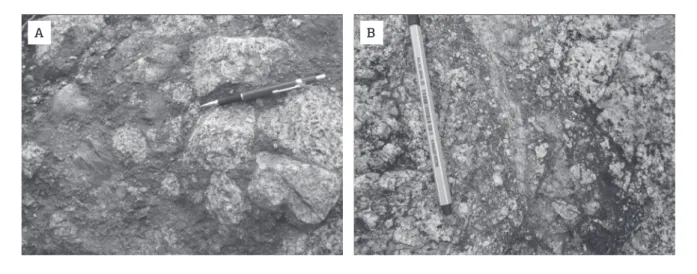
he GMCF predominates volumetrically in the mapped body and is characterized by gray, inequigranular to equi-granular medium- to coarse-grained leucocratic rocks, which are classiied as quartz-monzodiorite, granodiorite and mon-zogranite (Figs. 4, 5A and 5B). Pegmatite pockets up to 4 m thick are observed. In the mylonitic portion of this facies, stretched and rotated alkali feldspar porphyroclasts occur in a ine- to medium-grained quartz-feldspathic groundmass which is classiied as mylonite (Sibson 1977), based on the relationship between porphyroclasts and groundmass.
he PCF is composed of pink, inequigranular coarse-grained leucocratic rocks, which are classiied as quartz-monzonite
58° 57°
58° 23° 22° 21°
57°
Cuiaba Group
Amolar Domain Paleoproterozoic
Caranda Granite Serra da Bocaina Formation (effusive and pyroclastic rocks) Alumiador Batholith (granites, microgranites) Gabbro-anortosite Serra da Alegria Suite Triunfo Complex Alto Tererê Group (shists, gneisses, granites, anfíboles) Caracol Gneisses
Porto Murtinho Gneisses Morraria Gneisses
Passo Bravo Province Holocene
PM - Porto Murtinho
SUNSÁS MAGMATISM BASIC
FELSIC Dike swarm Maic Sills
Study area Brasilianos Granites
Cuiabá Group PARAGUAI MOBILE BELT
Alto Paraguai Group
Rio Perdido
Huanchaca Huanchaca Salto do Céu Rancho de Prata
Sunsás Suite (BO) Guapé Suite (BR) PF - Piso Firme
SI - San Ignácio R - Roboré PA - Ponta do Aterro VB - Vila Bela A - Araputanga C - Cuiabá BG - Barra do Garças Co - Corumbá
Pleistocene
Carboniferous Triassic
Neoproterozoic
Bocaina e Tamengo Formation Cercadinho Formation Itapocumi and Corumbá Groups
Aluvial Deposits
Colluvium Aluvium Deposits
Fecho dos Morros Alkaline Suite
Aquidauana Formation
B
A
Figure 2. Maps: (A) Tectonic of S/SW Amazon Craton (modiied from Ruiz et al. 2010); (B) Rio Apa Terrane (modiied
and monzogranite (Fig. 4). his facies is distinguished from the others due to the presence of dark-pink subhedral crys-tals of alkali feldspar up to 3 cm in length (Figs. 5C and 5D).
he PPF consists of light-pink, equi- to inequigranular hololeucocratic rocks of monzo to syenogranite composition (Fig. 4). Aplite dikes occur predominantly as ine-grained rocks, up to 15 cm in thickness, in abrupt and reactive con-tacts with GMCF and PCF (Figs.5E and 5F).
Optically, rocks from the GMCF show hipidiomorphic to xenomorphic textures as well as inequigranular to locally graphic textures composed of plagioclase, quartz, alkali feld-spar (microcline) and maic minerals, which are identiied as biotite, hornblende, and opaques. Accessory minerals are represented by titanite, apatite, allanite, opaques and zir-con (Fig. 6). he mylonites have a ine- to medium-grained groundmass showing porphyroblastic to granoblastic tex-tures. Felsic and maic minerals are oriented, however they also occur surrounding alkali feldspar porphyroclasts. Quartz aggregates and recrystallized feldspar may occur bordering porphyroclasts and characterizing pressure shadow. his facies is strongly afected by sericitization, argilitization, saussuritization of feldspars, and chloritization of biotite and amphibole as a result of hydrothermal alteration.
424000,000000 424000,000000 426000,000000 428000,000000 430000,000000 432000,000000 434000,000000 436000,000000
424000,000000
500 mNW
A’ A
SE
Horizontal scale 1:50.000
Lithostratigraphic Units
Cartographic conventions
Structural elements Course of permanent water
S0 - Layering
Outcrops with geochemistry 2500 Ma 1600 Ma 1000 Ma 542 Ma
Age U-Pb SHRIMP zircon
Paleoproterozoic
Era
Eon Period
Quartenary
Phanerozoic
Proterozoic
Cenozoic
Neoproterozoic
Extensional fault Cataclastic Bands Structural lineaments Indiscriminate fault S1 - Foliation Contour Unpaved road Paved road
Alluvial Deposits
Diabase dike Aplite dike Taquaral Granite
Urucum Formation Bocaina Formation Tamengo Formation Pantanal Formation
Vertical scale 1:50.000 400 m
300 m 200 m 100 m 0
7888000
,000000
7890000
,000000
7892000
,000000
7894000
,000000
7888000
,000000
7890000
,000000
7892000
,000000
7894000
,000000
424000 426000,000000 428000,000000 430000,000000 432000,000000 434000,000000 436000,000000
Figure 3. Geological Map of the Taquaral Granite and the Neoproterozoic and Quaternary sedimentary covers. Figure 4. QAP diagram for the rocks from the Taquaral
Granite (rock ields according to Le Maitre et al. 2002).
Q
Symbols
Pink ine-gained facies (PFF) Pink coarse-gained fecies (PCF) Gray medium to coarse-gained fecies (GMCF)
Microscopically, rocks from the PCF usually displays hipidiomorphic to xenomorphic textures, and rarely graphic texture, consisting of alkali feldspar (perthitic microcline),
plagioclase, quartz, biotite, and amphibole (hornblende) and having titanite, apatite, zircon, opaques as accessory minerals (Fig. 7). he rocks are strongly altered showing
Figure 5. Macroscopic aspects of the Taquaral Granite: (A) medium-grained, weakly foliated, granodiorite from the gray, medium- to coarse-grained facies; (B) gray, inequigranular medium- to coarse-grained granodiorite from the gray, medium- to coarse-grained facies; (C) coarse-grained, well foliated monzogranite from the pink, grained facies; (D) reddish-pink inequigranular rock displaying cataclastic bands from the pink, coarse-grained facies; (E) aplite dikes pink in color, up to 15 cm thick, in abrupt and reactive contacts with monzogranite,
and inclusions of angular fragments from the monzogranitic host; (F) ine-grained aplite of syenogranitic composition from the pink, ine-grained facies.
A
C
E
B
D
A
C
B
D
Figure 6. Microphotographs of gray, medium- to coarse-grained facies illustrating: (A) coarse-grained inequigranular texture; (B) plagioclase displaying intensely saussuritized core highlighting normal zoning, being epidote and calcite the main alteration products; (C) Quartz and feldspar in micrographic texture; (D) perthitic alkali-feldspar in contact with saussuritized plagioclase. Crossed polarizers.
sericitized or saussuritized feldspars with dusty aspect, as well as chloritized biotite and amphibole.
Under the microscope, rocks from the PPF are pre-dominantly equigranular having xenomorphic texture and consisting of alkali feldspar (microcline), quartz, pla-gioclase and less than 5% maic minerals (biotite, horn-blende, titanite, apatite and opaques; Figs. 8A and 8B). It is weakly altered with products such as sericite, clay minerals, chlorite and epidote-group minerals, which may occur within micro-veins.
Two enclaves of distinct nature and origin were found in the Taquaral Granite. One of maic composi-tion corresponds to a xenolith and another is identiied as microgranular felsic enclave (MFE) which represents the process of magma mingling (heterogeneous mixing). he xenoliths occurs volumetrically subordinate with amphibolitic composition, elongated, oval to rounded, ranging from centimeter to meter in size, and consisting
of amphibole, plagioclase, opaque minerals and titanite. he centimeter-size MFE is rounded and consists of pla-gioclase, quartz, alkali feldspars and biotite. Typical fea-tures of magma mixing are observed in the MFE at mac-roscopic and micmac-roscopic scales, such as: reactive contact with the host rock, engulfment of xenocrystals, corroded quartz, poikilitic quartz enguling biotite, hornblende, apatite, and opaque minerals and glomeroporphyros of plagioclase and biotite.
A B
Figure 7. Microphotographs of pink, coarse-grained facies illustrating: (A) coarse-grained equigranular texture; (B) microcline crystal of 8 mm in diameter. Crossed polarizers.
A B
Figure 8. Microphotographs of pink, ine-grained facies: (A) general aspect displaying predominant equigranular
xenomorphic texture and saussuritized plagioclase; (B) Xenomorphic texture in detail consisting of quartz, microcline, and saussuritized plagioclase. Crossed polarizers.
STRUCTURAL ANALYSIS
In order to understand the structural evolution and the kine-matics of deformation, which afected the Taquaral Granite, structural analysis was carried out in the study area (Fig. 3). he structural analysis follows the concept of deformation phases according to Sá and Hackspacher (1982) while description and tectonic structures classiication, such as foliations and lineations, are according to Passchier and Trouw (2005). Descriptive anal-ysis of ield-scale structures associated with examining satellite images and microscopic description allowed the identiication
of two deformation stages, here called F1 and F2.
Taquaral Granite does not display intense penetra-tive deformation and rocks are usually isotropic to weakly
foliated. Mylonitic foliation is developed in ductile defor-mation zones, and cataclasites are widely observed in fault zones. he latter also afected the sedimentary covers of the Corumbá and Jacadigo Groups.
he irst deformation phase (F1) is responsible for the
development of incipient penetrative foliation (S1) being
het-erogeneous in intensity and orientation (Fig. 10A). A mylonitic banding is observed with development of protomylonites to mylonites indicating strong ductile deformation associated
with phase F1. Mylonitic foliation is parallel to the regional
penetrative foliation (S1), both of them preferentially ori-ented to N20-30E, dipping 75°-85° towards the NW.
A
C
B
D
Figure 9. Field and macroscopic aspects of diabase dikes illustrating: (A) and (B) outcrops in abrupt contact with
Taquaral Granite; (C) dark-gray, ine-grained rocks in outcrop; (D) Subophitic texture composed of plagioclase laths and maic minerals.
A B
Figure 10. Microphotographs of the Taquaral Granite illustrating F1 deformation products: (A) S1 foliation in
N = 56 N
N
density % 26.41 23.48 20.54 17.61 14.67 11.74 8.80 5.87 2.93 0.00
Figure 11. Polar and frequency stereonet of the S1 foliation of Taquaral Granite showing maximum concentration at 287/82.Lower hemisphere.
0 0,2 0,4 0,6 0,8 1,0(mm)
A B
0 0,4 0,81,21,6(mm)
Figure 12. Microphotographs of F1 illustrating: (A) Level showing sigmoidal aspect consisting of quartz subgrains and recrystallized feldspars; (B) rotated and dusty alkali feldspar porphyroclast. Crossed polarizers in A and parallel in B. augen texture. Felsic and maic minerals are preferentially
oriented surrounding the porphyroclasts in the ground-mass (Fig. 10 B).
S1 measurements show small variations as illustrated in
Fig. 11. S1 ield measurements show a maximum
concen-tration at N10-20 E /80 to 90 NW.
Under the microscope, typical features of ductile defor-mation are observed, such as quartz ribbons, recrystallized grains of feldspars and quartz (Fig. 12A), kink bands in biotite, deformation twins in plagioclase, and rotated por-phyroclasts (Fig. 12B).
he second deformation phase (F2) is brittle, younger
and posterior to the deposition of sedimentary covers
of the Jacadigo and Corumbá Groups. This phase is responsible for the development of fault zones and cat-aclastic rocks, such as cataclasite, protocataclasite and rarely ultracataclasite.
Two regional faulting systems are identiied: one with faults striking N50 to W20 and another with E-W trend-ing faults, both dipptrend-ing nearly vertically. However, the chronological succession of these structures is not estab-lished. he development of thick cataclastic bands is observed in the granitic basement as well as in the sedi-mentary covers. Cataclasites from the Taquaral Granite and Corumbá Group are products of brittle deformation
SAMPLE RM78 RM12 RM92 RM78A RM11 RM90 RM40 RM09 A RM92 A
Facies GMCF GMCF GMCF GMCF PCF PCF PCF PPF PPF
SiO2 60.34 61.03 61.36 61.55 65.47 66.75 68.64 75.19 75.76
TiO2 0.91 0.89 0.95 0.79 0.63 0.60 0.56 0.23 0.16
Al2O3 16.17 16.17 15.85 15.92 16.13 14.57 14.99 12.22 12.01
Fe2O3 7.66 7.01 7.26 6.81 4.48 4.94 4.14 1.45 1.70
MnO 0.11 0.12 0.13 0.10 0.08 0.08 0.05 0.02 0.03
MgO 2.41 2.15 2.38 2.21 1.69 1.37 1.68 0.10 0.39
CaO 4.81 5.11 4.65 4.83 2.81 2.84 1.76 1.21 1.00
Na2O3 3.18 3.08 3.44 3.29 3.60 2.94 3.41 1.81 1.58
Table 2. Chemical data of the Taquaral Granite (major oxides (weight %), minor and trace elements in weight ppm).
Continue...
A B
Figure 13. Macroscopic features: (A) protocataclasite composed of angular to rounded fragments of granite, dolomitic limestone and diabase varying from 1 to 50 in diameter in a medium- to coarse-grained groundmass; (B) 10 cm-cataclastic band composed of angular to rounded crystals of alkali feldspar and plagioclase on the scale
of millimetres to centimetres set in a iner-grained groundmass, gray to pink in color.
portion and northwest of the study area. he fault rocks are classiied as protocataclasites composed of angular to rounded fragments of granite, dolomitic limestone and diabase varying between 1 and 50 cm in a medium to coarse-grained groundmass of granitic composition and carbonate cemented. In general, the contacts between clasts and groundmass are observable (Fig. 13A). he cataclas-tic bands up to 10 cm thick occur cutting the Taquaral Granite. hese bands are composed of angular to rounded grains of quartz, alkali feldspar and plagioclase varying from millimetres to 1-2 cm in a ine-grained ground-mass, gray to pink in color. Percolation of hydrothermal luids occurs parallel to the cataclastic bands leading to siliciication, epidotization, chloritization and sericiti-zation (Fig. 13B).
GEOCHEMICAL CHARACTERIZATION
Chemical data of the Taquaral Granite showed wide com-positional variation from intermediate to acid rocks with silica content between 60.34 and 75.76% (Tab. 2); GMCF shows values between 60.34 and 61.55%; PCF between 65.47 and 68.64%, and PFF from 75.19 to 75.76 %. Harker diagrams
(Fig. 14) indicate negative correlation for the elements TiO2,
Al2O3, Fe2O3 MgO, CaO and P2O5 versus SiO2, which may
suggest fractional crystallization.
SAMPLE RM78 RM12 RM92 RM78A RM11 RM90 RM40 RM09 A RM92 A
Facies GMCF GMCF GMCF GMCF PCF PCF PCF PPF PPF
K2O 2.09 2.37 2.02 2.25 2.94 4.02 2.75 7.05 6.48
P2O5 0.32 0.28 0.31 0.29 0.23 0.21 0.18 0.04 0.04
LOI 1.80 1.50 1.40 1.70 1.60 1.30 1.60 0.40 0.50
Total 99.74 99.76 99.77 99.75 99.65 99.66 99.75 99.75 99.63
Ba 807 769 450 712 1840 1857 1332 1458 2715
Be 0.00 2.00 2.00 0.00 3.00 2.00 1.00 0.00 1.00
Co 17.80 15.10 15.90 16.00 7.90 10.10 7.50 1.30 2.80
Cs 1.20 1.40 1.90 1.00 1.10 0.90 1.80 1.10 0.80
Ga 18.50 18.40 19.70 17.70 17.40 15.50 15.20 8.30 8.50
Hf 9.10 6.40 9.50 8.00 5.80 6.20 6.40 5.00 1.40
Nb 8.50 8.50 7.50 6.10 8.00 6.20 8.30 9.80 2.10
Rb 61.30 75.60 76.30 62.50 85.70 99.00 101.10 135.90 97.00
Sr 466.50 414.20 413.30 451.10 423.20 388.90 321.70 246.80 411.50
Ta 0.60 0.60 0.60 0.30 0.60 0.40 0.40 1.10 0.10
Th 5.10 7.30 8.70 6.00 6.90 13.80 9.60 20.80 10.30
U 0.80 1.10 3.40 1.20 1.20 1.60 1.30 1.50 0.60
W 0.70 0.5 0.50 0.90 0.50 0.60 0.50 0.50 0.50
Zr 315.30 269.20 347.80 278.60 208.00 241.10 241.40 165.20 41.80
Y 26.10 29.50 30.00 17.20 27.30 21.40 22.30 33.10 6.90
Pb 5.30 4.70 5.60 5.00 3.40 6.20 3.50 2.50 6.90
La 34.50 37.30 45.90 40.80 43.20 69.50 38.00 78.30 57.90
Ce 77.10 79.10 101.40 78.50 88.20 130.50 78.10 157.90 101.10
Pr 9.30 10.39 12.81 8.71 10.94 14.15 9.66 16.89 9.77
Nd 33.30 42.20 53.80 33.50 46.80 46.00 38.30 61.10 33.00
Sm 5.67 8.65 9.23 4.71 7.94 7.69 6.71 9.87 3.91
Eu 1.36 1.98 2.30 1.56 2.03 1.68 1.69 1.16 0.71
Gd 4.58 7.78 8.07 3.98 6.67 6.12 5.50 7.83 2.97
Tb 0.77 1.09 1.09 0.53 0.88 0.84 0.80 1.17 0.30
Dy 4.41 5.90 5.91 2.62 5.27 4.14 4.43 6.56 1.35
Ho 0.87 1.13 1.04 0.55 1.04 0.86 0.85 1.30 0.31
Er 2.92 2.92 3.35 1.72 2.99 2.25 2.32 3.64 0.66
Tm 0.36 0.45 0.54 0.26 0.37 0.31 0.37 0.50 0.14
Yb 2.66 2.86 3.57 1.59 2.51 1.89 2.19 3.17 0.83
Lu 0.44 0.39 0.46 0.27 0.35 0.29 0.35 0.42 0.11
Eu/Eu* 0.82 0.74 0.81 1.10 0.85 0.75 0.85 0.40 0.64
(La/Yb)n 8.76 8.81 8.69 17.34 11.63 24.85 11.73 16.69 47.14
(La/Sm)n 3.74 2.65 3.06 5.33 3.35 5.56 3.48 4.88 9.11
(Gd/Yb)n 1.37 2.16 1.73 1.99 2.11 2.28 2.00 1.96 2.85
Fig. 15B). Except for a sample plotted as quartz-monzonite, the granodioritic and granitic compositions are supported when using the classiication based on normative feldspar in the Ab-An-Or diagram, which is applicable to rocks with normative quartz contents higher than 10% as proposed by O’Connor (1965) and modiied by Barker (1979; Fig. 15C).
he Na2O+K2O-CaO versusSiO2 diagram by Frost et al.
(2001; Fig. 16A) assigns to the Taquaral Granite a magne-sian subalkaline magmatism, calc-alkaline type, enriched
in alkalis. According to the diagram K2O versusSiO2 by
Peccerillo and Taylor (1976; Fig. 16B), the granite showed medium to high potassium composition.
TiO2
Fe2O3
CaO 0.9
0.8
0.7 0.6
0.5
0.4 0.3
0.2 0.1 8.0 7.0
6.0
5.0
4.0
3.0
2.0 1.0 6.0
5.0
4.0
3.0
2.0
1.0
60 70
SiO2
80
Al2O3
MgO
P2O5 20.0
19.0 18.0 17.0 16.0 15.0 14.0 13.0 12.0 11.0 10.0 3.0
2.0
1.0
0.0 0.4
0.3
0.2
0.1
0.0
60 70
SiO2
80
Pink ine-gained facies (PFF) Pink coarse-gained fecies (PCF) Gray medium to coarse-gained fecies (GMCF)
Symbols
R1 = 4Si - 11(Ma + K) -2(Fe + Ti)
P = K - (Na + Ca)
Q = Si/3 - (K + Na + 2Ca/3)
R2 = 6Ca + 2Mg + Al
0 0
500
to gd ad gr
dq mzdq mzq
mz mzgo go sq s 500 1000 1000 1500 1500 2000 200 2500 2500 0 0 100 -100 -200 -300 -400 50 100 150 200 250 3000 3250 A B C Alkali Gabbro Olivina Gabbro Gabbro-norite An50 Syenogabbro Monzogabbro Gabbro Dorite Tonalite Tonalite Grandiorite Grandiorite Essexite Syenodiorite Monzonite Nefelina Syenite Syenite Quartz Syenite Quartz Monzonite Quartz Monzonite Granite Trondhjemite An Ab Or Syenogranite Monzogranite Alkali Granite Ab Or Monzodiorite
Figure 15. Diagrams showing representative distribution of the Taquaral Granite analyses: (A) R1-R2 (La Roche 1980); (B) Q-P (Debon & Le Fort
1983) ields: (C) Normative An-Ab-Or (O’Connor 1965, modiied by Barker 1979).
Q-P ields – to: tonalite; gd: granodiorite; ad: adamelite; gr: granite; sq: quartzsyenite; mzq: quartzo monzonite; mzdq: quartzo monzodiorite, dq: quartz diorite; s: syenito; mz: monzonite; mzgo: monzogabbro; go: gabbro.
50 55 60 65 70 75 80
12 alkaline calcic Basalt Basalt Andesite Andesite
Dacite e Riolite
Medium - K Calc alkaline
Low - K Calc alkaline High - K Calc alkaline alkali-calcic calc-alkaline 8 4 0 -4 -8 SiO2 Na 2
O + K
2
O - CaO
A
B
C
D
50
45 55 60 65 70 75 80
7 6 4 5 3 2 1 SiO2 K2 O
50 55 60 65 70 75 80
1 ferrous magnesium 0.8 0.6 0.4 0.2 0 SiO2 FeO/(F
eO + MgO)
0.5 1.0 1.5 2.0
3.0 2.6 1.8 2.2 1.4 1.0 0.8 0.4 ACKN Metaluminous Peraluminous Peralkaline ANK
Figure 16. Diagrams showing representative distribuition of the Taquaral Granite analyses: (A) Na2O+K2O-CaO versus SiO2 (Frost et al. 2001); (B) K2O versusSiO2 (Peccerillo & Taylor 1976); (C) FeOtot/
Figure 17. Diagrams showing representative distribution of the Taquaral Granite analyses: (A) Rb versusY+Nb
(Pearce et al.1984); (B) Hf-Rb/30-Ta*3 (Harris et al.1986).
Y + Nb
VAG ORG
syn-COLG
syn-COLG
INTRAPLATE WPG
WPG
Hf
VAG
Ta*3 Rb/30
Rb
2000
2000 1000
1000 100
100 10
10 1
A B
K2O
Sample/ORG
Sample/C1 Chondrite
100
10
1
0.1
400
100
10
3
Rb Ba Th Ta Nb Ce Hf Zr Sm Y Yb
La Ce Pr Nd Sm Eu Gd Tb Dy Ho Er Tm Yb Lu
A B
Figure 18. Diagrams showing elemental distribution patterns of the Taquaral Granite: (A) Trace elements and K2O
normalized to Ocean Ridge Granite values according to Pearce et al(1984); (B) REE normalized to C1 chondrite values (Sun & MacDonough 1989).
Excepting one PFF sample, rocks are magnesian granites
in the FeOt/(FeOt+MgO) versusSiO2 diagram (Fig. 16C)
proposed by Frost et al. (2001). Most of them are classiied
as metaluminous rocks, however rocks of monzogranitic composition from the GMCF coincide with the
peralumi-nous ield in the diagram A/CNK versusA/NK by Maniar &
Piccoli (1989; Fig. 16D) which is based on Shand’s indexes. he Taquaral Granite plots representatively within the
Magmatic Arc ield in the Rb versusY+Nb (Fig. 17A) and
Hf–Rb–Ta (Fig. 17B) diagrams proposed, respectively, by
Pearce et al. (1984) and Harris et al. (1986).
Trace elements pattern associated with K2O contents,
normalized to Ocean Ridge Granites values from Pearce
et al. (1984; Fig. 18A), shows enrichment in large-ion lito-phile elements (LILE) relative to high ield strength ele-ments (HFSE) with negative Nb and Ta anomalies, a typical
pattern caused by crustal contribution (Rollinson 1993) or
subduction zone settings (Kelemen et al. 1993).
he contents of Rare Earth Elements (REE) of the Taquaral Granite show similar pattern to calc-alkaline granitoids with impoverishment of heavy REE rela-tive to light REE when normalized to chondritic values from Sun and MacDonough (1989; Fig. 18B). Heavy
REE show subhorizontal pattern with (Gd/Yb)N ratios
between 1.37 and 2.85, and a stronger light REE
frac-tionation expressed by (La/Sm)N ratio varying from 2.65
A
1883.0±35.7 Ma
1873.9±34.9 Ma
1883.0±35.7 Ma
1873.9±34.9 Ma
1835.0±34.0 Ma
1867.5±35.1 Ma
500 µm
CPGEO
mode None
HV 15.00 kV
WD 16.9 mm
spot 6.0
mag 90 x
pressure 2.65e-4 Pa
1841.3±34.0 Ma
1850.1±34.7 Ma
1835.8±34.2 Ma
1882.3±34.9 Ma
B C D E
F G H I J
Figure 19. Cathodoluminescence imaging image of zircons from sample RM-07: (A) 2.1; (B) 3.1; (C) 4.1; (D) 5.1; (E) 6.1; (F) 7.1; (G) 9.1; (H) 10.1; (I) 11.1; (J) 12.1. This image also illustrates the zircon pits.
ratio between 0.74 and 1.10; PCF between 0.75 and 0.85, and PFF between 0.40 and 0.64. One of PFF samples show a strong negative Eu anomaly, however the same pattern for most of them. PFF samples show a vertical displacement due to lower contents of heavy REE indi-cating greater diferentiation.
ISOTOPIC DATA
In order to obtain the crystallization age and character-istics of magmatism, which formed the Taquaral Granite, two samples were collected from the Taquaral Settlement,
northeast part of the mapped body. he sample RM-07 (UTM 428893/7891896) was prepared for U-Pb zircon geochronology by SHRIMP and for whole-rock Sm-Nd isotopic analysis together with the sample RM-09A (UTM 429547/7891481). RM-07A belongs to the Gray Medium- to Coarse-grained Facies (GMCF) and RM-09A corresponds to the Pink Fine-grained Facies (PFF).
U-Pb zircon dating (SHRIMP)
Among the 150 zircon grains handpicked from RM-07, 10 (ten) grains were selected for U-Pb analyses. Most of the selected crystals displays short prism. Some crystals are elongated varying from 80 to 225 μm in length and showing a 3:1 length-width
Grain’s
symbol U (ppm)
Th (ppm)
232Th/ 238U
206Pb
c %
206Pb *
(ppm)
207Pb/ 235U
± %
206Pb/ 238U
± %
207Pb/ 206Pb
± %
206Pb/238U
Age (Ma) ±1
σ
207Pb/206Pb
Age (Ma) ±1
σ % disc.
Correted error
2.1 104 92 0.91 0.12 30.4 5.32 2.5 0.3392 2.2 0.1137 1.3 1883.0 35.7 1859.4 23.6 -1 0.858
3.1 138 117 0.88 0.07 39.5 5.24 2.4 0.3338 2.2 0.1139 1.0 1856.7 35.2 1862.3 18.5 0 0.905
4.1 184 153 0.86 0.25 52.2 5.13 2.4 0.3293 2.1 0.1129 1.1 1835.1 34.0 1846.1 20.7 1 0.881
5.1 181 179 1.03 -0.06 51.2 5.31 2.3 0.3306 2.1 0.1165 0.8 1841.3 34.0 1903.0 15.0 3 0.930
6.1 148 180 1.26 0.09 41.8 5.15 2.4 0.3295 2.1 0.1135 1.0 1835.8 34.2 1855.4 17.8 1 0.909
7.1 146 138 0.98 0.00 42.4 5.39 2.3 0.3374 2.1 0.1159 0.9 1873.9 34.9 1893.4 16.9 1 0.916
9.1 398 386 1.00 0.14 112.6 5.11 2.2 0.3289 2.1 0.1126 0.6 1833.0 33.3 1842.5 11.5 1 0.957
10.1 125 114 0.94 0.06 36.2 5.43 2.5 0.3360 2.2 0.1171 1.2 1867.5 35.1 1912.6 20.9 2 0.881
11.1 134 76 0.59 0.07 38.3 5.19 2.4 0.3324 2.2 0.1131 1.0 1850.1 34.7 1850.3 18.7 0 0.902
12.1 155 189 1.25 0.00 45.3 5.26 2.3 0.3391 2.1 0.1124 0.9 1882.3 34.9 1838.7 16.4 -2 0.921
Table 4. Sm-Nd Analytical data of the Taquaral Granite.
Sample Sm Nd 147Sm/144Nd 2σ 143Nd/144Nd 2σ f (Sm/Nd)* T
(DM) εNd (1.86Ga)
RM07 (GMCF) 7.48 37.98 0.11904 0.00022 0.511610 0.000008 -0.395 2.32 -1.48
RM09A (PPF) 13.35 76.16 0.10598 0.00022 0.511460 0.000004 -0.461 2.25 -1.28
0.365 data-point error ellipses are 68.3% conf.
0.355
0.375
0.335
0.325
0.315
0.305
4.7 4.9 5.1 5.3 5.5 5.7 5.9
207Pb/235U
RM07 Concordia Age = 861 ± 5.3 Ma (1σ, decay-const. errs includded)
MSWD (of concordance) = 0.58, Probability (of concordance) = 0.45
206
Pb/
238
U
Figure 20. U-Pb Concordia diagram (SHRIMP) of sample RM-07 from the Taquaral Granite showing an upper intercept age at 1861 ± 5.3 Ma which is interpreted as the crystallization age for the granitic body.
relationship. A few crystals are 1:1. Sometimes they occur frac-tured or broken, pink in color, varying from nearly incolor to dark. Cathodoluminescence imaging (CL) of zircons shows relatively regular light and dark band zoning which is inter-preted as a variation in U-content as diferentiation occurs. he crystal 12.1 shows two growth phases displaying over-growth rims (Fig. 19J).
he results are shown in Tab. 3. In the U-Pb Concordia diagram (Fig. 20), the zircon analyses furnished a
concor-dant age of 1861 ± 5.3 Ma (1σ). Taking into
consider-ation the magmatic features of the analysed grains, the age 1861 ± 5.3 Ma is interpreted as the crystallization age of the Taquaral Granite.
Sm-Nd isotopic analyses
Whole rock Sm-Nd analyses from the samples RM-07
and RM-09A show TDM model ages of 2.32 and 2.25
Ga, and strongly negative ε
Nd(0) values of -20.05 and
-22.98, respectively (Tab. 4). ε
Nd(t) values, calculated at
a crystallization age of 1861 ± 5.3 Ma, using the U-Pb SHRIMP dating show values of -1.48 for sample RM-07
and -1.28 for sample RM-09A. ε
Nd(1,86Ga) negative
val-ues and TDM model ages of 2.32 and 2.25 Ga indicate
a Paleoproterozoic crustal source for both facies of the Taquaral Granite involving partial melting of Rhyacian continental crust.
DISCUSSION AND CONCLUSIONS
he basement underlying the Neoproterozoic sedimen-tary covers in the region of Corumba has been described
by Araújo et al. (1982), Del’Arco et al. (1982), Godoi et al.
(2001) and Lacerda Filho et al. (2006) as an ensemble of
gneisses, amphibolites, metagranites and granodiorites grouped into the Archean Rio Apa Complex. By using ield, petro-graphic and geochronological data it is possible to redeine the basement in this region as a set of Orosirian batholitic granitic intrusions related to the Alumiador Intrusive Suite
of Araújo et al. (1982).
Studying the Taquaral granite allows recognizing three petrographic facies: Gray Medium- to Coarse-grained Facies (GMCF), Pink Coarse-grained Facies (PCF) and Pink Fine-grained Facies (PFF); as well as two distinct types of enclaves in terms of nature and origin, one of them is an amphibolitic xenolith and the other, a felsic microgranular enclave (FME) having the composition of quartz-diorite. For the latter, an origin related to magma mingling is attributed according to macroscopic features, such as reactive contact with the host rock and engulfment of xenocrystals as well as micro-scopic features such as poikilitic quartz or corroded quartz, and glomeroporphyros of plagioclase and biotite. Hibbard (1991) suggests that magma mingling is an important pro-cess of magmatic diferentiation because it results from the interaction between melts of distinct compositions, tem-perature, density, viscosity and crystallization leading to the formation of hybrid rocks of intermediate composition.
Diabase dikes, which intrude the Taquaral Granite, are representative of an extensional regime. However, the lack of geochronological data is an obstacle in order to estab-lish the igneous event in which these dikes were generated. Two deformation phases are identiied, a ductile phase
(F1) and a brittle phase (F2). he irst deformation phase F1
similar to the one observed for the Alumiador Intrusive Suite (Rio Apa Terrane) which in turn shows low-dipping folia-tions, usually lower than 40° towards the SE. Even though structural data from the Correreca Granite are scarce, a sim-ilar incipient foliation (Vargas-Mattos 2010) to that of the Taquaral Granite is identiied, however there are not enough measurements, making diicult to establish a structural cor-relation between these units. Kinematic analysis reveals that
phase F1 caused insigniicant crustal shortening as a result
of a NWW-SEE directed compressive stress leading to tec-tonic vergence towards the east-southeast. he second phase
(F2) afected both the basement granitic rocks as the rocks
from the sedimentary covers represented by the Corumba and Jacadigo Groups causing the nucleation of a set of faults in the Taquaral Granite and Corumba Group and forma-tion of cataclasites.
Phases F1 and F2 were generated during deformation
stages at two diferent crustal levels. he irst phase at crustal levels compatible with the greenschist facies settings and the second phase compatible with shallow crustal settings, likely related to either the evolution of Paraguay Belt and Tucavaca aulacogen or the evolution of Pantanal Basin.
he rocks grouped into the stratigraphic unit called Taquaral Granite are hornblende-biotite granitoids classi-ied as quartz-monzodiorites, quartz-monzonites, granodi-orites and monzo to syenogranites. hey have intermediate to acidic composition and were generated in magmatic arc settings by a magnesian medium to high K calc-alkaline magmatism, metaluminous to peraluminous.
Isotopic data from the Taquaral Granite indicate a crystallization age of 1,861 ± 5 Ma (U-Pb SHRIMP). ε
Nd (1,86Ga) values of -1.48 and -1.28 and TDM model ages
of 2.32 and 2.25 Ga point out a crustal contribution
to the magma, thus suggesting partial melting of conti-nental crust.
his work dismisses the possibility that Taquaral Granite and Correreca Granite (San Pablo Terrane) are related to the same magmatic event once the latter shows older ages,
between 1,925 and 1,894 Ma, and TDM Archean ages between
2.8 and 2.9 Ga difering from the Ryacian model ages for
the Taquaral Granite. Similarly, ε
Nd(t) values of -8.5 and -9.4
from the Correreca Granite difer signiicantly from the val-ues obtained for the unit studied here.
herefore we suggest a correlation between the Taquaral Granite and Alumiador Intrusive Suite (Rio Apa Terrane) once there display petrographic, compositional and age
similarities between the Alumiador (Cordani et al. 2010),
despite their distinct TDM model ages which suggest distinct
crustal sources. Regarding the tectonic settings, the Taquaral Granite constitutes an intrusion related to convergent plate boundaries, continental magmatic arc, generated from mag-ma-crust interaction. Considering a correlation between this intrusion and the plutons and batholiths from the Alumiador Intrusive Suite, thus we conclude that the Orosirian Amoguija
Magmatic Arc (Lacerda Filho et al. 2006) extends to the region
of Corumba (MS), in the Brazil-Bolivia frontier.
ACKNOWLEDGMENTS
he authors acknowledge CAPES (PROCAD 096/2007), CNPq (479779/2011-2), Crustal and Tectonic Evolution Research Group “Guaporé” and the GEOCIAM (National Institute of Science and Geosciences Technology of the Amazon) for inancial support in research development. he irst author is grateful to CAPES for the concession of master’s scholarship and to the Geoscience Postgraduate Program for supporting master studies.
Almeida F.F.M. 1967. Origem e evolução da plataforma brasileira. Rio de Janeiro, Boletim da Divisão de Geologia e Mineralogia, Boletim 241, p 1-36.
Alvarenga C.J.S. & Saes G.S. 1992. Estratigraia e Sedimentologia
do Proterozoico Médio e Superior da região Sudeste do Cráton Amazônico. Revista Brasileira de Geociências, 22:493-499.
Amaral G. 1974. Geologia Pré Cambriana da Região Amazônica. Tese de Doutorado, Instituto de Geociências, Universidade de São Paulo, 212 p.
Araújo H.J.T., Santos Neto A., Trindade C..H., Pinto J.C.A., Montalvão R.M.G., Dourado T.D.C., Palmeira R.C.B., Tassinari C.C.G. 1982. Folha SF. 21 – Campo Grande. In: Brasil. Ministério das Minas e Energia.
Projeto RADAMBRASIL – Geologia, 28:23-124.
Barker O.B. 1979. A contribution to the geology of the Soutpansberg Group, Waterberg Supergroup, northern Transvaal. M. Sc. Thesis, Witwatersrand Univ., Johannesburg, 116 p.
REFERENCES
Barreto C.J.S., Lafon J.M., Rosa-Costa L.T., Lima E.F. 2014. Palaeoproterozoic (~1.89 Ga) felsic volcanism of the Iricoumé Group, Guyana Shield, South America: geochemical and Sm-Nd isotopic constraints on sources and tectonic environment. International Geology Review, 56:1332-1356.
Barros A.M., Silva R.H., Cardoso O.R.F.A., Freire F.A., Souza Jr. J.J., Rivetti M., Luz, D.S., Palmeira R.C., Tassinari C.C.G. 1982. Folha SD. 21, Cuiabá. In: Brasil. Ministério das Minas e Energia. Projeto RADAMBRASIL - Geologia, 26:25-192.
Bettencourt J.S, Leite Jr W.B., Ruiz A.S., Matos R., Payolla B.L., Tosdal R.M. 2010. The Rondonian-San Ignácio Province in the SW Amazonian Craton: an overview. Journal of South American Earth Sciences, 29:28-46.
Brito Neves B.B., Sá J.M., Nilson A.A., Botelho N.F. 1995. A Tafrogênese Estateriana nos Blocos Paleoproterozoicos da América do Sul e processos subsequentes. Geonomos, 3:1-21.
Cordani U.G., Teixeira W., D´Agrella M.S., Trindade R.I. 2009. The position of the Amazonian Craton in supercontinents. Gondwana Research, 15:396-407.
Cordani U.G., Teixeira W., Tassinari, C.C.G., Ruiz A.S. 2010. The Rio Apa Craton in Mato Grosso do Sul (Brazil) and Northern Paraguay: geochronological evolution, correlations and tectonic implications for Rodinia and Gondwana. American Journal of Science, 310:1-43. Correia Filho F.C.L, Martins E.G., Araújo E.S. 1981. Projeto Rio Apa: Relatório da área I. Goiânia: CPRM, Convênio CODESUL/CPRM, v. 2. Debon F. & Le Fort P. 1983. A chemical mineralogical classiication of common plutonic rocks and associations. Trans. R. Soc. Edinburgh: Earth Science, 73:135-149.
Del’Arco J.O., Silva R.H., Tarapanof I., Freire F.A., Pereira L.G.M.,
Souza S.L., Luz J.S., Palmeira R.C.B., Tassinari, C.C.G. 1982. Geologia.
In: Brasil. Ministério das Minas e Energia, Projeto RADAMBRASIL, Folha SE.21. Corumbá e Parte da Folha SE 20. Geologia, 27:25-160. De Paolo D.J. 1981. Trace elements and isotopic efects of combined wallrock assimilation and fractional crystallization. Earth and Planetary Science Letters, 53:189-202.
Frost B.R., Barnes C.G., Collins W.J., Arculus R.J., Elis D.J., Frost C.D.
2001. A Geochemical Classiication for Granitic Rocks, Journal of Petrology, 42:2033–2048.
Godoi H.O., Martins E.G., Mello J.C.R., Scislewski G. 2001. Programa de Levantamentos Geológicos Básicos do Brasil - PLGB: folha SE.21-Y-D - Corumbá; Folha SF.21-V-B- Aldeia Tomázia; Folha SF.21-V-D - Porto Murtinho: escala 1:250 000. Brasília, CPRM, 88 p.
Godoy A.M., Manzano J.C., Araújo L.M.B., Silva J.A. 2010. Suíte Vulcânica Serra da Bocaina, Grupo Amoguijá - Maciço Rio Apa – MS.
São Paulo, UNESP, Geociências, 29:571-587.
Grohmann C.H., Campanha G.A.C., Soares Junior A.V. 2011. OpenStereo: um programa livre e multiplataforma para análise de dados estruturais. In: Simpósio Nacional de Estudos Tectônicos, 13,
Atas, p. 26-28.
Harris N.B.W., Pearce J.A., Tindle A.G. 1986. Geochemical characteristics of collision-zone magmatism. In: Coward M.P. & Ries, A.C. (eds) Special Publications of Geological Society, London, 19:67-81. Hibbard M.J. 1991. Textural anatomy of twelve magma-mixed granitoid systems. In: Didier J. & Barbarin B. (Eds.) Enclaves and granite petrology. Amsterdam: Elsevier,. p: 431-444.
Hutchinson C.S. 1974. Laboratory handbook of petrographic techniques. New York: John Wiley & Sons. 527 p.
Kelemen P.B., Shimizu N., Dunn T. 1993. Relative depletion of niobium in some arc magmas and the continental crust: partitioning of K, Nb, La and Ce during melt/rock reaction in the upper mantle.
Earth Planet. Sci. Lett, 120:111-134.
Lacerda Filho J.W., Brito R.S.C., Silva M.G., Oliveira C.C. De, Moreton L.C., Martins E.G., Lopes R.C., Lima T.M., Larizzatti J.H., Valente C.R. 2006. Geologia e Recursos Minerais do Estado de Mato Grosso do Sul. Programa integração, atualização e difusão de dados de geologia do Brasil. Convênio CPRM/SICME - MS, MME, 10. 28 p.
La Roche H. 1980. Granites chemistry through multicationic diagrams.
Sciences de la Terre, Série Informatique Géologique, 13:65-88 Le Maitre R.W. 2002. Igneous rocks: a classiication and glossary of
terms: recommendations of the international union of geological sciences subcommission on the systematics of igneous rocks. Cambridge, Cambridge University Press, 236 p.
Litherland M. & Klinck B.A. 1982. Introducting the terms: “Paraguá Cráton” and “Pensamiento Granitoid Complex” for use in sheet reports. Rep East Bolivia Miner Expl Proj., Santa Cruz, ML/37 (Upublished).
Litherland M., Annells R.N., Appleton J.D., Berrangé J.P., Bloomield K.,
Burton C.C.J., Darbyshire D.P.F., Fletcher C.J.N., Hawkins M.P., Klinck
B.A., Lanos A., Mithcell W.I., O Connor E.A., Pitield P.E.J., Power G.E.,
Webb B.C. 1986. The Geology and Mineral Resources of the Bolivian Precambrian Shield. British Geological Survey. Overseas Memoir 9.
London: Her Majesty’s Stationery Oice. 140 p.
Ludwig K.R. 2001. User’s manual for Isoplot/Ex. rev., 2.49.
A Geochronological Toolkit for Microsot Excel. Berkeley
Geochronological Center. 45 p. (Special Publication 1A)
Lugmair G.W. & Marti K. (1978). Lunar initial 143Nd/144Nd:
diferential evolution of the lunar crust and mantle. Earth and Planetary Science Letters,39:349-357.
Maniar P. D. & Piccoli P.M. 1989. Tectonic discrimination of granitoids. Geological Society American Bulletin, 101:635-643. Manzano J.C., Godoy A.M., Araújo L.M.B., Godoy L.P. 2012. Suíte Plutônica Alumiador, Grupo Amonguijá, Maciço Rio Apa – MS. São Paulo, UNESP, Geociências, 31(3):351-370.
Nogueira S. F., Sousa M. Z. A., Ruiz A. S., Batata M. E. F., Cabrera R. F., Costa J. T. 2013. Granito Aquidabã - Suíte Intrusiva Alumiador -
Sul do Cráton Amazônico – Geologia, Petrograia e Geoquímica. In:
Anais do Simpósio de Geologia da Amazônia, Belém, 13º, SBG-NO, Belém, p. 368-371.
O’Connor J.T. 1965. A classiication for quartz-rich igneous rocks based on feldspar ratios. US Geological Survey,525B, 79-84. Oliveira E.C., Lafon J.M., Gioia S.M.C.L., Pimentel M.M. 2008. Datação
Sm-Nd em rocha total e granada do metamorismo granulítico da
região de Tartarugal Grande, Amapá Central. Revista Brasileira de Geociências, 38 (1): 114-127.
Passchier C.W. & Trouw R.A.J. 2005. Microtectonics, 2nd ed., Germany, Springer-Verlag, 366 p.
Peccerillo R. & Taylor S. R. 1976. Geochemistry of Eocene calc-alkaline volcanic rocks from the Kastamonu area, northern Turkey.
Contributions to Mineralogy and Petrology, 58: 63-81.
Pearce J.A., Harris N.B.W., Tindle A.G. 1984. Trace element discrimination diagrams for the tectonic interpretation of granitic rocks. Journal of Petrology, 25(4):956-983.
Plens D.P., Ruiz A.S., Sousa M.Z.A.M., Batata E.F., Lafon J.M., Brittes A.F.N. 2013. Batólito Cerro Porã: granito tipo-A pós-orogênico do arco magmático Amoguijá – Terreno Rio Apa – sul do Cráton Amazônico.
Brazilian Journal of Geology, 43(3):515-534.
Rollinson H.R. 1993. Using geochemical data: evaluation, presentation, interpretation. Longman Geochemistry Series.
Ruiz A.S. 2005. Evolução geológica do sudoeste do Cráton Amazônico região limítrofe Brasil-Bolívia – Mato Grosso. Tese de Doutorado, Instituto de Geociências e Ciências Exatas, Universidade Estadual Paulista, 14-245 p.
Ruiz A.S., Simões L.S.A., Almeida H.L., Godoy A.M., Manzano J.F. 2005. Análise estrutural do batólito Santa Helena: implicações sobre a evolução tectônica do SW do Cráton Amazônico durante as Orogenias San-Ignácio-Rondoniano e Sunsás-Aguapeí. In: X Simpósio de Estudos Tectônicos, Curitiba, Anais, p. 411-414. Ruiz A.S., D’agrella Filho M.S., Sousa M.Z.A., Lima G.A. 2010. Tonian
sills and maic dike swarms of S-SW Amazonian Craton: records of
Sá E.F.J. & Hackspacher P.C. 1982. Revisão sobre análise estrutural, parte l - conceituação básica e métodos. Ciências da Terra, 5:24-36. Saes G.S. & Leite J.A.D. 1993. Evolução tectono-sedimentar do Grupo Aguapeí, Proterozoico Médio na porção meridional do Cráton Amazônico: Mato Grosso e Oriente Boliviano. Revista Brasileira de Geociência, 23(1):31-37.
Saes G.S. & Fragoso César A.R.S. 1994. The Aguapeí basin (Southwest Amazonia): A Grenville age aulacogen of the Sunsas orogeny. In: SBG, 38° Congresso Brasileiro de Geologia. Atas 1, 207-209.
Saes G.S. & Fragoso César A.R.S. 1996. Acresção de terrenos mesoproterozoicos no SW da Amazônia. In: SBG, Congresso Brasileiro de Geologia, 39, Atas, p. 348.
Saes G.S. 1999. Evolução Tectônica e Paleogeográica do Aulacógeno
Aguapeí (1.2-1.0 Ga) e dos Terrenos do seu Embasamento na Porção sul do Cráton Amazônico. Tese de Doutorado, Instituto de Geociências, Universidade de São Paulo, 135 p.
Santos J.O.S., Hartmann L.A., Gaudette H.E., Groves D.I., Mcnaughton N.J., Fletcher I.R. 2000. A new understanding of the
Amazon Craton Provinces based on integration of ield mapping
and U-Pb and Sm-Nd Geochronology, Gondwana Research,
3:453-488.
Santos J.O.S., Rizzotto G.J., Potter P.E., McNaughton N.J., Matos R.S., Hartmann L.A., Chemale Jr. F., Quadros M.E.S. 2008. Age and autochthonous evolution of the Sunsás Orogen in West Amazon Craton based on mapping and U Pb geochronology. Precambrian Research, 165:120-152.
Sato K., Basei M.A.S., Siga O.J., 2008. Novas técnicas aplicadas ao método U-Pb no CPGeo - IGc/USP: avanços na digestão química, espectrometria de massa (TIMS) e exemplos de aplicação integrada com SHRIMP. In: Geol. USP Série Cientíica, 8:77-99.
Sibson R.H. 1977. Fault rocks and fault mechanisms. Journal of the Geological Society, 133:191-213.
Stern R.A. 1998. High-resolution SIMS determination of radiogenic trace-isotopic ratios in minerals. In: Cabri, L.J., Vaughan, D.J (Eds). Modern approaches to ore and environmental mineralogy. Mineralogical association of Canada. Short Course Series, 27:241-268. Streckeisen A.L. 1976. To each plutonic rock its proper name. Earth Science Review, 12:1-33.
Sun S.S. & MacDonough W.F. 1989. Chemical and isotopic systematics of oceanic basalts: implications for mantle composition and process. Geological Society London, 1:1313-345.
Tassinari C.C.G. & Macambira, M.J.B. 1999. Geochronological provinces of the Amazonian Craton. Episodes, 38:174-182. Tassinari C.G.C. & Macambira M.J.B. 2004. A Evolução Tectônica do Cráton Amazônico. In: Neto-Mantesso V., Bartorelli A, Carneiro C. D. R., Brito-Neves, B.B. (eds). Geologia do Continente Sul-Americano: Evolução da Obra de Fernando Flávio Marques de Almeida, p. 471-486. Teixeira W., Geraldes M.C., Matos R., Ruiz A.S., Saes G., Vargas Mattos G. 2010. A review of the tectonic evolution of the sunsás belt. SW Amazonian Craton. Journal of South American Earth Sciences, 29:47-60. Trompette R., Alvarenga C.J.S., Walde D. Geological evolution of the Neoproterozoic Corumbá graben system (Brazil). 1998. Depositional
context of the stratiied Fe and Mn ores of the Jacadigo Group. Journal of South American Earth Sciences, 11:587-597.
Vargas-Mattos G.L. 2010. Caracterização geocronológica e geoquímica dos granitos proterozoicos: implicação para a evolução crustal da borda SW do Cráton Amazônico na Bolívia. Tese de Doutorado, Faculdade de Geologia, Universidade do Estado do Rio de Janeiro, 164 p.
Williams I. 1998. U-Th-Pb geochronology by ion microprobe, In: McKibben M.A., Shanks III W.C., Ridley W.I., (eds), Applications of microanalytical techniques to understanding mineralizing processes. Reviews in Economic Geology, 7:1-35.