* Extracted from the concluding residency work “Efeitos da terapia da dignidade para pacientes em fase inal de vida: revisão sistemática”, Programa de Residência em Enfermagem na Saúde do Adulto e Idoso, Escola de Enfermagem/Hospital Universitário, Universidade de São Paulo, 2016. 1 Universidade de São Paulo, Escola de Enfermagem, São Paulo, SP, Brazil. 2 Universidade de São Paulo, Escola de Enfermagem, Programa de Pós-Graduação em Saúde do Adulto, São Paulo, SP, Brazil. 3 Instituto do Câncer do Estado de São Paulo, Serviço de Cuidados Paliativos, São Paulo, SP, Brazil. 4 Universidade de São Paulo, Escola de Enfermagem, Departamento de Enfermagem Médico-Cirúrgica, São Paulo, SP, Brazil.
ABSTRACT
Objective: Analyzing the evidence of the efects of dignity therapy on terminally ill patients. Method: A Systematic review of the literature conducted using the search strategy in six databases. Inclusion criteria were primary studies, excluding literature reviews (systematic or not) and conceptual articles. Results: Ten articles were analyzed regarding method, results and evidence level. Dignity therapy improved the sense of meaning and purpose, will to live, utility, quality of life, dignity and family appreciation in studies with a higher level of evidence. he efects are not well established in relation to depression, anxiety, spirituality and physical symptoms. Conclusion: Studies with a moderate to high level of evidence have shown increased sense of dignity, will to live and sense of purpose. Further studies should be developed to increase knowledge about dignity therapy.
DESCRIPTORS
Palliative Care; Terminally Ill; Psychotherapy, Brief; Quality of Life; Holistic Nursing; Review.
Effects of dignity therapy on terminally ill
patients: a systematic review*
Efeitos da terapia da dignidade para pacientes em fase final de vida: revisão sistemática Efectos de la terapia dignidad para pacientes en fase final de vida: revisión sistemática
Suzana Cristina Teixeira Donato1, Jéssica Yumi Matuoka2, Camila Cristófero Yamashita3, Marina de Goés Salvetti4
How to cite this article:
Donato SCT, Matuoka JY, Yamashita CC, Salvetti MG. Effects of dignity therapy on terminally ill patients: a systematic review. Rev Esc Enferm USP. 2016;50(6):1011-1021. DOI: http://dx.doi.org/10.1590/S0080-623420160000700019
Received: 04/11/2016 Approved: 10/18/2016
ARTICLE REVIEW DOI: http://dx.doi.org/10.1590/S0080-623420160000700019
Corresponding author:
Marina de Góes Salvetti Av. Dr. Enéas de Carvalho Aguiar, 419 – Cerqueira César
INTRODUCTION
he term dignity was deined by the philosopher
Immanuel Kant in the study Groundwork of the Metaphysics
of Morals, where he dissected the concept of dignity from the realm of religiosity by bringing it into the political and
social realm, deining it as an irreplaceablevalue that coats
all people, devoid of religious value(1). In this respect, it is an
intrinsic quality of human beings, since they have autonomy in exercising practical reasoning as each individual has dis-tinct individual and indispensable personalities. he author claims that autonomy and dignity are distinct concepts, however, inseparable in the exercise of practical reason, and concluding that for this reason, only human beings can be
coated with dignity(1).
Many authors have discussed the term dignity through-out history; however, in a generic way, withthrough-out portraying aspects of terminally ill patients. In the middle of 1991, a
year in which the study Euthanasia and other medical decisions
concerning the end of life(2) was developed, the term dignity
began to be related to some issues of patients with incur-able diseases. In this study, loss of dignity appeared as the motivating factor for the choice of euthanasia or assisted
suicide in 57% of patients who had opted for this outcome(2).
For the irst time, loss of dignity was related to important decisions at the end of life, demonstrating the need to bring the theme of dignity into the context of terminality.
In 2002, a study investigated variables that interfered with the dignity of terminally ill patients and showed that 54% of the patients had a strong or intact sense of dignity, 46% reported that they had occasional and slight concerns about their dignity, and 7.5% reported that a loss of dignity was a serious problem in their lives, often associated with
feelings of degradation and shame(3).
he group of patients with threatened dignity presented lower quality of life and satisfaction, being associated with depression, anxiety, hopelessness and a greater desire for
anticipation of death(3). Issues of deterioration of appearance,
the feeling of being a burden, the need to be assisted during activities of daily living were related to loss of personal com-petence, autonomy and loss of personal identity, impacting
on the sense of dignity(3). Study participants were being
fol-lowed by palliative care programs of excellence, which may have directly inluenced the smaller number of patients who reported a problem related to aspects of dignity.
Another research has shown how patients diagnosed with advanced cancer conceived the term dignity, providing the basis for developing a conceptual model of dignity. Issues that could increase or decrease patients’ sense of dignity were: the behaviors of family members, friends and health pro-fessionals, aspects that provided meaning to life, essential activities, their own philosophies and feelings such as pride, self-respect, quality of life, well-being, hope and self-esteem. At the end of the study the authors proposed a conceptual model of dignity, arranged in three fundamental categories: concerns related to the disease (physical and psychological
symptoms), personal resources of dignity (psychological and/
or spiritual factors that inluence the sense of dignity) and
social resources of dignity (social context, encompassing
positive aspects, challenges and sufering)(4).
he model was proposed with the objective of deining physical, spiritual and psychosocial issues of terminally ill patients with some degree of impairment of dignity and, thus, improving the quality of life of these patients. From this conceptual model, Dignity herapy (DT) was created by Chochinov in 2005, a psychotherapeutic intervention devel-oped to give meaning to questions fostering psychosocial and existential anguish/sufering, with a brief and individualized approach that allows patients to discuss the most important individual issues for constructing a legacy document that can
be remembered after imminent death(5).
As the main contribution of therapy is the building of a legacy, patients are guided by a therapist (a trained health professional) to raise important questions – wishes, memories
and/or uninished business – audio recorded by the
profes-sional, who subsequently transcribes and edits them in the form of a document, and according to the patient’s choice it can be delivered during their life or after their death to
rela-tives or other loved ones(6). he palliative care team can also
make use of this material to better understand end-of-life issues and provide care focused on the speciics of each patient.
hrough these studies, we have hypothesized that loss of dignity may diminish as terminally ill patients are cared for in a comprehensive environment with quality support that provides holistic care associated to a symptomatic efective treatment; considering that the preservation of dignity is related to the care provided, the sensitivity of health
profes-sionals and caregivers, and the intensity of care(6).
According to the World Health Organization, palliative care strategy should be developed by a multiprofessional team that focuses attention not on the disease to be cured/ controlled, but on the patient/person, who are understood as active biographical beings, with the right to information and full autonomy for decisions regarding their treatment. he care must be individualized to the patient and their family, in order to obtain control of all symptoms and to
prevent sufering(7).
Data from the National Cancer Institute show that 596 thousand new cases of cancer are estimated in Brazil in
2016(8). According to IBGE (Instituto Brasileiro de Geograia
e Estatística), in 2050 there will be more older adults than children under 15 years of age. In 2012, the world population had 810 million people aged 60 and over, making up 11.5% of the global population. Projections indicate that in 2050
older adults will make up 22% of the global population(9).
Furthermore, according to a study published in 2014, the most frequent causes of death in Brazil are cardiovascular diseases (30.4%), neoplasias (16.4%), respiratory diseases
(6%) and diabetes (5.3%)(10). hus, many patients need or will
need a palliative approach and, since the WHO advocates that all issues of care should be addressed, including spiritual, psychosocial and family (issues), therapies that address these
aspects may be signiicant in palliative care(7).
this study is to analyze evidence on the efects of Dignity herapy on terminally ill patients. To meet this goal, the
following research question was formulated: What are the
physical, spiritual, and psychosocial efects of dignity therapy for terminally ill patients?
METHOD
his is a systematic review of the literature following
the recommendations of the Preferred Reporting Items for
Systematic Reviews and Meta-Analysis (PRISMA) guide-line(11-13). he PICO strategy was used to guide the research,
in which P refers to the patient (terminally ill patients), I to the intervention (dignity therapy), C to the compari-son (comparison with other interventions, as a search strat-egy was not used), O to the outcomes (physical, spiritual and psychosocial efects of dignity therapy). he searches were
conducted from August to December 2015(11-13).
Searches were carried out in six databases, namely: CINAHL, COCHRANE, LILACS, PubMed, SCOPUS, and WEB OF SCIENCE, in addition to articles found through manual searching in other sources such as free searches on Google Scholar and those found in the refer-ences of the analyzed articles, providing they met the inclu-sion criteria. he descriptors used in the search were selected through DeCS (descriptors in health sciences), MeSH (Medical Subject Headings) and CINAHL (Cumulative Index to Nursing and Allied Health Literature).
Chart 1 shows how the descriptors were used for each element of the PICO acronym.
Chart 1 – Descriptors for each element according to the PICO
strategy – São Paulo, 2015/2016.
CONTROLLED DESCRIPTORS UNCONTROLLED DESCRIPTORS
P
Palliative care, terminally ill, terminal care, hospice care, hospice and palliative care nursing.
CINAHL – “hospice and palliative nursing”.
Palliative Care, Terminally Ill, terminal care, hospice care, hospice and palliative care nursing.
I Living will, psychotherapy, brief psychotherapy.
Dignity therapy, living will, psychotherapy, brief psychotherapy.
C – –
O Quality of life. Quality of life.
To broaden the reach to studies of interest, the search strategy included controlled and uncontrolled descriptors combined with each other, as described below: “Palliative Care” OR “Hospice Care” OR “Hospice and Palliative Care Nursing” OR “Terminal Care” OR “Terminally Ill” AND “Living Wills” OR “Psychotherapy” OR “Psychotherapy, Brief ” OR “dignity therapy” AND “Quality of Life”.
he level of evidence was classiied according to the
GRADE system (Grading of Recommendations Assessment,
Development and Evaluation), which covers a number of recommendations that guide the process of assessing the quality of evidence from studies included in systematic reviews. he scores range from 1 to 4, according to the level of evidence: 1 – very low, 2 – low, 3 – moderate and 4 – high.
Randomized controlled trials have a higher level of evidence and non-randomized studies receive lower scores. Factors that may decrease the quality of evidence are: bias risk (I), inconsistency (II), indirect evidence (III), imprecision (IV) and publication bias (V); and factors that may increase the level of evidence are related to magnitude of efect (efect size (VI), dose-response gradient (VII) and possible residual
confusion (VIII)(14).
Randomized and controlled clinical trials have a thera-peutic focus and provide the best scientiic evidence, since randomization of subjects for allocation in study groups is the best way to make groups similar and comparable, reducing risk of bias. In quasi-experimental studies, how-ever, there is no group comparison and the same subjects are evaluated before and after the experiment. Although quasi-experimental studies also bring relevant information, the evidence produced is more fragile because the patient is
their only control(12).
According to the GRADE System guidelines(14),
ran-domized clinical trials have high levels of evidence (4 points) and they can gain or lose points according to the analy-sis of the items that are recommended in the trials. Non-randomized studies begin the analysis with a lower level of evidence and can gain or lose points according to an evaluation of the methodological quality, for example, non-randomized studies may increase points if they present a
large magnitude of efect(14). hus, a high level of evidence
means that the efect estimate and the true efect are close; in the case of moderate evidence, the true efect is likely to be close to the efect estimate, but there is a possibility of it being substantially diferent. In low and very low evidence, we have limited and little conidence in the estimation of the efect, respectively.
he inclusion criteria used were: primary studies that addressed the efects of dignity therapy, with a sample composed of adults (18 years of age or older). Articles in Portuguese, English or Spanish. Exclusion criteria were: literature reviews (systematic or not) and conceptual studies. he studies that met the inclusion criteria and answered the research question were selected for analysis in their entirety.
RESULTS
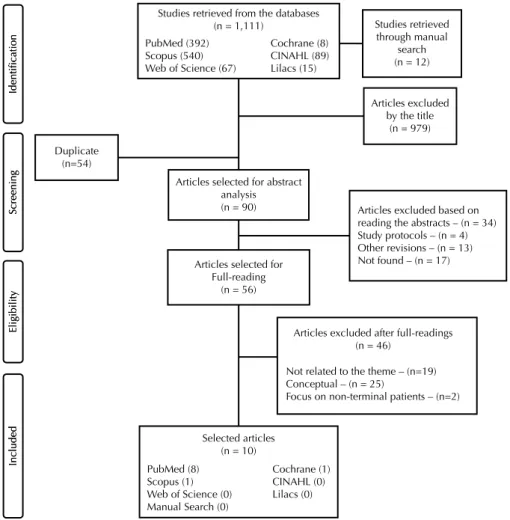
he searches resulted in retrieval of 1,111 articles and 12 other articles were found by a manual search from other sources. Of these, 979 were excluded by the title for not being related to the subject, and 54 duplicates were removed. After reading the abstracts, 56 were selected for full readings; 19 were excluded because they were not directly related to the subject; 25 more were excluded because they were con-ceptual studies and two articles were excluded because they addressed the efects of DT in patients with motor neuron disease (MND). he objective of the review was to analyze the efects of DT on terminally ill patients and MND is not a terminal illness, so the studies were excluded, although they represented innovative therapy application originally
proposed by Chochinov(4-5). Finally, 10 studies remained,
and this is an adaptation of the self-ill out model proposed
by the PRISMA guideline(11-12).
he articles analyzed were published between 2005 and 2015. Of the studies selected, 80% were found in PubMed,
10% in SCOPUS and 10% in COCHRANE. No stud-ies were selected in the searches performed in LILACS, CINAHL, WEB OF SCIENCE or through a man-ual search.
IdentificationIdentification
ScreeningScreening
EligibilityEligibility
IncludedIncluded
Duplicate (n=54)
Articles selected for abstract analysis (n = 90)
Articles selected for Full-reading
(n = 56)
Articles excluded based on reading the abstracts – (n = 34) Study protocols – (n = 4) Other revisions – (n = 13) Not found – (n = 17)
Articles excluded after full-readings (n = 46)
Not related to the theme – (n=19) Conceptual – (n = 25)
Focus on non-terminal patients – (n=2) Studies retrieved from the databases
(n = 1,111)
Selected articles (n = 10)
PubMed (8) Cochrane (1)
Scopus (1) CINAHL (0)
Web of Science (0) Lilacs (0) Manual Search (0)
PubMed (392) Cochrane (8) Scopus (540) CINAHL (89) Web of Science (67) Lilacs (15)
Studies retrieved through manual
search (n = 12)
Articles excluded by the title
(n = 979)
Figure 1 –Flowchart of selection of the articles of the Systematic Review, according to PRISMA(11-12) – São Paulo, 2015/2016.
he characterization of the studies included in the review is
summarized in Chart 2, and is organized according to author/
year/place, type of study, objectives, sample, and results. he
studies were grouped according to the patients’ proile and are discussed below. he studies included for analysis in the review were grouped according to the location in which the
patients were approached for the application of the interven-tions, and were listed from A1 to A10 for better organization of the results. In other words, group 1 gathered studies in
which the patients were hospitalized (A1 and A2)(6,15), group 2
studies include outpatients (A3 to A7)(16-20), and group 3
stud-ies included inpatients and outpatients (A8 to A10)(5,21-22).
Chart 2 – Characterization of articles included in the review – São Paulo, 2015.
Author/ year/place
of study
Type of
study Goal Sample Results
Group 1 – Patients in palliative care with advanced/terminal disease in hospitalization unit
A1
Julião et al., 2013 – Portugal(6)
Randomized Clinical Trial
Determine the effects of DT on the symptoms of depression and anxiety in patients with high level of suffering.
n = 60 terminal patients with life expectancy ≤ 6 months. Submitted to DT associated with palliative care (n = 29) and palliative care (n = 31);
95% cancer and 5% with non-malignant terminal conditions.
Patients undergoing DT showed a decrease in depression score on the fourth day (p = 0.001), maintained on the 15th day (p = 0.022), but not on the 30th day (p = 0.097). Lower indices of anxiety in all assessment periods (4th day – p = 0.005, 15th day – p = 0.006, 30th day – p = 0.054). Showed improvements regarding anxiety and depression, even in patients with high levels of suffering at the beginning. As an improvement in depression is not maintained until the 30th day, it is hypothesized that
a single DT session may be insuficient.
Author/ year/place
of study
Type of
study Goal Sample Results
A2 Julião et al., 2014 – Portugal(15)
Randomized Clinical Trial
Evaluate the effectiveness of DT on depression and anxiety scores of patients in palliative care.
n = 80 patients in palliative care with life expectancy ≤ 6 months. Submitted to DT (n = 39) and palliative care (n = 41);
92.5% cancer and 7.5% with non-malignant terminal conditions.
Patients undergoing DT showed a decrease in depression score in all periods of the evaluation in relation to the control group (4th day – p < 0.0001, 15th day – p = 0.010, 30th day – p = 0.043).
There was a signiicant decrease in anxiety for all
periods (4th day – p < 0.0001, 15th day – p = 0.001, 30th day – p = 0.003). DT showed improvements regarding anxiety and depression, even in patients with high levels of suffering at the beginning of the study. The improvements also showed a sustained effect (until the 30th day).
Group 2 – Outpatients/patients in palliative care with advanced/terminal disease
A3
Hall et al., 2011 – England(16)
Randomized Clinical Trial
Assess the feasibility, acceptability and potential effectiveness of dignity therapy in reducing psychological and spiritual suffering of elderly people.
n = 60 elderly people in nursing homes. Submitted to palliative care (n = 29) and DT (n = 31);
With oncological diseases and not at an advanced oncological terminal stage (with an average survival of 6 months in the intervention group).
There were no signiicant differences in the potential
measures of effectiveness between interventions. The DT presented small effects in relation to depression and quality of life 1 week after the intervention. Acceptability: the variables make life more meaningful
and serve as an aid to the families, showing signiicant
improvement (p = 0.04 and p = 0.02, respectively)
on the irst assessment, after 8 weeks only family support remained signiicant (p = 0.01). The DT was higher relative to the size of the effect in the irst
and second reviews, utility (0.38-0.55), made life more meaningful (0.58-0.25), increased the sense of purpose (0.27-0.53), decreased suffering (0.29-0.34), increased the will to live (0.46-0.39), helped or would help the family (0.66-0.85). The document/legacy took longer to be generated (about 1-5 visits).
A4
Johns et al., 2013 – USA(17)
Quasi-experimental
Study
Evaluate the feasibility of providing DT.
n = 10 patients with metastatic cancer; 100% caucasian women with stage IV metastatic cancer (without information on survival time).
Patients reported that DT was useful to them and to their families; it increased their meaning of life, their sense of dignity and decreased suffering (75%). With 100% satisfaction. Families and patients considered the document/legacy very useful. The levels of depression and satisfaction with quality of life worsened. The transcripts of the document were longer than other studies.
A5
Vergo et al., 2014 – USA(18)
Quasi-experimental
Study
Evaluate the feasibility of DT in patients with colorectal cancer and the changes in the acceptance of death, suffering, symptoms, quality of life, tranquility, and goals of care at the end of life and the treatment options before and after treatment with DT for each patient.
n = 9 patients with colorectal cancer who underwent palliative chemotherapy; 100% with stage IV metastatic cancer (without survival time information).
Feasibility of DT: 100% satisfaction, 88% reported usefulness of therapy and an increased sense of purpose, 78% which increased sense of dignity and purpose, 67% which increased the will to live. Physical symptoms: appetite improvement after the DT. Emotional symptoms: no changes presented. Clinical outcomes: increased acceptance of death (57% post-DT), choice of care and treatments that would not prolong life (58% post-DT).
A6 Rudilla et al., 2014 – Spain(19) Randomized Clinical Trial
Identify and quantify
the signiicant
differences in terms of emotional distress, quality of life and preservation of dignity after treatment with dignity therapy (DT) and counseling therapy.
n = 30 terminal patients in hospice care with advanced stage cancer; Submitted to DT (n = 15) and Therapeutic counseling (TC) (n = 15); Served at home. There is
no speciication of the
survival time.
In the comparison between the two therapies, there
were no statistically signiicant differences. Both therapies were statistically signiicant for: decreasing
suffering (DT p<0.001 and TC p = 0.001), increasing of quality of life (DT p = 0.000 and TC p = 0.009), decreasing existential suffering (DT p = 0.003 and TC p = 0.000).
A7 Rudilla et al., 2015 – Spain(20) Controlled Trial Examine and compare the effects of dignity therapy (DT) and advice on meeting the needs of the patient.
n = 70 patients in palliative care home service with advanced disease. Submitted to Therapeutic counseling (n = 35) and DT (n = 35);
Oncological and non-oncological diseases
(there is no speciication
of survival time).
In the pre-and post-intervention measures for DT,
there were statistically signiicant differences in
symptoms of pain, existential suffering, dependency, peace of mind, social support, intrapersonal, interpersonal and transpersonal spirituality, reliable support and affective support (p < 0.001), anxiety, depression (p = 0.001) and quality of life
(p = 0.011). There were no signiicant differences
with regard to resilience (p = 0.058). Counseling Therapy was superior to the DT regarding anxiety (p = 0.022). Also, analyzed in isolation obtained good results regarding resilience (p = 0.005). ...continuation
An analysis of the selected study designs showed: ive ran-domized controlled trials (50%), three with a moderate level
of evidence and two with a high level of evidence(6,15-16,19,21),
one controlled clinical trial (10%) with a moderate level of
evidence(20), four quasi-experimental studies (40%), being
two with low and two very low levels of evidence(5,17-18,22).
Chart 3 shows the detail of the scores of the studies included
in the review, according to the GRADE system(14).
Author/ year/place
of study
Type of
study Goal Sample Results
Group 3 – Admitted and non-admitted patients (inpatients/outpatients) in palliative care with advanced/terminal disease
A8
Chochinov et al., 2005 – Canada(5)
Quasi-experimental
Study
Establish the viability of DT;
Determine its impact on measures of psychological and existential suffering.
n = 100 terminal cancer patients with life expectancy ≤ 6 months; (97% cancer and 3% non-malignant terminal conditions).
DT had good satisfaction rates, utility, increasing sense of dignity (p = 0.085), purpose, meaning and will to live, improved self-reported depressing mood (p = 0.05), suffering (p = 0.023) and quality of life (p = 0.049). Reported that the DT helped them or would help the families.
A9
Chochinov et al., 2011 – Canada(21)
Randomized Clinical Trial
Compare DT with palliative care and patient-centered care standards regarding the dimensions of distress (depression and suffering), quality of life and dignity.
n = 326 patients in palliative care with life expectancy ≤ 6 months, submitted to DT (n = 108), Patient-Centered Care (n = 107) and Palliative Care
(n = 111); (95.8% neoplasia and 4.3% non-malignant terminal conditions).
Patients who received DT reported better indices in: utility (p<0.001), quality of life (p<0.001), sense of dignity (p = 0.002), satisfaction (p<0.001), family assessment (p<0.001). Reported that the DT would help them or their families (p<0.001). There were also improvements in spiritual well-being (p = 0.006), a decrease in sadness or depression
(p = 0.009). Better end-of-life quality experience.
The ability to decrease depression, the wish for death or suicide was not proven.
A10
Houmann et al., 2014 – Denmark(22)
Quasi-experimental
Study
Evaluate and explore the effectiveness of Dignity Therapy (DT) for patients with incurable cancer.
n = 80 patients with incurable cancer; 100% cancer with average survival of 4 months.
DT was considered: satisfactory and having useful potential to help for the family (73-89%), with an increase in the sense of dignity, purpose and the will to live (47-56%), making life more meaningful with reduction in pain and improvement of family
assessment (25 to 43%). At irst there was an
increase in depression score and a decreased overall quality of life; in the second evaluation there was an increase in the sense of dignity and it reduced the feeling of being a burden.
...continuation
Chart 3 – Level of study evidence, according to the GRADE system(22) – São Paulo, 2015.
Author/Year Study design Reducing factors Increasing factors Level of evidence
I II III IV V VI VII VIII
Julião et al., 2013(6) (A1) CRCT a / / / -1 / / / / Moderate 3
Julião et al., 2014(15) (A2) CRCT a / / / -1 / / / / Moderate 3
Hall et al., 2011(16) (A3) CRCT a / / / / / / / / High 4
Johns et al., 2013(17) (A4) QES c / / / / -1 / / / Very low 1
Vergo et al., 2014(18) (A5) QES c / / / / -1 / / / Very low 1
Rudilla et al., 2014(19) (A6) CRCT a -1 / / / -1 +1 / / Moderate 3
Rudilla et al., 2015(20) (A7) CCT b -1 / / / / / / / Moderate 3
Chochinov et al., 2005(5) (A8) QES c / / / / / / / / Low 2
Chochinov et al., 2011(21) (A9) CRCT a / / / / / / / / High 4
Houmann et al., 2014(22) (A10) QES c / / / / / / / / Low 2
a Controlled Randomized Clinical Trial (CRCT) / b Controlled Clinical Trial (CCT) / c Quasi-Experimental Study (QES).
I – Risk of bias; II – Inconsistency; III – Indirect Evidence; IV – Imprecision; V – Publication Bias; VI – Efect size; VII – Dose-response gradient; VIII – Possible residual confusion.
Group 1 – patientsofpalliativecarewith
advanced/terminaldiseaseinahospitalizationunit
Two randomized controlled trials with a moderate level of evidence were included in this group. he patients’ proile in these studies was: terminal patients with life expectancy ≤ 6 months, mostly including oncological diseases of diverse origins and non-oncological diseases (amyotrophic lateral sclerosis and trigeminal neuralgia in both). he patients were cared for at a hospice units specialized in palliative care in both studies; they were allocated to two groups with one being DT, and the other where patients received standard palliative care therapy in which the institution’s conventional palliative care was administered by a multiprofessional
spe-cialized team(6,15).
In study A1, the patients were evaluated before the inter-vention, presenting high rates of depression and anxiety. he results were statistically signiicant for depression (with the
exception of the 30th day – p = 0.097) and for anxiety at all
follow-up periods(6). In A2, patients also had higher rates of
psychosocial distress in the initial evaluation, but the results were statistically signiicant at all follow-up periods for the
two analyzed variables(15).
Group 2 – outpatients/patientsinpalliativecare
withadvanced/terminaldisease
In this group, ive studies were included: a randomized
controlled trial with a high level of evidence(16), a randomized
controlled trial with a moderate level(16), a controlled clinical
trial(20) with a moderate level of evidence, and two
quasi-experimental studies with very low levels of evidence(17-18).
he proile of the patients included in these studies was: outpatients who attended the services for performing pro-cedures and consultations and/or those followed by multi-professional home visiting teams and/or nursing homes, with
oncological and non-oncological diseases (unspeciied)(16-20).
In A3, patients were allocated to the intervention group (DT) and to the control group, in which they received the institution’s standard palliative care therapy. All patients were older adults living in nursing homes with oncological and non-oncological diseases (unspeciied). In the potential for eicacy (sufering related to dignity, loss of hope, depression, quality of life), there was only a small efect on reduction of depression (efect size = 0.05) and quality of life (efect size =
0.02) in favor of DT, following 1 week post-intervention(16).
For outcome acceptability, a signiicant diference was observed in the comparison with control group for the vari-ables making life more meaningful and family support both
at 1 week follow-up (p = 0.02) and at 8 weeks
post-inter-vention (p = 0.01). he efect of DT on utility (efect size =
0.55), increased sense of purpose (efect size = 0.53), will to live (efect size = 0.39) and decreased pain (efect size = 0.34) was considered moderate at 8 weeks follow-up. he last outcome evaluated was viability, where the number of visits to complete the initial intervention (DT) was one visit (93%)
and to complete the instrument was 1 to 5 visits on average(16).
In A4, the patients were women with metastatic cancer. DT was useful for themselves and their families in 75%
of patients, increasing the meaning of life, sense of dignity and reduced sufering. here was 100% satisfaction, as the patients considered the generated document very useful. In comparing the measures performed before and after the intervention, however, there was an increase in levels of
depression and anxiety(17).
In study A5, patients who were not hospitalized (outpa-tients) and who went to services only to perform palliative chemotherapy were evaluated. For the outcome of viability, beneits of DT were observed for all variables (satisfaction, utility, increased sense of meaning, purpose, dignity and increased will to live). For the outcome of physical symp-toms (pain, tiredness, nausea, drowsiness, appetite, dyspnea), only appetite improved after DT. Psychosocial symptoms (anxiety, depression, feeling of well-being, classiication and satisfaction with quality of life and distress) were not afected by DT. he most satisfactory results were related to clinical outcomes, with increased acceptance of death one month after DT (57%) and improvement in the choice for
treat-ments that did not prolong life (58%)(18).
In study A6 with a quasi-experimental design, patients/ outpatients with neoplasia living in the home were evalu-ated. herapeutic counseling (TC) consisted of an approach developed to facilitate communication between the health professional and the patients, based on three pillars: technical knowledge, attitudes and relationship strategies (assertive communication, personal self-regulation skills and problem-solving skills) with the goal of improving psychosocial
symp-toms(19). Both reduced sufering (DT p<0.001; TC p = 0.001),
increased quality of life (DT p = 0.000; TC p = 0.009) and
decreased existential distress (DT p = 0.003, TC p<0.001).
Regarding the efect size of these variables, TC was superior for quality of life (DT = 1.69, TC = 3.47) and existential distress (DT = 1.94, TC = 3.34) and DT was higher for
reducing sufering (DT = 2.74, TC = 2.50)(19).
In study A7, DT was also compared to TC in patients at home using a controlled clinical trial with a moderate level of evidence. In this case, a signiicant diference was observed between interventions only for the variable anxiety
(p = 0.022), in favor of TC (efect = 0.65, considered
moder-ate). For the variables: peace of mind (DT p<0.001/efect =
1.11; TC p<0.001/efect = 1.15), anxiety (DT p = 0.001/
efect = 0.58; TC p = 0.001/efect = 0.65), intrapersonal
spirituality (DT p<0.001/efect = 1.12; TC p<0.001/efect =
1.31) and transpersonal spirituality (DT p<0.001/efect =
0.83; TC p<0.001/efect = 1.49), a signiicant diference with
a large efect size was also observed, but in favor of TC(20).
Spirituality is deined as the human quest to transcend the self to ind meaning and purpose through connection with others, with nature and/or “a Supreme Being,” which may or may not include religious institutions. Intrapersonal spiritual-ity encompasses the elements of self-discovered spiritualspiritual-ity, involving the search for meaning and purpose; interpersonal spirituality involves interpersonal relationships, through the relationship between the personal journey and other people’s journeys; and transpersonal spirituality is related to ecocon-sciousness, meaning the connection of the personal journey
Group 3 – admittedandnon-admittedpatients
(inpatients/outpatients) inpalliativecarewithan
advanced/terminaldisease
hree studies with quasi-experimental design and low level of evidence were included in this group. In these stud-ies, the patients had a life expectancy of 4 to 6 months, most with advanced stage neoplasia of several origins and some patients with non-malignant terminal conditions (advanced
stage of multiple organ failure)(5,21-22).
In study A8, the viability analysis showed that 91% were satisied or very satisied with DT, 86% considering it useful or very useful, 60% indicating increased sense of dignity, 68% increased sense of purpose, 67% increased sense of meaning, 40% increased will to live and 81% reported that DT helped or would help their families. In the quantitative outcomes, post-intervention measures showed a signiicant reduction of
sufering (p = 0.023), and improvement in depressing mood
(p = 0.05); however, loss of hope, wishing for death, anxiety
and suicide were not afected by DT. In the same study, the patients who reported the greatest psychosocial distress at the start of the study were those who reported the greatest
beneits from therapy, and especially for: quality of life (p =
0.049), level of dignity (p = 0.021) and lower risk of suicide
(p = 0.012) measures, with all signiicantly related to utility
and satisfaction with therapy(5).
In study A9, patients were randomly allocated into three diferent groups, with one for DT, one for standard palliative care therapy and one for patient-centered care. his study was considered as having a high level of evi-dence for being a well-deined, randomized controlled trial. In standard palliative care therapy, patients received standard/conventional therapy from institutions where they were hospitalized or from multiprofessional home-visiting teams. Patient-centered care is a supportive psychothera-peutic approach in which therapist-nurses guide patients to discussions focused on “here and now” issues; for example, participants answered questions about their illness associ-ated with symptoms, and discussed what they were doing to solve their sufering. DT was superior to the two other
approaches, showing signiicant utility (p<0.001), quality
of life (p<0.001), sense of dignity (p = 0.002), satisfaction
(p<0.001) and improvement of family appreciation in
rela-tion to the patient indices (p<0.001). In this study, patients
also reported that DT helped or would signiicantly help
their families (p<0.001) in comparison to the other groups.
In the group that received DT, an improvement in spiritual
well-being (p = 0.006) and improvement in the patients’
sadness or depression (p = 0.009) was also observed(21).
In study A10, patients with advanced neoplasia were evaluated. As it consisted of a quasi-experimental study, it was considered as having a low level of evidence. he average survival time of patients was about 4 months. he patients were submitted to DT and evaluated about 30 days after the initial measurements, and at a second moment of about 60 days after the initial measurements. DT was considered useful, satisfactory and providing potential help for family members (73%); furthermore, DT increased sense of dignity,
purpose and will to live, making life more meaningful for 49% of those assessed. he 60-day post-assessment showed an increase in sense of dignity and a decrease in the feeling of being a burden to others, revealing that DT had prolonged efects for these variables. Initially, there was an increase in depression scores, but improvements were observed for this
variable in the 60-day evaluation(22).
DISCUSSION
he studies included in this review evaluated physical, psychosocial and spiritual efects of dignity therapy, although not all articles evaluated all three aspects.
More severely alicted patients at the start of the study may present impairment with the application of DT, since they can build a distorted view of themselves. However, the patients in A1 and A2 presented signiicant improvement in the variables of depression and anxiety, even in the presence of these conditions. In A1, the lack of prolonged efect of
DT for depression following the 30th day may suggest an
insuicient number of DT sessions(6,15).
In study A3, the DT-generated document had good acceptability, so much so that patients chose to turn it in before their own death. Also, the evaluation of those receiv-ing the document was also satisfactory in that it provided better patient insight and pleasant discussions about the highlighted memories. In this study, the levels of distress measured before the intervention were relatively low and the patients reported a good quality of life; in that sense, there was little room for improvement, which may represent a limitation(16).
he A4 study sample was small (n = 10) and only four patients completed pre and post-intervention measures, associated with clinical deterioration throughout the follow-up. hus, the conclusions of this study should be observed cautiously, especially because it was classiied with a very low level of evidence, with little conidence in the efect estimate. hus, there is no way of stating whether the application of DT could increase levels of anxiety and depression in
terminal patients(17).
In A5, DT showed good results mainly for improving the acceptance of death and end-of-life goals regarding treat-ment and care; but because it was a quasi-experitreat-mental study, there was no control group for comparison. herefore, it is not possible to determine if the improvement is related to the DT or the passage of time; in addition, it was a very small sample (only nine patients). Furthermore, many of the patients included in the study had never had a talk with the health team about prognosis, design, or therapeutic goals, and in providing that conversation, DT resulted in better
acceptance of death and better end-of-life choices(21).
which makes them similar, justifying the similarity of results between them and the lack of signiicant diference between
the interventions(19-20).
Study A8 presented good results on the acceptance of DT by inpatients and outpatients. he authors emphasized the importance of psychotherapy that is highly referred to as a potential help for family members (81%), since feeling that DT would help family members signiicantly
corre-lated with increased sense of meaning (p<0.001), sense of
purpose (p<0.001), accompanied by a decrease in sufering
(p = 0.001). hat is, the patients feeling that DT could help
their families, even after their deaths, helped improve the
end-of-life experience(5).
Study A9 showed that DT increased the quality of the end-of-life experience, with the ability to help the patients’ families. However, this study did not evaluate the measures of sufering and distress before the interventions were per-formed. his initial evaluation could have improved the analysis of the diferences between the three groups in the study, based on pre and post-intervention changes, allowing to hypothesize about the relationship between the initial
level of anxiety in patients and the success of DT(21).
In study A10, the patients most severely afected by psychosocial sufering were prevented from entering the study due to the exclusion criteria, and therefore there is no way to know if the outcomes would be the same for this patient proile. In addition, patients chose to deliver the DT-generated document about 14 days after the interven-tion, but when they had close relatives who were children, they had diiculty delivering and addressing the issue, so further studies should be conducted to determine the beneit
of DT for patients who have children as close relatives(22).
In general, a limitation of applying DT in studies is the loss in follow-up of patients during the pre- and post-inter-vention evaluations, since patients are in the terminal phase of life, and invariably their health conditions deteriorate, which makes it impossible for them to participate in the study due to lack of conditions or death.
Support for family members deserves special mention, since psychotherapies are focused on patients and their improvement outcomes, and most of the time they do not address family, friends and caregivers. he World Health Organization in its deinition of palliative care advocates that all aspects of care should be addressed, including the psychosocial aspects. By improving family support, there is improvement in the end-of-life experience for patients,
as evidenced by studies(7). Dignity therapy seems to exert
a good inluence on the family support variable, since this improvement was pointed out in ive studies with one pre-senting a moderate level of evidence and one a high level, meaning an estimate of approximate efect of the true
efect(5,16-17,21-22). hus, it may be the therapy of choice to
improve these aspects.
In addition, DT appears to be well accepted by patients.
It was identiied as satisfactory in ive studies(5,17-18,21-22),and
useful in six studies, with levels of evidence ranging from
very low to high(5,16-18,21-22). Increased dignity was noted in
ive studies(5,15,20-22), quality of life in four studies(15-17,19), and
decreased sufering was observed in six studies(5,16-17,19-20).
In other words, DT presented good levels of acceptance by inpatients and outpatients, both with oncological and non-oncological diseases and with reduced life expectancy. However, there is the need for further studies to evaluate the usefulness of therapy for non-malignant pathologies, since it was a minority in the studies evaluated. Although DT was designed with the intention of improving the patients’ spiritual issues, only two studies showed improvement in this aspect after DT, with a level of evidence of moderate to high(20-21).
Regarding the psychosocial distress variables, therapeutic counseling was superior to DT in the two studies comparing
these variables(19-20). In two studies evaluating a reduction in
depression and anxiety by DT, there was an improvement in scores, even for patients who were more severely distressed
at the beginning of the study(6,16). In another three studies
there was a decrease in depression after the intervention
with DT(5,16,21). Although controversial, the application of
DT appears to have had good efects on depression, with less impact on anxiety. However, larger impact studies and larger populations are needed to conirm the improvement or worsening of the psychosocial distress variables in monitor-ing the efectiveness of DT.
Further studies are needed to prove the sustained ben-eit of the therapy, as DT presented a sustained benben-eit in one study, however in another the improvement provided to
depression symptoms was not sustained until the 30th day of
intervention(6,16). None of the articles analyzed in this review
were published in Brazil, indicating that this review may represent an initial step for the development of intervention studies in this area within Brazil.
Furthermore, none of the experimental articles analyzed were published by nurses, although these professionals have developed theoretical studies in this area. Considering the role of nurses in palliative care, we can note that it is a ield with great potential for research development, especially intervention studies, which can bring advances to end-of-life/hospice care.
his study has limitations, which should be pointed out. he inclusion of articles only in Portuguese, English and Spanish might have excluded important studies from other cultures/languages.
CONCLUSION
not seem to be directly inluenced by DT, although many symptoms are subjective and can be indirectly improved by the impact of DT on feelings and emotions. Spirituality also
did not experience much impact of improvement reported by patients, and it should also be further evaluated in larger impact studies.
RESUMO
Objetivo: Analisar as evidências sobre os efeitos da terapia da dignidade para pacientes em fase terminal de vida. Método: Revisão sistemática da literatura realizada em seis bases de dados na estratégia de busca. Os critérios de inclusão foram estudos primários, excluindo-se revisões da literatura (sistemáticas ou não) e artigos conceituais. Resultados: Dez artigos foram analisados quanto ao método, aos resultados e nível de evidência. Nos estudos com maior nível de evidência, a terapia da dignidade melhorou o senso de signiicado, propósito, vontade de viver, utilidade, qualidade de vida, dignidade e apreciação familiar. Os efeitos não estão bem estabelecidos em relação à depressão, ansiedade, espiritualidade e aos sintomas físicos. Conclusão: Os estudos de nível de evidência de moderado a alto demonstraram aumento do senso de dignidade, vontade de viver e senso de propósito. Mais estudos devem ser desenvolvidos para ampliar o conhecimento sobre a terapia da dignidade.
DESCRITORES
Cuidados Paliativos; Doente Terminal; Psicoterapia Breve; Qualidade de Vida; Enfermagem Holística; Revisão. RESUMEN
Objetivo: Analizar las evidencias acerca de los efectos de la terapia dignidad para pacientes en fase terminal de vida. Método: Revisión sistemática de la literatura llevada a cabo en seis bases de datos en la estrategia de búsqueda. Los criterios de inclusión fueron estudios primarios, excluyéndose las revisiones de literatura (sistemáticas o no) y los artículos conceptuales. Resultados: Diez artículos fueron analizados en cuanto al método, los resultados y el nivel de evidencia. En los estudios con mayor nivel de evidencia, la terapida de la dignidad mejoró el sentido de signiicado, propósito, ganas de vivir, utilidad, calidad de vida, dignidad y estimación familiar. Los efectos no están bien planteados con respecto a la depresión, ansiedad, espiritualidad y los síntomas físicos. Conclusión: Los estudios de nivel de evidencia de moderado a alto demostraron incremento del sentido de dignidad, ganas de vivir y sentido de propósito. Se deben desarrollar más estudios a in de ampliar el conocimiento acerca de la terapia de la dignidad.
DESCRIPTORES
Cuidados Paliativos; Enfermo Terminal; Psicoterapia Breve; Calidad de Vida; Enfermería Holística; Revisión.
REFERENCES
1. Kant I, Galvão P. Fundamentação da metafísica dos costumes. Lisboa: Edições 70; 2007.
2. Van Der Maas PJ, Van Delden JJ, Pijnenborg L, Looman CW. Euthanasia and other medical decisions concerning the end of life. Lancet. 1991;338(8768):669-74.
3. Chochinov HM, Hack T, Hassard T, Kristjanson LJ, McClement S, Harlos M. Dignity in the terminally ill: a cross-sectional, cohort study. Lancet. 2002;360(9350):2026-30.
4. Chochinov HM, Hack T, McClement S, Kristjanson L, Harlos M. Dignity in the terminally ill: a developing empirical model. Soc Sci Med. 2002;54(3):433-43.
5. Chochinov HM, Hack T, Hassard T, Kristjanson LJ, McClement S, Harlos M. Dignity therapy: a novel psychotherapeutic intervention for patients near the end of life. J Clin Oncol. 2005;23(24):5520-5.
6. Julião M, Barbosa A, Oliveira F, Nunes B, Carneiro, AV. Eficacy of dignity therapy for depression and anxiety in terminally ill patients:
early results of a randomized controlled trial. Palliat Support Care. 2013;11(6):481-9.
7. World Health Organization (WHO). WHO Deinition of palliative care [Internet]. Geneva: WHO; 2014 [cited 2014 Jan 20]. Available
from: http://www.who.int/cancer/palliative/deinition/en/
8. Instituto Nacional de Câncer José Alencar Gomes da Silva. Incidência de câncer no Brasil: estimativa 2016 [Internet]. Rio de Janeiro: INCA;
2016 [citado 2014 jan. 14]. Disponível em: http://www.inca.gov.br/estimativa/2016/
9. Instituto Brasileiro de Geograia e Estatística. Projeção da população do Brasil e Unidades da Federação: 2000-2030 [Internet]. Rio de
Janeiro: IBGE; 2016 [citado 2016 fev. 20]. Disponível em: http://www.ibge.gov.br/apps/populacao/projecao/
10. Malta DC, Moura LD, Prado RRD, Escalante JC, Schmidt MI, Duncan BB. Mortalidade por doenças crônicas não transmissíveis no Brasil
e suas regiões, 2000 a 2011. Epidemiol Serv Saúde. 2014;23(4):599-608.
11. Moher D, Liberati A, Tetzlaff J, Altman DG. Preferred Reporting Items for Systematic Reviews and Meta-Analyses: the PRISMA statement. Ann Intern Med. 2009;151(4): 264-9.
12. Liberati A, Altman DG, Tetzlaff J, Mulrow C, Gøtzsche P, Ioannidis JPA, et al. The PRISMA statement for reporting systematic reviews and meta-analyses of studies that evaluate health care interventions: explanation and elaboration. PLoS Med. 2009;6(7):e1000100.
13. The Joanna Briggs Institute. Reviewers’ manual. ed. 2014 [Internet]. Adelaide: JBI; 2014 [cited 2016 Feb 20]. Available from: http://
joannabriggs.org/assets/docs/sumari/reviewersmanual-2014.pdf
14. Balshem H. Grade guidelines: 3 rating the quality of evidence. J Clin Epidemiol. 2011;64(4):401-6.
15. Juliao M, Oliveira F, Nunes B, Vaz Carneiro A, Barbosa A. Eficacy of dignity therapy on depression and anxiety in Portuguese terminally
16. Hall S, Goddard C, Opio D, Speck P, Higginson, IJ. Feasibility, acceptability and potential effectiveness of Dignity Therapy for older people in care homes: a phase II randomized controlled trial of a brief palliative care psychotherapy. Palliat Med. 2011;26(5):703-12.
17. Johns SA. Translating dignity therapy into practice: effects and lessons learned. Omega. 2013;67(1-2):135-45.
18. Vergo MT, Nimeir IH, Mulcahy M, Benson AB, Emanuel L. A feasibility study of dignity therapy in patients with stage IV colorectal cancer
actively receiving second line chemotherapy. J Comm Support Oncol. 2014;12(12):446-53.
19. Rudilla D, Barreto P, Oliver A, Galiana L. Estudio comparativo de la eicacia del counselling y de la terapia de la dignidad en pacientes
paliativos [resumen]. Med Paliat. 2016;23(4). DOI: 10.1016/j.medipa.2014.09.005
20. Rudilla D, Galiana L, Oliver A, Barreto P. Comparing counseling and dignity therapies in home care patients: a pilot study. Palliat Support
Care. 2015;14(4):321-9.
21. Chochinov HM, Kristjanson LJ, Breitbart W, McClement S, Hack TF, Hassard T, et al. Effect of dignity therapy on distress and end-of-life
experience in terminally ill patients: a randomised controlled trial. Lancet Oncol. 2011;12(8):753-62.
22. Houmann LJ, Chochinov HM, Kristjanson LJ, Petersen MA, Groenvold M. A prospective evaluation of Dignity Therapy in advanced cancer patients admitted to palliative care. Palliat Med. 2013;28(5):448-58.