UDC 575.21: 633.2 Original scientific paper
MORPHOLOGICAL CHANGES IN ATYPICAL BIRD’S FOOT TREFOIL PLANTS OBTAINED DURING GENETIC TRANSFORMATION BY
AGROBACTERIUM
Radomirka NIKOLIĆ and Nevena MITIĆ
ARI “Serbia”, Agricultural and Technological Research Centre, 19000 Zaječar, Serbia and Montenegro
Nikolić R. and N. Mitić (2003): Morphological changes in atypical bird’s foot trefoil plants obtained during genetic transformation by Agrobacterium. – Genetika, Vol. 35, No. 3, 177-185.
Atypical plants of bird’s foot trefoil (Lotus corniculatus L., Bokor cv.) showing altered morphological characters that deviate from a normal phenotype were found after plant regeneration from transformed tissue. It had been obtained by genetic transformation of root sections of seedlings using Agrobacterium tumefaciens vector LBA4404/pBI121 on a medium supplemented with 0.2 mg l-1 BAP. The transformants 2b and 4a were found to have a greatly atypical habit, including shortened inter-nodes, elongated leaves, regular leaf arrangement along the stem and thicker leaves. Inheritance of altered characters was observed in the first progeny generation, and their genetic origin was considered.
Key words: Lotus corniculatus, leguminous plants, in vitro regeneration, genetic transformation, somaclonal variation, phenotypic variants
_______________________________
Corresponding author: Radomirka Nikolić, Institut za istraživanja u poljoprivredi “Srbija”, Centar za poljoprivredna i tehnoloska istraživanja, Grljanski put b.b., 19000 Zaječar Tel: 019/420-222, Fax: 019/421-668
INTRODUCTION
Successful genetic transformation requires stable inheritance and expres-sion of transgenes in the progeny, as well as production of transformed plants with a normal phenotype equivalent to the characters of the transformed cultivar. How-ever, both procedures, i.e. the genetic transformation and in vitro regeneration, may result in acquiring plants with atypical phenotype or somaclonal variation. Re-garding leguminous plants, instances of somaclonal variation have been described mostly for soybean (BARWALE and WIDHOLM, 1987; 1990; RANCH and PALMER, 1987; SCHOEMAKERet al., 1991; GRIGA, 1999) and peas (STEJSKAL and GRIGA, 1992, GRIGA et al., 1995; GRIGA 2000). A number of phenotypic variations have been described in those plants, such as agglutinated seeds, multiple buds, dwarfish growth, abnormal morphology and leaf number, wrinkled leaves, leaf rolling, yel-low-green plants, isoenzymatic variants, partial or complete sterility, etc. Somaclonal variants have also been detected for bird’s foot trefoil (ORSHINSKY and TOMES, 1984; 1985; DAMIANI et al., 1985; PEZZOTI et al., 1985; WEBB and WATSON 1991). Bird’s foot trefoil plants transformed by Agrobacterium rhizogenes (TABAEIZADEH, 1993) and A. tumefaciens (WEBBet al., 1996) display-ing morphological deviation from the seed-grown control plant population have also been detected. This report gives a description of morphological alteration of bird’s foot trefoil plants acquired by direct regeneration in vitro from A. tumefa-ciens-transformed plant roots.
MATERIALS AND METHODS
The regenerated shoots were grown over two subcultures on a growth regulator-free MS medium supplemented with 100 mg l-1 kanamycin, followed by another two subcultures on a medium supplemented with kanamycin concentration reduced to 50 mg l-1. The shoots that survived the selection treatment were rooted on a selective MS medium with 0.2 mg l-1 IAA or a kanamycin-free MS medium containing 0.5 mg l-1 IBA. Rooted plants were acclimatized in a greenhouse. Phe-notypic variants were studied and compared with control seed-derived plants of identical genotype. (R1 seeds from fertile plants were collected and stored for
fur-ther evaluation.)
RESULTS
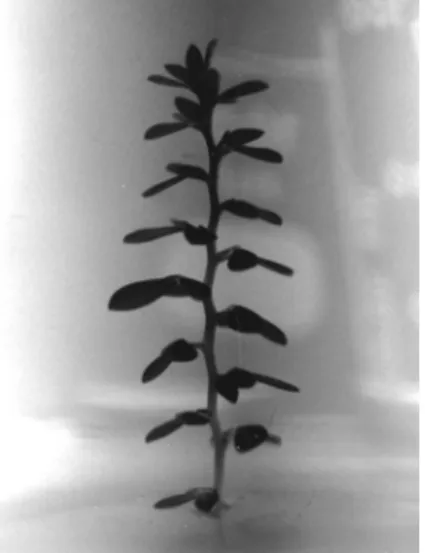
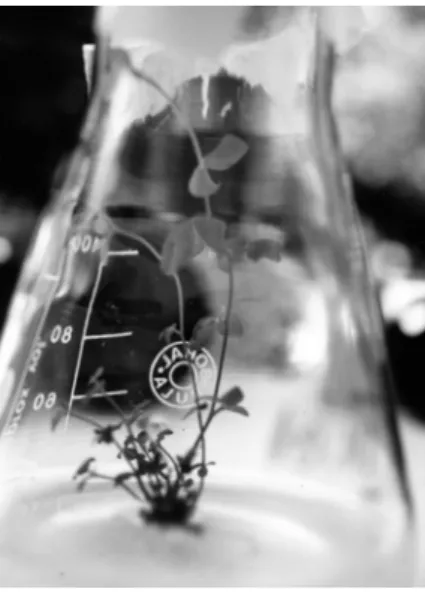
Kanamycin selection was survived by 18.3% of the shoots developing from the root sections transformed by LBA4404/pBI121, while no control shoots survived the selection treatment. Among the survivors were two rooted plants that, together with another two that failed to take root, belonged to the genotypes 2 and 4 showing altered morphological characters compared to normal control plants of the same genotypes. They also differed from the other shoots of other genotypes grown on kanamycin. Atypical plants of the genotype 4 (Fig. 1) had shorter inter-nodes and elongated leaves evenly distributed along the stem. Atypical plants of
Fig. 1. Atypical plantlet of the genotype 4
Fig. 2. Atypical plantlet of the genotype 2
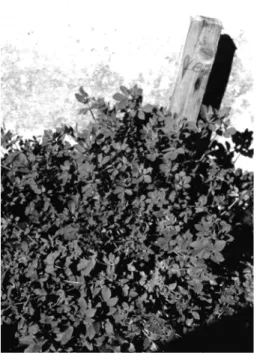
Two atypical rooted plants, i.e. 4a and 2b, were successfully acclimated in the greenhouse and transferred into experimental field to continue growth. Over the winter period, the plant 2b froze to death. The surviving plant 4a continued to grow
Fig. 3. Plantlet with normal fenotype
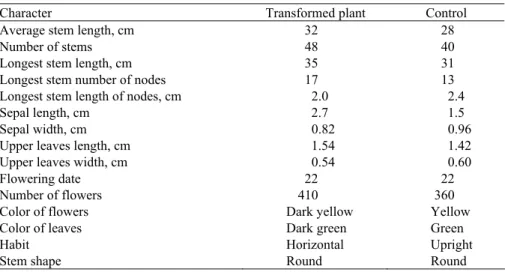
foot trefoil compared to the normal type. The plant’s morphological characters
Fig. 4. Plants after 50 d of acclimation (A-atypical plant 4a, B-normal fenotype)
compared to normal control plants are shown in Table 1. The plant flowered in spatial isolation of an experimental field but the number of seeds at an early stage of organogenesis was low. The seeds were collected and made to germinate in laboratory. The seedlings were then planted into pots and grown in the greenhouse.
Alterations of morphological characters found in the five filial plants were ob-served to be identical as those obob-served in the mother plant. Atypical genotypes have been cultivated for the past two years in the required distance to prevent cross pollination and multiplied by seeds.
Table 1. Morphological characters of atypical plants of the genotype 4
Character Transformed plant Control
Average stem length, cm 32 28
Number of stems 48 40
Longest stem length, cm 35 31
Longest stem number of nodes 17 13
Longest stem length of nodes, cm 2.0 2.4
Sepal length, cm 2.7 1.5
Sepal width, cm 0.82 0.96
Upper leaves length, cm 1.54 1.42
Upper leaves width, cm 0.54 0.60
Flowering date 22 22
Number of flowers 410 360
Color of flowers Dark yellow Yellow
Color of leaves Dark green Green
Habit Horizontal Upright
Stem shape Round Round
DISCUSSION
The main question the results presented here raise is what provokes the occurrence of atypical plants of bird’s foot trefoil following Agrobacterium trans-formation and in vitro regeneration. The atypical plants 4a and 2b survived the kanamycin selection. As all other survivors of the selection treatment had normal phenotype and did not differ significantly from control plants, the occurrence of atypical plants cannot be attributed to kanamycin activity.
There are two other possible explanations of the phenomenon. Firstly, the transformation itself may have brought about specific characters in the transfor-mants. Transformed plants with specific characters (T phenotype) different from the corresponding characters in control plants had already been reported for A. rhizogenes-transformed bird’s foot trefoil plants (TEPFER and CASSE-DELBRAT, 1989). Studying the morphological characters of L. corniculatus plants transformed by A. tumefaciens, WEBBet al. (1996) had observed plants with abnormal flowers. Those plants had reduced petals, while stigma and anthers protruded from the co-rolla. The next year, the plants produced flowers of similar abnormal morphology.
the bird’s foot trefoil cv. Leo derived from three different types of explants, and identified some morphological variants showing morphological (or even cytologi-cal) difference from control seed-derived plants.
The occurrence of atypical variants is hardly favorable regarding clonal propagation, i.e. multiplication of specific genotypes, or production of transgenic plants with an improved character but needing to have all other characters of the cultivar with normal phenotype unchanged. The occurrence of phenotype variants, on the other hand, enables selection of genotypes with some superior characters that may, as sources of genetic variability or carriers of desirable traits, be included in breeding procedures. Transformed plants of altered phenotype may therefore be used in studies of the functioning and expression of transgenes and other genes in the genome of transformed plants.
Received December 27th, 2003 Accepted December 29th, 2003
REFERENCES
BARWALE U.B. and J.M. WIDHOLM (1987): Somaclonal variation in plants regenerated from cul-tures of soybean. Plant Cell Rep., 6, 365-368.
BARWALE U.B. and J.M. WIDHOLM (1990): Soybean: plant regeneration and somaclonal variation. In: "Biotechnology in Agriculture and Forestry". Vol. 10. Legumes and Oilseed Crops I. Bajaj, Y.P.S. (Ed), Springer-Verlag, Berlin, pp.: 114-133.
DAMIANI F., D. MARIOTTI, M. PEZZOTTI, and S. ARCIONI (1985): Variation among plants re-generated from tissue culture of Lotus corniculatus L. Z. Pflanzenzücht, 94, 332-339. DAMIANI F., M. PEZZOTTI, and S. ARCIONI (1990): Somaclonal variation in Lotus corniculatus in
relation to plant breeding purposes. Euphytica, 46, 35-42.
GRIGA M. (1999): Somatic embryogenesis in grain legumes. In: "Advances in Regulation of Plant Growth and Development". Strnad, M., P. Peč, P. and E. Beck (Eds), Peres Publ., Prague, pp.: 133-250.
GRIGA M. and J. LÉTAL (1995): Somaclonal variation study of pea (Pisumsativum L.). In: "Recent Advances in Plant Biotechnology". Inst. Plant Genet., Nitra, pp.: 130-135.
GRIGA M. (2000): Morphological alterations in sterile mutant of Pisumsativum obtained via somatic embryogenesis. Biol. Plant., 43, 161-165.
ORSHINSKY B.R. and D.T. TOMES (1984): Comparison of plants derived from cuttings, node cul-tures, and ethyl methanesulfonate treated node cultures of bird’s-foot trefoil (Lotus cornicu-latus). Can. J. Bot., 62, 1501-1504.
ORSHINSKY B.R. and D.T. TOMES (1985): Effect of long-term culture and low temperature incuba-tion on plant regeneraincuba-tion from a callus line of birdsfoot trefoil (Lotus corniculatus L.). J. Plant Physiol., 119. 389-397.
PEZZOTTI M., S. ARCIONI S., F. DAMIANI, and D. MARIOTTI (1985): Time-related behaviour of phenotypic variation in Lotus corniculatus regenerants under field conditions. Euphytica, 34, 619-623.
SHOEMAKER R.C., L.A. AMBERGER, R.G. PALMER, L. OGLESBY, and J.P. RANCH (1991): The effect of 2,4-dichlorophenoxyacetic acid concentration on somatic embryogenesis and heri-table variation in soybean [Glycinemax (L.) Merr.]. Invitro cell. dev. Biol., 27P. 84-88. STEJSKAL J. and M. GRIGA (1992): Somatic embryogenesis and plant regeneration in Pisumsativum
L. Biol. Plant., 34. 15-22.
TABAEIZADEH Z. (1993): Transformation of birds-foot trefoil (Lotus corniculatus). In: "Biotechnol-ogy in Agriculture and Forestry". Bajaj, Y.P.S. (Ed), Vol. 23, Springer-Verlag, Berlin, Hei-delberg, pp.: 249-258.
TEPFER D. and F. CASSE-DELBRAT (1989): Agrobacteriumrhizogenes as a vector for transforming higher plants. Microbiol. Sci., 4, 24-28.
WEBB K.J., S. WOODCOCK, L.S. PIKE, and P.J. DALE (1986): Plant regeneration in the forage legumes. In: "Plant Tissue Culture and its Agricultural Applications". Withers, L.A. and P.G. Alderson (Eds.), Butterworths, London, pp.: 99-104.
WEBB K.J. and E.J.WATSON (1991): Lotus corniculatus L.: Morphological and cytological analysis of regenerants from three sources of tissue and selected progeny. Plant Cell Tiss. Org. Cult., 25, 27-33.
MORFOLOŠKE PROMENE KOD ATIPIČNIH BILJAKA ŽUTOG ZVEZDANA DOBIJENIH U TOKU GENETIČKE TRANSFORMACIJE SA
AGROBACTERIUM
Radomirka NIKOLIĆ i Nevena MITIĆ
Institut SRBIJA, Centar za poljoprivredna i tehnološka istraživanja, 19000 Zaječar, Srbija i Crna Gora
I z v o d
Atipične biljke žutog zvezdana (Lotus corniculatus L. kultivar Bokor) sa izmenjenim morfološkim karakteristikama koje su uslovile odstupanje od normal-nog fenotipa dobijene su regeneracijom iz transformisanormal-nog tkiva. Ono je dobijeno genetičkom transformacijom odsečaka korenova klijanaca sa Agrobacterium tu-mefaciens vektorom LBA4404/pBI121 na medijumu koji je sadržao 0.2 mg l-1 BAP. Transformanti 2b i 4a su imali veoma izmenjen habitus uključujući skraćene internodije, izduženo lišće, pravilan raspored listova na stablu, zadebljale listove. Zapažena je nasledljivost ovako izmenjenih karakteristika u prvoj generaciji poto-maka i razmatrana njihova genetička uslovljenost.