A Work Project, presented as part of the requirements for the Award of a Masters Degree in Finance from the Faculdade de Economia da Universidade Nova de Lisboa.
CORPORATE SOCIAL RESPONSIBILITY LEVELS
AND FIRM PERFORMANCE:
EVIDENCE FROM COUNTRIES IN CRISIS
MARIANA REBOCHO PAIS BELO DE MORAIS
Student number 615
A Project carried out with the supervision of
Professor Ana Marques
1
Abstract
2
Introduction
In times of economic downturn, as the one we have been living since the Leman Brothers bankruptcy in 2008, companies intensely increase their awareness to develop and focus on alternative ways to enhance their value. CSR (corporate social responsibility) activities have the potential to restore the markets‟ loss of confidence, trigger innovation and stimulate learning, helping companies grow their businesses and enhancing their financial value. For these reasons, shareholders and stakeholders have been expecting an increase in accountability related to this area. Several studies show a positive association between CSR and stock market returns (McWilliams and Siegel, 2001; Preston and O‟Bannon, 1997) but there is no consensus on whether CSR impacts firm value and, if it does, on what is the real direction of this rapport.
CSR disclosures are considered by investors as their preferred source of information regarding companies‟ CSR activities (Radley Yeldar, 2012). The Global Reporting Initiative (GRI) emerged in this context as it aims at providing companies a comprehensive sustainability reporting framework, where they can score their level of social responsibility with regard to six different organizational areas: Environment, Human Rights, Labor Practices & Decent Work, Product Responsibility, Society and Economic. The score varies from A to C, in a way that the highest level of disclosure (A) reflects a company that unveils its CSR activities within all the six areas in a highly detailed level. On the other hand, the C level reflects a company that reveals its CSR commitment in few areas with far less detail. A plus sign is added whenever an external party, usually an auditing company, verifies such disclosures.
3 informational level of CSR disclosures should impact a company‟s stock price (Ullman, 1985; Izzo & Donato, 2012). Some studies claim that this relation should be positive, since social responsibility disclosures are allied to a firm‟s long-term development strategy and performance sustainability (Orlitzky et al. 2003). DeVilliers and Marques (2013) are able to corroborate this theory, as they find a positive relation between European stock market returns and their respective firms‟ level of CSR, assessed
through GRI.
In this paper I analyze the relation between the stock market performance of Portuguese, Spanish, and Italian firms, and their levels of CSR reporting, during the current financial crisis. I focus my study on these countries since these were severely affected by the crisis. Thus, it is crucial for them to find alternative ways to enhance their value and to disregard any activity that is potentially value destructive. I study companies that are listed in the respective countries and I hand-collect each company‟s disclosure of GRI level from their CSR reports (or annual reports). The same analysis is done for the five years under study, 2008-2012.
4 with stakeholder‟s expectations, which may be peculiarly high in times of economic downturn due to the lack of confidence and trust in these markets. This theory helps to explain why markets do not value any CSR disclosure level, other than the lowest one.
Secondly, I examine whether returns are higher for companies that increase their CSR disclosure levels on a yearly basis and find evidence to support such hypothesis, as results indicate that a statistically significant relationship between stock returns and changes in GRI Disclosure Level exist. In fact and despite the lack of liquidity and financial contraction of companies, they have consistently increased their levels of disclosure during the financial crisis, indicating that they indeed see these changes as beneficial. These findings are consistent with DeVilliers and Marques (2013), who find the same rapport to hold in a study focused on the biggest 500 companies in Europe.
This paper reveals that, albeit slow, there has been a shift in company‟s purely financial focus towards a broader one in which the approximation to society, stakeholders and investors is much more fostered. Also it indicates that less developed financial markets start to acknowledge such behavior as they price companies differently bearing in mind their dissimilar behaviors with regards to CSR disclosures. I also find evidence which indicates that, during times of crisis, markets penalize companies located in the most affected economies that disclose insufficient CSR-related information, while rewarding companies that are able to increase their disclosure level.
5
Literature Review
In the last century, besides increasing shareholders‟ value through profit
maximization, companies are increasingly dedicating their resources to CSR related activities and endeavor to embrace them into their culture and business operations aiming at higher social value creation (Yang et al., 2010; KPMG, 2011). Although CSR related activities surely translate into societal benefits (Nelling and Webb, 2009), there is still no consensus on whether these have the capability to enhance a company‟s
financial performance, given the multitude of definitions used to describe these concepts (Waddock and Graves, 1997; Ullman, 1985) and the different statistical techniques employed (Nelling and Webb, 2009; Scholtens, 2008).
While some studies find CSR performance to be positively related to Financial performance (McWilliams and Siegel, 2001; Cochran and Wood, 1984; Preston and O‟Bannon, 1997), others find this relationship to be negative (Izzo and Donato, 2012) and even neutral (Ullman, 1985; Nelling and Webb, 2009). Orlitzky et al. (2003) perform the first meta-analysis on this topic and conclude that the majority of the studies executed in this arena find a positive relationship between social and financial performance, corroborating with the theory that CSR is value relevant for shareholders and that its long-term benefits outweigh its short-term costs (McWilliams and Siegel, 2001; Pava and Krausz, 1996).
The way markets perceive this CSR accountability may also impact firm‟s stock
6 (Hassan and Harahap, 2010; Yang et al., 2010), it can also be used to shape a company‟s reputation and image in the market (Hooghiemstra, 2000; McWilliams and Siegel, 2000; Branco and Rodrigues, 2006), regardless of whether these disclosures comply with company‟s real levels of Corporate Social Performance. Therefore the
trustworthiness behind CSR disclosures is still unclear and it is uncertain whether they are opportunistic or informative (Cahan et al., 2013; Waddock and Graves, 1997). Under the semi-strong efficient market hypothesis stock prices should reflect all publicly available information. Thus, the way equity holders assess the credibility and informational level of these disclosures should impact the present value of a firm‟s
future cash flows and be embedded in their valuation (Mackey and Mackey, 2007; Ullman, 1985; Izzo & Donato, 2012).
7 Cahan et al. (2013) examined this relationship using a sample drawn from 22 countries and Tobin‟s Q as a proxy for financial performance and they find that higher
levels of CSR disclosure are value added for investors. However, contrarily to the other studies employed, this study does not resort to the widely used GRI guidelines to analyze CSR disclosures. Instead, it focuses on the KPMG disclosure measure, which rates the top 100 firms in 22 countries based on their CSR disclosures. DeVilliers and Marques (2013) employ a multi-country approach to analyze the impact of different CSR disclosure levels, using GRI guidelines and stock market performance, and find CSR disclosures to be value relevant for investors as they impact firms‟ market
valuation. Their results indicate that it is not only the commencement of CSR reporting that influences the market value of firms (Dhaliwal et al., 2011), but likewise the level of such disclosures will impact market outcomes differently: high levels of disclosure are associated with higher share prices whereas low levels of disclosure are associated with lower share prices. This may indicate investors believe that high CSR disclosures are reflective of actual CSR performance (Cahan et al., 2013) and might also relate to investors‟ expectations concerning the degree of CSR disclosure that a firm is likely to unveil; when companies are able to meet these expectations, investors reward them by increasing their market valuation (Finch, 2005). This is consistent with the study performed by Weber et al. (2005), which examines the connection between GRI disclosure levels and the real impact firms have on sustainable development, and finds that there is a positive relationship between high disclosure levels and firms‟ corporate social responsibility performance.
8 turn, increase the market assessment of the firm‟s value. Consequently, it helps a firm to develop its relationship with key stakeholders and external actors regarding its credibility, reputation and image (Orlitszky et al., 2003; Branco and Rodrigues, 2006; Hawn and Ioannou, 2012) which creates value for shareholders (Garriga and Melé, 2004) by assisting in the development of intangible resources that are “valuable, rare and cannot be easily imitated” and that bring a competitive advantage for firms, as it enables to distinguish themselves from their competition (McWilliams and Siegel, 2001; Branco and Rodrigues, 2006; Branco and Rodrigues, 2008;).
9 investors are more likely to value companies that do not disclose any type of CSR instead of companies that do so at a lower level, as they may become suspected of trying to hide adverse information (Marques and De Villiers, 2013) related to the areas that are not disclosed.
Low levels of disclosure may thus negatively impact corporate reputation, worsening firm‟s relations with external stakeholders (Branco and Rodrigues, 2006;
Cahan et al., 2013). Inferior performance in primary stakeholder fields may, consequently, influence markets assessment of firm‟s financial performance (Waddock and Graves, 1997) and reputational risk, as it might instigate some doubts in market participants with respect to firm‟s capability to comply with stakeholders‟ implicit expectations (McGuire et al, 1988). Given that firms resort to CSR disclosures as one of the informative sources on which stakeholders ground their judgment of a company‟s
reputation (Fombrun and Shanley, 1990; Branco and Rodrigues, 2006), the inability to fulfill these expectations might yield some trepidation in markets and, subsequently, increase enterprise‟s risk premium (Cornell and Shapiro, 1987; Fiori et al., 2007). This may in turn decrease the market value of firms. Considering that investors are rational, they will embed in their valuations stakeholders‟ adverse reactions to CSR disclosure
(Cornell and Shapiro, 1987; Hamilton, 1995; Klassen and McLaughlin, 1996) as these can be perceived as agency costs (Ioannou and Serafeim, 2013). Therefore, disappointing key stakeholders has the potential to negatively impact firms‟ financial
performance
The above discussion leads to the development of the following hypothesis:
H1: Higher (Lower) levels of CSR disclosure are related to higher (lower) share
10 De-Villiers and Marques (2013) explore the impact that marginal changes in CSR disclosure levels may have on stock prices, using GRI guidelines and a sample comprising the pre-crisis period, and ascertain that an upward (downward) variation in the disclosure level is accompanied by a higher (lower) share price. Notwithstanding the drop in firms‟ profitability during the current financial crisis and the costs related to
CSR disclosures, such as collecting, compiling, and disseminating information (Ullman, 1985; Branco and Rodrigues, 2006), there are more companies disclosing higher levels of CSR information in this period (Giannarakis, 2011; KPMG, 2011; Mia and Mamum, 2011).
This implies that companies see incremental increases in CSR disclosure as value added investments, even in times of an economic downturn, that potentially foster their relationship between society and market participants and helps them to reestablish markets‟ loss of confidence in businesses and capital markets (Giannarakis, 2011; Branco and Rodrigues, 2006). Besides the reputational benefits, rises in the levels of disclosures during the financial crisis may also be related to the growing need to attain capital markets for additional funding; according to Marques and De Villiers (2013) companies that want to do so, are expected to disclose higher CSR levels, so as to mitigate uncertainties associated to potential CSR related liabilities. Moreover, Dhaliwal et al. (2011), who examines the relationship between firms‟ cost of equity capital and voluntary CSR disclosures, finds that firms with superior social responsibility disclosure benefit of a subsequent reduction in the cost of equity capital. Similarly, these findings might also explain why firms, overall, increase their CSR levels in times of crisis.
11 firm‟s risk and future cash flows, leading us to the establishment of the second and final hypothesis:
H2: Increases in CSR disclosure levels are related to increases in share prices
Sample
My original sample comprises 522 companies, which are based and listed in Portugal, Spain, and Italy. This sample was identified via Bloomberg and was chosen so as to fully capture the effect of the financial crisis, given the stock exchanges that companies belong to and their corresponding countries of origin. Subsequently, and following the work of Fiori et al (2007), I disregard enterprises that belong to either the financial or utility industry since these have explicit characteristics, rendering industry wide comparisons meaningless. Furthermore, I cross the firms that encompass my sample with those present on DataStream database (from where we obtain financial information) and lose 15 observations. This leaves me with a sample of 341 firms.
I collect the GRI level that corresponds to each of the parsed years of my sample, relating to the 2008-2012 financial crisis period. For this purpose I analyze the CSR reports of these firms, which are available in their websites. If they do not divulge such report I next examine their annual reports.
firm-12 year observations during 5 years), I am left with a sample comprised by 1,259 observations.
Methodology
Based upon the hypotheses developed I estimated two dissimilar equations to analyze my unbalanced panel data. This structure is the most apposite given that the sample has, simultaneously, a cross-sectional and a time-series dimension and because some companies are not observable over the entire five-time period1. This model allows me to control for unobservable firm-specific variables that do not vary over time, while still attaining robust estimators. So as to control for time-varying components, year dummies are included in both regression analysis.
In order to analyze the first hypothesis, which foresees a positive (negative) relationship between high (low) levels of CSR disclosure and share prices, I estimate the following regression:
Share_Pricei,t = β0 + β2 EPSi,t + β3 BV_pS + β4 GRI_disclosure_leveli,t+β5 Leveragei,t +
β6 Sales_Growthi,t + β7 Sizei,t + β8 Riski,t + β9 Cap_Expi,t + β10 Profitabilityi,t +
β11 Fin_Activ + year dummies+ ηi+ εi,t (1)
The dependent variable, Share_Price, represents the share price three months
following the end of the fiscal year, once this is how long it takes for both the annual and the CSR reports to be divulged. Stock prices are the most suitable metric to explore this rapport as they embed the market assessment of the firm‟s future expected cash flows, which reflects all long-term relevant information for investors. Inversely,
1
13 accounting-based measures focus on past performance and are more susceptible to differential accounting procedures and managerial manipulation. I apply a modified Ohlson (1995) model, which presumes that the market price per share is positively related with the amount of earnings per share and the book value per share. Hence, the
EPSandBV_pS variables are included in the regression model. GRI_disclosure_level is
the regression‟s variable of interest, which is decomposed into six indicator variables,
GRI_A+, GRI_A, GRI_B+, GRI_B, GRI_C+ and GRI_C, given its ordinal nature. These
are coded as one when they correspond to the firm‟s GRI level of compliance on that
year and zero otherwise. So as to avert the onset of perfect multicollinearity, the category comprised by companies that do not disclose any GRI-related information is omitted, and so this is the base group for the corresponding analysis.
Cahan et al. (2013) stress the size and leverage effect on stock prices, when analyzing CSR disclosures, and so these two variables are controlled for. Size is
measured via the natural logarithm of the company‟s market capitalization (the market value of the company‟s shares at the end of the fiscal year), while Leverage is given by
the ratio between the total debt and total assets, at the same point in time. Profitability is also one of the key features that affects the market valuation of a firm (Fiori et al., 2007). According to Weber et al. (2005) it should be measured through a company‟s Return on Equity, as it reflects the amount of profit an enterprise is able to engender given the resources delivered by its stockholders. Profitability is thus added and
computed as the ratio between the fiscal year‟s after-tax income and the book value of equity. A company‟s yearly sales growth is also introduced into the regression model, in comparison to the prior fiscal year amount. The significance of Sales_Growth relies on
14 Bhattacharya (2006), who point out the importance that innovation has on investors‟ evaluations of firms, the indicative Cap_Exp variable is included with the intend to
measure a firm‟s R&D intensity, coded as 1 if the firm invested in R&D during the corresponding year, and zero otherwise2. A Risk variable is also enclosed owing to the
effect it has on market performance. This is measured as the volatility of stock prices through the standard deviation of returns. As it is of paramount importance for investors to understand how firms finance their recurrent activities and if they are able to do so only by reinvesting their earnings, we add the variable Fin_Activ. This is computed as
the difference between sales and purchases of common and preferred shares plus change in long term debt. Year dummies are also appended to the regression as they capture
year specific traits that might drive a firm‟s market value. Conversely, all company-specific but time-invariant effects, such as the country or the industry where a company belongs to, are encapsulated through the inclusion of a random variable, ηi. Lastly, the
disturbance term εi,t captures random and unexpected shocks.
For the second hypothesis, which envisages that upsurges (reductions) in CSR disclosure levels are positively (negatively) valued by market participants, the regression computed is as follows:
RET i,t = β0 + β2 Change_EPSi,t + β3 Change_BV_pSi,t + β4 Change_GRI i,t + β5 Leveragei,t + β6 Sales_Growthi,t + β7 Sizei,t + β8 Riski,t + β9 Cap_Expi,t + β10
Profitabilityi,t+ β11 Fin_Activ + year dummies+ ηi+ εi,t (2)
The dependent variable RET epitomizes a company‟s stock return, calculated by
parceling the difference between the stock price three months after the fiscal year ended
15 and the stock price on the same day of the previous year, excluding any dividends or capital gains. Returns are chosen in this hypothesis since they reflect the stock appreciation relatively to previous year, which should reveal all significant changes in investor‟s awareness of the firm‟s intrinsic value. As in the first premise, the Ohlson
(1995) model is employed but as we consider returns as the independent variable, we now substitute Book Value per Share and the Earnings per Share variables with their yearly variation, captured by the following variables: Change_BV_pS and Change_EPS.
Herein the variable of concern is Change_GRI which represents the alteration in GRI
disclosure level in relation to the preceding year, resulting in the loss of all observations in the first year of the sample. This variable may adopt a value from -3 to +3, reflective of the extent of such variation. Contrarily to the first research design, we do not differentiate the external assurance within the GRI Level since these were almost nil. All control and remaining variables are as previously presented.
Data Analysis
Descriptive Statistics
As presented in Figure 1, the sample is majorly comprised by Italian companies as this is the country that has, simultaneously, the oldest stock exchange and the largest number of publicly listed companies3. Contrariwise, Portugal is the country with the lowest number of firms (11%). The industry distribution presented in Figure 2 shows
16 that the weights of the different sectors in the whole sample range from 3% (healthcare industry) to 31% (consumer discretionary), consistent with different countries‟ hefts. 4
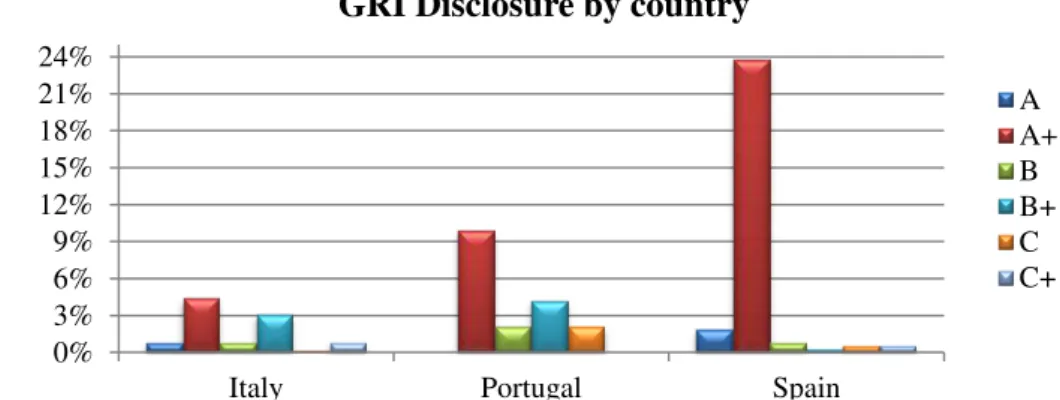
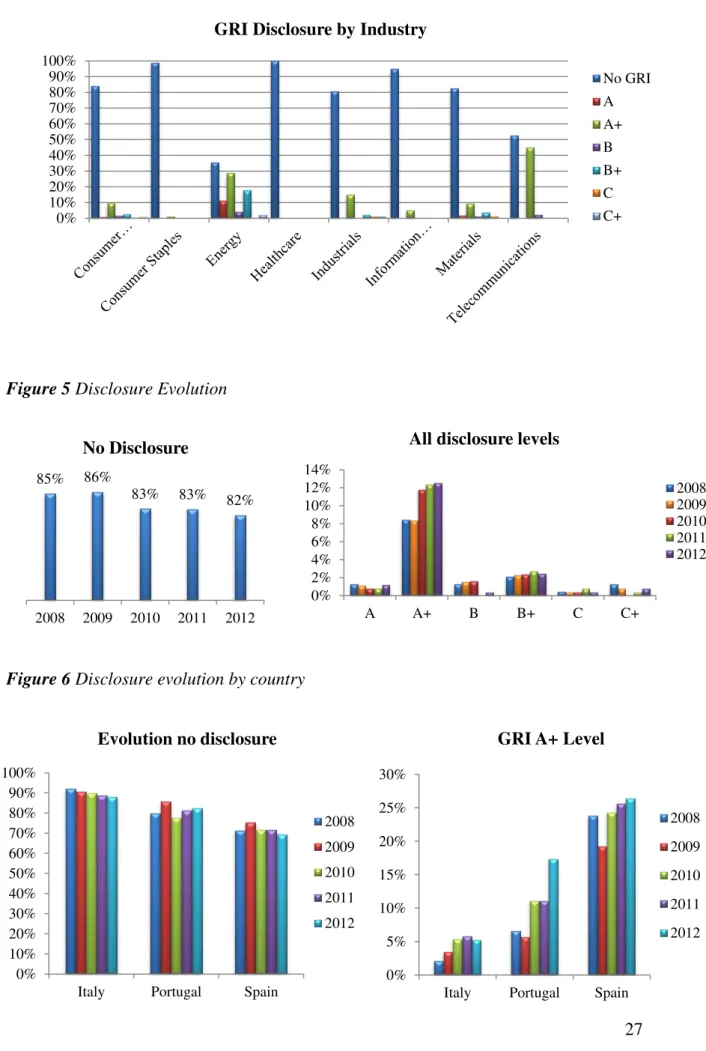
Table 1 shows the distribution of GRI scores collected. It indicates that, in my sample, enterprises did not embrace the GRI Guidelines during the financial crisis period, as other less affected countries did (KPMG, 2011). The data indicates that 84% of the entire sample does not disclose any GRI-related information, reflecting a lack of awareness of the importance of CSR related activities, something Izzo & Donato (2012) stress. Among those who follow these principles, companies tend to divulge the highest level (11% for A+) and the frequency of such disclosures prolapses in parallel with the drawdown of the GRI level (close to 0% for C). Although Spain is the nation that most releases GRI, this trend is unswerving across countries (Figure 3), suggesting that companies indeed perceive some and the same dissimilarity between the different levels. Figure 4 shows that the same holds for the various industries that encompass the sample, reinforcing the previous argument.
Notwithstanding the generalized low adoption of GRI, as shown in Figure 5 and consistent with Giannarakis (2011) findings, there is a tendency, albeit slow, for companies to disclose more GRI-related information and for this level of disclosure to increase as the financial crisis wades: the A+ level adoption increases from 8% to more than 12%, which corresponds to roughly the same increase as the overall level of disclosures. Contrarily, the lowest levels of C+ and C remain fairly constant at 1% and 0.4%, respectively. Uniquely in 2009 there is a minimal increase in companies that do not disclose, probably related to the outburst of the crisis and the sudden financial contraction of firms. Interestingly, the major difference is seen in 2010 in which the level of companies that do not disclose decreases towards an increase of the GRI A+
4
17 level of over 4%, showing companies‟ attempt to eliminate any information
lopsidedness triggered by the burst of the crisis. Figure 6 shows that this trend is steadier in both Spain and Italy as opposite to Portugal, which is more uneven given that the latest was the country most strongly affected by the economic downturn. Yet, this is the country that mostly increases its level of disclosures from 7% of A+ level in 2008 to circa 17% in 2012. Untabulated results show that, in the latter year, from the companies that adopted the GRI Guidelines, all disclosed the A+ Level.
Descriptive statistics on key and control variables included in both research equations are displayed in Table 2. Results show that, despite the economic crisis, these companies are able to grow in terms of sales, with an average value of 5%. Yet this growth was majorly financed with debt, as the Financing Activities average is of 12.6%. Risk ranges from 0% to a maximum of 1682% and presents a mean of 39.5% indicating that these are assessed as very risky companies. Also their mean and median returns edge below zero, reflective of the financial crisis and investors‟ uncertainty on these markets.
18
Estimation Results
To properly deal with unbalanced panel data I first estimate both a fixed effects model and a random effects model. Once analyzing the existence of autocorrelation and heteroskedasticity in both models under both hypotheses, adjusted Driscoll and Kraay
(1998)5 standard errors are employed. This allows controlling for both effects, as their presence would yield inefficient estimates and lead to erroneous conclusions. Afterwards, Hausman tests are performed so as to indicate which model is the most adequate given the characteristics of the sample data. Under this test, the null hypothesis is that company-specific traits are not significantly correlated with the explanatory variables and so there is no need to employ a model that controls for them, like the fixed effects one. If this does not hold and the null hypothesis is rejected, than the random effects model cannot be employed as it yields inconsistent estimates, grounded on improper assumptions. Test results show that the null hypothesis is rejected for both models, when considering a 1% significance level, professing that the fixed effects approach is the most apposite to apply. Thus, this is the model I use in my analyses. Given that it controls for firm-specific time-invariant effects, year dummies are included in both models so as to capture all time-variant effects.
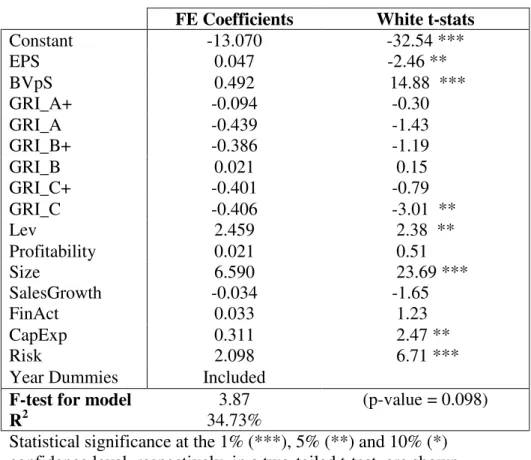
Table 4 unveils the results of estimating equation 1. I find that, although financial markets do not consider high levels of GRI disclosure value relevant during the crisis, they find these to be value destructive at their lowest level. This does not support part of the first hypothesis, which foresees a positive association between high
19 GRI levels and stock market performance, but it validates the theory that there is a negative relationship between the lowest level and stock market performance, since the coefficient for the GRI C level is negative and statistically significant at a 5% significance level. Thus, firms in these countries that disclose GRI C level information during the financial crisis have lower share prices than firms that do not disclose.
DeVilliers and Marques (2012) claim that the positive association between high levels of disclosure and share prices is more prominent in countries with higher levels of democracy, regulatory quality and government effectiveness, in which investors are better placed to express their concerns resulting in regulation and government increase in effectiveness. Izzo and Donato (2012) argue that less developed stock markets, and specifically the Italian one, are not mature enough and well advanced to properly appraise the positive value embedded in such releases. Both arguments may explain the lack of significance found in high CSR disclosure levels included in my sample. Furthermore, Branco and Rodrigues (2008) and Cahan et al. (2012) support that firms engage in CSR disclosures to obey stakeholder‟s norms and expectations, which may be
abnormally high in times of economic downturn due to the lack of confidence and trust in these markets. Thus, investors do not value GRI A, nor GRI B level, since it complies with their high expectations. Results support such theories and indicate that, during times of crisis, adopting high levels of CSR disclosure is an insufficient condition for companies located in the most affected economies to increase their stock valuations.
20 the potential to worsen in times of economic downturn due to the generalized lack of confidence in the markets and companies, supporting our findings. However, results also reveal that when this level is assured by a third party, usually an auditing company, the statistical significance of the variable disappears (p-value=0.472). Thus, market fears are no longer presented when such reports are revised. In fact, results presented in Table 3 show that the p-value of the correlation of GRI A+ and B+ levels with share prices is significant at 5%, and that significance is no longer present when the same levels are disclosed but not assured. This implies that markets only value these reports, regardless of the level disclosed, if they have an outer acknowledgment of the trustworthiness behind them.
In this equation, the Ohlson (1995) model holds as the EPS and BVpS variables are both statistically significant at a 1% and 5% significance level, respectively. Also and validating Ulman (1985) theory, Capital Expenditures seem to have an important role on investor‟s valuation of firms as this variable has a positive statistically significant impact on share prices. Finally, and upholding on what the research on the topic suggests, Leverage Size and Risk are all statistically significant independent variables.
21 are consistent with DeVilliers and Marques (2012), who found that changes in GRI levels are positively associated with the share prices from the 500 largest European companies and may explain why the considered firms consistently increased their GRI Levels during the analyzed periods.
. So as to make a country-wide comparison, we run both research designs for each country analyzed and find that these markets value disclosures and changes in such disclosures differently. Untabulated results show that Portugal is the only country which positively and significantly values all GRI disclosure levels, as well as changes in such disclosures. Being the country in our sample most affected by the financial crisis, these last results suggests that in times of economic crisis some markets indeed give value relevance to companies that fully embrace CSR-related activities.
Conclusion
During times of crisis, it is of paramount importance for companies to find alternate ways to enhance their value while disregarding activities that may potentially destroy it. This paper attempts to answer this question as it analyzes the association between different levels of CSR disclosure and stock market performance during the 2008 financial crisis of some of the countries that were most affected: Portugal, Italy and Spain. Thus, it focuses on the 2008-2012 period, resorting to a sample comprised by 1259 observations using the GRI Guidelines to measure CSR performance.
23
References
BRANCO, M. F., RODRIGUES, L. L. (2006) Corporate Social Responsibility and Resource-Based Perspectives. Journal of Business Ethics Vol. 69, No. 2, pp. 111-132.
BRANCO, M. F., RODRIGUES, L. L. (2008) Factors Influencing Social Responsibility Disclosure by Portuguese Companies. Journal of Business Ethics Vol. 83, No. 4, pp. 685–701.
BOWMAN, E. H. (1973) Corporate social responsibility and the investor. Journal of Contemporary Business Vol. 2, No. 1, pp. 21-43.
CAHAN, S. F., DE VILLIERS, C., JETER, D. C., NAIKER, V., VAN STADEN, C. (2013) Are CSR Disclosures Value Relevant? Cross-Country Evidence. Available at http://papers.ssrn.com/sol3/papers.cfm?abstract_id=2321727.
DEVILLIERS, C., MARQUES, A. (2012) Corporate Social Responsibility: Country-Level predispositions and the consequences of choosing a level of disclosure. Available at http://papers.ssrn.com/sol3/papers.cfm?abstract_id=2195511.
COCHRAN, P. L., WOOD R. A. (1984) Corporate Social Responsibility and Financial Performance. Academy of Management Journal Vol. 27, No. 1, pp. 42-56.
CORNELL, B., SHAPIRO, A. C. (1987) Corporate Stakeholders and Corporate Finance. Financial Management Vol. 16, No. 1, pp. 5-14.
DEKLERK, M., DEVILLIERS, C. (2012) The Value Relevance of Corporate Responsibility Reporting by South African Companies. Meditari Accountancy Research Vol. 20, No. 1, pp. 21-38.
DEKLERK, M., DEVILLIERS, C., VANSTADEN, C. (2012) The value relevance of Corporate Social Responsibility disclosure in the UK. Unpublished conference paper, AFAANZ Conference, Melbourne, July.
DEVILLIERS, C., NAIKER, V., VANSTADEN, C. (2011) The Effect of Board Characteristics on Firm Environmental Performance. Journal of Management Vol. 37, No. 6, pp. 1636-1663.
DHALIWAL, D. S., LI, O. Z., TSANG, A. H., YANG, Y. G. (2011) Voluntary Non-Financial Disclosure and the Cost of Equity Capital: The Case of Corporate Social Responsibility. The Accounting Review Vol. 86, No. 1, pp. 59-100.
DOWELL, HART, AND YEUNG, (2000) Do Corporate Global Environmental Standards Create or Destroy Market Value? Management of Science Vol. 46, No. 8, pp. 1059-1074.
FINCH, N. (2005) The motivations for adopting sustainability disclosure. Available at http://www.mgsm.edu.au/research.
FIORI, F., DONATO, F., IZZO, M. F., (2007) Corporate social responsibility and firms performance. An analysis on Italian listed companies. Available at http://papers.ssrn.com/sol3/papers.cfm?abstract_id=1032851.
24 GARRIGA , E., MELÉ, D. (2004) Corporate Social Responsibility Theories: Mapping the Territory. Journal of Business Ethics Vol. 53, No. 1, pp. 51–71.
GIANNARAKIS, G. (2011) The Effect of Financial Crisis in Corporate Social Responsibility Performance. International Journal of Marketing Studies Vol. 3, No. 1, pp. 2-10.
HAMILTON, J. (1995) Pollution as News: Media and Stock Market Reactions to the Toxic Release Inventory Data. Journal of Environmental Economics and Management Vol. 28, No. 1, pp. 98-103.
HART, O. (1995) Corporate Governance: Some theory and Implications. The Economic Journal Vol. 105, No. 430, pp. 678-689.
HASSAN, A., HARRAHAP, S. S. (2010) Exploring corporate social responsibility disclosure: the case of Islamic banks. International journal of Islamic and Middle Eastern finance and management Vol. 3, No. 3, pp. 203-227.
HAWN, O., IOANNOU, I. (2012) Do actions speak louder than words? The case of Corporate Social Responsibility (CSR). Available at http://papers.ssrn.com/sol3/papers.cfm?abstract_id=2101775.
HOOGHIEMISTRA, R. (2000) Corporate communication and impression management – new perspectives why companies engage in corporate social reporting. Journal of Business Ethics Vol. 27, No. 1, pp. 55 – 68.
IOANNOU, I., SERAFEIM, G., The Impact of Corporate Social Responsibility
on Investment Recommendations. Available at
http://papers.ssrn.com/sol3/papers.cfm?abstract_id=1507874.
IZZO, M. F., DONATO, F. (2012) The relation between Corporate Social Responsibility and stock prices: an analysis of the Italian listed companies. Available at http://papers.ssrn.com/sol3/papers.cfm?abstract_id=1986324.
KLASSEN AND MCLAUGHLIN (1996) The Impact of Environmental Management on Firm Performance. Management of Science Vol. 42, No. 8, pp. 1199-1214.
KPMG (2011) International survey of corporate responsibility reporting 2011.
KPMG International. Available at:
http://www.kpmg.com/PT/pt/IssuesAndInsights/Documents/ corporate-responsibility2011.pdf.
LUO, X., BHATTACHARYA, C. B. (2006) Corporate Social Responsibility, Customer Satisfaction, and Market Value. Journal of Marketing Vol. 70, No. 4, pp. 1– 18.
MACKEY, A., MAKCEY, T. B., BARNEY, J. B. (2007) Corporate Social Responsibility and firm performance: investor preferences and corporate strategies. Academy of Management Review Vol. 32, No. 3, pp. 817–835.
MCGUIRE J. B., SUNDGREEN, A., SCHNEEWEIS, T. (1988) Corporate Social Responsibility and firm financial performance. Academy of Management Joumal Vol. 31, No, 4, pp. 854-872.
25 McWILLIAMS, A., SIEGEL, D. (2001) Corporate Social Responsibility: A Theory of the Firm Perspective. The Academy of Management Review Vol. 26, No. 1, pp. 117-127
MIA, P., MAMUN, A. A. (2011) Corporate Social Disclosure during the Global Financial Crisis. International Journal of Economics and Finance Vol. 3, No. 6.
NELLING, E., WEBB, E. (2009) Corporate social responsibility and financial performance: the „„virtuous circle‟‟ revisited. Review of Quantitative Finance and Accounting Vol. 32, No. 2, pp. 197–209.
O‟DWYER, B. (2011) The Case of Sustainability Assurance: Constructing a New Assurance Service. Contemporary Accounting Research Vol. 28, No. 4, pp. 1230– 1266.
ORLITZKY, M., SCHMIDT, F.L., RYNES, S.L. (2003) Corporate Social and Financial Performance: A Meta-analysis. Organization Studies Vol. 24, No. 3, pp. 403– 441.
PAVA, M. L., KRAUSZ, J. (1996) The Association Between Corporate Social-Responsibility and Financial Performance" The Paradox of Social Cost. Journal of Business Ethics Vol. 15, No. 3, pp. 321-357.
PRESTON, L. E., O‟BANNON D. P. (1997) The Corporate Social-Financial Performance Relationship. Business Society Vol. 36, No. 4, pp. 419-429.
SCHOLTENS, B. (2008) A note on the interaction between corporate social responsibility and financial performance. Ecological Economics Vol. 68, No. 1-2, pp. 46–55.
SIMNETT, R., VANSTRAELEN, A., CHUA, W. F. (2009) Assurance on Sustainability Reports: An International Comparison. The Accounting Review Vol. 84, pp. 937-967.
TAIB, E. M., AMEER, R. (2012) Relationship between corporate sustainability practices and financial performance: Evidence from the GRI reporting companies. Available at http://ssrn.com/abstract=2152124.
ULLMAN, A. A. (1985) Data in Search of a Theory: A Critical Examination of the Relationships Among Social Performance, Social Disclosure, and Economic Performance of U.S. Firms. Academy of Management Review Vol. 10, No. 3, pp. 540-557.
WADDOCK, S. A., GRAVES, S. B. (1997) The Corporate Social performance-financial performance link. Strategic Management Journal Vol. 18, No. 4, pp. 303–319.
WEBER, O., KOLLNER, T., HABEGGER, D., STEFFENSEN, H., OHNEMUS, P. (2005) The relation between sustainability performance and financial performance of firms. Gesellschaft für Organisation und Entscheidung m.b.H.Report Vol. 5, No. 3, pp. 236-254.
26 Italy 60% Portugal 11% Spain 29%
Sample Distribution by Country
31% 8% 4% 7% 23% 11% 13% 3%
Sample distribution by Industry
Consumer Discretionary Consumer Staples Energy Healthcare Industrials Information Technology Materials Telecommunications
Figure 1 Distribution by Country
Figure 2 Distribution by Industry
Figure 3Breakdown of Disclosure by Country
0% 3% 6% 9% 12% 15% 18% 21% 24%
Italy Portugal Spain
GRI Disclosure by country
27 0% 2% 4% 6% 8% 10% 12% 14%
A A+ B B+ C C+
All disclosure levels
2008 2009 2010 2011 2012 0% 5% 10% 15% 20% 25% 30%
Italy Portugal Spain GRI A+ Level
2008 2009 2010 2011 2012 0% 10% 20% 30% 40% 50% 60% 70% 80% 90% 100%
Italy Portugal Spain Evolution no disclosure
2008 2009 2010 2011 2012
Figure 4 Breakdown of Disclosure by Industry
Figure 5 Disclosure Evolution
Figure 6 Disclosure evolution by country 0% 10% 20% 30% 40% 50% 60% 70% 80% 90% 100%
GRI Disclosure by Industry
No GRI A A+ B B+ C C+
85% 86%
83% 83% 82%
28
Table 1 Breakdown by GRI Disclosure
GRI Disclosure No GRI 1,055 84%
A+ 135 11%
A 13 1%
B+ 30 2%
B 12 1%
C+ 8 1%
C 6 0%
29
Table 2 Descriptive statistics of key and control variables
Average St.Deviation Median Minimum Maximum
Stock Price 6,184 9,334 2,660 0 100,550
Returns -0,042 0,476 -0,100 -1 3,852
EPS 0,126 3,200 0,100 -85,788 18,380
BVpS 4,626 6,760 2,262 -2,233 63,723
Change_EPS 0,157 3,132 0,177 -85,788 18,380
Change_BVpS 0,882 6,543 0,155 -71,650 51,545
GRI_A+ 0,107 0,310 0 0 1
GRI_A 0,010 0,101 0 0 1
GRI_B+ 0,024 0,153 0 0 1
GRI_B 0,010 0,097 0 0 1
GRI_C+ 0,006 0,079 0 0 1
GRI_C 0,005 0,069 0 0 1
Change_GRI 0,004 0,381 0 -3 3
Lev 0,313 0,186 0,302 0,000 1,486
Profitability 0,103 1,794 0,045 -8,335 42,821
Size 2,337 0,805 2,234 0,270 4,950
SalesGrowth 0,052 0,558 0,139 -0,990 17,412
FinAct 0,126 4,528 0,009 -34,906 83,081
CapExp 0,180 0,384 0 0 1
Risk 0,395 0,804 0,161 0 16,828
Where:
STOCK PRICE= market price per share three months after fiscal year ended;
RETURNS = return between the stock price three months after the fiscal year ended and the stock price on the same day of the previous year;
EPS =Earnings per Share at the end of fiscal year; BVpS =Book Value per Share at the end of fiscal year;
CHANGE_EPS = Earnings per share variation when compared to previous fiscal year; CHANGE_BVPS = Book Value per Share variation when compared to previous fiscal year;
GRI_LEVEL =Incorporates six indicator variables (GRI_A+, GRI_A, GRI_B+, GRI_B, GRI_C+, GRI_C) coded as one when they correspond to the firm’s GRI level of compliance on that year and zero otherwise;
CHANGE_GRI =Change in GRI level applied since last year and ranges from -3 to 3, such that GRI_A=3, GRI_B=2, GRI_C=1 and no GRI=0;
LEV = ratio of total debt to total assets;
PROFITABILITY =ratio of fiscal year’s after-tax income and book value of equity; SIZE = natural logarithm of the firm’s market capitalization at the end of the fiscal year; SALESGROWTH = Sales variation, when compared to previous fiscal year;
FINACT = Sales less purchases of common and preferred shares plus change in long term debt;
30
Table 3 Pearson Pairwise Correlation Matrix
Stock
Price Returns GRI_A+ GRI_A GRI_B+ GRI_B GRI_C+ GRI_C Change GRI Lev Profitability Size Sales Growth
Fin
Act CapExp Risk
Stock Price 1
Returns 0.201 1
GRI_A+ 0.227 0.040 1
GRI_A 0.014 -0.004 -0.035 1
GRI_B+ 0.049 0.021 -0.054 -0.016 1
GRI_B -0.004 0.092 -0.034 -0.010 -0.015 1
GRI_C+ -0.016 -0.008 -0.027 -0.008 -0.012 -0.007 1
GRI_C -0.001 -0.009 0.024 -0.007 -0.011 -0.006 -0.005 1
Change_GRI 0.019 0.026 0.021 0.052 0.155 -0.027 0.3024 0.226 1
Lev -0.235 -0.112 0.056 0.024 -0.040 0.009 -0.034 -0.009 -0.017 1
Profitability 0.024 0.135 0.0173 -0.002 -0.000 -0.004 0.001 0.001 0.003 0.003 1
Size 0.450 0.186 0.483 0.103 0.177 0.097 0.038 0.007 0.052 -0.105 0.005 1
SalesGrowth 0.039 -0.054 -0.010 0.237 -0.003 -0.007 -0.008 0.003 -0.018 -0.007 -0.002 0.062 1
FinAct 0.093 -0.004 0.050 0.034 0.004 0.005 0.004 -0.021 0.018 0.012 0.015 0.052 0.135 1
CapExp 0.094 0.053 0.085 -0.047 0.116 -0.003 0.014 -0.002 0.067 -0.069 -0.009 0.260 0.016 0.036 1
Risk 0.652 0.104 0.167 0.002 0.041 -0.004 0.022 -0.006 0.007 -0.148 0.016 0.280 0.037 0.136 0.062 1
31
Table 4 Analysis of first research question – Fixed Effects Approach
Table 5 Analysis of second research question – Fixed Effects Approach FE Coefficients White t-stats
Constant -13.070 -32.54 ***
EPS 0.047 -2.46 **
BVpS 0.492 14.88 ***
GRI_A+ -0.094 -0.30
GRI_A -0.439 -1.43
GRI_B+ -0.386 -1.19
GRI_B 0.021 0.15
GRI_C+ -0.401 -0.79
GRI_C -0.406 -3.01 **
Lev 2.459 2.38 **
Profitability 0.021 0.51
Size 6.590 23.69 ***
SalesGrowth -0.034 -1.65
FinAct 0.033 1.23
CapExp 0.311 2.47 **
Risk 2.098 6.71 ***
Year Dummies Included
F-test for model 3.87 (p-value = 0.098)
R2 34.73%
Statistical significance at the 1% (***), 5% (**) and 10% (*) confidence level, respectively, in a two-tailed t-test, are shown above (see Equation 1)
FE Coefficients White t-stats
Change_EPS 0.005 1.42
Change_BVpS 0.003 4.80 ***
Change_GRI 0.035 2.66 ***
Profitability
Lev -0.010 0.049 21.04 *** -0.05
Size 0.264 3.29 ***
SalesGrowth 0.057 2.21 **
FinAct -0.003 -4.67 ***
CapExp -0.121 -1.16
Risk 0.091 3.54 ***
F-test for model 4.28 (p-value = 0.128)
R2 41.09%
Statistical significance at the 1% (***), 5% (**) and 10% (*)