HBV and HCV serological markers in health
professionals and users of the Brazilian Uniied
Health System network in the city of Resende,
Rio de Janeiro, Brazil
Marcadores sorológicos para HBV e HBC em profissionais de saúde e usuários da rede
do Sistema Único de Saúde no Município de Resende, Rio de Janeiro, Brasil
Alexandre R. Silva1; Orlando C. Ferreira Jr.2; Rafael S. A. Sá3; Antonio L. Correia Jr.3; Suely G. C. Silva4; Marco Antonio L. Carvalho Netto1; Luís Cristóvão M. S. Pôrto3
1. Secretaria Municipal de Saúde de Resende, Rio de Janeiro, Brazil. 2. Universidade Federal do Rio de Janeiro (UFRJ), Rio de Janeiro, Brazil. 3. Universidade do Estado do Rio de Janeiro (UERJ), Rio de Janeiro, Brazil. 4. Instituto Nacional de Câncer José de Alencar da Silva (Inca), Rio de Janeiro, Brazil.
First submission on 23/01/16; last submission on 01/03/17; accepted for publication on 03/03/17; published on 20/04/17
ABSTRACT
Introduction: Infections caused by the hepatitis B virus (HBV) and hepatitis C virus (HCV) are a major public health problem. Objectives: The study aimed to detect HBsAg, anti-HBc, anti-HBs and anti-HCV among health professionals and users of the Brazilian Uniied Health System [Sistema Único de Saúde (SUS)] in the city of Resende, Rio de Janeiro, and to describe the sociodemographic proile and background of exposure. Methods: A total of 585 samples were collected between May and June 2014, obtained from the Brazilian Notiiable Diseases Surveillance System [Sistema de Informação de Agravos de Notiicação (SINAN)] data, which were tested for HBsAg, anti-HBc, anti-HBs and anti-HCV. Results: The predominant age group observed was 30-44 years (n = 277; 47.3%), 54.87% (n = 321) were female and 271 (46.32%) self declared skin colour/ethnicity white. The married participants were 262 (44.78%), 42.22% graduated from high school (n = 247) and 174 were health professionals (29.74%). Four participants were anti-HCV reagents and 18 were anti-HBc reagents. From these, 15 participants were reactive for anti-HBs antibodies. Among health professionals, 68.8% were anti-HBs positive. And 63.9% of participants declared to be vaccinated against hepatitis B. Conclusion: The prevalence of 0.68% for HCV and 3.08% for anti-HBc are below that detected in the Southeast region from the last census in the capitals of Brazil. There is still a reduced acceptance among health professionals for HBV and HCV screening.
Key words: health assessment; anti-hepatitis antibodies; hepatitis B antigens; anti-hepatitis C antibodies; healthcare technical personnel; immunization coverage.
INTRODUCTION
The distribution of viral hepatitis is universal, with variations according to the determinants agents, of which the most important are A, B and C viruses(1). Around the world, viral hepatitis are
considered the most common cause of serious liver diseases, such as cirrhosis and hepatocellular carcinoma, and it is a major public health problem due to the large number of individuals affected and the possibility of complications, which increases the public costs with treatments and social beneits(2, 3). According to estimates
by the World Health Organization (WHO), two billion people have
already had contact with the hepatitis B virus (HBV) and 350 million have become chronic carriers(4), while 150-200 million
(3% of the world population) are infected with the hepatitis C virus (HCV) and 130 million have evolved to chronic hepatitis and cirrhosis(5). HBV transmission occurs parenterally, and above
all by the sexual route, and is considered a sexually transmitted
disease(6). HCV is essentially transmitted by contact with blood,
blood products, needles, syringes and intravenous materials and, secondarily, sexually(7).
In the period from 1999 to 2011, 120,343 conirmed cases of hepatitis B in Brazil were notiied in the Brazilian Notiiable
Diseases Surveillance System [Sistema de Informação de Agravos de Notiicação (SINAN)], most of which were reported in the Southeast and South Regions. In the Southeast 43,673 cases of hepatitis B were registered, corresponding to 36.3% of the total cases in Brazil. In the Médio Paraíba Fluminense region, in the year 2012, the rate was 2.9/100,000 inhabitants and in the Municipality of Resende, 1.6/100,000 inhabitants(8).
Regarding hepatitis C, the historical series from 1999 to 2011 totaled 82,041 conirmed cases in the country, 9,565 in the last year. From the total, 55,222 come from the Southeast region, representing 67.3% of the cases notiied in Brazil, 8.5% of which are in Rio de Janeiro, with a rate of 5.8 cases/100,000 inhabitants in 2011. In the Médio Paraíba region, in 2012, the rate was 1.6/100,000 inhabitants, and in the municipality of Resende, 3.3/100,000 inhabitants, according to data notiied to SINAN by the Municipal Department of Health, 2012(9). It should be noted
that the presence of anti-HCV antibodies does not indicate that an infection is present, especially in the new cases, and it is impossible
to infer these data.
The municipality of Resende, located in the southern region of Rio de Janeiro state, presented an estimated population of 124,316 inhabitants in 2014(10). The proportion of female
subjects is 51.35%(11). The economically active age group of
the municipality represents 69.3% of the population and the majority of the population are aged between 30 and 49 years, followed by 50 year or older. The municipality is an important industrial, automotive, metallurgical, nuclear and tourist center, as well as it is the headquarter of the Agulhas Negras military academy. The municipal health network has a public hospital, two philanthropic hospitals, three private hospitals, one military hospital, two emergency care units and 32 health units of the Brazilian Uniied Health System [Sistema Único de Saúde (SUS)]. The municipal public network includes 581 health professionals.
The present study aimed to detect markers of viral hepatitis in health professionals in the municipality of Resende, from May to October 2014, as well as to describe the sociodemographic proile and history of exposure of hepatitis B and C viral infection.
METHODS
Characterization of the study and data collection
This is a cross-sectional study in which peripheral blood samples were collected between May and June 2014 from SUS users and health personnel who perform their professional activities in
the city of Resende (RJ) and were at risk of occupational exposure to biological material potentially contaminated with HBV or HCV. The health units of SUS Network where the endorsement for participation in the study were obtained by health professionals and users were: Hospital Municipal de Emergência Henrique Sérgio Gregori, Dental Specialties Center, Municipal Clinical Analyzes Laboratory, basic health units, Hemonúcleo, Hemodialysis Center and Zoonoses Control Center. The 581 health workers include doctors, nurses, dentists, biologists, biomedical, pharmacist-biochemist, physiotherapists, veterinary doctors, nutritionists, psychologists, social workers, laboratory technicians, nursing technicians, dental assistants, health agents (endemic disease combat agents) and community health agents.
Sampling among health professionals was calculated to reach at least 152 and 530 samples for HBV and HCV, respectively, based on the prevalence in the national survey in the Southeast region in 2010(12) (HBV ~0.070 and HCV ~0.013). The inclusion was carried
out by spontaneous adherence of the participants to the study from a letter of invitation to the public, philanthropic and private health units of the municipality. Only samples of health professionals and users of the public network that were enrolled in the study in that period were collected.
The social and demographic data of the study population were obtained immediately prior to blood sample collection using a self-declaration questionnaire that included information such as date of birth, gender, marital status, skin color/ethnicity, education and occupation. The second part of the questionnaire addressed 15 questions on HBV and HCV risk factors: illicit injecting drug use, inhaled drug use, body piercing/tattoo history, number of sexual partners in the last year, dental treatment, surgical treatment, history of blood transfusion, organ transplantation, hemodialysis, acupuncture, accidents with biological material, injectable medication, use of disposable material in the manicure/ pedicure and hairdressing/barber services, as well as the history of immunization for hepatitis B. The responses for the risk variables were grouped as 0 – no, 1 – yes and 2 – not declared; in the terms of disposable personal hygiene toiletries and own personal hygiene toiletries, as 0 – no, 1 – yes, 2 – sometimes and 3 – not declared; in terms of hepatitis B vaccine, the “not know” option was also included as a response.
This study was approved by the Ethics Committee of the Hospital Pedro Ernesto of the Universidade do Estado do Rio de Janeiro (UERJ) (registered under no. 500,169), and the data were analyzed according to Resolution 466/2012 of the Brazilian
Ministry of Health.
Serological and molecular tests
After collection, the samples were centrifuged and serum samples were aliquoted and stored at -70ºC until assay. All samples were screened in duplicate for: electrochemiluminescence sandwich immunoassay, anti-HCV, antibody to hepatitis B core antigen (HBc) and hepatitis B virus surface antigen (HBsAg) (Roche Diagnostics GmbH, Mannheim, Germany) on the Cobas analyzer, and tested for antibody against the hepatitis B surface antigen (anti-HBs) using a quantitative sandwich enzyme immunoassay, Bioelisa anti-HBs (Biokit SA, Barcelona, Spain), according to the manufacturers’ information in the Histocompatibility and Cryopreservation Laboratory of the UERJ. Participants with anti-HBs antibodies level above 10 mUI/ml were considered immune against HBV by natural infection healed or present alone in immunized individuals.
The reagent samples for anti-HCV, anti-HBc imunoglobulin classe G (IgG) and HBsAg were retested at the Laboratory of Serology/Nucleic Acid Testing (NAT) of the Hemotherapy Service of the Hospital do Câncer Unidade Instituto Nacional do Câncer José Alencar Gomes da Silva (Inca) using platform Architect (Architect, Abbott, North Chicago, IL, USA) chemiluminescent microparticle immunoassay. There was no disagreement between Roche and Abbott kits in the anti-HCV reagent samples and in the single HBsAg sample. The anti-HBc discordant results (n =
3) were considered as absence of infection, a result obtained with the Roche kit.
Statistical analysis
The data generated were organized in a Microsoft Excel worksheet document and analyzed with Epi InfoTM version 7.1.4.0 (Centers for Disease Control and Prevention, Atlanta, GA, USA, 2014) for descriptive analyzes, the χ2
(chi-square test) and the multivariate analysis. The variables with p < 0.20 in the univariate analysis were then tested in logistic regression (multivariate analysis) and those with p < 0.05 were considered independently associated with the presence of HBc or anti-HBs antibodies. The 95% conidence interval (CI 95%) was used to measure the prevalence accuracy for anti-HCV, HBsAg, anti-HBc and anti-HBs.
RESULTS
Demographic data
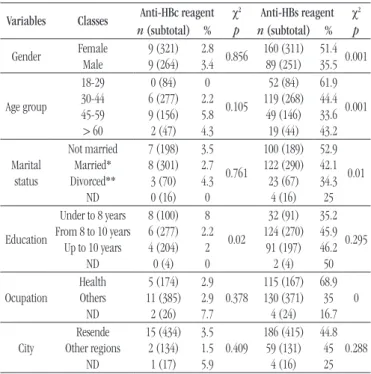
The sociodemographic data of the individuals who participate in this study are presented in Table 1. In brief, the predominant age group observed was 30-44 years (n = 277; 47.3%) with 54.87%
(n = 321) female and most of the participants (n = 271; 46.32%) self-declared white skin color/ethnicity. Married participants were n = 262 (44.78%), most completed high school (n = 247; 42.22%) and reported other professions (n = 385; 65.81%), since health professionals were n = 174, accounting for 29.74% of the study participants. The residents of Resende accounted for 74.2%
(n = 434) of the participants.
TABLE 1 − Anti-HBc (n = 585) and anti-HBs (n = 562) univariate analysis
reagents × socio-demographic variables
Variables
Classes
Anti-HBc reagent χ2 Anti-HBs reagent χ2
n (subtotal) % p n (subtotal) % p
Gender Female Male 9 (321) 9 (264) 2.8 3.4 0.856 160 (311) 89 (251) 51.4 35.5 0.001 Age group 18-29 30-44 45-59 > 60 0 (84) 6 (277) 9 (156) 2 (47) 0 2.2 5.8 4.3 0.105 52 (84) 119 (268) 49 (146) 19 (44) 61.9 44.4 33.6 43.2 0.001 Marital status Not married Married* Divorced** ND 7 (198) 8 (301) 3 (70) 0 (16) 3.5 2.7 4.3 0 0.761 100 (189) 122 (290) 23 (67) 4 (16) 52.9 42.1 34.3 25 0.01 Education
Under to 8 years From 8 to 10 years
Up to 10 years ND 8 (100) 6 (277) 4 (204) 0 (4) 8 2.2 2 0 0.02 32 (91) 124 (270) 91 (197) 2 (4) 35.2 45.9 46.2 50 0.295 Ocupation Health Others ND 5 (174) 11 (385) 2 (26) 2.9 2.9 7.7 0.378 115 (167) 130 (371) 4 (24) 68.9 35 16.7 0 City Resende Other regions ND 15 (434) 2 (134) 1 (17) 3.5 1.5 5.9 0.409 186 (415) 59 (131) 4 (16) 44.8 45 25 0.288
ND: not declared.
HBV data
From the total number of subjects in the study, 18 were anti-HBc antibody reagent. From these, 12 were reactive for anti-HBs antibodies (Figure). Univariate analysis indicated
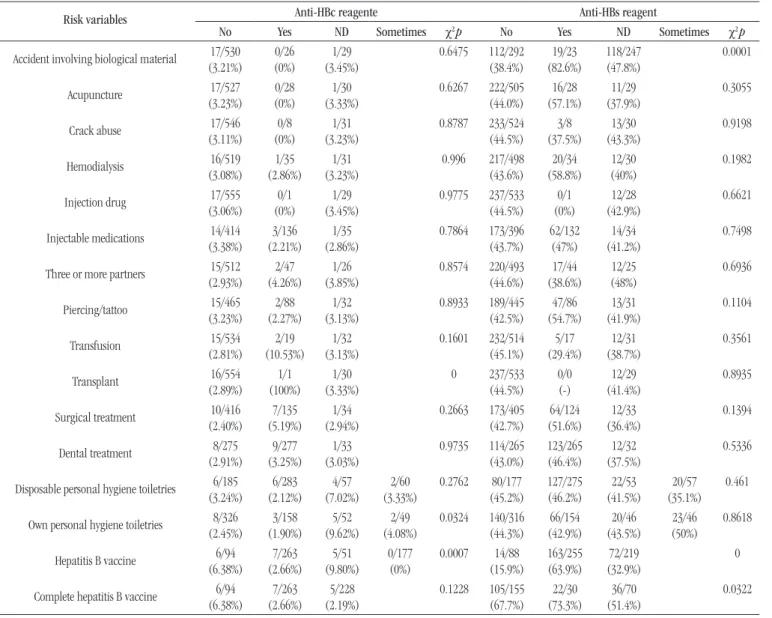
own personal hygiene toiletries for manicure/pedicure, organ transplantation and prior immunization for HBV (Table 2).
A single participant in the research that was anti-HBc reagent had previously undergone a kidney transplant. Regarding immunization, it was noted that 2.66% of the anti-HBc reactive subjects reported had received vaccine and were fully immunized against HBV. For analysis of reactivity to anti-HBs, 562 subjects were considered, 96.1% from the total study participants. Eighteen individuals were excluded for reactivity to anti-HBc (including one individual who was also reactive to HBsAg) and ive others because they could not be tested for anti-HBs. A total of 249 participants (44.3%; CI 95%: 40.2%-48.4%) showed anti-HBs levels above 10 mUI/ml. A higher percentage of women (51.45%) were protected against HBV.
FIGURE − Flowchart of participants in the hepatitis B and C health screening campaign
according to sample collection and results Participants
n = 619
Excluded
n = 34
• insuficient volume • incorrect identiication • improper packaging • patient with previous diagnosis of
hepatitis B or C
Anti-HCV+ Anti-HCV+ Anti-HCV- Anti-HCV- Anti-HCV- Anti-HCV- HbsAg+ Anti-HCV- HbsAg- Anti-HBc+ Anti-HBc+ Anti-HBc+ Anti-HBc+ HbsAg- Anti-HBc-Anti-HBs+ Anti-HBs- Anti-HBc-Anti-HBs+ Anti-HBs- Anti-HBs- Anti-HBc-Anti-HBs+
n = 3 n = 1 n = 12 n = 4 n = 1 n = 246*
Distribution of anti-HCV, HBsAg, anti-HBc and anti-HBs results from 585 study participants: anti-HBc+ (n = 18); anti-HBs+ (n = 15);
anti-HCV+ (n = 4); anti-HBc+ and anti-HCV+ (n = 1) and HBsAg+ (n = 1).
*Five samples were not tested for anti-HBs, and 313/580 (53.9%) were non-reactive for all tested markers.
TABLE 2 − Anti-HBc (n = 585) and anti-HBs (n = 562) univariate analysis reagents × risk variables
Risk variables
Anti-HBc reagente Anti-HBs reagent
No Yes ND Sometimes χ2 p No Yes ND Sometimes χ2 p
Accident involving biological material (3.21%)17/530 (0%)0/26 (3.45%)1/29 0.6475 112/292(38.4%) (82.6%)19/23 118/247(47.8%) 0.0001
Acupuncture (3.23%)17/527 (0%)0/28 (3.33%)1/30 0.6267 222/505(44.0%) (57.1%)16/28 (37.9%)11/29 0.3055
Crack abuse 17/546
(3.11%) 0/8 (0%)
1/31 (3.23%)
0.8787 233/524
(44.5%) 3/8 (37.5%) 13/30 (43.3%) 0.9198 Hemodialysis 16/519 (3.08%) 1/35 (2.86%) 1/31 (3.23%)
0.996 217/498
(43.6%) 20/34 (58.8%) 12/30 (40%) 0.1982
Injection drug 17/555
(3.06%) 0/1 (0%)
1/29 (3.45%)
0.9775 237/533
(44.5%) 0/1 (0%) 12/28 (42.9%) 0.6621
Injectable medications 14/414
(3.38%)
3/136 (2.21%)
1/35 (2.86%)
0.7864 173/396
(43.7%) 62/132 (47%) 14/34 (41.2%) 0.7498
Three or more partners 15/512
(2.93%)
2/47 (4.26%)
1/26 (3.85%)
0.8574 220/493
(44.6%) 17/44 (38.6%) 12/25 (48%) 0.6936 Piercing/tattoo 15/465 (3.23%) 2/88 (2.27%) 1/32 (3.13%)
0.8933 189/445
(42.5%) 47/86 (54.7%) 13/31 (41.9%) 0.1104
Transfusion (2.81%)15/534 (10.53%)2/19 (3.13%)1/32 0.1601 232/514(45.1%) (29.4%)5/17 (38.7%)12/31 0.3561
Transplant (2.89%)16/554 (100%)1/1 (3.33%)1/30 0 237/533(44.5%) 0/0(-) (41.4%)12/29 0.8935
Surgical treatment (2.40%)10/416 (5.19%)7/135 (2.94%)1/34 0.2663 173/405(42.7%) (51.6%)64/124 (36.4%)12/33 0.1394
Dental treatment 8/275
(2.91%)
9/277 (3.25%)
1/33 (3.03%)
0.9735 114/265
(43.0%) 123/265 (46.4%) 12/32 (37.5%) 0.5336
Disposable personal hygiene toiletries 6/185
(3.24%) 6/283 (2.12%) 4/57 (7.02%) 2/60 (3.33%) 0.2762 80/177 (45.2%) 127/275 (46.2%) 22/53 (41.5%) 20/57 (35.1%) 0.461
Own personal hygiene toiletries 8/326
(2.45%) 3/158 (1.90%) 5/52 (9.62%) 2/49 (4.08%) 0.0324 140/316 (44.3%) 66/154 (42.9%) 20/46 (43.5%) 23/46 (50%) 0.8618
Hepatitis B vaccine 6/94
(6.38%) 7/263 (2.66%) 5/51 (9.80%) 0/177 (0%) 0.0007 14/88 (15.9%) 163/255 (63.9%) 72/219 (32.9%) 0
Complete hepatitis B vaccine 6/94
(6.38%)
7/263 (2.66%)
5/228 (2.19%)
0.1228 105/155
(67.7%) 22/30 (73.3%) 36/70 (51.4%) 0.0322
HCV data
From 585 participants in the study, only four (0.68%; CI 95%: 0.02%-1.35%) were reactive for the anti-HCV test, with one participant also reactive for anti-HBc reagent and with no immunization for hepatitis B, as shown in Table 3, which compares the demographic data of these individuals.
Data on hepatitis in health professionals
From the total number of health professionals who spontaneously joined the research, 68.8% were anti-HBs reagent. However, only 28.7% of the health professionals in the municipal network participated in the hepatitis B and C screening project (Table 1). From 255 subjects who reported having received vaccine against HBV, 63.9% presented anti-HBs > 10 mUI/ml, i.e. they demonstrated protection against HBV. However, from the participants who had reported no history of immunization, a total of 15.9% showed to be reactive for anti-HBs marker. From the participants who declared being fully immunized against HBV, only 67.7% presented anti-HBs reagent. We observed that 82.6% of the interviewed who reported having suffered an accident with biological material presented anti-HBs reagent (Table 2). Excluding issues related to hepatitis B vaccine, eight variables were considered for the multivariate analysis: gender, age, marital status, occupation, accident with biological material, hemodialysis, piercing/tattoo and surgical treatment. Only ive of these are independently associated with the presence of anti-HBs: gender, age, occupation, accident with biological material and
hemodialysis.
DISCUSSION
According to the latest Population-Based Prevalence Study of hepatitis A, B and C virus infections conducted between 2005 and 2009, the prevalence of serological positivity indicative of exposure to HCV infection in the age group 10-69 years was 1.38%(13). The prevalence for 2010 in the Southeast region was
1.30% and for this study we observed a value of 0.68%, which
corresponds to a low endemicity for this disease. According to the latest Epidemiological Bulletin on Sexually Transmitted Diseases (STD)/Human Immunodeiciency Virus (Aids) and Viral Hepatitis (2014)(14), most of the total conirmed cases of
hepatitis C in the state of Rio de Janeiro centered around the age group 50-59 years, corroborating our indings. In this study, it was not possible to achieve the necessary sampling for prevalence validation among health professionals due to their low adherence.
Regarding hepatitis B, between 1999 and 2010, the Southeast region observed a growth of 0.3 to 6.2 in the detection rate per 100,000 inhabitants, with a peak in 2009. In this study, the prevalence of anti-HBc antibodies was 3.07%, a value that is below that 6.33% found for the Southeast region and that 7.4% for Brazil in the last cross-sectional study conducted in 2010(12). Regarding
the variable “having the habit of carrying their own personal hygiene toiletries for manicure and pedicure”, we observed that 73% of the interviewees are concentrated in the categories: not owning, owning sometimes, and not declared. Oliveira (2009)(15)
demonstrated that the anti-HBc serological marker was increasingly frequent in manicures and/or pedicures professional, showing a progressive increase with age. The socioeconomic and cultural level of the population directly inluence their perception of the health-disease process and, consequently, their quality of life(16).
However, analyzing the educational level of the participants of this study, we found that 64.4% were grouped among individuals with up to 10 years of education and that 78% of the participants reactive to anti-HBc antibody were also within this grading range in education.
The female predominance in the study (54.87%) and the highest percentage of women protected against HBV (51.45%) may be related to the fact that men seek less frequently the health system. Since 1982 immunization against hepatitis B has been recommended by the Control Diseases Center (CDC) to healthcare professionals with frequent exposure to blood or contaminated needles. Scheneider (1990)(17) and Yoshida
(1998)(18) have suggested, in studies carried out in the 1990s,
TABLE 3 − Demographic and serological characteristics for hepatitis B for anti-HCV reagent participants
Participant Sex Skin colour/ethnicity Marital status Age Education (years) Occupation Anti-HBc Anti-HBs
1 F White Widow 83 4 Other R NR
2 M Black Single 38 12 Health NR R
3 F White Married 57 8 Other NR R
4 F Caucasian Widow 65 8 Other NR R
the immunization of all health students when they enrolled in technical and undergraduate courses in Brazil. Despite this, the problem persists and is worrying, signaling the need for strategies to achieve vaccination coverage close to 100% of health professionals(19). In the municipality of Resende, during
the year 2014, were reported in the SINAN 23 cases of biological material accidents, occurred on SUS municipal network, two cases of exposure to known human immunodeiciency virus (HIV) source-patient, one case of HCV source patient and one case of HBV source patient, which demonstrates the potential risk of occupational transmission of viral hepatitis B and C with contaminated biological material.
We observed a low adherence of health professionals to the screening of this research, at both technical and higher level. In a study with dentists, Martins and Barreto (2003)(20) reported
that the main reasons given for incomplete or non-vaccination were the need for further information, lack of opportunity, lack of interest, forgetfulness and neglect, lack of time and fear. It was not possible to infer which reasons led to the low participation of health professionals in Resende, in a campaign for screening and immunization carried out in the health complex of UERJ in 2014, the refusals ones were accompanied by statements such as: 1) we know the risk, in this way, we know how to avoid it; 2) we have already taken all possible precautions, so our risk is minimized (our observation). Lopes et al. (2001(21)
demonstrated that occupational exposure and non-use of protective equipment were signiicantly associated with HBV seropositivity. Pinheiro and Zeitone (2008)(22) observed a higher
positivity for serological markers of hepatitis B with increased profession time, demonstrating that the risk of exposure to HBV is directly proportional to the working time in hemodialysis. Moreover, the incidence of HBV was higher among professionals who did not properly protect themselves, with the use of personal protective equipment(15, 23-25) as well as with vaccine protection(26).
Furthermore, the prevalence of hepatitis C was positively associated, among health professionals, with the negligence, among the most experient, or with the lack of knowledge, among younger professionals(16, 27). On the other hand, the
risk is higher among those who perform technical functions compared to those with administrative activities(24, 27). Silva
et al. (2009)(28) observed that the professional category most
exposed to biological hazard was nursing assistants/technicians (54.1%), followed by medical and dental students (10.4%). Additionally, Julio et al. (2014)(29) showed that among those
suffering biological material accidents, the highest percentage of not vaccinated against hepatitis B was from technicians and
nursing assistants(4.3%), followed by the street cleaners (2.4%) and hygiene and cleaning professionals (2.2%).
Vaccination against HBV is the most effective way to prevent acute or chronic infection and also to eliminate virus transmission in all age groups(30). Hepatitis B vaccine is extremely effective
(90%-95% immune response in immunocompetent adults), does not present toxicity and produces rare and insigniicant side effects(4). Numerous studies, both national and international,
have already shown that the vaccine against HBV also has good results for the protection of groups at risk: homosexuals, hemodialysis and immunosuppressed patients(31). It was possible
to observe that 44.3% of the research participants are immune to HBV, which brings to mind the importance of the national immunization strategy with the implementation of vaccination campaigns against hepatitis B since 1989 and the implementation of immunization for children under 1 year of age and for children under 15 years of age in 1991 and 1996, respectively. In 2013, the range of age group for immunization against hepatitis B, was increased, ranging from men and women through age of 29 to 49 years(32). It was observed that the age group that was signiicant
[18-29/odds ratio (OR) = 4.18], regarding immunization, had access to vaccine against HBV at the time of birth.
The low anti-HBs reactivity in the individuals immunized was possibly due to the fact that it was a self-declaration questionnaire, in which the individuals reported that they received the three doses (full hepatitis B immunization schedule), but the Vaccination Card was not requested, and it was not possible to document whether full immunization was performed. Further studies should be done to really prove the long-term effectiveness of the maintenance of the protective titles. Regarding the duration of immunity provided from vaccines, a longitudinal study conducted in Alaska to test the protection granted by the primary immunization, found that after 22 years 60% of participants showed anti-HBs level ≥ 10 mIU/l, after 22 years of immunization with full schedule. For those with anti-HBs lower than 10 mIU/l, a booster dose was performed; from these, 87% achieved protective levels of anti-HBs. Therefore, it was concluded that the protection granted by primary immunization by the hepatitis B vaccine during childhood lasts for at least 22 years, considering that booster doses are not required. And in cases where the vaccine can be proven, but the anti-HBs is lower than 10 mIU/l, the body may be in latent immunity, and after contact with HBV or the booster dose, the anti-HBs levels increase, granting immunity in approximately 90% of individuals(33).
populations, such as the disadvantaged from the educational point of view, the workers in the beautiication and hygiene services, and health professionals. Although viral hepatitis are notiiable diseases, the act of reporting should be understood as only one action, among others, in the surveillance process. Tracking the source of infection related to each case is of the utmost importance for the implementation of appropriate prevention measures. The conducting of active search helps in the identiication of new cases, especially among communicators and social groups where
they are inserted.
The importance of viral hepatitis as a public health problem led the WHO to create World Hepatitis Day (July 28) from 2010, in order to call the world’s attention to the prevention of a disease that can evolve with seriousness in acute and chronic cases. Therefore,
studies such as this on hepatitis are essential for: planning and improving care and prevention actions; identiication of new lines of epidemiological and operational research; the identiication of needs for improvement of surveillance and the improvement of the local capacity to recruit cases and conirm them using the recommended criteria.
CONCLUSION
Prevalence rates of 0.68% for HCV and 3.08% for anti-HBc are below that detected in the Southeast region in the last census in the capitals of Brazil. Health professionals with aHbs+ are 68.8%; their adherence to HBV and HCV screening is still limited. HBV immunization was reported by 6.9%.
REFERENCES
1. Te HS, Jensen DM. Epidemiology of hepatitis B and C viruses: a global overview. Clin Liver Dis. 2010; 14(1): 1-21. PubMed PMID: 20123436.
2. Maasoumy B, Wedemeyer H. Natural history of acute and chronic hepatitis C. Best Pract Res Clin Gastroenterol. 2012; 26(4): 401-12. PubMed PMID: 23199500.
3. Burns GS, Thompson AJ. Viral hepatitis B: clinical and epidemiological characteristics. Cold Spring Harb Perspect Med. 2014; 4(12): a024935. PubMed PMID: 25359547.
RESUMO
Introdução: As infecções causadas pelo vírus da hepatite B (VHB) e C (VHC) constituem grave problema de saúde pública. Objetivos: O estudo visou detectar os marcadores HBsAg, anti-HBc, anti-HBs e anti-VHC em profissionais de saúde e usuários do Sistema Único de Saúde (SUS) no município de Resende, Rio de Janeiro, bem como descrever o perfil sociodemográfico e os antecedentes de exposição. Métodos: Foram avaliadas 585 amostras entre maio e junho de 2014, obtidas dos dados do Sistema de Informação de Agravos de Notificação (SINAN). Elas foram testadas para HBsAg, anti-HBc, anti-HBs e anti-VHC. Resultados: A faixa etária predominante observada foi de 30-44 anos (n = 277; 47,3%); 54,87% (n = 321) eram do sexo feminino e 271 (46,32%) se autodeclararam de cor da pele/etnia branca. Os participantes casados foram 262 (44,78%); 42,22% tinham o ensino médio (n = 247) e 174 eram profissionais de saúde (29,74%). Quatro participantes eram anti-VHC reagentes e 18, reagentes para anti-HBc. Destes, 15 eram anti-HBs reagentes (aHBs+). Nos profissionais de saúde, 68,8% possuem aHbs+. Em relação à vacinação contra hepatite B, 63,9% declararam possuí-la. Conclusão: As prevalências 0,68% de VHC e de 3,08% de anti-HBc estão abaixo da detectada na região Sudeste no último censo nas capitais do Brasil. Há ainda reduzida adesão dos profissionais de saúde à testagem para VHB e VHC.
Unitermos: avaliação em saúde; anticorpos anti-hepatite; antígenos da hepatite B; anticorpos anti-hepatite C; pessoal técnico de saúde; cobertura vacinal.
4. World Health Organization [Internet]. Hepatitis B. WHO Fact Sheet, Geneva, Updated March 2015-2015. Available at: http://www.who.int/ mediacentre/factsheets/fs204/en/.
5. World Health Organization [Internet]. Hepatitis C. WHO Fact Sheet, Geneva, Updated April 2014 2014. Available at: http://www.who.int/ mediacentre/factsheets/fs164/en/.
6. Franco E, Bagnato B, Marino MG, Meleleo C, Serino L, Zaratti L. Hepatitis B: epidemiology and prevention in developing countries. World J Hepatol. 2012; 4(3): 74-80. PubMed PMID: 22489259.
8. Secretaria Municipal de Saúde, Resende-RJ. Plano para implantação do programa municipal de prevenção e controle das hepatites virais no município de Resende – análise de situação e resposta. Resende; 2012. 9. Boletim Epidemiológico: Hepatites Virais. Brasília (DF); 2012. 10. Datasus. Informações de Saúde TABNET. Brasília: Ministério da Saúde (Brasil); 2015. Available at: http://tabnet.datasus.gov.br/cgi/tabcgi. exe?ibge/cnv/popRJ.def.
11. IBGE. Censo demográico 2010. Características da população e dos domicílios. Resultados do Universo. Rio de Janeiro: IBGE; 2011. 12. Ximenes RA, Pereira LM, Martelli CM, et al. Methodology of a nationwide cross-sectional survey of prevalence and epidemiological patterns of hepatitis A, B and C infection in Brazil. Cad Saude Publica. 2010; 26(9): 1693-704. PubMed PMID: 20877930.
13. Pereira LMMB, Ximenes RAA, Moreira RC, Braga MC, Montarroyos UR. Estudo de prevalência de base populacional das infecções pelos vírus das hepatites A, B e C nas capitais do Brasil. Recife: Universidade de Pernambuco; 2010.
14. Boletim Epidemiológico DST/AIDS e Hepatites Virais. Rio de Janeiro: Secretaria de Estado da Saúde do Rio de Janeiro; 2014.
15. Oliveira ACDS. Estudo da estimativa de prevalência das hepatites B e C e da adesão às normas de biossegurança em manicures e/ou pedicures do município de São Paulo [thesis]. Programa de Pós-graduação em Ciências, Secretaria de Saúde do Estado de São Paulo, São Paulo; 2009. 16. Silva TRR, Rocha SA, Ayres JA, Juliani CMCM. Acidente com material perfurocortante entre proissionais de enfermagem de um hospital universitário. Rev Gaúcha Enferm. 2010; 4: 615-22.
17. Scheneider OD. Vacinação contra hepatite B no grupo hospitalar Conceição. Porto Alegre. Mom & Perspec Saúde. 1990; 4(1/2): 85-90. 18. Yoshida CFT. Hepatite B como doença ocupacional. In: Teixeira PVS, editor. Biossegurança: uma abordagem multidisciplinar. Rio de Janeiro: Fiocruz; 1998. p. 257-70.
19. Hatipoglu CA, Yetkin MA, Ergin F, et al. Vaccination of healthcare workers against hepatitis B virus in a teaching hospital. J Hosp Infect. 2007; 67(2): 200-2. PubMed PMID: 17900756.
20. Martins AM, Barreto SM. [Hepatitis B vaccination among dentits surgeons]. Rev Saude Publica. 2003; 37(3): 333-8. PubMed PMID: 12792684. 21. Lopes CLR, Martins RMB, Teles SA, et al. Peril soroepidemiológico da infecção pelo vírus da hepatite B em proissionais das unidades de
hemodiálise de Goiânia-Goiás, Brasil Central. Rev Soc Bras Med Trop. 2001; 34: 543-8.
22. Pinheiro J, Zeitune RCG. Hepatite B: conhecimento e medidas de biossegurança e a saúde do trabalhador de enfermagem. Esc Anna Nery Rev Enferm. 2008; 12(2): 258-64.
23. Carneiro AF, Daher RR. Serum prevalence of hepatitis B virus in anesthesiologists. Rev Bras Anestesiol. 2003; 53(5): 672-9. PubMed PMID: 19475322.
24. de Paiva EM, Tiplle AF, de Paiva Silva E, de Paula Cardoso DD. Serological markers and risk factors related to hepatitis B virus in dentists in the Central West region of Brazil. Braz J Microbiol. 2008; 39(2): 251-6. PubMed PMID: 24031211.
25. Braga JW, Werneck GL. Vigilância epidemiológica. In: Medronho RA, editor. Epidemiologia. 2 ed. São Paulo: Atheneu; 2009. p. 103-21. 26. Sanches GBSH, Honer MR, Pontes ERJC, Aguiar JI, Ivo ML. Caracterização soroepidemiológica da infecção pelo vírus da hepatite B em proissionais de saúde da atenção básica no Estado de Mato Grosso do Sul, Brasil. Rev Panam Infectol. 2006; 10(2): 17-22.
27. Ciorlia LA, Zanetta DM. [Hepatitis C in health care professionals: prevalence and association with risk factors]. Rev Saude Publica. 2007; 41(2): 229-35. PubMed PMID: 17384798.
28. Silva JAP, Paula VS, Almeida AJ, Villar LM. Investigação de acidentes biológicos entre proissionais de saúde. Esc Anna Nery Rev Enferm. 2009; 13(3): 508-16.
29. Julio RS, Filardi MB, Marziale MH. [Work accidents with biological material occurred in municipalities of Minas Gerais]. Rev Bras Enferm. 2014; 67(1): 119-26. PubMed PMID: 24676078.
30. Francis DP. Worldwide control of hepatitis B virus: an approaching reality? Pediatrics. 1985; 76(5): 851-2. PubMed PMID: 4058997. 31. Lavanchy D. Viral hepatitis: global goals for vaccination. J Clin Virol. 2012; 55(4): 296-302. PubMed PMID: 22999800.
32. Domingues CMAS, Lins Neto AA, Verotti MP, Burgos Filho R. Ampliação da oferta da vacina de Hepatite B para a faixa etária de 30 a 49 anos em 2013. Brasilia: Ministério da Saúde – Nota Técnica Conjunta 02/2013 CGPNI/DEVEP e CGDHRV/DST-AIDS; 2013.
33. Zanetti AR, Mariano A, Romano L, et al. Long-term immunogenicity of hepatitis B vaccination and policy for booster: an Italian multicentre study. Lancet. 2005; 366(9494): 1379-84. PubMed PMID: 16226616.
CORRESPONDING AUTHOR
Luís Cristóvão Pôrto