ORIGIN
AL RESEAR
CH
Corresponding address: Edson Meneses da Silva Filho – Rua Andrade Bezerra, 78. Centro – Timbaúba – PE, Brazil. Zip Code: 55870-000 – Email: [email protected] – Finance source: Coordination for the Improvement of Higher Education Personnel (Capes) – Conlict of interests: Nothing to declare – Presentation: Sept. 2016– Accepted for publication: Apr. 2017 – Approved by the Ethics and Research Committee of the Center for Health Sciences at UFPE (CEP/CCS/UFPE) on advice n. 6545 and registered at the database Clinical Trials (http://clinicaltrials.gov) under number NCT01623973.
1Physical therapist, Master’s student in the Graduate Program in Rehabilitation Sciences at the Universidade Federal do Rio Grande do Norte. 2Psychologist, PhD student in the Graduate Program in Social Psychology at the Universidade Federal da Paraíba.
ABSTRACT | The Constraint Induced Movement Therapy (CIMT) can assist in the recovery of patients with post cerebrovascular accident sequelae. The aim was to assess whether the modiied CIMT interferes with the balance and functional mobility of individuals in the chronic phase post-CVA. We conducted a randomized, blinded, clinical trial with 19 patients in the chronic phase post-CVA. Group 1, “no constraint,” was submitted only to the paretic upper limb (UL) speciic training (shaping). Group 2, “with constraint,” was submitted to the paretic UL speciic training (shaping) and non paretic UL constraint. The training was carried out 3 times a week for 4 consecutive weeks. The volunteers were evaluated before and immediately after the sessions with the Berg Balance scale (BBS), Timed “up & go” (TUG), evaluation of gait speed and going up and down stairs. Mann-Whitney test showed that the balance (BBS) showed signiicant improvement (p=0.014) in the group that used the constraint in the intra-group analysis. There was improvement in the gait speed (p=0.050) in the intergroups analysis. It was concluded that the modiied CIMT inluenced in the balance and gait speed of the Group submitted to the paretic UL speciic training and constraint in the non-paretic UL.
Keywords | Stroke; Mobility Limitation; Gait.
RESUMO | A terapia de restrição e indução ao movimento (TRIM) pode auxiliar na recuperação de pacientes com sequelas pós-acidente vascular encefálico. Objetivou-se
184
avaliar se a TRIM modiicada interfere no equilíbrio e na mobilidade funcional de indivíduos na fase crônica pós-AVE. Foi realizado um ensaio clínico, randomizado, cego, com 19 pacientes na fase crônica pós-AVE. O grupo 1, “sem restrição”, foi submetido apenas ao treinamento especíico do membro superior (MS) parético (shaping). O grupo 2, “com restrição”, foi submetido ao treinamento especíico do MS parético (shaping) e restrição no MS não parético. O treinamento foi realizado três vezes por semana, durante quatro semanas consecutivas. Os voluntários foram avaliados antes e imediatamente após as sessões com a Escala de Equilíbrio de Berg (EEB), Timed Up and Go (TUG), avaliação da velocidade da marcha e de subir e descer escada. O teste de Mann-Whitney mostrou que o equilíbrio (EEB) apresentou melhora signiicativa (p=0,014) no grupo que utilizou a restrição, na análise intragrupo. Houve melhora na velocidade da marcha (p=0,050) na análise intergrupos. Concluiu-se que a TRIM modiicada inluenciou no equilíbrio e na velocidade da marcha do grupo submetido ao treinamento especíico do MS parético e restrição no MS não parético.
Descritores | Acidente Vascular Cerebral; Limitação da Mobilidade; Marcha.
RESUMEN | La terapia de restricción y inducción al movimiento (TRIM) puede auxiliar en la recuperación de pacientes con secuelas post-accidente cerebrovascular
Influence of constraint induced movement therapy
on functional performance in stroke patients:
a randomized clinical trial
Inluência da terapia de restrição e indução do movimento no desempenho funcional de
pacientes com acidente vascular encefálico: um ensaio clínico randomizado
Repercusión de la terapia de restricción y inducción del movimiento en el rendimiento
funcional de pacientes con accidente cerebrovascular: un ensayo clínico randomizado
(ACV). Se objetivó evaluar se la TRIM modiicada interiere en el equilibrio y en la movilidad funcional de individuos en fase crónica post-ACV. Fue realizado un ensayo clínico, randomizado, ciego, con 19 pacientes en fase crónica post-ACV. El grupo 1, “sin restricción”, fue sometido sólo al entrenamiento especíico del miembro superior (MS) parético (shaping). El grupo 2, “con restricción”, fue sometido al entrenamiento especíico del MS parético (shaping) y restricción en el MS no parético. El entrenamiento fue realizado tres veces por semana, durante cuatro semanas consecutivas. Los voluntarios fueron evaluados antes y inmediatamente despues de las sesiones con escala de
equilibrio de Berg (EEB), Timed Up and Go (TUG), evaluación de la velocidad de marcha y de subir y bajar por escaleras. La prueba de Mann-Whitney mostró que el equilibrio (EEB) presentó mejora signiicativa (p=0,014) en el grupo que utilizó la restricción en el análisis intragrupo. Hubo mejora en la velocidad de marcha (p=0,050) en el análisis intergrupos. Se concluyó que la TRIM modiicada repercutió en el equilibrio y en la velocidad de marcha del grupo sometido al entrenamiento especíico del MS parético y restricción en el MS no parético.
Palabras clave | Accidente Cerebrovascular; Limitación de la Movilidad; Marcha.
INTRODUCTION
According to the World Health Organization (WHO), cerebrovascular diseases have been the leading death cause in the world since the 1970s1.
Due to increased life expectancy and changes in lifestyle of the population, the cerebrovascular accident (CVA) is becoming increasingly common. In addition to the large number of older people afected, it is possible to observe increase of incidence among young people, mainly due to the association with arterial hypertension2,3. CVA is a serious public health
problem, due to the generation of charge with early retirements and hospitalization expenses4.
he brain injury results in temporary or permanent neurological deicits, of varied intensities5. Among
the signs and symptoms observed after brain injury, hemiplegia or hemiparesis stand out as the most common clinical sign of the disease6. In addition,
hemiparesis patients may exhibit reduced muscle strength and resistance7, tone change8, changes in
sensory-motor integration, lack of stability and coordination between trunk and limbs during functional activities and gait9.
In an attempt to decrease the functional deicits, mainly of the paretic upper limb, many techniques have been developed, among them the constraint induced movement therapy CIMT). his technique has been employed to increase the function of the paretic upper limb (UL) post-CVA10. he technique,
in the original version, consists of repetitive motor activities and guided for up to 6 hours per day, while the non-paretic UL is maintained with a containment
Taub et al.12 were the irst to submit a clinical
trial using the CIMT during 90% of the awake time. However, diferent protocols have been proposed with shorter constraint time, for example, during 613 or 5
hours14. Studies that investigated the efects of CIMT
on the balance and functional performance of gait are scarce in the literature. With the increased use of paretic UL, there may be improvement of the upper limbs and trunk coordination, with balance improvement and the mass center positioning. his study aimed to investigate the possible efects of constraint of the non-paretic UL on balance and functional mobility in post-CVA patients.
METHODOLOGY
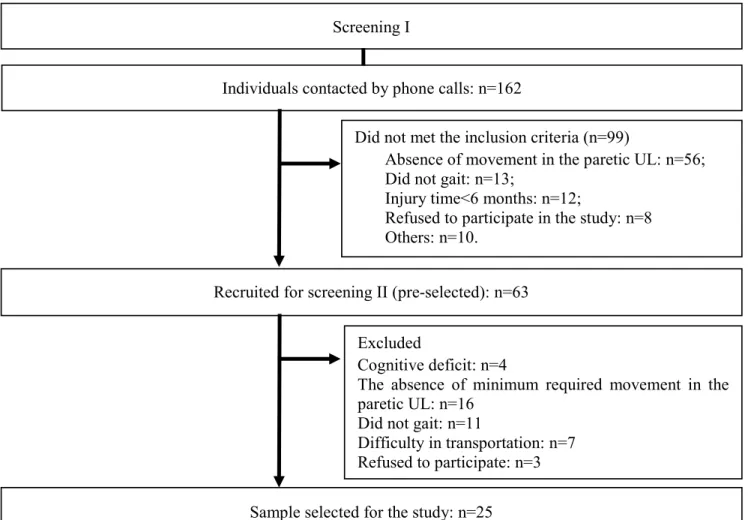
his randomized, controlled, blind clinical trial type study, constituted a pilot developed with individuals in the chronic post-CVA phase. It was developed in the Laboratório de Neurociência Aplicada e de Cinesiologia and Avaliação Funcional of the Department of Physical herapy at the Universidade Federal de Pernambuco (UFPE).
Did not met the inclusion criteria (n=99)
Absence of movement in the paretic UL: n=56; Did not gait: n=13;
Injury time<6 months: n=12;
Refused to participate in the study: n=8 Others: n=10.
Individuals contacted by phone calls: n=162
Recruited for screening II (pre-selected): n=63
Excluded
Cognitive deficit: n=4
The absence of minimum required movement in the paretic UL: n=16
Did not gait: n=11
Difficulty in transportation: n=7 Refused to participate: n=3
Sample selected for the study: n=25
Sample randomization
Losses and exclusions of Group 2 (n=3) Excluded by pain complaints: n=3 Abandoned: n=2
Losses and exclusions of Group 1 (n=3) Did not attend re-evaluation n=3 Abandoned: n=2
Screening I
Treatment without constraint: n=13 Treatment with constraint: n=13
Group 1 Group 2
Final sample of group 1: n=10 Final sample of group 2: n=8
To be included in the study, it was necessary the diagnosis of ischemic or hemorrhagic CVA, primary or recurrent, for more than 6 months; to be 21 years old or older; understanding to answer the formulated questions, evaluated with the Mini Mental State Examination\ Brazilian version15; ability to perform some tasks
with the paretic UL (such as to handle dominoes and marbles), ability to move from a sitting to a standing position, to keep the balance standing by at least two minutes. Patients with auditory deicits and/or speech disorders that would cause misunderstanding and diiculty of communication between the interlocutors and/or that performed physical therapy for less than 6 months were excluded from the study.
After the initial screening, anthropometric, demographic and clinical data were collected with a standardized assessment form. After collecting these data, the initial assessment (T0) was performed. At the end of this process, another researcher was told, responsible for sample randomization, the patients enrolled in the study, leaving the evaluator blind in regard to allocations. Composition of the sample and the characterization of groups were only known by the evaluation researcher upon completion of all the revaluations (T1). he evaluations before (T0) and after (T1) the therapeutic sessions were held without the use of constraint, regardless of the group. he randomization was done by means of a numerical sequence table created by a statistician not engaged in the research, in two groups: Group 1 “no constraint” and group 2 “with constraint”.
he primary outcome was the Berg Balance Scale and the secondary outcomes were: gait speed, timed “Up and Go” (TUG) and going up and down stairs.
Group 1 “no constraint” was submitted to modiied CIMT (based on the shaping activities), without using immobilization of the non-paretic UL. Group 2 “with constraint” was submitted to modiied CT (shaping activities) and use of immobilization of the non-paretic UL.
Volunteers were submitted, 3 times a week for 4 consecutive weeks to 40 minutes of the paretic UL specific training. The patient remained sitting in front of a table and each task was timed. Maximum allowable time was 3 minutes to complete each task. During the sessions, it was emphasized to the patient and/or caregiver, in the case of Group 2 “wih constraint”, the need for daily use of constraint for 6
the non-paretic UL immobilization hours (e.g., feeding, dressing, etc).
he modiied CIMT consisted of complete immobilization of the non-paretic UL and paretic UL training. Complete immobilization of the non- paretic UL was made by using a sling, with the shoulder in adduction and medial rotation, forearm (in 90° bending), wrist and ingers in neutral position, made to measure for each patient.
For use the constraint outside the lab, an agreement among physical therapist, caregiver and patient was established, in which the caregiver should undertake to describe the placement, removal and replacement of the sling in detail in a journal. When the withdrawal of constraint occurred, the patient and/or caregiver would record the reason in a journal.
Descriptive statistics (mean and conidence interval, CI), normality tests (Shapiro-Wilk) and data homogeneity tests (Levene) were calculated for all the measures assessed. For intergroups comparison, in pre-and post-intervention, we used the Mann-Whitney test. he intra-group analysis before and after the intervention was performed by the Wilcoxon test. he signiicance level adopted was a≤0,05. he software used for data analysis were the Excel 2010 and SPSS (Statistical Package for Social Sciences).
All volunteers and their guardians were informed about the goals and procedures of the study and that they could be allocated to any of the study groups. Participation was voluntary, pursuant to Resolution 466/2012 of the National Health Council – CNS. he study was approved by the Ethics and Research Committee of the Center for Health Sciences at UFPE (CEP/CCS/UFPE no. 036/10) and registered in the clinical trials database Clinical Trials (http:// clinicaltrials.gov) under no. NCT01623973.
RESULTS
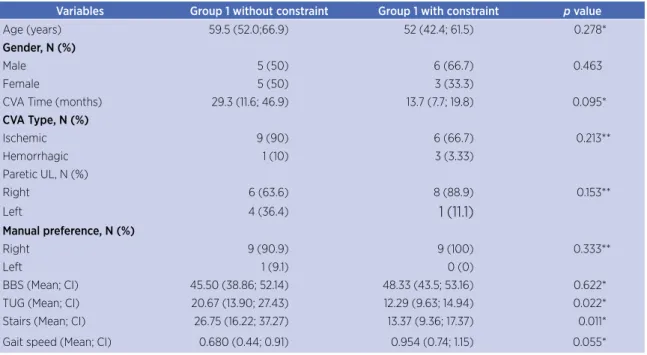
he Intergroup analysis (no constraint versus with constraint) before the therapeutic intervention showed that the samples did not difer signiicantly for most of the variables studied, except for TUG (p=0.022) and going up and down stairs test (p=0.011), as it can be seen in Table 1, which exposes the demographic and clinical data of outcome measures.
he group that used constraint, the values obtained on the scale of Berg showed signiicant improvement (p=0.014), but there was no diference intergroups. he group without constraint did not show signiicant gains in any of the parameters evaluated.
he comparison between groups, post-intervention, showed diference between the groups in the test Timed “up and go” (p=0.018), going up and down stairs (p=0.014) and gait speed (p=0.050), as indicated in Table 3, with the intergroups analysis in the post-intervention phase.
Table 1. Demographic, clinical and outcome measures assessed data
Variables Group 1 without constraint Group 1 with constraint p value
Age (years) 59.5 (52.0;66.9) 52 (42.4; 61.5) 0.278*
Gender, N (%)
Male 5 (50) 6 (66.7) 0.463
Female 5 (50) 3 (33.3)
CVA Time (months) 29.3 (11.6; 46.9) 13.7 (7.7; 19.8) 0.095*
CVA Type, N (%)
Ischemic 9 (90) 6 (66.7) 0.213**
Hemorrhagic 1 (10) 3 (3.33)
Paretic UL, N (%)
Right 6 (63.6) 8 (88.9) 0.153**
Left 4 (36.4) 1 (11.1)
Manual preference, N (%)
Right 9 (90.9) 9 (100) 0.333**
Left 1 (9.1) 0 (0)
BBS (Mean; CI) 45.50 (38.86; 52.14) 48.33 (43.5; 53.16) 0.622*
TUG (Mean; CI) 20.67 (13.90; 27.43) 12.29 (9.63; 14.94) 0.022*
Stairs (Mean; CI) 26.75 (16.22; 37.27) 13.37 (9.36; 17.37) 0.011*
Gait speed (Mean; CI) 0.680 (0.44; 0.91) 0.954 (0.74; 1.15) 0.055*
*Mann-Whitney Test; ** Chi square; Berg: balance scale; TUG: Time “up and go” test; Stairs: going up and down stairs
Table 2. Intra-group Analysis, according to Berg Balance Scale, Test Timed “up and go”, going up and down stairs and gait speed
Variables
Group 1 (no constraint)
*p value
Group 2 (no constraint)
*p value
T0 T1 T0 T1
℘ (CI) ℘ (CI) ℘ (CI) ℘ (CI)
BBS 45.5 48.3 0.074 48.3 51.8 0.014
(38.86; 52.14) (41.78; 54.82) (43.5; 53.16) (48.51; 55.27)
TUG 20.6 19.8 0.721 12.2 11.5 0.953
(13.90; 27.43) (12.78; 26.81) (9.63; 4.94) (9.29; 13.89)
Stairs 26.7 21.1 0.093 13.3 13.0 0.859
(16.22; 37.27) (15.61; 26.61) (9.36; 17.37) (9.79; 16.36)
Gait speed 0.6 0.7 0.201 0.9 1.0 0.553
(0.44; 0.91) (0.48; 0.93) (0.74; 1.15) (0.81; 1.19)
* Wilcoxon test; X=Mean; CI: Conidence Interval; BBS: Berg Balance Scale; TUG: timed “up and go” test; Stairs: going up and down stairs
Table 3. Intra-group analysis in post-intervention according to Berg Balance Scale, test Timed “up and go” and going up and down stairs and the gait speed
Variables
Group 1 (no constraint) Group 2 (no constraint)
*p value
T1 T1
℘ (CI) ℘(CI)
BBS 48.3 (41.78; 54.82) 51.8 (48.51; 55.27) 0.591
TUG 19.8 (12.78; 26.81) 11.5 (9.29; 13.89) 0.018
Stairs 21.1 (15.61; 26.61) 13.0 (9.79; 16.36) 0.014
Gait speed 0.7 (0.48; 0.93) 1.0 (0.81; 1,19) 0.050
DISCUSSION
This study aimed to investigate the possible effects of constraint of the non-paretic UL on balance and functional mobility in post-CVA patients. It was the first study to apply a time of reduced constraint (6 hours), associated with the activities of shaping for 40 minutes, 3 times during the week for 4 consecutive weeks.
Oscillation and coordination among the UL, the trunk and the gravity center are changed in post-CVA individuals16. In this study, individuals after using the
non-paretic UL constraint showed improvement in the scale of Berg in intra-group analysis. Increased use of the paretic UL may have inluenced the improvement of coordination of the upper limbs and the trunk, consequently inluenced positively in the balance 17.
Another explanation would be that the non-paretic UL constraint may cause reorganization of the central mass, which is changed after the CVA and usually displaced to the afected side18.
For the gait speed test, after the intervention, there was signiicant improvement in the intergroups analysis. he sling increases the feedback of individuals when forcing them to use the afected hemibody. Postural adaptations occur, reducing the horizontal and vertical displacements during the gait. his minor oscillation had positive impact on coordination and speed19.
Fuzaro et al.17 observed improvement in gait speed
test and TUG. During the gait presented by individuals with CVA, the compensations, motor deicits and non-coordination cause increased energy expenditure and imbalance. Coordination between the upper and lower limbs is essential20 and CIMT can provide improvement
of motor function and quality of life of this population. Individuals with CVA often neglect the afected hemibody, leading to the increase of their deicits, with this, after the forced usage required by constraint therapy there is a increased proprioception of trunk control, and visual feedback, referred to as possible inluences on the improvement of motor skills and functional independence17. Lin et al.21 corroborate this
idea that individuals submitted to CIMT improve the personal aspects, such as self-care.
Studies with longer constraint time observed positive efect in numerous tests, such as Action Reserch Arm Test, Fugl- Meyer, Wolf Motor Function Test, Motor Activity Log (MAL) and Stroke Impact
post-CVA individuals are correlated with the motor sequelae found. Early onset of therapy has direct inluence on functional gains in motor performance and locomotion22. his factor can have great inluence
on homogeneity between the groups.
In this study, the groups were not diferent in the Timed Up and Go Test (TUG) and the test of going up and down stairs and showed no gains in intra-group analysis. As the groups were formed after the end of assessments, the Timed Up and Go (TUG) variables and the going up and down stairs test presented heterogeneity, making statistical analysis diicult. he criterion of demand low should be reconsidered in future studies to obtain better sample distribution and higher number of patients in each group.
CONCLUSION
he use of constraint therapy for 6 hours a day positively inluenced in the gait speed of hemiparetic individuals. Studies with diferent times of use of constraint therapy and exercises are indicated to deepen the subject.
REFERENCES
1. Brasil. Ministério da Saúde. Datasus. Mortalidade. Óbitos para ocorrência por sexo segundo causa – CID-BR-10. Brasília, DF: Ministério da Saúde; 1979. [cited 2016 Aug 1]. Available from: https://goo.gl/14GSux
2. Correia BR, Cavalcante E, Santos EA. Prevalência de fatores de risco para doenças cardiovasculares em estudantes universitários. Rev Bras Clin Med. 2010;8:25-9.
3. Costa FA, Silva DLA, Rocha VM. Severidade clínica e funcionalidade de pacientes hemiplégicos pós-AVC agudo atendidos nos serviços públicos de isioterapia de Natal (RN). Cienc Saude Colet. 2011;16(1):1341-8. doi: 10.1590/ S1413-81232011000700068.
4. Falcão IV, Carvalho EMF, Barreto KML, Lessa FJD, Leite VMM. Acidente vascular cerebral precoce: implicações para adultos em idade produtiva atendidos pelo Sistema Único de Saúde. Rev Bras Saude Mater Infant. 2004;4(1):95-101. doi: 10.1590/ S1519-38292004000100009.
5. Lloyd-Jones D, Adams RJ, Brown TM, Carnethon M, Dai S, De Simone G,et al. Heart disease and stroke statistics update: a report from the American Heart Association. Circulation. 2010;121(7):e46-e215. doi: 10.1161/ CIRCULATIONAHA.109.192667.
Study of Health and Aging. Stroke. 2002;33(4):1016-21. doi: 10.1161/01.STR.0000013066.24300.F9.
7. Teixeira-Salmela LF, Olney SJ, Nadeau S, Brouwer B. Muscle strengthening and physical conditioning to reduce impairment and disability in chronic stroke survivors. Arch Phys Med Rehabil. 1999;80(10):1211-8. doi: 10.1016/ S0003-9993(99)90018-7.
8. Lavados PM, Hennis AJM, Fernandes JG. Stroke epidemiology, prevention, and management strategies at a regional level: Latin America and the Caribbean. Lancet Neurol. 2007;6(4):362-72. doi: 10.1016/S1474-4422(07)70003-0. 9. Levin MF, Panturin E. Sensorimotor integration for functional
recovery and the Bobath approach. Motor Control. 2011;15(2):285-301.
10. Wolf SL, Morris D, Winstein CJ, Miller JP, Taub E, Uswatte G, et al. Efect of constraint-induced movement therapy on upper extremity function 3 to 9 months after stroke: the excite randomized clinical trial. JAMA. 2006;296(17):2095-104. doi: 10.1001/jama.296.17.2095.
11. Taub E, Uswatt G. Constraint-induced movement therapy: answers and questions after two decades of research. NeuroRehabilitation, 2006;21(2):93-5.
12. Taub E, Miller NE, Novack TA, Cook EW 3rd, Fleming WC, Nepomuceno CS, et al. Technique to improve chronic motor deicit after stroke. Arch Phys Med Rehab. 1993;74(4):347-54. 13. Riberto M, Monroy HM, Kaihami HN, Otsubo PPS,
Battistella LR. A terapia de restrição como forma de aprimoramento da função do membro superior em pacientes com hemiplegia. Acta Fisiátr. 2005;12(1):15-9. doi: 10.5935/0104-7795.20050001.
14. Page SJ, Levine P, Khoury JC. Modiied constraint-induced therapy combined with mental practice: thinking through
better motor outcomes. Stroke. 2009;40(2):551-4. doi: 10.1161/STROKEAHA.108.528760.
15. Lourenço RA, Veras RP. Mini-Exame do Estado Mental: características psicométricas em idosos ambulatoriais. Rev Saúde Pública. 2006;40(4):712-9. doi: 10.1590/ S0034-89102006000500023.
16. Lee JH, Kim SB, Kyeong WL, Lee JY. Efect of prolonged inpatient rehabilitation therapy in subacute stroke patients. Ann Rehabil Med. 2012;36(1):16-21. doi: 10.5535/ arm.2012.36.1.16.
17. Fuzaro AC, Guerreiro CT, Galetti FC, Jucá RB, Araujo JE. Modiied constraint-induced movement therapy and modiied forced-use therapy for stroke patients are both efective to promote balance and gait improvements. Rev Bras Fisioter. 2012;16(2):157-65. doi: 10.1590/S1413-35552012005000010. 18. Acar M, Karatas GK. The efect of arm sling on balance in
patients with hemiplegia. Gait Posture. 2010;32(4):641-4. doi: 10.1016/j.gaitpost.2010.09.008.
19. Yavuzer G, Ergin S. Efect of an arm sling on gait pattern in patients with hemiplegia. Arch Phys Med Rehabil. 2002;83(7):960-3. doi: 10.1053/apmr.2002.33098.
20. Han SH, Kim T, Jang SH, Kim MJ, Park S, Yoon SI. The efect of an arm sling on energy consumption while walking in hemiplegic patients: a randomized comparison. Clin Rehabil. 2011;25(1):36-42. doi: 10.1177/0269215510381167.
21. Lin, K.C, Chang Y, Wu C, Chen Y. Efects of constraint-induced therapy versus bilateral arm training on motor performance, daily functions, and quality of life in stroke survivors. Neurorehabil Neural Repair. 2009;23(5):441-8. doi: 10.1177/1545968308328719.