DOI: 10.1590/1807-57622016.0383
The challenges faced by the More Doctors Program in providing and ensuring
comprehensive health care in rural areas in the Amazon region, Brazil
Lucélia Luiz Pereira(a)
Leonor Pacheco(b)
(a) Departamento de Serviço Social, Instituto de Ciências Humanas, Universidade de Brasília, Campus Universitário Darcy Ribeiro. SER - ICC Norte, Brasília, DF, Brasil, 70910-900. [email protected]
(b) Departamento de Saúde Coletiva, Faculdade de Ciências da Saúde, Universidade de Brasília. DF, Brasil. [email protected]
The objective of this research was to assess how the More Doctors Program has been implemented in rural areas and the contributions made by providing physicians to ensure comprehensive health care. A study was conducted in a predominantly rural city in the state of Pará, involving 42 interviews with health professionals and managers, council members and users. The interviews then underwent content analysis. The results suggest that there have been improvements in primary health care – such as a higher number of consultations and expanded access to the primary care services offered – that can be attributed to the presence of the physicians and the use of more equitable strategies. However, there are still challenges to be confronted in order to ensure comprehensive health care in rural areas, such as maintenance of the program and overcoming recurrent problems, such as: lack of drugs and tests; limitations in follow-up on patients referred to other services; and weaknesses in the health care network.
Keywords: Primary care physicians. Rural areas. Health.
Introduction
Health is a right of all citizens, protected in the Federal Constitution of 1988, which
must be fully and universally guaranteed. The Brazilian National Health System (SUS) was
implemented in 1988, based on the principles of health reform, aimed at restructuring the
health care model. The hegemony of the biomedical care model, which emphasizes
individual and biological aspects, with care focused on the illness, was questioned.
In contrast, the SUS advocates a comprehensive care model that takes into
consideration the needs of the population in the planning of care activities. It also organizes
the system with the objective of including promotion, prevention, treatment and recovery
based on primary, secondary and tertiary care.
Comprehensive care, which is one of the principles of the SUS, can be understood on
the basis of two dimensions or levels of analysis. The first refers to organization of the
health services network, where there is a need to guarantee coordinated prevention,
promotion, protection and recovery activities, at both the individual and collective level, for
all levels of complexity in the system.
The second is in regard to the approach adopted in the relationship between actors
(professionals and users) in terms of supply and demand for services, i.e., it is related to the
care process and entails understanding individuals as whole persons, thus ensuring a
biological, psychological and social approach1,2.
Some authors broaden the concept of comprehensiveness and consider other aspects
besides organization of services and understanding individuals, such as: attributes related to
the political sphere; and guaranteeing fairness, with differentiated treatment for users in
unequal situations; and care focused on individuals4.
According to Ferreira5, the implementation of a comprehensive health system
depends on the relationship between the principles of the SUS, such as universality, fairness,
and guaranteed access. Universality is expressed in the idea that the state must provide care
for the entire population.
As in the case of comprehensiveness, access has also been a subject of debate. It
could be limited to the supply of health services to the population, or could also encompass
responses provided by the service meet the needs of the population, based on time, space
and distance6.
Donabedian considers two aspects in the definition of accessibility: one is
socio-organizational and the other is geographic7. The first has to do with variables that influence
access to health, such as social, cultural, educational and economic conditions. The second
involves the distance between the services provided and users. Therefore, it not only
includes availability of resources, but also characteristics of services and resources, which
can strengthen or limit access to the network by users8.
In relation to fairness, it can be understood from a horizontal perspective, with equal
treatment for individuals in equal situations, as well as from a vertical point of view, defined
as differentiated treatment among individuals in unequal situations7. The principle of
fairness is based on the idea of social justice, with the goal of reducing social differences,
through differentiated care for different needs9.
Characteristics of health care in rural areas
According to the National Primary Care Policy, primary care is the gateway to the
health care process10. However, unequal access to primary health care in rural areas is
intensified by various access barriers related to geographical, economic, cultural and
organizational issues11-13.
The rural population depends almost exclusively on the SUS for its health care. Due
to the geographic location of primary healthcare units and economic and transportation
barriers for getting to them, rural residents generally look for health services closer to their
homes. This results in people going more often to the health unit located in the actual rural
area where they live. Going to the center of the city for care generally occurs when health
professionals are lacking in the primary healthcare unit or because of the need for
specialized care.
A number of studies have pointed out difficulties in recruiting and retaining
professionals in rural areas, in addition to high turnover in family health teams14-16. There
geographic location, since these areas are distant from major centers and are often hard to
reach.
Rural inhabitants account for 18.75% of the total population of Brazil, i.e., around
29.9 million people residing in approximately 8.1 million households, with 46.7% living on
the extreme poverty line17. There is a tendency in rural areas for the population to seek
health primarily in cases of illness and not for routine testing or prevention. The data shows
the characteristics of this population and the central role played by the SUS, due to the fact
that the rates of health plan coverage among rural residents is lower than those for
individuals living in urban areas18.
Due to unequal access to health services by rural dwellers, the federal government
implemented the National Policy of Comprehensive Health for the Population in Rural and
Forest Regions in 2013, aimed at social insertion and the right to health of populations
historically excluded from access to health services19. The policy notes that the rural
population experiences various disadvantages in relation to health care, which therefore
requires different strategies for its inclusion.
The policy includes health promotion among populations living in rural, forest and
waterway regions, through actions and initiatives that recognize characteristics such as
gender, generation, race/color, ethnic group and sexual orientation. This is done in order to:
provide access to health services; reduce health risks and complications resulting from
workplace conditions and agricultural technologies; and improve health and quality of life
indicators19.
Comprehensive health care in rural areas is a challenge, since these regions have
characteristics that hinder universality, fairness of access and use of services. To address
this challenge, the federal government implemented the More Doctors Program (MDP) in
2013, to strengthen primary care and reduce the shortage of physicians in various areas,
including rural areas and the outskirts of many urban centers20,21. The MDP responds to the
shortage of primary care physicians through the following measures: 1) calls for physicians
to work in needier regions, where there is a shortage or absence of these professionals; 2)
places in courses of medicine and medical residency; 3) investments in infrastructure and
equipment in health units.
The MDP was instituted by Provisional Measure No. 621 of July 8, 2013, and
converted into Law No. 12871/2013, representing an agreement to improve the care of
users of the SUS20,21. For their work in the cities, the physicians selected by the program
receive a stipend of BRL 10,000 per month, paid by the Ministry of Health. The local cities
were responsible for providing housing, food and transportation to carry out their activities.
The contracts with the physicians are for a period of three years and can be renewed for
another three years. Available openings in the MDP can be filled by physicians trained in
Brazilian universities or whose diplomas have been recognized in the country, or by
physicians educated in foreign universities. It is important to note that there is a set of
priorities in relation to the selection of physicians.
The objective of this paper was to study how the MDP has been implemented in the
rural areas of a city in the state of Pará, and the contributions made by physicians on rural
family health teams to guaranteeing health care to the city's residents.
Methodology
A qualitative study was conducted in a city in the state of Pará. Forty-two
semi-structured interviews were carried out with 18 professionals from Family Health Strategy
(FHS) teams, five managers, four MDP physicians, one representative from the Municipal
Health Council and 14 users. All interviews were recorded and transcribed.
The interview scripts employed with users, physicians, FHS professionals, managers
and the council member sought to capture the perceptions of the various actors regarding
the implementation of the MDP and the contributions of physicians to improving health care.
Therefore, questions were included about the health situation in the communities, the main
health problems noted, provision of services by the city, assessment of the implementation
of the MDP, and changes perceived after the physicians from the program started working.
In the case of managers, it was decided to do interviews with professionals directly
health secretary, and advisors. The users, physicians and FHS professionals who were
interviewed came from the primary healthcare units where the MDP physicians were
assigned. Choice was by convenience, i.e., the actors were in the primary healthcare units
and were invited to participate in the study. To choose the representative responsible for
oversight by the public, priority was given to the chairman of the local health council. The
interviews were conducted in accordance with ethical standards of confidentiality and
anonymity, and the study design was submitted to and approved by the ethics committee.
In relation to the profile of the professionals interviewed, there were: nine community
health agents, two nurses, two dentists, three nursing technicians and three nursing
assistants; most (12) had worked in the city for more than six years. Of the four MDP
physicians interviewed, three had been working on the FHS team for more than two years. In
the case of users, three men were interviewed, all rural workers, one of whom was retired. Of
the 11 female users, all said they had been rural workers, but only three were still working
as such; five were housewives and three were salespersons.
The content analysis technique was used, focused on the stages employed by
Bardin22: pre-analysis, exploration of the material, and treatment and interpretation of the
results. The support tool used to execute the analysis stages was the software Atlas.ti. This
was followed by systematization and categorization of the information, and an analysis
based on the literature, with a focus on issues pertaining to the study.
Results
The city under study was founded in the 1990s and is located around 200 km from
Belém. Its population is slightly under 30,000, with the inhabitants living predominantly in
rural areas (74%), according to the IBGE estimate of 2010. The main economic activity is
agriculture. However, there are other occupations in the city, such as fishing and harvesting
of plants and trees.
The primary health network of the city consists of nine primary healthcare units:
agent program and a family health support center. In relation to the MDP operation, four
physicians from the program work in rural FHS – Oral Hygiene units.
Operation of the More Doctors Program: changes and challenges in primary health
care in rural areas in the state of Pará
The MDP was implemented in the city in 2013, through the allocation of four Cuban
physicians. They were designated to work in four primary healthcare units located in rural
areas and made up the FHS teams. Three primary healthcare units are part of the Primary
Healthcare Unit Requalification Program, with two units already inaugurated.
The professionals from the primary healthcare units that were studied highlighted
the performance of health promotion and disease prevention activities, such as
consultations, vaccinations, registration and follow-up of users with chronic diseases,
prenatal care, growth and development, house calls and, to a lesser extent, group and
educational activities in the primary healthcare units, and also in other venues, such as
schools.
According to some professionals, before the MDP, one of the main challenges the
units faced was continuity of care of users, especially patients with chronic diseases. Both
professionals and users remarked that this problem was alleviated by the arrival of
physicians from the MDP, due to their consistent work in the primary healthcare units,
resulting in lower turnover, and because they established bonds with users:
“I didn't go to work that day.” (think the program is very good because they really
fulfill their working hours. Before, people would come and it was a waste of a trip
because there was no physician or the physician didn’t come very often or Health
Professional, FHP 1)
“I used to come here before and they'd always tell me the doctor wasn't there. After
the arrival of the Cuban doctor, she's always here. I've come in the morning, I've
The presence of the physicians increased the frequency with which users utilized the
system and follow-up on diseases, thereby ensuring greater access to health care. Various
users mentioned the importance of having medical care available every day in rural areas
and emphasized the special treatment given by the Cuban physicians.
She provides good care and is very attentive. The first times I came for a consultation, I was
embarrassed because she looks at you, wants to talk and asks a lot of things. But now I think
it is good she's like that with everyone. (User, FHP 3)
At the same time, this indicates the continuation of a model where the point of
reference for care is the physician. There is a need for more intensive work by teams to
ensure qualified care. The users pointed out various care situations involving professionals
that may be hindering the establishment of bonds, such as: frequent changes in nurses and
dentists in the area; lack of privacy and confidentiality in consultations; inadequate
reception; and disqualification of alternative therapies that have been adopted based on
cultural practices, such as self-medication, healing through prayers or blessings, and home
remedies.
Knowing the reality of users and their survival needs can help teams understand the
characteristics of the public being served and find ways to avoid criticizing the local health
strategies used. At the same time, it facilitates the creation of bonds, which are necessary
for strengthening the perception of health promotion.
The creation of bonds between users and the service also depends on trust
established with the professionals and, for this reason, attitudes during care are crucial.
Some users reported lack of confidentiality and privacy in the care process, which makes it
difficult to build these bonds. This is especially true when a certain amount of
intimacy/cooperation is required, such as cervical cancer preventive testing, where users feel
more exposed.
Therefore, it is essential to provide a welcoming environment focused on users’
health needs and based on important characteristics of this group. These are not always
taken into consideration by health teams, such as: high socioeconomic vulnerability and
food insecurity; low educational level; labor activities related to subsistence farming that
housing situations that lack sewage systems, basic sanitation, or treated water, which can
cause various sicknesses.
Three other factors prevent users from seeking and continuing to use services:
geographical accessibility, care deficiencies related to lack of drugs and difficulties doing
tests; and limitations in the specialized care network. In relation to geographic accessibility,
it was noted that most of the primary healthcare unit users interviewed lived far from the
reference primary healthcare unit and from the center of the city. Geographic obstacles, such
as distance and poor roads, are also a reality in rural areas, exacerbated by infrequency of
public transportation and the fact that the users’ financial situations do not always allow
them to pay for transportation.
For this reason, the physicians interviewed stressed that understanding the realities
of users encourages the adoption of strategies, based on organization of schedules, that
enable them to take into consideration the needs of more distant residents. This was
reflected in a higher number of spontaneous consultations or establishing specific days to
visit individuals living in distant locations, combining these days with availability of public
transportation.
In terms of the care deficiencies, there were various complaints from users and
professionals in the interviews. Both commented that lack of drugs is a regular problem in
the city, and that not all patients have the financial means to purchase them, resulting in
patients not receiving the proper treatments to control chronic diseases and prevent
possible complications.
With respect to doing tests, both professionals and users said there are flaws in the
provision of this service. Pregnant users, for example, pointed out that there are often no
openings to schedule routine prenatal care and, consequently, these procedures are done in
private clinics. However, the professionals know that the economic situation of users limits
the use of private health care services, preventing them, from being tested in a timely
manner to check the development of the fetus.
Finally, the issue of limited referrals and counter-referrals can also be considered a
factor that reduces the participation of users in the activities offered by the primary
appointments with specialists and that sometimes the primary healthcare unit is used as a
bureaucratic gateway to the network of specialized services. For this reason, some users do
not understand that the FHP is a health promotion strategy and they show a cultural belief
that specialized care is a more effective route for resolving their health needs.
“In primary care, I can strive to provide a quality visit for the user, but sometimes I
need additional tests and have to refer the person to a specialist. At times, this
continuity of care does not occur. “(MDP physician)
However, various users mentioned that their point of view changed after visiting
physicians from the MDP and they realized that going to a primary healthcare unit is not just
for obtaining a referral, but also for resolving problems that were previously considered the
realm of specialized care. This attitude was due, not only to lack of knowledge of the
services provided by primary healthcare units, but also to the insufficient number physicians
to compose family health teams.
There is a convergence in the comments of the interviewees regarding the challenges
to improving the comprehensiveness of health care in the city, related to three points: 1)
lack of structure (tests, drugs, transportation and referral and counter-referral network); 2)
failure to establish bonds with users so that the point of reference will be the team and not
just the physician, thereby enabling comprehensive care; and 3) the need to improve human
resources for better performance of family health teams in areas such as fulfilling work
hours, reduced turnover and mapping of the region so that the work is focused on the needs
of users, based on the characteristics of rural areas.
In relation to the perception of changes that occurred after the MDP physicians
started to work, the remarks of the interviewees can be categorized into three subgroups.
The first group commented on the existence of differentiated clinical practices. The
interviewees gave positive assessments of the program based on elements such as how they
are received and care quality. According to users, the Cuban physicians are "more human,"
since during consultations they are attentive, talk to the users, and seek strategies to build
In the second subgroup, the issues were related to the continuity of the physicians in
the FHP. The interviewees noted that continuity in the service enables continuity of care and
follow-up of users for longer periods. This makes it possible to understand the particular
needs of the public being served and seeks to include users who work in agriculture in the
morning, or who live in very distant rural areas. Such strategies not only help to create
bonds, but also facilitate carrying out mid-term activities that can support the process of
health promotion and disease prevention, enhance the problem-solving capacity of the units
and reduce the demand for hospital services.
Finally, the third subgroup reflects issues associated with the provision of primary
care. According to some interviewees, although the local health system has a medicalized
care approach, the work of the MDP physicians strengthened the perception of primary
health care, through education in health activities, planning of actions with the team, and
more frequent house calls. This different approach to care enabled users to participate more
in FHP activities and resulted in better organization of care requests.
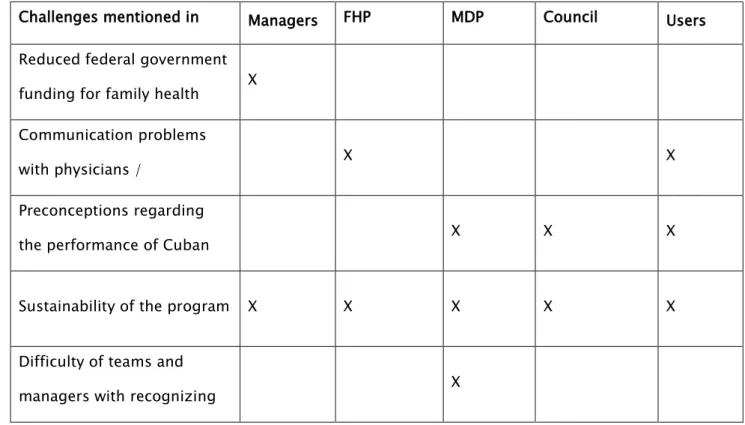
Table 1. Challenges of the More Doctors Program as perceived by the key actors interviewed. Pará, 2015.
Challenges mentioned in
relation to the program
Managers FHP
professional
MDP
physicians
Council
Representativ
Users
1. Reduced federal government
funding for family health
teams with MDP physicians X
2. Communication problems
with physicians /
understanding the language
X X
3. Preconceptions regarding
the performance of Cuban
physicians
X X X
4. Sustainability of the program X X X X X
5. Difficulty of teams and
managers with recognizing
the importance of
X
In terms of the challenges to implementing the MDP, there was unanimous concern
among the interviewees as to the sustainability of the program. Although managers
acknowledged the importance of the MDP in increasing the supply of health care in the city,
as well as its quality, there was no mention that they intended to renew their participation in
the program. One reason for this may be the perception of managers that utilizing teams
composed of physicians from the MDP results in loss of financial resources. As for users,
besides the challenge related to the sustainability of the MDP, they noted that in the
beginning it was difficult to understand the "physician's language," but that this has
lessened over time.
The physicians from the MDP stated that the main challenge is the difficulty, on the
part of professionals and managers in understanding and recognizing the importance of the
primary care service they provide. The physicians believe that city authorities lack a deeper
understanding of the role of primary care and the importance of teamwork, which needs to
take place between different health care levels, but also requires building bonds with
professionals from different fields who could contribute to health promotion.
Another issue highlighted by the physicians was the effect that the controversy
surrounding the program has on assessing the physicians' performance and on people’s
trust in the work being done. They reported facing various difficulties in their day-to-day
work related to preconceptions and mistrust about the work they do. They recognized,
however, that the professionals have gradually come to understand the health outlook and
work strategies used to strengthen municipal primary care.
Discussion
An analysis of the implementation of the MDP in rural family health programs in the
state of Pará suggests that improvements have occurred in primary health care in these
locations. These improvements are reflected in a higher number of consultations and
increased access to services provided by primary healthcare units, based on more equitable
One of the challenges stressed by the MDP physicians involves the limited conception
of primary care and health promotion, which hinders development of a coordinated network
in the city. Fighting for a broader concept of health means understanding that health
promotion involves not only action in relation to the specific policy, but sectoral
coordination with other areas that also affect health23.
Another challenge cited by the MDP physicians is resistance by some professionals to
the work of the Cuban doctors. Similar experiences have also been observed in other
countries24-26. However, there are studies that demonstrate the contributions made by
Cuban physicians to improving health services in countries participating in cooperation
agreements, even in Brazil27-31. The current study found that many of the users and
professionals interviewed evaluated the program and the work of the physicians as
satisfactory. Allocation of physicians to the city’s rural areas was considered very important,
in light of constant shortages and high turnover of these professionals in the family health
teams.
It is important to add that this study has limitations regarding the definition of the
user population that participated. The users were selected in the health units which may, to
some extent, have had a bearing on their positive assessment of the program’s
implementation and satisfaction with the care provided by the MDP physicians, since the
interviewees were using the health services. Despite this limitation, the findings of this study
were similar to those of other studies on the MDP that indicated high satisfaction of users
and professionals with the implementation of the program29,31.
Half the world's population lives in rural and remote areas and faces difficulties
obtaining adequate and fair access to health care32. In the case of rural populations, various
studies have mentioned the issue of shortages of professionals to work in these areas, as
well as barriers related to the distance from the health units, which hinders the population's
access to health care24,33. For this reason, Cuban physicians are generally assigned to distant
and remote rural areas, i.e., to locations where it is difficult to provide doctors34.
It was observed that the population studied experiences serious social and health
reality that has been pointed out in other studies that address the condition of rural
inhabitants35,36.
With respect to health care, the results of the present study show that progress has
been made in operationalizing health practices and work processes. However, more effective
strengthening also depends on improvements in the organizational/managerial realm, i.e.,
the reorganization of activities and services and establishing relationships between units
that provide services37. Enhancing the value of primary care depends on a combination of
strategies involving the organization of work processes and levels of complexity, in order to
provide continuity of care.
The results indicate that many users tend to value specialized services that focus on
the use of technology and prescription of drugs37. Even so, in the initial stages, it was noted
that primary healthcare units have stopped serving as a bureaucratic stepping stone to
accessing hospital care. Users said that having physicians in the area encourages use of the
services offered by the family health program and enables greater participation in education
in health activities.
On the other hand, teamwork needs to be strengthened, which has previously been
recommended in primary care10,38. The results of the present study show that physicians
from the MDP strive to reinforce teamwork in the planning of primary healthcare unit
activities and by doing house calls and engaging in education in health initiatives.
Nevertheless, users still seek private medical consultations.
One explanation for the continuation of this reality is limited bonds between team
and users, as reported in various interviews that mentioned shortcomings in how users are
received, related to lack of dialogue and lack of education in health initiatives. Therefore,
family health teams should intensify their health diagnosis activities in the regions, to
understand the needs of users.
Future qualitative studies are needed regarding the work of the MDP in rural areas
with specific publics, such as quilombolas (descendants of Afro-Brazilian slaves who
escaped from slave plantations that existed in Brazil and currently live in hinterland
settlements), indigenous people and riverside communities. It would also be important to do
Final considerations
This research demonstrates that the MDP has contributed to providing rural
populations with greater access to primary health care, even though limitations in health
care persist, such as lack of drugs, difficulties doing tests and limitations in the specialized
care network.
There is evidence that MDP physicians adopt professional practices that seek to meet
the characteristics of the rural population, based on certain strategies: expansion of
education in health initiatives; planning of actions with the team; better organization of the
agenda in an effort to include the needs of individuals living in distant and/or isolated areas;
more frequent house calls; greater continuity of health care, which enables the creation of
bonds, especially with users suffering from chronic diseases; and greater presence in the
health services, resulting in reduced turnover. Finally, another strong point of the MDP,
reported by both users and professionals, is the special treatment given by the Cuban
physicians, demonstrating a clinical approach that respects the culture of the residents,
evidenced by more dialogue and attention to the particular needs of the rural public being
served.
The core issue to be addressed by government agencies and bodies for oversight of
public administration in cities is strategies to be adopted that will ensure the sustainability
of the progress achieved through the MDP, i.e., policies of a structural nature need to be
discussed that will strengthen government actions and guarantee quality access to health
care by users in rural areas.
Reducing inequalities and strengthening the comprehensiveness of health care
depends especially on guaranteeing that professionals will be supplied for rural family health
teams. It also depends on the development of strategies that seek to deal with recurrent
problems in health services in rural areas, such as: geographical barriers; lack of drugs;
problems scheduling tests; limitations in the referral and counter-referral system; and,
Therefore, strengthening primary health care in the rural areas studied and
guaranteeing the principles of universality, comprehensiveness and fairness do not just
depend on the work of physicians from the MDP. Also important are factors such as:
combining the professional knowledge of teams; respect for traditional health care practices;
effective coordination between the various care levels; and, last, the promotion of strategies
that encompass the specific needs of rural residents and ensure the provision of health care.
Collaborators
Lucélia Pereira: Research design, data collection, analysis of the results and final review of the
text.Leonor Pacheco: Discussion and analysis of the results, translation of the abstract and review of
the text.
References
1. Dalmaso ASW. Oferta e consumo de ações de saúde: como realizar o projeto da integralidade? Saude Debate. 1994;(44):35-8.
2. Giovanella L, Lobato LVC, Carvalho AI, Conill EM, Cunha EM. Integralidade da atenção em sistemas municipais de saúde: metodologia de avaliação e intervenção. Saude Debate. 2002;26(60):37-61.
3. Mattos RA. Os sentidos da integralidade: algumas reflexões acerca de valores que merecem ser defendidos. In: Pinheiro R, Mattos RA, organizadores. Os sentidos da integralidade na atenção e no cuidado à saúde. Rio de Janeiro: Uerj/IMS; Abrasco; 2001. p. 43-68.
urtado ana a Processo de constru o de um distrito de sa de na perspecti a de gestores
e m dicos: estudo de caso. Rev. Saúde Pública. 1998; 32(6):587-95.
5. Ferreira SC, organizador. Gestão em saúde: contribuições para a análise da integralidade. Rio de Janeiro: EPSJV; 2009.
6. Iturri JA. Acesso e integralidade da atenção. Tempus. 2014;8(1):85-90.
7. Sanchez RM, Cicoelli RM. Conceitos de acesso à saúde. Rev Panam Salud Publica. 2012;31(3):260–8.
8. Travassos C, Martins M. Uma revisão sobre os conceitos de acesso e utilização de serviços de saúde. Cad Saude Pública. 2004;20(2):190-8.
9. Cunha JPP, Cunha RRE. Sistema Único de Saúde - SUS: princípios. In: Campos FE, Oliveira Jr M, Tonon LM, organizadores. Cadernos de saúde I. Planejamento e gestão em saúde. Belo Horizonte (MG): Coopmed; 1998. p. 11-26.
10. Portaria n° 2.488, de 21 de Outubro de 2011. Aprova a Política Nacional de Atenção Básica,
11. Vieira EWR. Acesso e utilização dos serviços de saúde de atenção primária em população rural do Município de Jequitinhonha. Jequitinhonha [dissertação]. Belo Horizonte: Universidade Federal de Minas Gerais; 2010.
12. Arcury TA, Gesler WM, Preisser JS, Sherman J, SpencerJ, Perin J. The effects of geography and spatial behavior on health care utilization among the residents of a rural region. Health Ser Res. 2005;40(1):135-56.
13. Travassos C, Viacava F. Acesso e uso de serviços de saúde em idosos residentes em áreas rurais, Brasil, 1998 e 2003. Cad Saude Publica. 2007;23(10):2490-502.
14. Dolea C, Stormont L, Braichet JM. Evaluated strategies to increase attraction and retention of health workers in remote and rural areas. Bull World Health Organ. 2010;88(5):379–85.
15. Silva, AS, Nogueira DA, Paraizo CMS, Fracoli LA. Assessment of primary health care: health
professionals’perspecti e Re Esc Enferm USP 201 ; 8:122-8.
16. Pitilin EB, Lentsck MH. Atenção Primária à Saúde na percepção de mulheres residentes na zona rural. Revista da Escola de Enfermagem da USP. 2015; 49(5): 726-732.
17. Ministério da Saúde. Secretaria de Gestão Estratégica e Participativa. Departamento de Apoio à Gestão Participativa. Políticas de promoção da equidade em saúde. Brasília: Ministério da Saúde; 2012.
18. Almeida FM, Barata RB, Montero CV, Silva ZP. Prevalência de doenças crônicas autoreferidas e utilização de serviços de saúde, PNAD/1998, Brasil. Cienc Saude Coletiva. 2002;7(4):743-56.
19. Ministério da Saúde. Secretaria de Gestão Estratégica e Participativa. Departamento de Apoio à Gestão Participativa. Política nacional de saúde integral das populações do campo e da floresta. 1a ed. Brasília: Ministério da Saúde; 2013.
20. Lei no 12.871, de 22 de Outubro de 2013. Institui o Programa Mais Médicos, altera as Leis no 8.745, de 9 de dezembro de 1993, e no 6.932, de 7 de julho de 1981, e dá outras providências. Diário Oficial da União. 22 Out 2013.
21 Medida Pro isória no 621 de 8 de Julho de 2013 Institui o “Programa Mais M dicos” e dá outras
providências. Diário Oficial da União. 9 Jul 2013.
22. Bardin L. Análise de conteúdo. Lisboa: Edições 70; 2010.
23. Catrib AMF, Dias MSA, Frota MA, organizadoras. Promoção da saúde no contexto da estratégia saúde da família. Campinas(SP): Saberes; 2012.
24. Asante AD, Negin J, Hall J, Dewdney J, Zwi AB. Analysis of policy implications and challenges of the Cuban health assistance program related to human resources for health in the Pacific. Hum Resour for Health. 2012;10:1-10.
25. Henrique F, Da Ros MA, Goronzi T, Soares GB, Gama LA. Modelo de atenção primária à saúde na Venezuela, misión barrio adentro I: 2003-2006. Trab Educ Saude. 2014;12(2):305-26.
26. Villanueva T, de Albornoz SC. Venezuelan doctors resent presence of thousands of Cuban doctors in their country. Br Med J. 2008,336(7644):579.
28. Fawthrop T. Impoverished Cuba sends doctors around the globe to help the poor. Sydney: The Sydney Morning Herald; 2006.
29. Tribunal de Contas da União (BR). Auditoria operacional: Programa Mais Médicos. Projeto Mais Médicos para o Brasil. Avaliação da eficácia do programa. Brasília:TCU; 2014 (TC no 005.391/2014-8).
30. Molina J, Fortunato MA, Suárez J, Oliveira G, Cannon, LRC. O Programa Mais Médicos e as Redes de Atenção à Saúde no Brasil. Divulg Saude Debate. 2014;(52):190-201.
31. Pereira LL, Silva HP, Santos LMP. Projeto Mais Médicos para o Brasil: estudo de caso em comunidades quilombolas. Rev ABPN. 2015;7(16):28-51.
32. Rourke J. WHO Recommendations to improve retention of rural and remote health workers - important for all countries. Rural Remote Health. 2010;10(4):1654.
33. Travassos C, Oliveira EXG, Viacava F. Desigualdades geográficas e sociais no acesso aos serviços de saúde no Brasil: 1998 e 2003. Cienc Saude Coletiva. 2006;11(4):975-86.
34. Werlau, Maria C. Cuba-Venezuela health diplomacy: the politics of humanitarianism. In: Papers and Proceedings of the 20th Annual Conference of the Association for the Study of the Cuban Economy; 2010; Miami, Florida. Cuba in Transition: Volume 20. Florida; 2010. [citado 10 Fev 2016]. Disponível em: http://www.ascecuba.org/c/wpcontent/uploads/2014/09/v20-werlau.pdf
35. Instituto Brasileiro de Geografia e Estatística (IBGE). Pesquisa Nacional por Amostra de Domicílios. Banco da Dados Agregados (PNAD), 2011 [Internet]. 2011 [acesso 20 Jan 2016]. Disponível em: http://www.sidra.ibge.gov.br/pnad/pnadpb. asp?o=3&i=P
36 osta uilhoto JJM Saneamento rural no rasil: impacto da fossa s ptica iodigestor. Eng Sanit
Ambient. 2014;19(no esp):51-60.
37. Teixeira CF, Solla JP. Modelo de atenção à saúde. Promoção, vigilância e saúde da família. Salvador: Edufba; 2006.
38. Giovanella L, Mendonça MHM. Atenção Primária à Saúde. In: Giovanella L, Lobato LVC, Noronha JC, Carvalho AI, organizadores. Políticas e Sistema de Saúde no Brasil. 2ª Edição revista e ampliada. Rio de Janeiro: Editora Fiocruz; 2012.