Assessment of nursing perceptions of three insulin protocols
for blood glucose control in critically ill patients
Avaliação da percepção de enfermeiros sobre três protocolos para
controle glicêmico em pacientes críticos
Thiago Domingos Corrêa1, Francisca Pereira de Almeida1, Alexandre Biasi Cavalcanti1,
Adriano José Pereira1, Eliézer Silva1
Study carried out at the Intensive Care Unit, Hospital Israelita Albert Einstein – HIAE, São Paulo (SP), Brazil.
1 Intensive Care Unit, Hospital Israelita Albert Einstein – HIAE, São Paulo (SP), Brazil.
Corresponding author: Eliézer Silva – Avenida Albert Einstein, 627 – Morumbi – Zip code: 05651-901 – São Paulo (SP), Brazil – Phone: (55 11) 2151-1500 – Fax: (55 11) 3746-9411 – E-mail: [email protected] Received on: Jan 26, 2012 – Accepted on: Jul 26, 2012
Conflict of interest: none. ABSTRACT
Objective: To evaluate nurses’ perception regarding three different blood glucose control protocols for critically ill patients. Methods:
As part of a randomized trial comparing three blood glucose control protocols in critically ill patients (Computer-Assisted Insulin Protocol, Leuven Protocol, and conventional treatment), all nursesparticipating in the study were asked to fill in a questionnaire to assess their perceptions of efficacy, complexity, feasibility, and safety (as to the occurrence of hypoglycemic episodes), an to indicate which protocol they would like to see adopted as the standard one in the Intensive Care Unit they worked. Results: Sixty nurses answered the questionnaires. Computer-Assisted Insulin Protocol was considered the most efficient protocol to maintain blood glucose levels within the target range by 58% of the nurses, compared to 22% for Leuven Protocol (p<0.001) and 40% for conventional treatment (p=0.04). Computer-Assisted Insulin Protocol was considered easier to use than Leuven Protocol (p<0.001) and as easy as conventional treatment (p=0.78). Out of the nurses, 37%consideredComputer-Assisted Insulin Protocolmore feasible thanLeuven Protocol and conventional treatment. A total of 51% of nurses choseLeuven Protocolas the protocol more often associated with hypoglycemia, while 27% choseComputer-Assisted Insulin Protocoland 8% conventional treatment. Finally, 56% of the nurses selectedComputer-Assisted Insulin Protocolas the protocol they would like to see adopted as the standard one in the Intensive Care Unit they were based, as compared to 22%that selectedLeuven Protocoland 15% that selected conventional treatment. Conclusion:
Computer-Assisted Insulin Protocol was considered more efficacious, easier to use and safer than Leuven Protocol by nurses. The complexity and feasibility of Computer-Assisted Insulin Protocol were considered similar to conventional treatment. Most nurses chose of Computer-Assisted Insulin Protocol as the protocol they would like to see adopted in their Intensive Care Units.
Keywords: Blood glucose/metabolism; Insulin; Hyperglycemia; Hypoglycemia; Metabolism
RESUMO
Objetivo: Avaliar a percepção de enfermeiros a respeito de três protocolos para controle glicêmico em pacientes críticos. Métodos:
Como parte complementar de um estudo randomizado comparando três protocolos de controle glicêmico em pacientes críticos(Protocolo de Insulina Assistido por Computador, Protocolo de Leuven e tratamento convencional), todos os enfermeiros participantes do estudo foram convidados a preencher um questionário a fim de avaliar suas percepções a respeito da eficácia, complexidade, viabilidade e segurança (em razão da ocorrência de episódios de hipoglicemia), e indicar qual dos três protocolos eles gostariam que fosse adotado na Unidade de Terapia Intensiva em que trabalhavam. Resultados: Os questionários foram respondidos por 60 enfermeiros. O Protocolo de Insulina Assistido por Computador foi considerado o protocolo mais eficiente para a manutenção do nível de glicemia dentro da faixa-alvo por 58% dos enfermeiros, comparado a 22% para PL (p<0,001) e 40% para TC (p=0,04). OProtocolo de Insulina Assistido por Computador foi considerado mais fácil de ser utilizado em relação ao Protocolo de Leuven (p<0,001) e tão fácil quanto o tratamento convencional (p=0,78). Dentre os enfermeiros, 37%consideraram oProtocolo de Insulina Assistido por Computador mais viável do que oProtocolo de Leuven e o tratamento convencional. O Protocolo de Leuven foi escolhido por 51% como o mais frequentemente associado à hipoglicemia, enquanto 27% dos enfermeiros elegeram oProtocolo de Insulina Assistido por Computadore 8% o tratamento convencional. Finalmente, 56% dos enfermeiros escolheram oProtocolo de Insulina
Assistido por Computador como o protocolo que gostariam que
em comparação a 22% para oProtocolo de Leuven e 15% para o tratamento convencional. Conclusão: Protocolo de Insulina Assistido por Computadorfoi considerado pelos enfermeiros mais eficaz, fácil de utilizar e mais seguro do que oProtocolo de Leuven. A complexidade e viabilidade do Protocolo de Insulina Assistido por Computador foram consideradas similares ao tratamento convencional. A maioria dos enfermeiros gostaria que o Protocolo de Insulina Assistido por Computadorfosse o protocolo adotado na Unidade de Terapia Intensiva em que trabalhavam.
Descritores: Glicemia/metabolismo; Insulina; Hiperglicemia; Hipoglicemia; Metabolismo
INTRODUCTION
Tight blood glucose control with continuous intravenous insulin administration may reduce morbidity and mortality
in critically ill patients(1-3). Since the publication of
the reference randomized controlled trial of Van den
Berghe et al.(1), intensive insulin therapy strategy has
been recommended based on guidelines from several medical associations(4,5).
Different results regarding efficiency and safety have been published related to the implementation of various insulin protocols in Intensive Care Units
(ICUs)(1,6-8). The best results were found with
nurse-driven protocols, which quickly led to more effective blood glucose control in critically ill patients, compared
to physician-led management(9,10). Therefore, highly
involved and motivated ICU nurses are essential for successful implementation of an efficient and safe
protocol(10-12). One of the most important obstacles
in the implementation of a tight glucose control algorithm is the increased nursing workload imposed by frequent blood glucose determinations and insulin
adjustments(11,12). Nursing staff concerns regarding
hypoglycemia risk and a lack of knowledge about normal blood glucose maintenance benefits may also hinder protocol acceptance(12,13).
Some studies were performed to evaluate the workload, time, and costs related to algorithms for tight glycemic control. Only a few studies examined the perception of nurses regarding intensive insulin
therapy(12,14-16). However, we are not aware of any studies
that have compared nurses’ views on three different protocols implemented simultaneously as part of a randomized controlled trial.
OBJECTIVE
Our aim was to evaluate nurses’ perception of the efficacy, complexity, feasibility, and safety (measured by the occurrence of hypoglycemic episodes), as well as
which protocol they would you like to see adopted as the standard in their ICU, among three different blood glucose control protocols administered to critically ill patients as part of a prospective, randomized,
controlled, multicenter trial(17). The three insulin
protocols evaluated in the randomized controlled trial
were Computer-Assisted Insulin Protocol (CAIP)(17), the
Leuven Protocol (LP)(1,2), and conventional treatment
(CT).
METHODS
Participants
A randomized controlled trial was conducted to compare three insulin administration protocols
in intensive care patients(17). When this study was
complete, a questionnaire was given to all nurses to assess their perceptions about efficacy, complexity, feasibility, and safety (measured by the occurrence of hypoglycemic episodes), as well as which protocol they would you like to see adopted as the standard in their
ICU (Supplemental Digital Content / Methods).
The study was conducted in five ICUs from different
Brazilian organizations: Hospital Estadual Mário Covas,
a 32-bed closed teaching ICU in a 321-bed hospital; Hospital Israelita Albert Einstein (HIAE), a 30-bed open
teaching ICU in a 450-bed hospital; Hospital Municipal
São José, a 8-bed, teaching closed ICU in a 200-bed
hospital; Hospital Dona Helena, a 7-bed, non-teaching,
closed ICU in a 120-bed hospital; and Centro Hospitalar
UNIMED, an 8-bed, non-teaching, closed ICU in a 140-bed hospital.
Adult medical patients admitted to the ICU were eligible for the study if they had at least one blood glucose
measurement ≥150 mg/dL plus one of the following: 1) mechanical ventilation for an acute process, with an
expected duration ≥24 hours; 2) trauma; 3) burns; and/
or 4) systemic inflammatory response syndrome (SIRS, modified criteria), with at least three of the following:
a) a core temperature ≥38°C or ≤36°C; b) heart rate of ≥90 beats per minute, except in patients with a medical
condition or who were receiving a medication known
to prevent tachycardia; c) respiratory rate ≥20 breaths
per minute or a partial pressure os carbonic dioxide
(PaCO2) ≤32mmHg; and/or d) white blood cell count
≥12,000/mm3 or ≤4,000/mm3, or >10% immature
neutrophils.
imminent. The study protocol and consent form were approved by the ethics review board of each institution. The study was performed in accordance with ethical standards stated in the Declaration of Helsinki. Written consent was obtained from every patient or the next of kin when the patient was unable to give it.
Insulin protocols (Supplemental Digital Content/Methods)
The three insulin protocols evaluated in the randomized controlled trial were: CAIP, a protocol developed by the authors, based on continuous infusion of insulin with adjustments guided by a hand-held device or desktop software with target glucose levels between100-130mg/dL(17). LP is the standard strict blood
glucose control protocol described in two large clinical
trials(1,2). It is a continuous insulin infusion protocol
with glucose target levels between 80 and 110mg/ dL. CT involves intermittent subcutaneous insulin administration according to a sliding scale starting with levels above 150mg/dL, with glucose target levels for glucose levels between 80 and 150mg/dL. A computer-generated centralized, blinded allocation sequence, with blocks of six patients and stratified by center was performed. All nurses involved in the study
were trained in all protocols before enrollment(17).
Data collection
A waiver for informed consent was obtained from the hospital Institutional Review Board to distribute surveys to critical care nurses.
At the end of the randomized study, we sent the questionnaires to the research coordinator of each of the five centers involved in the study. Then, the questionnaires were delivered by a person not involved in the study to the nurses who were involved in the administration of all three protocols, who filled them out without the presence of the investigators at the nursing station or in the break room, during normal shift hours. To protect the subjects’ anonymity, the survey did not ask for any personal identifiers (name, age, ICU, shift etc.), and nurses were instructed to complete the questionnaire without including any identifying information. This questionnaire, developed by the investigators before the randomized controlled trial began, was first tested by six critical care nurses not involved in this study, who provided feedback regarding its validity.
The questionnaire consisted of 10 multiple choice questions (Appendix 1). The first part of the questionnaire (questions A1-A4) asks about the
efficacy of the glycemic control: questions A1-A3 allowed the nurses to evaluate the performance of the CAIP, LP, and CT protocols regarding their efficiency in maintaining glucose levels in the target range (% of time that blood glucose levels were under control), and question A4 asked which protocol (CAIP, LP, or CT) was the most efficient for the control of blood glucose levels. The second part (questions B1-B4) evaluated protocol complexity (time spent to execute the protocol tasks) and feasibility: questions B1-B3 asked the nurses to evaluate the complexity of CAIP, LP, and CT, and question B4 asked which protocol (CAIP, LP, or CT) was the most feasible. The third part, question C1, was about safety and asked which protocol had the most
episodes of hypoglycemia (blood glucose ≤40mg/dL).
The final section of the survey (question D1) asked which of the three protocols (CAIP, LP, and CT) the nurses would like to see adopted as the standard protocol in their ICUs.
Statistical analysis
Comparisons were made between CAIP versus LP and
CAIP versus CT. Categorical variables were displayed
as absolute and relative frequencies. Nominal variables (with more than two categories) were displayed as proportions with 95% confidence intervals (95%CI).
Comparisons of proportions were made using a χ2
test or Fisher’s exact test, when appropriate. P-values <0.05 were considered statistically significant. The Statistical Package for Social Sciences (SPSS) version
18.0 (SPSS Inc®; Chicago, IL, USA) was used for
statistical analysis.
RESULTS
From August to December 2006, 60 nurses from the 5 institutions involved in the study filled out the questionnaires. Out of total of 600 questions, only 2 were left unanswered for an overall response rate of 99.7%.
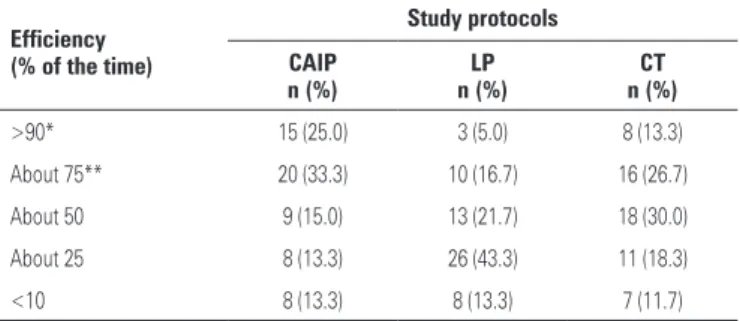
Nurses’ perceptions of the efficacy of protocols are presented in table 1. CAIP was considered efficient for maintaining glucose levels in the target range more than 75% of the time by 35/60 (58%) nurses. A total of 13/60 (22%) and 24/60 (40%) nurses considered LP and CT, respectively, efficient in maintaining glucose
levels under control (p<0.001 for CAIP versus LP and
p=0.04 for CAIP versus CT). When considering the
by CT with 13% (8/60) and LP with 5% (3/60) of the
nurses (p<0.001 for CAIP versus LP and p=0.16 for
CAIP versus CT) (Table 1).
(blood glucose ≤40mg/dL), while 27% (16/59) chose
CAIP (95%CI: 16-40), 8% (5/59; 95%CI: 3-19) chose CT, and 14% (8/59; 95%CI: 6-25) believed no difference existed between them.
Finally, the nurses were asked which protocol they wished to be implemented in their ICUs. Out of the nurses, 56% (34/60; 95%CI: 43-69) selected CAIP as the protocol they would like to be adopted in their ICUs, followed by LP with 22% (13/60; 95%CI: 12-34) and CT with 15% (9/60; 95%CI: 7-27). Among nurses involved in this study, 7% (4/60; 95%CI: 2-16) believed no difference existed between them.
DISCUSSION
In 2001, a large randomized controlled trial by Leuven demonstrated that the normalization of blood glucose levels using an intensive insulin infusion protocol improved clinical outcomes in patients admitted to a
surgical ICU(1). Since this publication, intensive insulin
therapy strategy has been recommended by guidelines
from several medical associations(4,5).
Although nurses agree with the need for glycemic control and believe that such intervention is beneficial for patient care, they also recognize the increased work effort associated with maintaining
tight glycemic control(10). Reaching blood glucose
goals requires extensive efforts from nurses, including frequent bedside capillary glucose monitoring and the implementation of a variety of insulin infusion protocols, with different degrees of complexity. Moreover, the prevalent fear of hypoglycemia among hospital staff further hinders the widespread acceptance of intensive blood glucose control protocols
administered to critically ill patients(10,11).
In the present study, nurses considered CAIP more efficacious in maintaining blood glucose levels within the target range, easier to use, and safer than the LP. In fact, nurses’ perceptions corresponded to the randomized controlled trial findings in which the mean of patients’ median blood glucose was 125.0 (±17.7)mg/dL in CAIP and 127.1 (±32.2)mg/dL in LP (p=0.34). In the CAIP group, 21.4% of patients had
at least one episode of hypoglycemia ≤40mg/dL, as
compared to 41.4% in LP (p=0.02)(17).
When CAIP was compared to CT, a statistically significant difference regarding efficacy in maintain blood glucose levels in the target range for more than 75% of the time was found. Both CAIP and CT were considered equally easy to use and feasible. Finally, the majority of nurses chose CAIP as the protocol they
Table 1. How nurses evaluate the performance of Computer-Assisted Insulin Protocol, Leuven Protocol, and conventional treatment regarding their efficiency in maintaining glucose levels within the target range (% of time that blood glucose levels were under control)
Efficiency (% of the time)
Study protocols CAIP
n (%)
LP n (%)
CT n (%)
>90* 15 (25.0) 3 (5.0) 8 (13.3)
About 75** 20 (33.3) 10 (16.7) 16 (26.7)
About 50 9 (15.0) 13 (21.7) 18 (30.0)
About 25 8 (13.3) 26 (43.3) 11 (18.3)
<10 8 (13.3) 8 (13.3) 7 (11.7)
* more than 90% of the time: p<0.001 for CAIP versus LP and p=0.16 for CAIP versus CT; ** more than 75% of the time: p<0.001 for CAIP versus LP and p=0.04 for CAIP versus CT.
CAIP: Computer-Assisted Insulin Protocol; LP: Leuven Protocol; CT: conventional treatment.
Table 2. Nurses’ evaluation of the complexity of the protocols
Complexity CAIP n (%)
LP n (%)
CT n (%)
Very easy 34 (56.7) 14 (23.3) 38 (63.4)
Easy 19 (31.7) 23 (38.3) 14 (23.3)
Difficult 3 (5.0) 16 (26.7) 6 (10.0)
Very difficult 4 (6.6) 7 (11.7) 2 (3.3)
CAIP: Computer-Assisted Insulin Protocol; LP: Leuven Protocol; CT: conventional treatment.
In answering the question, “which protocol do you believe is the most efficient?”, 34/59 (58%; 95%CI: 44-70) of the nurses chose CAIP as the most efficient, 9/59 (15%; 95%CI: 7-27) chose LP, 8/59 (14%; 95%CI: 6-25) chose CT, and 8/59 (14%; 95%CI: 6-25) believed no difference existed between them.
Nurses’ evaluation of the complexity of the protocols is presented on table 2. CAIP was classified as difficult or very difficult to use by 7/60 (11.6%) of nurses, as compared to 23/60 (38.3%) for LP and 8/60 (13.3%) for
CT (p<0.001 for CAIP versus LP and p=0.78 for CAIP
versus CT).
The nurses were asked “which protocol was the most feasible?” and they answered as follows: 22/60 (37%; 95%CI: 24-50) elected CAIP, 13/60 (22%; 95%CI: 12-34) chose LP, 20/60 (33%; 95%CI: 22-47) chose CT, and 5/60 (8%; 95%CI: 3-18) believed no difference existed between them.
in the setting of a randomized controlled trial in five different ICUs. This increases the confidence that differences in nurses’ evaluations are due to the protocols’ properties instead of an imbalance in patient characteristics (e.g., the sickest group of patients being treated with any specific protocol). All nurses involved in the administration of the protocols filled out the questionnaires, with a very low frequency of unanswered questions. Only few studies examined nurses’ perceptions as to intensive
insulin therapy(10,12,14-16). We are not aware of any
study comparing nurses’ views of three different protocols implemented simultaneously. Based on our results, it may be interesting to involve the nursing team in an insulin protocol implementation process, and it also may help to support future improvement actions.
CONCLUSIONS
The CAIP was more efficacious, easier to use, and safer than the LP according to evaluation by nurses. Compared to CT, the feasibility and safety of CAIP were considered similar. Most nurses chose CAIP as the protocol they would like to see adopted as the standard algorithm in their ICU.
REFERENCES
1. van den Berghe G, Wouters P, Weekers F, Verwaest C, Bruyninckx F, Schetz M, et al. Intensive insulin therapy in the critically ill patients. N Engl J Med. 2001;345(19):1359-67.
2. van den Berghe G, Wilmer A, Hermans G, Meersseman W, Wouters PJ, Milants I, et al. Intensive insulin therapy in the medical ICU. N Engl J Med. 2006;354(5):449-61.
3. Finney SJ, Zekveld C, Elia A, Evans TW. Glucose control and mortality in critically ill patients. JAMA. 2003;290(15):2041-7.
4. Dellinger RP, Levy MM, Carlet JM, Bion J, Parker MM, Jaeschke R, Reinhart K, Angus DC, Brun-Buisson C, Beale R, Calandra T, Dhainaut JF, Gerlach H, Harvey M, Marini JJ, Marshall J, Ranieri M, Ramsay G, Sevransky J, Thompson BT, Townsend S, Vender JS, Zimmerman JL, Vincent JL; International Surviving Sepsis Campaign Guidelines Committee; American Association of Critical-Care Nurses; American College of Chest Physicians; American College of Emergency Physicians; Canadian Critical Care Society; European Society of Clinical Microbiology and Infectious Diseases; European Society of Intensive Care Medicine; European Respiratory Society; International Sepsis Forum; Japanese Association for Acute Medicine; Japanese Society of Intensive Care Medicine; Society of Critical Care Medicine; Society of Hospital Medicine; Surgical Infection Society; World Federation of Societies of Intensive and Critical Care Medicine. Surviving Sepsis Campaign: international guidelines for management of severe sepsis and septic shock: 2008. Crit Care Med. 2008;36(1):296-327. Erratum in: Crit Care Med. 2008 Apr;36(4):1394-6.
5. Reinhart K, Brunkhorst F, Bone H, Gerlach H, Gründling M, Kreymann G, Kujath P, Marggraf G, Mayer K, Meier-Hellmann A, Peckelsen C, Putensen C, Quintel M, Ragaller M, Rossaint R, Stüber F, Weiler N, Welte T, Werdan K; Deutsche would like to be adopted as the standard algorithm
in their ICUs. We believe that CAIP was considered easier to use than LP because, in CAIP, adjustments are quick and easily completed using the computer software, while, with LP, nurses must consult a written and relatively long protocol(1,2,17).
The reason why LP was considered less safe than the other protocols may be due to the fact that nurses observed a higher incidence of hypoglycemia with this algorithm. However, the fact that, with LP, decisions regarding insulin adjustments are often left to the discretion of the nurses may have contributed to the feeling of less safety.
Blood glucose control in intensive care should be
a nurse-driven task(10-12,15,16). Nurse-driven protocols
achieve the best results in terms of glucose control and
safety(9-11). For this reason, an accurate understanding
of the insulin algorithms by nurses is essential. In particular, they should consider whether the algorithm is efficacious in terms of maintaining a controlled blood glucose level, safe and easy to use. We were able to demonstrate that CAIP was the protocol that best met these criteria.
We believe that our results can be generalized for most ICUs. The survey was performed in the setting of a trial involving five mixed ICUs. Eligibility criteria for the trial were very pragmatic and included critically ill hyperglycemic patients, who are ordinarily managed with strict blood glucose control. Finally, the algorithms evaluated are in current use (LP or CT) or may be easily implemented in the ICU routine (CAIP).
Several limitations exist in this study. First, the sample size of nurses is relatively small. Nevertheless, we observed statistically significant differences for most of the comparisons that were carried out. Second, the CAIP protocol was developed by one of the clinical trial authors. However, the study was carried out in five centers, and most nurses were not aware of this fact. Nevertheless, this may have influenced nurses’ answers. Although we were not able to estimate the size of this possible bias, we do believe it would not have changed the main conclusions of the study. Third, the difference in the target blood glucose range between CAIP (100-130 mg/dL), LP (80-110 mg/dL) and CT (80-150 mg/dL) must have influenced the nurses’ perceptions about the efficacy, complexity, and feasibility of the protocols. We cannot estimate to what extent the target blood glucose range independently influences the nurse’s perception.
Sepsis-Gesellschaft e.V. [Diagnosis and therapy of sepsis: guidelines of the German Sepsis Society Inc. and the German Interdisciplinary Society for Intensive and Emergency Medicine]. Anaesthesist. 2006;55 Suppl 1:43-56. Review. German.
6. Brunkhorst FM, Engel C, Bloos F, Meier-Hellmann A, Ragaller M, Weiler N, Moerer O, Gruendling M, Oppert M, Grond S, Olthoff D, Jaschinski U, John S, Rossaint R, Welte T, Schaefer M, Kern P, Kuhnt E, Kiehntopf M, Hartog C, Natanson C, Loeffler M, Reinhart K; German Competence Network Sepsis (SepNet). Intensive insulin therapy and pentastarch resuscitation in severe sepsis. N Engl J Med. 2008;358(2):125-39.
7. NICE-SUGAR Study Investigators, Finfer S, Chittock DR, Su SY, Blair D, Foster D, et al. Intensive versus conventional glucose control in critically ill patients. N Engl J Med. 2009;360(13):1283-97.
8. Van den Berghe G, Wilmer A, Milants I, Wouters PJ, Bouckaert B, Bruyninckx F, et al. Intensive insulin therapy in mixed medical/surgical intensive care units: benefit versus harm. Diabetes. 2006;55(11):3151-9.
9. Taylor BE, Schallom ME, Sona CS, Buchman TG, Boyle WA, Mazuski JE, et al. Efficacy and safety of an insulin infusion protocol in a surgical ICU. J Am Coll Surg. 2006;202(1):1-9.
10. Goldberg PA, Siegel MD, Sherwin RS, Halickman JI, Lee M, Bailey VA, et al. Implementation of a safe and effective insulin infusion protocol in a medical intensive care unit. Diabetes Care. 2004;27(2):461-7.
11. Vogelzang M, Ligtenberg JJ. Practical aspects of implementing tight glucose control in the ICU. Curr Opin Clin Nutr Metab Care. 2007;10(2):178-80. 12. Aragon D. Evaluation of nursing work effort and perceptions about blood
glucose testing in tight glycemic control. Am J Crit Care. 2006;15(4): 370-7.
13. Meijering S, Corstjens AM, Tulleken JE, Meertens JH, Zijlstra JG, Ligtenberg JJ. Towards a feasible algorithm for tight glycaemic control in critically ill patients: a systematic review of the literature. Crit Care. 2006;10(1): R19.
14. Malesker MA, Foral PA, McPhillips AC, Christensen KJ, Chang JA, Hilleman DE. An efficiency evaluation of protocols for tight glycemic control in intensive care units. Am J Crit Care. 2007;16(6):589-98.
15. Osburne RC, Cook CB, Stockton L, Baird M, Harmon V, Keddo A, et al. Improving hyperglycemia management in the intensive care unit: preliminary report of a nurse-driven quality improvement project using a redesigned insulin infusion algorithm. Diabetes Educ. 2006;32(3):394-403.
16. Preston S, Laver SR, Lloyd W, Padkin A. Introducing intensive insulin therapy: the nursing perspective. Nurs Crit Care. 2006;11(2):75-9.
17. Cavalcanti AB, Silva E, Pereira AJ, Caldeira-Filho M, Almeida FP, Westphal GA, et al. A randomized controlled trial comparing a computer-assisted insulin infusion protocol with a strict and a conventional protocol for glucose control in critically ill patients. J Crit Care. 2009;24(3):371-8.
Part A: efficacy of glycemic control
Question A1. How do you evaluate the Computer-Assisted Insulin Protocol (CAIP) performance regarding its efficiency to maintain glucose levels in the target range (100-130 mg/dL)?
☐ Glucose levels were almost all the time under control (>90% of the time). ☐ Glucose levels were under control most of the time (about 75% of the time). ☐ Glucose levels were under control half of the time (about 50% of the time).
☐ Glucose levels were under control only in a minor part of the time (about 25% of all time). ☐ Glucose levels were rarely under control (<10% of the time).
Question A2.How do you evaluate the Leuven Protocol (LP) performance regarding its efficiency to maintain glucose levels in the target range (80-110 mg/dL)? ☐ Glucose levels were almost all the time under control (>90% of the time).
☐ Glucose levels were under control most of the time (about 75% of the time). ☐ Glucose levels were under control half of the time (about 50% of the time).
☐ Glucose levels were under control only in a minor part of the time (about 25% of all time). ☐ Glucose levels were rarely under control (<10% of the time).
Question A3.How do you evaluate the Conventional treatment (CT) performance regarding its efficiency to maintain glucose levels in the target range (80-150 mg/dl)? ☐ Glucose levels were almost all the time under control (>90% of the time).
☐ Glucose levels were under control most of the time (about 75% of the time). ☐ Glucose levels were under control half of the time (about 50% of the time).
☐ Glucose levels were under control only in a minor part of the time (about 25% of all time). ☐ Glucose levels were rarely under control (<10% of the time).
Question A4.In your opinion, which protocol was the most efficient to control blood glucose levels? ☐ Computer-Assisted Insulin Protocol (CAIP).
☐ Leuven protocol (LP). ☐ Conventional treatment (CT). ☐ No difference between the protocols.
Part B: complexity and feasibility of protocols
Question B1. How do you evaluate the Computer-Assisted Insulin Protocol (CAIP) in relation to its complexity? ☐ Very easy.
☐ Easy. ☐ Difficult. ☐ Very difficult.
Appendix 1. Questionnaire evaluating nurses’ perception of efficacy, complexity, feasibility, safety of three different blood glucose control protocols, as well as which of these they would like to see adopted in their Intensive Care Unit (Translated from Portuguese)
Appendix 1. Continuation
Question B2.How do you evaluate the Leuven protocol (LP) in relation to its complexity? ☐ Very easy.
☐ Easy. ☐ Difficult. ☐ Very difficult.
Question B3.How do you evaluate the Conventional treatment (CT) in relation to its complexity? ☐ Very easy.
☐ Easy. ☐ Difficult. ☐ Very difficult.
Question B4. In your opinion, which protocol was the most feasible? ☐ Computer-Assisted Insulin Protocol (CAIP).
☐ Leuven protocol (LP). ☐ Conventional treatment (CT). ☐ No difference between the protocols.
Part C: safety
Question C1.In your opinion, more hypoglycemic episodes (blood glucose <40mg/dL) occurred in which protocol? ☐ Computer-Assisted Insulin Protocol (CAIP).
☐ Leuven protocol (LP). ☐ Conventional treatment (CT). ☐ No difference between the protocols.
Part D: general preferences
Question D1.Among the glycemic control protocols tested in this study, which of them would you like to see adopted as the standard protocol in your institution? ☐ Computer-Assisted Insulin Protocol (CAIP).