regional committee
XXVII Meeting
Washington, D.C. September-October 1980
WORLD
HEALTH
ORGANIZATION
XXXII Meeting
Provisional Agenda Item 27 CD27/35 (Eng.)
4 September 1980 ORIGINAL: ENGLISH
STUDY OF WHO'S STRUCTURES IN THE LIGHT OF ITS FUNCTIONS
PAN AMERICAN
HEALTH
ORGANIZATION
In accordance with Resolution XXIV of the XXVI
Meeting of the Directing Council, a decision was taken
during the 83rd Meeting of the Executive Committee in October 1979 that the Representatives from Guyana, Peru and the United States of America be appointed to "analyze, before the 84th Meeting of the Executive Committee, the, measures to be adopted by the Governing Bodies of WHO to facilitate the work of the Committee." This decision was taken in response to
resolutive paragraph 7 of Resolution XXIV, which
states:
"To request the Director to inform the 84th Meeting of the Executive Committee on the
results of the deliberations of the 65th Session of the Executive Board of WHO and the Thirty-fourth World Health Assembly on the
regional responses to this study and the
implications for the Region of the Americas."
This Subcommittee met prior to the discussion of the topic by the 84th Meeting of the Executive
Committee, and the Subcommittee Chairman, Dr. John H. Bryant of the United States of America, presented a preliminary report and brief commentary on the 65th Executive Board and Thirty-third World Health Assembly deliberations on this topic (see Document CE84/10). Due to the complexity of Resolutions EB65.RIO and
WHA33.17 and the very short time period between the
World Health Assembly and Executive Committee meeting,
further time for analysis was required by the
Subcommittee to appropriately focus on the relevant resolutive parts of WHA33.17 in terms of their impact on the Region. The Executive Committee concurred. Brazil replaced Peru on the Subcommittee at the latter's request. The Subcommittee held meetings at the conclusion of the Executive Committee meeting on 27 June 1980 and on 14 and 15 August 1980 to prepare, with the help of the Secretariat, its report to the XXVII Meeting of the Directing Council.
directing council
CD27/35 (Eng.) Page 2
Preliminary Report of the Subcommittee to the 84th Meeting of the Executive Committee
In its preliminary report to the 84th Meeting of the Executive Committee the Subcommittee identified those segments of Resolutions EB65.R17 and WHA33.17 which appeared to be of greatest concern to this Region, and provided some general observations:
-A major purpose of the structures and functions study was to strengthen the organizational and managerial framework of PAHO and WHO and provide concrete mechanisms to assist Governments in attaining the goal of health for all by the year 2000.
- The Subcommittee noted that the Assembly resolution was rather general and did not reflect a number of detailed suggestions that were contained in the Regional Report, and planned to carry out the following tasks during the interval prior to the meeting of the Directing Council:
· to translate into more specific ideas and actions those elements of the resolution of particular importance to the Region;
. to identify areas where there might need to be approaches which differed with the Assembly's resolution because of problems presented for the Region.
The Subcommittee highlighted the following components of the resolution:
. that various component bodies of WHO should now work more effectively toward attaining health for all by the year 2000;
· that Member Governments adopt an intersectoral approach to health development programs;
. that Member Governments ensure national programs are directed towards impementing directives adopted in.Geneva;
CD27/35 (Eng.) Page 3
that the Director General and Regional Director respond favorably to program requests of Member States only if they are in conformity with the Organization policies, which those Member States had helped formulate;
. that Regional Committee Meetings Members consider how their activities could be harmonized with the program and priorities of WHO;
· that Member Governments consider closer and more effective com-munication between representatives ·sent by Governments to PAHO and WHO meetings, particularly when the same persons did not attend both;
. that greater emphasis should be placed on TCDC.
The composition of the Subcommittee on Structures appointed by the 84th Meeting of the Executive Committee is:
- Dr. John H. Bryant, USA (Chairman) and Dr. Howard A. Minners (Acting Chairman)
- Dr. Mozart de Abreu e Lima, Brazil
- Dr. Thomas R. Jones, Guyana
The Regional Director, in accordance with operative paragraph 3 of Resolution CE84.R17, designated a working group of the Secretariat com-posed of Dr. Ruperto Huerta, Mr. Frank Lostumbo, Mr. Roberto Rivero and Mr. Lyndall Beamer to provide analytical assistance and support and to
prepare draft material.
CD27/35 (Eng.)
EXECUTIVE SUMMARY
This report is an analysis of the implementation requirements for the Region of the Americas in response to WHO Resolution WHA33.17 on the "Study of the Organization's Structures in the Light of its Functions." The substance of the report is organized into three major sections and can be described as follows:
Section I places emphasis on support of integrated program planning and the administrative and financial reorientation that program efforts for achieving health for all by the year 2000 will require. This involves synchronization of planning cycles with key organizations, review of the timing and content of Governing Body meetings, more effective resource allocation, and increased efforts in monitoring and evaluation activities.
Section II is devoted to the utilization of technical cooperation between and among countries (TCDC). It is noted that TCDC can be improved and strengthened through greater participation of the technical components of the Organization and through a corresponding commitment at the national level. Besides the Country Representatives, mechanisms such as the Pan American Centers, Advisory Committee on Medical Research (ACMR), and various other advisory committees should play a key role in providing technical resources for TCDC.
Section III addresses the improvement of Country/PAHO interaction. It emphasizes strengthening the role and capabilities of Country Representatives in the areas of management and administration. This strengthening will allow a broader range of functions in planning, programming, budgeting and evaluation processes, as well as provide a mechanism for Member Government involvement in TCDC. This section also
reviews country-level responsibilities, including the
CD27/35 ANNEX
(Eng.)
EVOLUTION OF THE STUDY OF WHO's STRUCTURES IN THE LIGHT OF ITS FUNCTIONS
RESOLUTION WHA 30.43 (1977) Set Goal of HFA-2000
DOCUMENT DGO 78.1
RESOLUTION WHA 31.27 (1978)
Requested Study of WHO Structures
J
Background Paper for Study
XX PAN AMERICAN SANITARY CONFERENCE (1978)
Requested Executive Committee to reevaluate & redefine role of PAHO/WHO in the Region
82nd EXECUTIVE COMMITTEE RESOLUTION XXXI (1979) Discussed and reviewed Analysis and Report
WHO SECRETARIAT
Review of Regional Reports EB 65/18 (1979)
33rd WORLD HEALTH ASSEMBLY Deliberated on topic and prepared
RESOLUTION WHA 33.17
XXVII
DIRECTING CO
XXVII DIRECTING COU81st EXECUTIVE COMMITTEE (1978) Established a Working Group Ecuador. U.S., Trinidad & Tobago - Prepared Summary Analysis - Sent Questionnaire
- Analyzed responses
XXVI DIRECTING COUNCIL (1979) RESOLUTION XXIV
Requested Executive Committee to complete Report & Secretariat to forward to WHO
REPORT of REGION sent to WHO
65th EXECUTIVE BOARD (1980) Discussed and submitted Resolution EB 65 R 12
84th EXECUTIVE COMMITTEE (1980)
Working Group,composed of Subcommittee including Brazil, Guyana, the United States with the assistance of PASB conducted an analysis and prepared a REPORT ON THE REGIONAL IMPLICATIONS OF WHA 33.17
CD27/35 (Eng.) ANNEX
REPORT TO THE XXVII MEETING OF THE DIRECTING COUNCIL
OF THE SUBCOMMITTEE ON THE "STUDY OF WHO
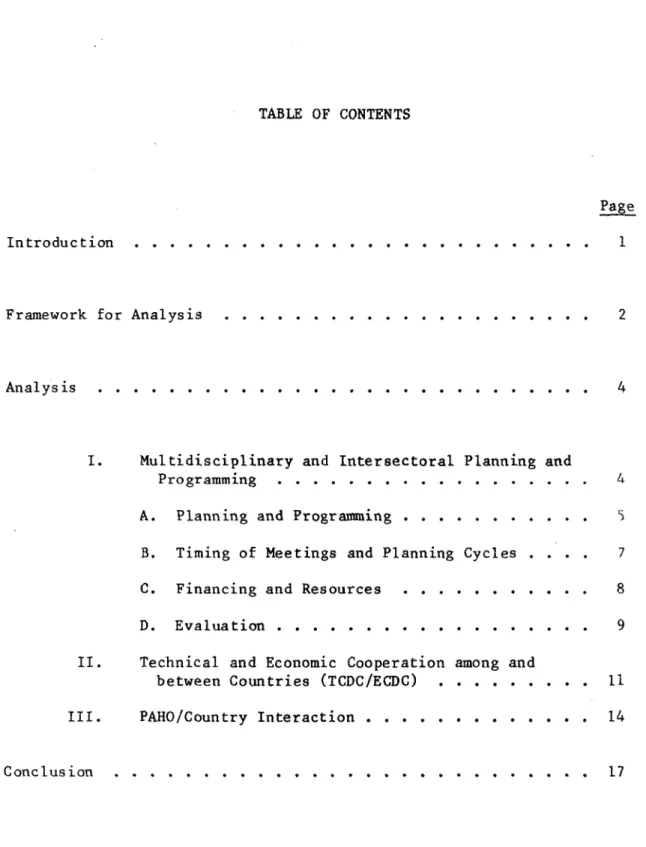
TABLE OF CONTENTS
Page
Introduction ... ... 1
Framework for Analysis . . . .. 2
Analysis . . . 4
I. Multidisciplinary and Intersectoral Planning and
Programming ... 4
A. Planning and Programming . . . 5
B. Timing of Meetings and Planning Cycles . . .. 7
C. Financing and Resources . . . 8
D. Evaluation ... 9
II. Technical and Economic Cooperation among and
between Countries (TCDC/ECDC) . . . ... 11
III. PAHO/Country Interaction . . . ... 14
INTRODUCTION
1. World Health Assembly Resolution WHA30.43 (1977) called for the attainment by all people of the world by the year 2000 of a level of health that will permit them to lead a socially and economically productive life. In view of the enormous implications of this resolution, the following year the Assembly approved Resolution WHA31.27, which asked the Director General to re-examine the Organization's "structure in the light of its functions" to meet the goal it had set for itself over the next two decades.
2. In response to this request, and to define the terms involved, in July 1978 the Director General prepared Document DGO78.1 which outlined
the basis for further study and recommendations by the Member Governments. In this and related documents the Director General promoted the view that the "Organization" under study was not merely the Secretariats at Headquarters or regional levels but rather the Organization in its broadest sense: the Governing Bodies, Secretariats, and, most importantly, the Member Countries themselves. Further, the term "structures" is interpreted broadly to include all of the process, organs, organizational structures, mechanisms and working relationships involved in reaching the overall objectives of the Organization.
3. Therefore, the title of this undertaking, "Study of WHO's Structures in the Light of Its Functions," implies that the Governing Bodies of PAHO/WHO should participate in the long-term process of adjusting the Organization's structures to the new strategies--and the resulting new functions--that will be formulated in order to attain the goal of health for all by the year 2000.
4. Because of the complicated nature and far-reaching effects of the document, the 81st Meeting of the Executive Committee of PAHO selected three Governments to serve as a Working Group on behalf of the Executive Committee to study DGO78.1 and to develop a report for submission to PAHO's 82nd Executive Committee and XXVI Directing Council in 1979. The Working Group prepared a summary analysis of the document and developed a questionnaire which was sent to all Member Governments of the Region to solicit their views on the major issues and on the options presented. On the basis of the responses received, the Working Group prepared a report for the consideration of the XXVI Meeting of the Directing Council. After the Directing Council's study of the report, and the incorporation of the salient features of its discussion, the final version of this report was transmitted by the Regional Director to the Director-General of WHO on behalf of the Member Governments of the Region of the Americas.
-
2-6. At the Thirty-third World Health Assembly (May 1980) the Chairman of the Executive Board submitted the Board's report and proposed resolution to a plenary session of the Assembly, where they received further careful scrutiny. The Assembly's resolution, "Study of the Organization's Structures in the Light of Its Functions" (WHA33.17), represents the results of the efforts of all of the Member Governments, the Regional Offices and Headquarters over the past two years.
7. Due to the scope, complexity and importance of WHA33.17, the 84th Meeting of the Executive Committee of PAHO asked the three-member Working Group (thereafter called Subcommittee for the Study of WHO's Structures in the Light of Its Functions) and the Secretariat to continue its analysis of the issues raised by the resolution. The results of the Working Group's study, which are submitted for the consideration of the XXVII Meeting of the Directing Council, are set forth in the report which follows.
FRAMEWORK FOR ANALYSIS
8. To carry out the responsibilities assigned by the 84th Meeting of the Executive Committee (CE84/10), i.e., to analyze the issues raised by the "Study of the Organization's Structures in the Light of Its Functions" and by WHA33.17, the Working Group and the Secretariat made every effort to reflect the views and interests of the Member Governments of the Region. This involved a careful analysis of the following documents:
a) Study of WHO's Structures in the Light of Its Functions, DGO78.1 (July 1978);
b) Study of WHO's Structures in the Light of Its Functions: Report of the Member States of the Region of the Americas
(October 1979);
c) Proceedings of the 65th Executive Board (1980) and the Thirty-third World Health Assembly (1980), the 82nd Executive Committee and the XXVI Directing Council (1979), and the 84th Executive Committee (1980);
d) Resolutions WHA33.19 and WHA31.27, and Resolutions XVII and XVIII of the 84th Meeting of the Executive Committee.
9. Resolution WHA33. 17 contains 37 operative paragraphs in six sections which assign interrelated responsibilities to various levels of
the Organization. These responsibilities can be categorized as follows:
Section 1; eight paragraphs related to general or global decisions;
-3-Section III: eight paragraphs addressed to the Regional Committees;
Section IV: five paragraphs related to the Executive Board;
Section V: one paragraph addressed to the Director General and Regional Directors;
Section VI: five paragraphs addressed to the Director General.
10. While bearing in mind the intent of the entire resolution, the Subcommittee concentrated its efforts on key items in Sections II and III for in-depth analysis. This emphasis was motivated by the fact that these sections contain the most direct regional/country responsibil-ities. The items in these sections were reviewed with the following criteria in mind:
- Areas or issues which lend themselves to immediate implementation by PAHO;
- Areas or issues which primarily require: country initiatives; cooperative country/PAHO activities or further development within PAHO.
11. After considering the foregoing factors and reviewing the
above-mentioned documents, the Subcommittee decided upon an
issue-oriented approach to its analysis. Three substantive, interrelated issues were identified as particularly relevant to the PAHO Member Governments and of basic, underlying importance to the entire resolution. These issues, which provide the basic orientation of this report, are:
I. Multidisciplinary, Intersectoral Planning and Programming;
II. Technical and Economic Cooperation among and between Member Governments (TCDC/ECDC);
III. Country/PAHO Interaction.
12. Focusing its analysis on these major issues, the Subcommittee, with the very helpful support and cooperation of the PAHO Secretariat, has identified current regional activities which may be seen as
responsive to WHA33.17. The Subcommittee then makes specific recommendations for future action, identifying concrete steps for their
implementation. The Subcommittee has sought to make these
-4-ANALYSIS
I. MULTIDISCIPLINARY AND INTERSECTORAL PLANNING AND PROGRAMMING
13. WHO and PAHO have agreed that health for all by the year 2000 (HFA-2000) is the universal goal upon which all global and regional priorities should focus. The pursuit of this objective should guide programming, planning, monitoring and evaluation functions, and it should provide the bas is on which the roles of global, regional, and sub-regional components are determined.
14. Planning health programs must be a joint effort between the Member Governments and all levels of the Organization. Collaborative functions
should be mutually supportive and properly interrelated at all levels, with the understanding that such efforts must include health and related socioeconomic sectors of society. Care must be taken to develop technologies which are effective, relevant, socially acceptable and economically feasible.
15. Sections II and III of WHA33.17 contain a number of operative paragraphs which refer to these issues.
16. WHA33.17 recognizes the importance of the goal of HFA-2000 as the foundation for all prioritization explicitly in Sections II and III,
paragraphs 2.3, 2.6, 2.9, 3.1, 3.2, 3.3, 3.4, 3.8, and implicitly throughout the entire document. Specific recommendations include better coordination between Member Countries of national, regional and interregional health programs and a more active regional role in making recommendations and proposing strategies, particularly through the strengthening of appropriate subcommittees of the Regional Committee. The resolution calls for closer coordination, careful choice of country representatives to serve on planning and governing bodies, and an
increase in monitoring, control and evaluation functions at the Regional Committee level to improve the quality of program implementation.
PAHO Regional Response to the Director General
17. A review of the Report of the Member States of the Region of the
Americas on WHO structures, and of WHO proceedings, indicates that the Member Governments are generally satisfied with the basic structures of the Organization but stress the need for a new philosophy and orientation
in the dynamics and conduct of the work of the Organization.
18. The PAHO Member Governments called for the improvement of program planning efforts through multisectoral programming by making greater use
of working groups and task forces and by focusing on planning in a coordinated way from the country level up to the sub-regional, regional and global levels.
-5-19. The PAHO Member Governments strongly agree with HFA-2000-oriented prioritization at the country, regional and global levels. There is strong support for greater country and regional input in the development of policies, programs and strategies and a modest amount of support for the strengthening of regional subcommittees to assist in this development.
Discussion
A. Planning and Programming
20. The Subcommittee recognized that the goal of HFA-2000 required some fundamental shifts at national levels in policy, approach and in coordination with other sectors related to health. Further national plans should include progams consistent with regional and global priorities. National goals should encompass quantifiable objectives with measurable outputs. An important component in the development of national strategies should include considerations of funding realloca-tions and reprogramming of available national resources, including health and related sectors. At the regional level, increased productivity and more effective program management is necessary. This will also require new and innovative approaches to utilization of existing mechanisms, such as advisory committees or special working groups. An expanded role in priority setting could be envisaged for the Advisory Committee on Medical Research (ACMR).
21. To develop regional health policies and programs in support of strategy development and technical cooperation, the following committees or study groups have recently been formed:
21.1 The 82nd Meeting of the Executive Committee (1979) appointed a subcommittee, currently composed of representatives from Canada, Chile, and Guatemala, to participate in the development of long-term planning strategies. This subcommittee is unique in providing opportunities for several Member Governments to actively participate in the regional planning and policy development process. This group has collaborated with the Headquarters Program Committee and with the Secretariat's own Long-Term Planning Unit to review a draft document on the regional strategies for health for all.
-6-21.3 At the request of the Directing Council, various external study groups have been involved in the monitoring and evaluation of several of the Pan American Centers. These efforts and experiences will contribute to defining the future role that the Organization will play in the development and support of health for all.
22. The Directing Council's attention is drawn to the steps taken by the Director in implementing the policies and guidelines of the Governing Bodies. These include the following:
- Creation of better norms and guidelines for the
activities of Country Representatives and close
monitoring of their application, validity and
effectiveness;
- Progressive decentralization to enable prompter response and action at 'the country level to the greatest extent possible;
- Renewed emphasis on the promotion and utilization of primary health care, community participation, and appropriate technology under the concepts of TCDC and
economic cooperation among developing countries (ECDC);
- Emphasis on multidisciplinary team-oriented problem solving;
- Creation of the Office of Operations Manager to oversee and to monitor program development and implementation at field level, and to provide support to Country Representatives;
- Modifications and integration of the various technical program functions of the Secretariat and consolidation into four primary divisions to achieve greater horizontal coordination, and to better serve the countries in the attainment of HFA-2000;
- Establishment of the Long-Term Planning Unit to
complement the planning efforts of the Region.
7
-B. Timing of Meetings and Planning Cycles
23. Recognizing the importance of the interaction of PAHO's and WHO's planning and programming cycles, the timing of the meetings of their respective Governing Bodies, and the potential implications of biennial World Health Assemblies, which are being studied in greater depth by other bodies in PAHO and WHO, the Subcommittee believes that such matters should be discussed as an integral part of planning and programming issues.
23.1 The Subcommittee noted problems with the sequence of regional vs. global review of some important policy and related budgetary issues. This may not be due to the chronological sequence of PAHO and WHO meetings but rather to the timing of the review process. For example,
PAHO currently reviews the WHO Program and Budget after it has been approved by the World Health Assembly. A more anticipatory scheduling of the review process for this and other items would be desirable.
23.2 Concerning planning and programming cycles, the Program Development Working Group of WHO, a subsidiary unit of the Global Program Committee (GPC), held a meeting in Manila (14-18 July 1980) with PAHO participation. A report will be presented to the GPC. The Subcommittee on Long-Term Planning, of the Executive Committee of PAHO prepared a draft resolution which recommends the development of a plan of action to implement regional strategies. This plan should include measures to bring about greater coordination in the planning and programming cycles of PAHO and WHO, taking into consideration the many factors which uniquely characterize the Region of the Americas. In this respect the synchronization of PAHO program and planning cycles must continue to relate effectively not only with WHO as a whole but also with the program
and planning cycles of such other organizations as the Inter-American Development Bank (IDB), Economic Commission for Latin America (ECLA), United Nations Development Program (UNDP), etc. While these latter planning cycles are on a 10-year basis, the WHO Programs of Work are on a
6-year cycle. The question raised by the Subcommittee is: Should PAHO follow the same cycle as WHO, and if so, will this adversely affect compatibility with other systems?
-8-25. The 84th Meeting of the Executive Committee passed Resolution XVIII supportive of the concept of biennial World Health Assemblies. This places even greater, responsibility on the Regional Committee to maintain strong continuity and to initiate and contribute innovative
ideas and resolutions to the Board and Assembly. Logically scheduled meetings are critical to achieving an effective and efficient dialogue.
26. The PAHO Member Governments are in favor of the synchronization of
planning and programming cycles: 12 of the 18 responding Governments favored biennial Assemblies and a majority suggested the careful study of the coordination of the timing of meetings. Another important aspect is the composition of delegations and national-level preparation and coordination to assure that consistent positions can be taken by national delegations at both PAHO and WHO meetings.
C. Financing and Resources
27. The Director General iaLs established the "Health 2000 Resources Group" (HRG) at the global level. The group will be composed of members from developed and developing countries, multilateral agencies, and non-governmental organizations, acting in their personal capacities. The Region may wish, through inputs to the Executive Board, to suggest a broadened scope of the ERG, which currently emphasizes the donor role and funding, to focus more on the programming aspects of achieving HFA-2000. The Director General has invited the Regional Committee to nominate a member from the Region of the Americas. Under Item 42 of the Provisional Agenda, the Directing Council/Regional Committee is asked to consider selecting one of its Member Governments, which will in turn nominate an individual to this group.
28. A commitment to the goal of HFA-2000 requires all levels of the Organization to assess the health-related sectors for available resources that can be equitably distributed and determine priority areas needing new external sources of funds. External funding of international health activities has become increasingly important in the work of PAHO/WHO. In
9
-29. Within PAHO, the Director has established the Project Review Group (PRG) as a first step toward rationalization and coordination of external funding for health for all. The PRG is designed to ensure the integration of PAHO's activities as an executing agency of extrabudgetary funded projects and to monitor adherence to priorities set by the Governing Bodies. It is chaired by the Deputy Director and includes the heads of the Technical Divisions. All externally funded projects, including grants, contracts, loans, etc., are screened by the PRG. As an internal mechanism for examining the relevance of proposals to the priorities of the Organization, the PRG should develop a working relationship with the external HRG at the global level.
D. Evaluation
30. In PAHO/WHO the process of monitoring and evaluation at the level of the Governing Bodies was promoted by the 82nd Executive Committee's Evaluation Model for application to the Pan American Centers. The model is based on four phases to allow for full country and Secretariat participation during the process. Phase one is a self-audit by the Center. Phase two is a technical and administrative analysis undertaken by the Secretariat. Phase three comprises the perceptions and assessments of the Member Governments served by the Center. And phase four is the analysis and recommendations of an external team of multidisciplinary experts.
31. The Member Governments develop the Organizations policies and resolutions. It is therefore incumbent upon them to review and evaluate, with the collaboration of the Secretariat, the effectiveness of their programs. PAHO can cooperate in this effort through the Planning and Evaluation Program of the Region of the Americas (AMPES) and other means. This can involve identification of program progress and of appropriate corrective steps which can be taken if necessary. In the last few years PAHO has cooperated with several Governments in the evaluation of its activities in those countries.
32. The experience gained in the process of applying the Evaluation Model to five PAHO Centers has provided the Region with a significant base of experience. It is expected that this process will be continued at a rate of two additional Centers per year until they have all been evaluated. The Directing Council may give consideration to the application of a similar approach to the evaluation of selected regional (AMRO) projects.
Recommendations
1. That particularly in view of biennial Assemblies, the Directing Council consider ways and means of increasing the flow of information and experience from PAHO to WHO in a constructive and creative manner;
- 10
-b) to utilize the leadership capacity that exists in the Region;
c) to strive to have resolutions presented at the global level which have been initiated by the Region and which reflect country needs and activities.
2. That the Member Governments should develop national health programs, in cooperation with the Secretariat, which reflect an appropriate consistency with the global and regional priorities of the Organization.
3. That the Director of PAHO seek ways to broaden the scope of the ACMR and to incorporate it into the regional priority setting process.
4. That Member Governments work to enhance the preparation and coordination of Member Governments delegations to the Meetings of the Governing Bodies of PAHO and WHO, to achieve a more consist input.
5. That the Director analyze the content and timing of the Meetings of the Executive Committee/Directing Council for the purpose of strengthening PAHO contributions to the review process of the Executive Board and World Health Assembly and make recommendations to the 86th Executive Committee Meeting.
6. That PAHO strive to synchronize its planning cycles with those of WHO taking into consideration the cycles of other agencies within the
UN System.
7. That the Directing Council consider the establishment of a regional mechanism to improve the flow of resources available for priority programs from the global to the regional level.
8. That consideration be given to reorient the role and functions of the Pan American Health and Education Foundation (PAHEF), with the
assistance of the Director, as a mechanism for multisectoral fund-raising.
9. That the Directing Council consider an allocation of resources to increase the emphasis on monitoring and evaluation activities during the 1982-1983 period.
10. That the Directing Council give consideration to the application of an approach similar to the Pan American Centers Evaluation Model to evaluate selected regional AMRO projects.
11. That the Governing Bodies should use the experience gained by PAHO/country programming activities and in the use of AMPES for further
- 11
-II. TECHNICAL AND ECONOMIC COOPERATION AMONG AND BETWEEN COUNTRIES
(TCDC/ECDC)
33. Technical cooperation between and among countries is seen as the major mechanism through which WHO and PAHO programs are to be carried out in a coordinated fashion. PAHO has led the way in this area and such cooperative relationships reflect the truly international nature of the Organization.
33.1 The discussion of this item at the January 1980 meeting of the Executive Board of WHO focused primarily on the coordination of external donors for health for all. This subject, however, encompasses a large and complex set of issues which have come to the attention of the international community.
34. WHA33.17 makes repeated reference to the increased need for TCDC in the activities of Member Countries and Regional Committees. Sections II and III, paragraphs 2.3, 2.4, 2.5, 2.6, 3.1, 3.3 and 3.4, refer to TCDC. They call for intercountry coordination of TCDC and strong Regional Committee support for and facilitation of TCDC.
PAHO Regional Response to the Director General
35. The PAHO Member Governments called for the establishment of in-country TCDC focal points, an increased TCDC coordinating role for the PAHO Headquarters, the improvement of technical expertise at the ministry of health level, and for better communication based on the development of an improved information system which would provide an up-to-date
inventory of country needs and resources.
Discussion
36. Technical Cooperation Among Developing Countries (TCDC), and more recently, Economic Cooperation Among Developing Countries (ECDC), have been the subject of high-level, international discussions as instruments to further cooperation among Member Countries. Given the importance assigned by all levels of the Organization to the TCDC/ECDC mechanisms, the following is a review of several important factors in applying these concepts:
36.1 The most readily available expression of direct technical cooperation is collaboration between two or more countries, regardless of their level of socioeconomic development.
12
-36.3 The successful utilization of TCDC/ECDC is heavily dependent on a definitive commitment of the resources of the countries to this mechanism. In this context the Pan, American Centers offer a unique capability in creating opportunities for TCDC and in providing relevant information and technical support to the countries.
37. There are a number of excellent examples of cooperation between and among Member Countries within TCDC/ECDC. A few of these are highlighted here as representative of efforts under way in the Region of
the Americas.
37.1 Early practical exercises in TCDC began with the advent of malaria eradication programs in AMRO during the fifties. The countries of Central America and Panama concluded bilateral agreements for both
interior house spraying with insecticides and epidemiological evaluation, with the staff of one country conducting operations on the territory of a neighboring country, and ongoing exchanges of information on the malaria situation in border areas. A, more recent example is the bilateral agreement between Argentina and Bolivia for a malaria eradication program.
37.2 The Training Program for Community Health for Central America and Panama (PASCCAP) is a working example of technical cooperation among developing countries. It: operates through a center for the education and training of auxiliary health personnel, located in Costa Rica, which receives the technical and financial support of PAHO/WHO, UNDP, UNICEF, and the Canadian International Development Agency (CIDA). The national personnel of the countries in the area participate in charting the policies, drawing up study plans and implementing teaching activities for their collective benefit. This Center functions through collaborating national subcenters which are themselves additional resources of an expanding network. Experts from developed countries and national teaching institutions of international standing contribute to activities under PASCCAP.
37.3 The U.S-Mexico Border Health Association exemplifies the concept of cooperation between these two Member Governments in a planned and coordinated manner, using a wide range of resources at different governmental levels, and including the private sector. PAHO cooperates in and provides the support mechanism for these activities through its Field Office in E1l Paso, Texas.
37.4 The program for education and training of allied health personnel in the Caribbean has five national centers and its headquarters in Barbados. Its main function is to train personnel from all of the English-speaking Caribbean countries and territories, including Belize.
13
-38. While there is general commitment to the concept of TCDC, some administrative and legal barriers exist which will require eventual resolution. These include administrative and procedural norms at country level which may delay and/or restrict deployment or selection of personnel, processing of financial actions, travel authorizations, etc., and global level criteria regarding recruitment policies. These guidelines for geographical distribution of staff tend to create some difficulties in the Americas, particularly in the subregion of the Caribbean. An example involves nationals of some countries which are already over-represented and are thus, to a degree, precluded from recruitment to PAHO posts. Further, at national levels, there are legal barriers in some countries that restrict nationals traveling on
international consultantships in TCDC activities. In this context attention needs to be given by the countries and the Organization to developing more flexible approaches to international cooperation and, to the extent possible, to resolve those administrative and legal restrictions that constrain TCDC efforts.
38.1 The Subcommittee acknowledged the need for better information dissemination between and among the Organization and Member Governments and the need for a databank for TCDC. However, it urged caution in the development of large information systems and databanks without first considering the strategies and priorities being developed within the
k
Region. The Subcommittee noted that large information systems do not always justify the costs of maintenance and updating when assessed in terms of their usefulness. In relating different ways that information systems can be approached, the Subcommittee noted that the Organization should be flexible in regards to the type of any proposed information system. PAHO should focus on mechanisms for assisting interested countries in identifying available resources and technical expertise within the Region to pursue in a cooperative manner TCDC initiatives.38.2 In this regard the sharing of information throughout all levels of the Organization can be improved through better use of Country Representatives and of existing mechanisms, such as Centers and Advisory Committees. Drawing on the priorities of the Region and utilizing the various mechanisms cited above, the Secretariat could establish problem-oriented task forces as instruments for pursuing TCDC initiatives at regional levels.
Recommendations
14
-2. The Secretariat should exert more of a leadership role in developing mechanisms to facilitate the interaction of countries to pursue TCDC efforts around subjects of common interest.
3. The Secretariat should analyze the needs and requirements for information related to TCDC and,, utilizing such mechanisms as Centers and Advisory Committees, focus initiatives
on-- stimulating cooperative activities at subregional levels;
- providing relevant information for dialogue among interested countries;
- considering the establishing and coordination of information exchange systems for TCDC utilizing country focal points.
III. PAHO/COUNTRY INTERACTION
Background
39. As discussed in Section I, achievement of the global goal of HFA-2000 requires program modifications and improvements on the part of both the Secretariat and the Member Governments. These modifications and improvements will primarily rely on the interaction of PAHO field units with national counterparts. The key to making this work effectively is the Country Representative.
40. WHA33.17, 2(4), (urges Member States) "to ensure that WHO's action in their countries reflects adequately Resolution WHA31.27 concerning the conclusions and recommendations of the Executive Board's Organizational Study on 'WHO's Role at the Country Level, Particularly the Role of WHO Representatives,' and particularly the shift from technical assistance to technical cooperation." The Organizational Study mentioned above stressed the importance of flexibility and the recognition of individual differences in the relationships between PAHO Country Representatives or WHO Coordinators and the national officials of the countries to which
they are assigned. Attainment of HFA-2000 places a higher order of responsibility on PAHO Country Representative in terms of reorienting field units operations and in terms of a partnership role with national counterparts, in planning and implementation of PAHO/WHO activities..
15
-42. WHA33.17 speaks repeatedly, to the need for strengthening the role of the WHO Member Governments at every level, especially in paragraphs 2.1, 2.2, 2.3, 2.4, 2.6, 3.4, 3.6 and 3.8. This places increased importance on the development of national intersectoral cooperation and on the organizations in the Region of the Americas through broader use of the Country Representatives.
PAHO Regional Response to the Director General
43. The PAHO Member Governments strongly support the expansion of the Country Representative role through additional training in technical areas, including management and administrative skills. This would allow the assignment to the Country Representative of increased budgeting, programming, planning, evaluation and monitoring functions. It would also provide a mechanism for response to the Member Governments request
for an in-country focus to promote TCDC.
Discussion
44. Important points of the study on "WHO's Role at the Country Level, particularly the Role of the WHO Representatives" and Resolution WHA31.27 include:
· The need to establish a cooperative relationship with national officials to the greatest extent possible, utilizing their expertise in the development of country programs and moving from technical assistance and dependence on outside assistance to technical cooperation and national self-reliance;
Improvement of the collaboration between the Country Representatives (CR's) and national health officials to promote the most effective management, planning and evaluation of country health programs. This implies the most effective possible use and redeployment of national resources as well as those available from external sources;
· The need for well-qualified CR's with the appropriate background, interest, and professional skills is of vital importance. In this relationship, emphasis should be on their technical and managerial skills rather than diplomatic and representational functions. This requires careful selection of new candidates from a variety of disciplines and, where necessary, provision of additional
16
-45. A one-week meeting of Headquarters and field managers of PAHO took place in early March 1980. The purpose was to review with Field Managers the reorientation of regional and global policies of the Organization and their implications, as well as the process and definition of national and regional strategies for the year 2000. Special emphasis was placed on a clear definition of lines of authority and coordination among the different levels of the Secretariat, as well as the requirements of this new relationship between all levels of the Organization and national authorities.
46. The Subcommittee recognizes the importance of PAHO's role in assisting the Member Governments, as required, in the process of strengthening the technical expertise of ministries of health in support of multisectoral strategies of HFA-2000. It also recognizes that administrative and procedural regulations exist in some countries which may hinder the effective delivery of health services.
Recommendations
1. That PAHO more clearly define its goals and objectives to encourage an improved understanding among all concerned of the coordinative/collaborative role and function of PAHO. This might include: communication with national authorities and CR's on PAHO's role; increased emphasis by the Secretariat on the type of role PAHO can play in the promotion of the IEFA-2000, and a clearer understanding that the strength of PAHO is based on its human resource capacity in providing technical cooperation and coordination and as a catalytic agent. It should be understood that PAHO is not equipped to simply fund projects or serve as a supply mechanism.
2. That countries identify and implement appropriate initiatives for removing administrative barriers which hinder program delivery.
3. That the Director continue to strengthen support for CR's in the field and to delegate to them increased responsibilities while providing better communications and managerial support, and developing more flexible administrative guidelines for the field. In conjunction with this the Organization should:
a) emphasize in-service training of field office staff utilizing
seminars, workshops, correspondence courses and other
continuing education mechanisms;
- 17
-c) assure that all Country Representatives be informed of the decisions made by the PAHO Governing Bodies.
4. The Organization should broaden its selection process for selecting future CR's to include qualified applicants with international experience from a variety of backgrounds (e.g., the social sciences, engineering, business administration) and with appropriate basic skills and experience, particularly in management, to meet the wider responsibilities of the coming decades.
5. The Organization should work with Member Governments in organizing seminars for appropriate national health staff to increase their expertise in developing externally funded projects. In support of this effort, the Directing Council should consider scheduling Technical Discussions at a future meeting of the Directing Council on analyzing opportunities and problems for externally funded health projects.
CONCLUSION
Achievement of the goal of HFA/2000 places responsibility on all levels of the Organization. This report focuses *on the analysis of issues of particular importance to the Region. It also outlines responsibilities and provides guidelines for the national and regional response to the recommendations embodied in Resolution WHA33.17.
The national level responsibilities include;
. the assurance of a dynamic interaction between health and socioeconomic sectors and the development of measurable objectives and quantifiable indicators in the planning and budgeting process;
· the establishment of priorities for reallocation of available governmental resources from all sectors and for external funding requirements;
· the establishment of internal communication mechanisms to assure continuity of Member Government participation in WHO and PAHO Governing Body meetings;
· the continuation of collaboration with the Organization in the evaluation of PAHO country projects; and
18
-The regional level responsibilities include:
· the reorientation of the Secretariat to provide
multidisciplinary, team-oriented support to assist Member Governments in program planning and implementation;
· the adjustment of the scheduling of PAHO Governing Body review of WHO policy and budgetary issues to precede global level approval and movement toward the synchronization of PAHO/WHO planning cycles, taking into account other UN system planning cycles.
· the creation of a proper environment to encourage multicountry TCDC efforts utilizing PAHO Advisory Committees, PAHO Centers/National Centers, extrabudgetary funding sources, and the strengthening of the CR role in subregional activities; and