Effects of cytoplasmic inheritance on preweaning traits of Hereford cattle
Carlos Alberto Mezzadra
2, Lilia Magdalena Melucci
1, Pablo Marcelo Corva
1, Sebastián López Valiente
1,
María Verónica Rípoli
3, Pedro Lirón
3and Guillermo Giovambattista
31
Universidad Nacional de Mar del Plata, Facultad de Ciencias Agrarias, Departamento de Producción
Animal, Balcarce, Argentina.
2
Instituto Nacional de Tecnología Agropecuaria, Departamento de Producción Animal, Balcarce, Argentina.
3
Universidad Nacional de La Plata, Facultad de Ciencias Veterinarias, Centro de Investigaciones
en Genética Básica y Aplicada, La Plata, Argentina.
Abstract
The influence of cytoplasmic inheritance on birth and weaning weight was evaluated in an experimental Hereford herd. Data on 1,720 records for birth and weaning weights from calves born between 1963 and 2002 were studied. Variance components were estimated using MTDFREML procedures and an animal model was fitted for each trait. Direct and maternal additive effects and permanent environment and maternal lineage effects were treated as random, while year and month of birth, age of dam and sex of the calf were treated as fixed. Identification of maternal lineages was based on pedigree information. The contribution to phenotypic variance of cytoplasmic lineages defined by pedigree information was negligible for both traits. Mitochondrial genotypes of cows present in the herd in 2002 were analyzed by single strand conformation polymorphism (SSCP) analysis. Only five different genotypes were identified among 23 maternal lineages. All the animals with records were assigned to maternal genotypes based on pedigree information. The statistical analysis was repeated, removing maternal lineage from the model and including mitochondrial genotype as a fixed effect. No evidence of genotype effects was detected. These results suggest a negligible effect of the mitochondrial genome on the preweaning traits of this Hereford herd.
Key words:beef cattle, Hereford, birth weight, weaning weight, cytoplasmic inheritance, SSCP.
Received: July 7, 2004; Accepted: April 18, 2005.
Introduction
The Hereford herd at the National Institute of Agri-cultural Technology (Instituto Nacional de Tecnología Agropecuaria, INTA) Experimental Station at Balcarce, Argentina was created in 1959 with cows bought from dif-ferent private ranches and has been under selection for preweaning traits since 1986. Selection was originally based on a phenotypic index aimed at increasing relative preweaning growth rate while keeping birth weight con-stant (Melucciet al., 1983). More recently, the index was reformulated in order to include additive direct effects for growth rate and birth weight estimated by an animal model instead of the corresponding phenotypic values (Melucci, 1995).
Response to selection and changes in genetic parame-ters in this population have been monitored (Melucci and Mezzadra, 2003) but all the studies were focused on the
ef-fects of the nuclear genome and the influence of the mito-chondrial genome, another potential source of genetic vari-ation, has never been evaluated in this herd.
The mitochondrial genome has much fewer genes than the nuclear genome but a high proportion of mitochon-drial genes are involved in the regulation of cellular energy metabolism (Anderson et al., 1982) and given the high number of mitochondria per cell (Alberts et al., 1994), a slight difference in the effects of these genes could have an impact in cell metabolism and consequently, could also in-fluence the performance of economically important traits. In short, there could exist a link between economically im-portant cattle traits and genetic variation at the level of the mitochondrial genome.
It has been assumed that the mitochondrial genome is transmitted almost exclusively through the maternal line. In most South American countries, new breeds and biotypes within breeds have been introduced through semen impor-tation in order to upgrade the local breeds (Mirol et al., 2003). In this situation, the cytoplasmic genetic back-ground remains fairly constant over time and it would be www.sbg.org.br
Send correspondence to Pablo M. Corva. Instituto Nacional de Tecnología Agropecuaria, Departamento de Producción Animal, CC 276, 7620 Balcarce, Argentina. E-mail: [email protected]. gov.ar.
worthwhile to assess the existence of more productive mi-tochondrial genotypes.
Several studies have addressed the influence of cyto-plasmic inheritance in dairy and beef cattle, either by esti-mation of the contribution of maternal ancestry to total variance or by direct association between mitochondrial DNA polymorphisms and productive traits. The results of these experiments are controversial and do not confirm any advantage of one given approach (i.e.biometric or molecu-lar) over the other. While some workers have reported a sig-nificant influence of mitochondrial genes on performance (Schutzet al., 1994; Mannenet al., 1998; Roughsedgeet al., 1999; Schnitzenlehner and Essl, 1999) others have con-cluded that the effect of such genes is negligible (Rohreret al., 1994; Albuquerqueet al., 1998; Roratoet al., 1999) and it therefore appears that the importance of mitochondrial genome on cattle performance has not yet been fully eluci-dated.
Because there is some evidence suggesting a relevant role of the mitochondrial genome on cattle performance, and in order to complete the genetic characterization of the INTA Hereford herd we evaluated the influence of cyto-plasmic inheritance on preweaning traits using several dif-ferent strategies. In one approach we estimated the contribution of maternal lineage effects to total variance us-ing an animal model. In another approach the identity of maternal lineages was confirmed by identifying mitochon-drial DNA (mtDNA) genotypes using single strand confor-mation polymorphism (SSCP) analysis and correlated these genotypes with preweaning traits.
Materials and Methods
Experimental design
At the National Institute of Agricultural Technology (Instituto Nacional de Tecnología Agropecuaria, INTA) Experimental Station at Balcarce, Argentina, a herd of about 120 Hereford cows is kept on pasture throughout the year. Calving season normally runs from August to Octo-ber, although in some years cows have calved in Novem-ber. Calves do not have access to creep feed. Some Hereford cows are included in crossbreeding experiments each year, so in our analysis records relating to calves not sired by Hereford bulls were removed. Although most male calves are left intact, some castrated animals produced in-formation and were included in the data set.
Maternal lineages were identified by tracing female paths to the last female ancestor in the herd. In order to pro-vide a better estimation of variance components only those maternal lines with at least five records were considered in our analysis (Roughsedgeet al., 1999). The final data set consisted of 1,720 records of birth and weaning weight lin-early adjusted to 180 days of age, from calves born between 1963 and 2002 (one to nine records per cow). A total of 2,389 animals were in the pedigree file.
Molecular analysis
Blood samples were collected from most of the cows present in the herd in 2002. The DNA was extracted from whole blood according to standard procedures (Maniatiset al., 1982). Two to four cows from each of twenty-three ma-ternal lineages were picked at random for mitochondrial DNA (mtDNA) analysis. Two different regions of the hypervariable mitochondrial displacement loop (D-Loop) were amplified by PCR. Fragment 1 corresponded to a 489 bp fragment spanning nucleotides 16,184 to 340 of the mitochondrial genome (Andersonet al., 1982) and was am-plified using primers designed by Eledath and Hines (1996). Fragment 2 corresponded to the region between nu-cleotides 15,960 and 16,334 (375 bp) and was amplified ac-cording to Cymbronet al.(1999). The 25mL PCR reaction mix contained 2mL of total DNA, 0.4mM of each primer, 0.1 mM of dNTPs and 0.8 U of Taq polymerase (Invitrogen, Carlsbad, CA, USA) in 20 mM Tris-HCl (pH 8.4), 50 mM KCl and 4 mM MgCl2, under mineral oil. The PCR protocol consisted of an initial step of 2 min at 94 °C followed by 30 cycles of 45 s at 94 °C, 60 s at 50 °C and 60 s at 72 °C, with a final elongation step of 5 min at 72 °C. Ge-notypes at each site were distinguished by single-strand conformation polymorphism analysis (SSCP) (Oritaet al., 1989). Six microliters of each PCR product were added to 12 mL of LIS loading dye (10% sucrose, 0.01% bromo-phenol blue, 0.01% xylene cyanol) and 10mL of water. The samples were then heated at 96 °C for 10 min, cooled on ice for at least 5 min, loaded onto a 10% polyacrylamide gel (381 acrylamide/bisacrylamide) and subjected to electro-phoreses at 4 °C, 200 V,in 0.5X TBE buffer for 16 h. The gels were subsequently fixed in 5% ethanol, stained with 0.2% AgNO3and revealed with 2% CaCO3.
Statistical analyses
Maternal lineage effects can be properly accounted for with a full animal model that includes separate esti-mates of these effects and maternal random additive effects (Gibson et al., 1997). The data were analyzed using the MTDFREML algorithm (Boldmanet al., 1995) and the an-imal model used was:
Y=Xb+Z1uD+Z2uM+Z3uP+Z4uL+e
whereYis the observation vector,bthe fixed effect vector (year and month of birth, sex of calf, age of dam),uDthe
ad-ditive direct genetic effect vector,uMthe additive maternal
genetic effect vectors,uPthe permanent environment effect
vector,uLthe maternal line effect vector,ethe residual
including birth and weaning weights was not feasible so these traits were analyzed separately.
In order to take into account molecular information relating to the mtDNA genotypes the statistical analysis de-scribed above was repeated, removing maternal lineage from the model and including mitochondrial genotype as a fixed effect. A total of 824 calves were allocated to each genotypic class based on pedigree information. Heritabilities and genetic correlations were not estimated in this second analysis.
Results
The mean birth weight was 32.3±5.0 kg and the ad-justed weaning weight was 151.4±24.7 kg. It is worth not-ing that since its creation this Hereford herd had never been subjected to selection for postweaning growth rate or size, which means that adult body size and correlated growth measurements are lower than those of many commercial herds where selection has been practiced.
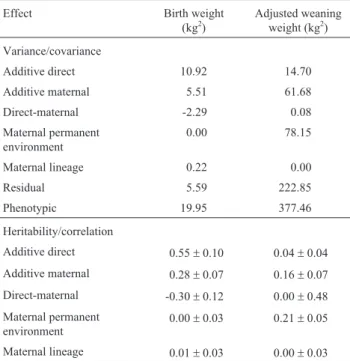
A total of 223 maternal lines were identified by pedi-gree analysis,with the largest maternal families spanning eight generations. On average there were nine records per line (range: 1 to 76 records/line) but because only those ma-ternal lines with five or more records per line were included in the analysis the number of maternal lineages in the final data set was 89, of which only 29 were present in the herd in 2002 when the DNA samples were collected. Direct effect heritability estimates were 0.55±0.10 for birth weight and 0.04± 0.04 for weaning weight (Table 1), agreeing with previous estimates of the genetic parameters of this herd (Melucci and Mezzadra, 2003). Estimates of maternal ef-fect heritability were 0.28 ± 0.07 for birth weight and 0.16±0.07 for weaning weight (Table 1). Genetic correla-tions between direct and maternal effects were negative for birth weight and very close to zero for weaning weight. Ma-ternal lineages accounted for a minimal proportion of the phenotypic variance both for birth and weaning weight. Es-timates of variance were consistent between the analyses that included maternal lineage (Table 1) or mitochondrial genotypes (Table 2), with the exception of direct effects for weaning weight.
Surprisingly, when fragment 1 was analyzed using mtDNA SSCP analysis only two genotypes were identified, one of which appeared in just five of the maternal lines sampled in 2002. To find a more informative D-Loop site a second DNA fragment upstream of the first was subjected to SSCP analysis and at this site five different genotypes were identified which we named A to E (Table 3). Seven-teen out of 23 maternal lines for which we had DNA sam-ples shared the same genotype. Combining the genotypes at both sites into haplotypes did not produced additional in-formation due to the strong imbalance of genotype frequen-cies at both sites, this being the case we only considered fragment 2 genotypes in the statistical analysis.
Conflicting results were obtained for three maternal lineages in which two cows with different fragment 2 geno-types were identified, this being resolved for two of the lin-eages by typing at least three cows but because the third lineage was represented by only two cows it was not possi-ble to assign it unequivocally to any genotypic class. The four cows with discrepant genotypes were not considered in the statistical analysis.
Statistical comparisons of estimated effects failed to detect any significant difference between mitochondrial ge-notypes for either birth or weaning weight (Table 3).
Discussion
Although our study focused on the influence of cyto-plasmic inheritance on birth and weaning weights,
Table 1- Estimated (co)variancecomponents and heritabilities for the
analysis that included maternal lineage as a random effect for Hereford cattle birth and weaning weight.
Effect Birth weight
(kg2)
Adjusted weaning weight (kg2)
Variance/covariance
Additive direct 10.92 14.70
Additive maternal 5.51 61.68
Direct-maternal -2.29 0.08
Maternal permanent environment
0.00 78.15
Maternal lineage 0.22 0.00
Residual 5.59 222.85
Phenotypic 19.95 377.46
Heritability/correlation
Additive direct 0.55±0.10 0.04±0.04
Additive maternal 0.28±0.07 0.16±0.07
Direct-maternal -0.30±0.12 0.00±0.48
Maternal permanent environment
0.00±0.03 0.21±0.05
Maternal lineage 0.01±0.03 0.00±0.03
Table 2 - Estimated (co) variance components for the analysis that
included mitochondrial genotype as a fixed effect for Hereford cattle birth and weaning weight.
Effect Birth weight
(kg2)
Adjusted weaning weight (kg2)
Additive direct 7.84 0.13
Additive maternal 4.85 51.57
Direct-maternal -1.63 2.6
Maternal permanent environment
0.0002 53.24
Residual 6.49 205.02
heritability was also estimated in order to assess the genetic variability linked to two traits of major interest, especially in the maternal component. Estimated heritability (direct and maternal) for weaning weight was unexpectedly low, however, a previous study based on the same population (Melucci and Mezzadra, 2002) demonstrated that the ge-netic trend for direct weaning weight was positive as a con-sequence of selection for that trait.
Many studies have attempted to quantify the contri-bution of the mitochondrial genome to performance in cat-tle. In an experiment involving beef and dairy cattle, Brown
et al.(1988) studied variables related to mitochondria me-tabolism (i.e.oxygen consumption, ADP:O2ratio and ATP synthesis) but found very little association between mito-chondrial metabolism and growth traits in beef cattle al-though in dairy cattle there tended to be a positive correlation between mitochondrial-related variables and performance, principally in respect to milk yield. In a simi-lar experiment with mice, Brownet al.(1989) found no dif-ferences in growth traits related to cytoplasmic genetic effects between inbred lines, even though there were differ-ences in mitochondrial metabolic activity. Lindberget al.
(1989) were able to detect a higher production efficiency of ATP in mammary gland mitochondria derived from a mouse line selected for high milk production as compared to a line selected for low milk production.Taken together, these results and those from Brownet al.(1988) suggest that differences in mitochondrial metabolism due to genetic variation will be detected mainly in highly energy demand-ing processes, such as milk production, where the ability of the mitochondria to provide ATP is challenged.
Despite the evidence provided by metabolic studies, experimental results from dairy cattle are not conclusive. Roughsedgeet al.(1999) confirmed a significant effect of maternal lineage on fat yield (5% of the phenotypic vari-ance) in a Holstein Friesian herd. Interestingly, Schnitzenlehner and Essl (1999) detected a significant ma-ternal line contribution to variance in fitness-related traits (persistency, days open and herd life) in Austrian Simmen-tal cattle. Analysis of a Holstein cattle data set by
Albuquer-queet al.(1998) concluded that the contribution of the cy-toplasmic line to the total variance of milk yield was only 1.1%, to fat yield 0.8% and to percentage fat 0.9% and were too small to be relevant to genetic evaluations, a conclusion subsequently supported by the work of Roratoet al.(1999) who found that in the same data set the maternal lineage only accounted for 1.1% of the phenotypic variance of milk yield.
These significant differences in performance detected between maternal lineages have been supported by associa-tion studies between mtDNA polymorphisms and produc-tion traits (Schutz et al., 1993; Schutz et al., 1994; Boettcheret al., 1996); however, it has been pointed out that in many cases associations detected as significant cor-responded to rare and probably detrimental mutations (Gib-sonet al., 1997).
Tesset al.(1987) reported significant cytoplasmic ef-fects (accounting for 1% to 5% of the phenotypic variance) for preweaning traits in beef cattle in a Hereford herd but the least-squares methodology used by Tesset al.(1987) proved later not to be appropriate for that kind of analysis, in fact, reanalysis of the same data set using mixed model methodologies showed no significant maternal lineage ef-fects (Tess and Robinson, 1990). Similar results were ob-tained in another population of the same breed by Tess and McNeil (1994) and also in our present survey. Rohreret al.
(1994) also failed to detect any significant maternal lineage effects on birth or weaning weights of Brangus cattle. Inter-estingly, a very significant mitochondrial haplotype effect on body composition and beef quality has been reported in Japanese Black cattle (Mannenet al., 1998).
Leaving aside the real influence of the mitochondrial genome on performance, the lack of significance of mater-nal line effects manifested in many studies could be attrib-uted to weaknesses within the design of the studies (Gibson
et al., 1997; Roughsedge et al., 2001). Although mixed model methodologies allow for an adequate partition of variance and the unbiased estimation of maternal lineage effects,such methodologies rely on pedigree records for the definition of maternal lines. Two factors could affect the
Table 3 - Unbiased effects on Hereford cattle birth and weaning weights of mitochondrial genotypes defined by single-strand conformation
polymorphism analysis (SSCP).
Genotype1 Number of maternal lines2 Number of calves3 Genotype effects4
Birth weight Weaning weight
A 17 582 2.77 26.26
B 2 81 2.68 21.31
C 2 43 3.48 26.02
D 1 60 2.85 24.72
E 1 68 2.40 24.06
1SSCP of mtDNA, positions 15,960 to 16,334 .
2Maternal lines present in the herd in 2002 when DNA samples were collected. 3
Number of calves allocated to each genotypic class based on pedigree information.
4
statistical power of designs based on pedigree information, namely pedigree errors and incomplete pedigree informa-tion (Roughsedge et al., 2001). Simulation studies have demonstrated that pedigree errors could lead to severe un-derestimation of true line effects (Roughsedgeet al., 2001). Misidentification rates as high as 23% have been reported for commercial populations (Ronet al., 1996). In our case, the data corresponded to an experimental herd and there-fore we expected a minimal contribution of that source of error. However, the design of our study was sensitive to er-rors due to the possible existence of maternal subfamilies that are actually part of larger families sharing a common mitochondrial genome.
In order to evaluate the possibility of incorrect assign-ment of cows to mitochondrial lineages that could mask pu-tative maternal line effects, we attempted to identify mitochondrial lineages based on direct mtDNA analysis. The first of the sites analyzed by SSCP identified only two genotypes in Hereford cows. When the same site was stud-ied on 16 maternal lineages of the Holstein breed, six differ-ent genotypes were iddiffer-entified (Eledath and Hines, 1996). These results suggest that in order to identify with confi-dence different mitochondrial genotypes, the most infor-mative sites should be defined on a per-breed basis.
The analysis of a second site in the D-loop produced five different genotypes in the Hereford herd. Interestingly, of 23 lineages sampled in 2002, 17 shared the same geno-type. This strong imbalance between genotype frequencies persisted when the original data was redistributed to these cytoplasmic lineages, supporting the hypothesis that the lack of cytoplasmic effect could be in part attributed to a much lower variability than expected, based on the number of maternal lines.
In our study we identified maternal genotypes using SSCP analysis, a very sensitive technique able to detect even single nucleotide polymorphisms. However, we could have missed some polymorphisms, because SSCP condi-tions were not optimized for detection of individual polymorphisms knowna priori. Sequencing the entire D-Loop region would allow for a better definition of mito-chondrial haplotypes and provide more statistical power to the tests (Mannenet al., 1998) but it is more expensive and time consuming.
On the other hand, it is important to consider that the mitochondrial D-Loop is not a coding sequence. Because mitochondria are inherited asexually through the maternal line, it is accepted that polymorphisms in the D-Loop tag haplotypes over the entire genome. However, polymor-phism analysis at the level of the D-Loop could probably identify haplotypes that are actually monomorphic at the gene level, because the D-Loop has a much higher mutation rate than the sequence of mitochondrial genes. Therefore, grouping of maternal lines based on D-loop poly-morphisms probably establishes an upper limit for the ac-tual number of mitochondrial variants.
Using the information of mitochondrial genotypes, we grouped the maternal families into larger mitochondrial lineages under the assumption that mtDNA is strictly ma-ternally inherited and its sequence is conserved through a maternal lineage. However, the existence of different mito-chondrial genotypes within maternal lines has been previ-ously reported (Ashleyet al., 1989; Koehleret al., 1991). In fact, we found three cases of cows from the same maternal line that differed in their mitochondrial genotypes. It re-mains to be proved whether these were real cases of heteroplasmy or pedigree errors.
In summary, neither maternal lineage nor mitochon-drial genotypes showed any significant effect on the traits analyzed in this experiment. These results suggest that in this Hereford herd the effect of the mitochondrial genome on birth and weaning weights can be considered negligible.
References
Alberts B, Bray D, Lewis J, Raff M, Roberts K and Watson J (1994) Molecular Biology of the Cell. Garland Publishing, Inc., New York, 1294 pp.
Albuquerque LG, Keown JF and Van Vleck LD (1998) Variances of direct genetic effects, maternal genetic effects, and cyto-plasmic inheritance effects for milk yield, fat yield, and fat percentage. J Dairy Sci 81:544-549.
Anderson S, De Bruijn MHL, Coulson AR, Eperon IC, Sanger F and Young IG (1982) Complete sequence of bovine mito-chondrial DNA: Conserved features of the mammalian mi-tochondrial genome. J Mol Biol 156:683.
Ashley MV, Laipis PJ and Hauswirth WW (1989) Rapid segrega-tion of heteroplasmic bovine mitochondria. Nucleic Acids Res 17:7325-7331.
Boettcher PJ, Freeman AE, Johnston SD, Smith RK, Beitz DC and McDaniel BT (1996) Relationships between polymorphism for mitochondrial deoxyribonucleic acid and yield traits of Holstein cows. J Dairy Sci 79:647-654.
Boldman KG, Kriese LA, Van Vleck LD, Van Tassell CP and Kachman SD (1995) A manual for use of MTDFRML. A set of programs to obtain estimates of variances and covariances. (Draft). U.S. Department of Agriculture, Agri-cultural Research Service, Clay Center, Nebraska, 114 pp. Brown DR, De Nise SK and McDaniel RG (1988) Mitochondrial
respiratory metabolism and performance of cattle. J Anim Sci 66:1347-1354.
Brown DR, De Nise SK and McDaniel RG (1989) Cytoplasmic genetic effects and growth of hybrid mice. J Anim Sci 67:887-894.
Cymbron T, Loftus R, Malheiro M and Bradley D (1999) Mito-chondrial sequence variation suggests an African influence in Portuguese cattle. Proc R Soc Lond B Biol Sci 266:597-603.
Eledath FM and Hines HC (1996) Detection of nucleotide varia-tions in the D-loop region of bovine mitochondrial DNA us-ing polymerase chain reaction-based methodologies. Anim Genet 27:333-336.
Koehler CM, Lindberg GL, Brown DR, Beitz DC, Freeman AE, Mayfield JE and Myers AM (1991) Replacement of bovine mitochondrial DNA by a sequence variant within one gener-ation. Genetics 129:247-255.
Lindberg GL, Shank BB, Rothschild MF, Mayfield JE, Freeman AE, Koehler CM and Beitz DC (1989) Characteristics of mammary mitochondria in lines of mice genetically diver-gent for milk production. J Dairy Sci 72:1175-1181. Maniatis T, Fritsch EF and Sambrook J (1982) Molecular cloning:
A laboratory manual. Cold Spring Harbor Laboratory, New York, 545 pp.
Mannen H, Kojima T, Oyama K, Mukai F, Ishida T and Tsuji S (1998) Effect of mitochondrial DNA variation on carcass traits of Japanese Black cattle. J Anim Sci 76:36-41. Melucci LM (1995) Estimación de un índice genético restricto
para crecimiento predestete en bovinos para carne. XXVI Congreso Argentino de Genética, Bariloche, Argentina, R. Argentina: 87.
Melucci LM, Miquel M y Molinuevo HA (1983) Indices de selección para crecimiento en bovinos para carne. Producción Animal 10:417-426.
Melucci LM y Mezzadra CA (2002) Respuesta a la selección por crecimiento en ganado Hereford. J Basic Appl Genet XV(suplement):129. XXXI Congreso Argentino de Gené-tica, La Plata, Argentina.
Melucci LM and Mezzadra CA (2003) Direct and maternal ge-netic parameters for growth traits in a Hereford cattle popu-lation. J Basic Appl Genet 15:63-72.
Mirol PM, Giovambattista G, Liron JP and Dulout FN (2003) Af-rican and European mitochondrial haplotypes in South American Creole cattle. Heredity 91:248-254.
Orita M, Iwahana H, Kanazawa H, Hayashi K and Sekiya T (1989) Detection of polymorphisms of human DNA by gel electrophoresis as single-strand conformation poly-morphisms. Proc Natl Acad Sci USA 86:2766-2770. Rohrer GA, Taylor JF, Sanders JO and Thallman RM (1994)
Evaluation of line and breed of cytoplasm effects on
perfor-mance of purebred Brangus cattle. J Anim Sci 72:2798-2803.
Ron M, Blanc M, Band E, Ezra E and Weller JI (1996) Misidenti-fication rate in the Israeli dairy cattle population and its im-plications for genetic improvement. J Dairy Sci 79:676-681. Rorato PR, Keown JF and Van Vleck LD (1999) Variance caused
by cytoplasmic line and sire by herd interaction effects for milk yield considering estimation bias. J Dairy Sci 82:1574-1580.
Roughsedge T, Brotherstone S and Visscher PM (1999) Estima-tion of variance of maternal lineage effects at the Langhill dairy herd. Animal Science 68:79-86.
Roughsedge T, Brotherstone S and Visscher PM (2001) Bias and power in the estimation of a maternal family variance com-ponent in the presence of incomplete and incorrect pedigree information. J Dairy Sci 84:944-950.
Schnitzenlehner S and Essl A (1999) Field data analysis of cyto-plasmic inheritance of dairy and fitness-related traits in cat-tle. Animal Science 68:459-466.
Schutz MM, Freeman AE, Lindberg GL and Beitz DC (1993) Ef-fects of maternal lineages grouped by mitochondrial geno-types on milk yied and composition. J Dairy Sci 76:621-629. Schutz MM, Freeman AE, Lindberg GL, Koehler CM and Beitz DC (1994) The effect of mitochondrial DNA on milk pro-duction and health in dairy cattle. Livest Prod Sci 37:283-295.
Tess MW and MacNeil MD (1994) Evaluation of cytoplasmic ge-netic effects in Miles City Line 1 Hereford cattle. J Anim Sci 72:851-856.
Tess MW, Reodecha C and Robinson OW (1987) Cytoplasmic genetic effects on preweaning growth and milk yield in Her-eford cattle. J Anim Sci 65:675-684.
Tess MW and Robinson OW (1990) Evaluation of cytoplasmic genetic effects in beef cattle using an animal model. J Anim Sci 68:1899-1909.