Concentration, characterization and application of lipases
from
Sporidiobolus pararoseus
strain
Alessandra Smaniotto
1, Aline Skovronski
1, Elisandra Rigo
1, Siu Mui Tsai
2,
Ademir Durrer
2, Lillian Liva Foltran
2, Natália Paroul
1, Marco Di Luccio
3,
J. Vladimir Oliveira
3, Débora de Oliveira
3, Helen Treichel
41
Departamento de Engenharia de Alimentos, Universidade Regional Integrada do Alto Uruguai e das Missões, Campus de Erechim, Erechim, RS, Brazil.
2
Laboratório de Biologia Celular e Molecular, Universidade de São Paulo, Piracicaba, SP, Brazil. 3
Departamento de Engenharia Química e de Alimentos, Universidade Federal de Santa Catarina, Campus Universitário, Florianópolis, SC, Brazil.
4
Universidade Federal da Fronteira Sul, Campus de Erechim, Erechim, RS, Brazil.
Submitted: July 20, 2012; Approved: September 9, 2013.
Abstract
Lipases produced by a newly isolatedSporidiobolus pararoseusstrain have potential catalytic ability for esterification reactions. After production, the enzymatic extracts (conventional crude and precipi-tated, ‘CC’ and ‘CP’, and industrial crude and precipiprecipi-tated, ‘IC’ e ‘IP’) were partially characterized. The enzymes presented, in general, higher specificity for short chain alcohols and fatty acids. The precipitated extract showed a good thermal stability, higher than that for crude enzymatic extracts. The ‘CC’ and ‘CP’ enzymes presented high activities after exposure to pH 6.5 and 40 °C. On the other hand, the ‘IC’ and ‘IP’ extracts kept their activities in a wide range of pH memory but presented preference for higher reaction temperatures. Preliminary studies of application of the crude lipase ex-tract in the enzymatic production of geranyl propionate using geraniol and propionic acid as sub-strates in solvent-free system led to a reaction conversion of 42±1.5%.
Key words:Sporidiobolus pararoseus, ‘synthetic lipase’, submerged fermentation, enzyme charac-terization.
Introduction
Lipases are ubiquitous in all types of living organisms and can be obtained from different sources such as microor-ganisms, animals and plants (Lotti and Alberguina, 2007; Bonet al., 2008; Reiset al., 2009). The enzymes of bacteria and fungi have the greatest potential as industrial bio-catalysts, as they present high reaction rates, high-yield conversion of substrate to product, great versatility and simplicity in environmental and genetic manipulation of its productive capacity and easy recovery from fermentation broth (Lotti and Alberguina, 2007; Bonet al., 2008).
Microbial lipases are produced mainly by submerged culture (Sharmaet al., 2001) and a wide variety of culture conditions that stimulate or suppress the production of
mi-crobial lipases is described in the literature. However, there is no general procedure to improve lipase production (Ka-demiet al., 2004). The so-called ‘industrial medium’ for production of lipases commonly uses agroindustrial wastes or byproducts in its formulation, while the conventional medium is based on ingredients with a definite composition like salts, aminoacids, vitamins, growth factors, or costly complex ingredients like yeast extract, peptones and malt extract, among others. The main advantage of the industrial medium over the conventional one is its reduced costs, which may impact on the final product price. Over the re-cent years, research on the selection of suitable substrates for fermentative processes has mainly focused on agro-industrial residues, due to their potential advantages.
Utili-Send correspondence to H. Treichel. Universidade Federal da Fronteira Sul, Campus de Erechim, Erechim, RS, Brazil. E-mail: [email protected].
zation of agroindustrial wastes provides alternative substrates and may help solving pollution problems, which otherwise might be caused by their disposal. The choice of the substrate depends upon several factors, mainly related to cost and availability (Treichelet al., 2010).
After the fermentation step, the enzyme is contained in a medium together with a series of other compounds of no interest. Precipitation is normally used as the first step in the purification procedure and the ammonium sulfate frac-tionation is the method most widely used (Martinset al., 2008).
The effects of some variables on the activity of crude and purified lipases have been studied by some researchers. Factors such as pH, temperature, metallic ions, organic sol-vents, among others, can increase or decrease lipase activ-ity. Besides, lipases can present different specificity to substrates. So, biochemical characterization can determine the adequacy of each enzyme to industrial processes (Ha-sanet al., 2006).
Lipases that present esterification activity are gaining more attention nowadays because of their potential to cata-lyze the production of biodiesel, bioaromas and pharma-ceuticals, reducing the operational costs associated with the conventional process, as well as overcoming problems re-lated with chemical catalysis. As the production cost of the lipase is a major obstacle to the commercialization of the enzyme catalyzed process, various attempts have been made to develop cheaper systems. Many other applications of lipase with synthetic activity have been proposed, such as enantioselective reactions, synthesis of various esters and kinetic resolutions of chiral compounds (Treichelet al., 2010).
In this context, this work aimed at characterization of crude and precipitated lipase extracts from conventional and industrial media in terms of stability at high and low temperatures, esterification substrate specificity (different fatty acids and alcohols) and acting ranges of memory of pH and temperature. A preliminary investigation of the potential application of the crude lipase extract on the enzy-matic production of geranyl propionate using geraniol and propionic acid as substrates in solvent-free system was also carried out.
Materials and Methods
Cell production
The yeast used in the present study was previously isolated from soybean meal (9) and identified as
Sporidiobolus pararoseus(Smaniottoet al., 2012). It was maintained in glycerol at -80 °C and potato dextrose agar slants under refrigeration. The propagation was carried out for 3 days at 30 °C in Petri dishes containing a medium con-stituted by potato dextrose agar (PDA) 3.9 wt% and dis-tilled water. The pre-inoculum was prepared by transferring the microorganism from the Petris dish to test
tubes containing 10 mL of PC medium (0.5, 0.25 and 0.1 wt% of tryptone, yeast extract and dextrose, respectively) sterilized at 121 °C for 15 min. The mixture was incubated at 30 °C for 24 h. The inoculum was prepared by mixing the pre-inoculum with 90 mL of sterilized PC medium in 250 mL Erlenmeyer flasks covered with cotton plugs. Flasks were incubated in a rotary shaker at 30 °C and 150 for 24 h.
Culture conditions
Lipase was produced in conventional and industrial media. The conventional medium consisted of 5.0, 6.8, 7.0 and 1.0 wt% of peptone, yeast extract, NaCl and olive oil, respectively. The industrial medium consisted of corn steep liquor (5.0 wt%), hydrolyzed yeast extract (6.8 wt%), waste frying oil (1.0 wt%) and NaCl (7.0 wt%). Residual frying oil consisted of refined soybean oil, submitted to three suc-cessive frying batches of potatos at 180 °C (Juarézet al., 2011). Cultivation was carried out in 250 mL Erlenmeyer flasks covered with cotton plugs in rotary shaker at 30 °C and 150 rpm. The media (in 90 mL aliquots) were sterilized at 121 °C for 15 min, cooled and inoculated with the inoculum solution (10%). After fermentation, samples were collected and filtered through Whatmann qualitative paper. The filtrate was frozen at -80 °C for 24 h and then lyophilized for 48 h. The resultant solid was considered as the crude enzymatic extract and used for analytical assays.
Concentration of crude enzymatic extract
Ammonium sulfate was added to 150 mL of extract until the desired degree of saturation. The precipitation was carried out in single steps (using 40 and 60% of the satura-tion concentrasatura-tion) and in two sequential steps. The first step was carried out with addition of ammonium sulfate un-til 20% of saturation was reached. After the separation of the precipitated material, the supernatant was then further precipitated adding ammonium sulfate up to 40% of satura-tion.
The mixture was kept at 4 °C in an ice bath with con-stant agitation, with the pH maintained at 7.0 through the addition of NaOH 20%. The mixture was then transferred to centrifuge tubes, maintained at -10 °C for 5 h and then centrifuged at 4 °C and 5400gfor 30 min. The supernatant was discarded and the precipitate removed with a minimum amount of sodium phosphate buffer 100 mM pH 7.0 (8, 10). Samples were freezed at -80 °C and lyophilized for 48 h. The enzymes obtained in conventional and in industrial media in the crude (CC and IC) and precipitated (CP and IP) forms were partially characterized as described below. Protein was determined in all extracts as described by Fernandeset al.(2004).
Esterification activity
of 0.1 g sample of lyophilized enzyme was added to a 1:2 mixture of oleic acid and ethanol. After incubation in shaker for 40 min at 40 °C and 150 rpm, the reaction was in-terrupted and the products were extracted by the addition of 20 mL of an acetone/ethanol solution (1:1v/v). The residual oleic acid was titrated with 0.02 M NaOH until pH 11. Re-action blanks were run in the same way, but adding the sample after addition of acetone/ethanol solution. The as-says were carried out in duplicates. A unit of lipase activity was defined as the amount of enzyme that consumes 1mmol of oleic acid per minute under the assay conditions.
Specificity of the crude and precipitated enzymatic extract
The crude and precipitated lyophilized enzymatic ex-tracts were characterized based on their esterification activ-ity in different alcohols (methanol, ethanol, n-propanol and n-butanol) and fatty acids (lauric (12:0), oleic (18:1) and butyric (4:0)) (4, 5, 31).
Stability of the crude and precipitated enzymatic extract at low and high temperatures
The stability of lyophilized crude and precipitated en-zymatic extracts at low temperatures was studied at 4 and -10 °C by measuring the esterification activities each 5 days during storage. The evaluation of stability at high tempera-tures was carried out by incubation at 30, 45 and 60 °C. The esterification activity was monitored every 24 h until total loss of activity.
Effect of temperature and pH memory on the crude and precipitated extracts
The pH memory was assessed by incubating the crude and precipitated enzymes (‘CC’, ‘CP’, ‘IC’ and ‘IP’) in dif-ferent buffers (pH varying from 3.0 to 10.0) for 20 min at 4 °C. The extracts were then lyophilized, according to Sun
et al.(2009) and the esterification activity was measured at different temperatures (11.8-68.2 °C) following the method described below.
These ranges of pH and temperature were evaluated according to a composite central rotatable design (DCCR) 22, which was carried out for each extract.
Enzymatic esterification for production of geranyl esters
The esterification reactions were carried out by pre-paring a reactional mixture of geraniol, propionic acid (at molar ratios optimized previously by our research group using commercial lipases) and molecular sieves (20 mg/mL of substrates) in a 50 mL Erlenmeyer. After complete disso-lution of the substrates, the enzymatic extract was added to the mixture. All experiments were carried out in an orbital shaker at constant agitation of 150 rpm. After the reaction time completion, the samples were kept at 5 °C for further
determination of reaction conversion, following a previ-ously established method (Sun and Xu, 2008).
Quantitative analyses of geranyl esters produced were carried out in a gas chromatograph (Shimadzu GC-2010), using a capillar column of fused silica INOWAX (30 m length x 250mm i.d. x 0.25mm thickness), flame ion-ization detector, with the following temperature program: 40-180 °C (3 °C/min), 180-230 °C (20 °C/min), 230 °C (20 min), injector temperature 250 °C, detector at 275 °C, injection in the mode split, ratio of split 1:100. Hydrogen (56 KPa) was used as carrier gas and a volume of 0.4mL of sample diluted in n-hexane (1:10) was injected. Reaction conversion was calculated based on the reduction of area of limitant reagent on the basis of reaction stoichiometry (Sun and Xu, 2008).
Results and Discussion
Lipase production
The yeast Sporodiobolus pararoseus isolated and identified by our research group was previously presented as good synthetic lipase producer. Using the conventional optimized medium as substrate (Smaniottoet al., 2012) the esterification activity was 26.9 U/mL of fermented medium in 72 h of fermentation. This yield is higher than those re-ported in literature for good lipase producer strains. Teng and Xu (Teng and Xu, 2008) obtained 13.9 U/mL of a lipase produced byRhizopus chinensis at optimal condi-tions.
In the present study, theSporodiobolus pararoseus
was used to produce lipase using a low-cost substrate based on corn steep liquor, hydrolyzed yeast extract, waste frying oil and NaCl. The crude enzymatic extract obtained after 72 h of fermentation presented 12.3 U/mL of esterification activity. Although the lipase activity with this medium was lower than that obtained from conventional one, the lower costs of the residues may justify the study of the precipita-tion and characterizaprecipita-tion of the enzyme extract from indus-trial media.
It is important to mention that the corn steep liquor and the yeast hydrolysate presents a complex composition and both are sources of nitrogen, carbon, mineral salts and vitamins. The industrial medium contains a rich mixture of nutrients that might repress lipase production (Wang etal., 2008). Pinheiroet al.(2008), studying the conventional and industrial media for lipase production by submerged fer-mentation fromPenicillium verrucosum,observed that the lipase hydrolytic activity was 1.2 times higher in the con-ventional compared to the industrial medium. Immanuelet al.(2008) also discuss the importance of the use of indus-trial medium for enzyme production. They evaluated the substitution of the tryptone by casein in the production of an extracellular lipase from Serratia rubidaea, which caused an increase from 4.0 to 6.5 U/mL. Bapirajuet al.
mutantRhizopussp., concluded that the potato starch, corn steep liquor and olive oil were the most promising sources of carbon, nitrogen and lipids, respectively.
Concentration of the crude enzymatic extracts
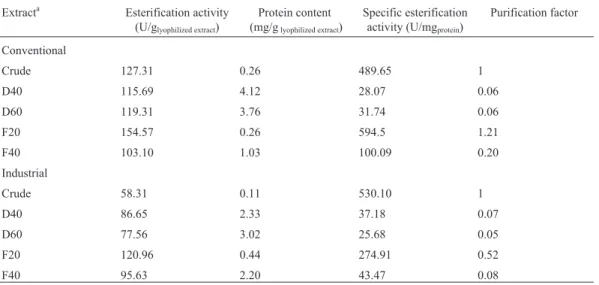
Table 1 presents the results obtained for the concen-tration using ammonium sulfate in terms of esterification activity (U/glyophilized extract), protein content (mg/mL) and specific esterification activity (U/mgprotein). The first step of the fractional precipitation (20% of ammonium sulfate sat-uration) resulted in higher purification folds for the lipase produced both in conventional and industrial media (1.2 and 0.5-fold, respectively). These precipitated extracts pre-sented the highest synthesis activity (154.6 and 120.9 U/g lyophilized extract, respectively) and the lowest protein content.
Specific lipase activity and purification folds pre-sented in the literature vary a lot according to fermentation and precipitation condition, as well as the microorganism. The literature points out that the purification folds by pre-cipitation with ammonium sulfate are usually low, but can reach up to 10, when optimized conditions are applied (Bradooet al., 2002; Stanburryet al., 2003; Bapirajuet al., 2005; Bonet al., 2008).
Characterization of the lipases
Specificity of the crude and precipitated enzymatic extracts
The esterification activity of the crude extracts using butyric and oleic acids as substrates and different alcohols is presented in Figure 1 (a) and (b), respectively. In general, the use of butyric acid as acil donor affords higher esteri-fication activities. The IC extract presented the highest
esterification activity using methanol, independent from the acid used.
It is interestig to note that higher specificities for methanol and butanol can be observed when butyric acid is used. The same behavior can be seen using oleic acid when the enzymes from industrial medium (IC and IP) were eval-uated. The alcohol specificity, towards oleic acid esteri-fication, of the lipase produced with conventional medium presented a distinct behavior from that described above, since higher activities were obtained using methanol, etha-nol and propaetha-nol with the enzymes CC and CP, respec-tively. When lauric acid was used as the acil donor, only the enzymes from the industrial medium (IC and IP) presented esterification activities, using methanol as substrate.
The produced enzymes showed higher apparent specificities for short chain fatty acids (butyric acid) and short chain alcohols (methanol). Sun et al. (2009) and Wang et al. (1995) cite that lipases commonly present higher specificity to fatty acids with 8 to 16 carbons. Usually, short chain fatty acids are known as inhibitors of the catalytic activity of the lipases. However, Abbas and Comeau (2003) showed that a lipase fromMucorsp. was able to catalyze esterification reaction using different alco-hols and acids.
The lipase evaluated by Abbas and Comeau (2003) presented a particular specificity to short chains alcohols such as methanol, ethanol, 2-propen-1-ol and butanol. These results are in agreement with the studies carried out by Langrandet al.(1998) and Sunet al.(2009), where the yields decreased with the increase of the number of car-bons. According to Ghandi et al. (1995) and Abbas and Comeau (2003) differences in lipase specificities to differ-ent alcohols can be explained in terms of the binding energy that is liberated when the substrate binds to the active site.
Table 1- Concentration of lipase extract using ammonium sulfate.
Extracta Esterification activity (U/glyophilized extract)
Protein content (mg/glyophilized extract)
Specific esterification activity (U/mgprotein)
Purification factor
Conventional
Crude 127.31 0.26 489.65 1
D40 115.69 4.12 28.07 0.06
D60 119.31 3.76 31.74 0.06
F20 154.57 0.26 594.5 1.21
F40 103.10 1.03 100.09 0.20
Industrial
Crude 58.31 0.11 530.10 1
D40 86.65 2.33 37.18 0.07
D60 77.56 3.02 25.68 0.05
F20 120.96 0.44 274.91 0.52
F40 95.63 2.20 43.47 0.08
aD40 and D60 refer to the extract precipitated by direct addition of ammonium sulfate at 40% and 60% of saturation. F20 and F40 refer to the extracts
Short chain ethyl esters synthesized from acids are an important group of flavor and fragrances widely employed in food and beverages’ industries (Kashmiriet al., 2006). The market value of such compounds obtained by enzy-matic reactions is usually higher than those produced by the conventional chemical path. Few studies can be found in the literature showing the specificity of non-commercial li-pases to short-chain substrates, since these compounds can cause inhibitory effects (Peter and Preda; 2002; Shuet al., 2006). So, the lipases presented here can find potential ap-plication in the production of flavours.
Stability of the crude and precipitated enzymatic extracts to low and high temperatures
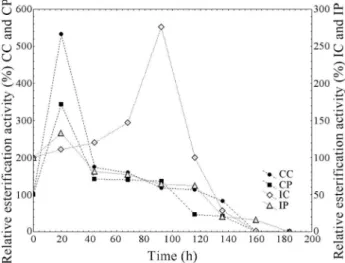
Figures 2, 3 and 4 present the evolution of lipase ac-tivities with time of incubation at 30, 45 and 60 °C, respec-tively. From Fig. 2 it is possible to observe the activation of the enzymes when incubated at 30 °C. The enzymes from conventional medium presented a maximum esterification activity after 20 h of incubation, at this time an increase of 5.3 and 3.4-fold in the activity was observed for the CC and CP, respectively. The extracts IC and IP showed the highest esterification activity after 92 and 20 h of incubation (2.8 and 1.3 times), respectively. The crude extracts presented a more marked activation. However, after 160 h of incuba-tion, almost complete deactivation of all the extracts oc-curred. The activation of lipases at 30 °C was also observed
by Fernandes et al.(2004) studying hydrolysis reactions catalyzed by lipases fromThermomyces lanuginosa.
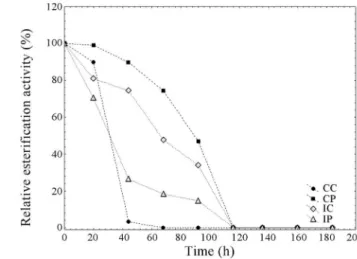
Figure 3 shows that at 45 °C the enzyme IP did not present an initial activation, but this extract kept the en-zyme activity until 116 h of incubation. At 60 °C (Figure 4), all extracts lost the esterification activity during the incuba-tion time (92 h) and the CC was the most heat sensitive (loss of all activity after 44 h of incubation).
Figure 1- Esterification activities (EA) of the crude extracts using oleic (a) and butyric (b) acids as substrates and different alcohols.
The evaluation of low temperature stability showed that the precipitated enzymes CP and IP presented higher stabilities. Both kept 100% of their esterification activity until 60 days of storage at 4 and -10 °C. These results are in agreement with the work of Menoncinet al.(2010). The study of these authors showed that a concentrated lipase ex-tract fromPenicillium verrucosumkept its activity until 90 days of storage at the same low temperatures. Thus, the pre-cipitation step is advantageous when considering the lipase stability. Although the esterification activity did not im-prove when the extracts were precipitated, the increase in the stability could be considered a promising result in terms of future application of these extracts.
Effect of temperature and memory of pH on the crude and precipitated extracts
According to Sun et al. (2009) and Sun and Xu (2008), lyophilized enzymes present a “memory of pH”
ef-fect. This can be explained by the fact that the esterification activity in organic solvents is extremely dependent on the pH of the aqueous solution before the lyophilization. This “memory of pH” effect probably occurs due to the ionic fixation of the catalytic site. Thus, after freeze-drying of the enzyme, the biocatalyst keeps the same state as in non-aqueous medium.
To evaluate the behavior of the extracts at different temperatures and pH memories, one CCRD 22was carried out for each extract. Table 2 presents the matrix of the ex-perimental design and the respective responses in terms of esterification activity for each extract.
The highest activity was obtained for the CC extract (around 145 U/glyophilized extract), at a pH memory of 6.5 and 40 °C. High activity values for the CP were obtained at the central points (around de 64 U/glyophilized extract), and these values show that the enzymes from conventional medium Figure 3- Lipase activities during incubation at 45 °C. Initial activities:
CC = 127.3 U/g, CP = 154.6 U/g, IC = 58.3 U/g, IP = 121.0 U/g.
Figure 4- Lipase activities during incubation at 60 °C. Initial activities: CC = 127.3 U/g, CP = 154.6 U/g, IC = 58.3 U/g, IP = 121.0 U/g.
Table 2- Effect of the temperature and pH memory on the crude and precipitated extract: Matrix of the experimental design (coded and real values) and the respective responses in terms of esterification activity for each extract.
Run pH T (°C) Esterification activity (U/glyophilized extract)
CC CP IC IP
1 -1(4.0) -1(20) 26.87 4.65 18.42 9.09
2 +1(9.0) -1(20) 22.54 4.61 32.56 0.00
3 -1(4.0) +1(60) 52.55 8.96 92.41 50.96
4 +1(9.0) +1(60) 114.51 42.47 39.92 42.80
5 0(6.5) 0(40) 143.57 64.78 32.90 8.52
6 0(6.5) 0(40) 159.20 59.86 38.10 9.26
7 0(6.5) 0(40) 132.44 66.66 44.21 8.44
8 0(6.5) -1.41(11.8) 0.00 0.00 0.00 0.00
9 0(6.5) +1.41(68.2) 0.00 0.00 85.9 48.46
10 -1.41(3.0) 0(40) 56.62 52.54 0.00 0.00
presented higher activities at pH memory of about 7 and near ambient temperatures.
High activities were also obtained with lipase pro-duced with industrial medium, in runs 3 (pH 4.0 and 60 °C) and 9 (pH 6.5 and 68.2 °C), showing that the enzymes pres-ent activity in a wide range of pH memory and high temper-atures.
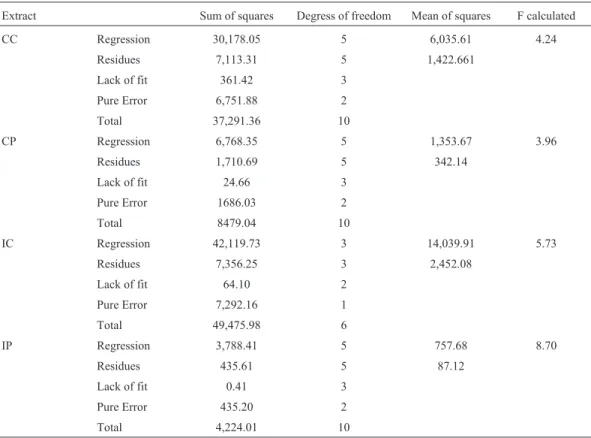
Table 3 presents the empirical models that predict the lipase activity as a function of pH and temperature. All of them were validated (Fcalculated> Flisted) by analysis of vari-ance (Table 4) at 90% of confidence level. The determina-tion coefficients were 81, 80, 85 and 90% for the extracts CC, CP, IC and IP, respectively.
Preliminary studies for the application of the lipase extract
Preliminary studies of application of the conventional crude lipase extract in the enzymatic production of geranyl
propionate using geraniol and propionic acid as substrates, in solvent-free system, showed that in optimized operating conditions for propionate production using commercial li-pases (geraniol to propionic acid molar ratio of 3:1, 40 °C, 150 rpm and 10 wt% of enzyme, conversions of about 95% (Sun and Xu, 2008)), a reaction conversion of 42±1.5% was achieved. This result is very promising, since it was ob-tained using optimized conditions for a commercial lipase. Probably, after optimization of operation parameters for the lipase of Sporidiobolus pararoseus, higher conversions could be obtained.
Conclusions
The yeastSporodiobolus pararoseusis a promising synthetic lipase producer using conventional (13.9 U/mL) and industrial (12.3 U/mL) media. The enzymatic extracts presented, in general, higher specificity for short chain
al-Table 3- Empiric models for the esterification activity in function of pH and temperature for each studied extract.
Extract Coded model
CC 144 92. -1 47. pH L( )-47 00. pH Q( )+14 75. T L( )-63 12. T Q( )+16.57pH L T L( ) ( )
CP 63 75. -5 09. pH L( )-18 27. pH Q( )+5 29. T L( )-31 48. T Q( )+8 39. pH L T L( ) ( )
IC 153 27. -12 87. pH L( )+99 38. T L( )-19 84. pH L T L( ) ( )
IP 8 69. -2 16. pH L( )-0 96. pH Q( )+10 18. T L( )+11 23. T Q( )+0 23. pH L T L( ) ( )
Table 4- Analysis of variance for each model presented in Table 3.
Extract Sum of squares Degress of freedom Mean of squares F calculated
CC Regression 30,178.05 5 6,035.61 4.24
Residues 7,113.31 5 1,422.661
Lack of fit 361.42 3
Pure Error 6,751.88 2
Total 37,291.36 10
CP Regression 6,768.35 5 1,353.67 3.96
Residues 1,710.69 5 342.14
Lack of fit 24.66 3
Pure Error 1686.03 2
Total 8479.04 10
IC Regression 42,119.73 3 14,039.91 5.73
Residues 7,356.25 3 2,452.08
Lack of fit 64.10 2
Pure Error 7,292.16 1
Total 49,475.98 6
IP Regression 3,788.41 5 757.68 8.70
Residues 435.61 5 87.12
Lack of fit 0.41 3
Pure Error 435.20 2
Total 4,224.01 10
cohols and fatty acids. So, the use of the lipase extract pre-sented here in the production of flavours could be consid-ered an interesting application.
The concentrated extracts presented a good thermal stability, and are more stable than the crude enzymes. The CC and CP enzymes presented higher activities at pH mem-ories around neutrality (6.5) and 40 °C. On the other hand, the IC and IP enzymes kept the activity in a wide range of memories of pH.
Preliminary studies of application of the produced lipase showed promising results. The enzymatic production of geranyl propionate using geraniol and propionic acid as substrates in solvent-free system yielded a reaction conver-sion of 42±1.5%
Acknowledgments
The authors thank CAPES and CNPq for the financial support of this work and scholarships.
References
Abbas H, Comeau L (2003) Aroma synthesis by immobilized lipase fromMucorsp. Enz Microb Technol 32:589-595. Bapiraju KVVSN, Sujatha P, Ellaiah P, Ramana T (2005)
Se-quential parametric optimization of lipase production by a mutant strain Rhizopus sp. BTNT-2. J Basic Microbiol 45:257-273.
Bon EPS, Ferrara MA, Corvo ML (2008) Enzimas em biotec-nologia. Interciência, Brazil.
Bradoo S, Rathi P, Saxena RK, Gupta R (2002) Microwave-assisted rapid characterization of lipase selectivities. J Bio-chem 51:115-120.
Colen G, Junqueira RG, Moraes-Santos T (2006) Isolation and screening of alkaline lipase-producing fungi from Brazilian savanna soil. World J Microbiol Biotechnol 22:881-885. Fernandes MLM, Krieger N, Baron AM, Zamora PP, Ramos LP,
Mitchell DA (2004) Hydrolysis and synthesis reactions catalysed by Thermomyces lanuginosa lipase in the AOT/Isooctane reversed micellar system. J Mol Catal B En-zymatic 30:43-49.
Ghandi N, Sawant SB, Joshi JB (1995) Specificity of a Lipase in Ester Synthesis: Effect of Alcohol. Biotechnol Progress 11:282-287.
Griebler N, Polloni A, Remonatto D, Arbter F, Vardanega R, Cechet J, Di Luccio M, Oliveira D, Treichel H, Cansian R, Rigo E, Ninow J (2011) Isolation and Screening of Lipase-Producing Fungi with Hydrolytic Activity. Food Bioproc Technol 4:578-586.
Gutarra MLE, Godoy MG, Maugeri F, Rodrigues MI, Freire DMG, Castilho L (2009) Production of an acidic and ther-mostable lipase of the mesophilic fungus Penicillium simplicissimum by solid state fermentation. Bioresour Technol 100:5249-5254.
Hasan F, Shah AA, Hameed A (2006) Industrial applications of microbial lipases. Enzyme Microb Technol 39:235-251. Immanuel G, Esakkiraj P, Jebadhas A, Iyapparaj P, Palavesam A
(2008) Investigation of lipase production by milk isolate Serratia rubidaea. Food Technol Biotechnol 46:60-65.
Juaréz MD, Osawa CB, Acuña ME, Sammán N, Gonçalves LAG (2011) Degradation in soybean oil, sunflower oil and par-tially hydrogenated fats after food frying, monitored by con-ventional and unconcon-ventional. Food Control 22:1920-1927. Kademi A, Leblane D, Houde A (2004) Lipases. In: Pandey A.
Concise Encyclopedia of Bioresource Technology. The Haworth Press Inc., New York.
Kashmiri MA, Adnan A, Butt BW (2006) Production, purification and partial characterization of lipase from Trichoderma viride. African J Biotechnol 5:878-882.
Langrand G, Triantaphylides C, Baratti J (1998) Lipase catalyzed formation of flavour esters. Biotechnol Lett 10:549-554. Lotti M, Alberghina L (2007) Lipases: Molecular Structure and
Functions. In: Polaina J and MacCabe A P. Industrial En-zymes: Structure, Function and Applications. Springer, Dordrecht, pp 263-282.
Martins VG, Kalil SJ, Costa JV (2008) Co-produção de lipase e biossurfactante em estado sólido para utilização em biorre-mediação de óleos vegetais e hidrocarmonetos. Química Nova 31:1942-1947.
Menoncin S, Domingues NM, Freire DMG, Toniazzo G, Cansian RL, Oliveira JV, Di Luccio M, Oliveira D, Treichel H (2010) Study of the Extraction, Concentration, and Partial Characterization of Lipases Obtained from Penicillium verrucosum using Solid-State Fermentation of Soybean Bran. Food Bioproc Technol 3:537-544.
Peter F, Preda G (2002) Characterisation of pancreatic lipase sub-strate specificity in organic reaction media by a kinetic method. J Mol Catal B Enzymatic 19-20:467-472.
Pinheiro TF, Menoncin S, Domingues NM, Oliveira D, Treichel H, Di Luccio M, Freire DM (2008) Production and partial characterization of lipase fromPenicillium verrucosum ob-tained by submerged fermentation of conventional and in-dustrial media. Ciência e Tecnologia de Alimentos 28:444-450.
Reis P, Holmberg K, Watzke H, Leser ME, Miller R (2009) Li-pases at interfaces: a review. Adv Colloid Interface Sci 147-148:237-250.
Sharma R, Chisti Y, Banerjee UC (2001) Production, purification, characterization, and applications of lipases. Biotechnol Adv 19:627-662.
Shu C-H, Xu C-J, Lin G-C (2006) Purification and partial charac-terization of a lipase fromAntrodia cinnamomea. Process Biochem 41:734-738.
Smaniotto A, Skovronski A, Rigo E, Tsai SM, Durrer A, Foltran LL, Di Luccio M, Oliveira JV, Oliveira D, Treichel H (2012) ‘Synthetic lipase’ production from a newly isolated Sporidiobolus pararoseus strain by submerged fermenta-tion. Braz J Microbiol 40:1490-1498.
Stanbury PF, Whitaker A, Hall SJ (2003) Principles of fermenta-tion technology. Butterworth-Heinemann, London. Sun SY, Xu Y (2008) Solid-state fermentation for ‘whole-cell
synthetic lipase’ production fromRhizopus chinensis and identification of the functional enzyme. Process Biochem 43:219-224.
Sun SY, Xu Y, Wang D (2009) Novel minor lipase fromRhizopus chinensisduring solid state fermentation: Biochemical char-acterization and its esterification potential for ester synthe-sis. Bioresour Technol 100:2607-2612.
Rhizopus chinensis using statistical method. Bioresour Technol 99:3900-3907.
Treichel H, Oliveira D, Mazutti MA, Di Luccio M, Oliveira JV (2010) A review on microbial lipases production. Food Bioproc Technol 3:182-196.
Wang D, Xu Y, Shan T (2008) Effects of oils and oil-related sub-strates on the synthetic activity of membrane-bound lipase
fromRhizopus chinensisand optimization of the lipase fer-mentation media. Biochem Eng J 41:30-37.
Wang Y, Srivastava KC, Shen GJ, Wang HY (1995) Thermostable alkaline lipase from a newly isolated thermophilicBacillus, strain A30-1 (ATCC 53841). J Fer-ment Bioeng 79:433-438.