Objective: To investigate the presence of association between objective and subjective evaluation of orthodontic treatment needs in adolescents and their impact on their self-esteem.
Methods: Cross-sectional study with adolescents aged 10–17 years old in Sri Ganganagar city, Rajasthan, India. The objective index of orthodontic treatment need (IOTN) dental health component (DHC) and the subjective aesthetic component (AC) were used to determine the normative and the self-perception need for orthodontic treatment, respectively. The selected students were further examined for dental trauma, tooth loss, and dental caries. Rosenberg Self-Esteem Scale was applied for self-esteem level determination. Linear regression analysis was executed to test the individual association of different independent clinical variables with self-esteem scores.
Results: Among 1,140 studied adolescents, the prevalence of dental normative orthodontic treatment need was in 56.9% of individuals, whereas 53.3% of individuals considered themselves as needy for the treatment. Multivariate analyses revealed that out of all dental disorders, DHC followed by AC of IOTN had maximum impact on the self-esteem of the adolescence.
Conclusions: Dissatisfaction with dental appearance is a strong predictor for low self-esteem in adolescence.
Keywords: adolescent; index of orthodontic treatment need; aesthetics; malocclusion.
Objetivo: Veriicar a presença de associação entre a avaliação objetiva e subjetiva da necessidade de tratamento ortodôntico em adolescentes e seu impacto na autoestima.
Métodos: Estudo transversal com adolescentes de 10 a 17 anos da cidade de Sri Ganganagar, Rajastão, Índia. Foi utilizado o Índice de Ortodontia de Saúde Dental (IOTN) para avaliar de modo objetivo a necessidade de tratamento (DHC) e o componente estético desse índice (AC) para a avaliação subjetiva. Os estudantes selecionados foram também avaliados quanto a traumatismos dentários, perda dentária e cárie dentária. Aplicou-se a escala de autoestima de Rosenberg para determinar o nível de autoestima dos estudantes. Os dados foram analisados por regressão linear múltipla, testando a associação individual das diferentes variáveis clínicas independentemente da autoestima dos adolescentes, de acordo com o escore da escala de Rosenberg.
Resultados: Entre 1.140 adolescentes estudados, a prevalência da necessidade de tratamento ortodôntico avaliado de modo objetivo pelo IOTN-DHC ocorreu em 56,9% dos indivíduos. A avaliação subjetiva do adolescente (IOTN-AC) revelou prevalência de necessidade de tratamento de 53,3%. A análise multivariada mostrou que, além de todos os problemas dentários, o componente objetivo (IOTN-DHC), seguido do componente estético subjetivo (IOTN-AC), teve maior impacto na autoestima dos estudantes analisados.
Conclusões: A insatisfação com a aparência dental é um forte preditor de baixa autoestima na adolescência.
Palavras-chave: adolescente; índice de necessidade de tratamento ortodôntico; autoestima, maloclusão dos dentes.
ABSTRACT
RESUMO
*Corresponding author. E-mail: [email protected] (A. Sharma).
aDepartment of Public Health Dentistry, Surendera Dental College and Research Institute, Sri Ganganagar, Rajasthan, India.
OBJECTIVE AND SUBJECTIVE EVALUATION OF
ADOLESCENT’S ORTHODONTIC TREATMENT
NEEDS AND THEIR IMPACT ON SELF-ESTEEM
Avaliação objetiva e subjetiva da necessidade de tratamento
ortodôntico do adolescente e seu impacto sobre a autoestima
Anshika Sharma
a,*, Anmol Mathur
a, Manu Batra
a, Diljot Kaur Makkar
a,
87
INTRODUCTION
One-ifth of the world’s population is adolescent. his term is deined as a person between 10 and 19 years old by the United Nations Children’s Fund (UNICEF).1 In the adolescence stage,
individuals undergo extensive physical, psychological, emotional, and personality transformations, which determine an identity that will inluence their future.2 During this period, individuals are
extremely concerned with their appearance and are particularly in a need to improve their appearance and social attractiveness. Facial attractiveness plays a major role in the socialization, and adolescents with a normal dental appearance are often judged to be better-looking and more desirable among friends.3
A smile is one of the most efective measures by which peo-ple convey their emotions and, moreover, a beautiful smile is an added asset to a beautiful face.4 As adolescents are very
sen-sitive about their facial aesthetics, malocclusion can often lead to a conscious efort to hide or avoid their smile, thus lower-ing their self-conidence. It is assumed that havlower-ing a harmo-nious smile may increase levels of self-esteem in adolescents and, hence, their ability to interact appropriately in society.5
Malocclusion is the second most prevalent oral pathol-ogy,6 which not only afects physical appearance of an
indi-vidual, but also has other consequences. Individuals with malocclusion, for instance, can develop feeling of embarrass-ment about their dental arrangeembarrass-ment and feel shy in social contacts. his might afect their self-esteem, that is a socially derived construct and a product of many factors, such as conidence, self-image, self-awareness, self-respect, attitudes, values, and self-worth.7 It has a strong relation to happiness,
and the presence of low self-esteem is likely to lead toward depression under some circumstances.8
Self-esteem or one’s overall evaluation or appraisal of one’s own value is associated with greater life satisfaction and fewer health problems.9 he social background inluence and
self-ception are important factors which play a vital role on a per-son’s self-esteem toward malocclusion. Some patients with severe malocclusion are satisied or indiferent about their aesthetics, while others with minor irregularities are very much concerned about their aesthetics. hat is, the normative and subjective need of the individual can vary in terms of orthodontic treatment.
herefore, adolescents’ own perception toward the severity of their malocclusion is an important contributing factor, for-mulating their self-esteem levels.2 As malocclusion is not a
dis-ease, it is deined as the deviation from normal occlusion and it is generally the subjective perception inluenced by judgments depending on aesthetic standards of the individual and soci-ety.10 here is a considerable diference between the clinician
and the patient perception toward dental appearance, and both are important for assessing the orthodontic treatment need of
an individual. A better understanding of this variation can be evaluated by index of orthodontic treatment need (IOTN), which measures both the normative need and the self-percep-tion need of the individual for orthodontic treatment.
hus, the purpose of this study was to assess the objective and the subjective orthodontic treatment needs of adolescents and their impact on their self-esteem in Sri Ganganagar city, Rajasthan, India.
METHOD
he present study was conducted among 10–17-year-old ado-lescents in a cross-sectional design. It was approved by the institutional ethical review board, and a written consent was taken from the administrators of the selected schools and the students’ guardians for the research.
he required cluster of adolescents was targeted for the chil-dren enrolled in various schools. In order to obtain a represen-tative sample, the multi-stage sampling technique was used, for which the city was divided into four diferent zones in the irst stage. Later, four wards were selected randomly from each zone. From each selected ward, a school was chosen based on probabil-ity proportional to enrolment size (PPE), making the initial num-ber of selected school to 16. According to PPE, the schools with a high number of regularly attending students were more likely to be selected than schools with low attendance. Out of 16 total schools, two refused to participate, giving an initial school partic-ipation rate of 87.5%. To ensure that the sample remained repre-sentative of the population, appropriate replacements were made.
Oral health assessment was carried out among 1,784 adoles-cents from the selected schools. A total of 1,245 students were diagnosed with either one of dental disorders, such as maloc-clusion, dental trauma, dental caries, and missing teeth. hese students were further contacted for the next segment of the study. he selected students who could not obtain the parental consent, who were undergoing orthodontic treatment or were sufering from systemic ailments were excluded from the inves-tigation. Considering the exclusions, the inal sample size was 1,140 at a response rate of 91.5%. hus, 1,140 students were selected for the detailed intraoral examination followed by a questionnaire related to self-esteem. An intraoral examination was performed by two calibrated examiners. WHO type III examination was carried out under natural light using mouth mirrors and sharp probes.11
All students were examined for dental health component (DHC) of the IOTN12 for assessment of children’s normative
caries. For the DHC of IOTN, several traits of malocclusion were assessed: overjet, reverse overjet, overbite, open bite, cross bite, crowding, impeded eruption, defects of cleft lip and pal-ate, as well as any craniofacial anomaly, class II and class III buccal occlusions, and hypodontia. Only the highest scoring trait was used to assess treatment need.
he treatment needs of the patients were categorized into ive grades: grades 1 and 2 represent no-or-little need, grade 3 a borderline need, and grades 4 and 5 a deinite need for treat-ment. For the assessment of dental trauma, all maxillary and mandibular anterior teeth from canine to canine was exam-ined for traumatic injury, which was scored using a modiied version of Ellis classiication.13 Tooth loss and untreated decay
were further categorized into the number of teeth and zones (masticatory and/or aesthetic). he aesthetic zone was deined as incisors, canines, and irst premolars in the upper jaw, and incisors and canines in the lower jaw. he masticatory zone was deined as the second premolars and irst and second molars in the upper jaw and both premolars and irst and second molars in the lower jaw.14 Number and zone (masticatory and/or
aes-thetic) of the untreated carious lesion and missing teeth were examined using WHO criteria.
he two pre-trained examiners performed intraoral exam-ination among 20–25 adolescents before the main study was carried out, and they were calibrated against a gold standard in the use of the dental disorders, i.e., malocclusion, dental trauma, tooth loss, and untreated carious lesion (intra-examiner and inter-examiner kappa>0.85). he kappa values obtained in the clinical session with respect to intra-examiner and inter-exam-iner, respectively, were 0.95 and 0.89 for malocclusion, 0.86 and 0.88 for dental trauma, 0.89 and 0.90 for tooth loss, and 0.87 and 0.89 for untreated carious lesions.
After the intraoral examination, the AC of the IOTN has been recorded. It consists of 10 colored photographs with dif-ferent levels of dental attractiveness, ranked from the most attractive (grade 1) to the least attractive (grade 10). Each ado-lescent was shown the set of illustrated photographs and was told to compare their dental appearance to these standard pho-tographs and to grade their aesthetics to the nearest resembling photograph. Grading was done as per the score was given by the student. Grades 1–4 represent no-or-little aesthetic need, grades 5–7 borderline aesthetic need, and grades 8–10 deinite aesthetic need for orthodontic treatment.
Along with the AC component, the Rosenberg’s Self-Esteem Scale (RSES) proforma was distributed among the students with a prior detailed description of the inventory in regional language for better understanding. he RSES consists of 10 items regarding self-esteem. Each item is rated on a 4-point response scale — 1 is strongly agree, and 4 strongly disagree.
Five items are positively worded (items 1, 3, 4, 7, 10), and ive are negatively worded (items 2, 5, 6, 8, 9). he scores for the positively worded items were in the analysis inversed, so that a score of 1 (strongly agree) was set to 4. he addition of the item scores gave an overall score from 10–40, with the higher score indicating higher self-esteem.
he descriptive and inferential analysis of the data was done by using IBM SPSS Statistics Windows, version 20.0 (IBM Corp., Armonk, New York, United States). Linear regression analysis was executed to test the individual association of dif-ferent independent clinical variables with self-esteem scores. he efect of each independent variable was assessed adjusting for that of all others in the model.
RESULTS
Table 1 depicts the distribution of descriptive and clinical char-acteristics of 1,140 subjects with a mean age of 15 years old. Mean RSES score among adolescent subjects was found to be 27.1, whereas mean RSES score in males and females was found to be 25.2 and 29.0, respectively.
While evaluating malocclusion through IOTN DHC and AC need for treatment, it was found that normative treatment was required by 649 individuals and the subjective perceptions for treatment was found in 608, respectively. A total of 172 indi-viduals were reported with trauma in their anterior teeth, and tooth loss was experienced by 80 individual, while untreated carious lesions were found in 568 individuals.
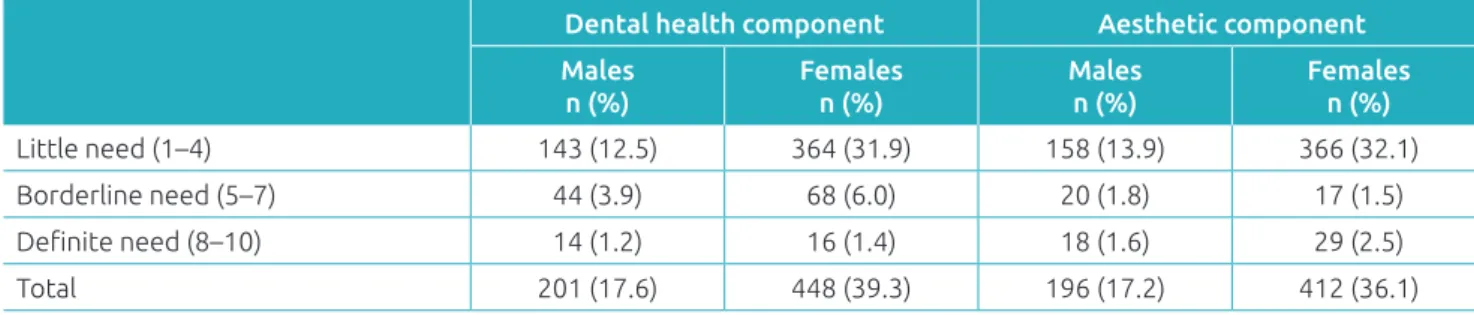
Table 2 exposes the results of normative treatment need, and subjective perception of treatment need was measured using the DHC and AC of the IOTN in males and females. It was found that normative treatment was required by 17.6% of males and 39.3% of females. Out of which, deinite treatment was required by 1.2% of males and 1.4% of females, whereas borderline needs were seen in 3.9% of the males and 6.0% of females. he sub-jective perception of treatment need by adolescents was low as compared to normative treatment need. In total, 17.2% of males and 36.1% of females considered themselves as needy for the treatment, out of which 1.6% of males and 2.5% of females had the perception of really needing the treatment, whereas subjec-tive perception for borderline need was found in 1.8% of males and 1.5% of females. Females were more concerned and aware about their aesthetic needs, compared to males.
89
loss (masticatory), and anterior fracture of tooth. IOTN DHC level explained 40.1% of the variance in the model and the cumulative variance provided by all the predictors [DHC, AC, decay (aesthetic zone), decay (masticatory), tooth loss (aesthetic zone), tooth loss (masticatory), anterior fracture of the tooth] was 78%. he dependent variable (RSES) showed the greatest association with model 1, model 3, and model 5, whereas it showed the least association with model 2.
DISCUSSION
Self-esteem refers to a person’s general sense of worth or accep-tance. It has become a household word. Teachers, parents, ther-apists, and others have focused eforts on boosting self-esteem, as high self-esteem will cause many positive outcomes and beneits. People high in self-esteem claim to be more likable and attractive, to have better relationships, and to make bet-ter impressions on others than people with low self-esteem.8
Adolescence is a stage of life that ofers the potential to prevent from both current impairment and future illness and promoting successful development into productive adult-hood. hus, the purpose of this study was to assess objective
Table 2 Frequency and prevalence (%) of index of orthodontic treatment need (IOTN) dental health component
(DHC) and aesthetic component (AC) scores.
Dental health component Aesthetic component
Males n (%)
Females n (%)
Males n (%)
Females n (%)
Little need (1–4) 143 (12.5) 364 (31.9) 158 (13.9) 366 (32.1)
Borderline need (5–7) 44 (3.9) 68 (6.0) 20 (1.8) 17 (1.5)
Deinite need (8–10) 14 (1.2) 16 (1.4) 18 (1.6) 29 (2.5)
Total 201 (17.6) 448 (39.3) 196 (17.2) 412 (36.1)
Table 3 Multiple linear regression model for Rosenberg’s Self-Esteem Scale.
Model R R2 Adjusted R2 SE R2 Change p-value
1 0.59 0.41 0.41 3.72 0.40 0.001
2 0.62 0.45 0.45 3.74 0.05 0.004
3 0.68 0.53 0.53 3.77 0.06 0.001
4 0.71 0.57 0.57 3.78 0.07 0.002
5 0.78 0.67 0.67 3.81 0.06 0.001
6 0.83 0.74 0.74 3.84 0.08 0.013
7 0.86 0.78 0.78 3.85 0.10 0.011
1: Dental health component (DHC); 2: DHC, aesthetic component (AC); 3: DHC, AC, decay (aesthetic zone); 4: DHC, AC, decay (aesthetic zone), decay (masticatory zone); 5: DHC, AC, decay (aesthetic zone), decay (masticatory zone), tooth loss (aesthetic zone); 6: DHC, AC, decay (aesthetic zone), decay (masticatory zone), tooth loss (aesthetic zone), tooth loss (masticatory zone); 7: DHC, AC, decay (aesthetic zone), decay (masticatory zone), tooth loss (aesthetic zone), tooth loss (masticatory zone), anterior fracture of tooth; R: correlation coeicient between the observed and predicted values, in which smaller value indicates that there is little or no linear relationship between the dependent variable and the independent variable; R2: a statistical measure of how close the data are to the itted regression line, also known as the coeicient
of determination, or the coeicient of multiple determinations for multiple regression; SE: standard error.
Table 1 Descriptive and clinical variables of the subjects.
Variables
RSES, mean (SD) 27.09 (3.1)
Age, mean (SD) 14.95 (2.1)
Gender [n (%)]
Male 496 (43.5)
Female 644 (56.5)
IOTN [n (%)]
DHC 649 (56.9)
AC 608 (53.3)
Anterior traumatic tooth [n (%)] 172 (15.1)
Tooth loss [n (%)] 80 (7.0)
Zone of tooth loss [n (%)]
Masticatory 34 (3.0) Aesthetic 46 (4.0) Untreated carious lesion [n (%)] 568 (49.9) Decay zone [n (%)]
Masticatory 497 (43.6)
and subjective orthodontic treatment needs of adolescents and other dental disorders on the self-esteem of adolescents using RSES. hat scale is widely used the self-reported instrument for evaluating individual self-esteem.
It was seen in the present study, according to the multi-variate analyses, that, out of all dental disorders, DHC has maximum impact on the adolescents’ self-esteem, followed by AC, which discriminates between the impact of other dental disorders and dental aesthetics on self-esteem. Dental aes-thetics plays a vital role in adolescents’ life, afecting their self-esteem level. here was a signiicant association between self-esteem and perceived dental aesthetics in our investiga-tion, reported similar to Badran7 and Kenealy et al’s15
stud-ies, which found that subjects who perceive their teeth as less attractive tend to have a lower self-esteem. On the other hand, Sheikh, Mathew and Siew16 did not support any association
between malocclusion and self-esteem. his could be due to the fact that minor irregularities may be very disturbing for some people, while severe malocclusions may not be of any concern for others.
A study conducted by Dogan et al.17 showed a huge
difer-ence between IOTN-DHC and IOTN-AC, but the present research found minor diferences between both components of IOTN. he diference in indings might be attributed to difer-ences in the studied subjects’ age, as well as cultural diferdifer-ences. he minor diferences between IOTN-DHC and IOTN-AC in the present study can be interpreted as a little diference between normative deinite treatment need and self-perceived treatment need of the population. It implies that the adoles-cents enrolled in the present study were more aware and con-cerned toward their aesthetics and were in constant need to improve their dental appearance and self-esteem.
he present study showed that gender played an important role in the association between self-esteem and malocclusion. he higher RSES scores were found in females. his result is not in agreement with Birkeland, Boe and Wisth,18 and the
diference might be because, when assessing the attractiveness, females placed themselves at the more attractive end of the scale
compared to males, which is in line with another study con-ducted by Abu Alhaija, Al-Nimri and Al-Khateeb.19 However,
according to Galambos, Baker and Krahn, attractiveness toward aesthetics changes with age and is not being static for any gen-der predisposition.20
he results of this study suggest that the role of attrac-tiveness in the formation of self-esteem may have to be re-evaluated and refrained. Perhaps adolescent self-esteem is more related to interpersonal performance. Given this frame-work for understanding adolescent self-concept, demonstra-ble treatment efects would depend on treatment-related changes in self-protective strategies and social interaction outcomes. In addition, these results call into question the common rationale for providing orthodontic treatment, at least for individuals with mild-to-moderate malocclusion. he full context of adolescent social development needs to be considered in decisions related to orthodontic treatment for young people.
However, the cross-sectional design of the present investigation prevents establishing any causal relationship between dental disorders and the poor self-perception of oral aesthetics, making it impossible to determine whether the associations found preceded or followed the occurrence of the outcome.
In conclusion, the results of the present study indicated that DHC, as well as AC, has a strong association with self-esteem among adolescents, although DHC association was on a little higher side as compared to AC. Based on these indings, the psychosocial problems of an unattractive dental appearance should not be overlooked. Moreover, implementing aesthetic self-evaluation methods may be a useful tool to consider when prioritizing orthodontic treatment modalities.
Funding
his study did not receive funding.
Conflict of interests
he authors declare no conlict of interests.
REFERENCES
1. United Nations Children’s Fund (UNICEF) [homepage on the Internet]. The emerging generation. The state of the world’s children 2011 [cited 2011 Feb 11]. New York; 2011. Available from: http://www.unicef.org/sowc2011/fullreport.php
2. Williams JM, Currie JE. Self-esteem and physical development in early adolescence: pubertal timing and body image. J Early Adolescence. 2000;20:129-49.
3. Shaw WC. The inluence of children’s dentofacial appearance on their social attractiveness as judged by peers and lay adults. Am J Orthod. 1981;79:399-415.
91
5. Mala AC, Luna EG, Sánchez NR, Barrera DA, Muñoz GM. Dental aesthetics and self esteem in adolescents. Colomb Med. 2011;42:482-9.
6. Sharma J, Sharma RD. IOTN – a tool to prioritize treatment need in children and plan dental health services. Oral Health Dent Manag. 2014;13:65-70.
7. Badran SA. The efect of malocclusion and self-perceived aesthetics on the self esteem of a sample of Jordanian adolescents. Eur J Ortho. 2010;32:638-44.
8. Motamedi KM, Behzadi A, Khodadad N, Zadeh AK, Nilchian F. Oral health and quality of life in children: a cross-sectional study. Dent Hypotheses. 2014;5:53-8.
9. Agou S, Locker D, Streiner DL, Tompson B. Impact of self-esteem on the oral-health-related quality of life of children with malocclusion. Am J Orthod Dentofacial Orthop. 2008;134:484-9. 10. Kiyak HA. Does orthodontic treatment affect patients’
quality of life? J Dent Educ. 2008;72:886-94.
11. Peter S. Survey procedures. In: Peter S, editor. Essential of preventive dentistry. 2nd ed. New Delhi: Arya Publishing House; 2003. p. 616-44.
12. Brook PH, Shaw WC. The development of an index of orthodontic treatment priority. Eur J Orthod. 1989;11:309 20.
13. Ellis RG. The classiication and treatment of injuries to the teeth of children. 3rd ed. Chicago: The Year Book Publishers, 1952.
14. World Health Organization. Oral health surveys: basic methods. 4th ed. Geneva: WHO; 1997.
15. Kenealy P, Gleeson K, FrudeN, Shaw W. The importance of the individual in the “causal” relationship between attractiveness and self-esteem. J Commu Appl Soc Psychol. 1991;1:45-56.
16. Sheikh A, Mathew T, Siew TB. Dental malocclusion among university students and its efect on self-esteem: a cross-sectional study. World J Dent. 2014;5:204-8.
17. Dogan AA, Sari E, Uskun E, Saglam AM. Comparison of orthodontic treatment need by professionals and parents with different socio-demographic characteristics. Eur J Orthod. 2010;32:672-6.
18. Birkeland K, Boe OE, Wisth PJ. Orthodontic concern among 11-year-old children and their parents compared with orthodontic treatment need assessed by Index of Orthodontic Treatment Need. Am J Orthod Dentofacial Orthop. 1996;110:197-205.
19. Abu Alhaija ES, Al-Nimri KS, Al-Khateeb SN. Self-perception of malocclusion among north Jordanian school children. Eur J Orthod. 2005;27:292-5.
20. Galambos NL, Barker ET, Krahn HJ. Depression, self-esteem, and anger in emerging adulthood: seven-year trajectories. Dev Psychol. 2006;42:350-65.