1. Laboratório de Nutrição e M etabolismo Aplicados à Atividade M otora, Escola de Educação Física e Esporte da Universidade de São Paulo. Received in 24/2/06. Final version received in 15/6/06. Approved in 20/7/ 06.
Correspondence to: Guilherme Giannini Artioli, Laboratório de Nutrição e M etabolismo Aplicados à Atividade M otora, Escola de Educação Física e Esporte da Universidade de São Paulo, Av. Professor M ello M oraes, 65, Cidade Universitária, Butantã – 05508-900 – São Paulo, SP. E-mail: artioli@ usp.br
Can sodium bicarbonate intake contribute
to judo fights performance?
Guilherme Giannini Artioli1, Desiré Ferreira Coelho1, Fabiana Braga Benatti1,
Alessandra Carvalho Gailey1, Bruno Gualano1 and Antonio Herbert Lancha Junior1
O
RIGINALA
RTICLEKeyw ords: M artial arts, Alkalosis. Lactate. Fatigue. ENGLISH VERSION
ABSTRACT
The objective of this study w as to investigate the effect of the
NaHCO3 ingestion on the judo performance. Six male athletes
in-gested 0.3 g • kg-1 body w eight of NaHCO3 or CaCO3 (placebo) 2 h
before 3 fights of 5 min, w ith 15 min recovery. Immediately after-w ards, and 15 min after each fight, the athletes related their per-ceived exertion. The blood lactate concentration w as verified in rest, after w arming up, 0, 3, 5, 7, 10 and 15 min after each fight. The same experimental protocol w as repeated tw ice by each athlete, except for the ingested substance. The study adopted the counter-balanced double-blind model. There w as no significant difference for the performance variables. The perceived exertion did not differ among the treatments, and the blood lactate concentration w as sig-nificantly greater (p < 0.05) after NaHCO3 ingestion in the first mo-ments of the protocol. In conclusion, the ergogenic effects of
NaH-CO3 are not enough to contribute to the improvement of the
performance in judo fights. How ever, the model limitations must be considered w hen generalizing these results. Future studies should use other tools to evaluate the performance in judo.
INTRODUCTION
The main physiological characteristic of judo fights is the inter-mittence. It consists of a series of supra-maximal exertions (w ith mean duration of 15 to 30 seconds), alternated w ith 10 to 15
sec-onds of recovery(1). In these short intervals, there is not sufficient
time for a suitable ATP resynthesis by the aerobic w ays, w hich makes these exertions highly dependant on the lactic anaerobic
w ay(2). The importance of the glycolytic anaerobic w ay of energy
production for judo may be demonstrated by the high blood lactate
concentration in athletes of this modality(3).
In exercises w ith the mentioned characteristics above, the high
H+ ions concentration has been mentioned as one of the main
caus-es of muscular fatigue(4-5). The decrease of the intramuscular pH is
related w ith a series of events w hich harm the muscular
contrac-tion-relaxation and energy obtaining processes(4-6).
In this context, several studies have researched the ergogenic action of alkaline substances in activities of high intensity and short duration. The increase of the blood pH caused by the alkalosis w ould provide delay in the fatigue occurrence and improvement in exer-cise w ith this characteristic(7-14). Nonetheless, some studies fail to
show the efficiency of this resource(15-20). Despite that, the use of
alkaline substances seems to be especially efficient in improving the performance in intermittent series of supra-maximal exercis-es, or in series of exercises w ith approximate duration of 60 s up
to approximately five minutes(7-8,10,21). According to Robertson et
al.(9), alkalosis causes a special effect in exercises w ith
predomi-nance of upper limbs, such as judo. Therefore, it is important to investigate the effect of the induced alkalosis on judo performance, once there is no consensus in the literature concerning the use of alkaline substances as ergogenic resource in anaerobic exercises. M oreover, athletes of this modality may theoretically benefit from the use of such resource.
Thereby, the aim of this study w as to verify w hether the sodium
bicarbonate (NaHCO3) ingestion is a reliable w ay of improving
per-formance in judo fights. The investigation on the sodium bicarbon-ate ingestion effect on the blood lactbicarbon-ate concentration and on the perceived exertion w as also aimed in this study.
M ETHODS
Subjects
Seven male judo fighters participated in this study. They w ere selected according to the follow ing inclusion criteria: to be betw een 18 and 30 years of age; to dedicate to judo training for at least 6 w eekly hours; to have a minimum brow n belt graduation; to regu-larly compete in regional or higher championships. One of the ath-letes got injured betw een the test days, consequently leaving the study. Three of the subjects w ere competitors of state level; tw o of regional level; and one of national level.
Protocol
Before the beginning of the tests, the subjects answ ered a ques-tionnaire in order to verify their competitive level, the training sta-tus and the judo practice time. After reading and signing the con-sent form, the volunteers w ere submitted to an anthropometrical and body composition evaluation. All the experimental procedure w as approved by the Ethics in Human Research Committee of the Institute of Biomedical Sciences of the São Paulo University.
The volunteers presented to the laboratory in tw o different days (separated for a minimum of tw o days and maximum of seven
days) in order to perform the tests. They ingested 0,3 g • kg-1 of
body w eight of NaHCO3 or placebo (calcium carbonate – CaCO3),
in each of the experimental procedures. The substances w ere in-gested via gelatin capsules, 120 min prior to the fights. The same experimental protocol w as repeated by each athlete, except for the administered substance. This study adopted the counterbal-anced double-blind model.
Ac-cording to Franchini et al.(22), this procedure guarantees the
meta-bolic response similarity betw een the different test days. No kind of encouragement w as given to the athletes during the fights.
The volunteers w ere instructed to arrive at the tests site w ell-fed and in an euhydration state, w ithout ingestion of any kind of food in the tw o hours w hich preceded the capsules intake. They w ere also instructed to eat similarly in the eve of the tw o test days, as w ell as not to practice intense exercises in the 16 hours preceding the tests. During the entire experimental period the ath-letes ingested w ater ad libitum.
Before the first fight, the athletes had a free w arm-up of 10 min. All of them performed a combination of running; stretching; knock out absorbing and projection movements.
The blood collections for later blood lactate concentration analy-sis occurred in the follow ing moments: in rest after the placebo or
NaHCO3 ingestion; after the w up; immediately after the w
arm-up; immediately after each fight; and 3, 5, 7, 10 and 15 min after each fight. The perceived exertion w as verified immediately after and 15 min after each fight. Blood samples of 25 µL w ere collect-ed from the earlobe, through heparinizcollect-ed capillary tubes and im-mediately stored in microtubes containing 50 µL of sodium fluorite solution 2% . All samples w ere refrigerated immediately after col-lection, and later analyzed in an automatized lactometer (YSI 2300 – Yellow Springs, Ohio, USA) for measurement of the blood lactate concentration. The perceived exertion w as reported using the Borg’s scale(23) of 6-20 points.
Figure 1 illustrates the experimental outlining of this study.
ferences w henever they occurred. The significance level p < 0,05 w as chosen before the beginning of the study. All analyses w ere
done w ith the aid of the softw are SAS for Window s® version 8.
RESULTS
The main characteristics of the participant subjects of this study are presented in table 1.
Figure 1 – – – – – Experimental outlining of the study
The body composition w as verified through hydrostatic w eight-ing. The body w eight w as measured using a digital scale (Kratos CAS, models linea – precision of 100 g), and the height through a board stadiometer.
The fights w ere filmed and later verified regarding their tempo-ral characteristics (exertion time; recovery time; standing fight time and fight time on the ground) as w ell as the technical actions of the evaluated subjects counted (number of standing attacks; num-ber of attacks on the ground; total of attacks and total of move-ments w hich resulted in punctuation). The exertions times during each fight w ere added in order to determine the total time of exer-tion. The same procedure w as used for determination of the total time of recovery, standing fight and fight on the ground.
Statistical analysis
The results are expressed in mean ± standard deviation. The data of performance, blood lactate concentration and perceived exertion w ere compared betw een the experimental treatments in order to verify significant differences through variance analysis for repeated measurements. Several variance and co-variance struc-tures w ere tested (non-structured; auto-regressive; symmetric and Toeplitz) w ith the purpose to find the best adjustment to the re-peated measurements. After this adjustment, the model w ith the co-variance structure w hich best adapted to the dependence struc-ture of the data w as selected. Later, t-Student tests w ere conduct-ed for dependent samples in order to establish the significant
dif-TABLE 1
M ain characteristics of the participants of this study (n = 6)
Age Judo time Weight Height Fat
(years) (years) (kg) (cm) (%)
M ean ± SD 20 ± 1,9 10,2 ± 1,3 74,2 ± 7,2 174,2 ± 5,5 7,9 ± 0,6
Variation 17-22 8-12 64,8-84 167-180,5 7,4-8,7
Temporal characteristics
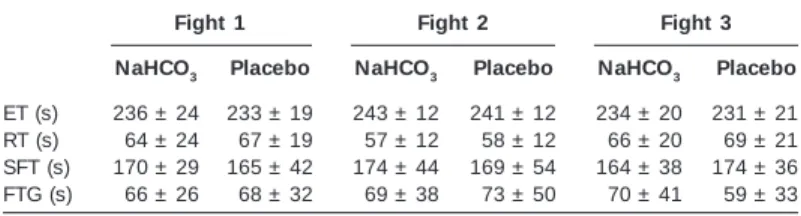
The statistical analysis did not show any significant difference betw een the treatments for the temporal variables of the fights, show ing that the subjects w ere submitted to periods of exertion and recovery similar in both treatments (table 2).
TABLE 2
Temporal characteristics of the three fights, in both treatments (mean ± SD)
Fight 1 Fight 2 Fight 3
NaHCO3 Placebo NaHCO3 Placebo NaHCO3 Placebo
ET (s) 236 ± 24 233 ± 19 243 ± 12 241 ± 12 234 ± 20 231 ± 21
RT (s) 064 ± 24 067 ± 19 057 ± 12 058 ± 12 066 ± 20 069 ± 21
SFT (s) 170 ± 29 165 ± 42 174 ± 44 169 ± 54 164 ± 38 174 ± 36
FTG (s) 066 ± 26 068 ± 32 069 ± 38 073 ± 50 070 ± 41 059 ± 33
ET = exertion time; RT = recovery time; SFT = standing fight time; FTG = fight time on the ground.
Performance
Table 3 presents the sum of the technical actions of the three fights in each treatment. There w as no statistically significant dif-ference betw een the treatments for any performance variable.
TABLE 3
Indicative variables of the performance in the fights (the data correspond to the sum of the indices of each fight; mean ± SD)
NaHCO3 Placebo
Standing attacks 41,8 ± 11,0 37,0 ± 16,3
Attacks on the ground 07,8 ± 04,7 09,0 ± 04,9
Total of attacks 49,6 ± 10,9 46,0 ± 16,5
Attacks w hich resulted in punctuation 08,5 ± 09,8 08,3 ± 09,4
Blood lactate concentration
The mean of the blood lactate concentration w as higher in all collection moments w hen the athletes ingested sodium bicarbon-ate (figure 2). The variance analysis show ed that the blood lactbicarbon-ate w as significantly higher after the NaHCO3 ingestion (p < 0,01). There w as statistically significant difference betw een treatments after fight 1 (p < 0,05). In the 3rd minute after fight 1 tendency to
signif-icant difference betw een treatments w as observed (p = 0,09), as w ell as after fight 2 (p = 0,05).
Perceived exertion
According to w hat is illustrated in figure 3, the perceived exer-tion did not differ betw een the experimental treatments. How ev-er, there w as significant difference betw een the indices immedi-ately after and 15 minutes after the fights in both experimental treatments (p < 0,0001).
a = blood collection for lactate analysis; b = perceived exertion. Time (min) Ing
est ion
Wa rm
-up
Fight 1
Recovery Fight
2
Recovery Fight
3
DISCUSSION
Although there w ere some conflicting results, the literature has show n that the administration of alkaline substances improves performance in activities w ith characteristics similar to judo(7,9,11).
According to Hickner et al.(24), one of the main limitations of
stud-ies w hich evaluate performance in modalitstud-ies of domain fight is the kind of test used. The use of tests extremely specific to the motor gestures and physiological demand of the fight is needed in order to avoid results of little practical application. A protocol of three fights w as used w ith the purpose to simulate the competi-tion environment.
Considering that the technical-tactic aspects have a great influ-ence on the final result of a fight, victories or defeats w ere not considered as indicative of performance. We suppose that the counting of the number of attacks and the quantity of movements w hich resulted in punctuation w ould be better indicators of perfor-mance. This thought relies on the fact that an athlete physically fit, theoretically speaking, is able to perform a higher number of at-tacks than w hen he is in fatigue state. Likew ise, his atat-tacks w ould have, theoretically, greater strength, velocity and coordination, w hich could make them more efficient.
The results of the present study show ed that the administration of alkaline substances w as not capable of improving performance in judo fights. How ever, the hypothesis that the alkalosis induction could not, somehow, contribute to fights performance cannot be discarded. Certainly, the great quantity of variables related to per-formance in a judo fight (tactic and psychological factors, besides the opponents performance itself, for instance) contributed so that differences betw een the treatments w ere not observed.
Tw o hypotheses may be formulated to explain the results of the present study: either the used test, despite its great ecological validity, w as not sensible enough to detect alterations in the per-formance caused by the sodium bicarbonate ingestion; or the
im-provement magnitude in the performance caused by the sodium bicarbonate ingestion w as not sufficient in order to reflect in per-formance improvement in fights. From this flow of thinking, the major issue that the present study raises is: to w hat extent im-provement in the “ physical” aspects of the athlete is capable of inducing improvement in performance in fights, in w hich the tech-nical and tactic aspects are also very important? It is concluded from the data obtained in this study that possible improvement in the “ physical” aspects did not reflect in performance improvement in fights. Anyw ay, the limitation of this study, such as the low sam-ple number and the limitations of the used method (w hich despite being extremely applied, does not allow large control over other variables w hich influence performance) should be pondered w hen interpreting the results.
Future studies w hich need to evaluate judo performance w ill have to choose betw een highly specific protocols, ecological valid-ity and low control of intervenient variables (w hich w as the case of the present study), or protocols of higher accuracy and sensibility and low er practical application. Tests such as the Wingate for up-per limbs and the Special Judo Fitness Test have been used in
order to evaluate judo fighters performance(3,25) and are options of
test w ith higher accuracy but low er specificity(25).
The blood lactate concentration mean w as higher after NaHCO3
ingestion in all moments of the collection. Significant differences w ere only observed in the first minute after the first fight. Such fact is an indication that there is a tendency to decrease the alkalo-sis effects w ith time progression, once the difference betw een the groups tend to decrease. Future studies should search for an-sw ers for this issue, evaluating the duration of the bicarbonate blood concentration increase after the alkalosis induction, since
the decrease of efficiency of the NaHCO3 after some hours could
alter the ingestion strategy or even the decision to ingest it or not. Studies that used different exercise protocols and different dos-es of bicarbonate found conflicting rdos-esults of blood lactate. Ac-cording to our results, some studies also found significant increase of the blood lactate concentration after the alkalosis induction (8,10,12-14,26-27). Conversely, other studies verified either a non-significant
tendency of increase of blood lactate, or no difference at all
(7,15-17,19,20,28). Obviously, these divergences are due to different doses
administration as w ell as the several types of exercises applied. Differences in the blood lactate and performance w ere not observed in the studies in w hich the exercises did not have sufficient lactic anaerobic demand, besides not causing an extreme acidosis pro-file(15,17,19,26).
The present study w as the first one to evaluate judo in combat situations. Considering the judo fights characteristics (promotion of an extreme acidosis and fatigue profile; presentation of great lactic anaerobic demand and constitution of subsequent series of intermittent supra-maximal exertions), the effects observed over the blood lactate concentration are consistent w ith other w orks w hich used exercise protocols w ith similar characteristics(13,15,17,19,26).
Such fact reinforces the hypothesis that the controversial results obtained so far may be related to the inadequacies of the test pro-tocols, and not to the inconsistent effect of the sodium bicarbon-ate.
It has been demonstrated that the dose used in the present study is more efficient in the performance improvement than a 0.2
g • kg-1 or low er dose. Higher does on the other hand, do not
pro-mote more benefits than the 0.3 g • kg-1 dose(12). The NaHCO
3
in-gestion promotes significant increase of the HCO3- plasmatic
con-cent rat ion, as w ell as of t he blood pH and t he BE (base excess)(7,9,16,19,27,28).
The hypothesis that the H+ ions are buffered in the muscular
cells is discarded due to the impermeability of the sarcolemma to
the HCO3-(29). Nevertheless, the high concentration of HCO
3 - caused
by the NaHCO3 ingestion promotes increase of inflow of the H+
ions of the muscular cells to the blood, w here they are buffered(30).
Figure 3 – – – – – Perceived exertion reported in the different moments of collec-tion (* p < 0,0001)
Figure 2 – – – – – Response of the blood lactate concentration in both treatments (* p < 0,05; * * p = 0,09; # p = 0,05)
after fight 1 after fight 2 after fight 3
reco very afte
r w arm
-up
time (min)
B
o
rg
’s
s
c
a
le
p
o
in
ts
after L1 15’ after
L1
after L2 15’ after
L2
after L3 15’ after
Consequently, the intramuscular acidosis decreases, w hich extends
the functioning of the glycolytic w ay and delays fatigue(14). Such
mechanism could explain the higher blood lactate concentration observed in this study. Besides the higher lactate production caused by the intramuscular pH decrease, other mechanisms may con-tribute to the increase of the blood lactate concentration after the sodium bicarbonate ingestion. Some authors suggest increase in the lactate inflow rate, since the exit of this anion is connected to
the H+ exit in the symport performed by the M CT-1
(monocarbox-ilate transporter)(31). Other still produced evidence of low er lactate
pick up by the non-exercised muscles(14).
There is a straight relation betw een muscular acidosis and
fa-tigue, due to the follow ing effects of the H+ ions: 1) inhibition of
the maximal velocity of muscular shortening(4); 2) inhibition of the
miofibrilar ATPase and the enzymes important for the regulation of
the glycolytic anaerobic process of energy obtaining(4,6); 3)
reduc-tion of the crossed bridges formareduc-tion through inhibireduc-tion of the Ca+ +
to the TNC site of the troponin(4-6); and 4) reduction of the Ca+ +
return by the inhibition of the sarcoplasmatic ATPase, w hich leads
to reduction in the Ca++ release(4). Therefore, as previously
men-tioned, a reduction in the H+ concentration in the muscular cell
promotes delay in fatigue besides allow ing that the glycolytic w ay is used for a longer period.
Although the performance evaluation in fights had not been sen-sible enough to detect alterations in performance, the increase of the blood lactate concentration after alkalosis induction observed in the present study suggests that this resource may potentially delay fatigue, as w ell as contribute to performance of judo fight-ers. The high blood lactate is an indication of higher energy pro-duction by the glycolytic w ay, w hich meant that theoretically the intramuscular acidosis w as low er.
Lavender and Bird(11) claimed that the pH return close to resting
indices, caused by the higher inflow of H+ ions during alkalosis
caus-es a more complete recovery betw een sericaus-es in intermittent exer-cises. Therefore, w e hypothesized that the fatigue sensation could be low er due to the alkalosis induction, both after the fight as w ell as before the follow ing combat. Nonetheless, it w as observed that there w as no alteration in the perceived exertion caused by the
NaHCO3 ingestion. These results are according to the ones by
Kozak-Collins et al.(32) and Stephens et al.(27), w ho used scales
sim-ilar to the ones from this study. Poulus et al.(33), using another scale
that measured fatigue, also verified that there w as no alteration in
the fatigue sensation derived from the NaHCO3 utilization.
Accord-ing to the same authors, the fatigue sensation depends on meta-bolic, circulatory and psychochemical alterations, among others. The alterations in the acid-base balance caused by studies like this are only one among several physiological processes w hich involve the fatigue phenomenon. Such episode may explain the fact that there w ere not significant differences in the perceived exertion in any moment of the collection. How ever, used the scale w as effi-cient in distinguishing fatigue (post-fights) and recovery moments. In conclusion, although the sodium bicarbonate ingestion increas-es the blood lactate (indicating more extended utilization of the glycolytic w ay), w hich theoretically could contribute to performance in fights, the present study provides strong evidence that such strategy is innocuous in application terms, both for performance improvement as w ell as for decreasing the perceived exertion. Nonetheless, the method’s limitations, such as the strong influ-ence of technical, tactic and psychological aspects, should be con-sidered. M oreover, there is the risk that the athletes present sen-sibility to the minimum necessary dose, w hich w ould be extremely counterproductive in terms of performance.
Future studies should use tests combinations w ith different degrees of objectiveness and specificity, such as the Wingate for upper limbs and Special Judo Fitness Test.
ACKNOWLEDGM ENTS
The authors thank the Institute of M athematics and Statistics of USP for the conduction of the statistical analysis; the FAPESP for the financial sup-port; to Prof. Dr. Emerson Franchini for the contributions during the Project; to the physical trainers M arcos Antônio Lopes and Jaime Bragança; to the scholars André M assaru and M ilena Bushatsky and to the athletes for the collaboration in this study.
All the authors declared there is not any potential conflict of inter-ests regarding this article.
1. Castarlenas JL, Planas A. Estudio de la estructura temporal del combate de judo. Apunts: Educación Física e Deportes. 1997;47:32-9.
2. Tabata I, Irisaw a K, Kouzaki M , Nishimura K, Ogita F, M iyachi M . M etabolic pro-file of high intensity intermittent exercises. M ed Sci Sports Exerc. 1997;29:390-5.
3. Franchini E, Takito M Y, Nakamura FY, M atsushigue KA, Kiss M APDM . Effects of recovery type after a judo combat on blood lactate removal and on performance in an intermittent anaerobic task. J Sports M ed PhysFitness. 2003;43:424-31.
4. Gladden LB. Lactate metabolism: a new paradigm for the third millennium. J Physiol. 2004;558:5-30.
5. Hermansen L, Osnes JB. Blood and muscle pH after maximal exercise in man. J Appl Physiol. 1972;32:304-8.
6. Daw son M J, Gadian DG, Wilkie DR. M uscular fatigue investigated by phospho-rus nuclear magnetic resonance. Nature. 1978;274:861-6.
7. Costill DL, Verstappen F, Kuipers E, Janssen E, Fink W. Acid-base balance during
repeated bouts of exercise: influence of HCO3. Int J Sports M ed.
1984;5:228-31.
8. Wijnen S, Verstappen F, Kuipers E. The influence of intravenous NaHCO3
-admin-istration on interval exercise: acid-base balance and endurance. Int J Sports M ed. 1984;5:130-2.
9. Robertson RJ, Falkel JE, Drash AL, Sw ank AM , M etz KF, Spungen SA, et al. Effect of induced alkalosis on physical w ork capacity during arm and leg exer-cise. Ergonomics. 1987;30:9-31.
10. Bouissou P, Defer G, Guezennec CY, Estrade PY, Serrurier B. M etabolic and blood catecholamine responses to exercise during alkalosis. M ed Sci Sports Exerc. 1988;20:228-32.
11. Lavender G, Bird SR. Effect of sodium bicarbonate ingestion upon repeated sprints. Br J Sports M ed. 1989;23:41-5.
REFERENCES
12. M cNaughton LR. Bicarbonate ingestion: effects of dosage on 60 s cycle ergom-etry. J Sports Sci. 1992;10:415-23.
13. M cNaughton LR. Sodium bicarbonate ingestion and its effects on anaerobic ex-ercise of various durations. J Sports Sci. 1992;10:425-35.
14. Granier PL, Dobouchaud H, M ercier BM , M ercier JG, Ahmaid S, Préfaut CG.
Effect of NaHCO3 on lactate kinetics in forearm muscles during leg exercise in
man. M ed Sci Sports Exerc. 1996;28:692-7.
15. Kindermann W, Keul J, Huber G. Physical exercise after induced alkalosis (bicar-bonate or tris-buffer). Europ J Appl Physiol. 1977;37:197-204.
16. Horsw ill CA, Costill DL, Fink WJ, Flynn M G, Kirw an JP, M itchell JB, et al. Influ-ence of sodium bicarbonate on sprint performance: relationship to dosage. M ed Sci Sports Exerc. 1988;20:566-9.
17. Linderman J, Kirk L, M usselman BD, Dolinar BD, Fahey TD. The effects of sodi-um bicarbonate and pyridoxine-alpha-ketoglutarate on short-term maximal exer-cise capacity. J Sports Sci. 1992;10:243-53.
18. Pierce EF, Eastman NW, Hammer W, Lynn TD. Ef fect of induced alkalosis on sw imming time trials. J Sports Sci. 1992;10:255-9.
19. Webster M J, Webster M N, Craw ford RE, Gladden B. Effect of sodium bicarbon-ate ingestion on exhaustive resistance exercise performance. M ed Sci Sports Exerc. 1993;25:960-5.
20. Tiryaki GR, Atterbom HA. The effects of sodium bicarbonate and sodium citrate on 600 m running time. J Sports M ed Phys Fitness. 1995;35:194-8.
21. Wilkes D, Gledhill N, Smyth R. Effect of acute induced metabolic alkalosis on 800m racing. M ed Sci Sports Exerc. 1983;15:277-80.
23. Borg GAV. Psychophysical bases of perceived exertion. M ed Sci Sports Exer. 1982;14:377-87.
24. Hickner RC, Horsw ill CA, Welker J, Roemich JN, Costill DL. Test development for the study of physical performance in w restlers follow ing w eight loss. Int J Sports M ed. 1991;12:557-62.
25. Franchini E. Tipo de recuperação após a luta, diminuição do lactato e desempe-nho posterior: implicações para o judô [Tese (doutorado em Educação Física)]. São Paulo: EEFE-USP, 2005.
26. Portington KJ, Pascoe DD, Webster M J, Anderson LH, Rutland RR, Gladden LB. Effect of induced alkalosis on exhaustive leg press performance. M ed Sci Sports Exerc. 1998;30:523-8.
27. Stephens TJ, M cKenna M J, Canny BJ, Snow RJ, M cConnell GK. Effect of sodi-um bicarbonate on muscle metabolism during intense endurance cycling. M ed Sci Sports Exerc. 2002;34:614-21.
28. Robergs R, Hutchinson K, Hendee S, M adden S, Siegler J. Influence of pre-exercise acidosis and alkalosis on the kinetics of acid-base recovery follow ing intense exercise. Int J Sport Nutr Exerc M etab. 2005;14:59-74.
29. M ainw ood GW, Cechetto D. The effect of bicarbonate concentration on fatigue and recovery in isolated rat diaphragm muscle. Can J Physiol Pharmacol. 1980; 58:624-32.
30. M ainw ood GW, Worsley-Brow n PA. The effect of extracellular pH and buffer concentration on the efflux of lactate from frog sartorius muscle. J Physiol. (Lon-don) 1975;250:1-22.
31. Brooks GA, Dubouchard H, Brow n M , Sicurello JP, Butz CE. Role of mitochon-drial lactate dehydrogenase and lactate oxidation in the intracellular lactate shut-tle. Proc Natl Acad Sci. 1999;96:1129-34.
32. Kozac-Collins K, Burke ER, Schoene RB. Sodium bicarbonate does not improve performance in w omen cyclists. M ed Sci Sports Exerc. 1994;26:1510-5.