Official Journal of the Brazilian Psychiatric Association Volume 34 • Number 3 • October/2012
Psychiatry
Revista Brasileira de Psiquiatria
Abstract
Objectives: To evaluate the prevalence of suicide risk and comorbidities in postpartum women.
Methods: This is a cross-sectional study of postpartum women. The sample comprised mothers who have received prenatal care from the Brazilian National System of Public Heath in the city of Pelotas. Suicide risk and other mental disorders were evaluated using the Mini International Neuropsychiatric Interview (MINI). A yes answer on one of the six interview questions was considered a sign of suicide risk. Results: The sample consisted of 919 postpartum women. The 11.5% suicide prevalence was 4.62 (CI 2.45, 8.73) times higher in women with low educational levels. Women with comorbid depression or an anxiety disorder showed a 17.04 (CI 2.27; 19.96) times greater risk of suicide than those who did not suffer from any mood disorder. Conclusion:
Lower education levels and psychiatric disorders are associated with suicide risk. Bipolar disorder is the psychiatric disorder with the highest impact on suicide risk.
Prevalence of suicide risk and comorbidities in
postpartum women in Pelotas
Daniele Tavares,
1Luciana Quevedo,
1Karen Jansen,
1Luciano Souza,
1Ricardo Pinheiro,
1Ricardo Silva
11 Health and Behavior Post-graduation Program, Universidade Católica de Pelotas, Brazil
Received on May 24, 2011; accepted on December 2, 2011
DESCRIPTORS
Postpartum Depression; Suicide Risk;
Maternal Depression; Anxiety Disorders; Woman.
ORIGINAL ARTICLE
Corresponding author: Luciana Quevedo. E-mail: [email protected] 1516-4446 - ©2012 Elsevier Editora Ltda. All rights reserved.
Prevalência do risco de suicídio e de comorbidades em mulheres pós-parto em Pelotas
Resumo
Objetivos: Avaliar a prevalência do risco de suicídio e de comorbidades em mulheres pós-parto.
Métodos: Este foi um estudo em corte transversal com mulheres pós-parto. A amostra foi constituída de mães que receberam cuidados pré-natais prestados pelo Sistema Nacional de Saúde Pública do Brasil na cidade de Pelotas. O risco de suicídio e outros transtornos mentais foram avaliados pela Mini International Neuropsychiatric Interview (MINI). Uma resposta airmativa a
qualquer das seis perguntas é considerada um risco de suicídio. Resultados: A amostra consistiu de 919 mulheres pós-parto. A prevalência do risco de suicídio foi de 11,5%. Ela foi 4,62 vezes mais alta (IC de 95% 2,45; 8,73) em mulheres de baixo nível educacional. Mulheres apresentando qualquer comorbidade para depressão e transtornos ansiosos tiveram uma chance 17,04 vezes maior (IC 95% 2,27; 19,96) àquelas que não apresentaram nenhum transtorno afetivo. Conclusão:
Um nível educacional mais baixo e a presença de um transtorno psiquiátrico se associam ao risco de suicídio. O transtorno bipolar é o diagnóstico psiquiátrico com maior impacto sobre o risco de suicídio.
DESCRITORES:
Depressão pós-parto; Risco de suicídio; Depressão maternal; Transtornos de ansiedade; Mulher.
Introduction
In 2008, according to the World Health Organization (WHO), there were 9,206 suicide deaths in Brazil, which corresponds to 22 deaths per day. The suicide incidence is on average 4.8 deaths per 100,000 inhabitants. Compared with other coun-tries, the suicide rate in Brazil is low; however, the absolute number is high because of its large population.1 Rio Grande do Sul is the Brazilian state with the highest suicide incidence (mean = 10.2 suicide deaths/100,000 inhabitants).2 This rate has motivated scientists from different research areas, such as the social and health sciences, to examine ethnicity, culture, social crises and even regional climate as potential factors that may affect this problem.2,3
There are dificulties in assessing suicide risks, particularly the lack of uniformity in classifying the features of this be-havior. Suicidality involves both suicidal ideation and suicidal behaviors. Suicidal ideation includes the thoughts and feelings that are often associated with suicidal behavior (e.g., devel-oping a suicide plan, preoccupation with thoughts of death, etc.). Suicidal behavior involves the deliberate attempt to take one’s own life.4 Most suicidal individuals have at least
one psychiatric disorder, and 20% to 30% have made a previ-ous suicide attempt.5
The onset of mental disorders is associated with stressful life events.6 Signiicant changes such as the birth of a child
may be related to the brain's stress response and can cause postpartum depression (PPD).6 PPD is a common complication
of childbearing, and has increasingly been identiied as a major public health problem. The prevalence of PPD ranges from 10% to 20% according to most studies.7-11
Depressed mothers often have suicidal ideation12 and
although suicide rates associated with postpartum depres-sion (PPD) are lower than the rates in the non-childbearing population, suicide is responsible for 28% of all female deaths during the irst postpartum year. In addition, suicide is con -sidered one of the three major factors in maternal mortality rates.13-16 Studies of maternal deaths in Australia (1994–2002)
have suggested that maternal psychiatric illness was a leading cause of maternal death; the majority of suicides occurred violently.17 The Ofice for National Statistics (ONS), a record
linkage study in the U.K. identiied over 40 additional maternal deaths in the triennium from 1997 to 1999 from suicide or violent causes; this discovery made suicide the leading cause of indirect maternal deaths after these cases were added to the National Institute for Health and Clinical Excellence (NICE) report statistics.15,18 A similar inding was also found in
a Finnish linkage study of maternal deaths, which reported 73 suicides associated with pregnancy between the years 1987 and 1994.19 In Denmark, between 1985 and 1994, 35.5% of the maternal deaths were suicides.20 In Brazil, 5.7% of the population is at high risk for suicide.21
A well-established risk factor for suicidal behavior is the presence of mental disorders, particularly mood disorders,3,4
However, it is also important to investigate anxiety disor-ders.22 One previous study has emphasized the importance of
comorbid anxiety disorders and symptoms in increasing the suicide risk in depressed patients.23 Although there has been
signiicant interest in whether anxiety disorders are risk fac -tors for suicidal behavior, it remains a controversial topic. One study has shown that 37.7% with major depressive episodes also had a comorbid anxiety disorder.24
Mental disorders occurring in the postpartum period could have serious consequences and, if not treated early, can even affect the quality of child care. Mental disorders can also lead to cognition and behavior disorders, poor social interac-tion and impaired physical development in the irst year of a child's life.25
The objective of this study was to verify the prevalence of suicide risk and comorbidities in postpartum women. We hypothesized that the comorbidity between mood disorders and anxiety disorders increases the suicide risk.
Method
prenatal care provided by the Brazilian National System of Public Health. The assessment was performed out within a 30 to 90-day postpartum period.
Suicide risk and other mental disorders were assessed us-ing the Mini International Neuropsychiatric Interview (MINI). MINI is a short structured interview with adequate validity and reliability.26 The suicidality module inquires about several
components of suicide risk (suicidal thinking and/ or suicidal attempts) and comprised the following questions. Over the last month, 1) Have you wished you were dead?; 2) Have you wanted to harm yourself?; 3) Have you thought of commit-ting suicide?; 4) Have you planned how to commit suicide?; 5) Have you attempted suicide? and 6) Have you ever attempted suicide? The MINI assesses the suicide risk according to the criteria outlined in the DSM-IV; therefore, a "yes" answer on one of the six answered questions is considered a suicide risk.27
In addition to the diagnostic interview, each woman an-swered a questionnaire regarding her socioeconomic status, schooling, social support, stressful events during pregnancy, smoking, alcohol use and delivery. We used the Brazilian Association of Research Companies (ABEP) classiication to assess the socioeconomic status of each family. This classiica -tion is based on the material wealth and educa-tion level of the head of household. The women were regrouped into high (A1, A2, and B1), medium (B2, C1, and C2) and low (D and E) socioeconomic levels.28
The data were double-typed in the EpiInfo 6,04d software and analyzed with the statistical software SPSS 10.0 and Stata 9. A Chi-square test was used to compare proportions. Because the etiology of suicide risk is not well established, and many explanatory factors can be involved, the independent variables were stratiied into two hierarchical levels for the multivariate analysis. The irst level comprised the sociodemographic vari -ables (age, education level, socioeconomic status and living with a partner) and the second level involved reproductive and behavioral variables (abortion, social support, stressful events in pregnancy, alcohol abuse, smoking and comorbidi-ties). We used a Poisson regression model to control for pos-sible confounding factors. The variables with p-values < 0.2 in the gross analysis were included in the adjusted analysis. The analysis model was adjusted to obtain the remaining effects between the variables to ensure that after adjusting for the irst level, the variables with p-values < 0.2 were not included in the second hierarchical analysis. After the adjusted analysis, statistical signiicance was consistently evaluated using the level of 0.05 (two-tailed) to indicate statistical signiicance.29
All of the subjects provided written informed consent for the analysis and the anonymous publication of the research indings. The study was approved by the Ethics Research Committee of the Universidade Católica de Pelotas, in accor-dance with existing regulations (CONEP-Res196/96).
Results
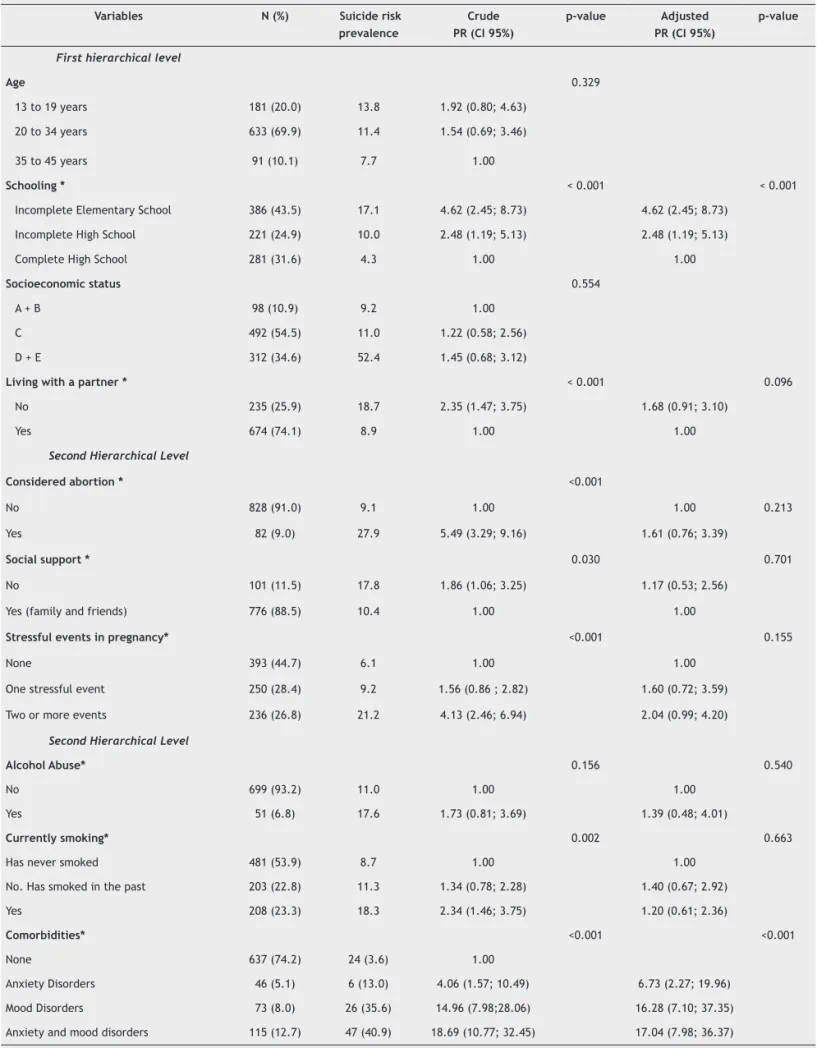
A total of 1,053 pregnant women were identiied. However, 12.7% (N = 134) were not found or refused participation in the study. Therefore, 919 postpartum women were enrolled in the study. We found an 11.5% prevalence of suicide risk in the postpartum period. Our sample had the following demo-graphics: predominantly middle class (54.5%), aged 20 to 34 years (69.9%) and low education levels (43.5%). Additionally, 74% had partners; 9% had considered abortion; 88.5% had
social support; 26.8% suffered one stressful pregnancy-related event; 6.8% were alcoholics; and 23.3% smoked (Table 1). The raw analysis showed a signiicant difference in the suicide risk according to schooling, living with a partner, considering abor-tion, social support, stressful events, smoking and comorbidity for depression and anxiety disorder (p > 0.05). After adjust-ing for possible confoundadjust-ing variables irst level = education level and living with a partner; second level = thought about abortion, social support, stressful events in pregnancy, alcohol abuse, currently smoking and comorbidities), the suicide risk remained associated with education level (p < 0.001) and co-morbidity for depression and anxiety (p = 0,001).The mothers who had not inished elementary school showed a 4.62 [95% conidence interval (CI), 2.45, 8.73] chance of showing signs of suicide risk when compared to the ones who had inished high school. The women with comorbidities of depression and an anxiety disorder showed a 17.04 (CI 2.27; 19.96) times higher risk for suicide than those who did not suffer from any mood disorder.
Table 2 shows the association between suicide risk and psy-chiatry disorders in postpartum women. Depressive episodes, hypo(manic) and mixed episodes, panic disorders, social pho-bia, generalized anxiety disorder (GAD), obsessive compulsive disorder (OCD), and posttraumatic stress disorder (PTSD) were associated with suicide risk (p ≤ 0.001). The number of anxiety disorders was also associated with suicide risk. The mothers who experienced depressive episodes showed a 12.57 (6.99, 22.59) times greater risk for presenting with suicidal signs. The women who had hypomanic episodes were 7.01 (3.54, 13.88) times more likely to shows signs of suicide risk compared to those without hypomanic episodes. The women with mixed episodes showed a 38.67 (19.52, 76.57) times greater risk than those who did not suffer from mixed episodes. The suicide risk was 5.42 (3.73, 7.89) times greater in mothers who were diagnosed with panic disorder compared with those who did not present with such an episode during the postpartum period and 4.56 (3.11, 6.70) times greater in the mothers who had social phobia compared with those.The prevalence of suicide risk was 4.32 (3.08, 6.07) times greater in women who suffered from a GAD compared with those who did not. The mothers who had OCD were 3.96 (2.65, 5.93) times more likely to shows signs of suicide risk and women with PTSD had a 5.49 (3.80, 7.94) times greater risk of showing suicidal signs compared with those who did not have PTSD. We found that women who had two or more anxiety disorders were 12.34 (7.12, 21.39) times more likely to show suicidal signs.
Discussion
The prevalence of suicide risk in postpartum women was 11.5%. The main factors associated with the suicide risk were low schooling and psychiatric disorders. Moreover, mixed epi-sodes were highly associated with suicide risk. Other studies have conirmed that mixed episodes increased the risk for suicide.5,30,31 A study of postpartum women found an 11.1%
prevalence suicide risk,21 which corroborated our results.
Botega et al. found a lifetime prevalence of 17.1% for suicidal ideation in the Brazilian population.32
This study showed an disorders and suicide risk in the postpartum period. Ninety percent of people who commit suicide also have a comorbid mental disorder.33 Research
Table 1 Distribution, prevalence rates (PR) and association test (p-value) in the sample sociodemographic characteristics and suicide risks
Variables N (%) Suicide risk
prevalence
Crude PR (CI 95%)
p-value Adjusted
PR (CI 95%)
p-value
First hierarchical level
Age 0.329
13 to 19 years 181 (20.0) 13.8 1.92 (0.80; 4.63)
20 to 34 years 633 (69.9) 11.4 1.54 (0.69; 3.46)
35 to 45 years 91 (10.1) 7.7 1.00
Schooling * < 0.001 < 0.001
Incomplete Elementary School 386 (43.5) 17.1 4.62 (2.45; 8.73) 4.62 (2.45; 8.73)
Incomplete High School 221 (24.9) 10.0 2.48 (1.19; 5.13) 2.48 (1.19; 5.13)
Complete High School 281 (31.6) 4.3 1.00 1.00
Socioeconomic status 0.554
A + B 98 (10.9) 9.2 1.00
C 492 (54.5) 11.0 1.22 (0.58; 2.56)
D + E 312 (34.6) 52.4 1.45 (0.68; 3.12)
Living with a partner * < 0.001 0.096
No 235 (25.9) 18.7 2.35 (1.47; 3.75) 1.68 (0.91; 3.10)
Yes 674 (74.1) 8.9 1.00 1.00
Second Hierarchical Level
Considered abortion * <0.001
No 828 (91.0) 9.1 1.00 1.00 0.213
Yes 82 (9.0) 27.9 5.49 (3.29; 9.16) 1.61 (0.76; 3.39)
Social support * 0.030 0.701
No 101 (11.5) 17.8 1.86 (1.06; 3.25) 1.17 (0.53; 2.56)
Yes (family and friends) 776 (88.5) 10.4 1.00 1.00
Stressful events in pregnancy* <0.001 0.155
None 393 (44.7) 6.1 1.00 1.00
One stressful event 250 (28.4) 9.2 1.56 (0.86 ; 2.82) 1.60 (0.72; 3.59)
Two or more events 236 (26.8) 21.2 4.13 (2.46; 6.94) 2.04 (0.99; 4.20)
Second Hierarchical Level
Alcohol Abuse* 0.156 0.540
No 699 (93.2) 11.0 1.00 1.00
Yes 51 (6.8) 17.6 1.73 (0.81; 3.69) 1.39 (0.48; 4.01)
Currently smoking* 0.002 0.663
Has never smoked 481 (53.9) 8.7 1.00 1.00
No. Has smoked in the past 203 (22.8) 11.3 1.34 (0.78; 2.28) 1.40 (0.67; 2.92)
Yes 208 (23.3) 18.3 2.34 (1.46; 3.75) 1.20 (0.61; 2.36)
Comorbidities* <0.001 <0.001
None 637 (74.2) 24 (3.6) 1.00
Anxiety Disorders 46 (5.1) 6 (13.0) 4.06 (1.57; 10.49) 6.73 (2.27; 19.96)
Mood Disorders 73 (8.0) 26 (35.6) 14.96 (7.98;28.06) 16.28 (7.10; 37.35)
Anxiety and mood disorders 115 (12.7) 47 (40.9) 18.69 (10.77; 32.45) 17.04 (7.98; 36.37)
Brazilian study found a 71.9% prevalence of comorbid mental disorders in patients who had a previous suicide attempt.35
The psychiatric problems most consistently linked to suicidality are mood and anxiety disorders.36
Our data are in agreement with some previous studies that have suggested an association between anxiety and depressive symptoms.37,38 The results showed that the comorbidities of
anxiety and mood disorders had the greatest impact on suicide risk. Comorbidity is an important consideration when the risk factors for suicidal behavior are being evaluated. Psychological disorders rarely occur alone, and anxiety disorders occur more frequently with depression (a strong risk factor for suicidality) than without it.39 Furthermore, studies have emphasized that
anxiety symptoms, rather than diagnoses, predict suicidal behavior.40
Regarding mood disorders, a limitation of our study is that the MINI does not evaluate past depressive episodes when there are no current symptoms of depression. Thus, we cannot determine if the hypomanic episodes observed were isolated episodes.
Some studies have analyzed the relationship between anxi-ety disorders and suicide risk. Panic disorder has been the most investigated anxiety disorder in relation to suicide. Studies have shown that subjects with a panic disorder that was comorbid with another mood disorder were more than twice
as likely to attempt suicide.41 Another inding suggested that
patients with panic disorders and comorbid major depression had higher suicide risks than patients with major depression alone.42 Moreover, another study showed that after controlling
for comorbid disorders, posttraumatic stress disorder was the only anxiety disorder that was signiicantly associated with suicide attempts.43
The risk factors for suicidal behavior in OCD patients have not received signiicant attention compared with other anxiety disorders. Nevertheless, signiicantly higher rates of suicidal behavior have been reported, which suggests that 10-27% of those suffering from an OCD may attempt suicide at least once in their lifetimes.44-45
As for social phobia, some data showed that depressed patients with comorbid social phobias presented with higher suicide attempt rates than those without such phobic disorders (19% versus 4%).46 We also found that women who had two or
more anxiety disorders had higher suicide risks. Note that suicide risk has a complex correlation with symptom severity.47
Low maternal schooling was associated with suicide risk. In Brazil, a suicide study conducted between 1980 and 2006 found a higher suicide rate in people with low schooling.48
Similarly, a case-control study found that higher levels of schooling (measured in years of study) related to lower lev-els of suicidal ideation.49 A recent Swedish study found that
Table 2 Psychiatric disorders and suicide risks
Variables N (%) Suicide risk N (%) PR (CI 95%) p-value
Mood Disorders < 0.001
None 727 (79.3) 31 (4.3) 1.00
Hypo (Manic) Episodes 63 (6.8) 15 (23.8) 7.01 (3.54; 13.88)
Depression 78 (8.5) 28 (35.9) 12.57 (6.99; 22.59)
Mixed Episodes 49 (5.3) 31 (63.3) 38.67 (19.52; 76.57)
Anxiety Disorders
Panic Disorder < 0.001
No 880 (96.6) 89 (10.1) 1.00
Yes 31 (3.4) 17 (54.8) 5.42 (3.73;7.89)
Social Phobia < 0.001
No 837 (95.1) 85 (9.7) 1.00
Yes 45 (4.9) 20 (44.4) 4.56 (3.11; 6.70)
Generalized Anxiety Disorder < 0.001
No 806 (87.7) 66 (8.2) 1.00
Yes 113 (3.6) 40 (35.4) 4.32 (3.08; 6.07)
Obsessive-compulsive Disorder < 0.001
No 871 (94.8) 87 (10.0) 1.00
Yes 48 (5.2) 19 (39.6) 3.96 (2.65;5.93)
Posttraumatic Stress Disorder < 0.001
No 886 (96.4) 88 (9.9) 1.00
Yes 33 (3.6) 18 (54.5) 5.49 (3.80;7.94)
Number of Anxiety Disorders None
One Two or more
752 (82.6) 89 (9.8) 69 (7.6)
52 (6.9) 20 (22.5) 33 (47.8)
1.00 3.90 (2.20; 6.91) 12.34 (7.12; 21.39)
suicide risks decreased as education levels increased. The authors stated that the correlation was robust, even after excluding individuals who had been hospitalized for mental health problems or drug-related diagnoses.50
There was a 12% attrition in our study sample, most likely because of address or phone number changes. It was not possible to identify the women who were not receiving SUS care; this inding was another limitation. The women who had their prenatal care provided through health plans or in private practices and those women who did not have prenatal care because of severe mental disorders or social situations were not included in the sample. Nevertheless, this study was able to include all the health units from the city of Pelotas. In ad-dition, the assessment instrument was a standardized clinical interview, which enhanced the precision of the results.
Another limitation of our study relates to the women’s treatment. Women who were diagnosed with depressive symptoms during pregnancy were referred to the psychiatric service. In the postpartum assessment, we did not ask about the treatment, (e.g., whether they sought treatment).
These indings indicate that women may show suicidal ideation during the postpartum period and should be treated. In this period, family members, partners, doctors and other health professionals should observe the presence of negative moods and affective changes. Note that the most common symptoms include persistent prostration or fatigue, guilt feelings, sleep disturbances, suicidal thoughts, decreases in appetite, libido, and mental functioning, the presence of ob-sessive or overrated ideas, and the sensation of being unable to deal with new situations.11,51 When these symptoms are identiied, the patient should be advised to see a mental health professional for an accurate diagnosis. The recommended treatment, whenever possible, is psychotherapy, given that the anti-depressive drugs may cause undesired effects in the infant through breastfeeding.52-54
Early detection may help the postpartum mother to re-late positively to the child and prevent further psychiatric disorders. Public health policies in Brazil encourage preg-nant women to seek prenatal care. However, these women are assisted only physically, not psychologically. There is no planning process concerning mental health assistance during pregnancy, which is the period when women more often seek these health units. Thus, this situation presents an opportunity for health professionals to assess such the mental health of pregnant women.
The decrease in suicide rates has become an international goal in mental health care. The World Health Organization prepared a manual for health professionals on how to prevent suicide and identify suicide risk and comorbidities early.33 If
some disorders are identiied as risk factors for suicide, proper treatment will most likely reduce suicidal risk. In summary, depression diagnosis and treatment play an important role in suicide prevention.
Disclosures
Daniele Tavares
Other: Health and Behavior Post-graduate Program at the Universidade Católica de Pelotas, Brazil.
Luciana Quevedo
Other: Health and Behavior Post-graduate Program at the Universidade Católica de Pelotas, Brazil.
Karen Jansen
Other: Health and Behavior Post-graduate Program at the Universidade Católica de Pelotas, Brazil.
Luciano Souza
Other: Health and Behavior Post-graduate Program at the Universidade Católica de Pelotas, Brazil.
Ricardo Pinheiro
Other: Health and Behavior Post-graduate Program at the Universidade Católica de Pelotas, Brazil.
Ricardo Silva
Other: Health and Behavior Post-graduate Program at the Universidade Católica de Pelotas, Brazil.
* Modest
** Signiicant
*** Signiicant. Amounts given to the author’s institution or to a colleague for
research in which the author has participation, not directly to the author.
References
1. Organização Mundial da Saúde. Suicide rates (per 100,000), by
gender, Brazil, 1980-2008. [serial on the internet, cited on Aug 2011]. Available from URL: [http://www.who.int/mental_health/ media/braz.pdf].
2. Meneghela S, Victora C, Faria N, Carvalho L, Falk J. [Características epidemiológicas do suicídio no Rio Grande do Sul]. Rev Saúde
Pública. 2004;3(6);804-10.
3. Baptista MN. Suicídio e depressão - atualizações. Rio de Janeiro: Editora Guanabara Koogan; 2004.
4. Kapczinski F, Quevedo J, Schitt R, Chachamovich E. Emergências psiquiátricas. Porto Alegre: Artmed; 2001.
5. Balázs J Benazzi F, Rihmer Z, Rihmer A, Akiskal KK, Akiskal HS. The close link between suicide attempts and mixed (bipolar) depression: Implications for suicide prevention. J Affect Disord. 2006;91:133-8.
6. Kessing LV, Agerbo E, Mortensen PB. Major stressful life events
and other risk factors for irst admission with mania. Bipolar
Disord. 2004;6:122-9.
7. Abou-Saleh MT, Ghubash R. The prevalence of early postpartum psychiatric morbidity in Dubai: a transcultural perspective. Acta Psychiatr Scand. 1997:95(5):428-32.
8. Alvarado R, Rojas M, Monardes J, Neves G, Olea E, Perucca Páez E et al. Cuadros depresivos en el posparto en una cohorte de embarazadas: construcción de um modelo causal. Rev Chil Neuropsiquiatr. 2000;38(2):84-93.
9. Da-Silva VA, Moraes-Santos AR, Carvalho MS, Martins MLP, Teixeira NA. Prenatal and postnatal depression among low income Brazilian women. Braz J Med Biol Res. 1998;31(6):799-804. 10. Sierra Manzano JM, Carro García C, Ladron Moreno E. Variables
asociadas al riesgo de depresión posparto: Edinburgh postnatal depression scale. Aten Primaria. 2002;30(2):103-11.
11. Moraes IGS, Pinheiro RT, Silva RA, Horta BL, Sousa PL, Faria AD.
[Prevalência da depressão pós-parto e fatores associados]. Rev
Saúde Pública. 2006;40(1):65-70.
12. Sit D, Seltman H, Wisner KL. Seasonal effects on depression risk and suicidal symptoms in postpartum women. Depress Anxiety. 2011;0:1-6.
13. Appleby L, Mortensen B. Suicide and other causes of mortal-ity after post-partum psychiatric admission. Br J Psychiatry. 1998;173(9):209-11.
14. Schiff MA, Grossman DC. Adverse perinatal outcomes and risk for postpartum suicide attempt in Washington State, 1987-2001. Pediatrics. 2006;118:669-75.
15. Oates M. Perinatal psychiatric disorders: a leading cause of maternal morbidity and mortality. Br Med Bull. 2003;67:219-29. 16. Henshaw C. Maternal suicide. In: Cock Burn J, Pawson M (eds)
17. Austin MP, Kildea S, Sullivan E. Maternal mortality and psychiatric morbidity in the perinatal period: challenges and opportunities for prevention in the Australian setting. Med J Aust. 2007;186:364-7.
18. Lewis G. Conidential Enquiry into Maternal and Child Health. Why mothers die 2000-2002. Sixth report of the Conidential Enquiries
into Maternal Deaths in the United Kingdom. Ch. 11A: Deaths from suicide and other psychiatric causes. London: RCOG Press, 2004. 19. Gissler M, Hemminki E, Lonnqvist J. Suicides after pregnancy in
Finland, 1987-1994: register linkage study. BMJ. 1996;313:1431-4. 20. Andersen BR, Westergaard HB, Bødker B, Weber T, Møller M,
Sørensen JL. Maternal mortality in Denmark, 1985-1994, Eur J Obstet Gynecol Reprod Bio. 2009;142:124-8).
21. Pinheiro RT, Silva RA, Magalhães PV, Horta BL, Pinheiro KA. Two studies on suicidality in the postpartum. Acta Psychiatr Scand. 2008;118:160-3.
22. Bolton JM, Cox BJ, Aii TO, Enns MW, Bienvenu OJ, Sareen J. Anxiety disorders and risk for suicide attempts: indings from
the Baltimore Epidemiologic Catchment area follow-up study. Depress Anxiety. 2008;25(6):477-81.
23. Pfeiffer PN, Ganoczy D, Ilgen M, Zivin K, Valenstein M. Comorbid anxiety as a suicide risk factor among depressed veterans. Depress Anxiety. 2009;26(8):752-7.
24. Austin MPV, Hadzi-Pavlovic D, Priest SR, Reilly N, Wilhelm K, Saint K, Parker G. Depressive and anxiety disorders in the postpartum period: how prevalent are they and can we improve their detection? Arch Womens Ment Health. 2010;13:395-401. 25. Quevedo LA, Silva RA, Godoy R, Jansen K, Matos MB, Tavares
Pinheiro KA, Pinheiro RT. The impact of maternal post-partum depression on the language development of children at 12 months. Child Care Health Dev. 2011;38:420-4.
26. Amorim P. [Mini International Neuropsychiatric Interview (MINI):
validação de entrevista breve para diagnóstico de transtornos
mentais]. Rev Bras Psiquiatr 2000;22(3):106-15.
27. Sheehan DV, Lecrubier Y, Sheehan KH, Amorim P, Janavs J, Weiller E, Herqueta T, Baker R, Dunbar GC. The Mini-International Neuropsychiatric Interview (M.I.N.I.): the development and validation of a structured diagnostic psychiatric interview for DSM-IV and ICD-10. J Clin Psychiatry. 1998;59(Suppl.20):22-33. 28. ABEP - Associação Brasileira de Empresas de Pesquisa, 2003. Dados
com base no Levantamento Sócio Econômico (IBOPE). Access May 2008: http://www.ibge.gov.br.
29. Victora CG, Huttly SR, Fuchs SC, Olinto MT. The role of conceptual frameworks in epidemiological analysis: a hierarchical approach. Int J Epidemiol1997; 26(1):224-7.
30. Moreno D.H., Moreno R.A. [Estados mistos e quadros de ciclagem rápida no transtorno bipolar]. Rev Psiq Clín.
2005;32(Suppl1):56-62.
31. Khalsa HMK, Salvatore P, Hennen J, Baethge C, Tohen M,
Baldessarini RJ. Suicidal events and accidents in 216 irst-episode
bipolar I disorder patients: Predictive factors. J Affect Disord. 2008;106:179-84.
32. Botega N, Barros M, Oliveira H, Dalgalarrondo P, Marín-León L. Suicidal behavior in the community: Prevalence and factors associated with suicidal ideation. Rev Bras Psiquiatr. 2005;27(1):45-53.
33. Ministério da Saúde (BR). Prevenção do Suicídio: Manual dirigido a
proissionais das equipes de saúde mental. Brasília (DF): Ministério
da Saúde 2006.
34. Ferreira M, Colombo E, Guimarães P, Soeiro R, Galdalarrondo, Botega N. Suicide risk among inpatients at a university general hospital. Rev Bras Psiquiatr. 2007;29(1):51-3.
35. Santos S, Lovisi G, Legay L, Abelha L. [Prevalência de transtornos
mentais nas tentaivas de suicídio em um hospital de emergências
no Rio de Janeiro, Brasil]. Cad Saude Publica. 2009; 25(9);
2064-2074.
36. Hawton K, Heeringen K. Suicide. Lancet. 2009;373:1372-81. 37. Grant KA, McMahon C, Austin MP. Maternal anxiety during the
transition to parenthood: a prospective study. J. Affect. Disord. 2008;108:101-11.
38. Le Strat Y, Dubertret C, Le Foll B. Prevalence and correlates of major depressive episode in pregnant and postpartum women in the United States. J Affect Disord. 2011;135:128-38.
39. Brown TA, Campbell LA, Lehman CL, Grisham JR, Mancill RB. Current and lifetime comorbidity of the DSM-IV anxiety and mood disorders in a large clinical sample. J Abnorm Psychol. 2001;110:585-99.
40. Ghaemi SN, Ko JY, Goodwin FK. The bipolar spectrum and the antidepressant view of the world. J Psychiatr Pract. 2001;7(5):287-97.
41. Kilbane EJ, Gokbayrak NS, Galynker I, Cohen L, Tross S. A review of panic and suicide in bipolar disorder: Does comorbidity increase risk? J Affect Disord. 2009;115(1-2):1-10.
42. Brown LA, Gaudiano BA, Miller IW. The impact of panic-agoraphobic comorbidity on suicidality in hospitalized patients with major depression. Depress Anxiety. 2010;27(3):310-5. 43. Sareen J, Houlahan T, Cox BJ, Asmundson GJG. Anxiety disorders
associated with suicidal ideation and suicide attempts in the National Comorbidity Survey. J Nerv Ment Dis. 2005;193:450-4. 44. Kamath, P, Reddy, J, Kandavel, T. Suicidal behaviour in
obsessive-compulsive disorder. J Clin Psychiatry. 2007;68:1741-50. 45. Torres AR, de Abreu Ramos-Cerqueira AT, Torresan RC, de
Souza Domingues M, Hercos AC, Guimarães AB. Prevalence and associated factors for suicidal ideation and behaviors in obsessive-compulsive disorder. CNS Spectr. 2007;12(10):771-8.
46. Bronisch T, Wittchen HU. Suicidal ideation and suicide attempts: comorbidity with depression, anxiety disorders, and substance abuse disorder. Eur Arch Psychiatry Clin Neurosci 1994;244:93-8. 47. Estellita-Lins C, Oliveira VM, Coutinho MFC. [Acompanhamento terapêutico: intervenção sobre a depressão e o suicídio]. Psyche
(São Paulo). 2006;10(18):151-66.
48. Lovisi G, Santos S, Legay L, Abelha L, Valencia E. [Análise epidemiológica do suicídio no Brasil entre 1980 e 2006]. Rev Bras
Psiquiatr. 2009;31(Suppl2):S86-S93.
49. Silva V, Oliveira H, Botega N, Marín-León L, Barros M,
Dalgalarrongo. [Fatores associados à ideação suicida na comunidade: um estudo de caso-controle]. Cad Saude Publica.
2006;22(9);1835-43.
50. Björkenstam C, Weitoft GR, Hjern A, Nordström P, Hallqvist J, Ljung R. School grades, parental education and suicide - a national register-based cohort study. J Epidemiol Community Health. 2010;65:993-8.
51. Schwengber DDS, Piccinini CA. [O Impacto da depressão pós-parto para a interação mãe-bebê]. Estud Psicol. 2003;8(3):403-11.
52. O’Hara MW, Stuart S, Gorman LL, Wenzel A. Efficacy of Interpersonal Psychotherapy for Postpartum Depression. Arch Gen Psychiatry. 2000;57:1039-45.
53. Pearlstein T, Howard M, Salisbury A, Zlotnick C. Postpartum depression. Am J Obstet Gynecol. 2009;200(4)357-64.
54. Weissman AM, Levy BT, Hartz AJ, Bentler S, Donohue M, Ellingrod VL. Pooled analysis of antidepressant levels in lactating mothers, breast milk, and nursing infants. Am J Psychiatry.