Heterogeneous geographic distribution
of human T-cell lymphotropic viruses
I and II (HTLV-I/II): serological screening
prevalence rates in blood donors from
large urban areas in Brazil
Distribuição geográfica heterogênea
dos vírus linfotrópicos humanos de célula
T tipos I e II (HTLV-I/II): prevalência na triagem
sorológica de doadores de sangue de grandes
áreas urbanas no Brasil
1 Fundação Hemominas, Belo Horizonte, Brasil. 2 Faculdade de Medicina, Universidade Federal de Minas Gerais, Belo Horizonte, Brasil. 3 Interdisciplinary HTLV Research Group, composed by Barbosa EF, Brito-Melo GEA, Carneiro-Proietti ABF, Catalan-Soares BC, Cruz B, Guedes AC, Kroon EG, Lambertucci JR, Namen-Lopes MSS, Martins ML, Martins Filho OA, Nobre V, Pfeilstiker OMC, Pinheiro SR, Proietti FA, Ribas JGR, Thorun GW.
Correspondence B. Catalan-Soares Fundação Hemominas. Al. Ezequiel Dias 321, Belo Horizonte, MG 30130-110, Brasil.
Bernadette Catalan-Soares 1
Anna Bárbara de F. Carneiro-Proietti 1
Fernando Augusto Proietti 2
Interdisciplinary HTLV Research Group 3
Abstract
Brazil may have the highest absolute number of HTLV-I/II seropositive individuals in the world. Screening potential blood donors for HTLV-I/II is mandatory in Brazil. The public blood center network accounts for about 80.0% of all blood collected. We conducted a cross-sectional study to assess the geographic distribution of HTLV-I/II serological screening prevalence rates in blood donors from 27 large urban areas in the various States of Brazil, from 1995 to 2000. En-zyme immunoassay (EIA) was used to test for HTLV-I/II. The mean prevalence rates ranged from 0.4/1,000 in Florianópolis, capital of Santa Catarina State, in the South, to 10.0/1,000 in São Luiz, Maranhão State, in the Northeast. EIA prevalence rates are lower in the South and higher in the North and Northeast. The reasons for such heterogeneity may be multiple and need further studies.
HTLV-I; HTLV-II; Blood Donors; Immunoen-zyme Techniques
Introduction
Since 1989 several studies have reported on the occurrence of human T-lymphotropic viruses I and II (HTLV-I/II) and associated diseases in Brazil 1,2,3,4. However, only mandatory
screen-ing for the viruses in potential blood donors, beginning in 1993, allowed for a better under-standing of the public health importance and distribution of the viruses.
Two diseases are clearly associated with HTLV-I seropositivity: adult T-cell leukemia (ATL) 5,6,7,8and a neurological disease, HTLV-I associated myelopathy/tropical spastic para-paresis (HAM/TSP) 9,10,11. Other diseases have been associated with HTLV-I, for example poly-myositis, polyarthritis, uveitis, and dermato-logical conditions 12,13.
their occurrence are not available for meaning-ful public health recommendations for physi-cians and other health professionals.
Based on data from blood donations and in only one population-based study in the State of Bahia (Northeast region), it is estimated that Brazil may have the largest absolute number of seropositive individuals in the world, about 2.5 million 8.
In 2000, the HTLV Chapter of the Brazilian Virology Society (SBV) recommended a nation-wide descriptive study of HTLV-I/II seropreva-lence among individuals donating blood at the network of public blood centers in the country. This network, known as the Public Blood Center Network, has services in each of the 26 States and the Federal District (or Brasília, the nation-al capitnation-al). This paper reports the results of this study. To our knowledge, this is the first com-prehensive description of the geographic dis-tribution of HTLV-I/II screening results among potential blood donors in Brazil.
Material and methods
Study population
Brazil is a tropical country with a territory of 8,514,215 km2and a population of 169,799,170. The country is divided administratively and politically into 26 States and the Federal Dis-trict. The States are highly heterogeneous in size, population density, demography, econom-ic development, and social and health indeconom-ica- indica-tors. Our data refer to the largest urban areas in each State, represented by the State capitals. It is estimated that about half of the Brazilian population live in these 27 Greater Metropoli-tan Areas 14.
The Public Blood Center Network is the largest and most important network of blood centers in Brazil and is responsible for about 80.0% of the blood collected in the country. Blood donor selection procedures (clinical exam and inter-view, blood collection, laboratory testing) are relatively uniform throughout the Network, fol-lowing official written guidelines issued by the Ministry of Health.
Donor candidates are submitted to a rou-tine pre-donation questionnaire and clinical examination. Individuals considered eligible for blood donation are between 18 and 60 years of age, in general good health, and have no re-port of risk behavior for retrovirus infection
(use of illegal injecting drugs, unsafe sexual practices, etc.) and no history of blood/blood product transfusion in the previous ten years. Qualified donors are tested for bloodborne in-fections, namely HTLV-I/II, HIV-1/2, HBV, HCV,
Trypanosoma cruzi, and Treponema pallidum.
In Brazil, all donors are volunteers, since the law forbids any reimbursement or compensa-tion for blood donacompensa-tion.
For HTLV-I/II, donor candidates are con-sidered seropositive if their serum samples are positive for antibodies in the EIA as well as in the Western Blot (WB) confirmatory test, ac-cording to manufacturer’s instructions. How-ever, since WB testing is not legally required, in many centers the test is not performed. In this situation, after initial counseling individuals are referred to their physicians or city, State, or Federal public health services.
Study design and source of information
We conducted an observational cross-sectional study. The unit of study is each blood center belonging to the Public Blood Center Network, located in the 26 State capitals and the Federal District (Brasília). We began by describing the study objectives and methodology to the direc-tor of each of the 27 blood centers. After their consent we mailed a questionnaire requesting information for the period from January 1995 to December 2000 on the following: number of donations, number of blood samples tested for HTLV-I/II and the serological results for EIA (and WB when available), as well as informa-tion on test manufacturers.
Results
EIA was performed on 6,218,619 donations/ donors from the 27 Greater Metropolitan Areas from January 1995 to December 2000. Only 11 blood centers (40.1%) reported conducting WB on EIA-seropositive samples for at least one year during the study period. Therefore this informa-tion was not further considered in this report.
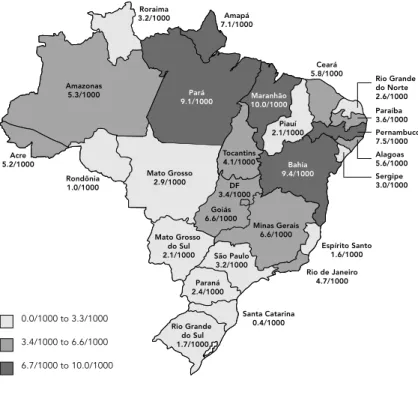
Maranhão State, in the Northeast. On average, EIA prevalence rates are lower in the main cities in the South and higher in the North and North-east (Figure 2).
Table 1 shows average prevalence rates by year. The highest mean prevalence rate was in 1996. Nationwide, beginning in 1997 there was a consistent decrease in the rates, ranging from 5.55/1,000 in 1995, one year after implementa-tion of mandatory HTLV-I/II screening, to 3.26/ 1,000 in 2000.
Discussion
Our results display an important geographic heterogeneity in the distribution of HTLV-I/II serological screening prevalence rates in po-tential blood donors from large urban areas in Brazil. Similar data were reported 4in a more limited sample including five cities represent-ing four of the five Brazilian regions (no city from the Central Western Region was includ-ed). Primary population-based studies from
HTLV-I/II is characterized by important vari-ability, with clustering of the infection and much higher seroprevalence rates in some ar-eas than in others, especially in the Southwest
15,16. In Colombia (South America) and Jamaica (Caribbean), seroprevalence was higher in low-altitude areas 17,18. However, another study from Jamaica did not find major geographic varia-tion in HTLV-I seroprevalence among the coun-try’s political subdivisions 19.
The decrease in overall seroprevalence with time may be a result of the current exclusion of HTLV-I/II seropositive individuals from the pool of potential blood donors. It is possible that these individuals are not replaced with equal numbers (or at an equal rate) of seropositive blood donor candidates, resulting in the de-creasing trend found in our study, even for such a short period of time.
It is well known in Brazil that blood donors and possibly potential blood donors are not representative of the general population. There are many reasons for the non-comparability. It may be a consequence of official guidelines (for example, age 18-60 years) and poorly stud-ied behaviors (for example, the fact that poten-tial blood donors are predominantly male). However, nationwide data derived from this group can be compared, even considering the methodological limitations of our study. All ser-vices under the Public Blood Center Network follow similar national guidelines for routine pre-donation questionnaires and serological screening, using third-generation EIA as the screening test for HTLV-I/II. As a consequence, concerning age, sex distribution, and behav-ioral profile, eligible donors are quite similar all over the country. Therefore, variability between blood centers in the distribution of these vari-ables, especially age and sex, known to be high-ly correlated with HTLV-I/II seropositivity, could hardly explain the heterogeneous sero-prevalence rates between centers. However, we can not rule out other potential sources of bias, like variability between EIA manufacturers and/or among laboratory personnel responsi-ble for the testing.
This study was not designed to address the determinants of HTLV-I/II geographic variabil-ity among blood donors. However, at least three possibilities could be suggested. One is prehis-toric population migration from Asia through North America, reaching what is now the North and Northeast area of Brazil before the rest of the country. Other possibilities are the African slave trade during Portuguese colonization,
(/1,000 donations) in blood donors from the Capital cities of 26 States and the Federal District of Brazil.
Amazonas 5.3/1000
Acre 5.2/1000
Rondônia 1.0/1000
Roraima
3.2/1000 Amapá
7.1/1000
Maranhão 10.0/1000
Mato Grosso 2.9/1000
Tocantins 4.1/1000
Piauí 2.1/1000
Ceará 5.8/1000
Bahia 9.4/1000
Goiás 6.6/1000
Minas Gerais 6.6/1000
Rio Grande do Norte 2.6/1000
Paraíba 3.6/1000 Pernambuco 7.5/1000 Alagoas 5.6/1000 Sergipe 3.0/1000
Mato Grosso do Sul 2.1/1000
DF 3.4/1000
São Paulo 3.2/1000
Paraná 2.4/1000
Santa Catarina 0.4/1000 Rio Grande
do Sul 1.7/1000
Espírito Santo 1.6/1000
Rio de Janeiro 4.7/1000
0.0/1000 to 3.3/1000 3.4/1000 to 6.6/1000 6.7/1000 to 10.0/1000
mostly to the Southeast and Northeast of Brazil, suggesting a Post-Columbian African origin of the virus 20, and the intense Japanese immigra-tion during the first half of the 20thcentury,
mostly to São Paulo State in the Southeast. Besides, in relation to economic, educational, health, and other inequalities (which are worse on average in the North and Northeast), there is a clear positive ecological or aggregate corre-lation trend with the higher HTLV-I/II sero-prevalence rates among blood donors in these regions of the country. This finding is similar to individual data we reported from one of the blood centers, in Belo Horizonte, Minas Gerais State, in the Southeast 21; the study population consisted of former blood donor candidates, who were HTLV-I/II seropositive or seroinde-terminate, and seronegative blood donors (EIA and WB tested), enrolled in an open prevalence prospective cohort study. The cross-sectional analysis at the baseline visit evaluated behav-ioral and environmental risk factors. In the multi-nomial logistic regression model, HTLV-I/II seropositivity was associated with history of re-ceiving a blood transfusion, use of non-intra-venous illegal drugs, and fewer years of formal education, a marker for socioeconomic status.
Nevertheless, further studies are needed to better elucidate the observed spatial hetero-geneity in HTLV-I/II seroprevalence among blood donors in Brazil.
Figure 2
HTLV-I/II serologic enzyme immunoassay (EIA) screening prevalence rates in blood donors (/1,000 donations) from the Capital cities in each of the 26 States and the Federal District, according to the five Brazilian regions. Public Blood Center Network; 1995/2000.
The y axis represents the median seroprevalence rate for all cities (4.45/1,000).
0 5 10
North Northeast Central
Western Southeast
South
Table 1
HTLV-I/II serologic enzyme immunoassay (EIA) screening prevalence rates (per 1,000 donations) in blood donors from large urban areas in Brazil. Public Blood Center Network, 1995/2000.
Year Prevalence rate
(per 1,000 donations)
1995 5.60
1996 6.87
1997 5.59
1998 4.29
1999 4.07
2000 3.46
Mean 4.78
Resumo
Devido ao tamanho absoluto de sua população, o Bra-sil pode abrigar o maior número absoluto de pessoas soropositivas para HTLV-I/II. A triagem sorológica para o HTLV-I/II, dos candidatos à doação de sangue é obri-gatória no país e a rede de hemocentros é responsável pela coleta de aproximadamente 80,0% do sangue doa-do. Conduzimos estudo transversal para determinar e quantificar a distribuição geográfica das taxas de prevalência para HTLV-I/II resultantes da triagem em candidatos a doadores de sangue, doando em 27 áreas urbanas correspondendo às capitais de cada um dos Estados brasileiros, no período de 1995 a 2000. Neste estudo, o teste de EIA foi utilizado para testar a pre-sença de anticorpos para HTLV-I/II. As taxas de preva-lência médias apresentaram grande heterogeneidade geográfica, variando de 0,4/1.000 em Florianópolis, na Região Sul, até uma taxa 25 vezes maior, 10,0/1.000 em São Luís, na Região Nordeste. Em média, as taxas de soropositividade ao EIA são menores nas capitais do Sul do país, tendendo a aumentar em direção ao Nor-deste e Norte. As razões para esta heterogeneidade po-dem ser múltiplas e necessitam de mais estudos.
Acknowledgments
The authors would like to thank the directors of all participating Public Blood Centers (Hemocenter Net-work) and the following individuals: HEMOSC: Jane Terezinha Martins, Fernando César Luiz; HEMOPAR: Maria do Pilar G. E. Bertol; Elza Candeu Jagher; PRÓ-SANGUE: Nanci Alves Salles; Dalton Chamone; HE-MORIO: Katia Machado da Motta, Sílvia Maia Farias Carvalho; HEMOMINAS: Adriano Eustáquio do Ama-ral, Marcelo Eduardo Lima Souza; HEMOES: Fabrício Souza; HEMOBA: Aurelino de Jesus Santana, Rita de Cássia de Jesus A. Cabral; HEMOSE: Maria Cristina Andrusyszyn Celino, Davis Almeida; HEMOAL: Dimas Ferreira da Silva Junior; HEMOPE: Paula Loureiro, Ana Cristina Bezerra; HEMOÍBA: Socorro Pires; HE-MONORTE: Manoel Josué Batista Neto; HEMOCE: Vânia Barreto A. F. Gomes; HEMOPI: José da Silva Fonte; HEMOMAR: Dinaura M. Cruz; HEMOPA: Ana Suely Leitte Saraiva, Maria do Socorro de O. Cardoso; HEMOAM: Claudia Abrahim; HEMORAIMA: Erika Araújo; HEMOACRE: Edilene Maria Alves Sabóia; MORON: Maria do Socorro Rodrigues da Silva; HE-MOMAT: Brígida Rosa; HEMOSUL: Hélio Dantas San-tos; HEMOTO: Perla Risette Alves Lima; HEMOG: Célio Oliveira Santos; Distrito Federal: Mariza Rodri-gues Naves e Ribeiro; Rio Grande do Sul: Carlos Vi-cente Timponi; Amapá: Juvanete Amoras.
B. Catalan-Soares and A. B. F. Carneiro-Proietti con-tributed to the data collection at the respective blood centers in the Brazilian State capitals and Federal District. B. Catalan-Soares and F. A. Proietti tabulated and analyzed the data. The three authors participat-ed in drafting and reformulating the article and in the literature review. The various sectors in the article were approached main according to the respective authors’ specialties (A. B. F. Carneiro-Proietti: Hema-tology; B. Catalan-Soares and F. A. Proietti: Epidemi-ology and Statistics).
1. Cortes E, Detels R, Aboulafia D, Li XL, Moudgil T, Alam M, et al. HIV-1, HIV-2 and HTLV-I infection in high-risk groups in Brazil. N Engl J Med 1989; 320:953-8.
2. De Oliveira MS, Matutes E, Famadas LC, Schulz TF, Calabro ML, Nucci M, et al. Adult T-cell leukaemia/lymphoma in Brazil and its relation to HTLV-I. Lancet 1990; 336:987-90.
3. Proietti FA, Lima-Martins MV, Passos VM, Brener S, Carneiro-Proietti AB. HTLV-I/II seropositivity among eligible blood donors from Minas Gerais State, Brazil. Vox Sang 1994; 67:77.
4. Galvão-Castro B, Loures L, Rodrigues LG, Sereno A, Ferreira Jr. OC, Franco LG et al. Distribution of human T-lymphotropic virus type I among blood donors: a nationwide Brazilian study. Transfusion 1997; 37:242-3.
5. Blattner WA, Gibbs WN, Saxinger C, Robert-Guroff M, Clark J, Lofters W, et al. Human T-cell leukaemia/lymphoma virus-associated lym-phoreticular neoplasia in Jamaica. Lancet 1983; 2:61-4.
6. Yoshida M, Seiki M, Yamaguchi K, Takatsuky K. Monoclonal integration of human T-cell leukemia provirus in all primary tumors of adult T-cell leukemia suggests causative role of human T-cell leukemia virus in this disease. Proc Natl Acad Sci U S A 1984; 81:2534-7.
7. Tokudome S, Tokunaga O, Shimamoto Y, Miyamoto Y, Sumida I, Kikuchi M, et al. Incidence of adult T-cell leukemia/lymphoma among hu-man T-lymphotropic virus type I carriers in Saga, Japan. Cancer Res 1989; 49:226-8.
8. Carneiro-Proietti AB, Ribas JG, Catalan-Soares BC, Martins ML, Brito-Melo GE, Martins-Filho OA, et al. Infecção e doença pelos vírus lin-fotrópicos humanos de célula T (HTLV-I/II) no Brasil. Rev Soc Bras Med Trop 2002; 35:499-508. 9. Gessain A, Barin F, Vermant JC, Gout O, Maurs L,
Calender A, et al. Antibodies to human T-lym-photropic virus type I in patients with tropical spastic paraparesis. Lancet 1985; 2:407-10. 10. Osame M, Usuku K, Izumo S, Ijichi N, Amitani H,
Igata A, et al. HTLV-I associated myelopathy, a new clinical entity. Lancet 1986; 1:1031-2. 11. Castro-Costa CM, Salgueiro MR, Caron H.
Tropi-cal spastic paraparesis in Northeastern Brazil. Arq Neuropsiquiatr 1989; 47:134-8.
12. LaGrenade L, Hanchard B, Fletcher V, Cranston B, Blattner W. Infective dermatitis of Jamaican chil-dren: a marker for HTLV-I infection. Lancet 1990; 336:1345-7.
13. Mochizuki M, Watanabe T, Yamaguchi K, Yoshimura K, Nakashima S, Shirao M, et al. Uveitis associated with human T-cell lym-photropic virus type I. Am J Ophthalmol 1992; 114:123-9.
14. Instituto Brasileiro de Geografia e Estatística. Ca-racterísticas da população e dos domicílios – re-sultados do Universo 2000. Censo demográfico. Rio de Janeiro: Instituto Brasileiro de Geografia e Estatística; 2000.
leukemia-virus-associated antigen (ATLA) in sera from patients with ATL and controls in Japan: a nationwide seroepidemiologic study. Int J Cancer 1982; 29:631-5.
16. Ishida T, Yamamoto K, Omoto K, Iwanaga M, Os-ato T, Hinuma Y. Prevalence of a human retro-virus in native Japanese: evidence for a possible ancient origin. J Infect 1985; 11:153-7.
17. Maloney EM, Ramirez HC, Levin A, Blattner WA. A survey of the human T-cell lymphotropic virus type I (HTLV-I) in south-western Colombia. Int J Cancer 1989; 44:419-23.
18. Maloney EM, Murphy EL, Figueroa JP, Gibbs WN, Cranston B, Hanchard B, et al. Human T-lym-photropic virus type I (HTLV-I) seroprevalence in Jamaica. II. Geographic and ecological determi-nants. Am J Epidemiol 1991; 133:1125-34. 19. Murphy EL, Figueroa JP, Gibbs WN,
Holding-Cob-ham M, Cranston B, Malley K, et al. Human T-lymphotropic virus type I (HTLV-I) seropreva-lence in Jamaica. I. Demographic determinants. Am J Epidemiol 1991; 133:1114-24.
20. Alcantara Jr. LC, van Dooren S, Gonçalves M, Kashima S, Costa MC, Santos FL, et al. Globin haplotypes of human T-cell lymphotropic virus type I-infected individuals in Salvador, Bahia, Brazil, suggest a Post-Columbian African origin of this virus. J Acquir Immune Defic Syndr 2003; 33:536-42.
21. Catalan-Soares B, Carneiro-Proietti ABF, Proietti FA. Human T-cell lymphotropic viruses type I and II (HTLV-I/II) in blood donors in Minas Gerais, Brasil: determinants associated with seropositivi-ty in a low-risk population. Rev Saúde Pública 2003; 37:470-6.
Submitted on 12/Feb/2004