AR
TICLE
1 Faculdade de Saúde Pública, Departamento de Nutrição, Universidade de São Paulo (USP). Av. Dr. Arnaldo 715, Cerqueira Cezar. 01246-904 São Paulo SP Brasil.
[email protected] 2 Instituto de Saúde e Sociedade, Universidade Federal de São Paulo. São Paulo SP Brasil. 3 Escola de Educação Física e Esporte, USP. São Paulo SP Brasil.
4 Faculdade de Ciências Aplicadas, Universidade de Campinas (Unicamp). Limeira SP Brasil. 5 Faculdade de Educação Física, Unicamp. Campinas SP Brasil.
Cross-cultural adaptation of the State and Trait Food Cravings
Questionnaires (FCQ-S and FCQ-T) into Portuguese
Abstract This study aimed to present the cross-cultural adaptation of the State and Trait Food Cravings Questionnaires (FCQ-S and FCQ-T) into Portuguese. Tools were translated and back-translated, field experts evaluated the conceptual, operational and item-based equiv-alence and a sample of students assessed tools, evaluating the level of understanding and ana-lyzing internal consistency through Cronbach’s coefficient. In addition, the semantic equivalence was assessed though the intraclass correlation coefficient between the bilingual scores in each question of both versions (English and Portu-guese). Tools were considered easy to understand (experts scored 95.4% and 97% for the FCQ-T and FCQ-S, respectively, and 81.8% of students considered them easy to understand), and showed satisfactory internal consistency values (FCQ-T ranged from 0.6 to 0.8 and FCQ-S ranged from 0.5 to 0.8). From the cross-cultural adaptation process, the satisfactory results enable the recom-mendation of the Brazilian version of FCQs. Key words Cross-cultural adaptation, Food craving, Translation, Questionnaires
Mariana Dimitrov Ulian 1
Priscila de Morais Sato 2
Fabiana Braga Benatti 3
Patricia Lopes de Campos-Ferraz 4
Odilon José Roble 5
Ramiro Fernandez Unsain 2
Bruno Gualano 3
U
lian MD
Introduction
In English, the term “food craving” refers to an intense desire or an urgency to eat certain food1.
What differentiates such desire from hunger is the intensity and specificity of the former. While food craving may be due to a biological stimu-lus, pleasurable sensations accompanying eating – such as relief from guilt and stress – can also trigger it2. Although food cravings are often
asso-ciated with overeating, they do not necessarily re-flect a disturbed eating, nor are they synonymous of overeating2. However, such behavior, if not
occasional, can contribute to health problems. For example, food cravings are a striking fea-ture of bulimia nervosa3, but they are also
prev-alent in unspecified eating disorders and obesity. These also appear to be associated with bouts of binge-eating3.
This scenario has been driving investigations into aspects that influence food cravings. Kemps and Tiggemann4 investigated whether stimulus
or avoidance messages influenced women’s food intake. It was observed that obese women had a faster response than normal weight women to consume food when it was associated with the stimulus messages4.
In addition, Klatzkin et al.5 observed that
obese women with binge-eating, when compared to obese women and normal weight women without binge-eating, had higher blood pressure, greater depressive and stress-related symptoms and a more conflicting relationship with food. Immediate response to external stimuli, as noted in the study by Kemps and Tiggemann4, can be
particularly problematic in obesogenic environ-ments found in most western countries, in which palatable foods are almost permanently accessi-ble and availaaccessi-ble.
Food overexposure can lead to excessive consumption, and consequently lead to weight gain, especially among individuals who are more vulnerable to external stimuli. This scenario is especially alarming considering the current glob-al attention on obesity and its consequences for health6. On a global scale, in 2014, more than 1.4
billion adults were overweight and of these, al-most 200 million men and 300 million women were obese6. The current estimate is that 33% of
the world population are obese6.
In Brazil, 12.4% of men and 16.9% of women are estimated to be obese7. According to data from
the Chronic Diseases Risk and Protection Factors Surveillance System by Telephone Inquiry (VIG-ITEL), in the period from 2006 to 2012,
obesi-ty prevalence in the adult population increased from 11.6% to 17.4%8. Results of Klatzkin et al.5
are also relevant, since eating disorders also lead to significant physical, social, psychological and health diseases (e.g. coronary problems, growth problems, unregulated electrolyte balance) and can even lead to death9.
Binge-eating has been shown to be more prevalent in male adults, with worldwide esti-mates varying from 0.78% to 2.0% (values that are close to or equal for females)10. Regarding
bulimia nervosa and anorexia nervosa, these esti-mates are more variable, ranging from 0.13% to 1.34% for the former and from 0.00% to 0.53% for the latter. On the other hand, unspecified eat-ing disorders have global prevalence of 3.38%10.
In Brazil, a study carried out with a population of adolescents with low socioeconomic level in Rio de Janeiro revealed that 37.3% had binge-eating symptoms11. In a study conducted with female
Porto Alegre dwellers, 16.5% evidenced eating disorders symptoms12. Another study evaluated
1,807 children and adolescents living in Minas Gerais and found that 13.3% of the sample had eating disorders symptoms13. Studies conducted
in the Brazilian Northeast also found data related to the prevalence of eating disorders. In a sam-ple of 1,273 participants, it was found that the prevalence of periodic binge-eating disorder was 4.3% and the prevalence of bulimia nervosa was 1.0%14. A study conducted with schoolchildren
identified that 23% of the participants had eating disorders symptoms15. Considering association
between food cravings and obesity, eating disor-ders and health problems, detection and treat-ment of this behavior is fundatreat-mental.
Examples of tools developed to access food cravings-related aspects are the Attitudes to Chocolate Questionnaire (ACQ)16, the
Orienta-tion Towards Chocolate QuesOrienta-tionnaire (OCQ)17
and The Food Craving Inventory (FCI)18. Each
of these tools have a different approach to the construct in question and, while of great value and contribution, are limited to evaluating cus-tomary food-specific cravings (such as chocolate, for example) and associating more emphatically such cravings to feelings of guilt or ambivalent behavior. Such characteristics limit the range of tools to only a few food cravings dimensions.
In response to the dissatisfaction with the available tools related to this construct, Cepe-da-Benito et al.19 developed and validated the
e C
ole
tiv
a,
22(2):403-416,
2017
foods, without restricting them to specific cat-egories. In addition, the questionnaires encom-pass eating-related behavioral, cognitive and psychological aspects, which makes them mul-tidimensional tools19. FCQs combine two tools,
which access different food craving aspects: Food Cravings Questionnaire-Trait (FCQ-T) and the Food Cravings Questionnaire-State (FCQ-S). In the FCQ-T, the respondent is asked to con-sider which foods he usually has cravings for; in FCQ-S, the respondent is asked to consider which specific foods he has cravings for at the time he/she answers the questionnaire.
The FCQ-T consists of 39 statements and was developed to access food cravings aspects over time and in various situations, considering them as a (usual) trait behavior of the respondent19.
Higher scores in this questionnaire are related to a more exaggerated eating19.
The FCQ-S is composed of 15 statements and is a tool sensitive to changes in contextual, psy-chological and physiological states in response to specific situations (such as stressful events or food deprivation), considering the food craving as a (sporadic) state behavior of the respondent19.
Higher scores in this questionnaire are associated with greater food deprivation, negative eating-re-lated experiences and a greater susceptibility to triggers that lead to eating19. Totals of both tools
for the full subscales and their dimensions are calculated by adding the corresponding scores of each statement19.
To the best of our knowledge, FCQs are the only published food cravings evaluation tools that have been validated psychometrically. Avail-able versions include the original version, in English19, as well as in Spanish20, Dutch21,
Kore-an22 and German23. Since there are no validated
national food cravings investigation tools, this paper aimed to present the cross-cultural ad-aptation of the State and Trait Food Cravings Questionnaires (FQC-S and FQC-T) for use in Brazilian studies.
Methodology
The cross-cultural adaptation operationalization process was based on the procedures suggested by Reichenheim and Moraes24, which include
some stages. FCQs authors authorized their use for this process.
We emphasize that each of the questionnaires has particularities. In the FCQ-T, respondents should indicate on a 6-point scale (which varies
from never, rarely, sometimes, frequently, very frequently, always) how often each statement is true for them in each situation19. This
ques-tionnaire is composed of nine dimensions or subscales that evaluate: 1) the intention and the plans to eat; 2) anticipation of the positive rein-forcement that can result from eating; 3) antic-ipation of relieving negative states and feelings because of eating; 4) the possible lack of control over eating; 5) thoughts or concerns about food; 6) food cravings as a physiological state (such as hunger); 7) possible emotions before or during food cravings; 8) triggers that can give rise to food cravings and; 9) guilt because of food crav-ings or of giving in to them19.
In the FCQ-T, respondents should indicate on a 5-point scale how much they currently agree with each statement at this very moment, ranging from: strongly disagree, disagree, neither agree nor disagree, agree, strongly agree. The FCQ-T consists of five dimensions or subscales that as-sess at the time of the interview: 1) food cravings; 2) anticipation of the positive reinforcement that can result from eating; 3) anticipation of relieving negative states and feelings as a result of eating; 4) lack of control over food and; 5) food cravings as a physiological state (such as hunger)19.
In a first step, in order to obtain the semantic, conceptual and item equivalence, the 39 and 15 statements, as well as the underlying subscales of the respective tools of the FCQs were translated from English to Portuguese. This step was con-ducted separately by two experienced and fluent English researchers, resulting in versions 1 and 2 of the instrument. The next step analyzed and compared these versions, which was carried out by a researcher who works with food practices. Version 3 of the tool was established based on the considerations of this professional.
The third step sought to evaluate the tool content validity. Thus, version 3 was submitted to 12 experts in the field of Nutrition (n = 9), Philosophy (n = 1), Psychology (n = 1) and An-thropology (n = 1) in order to clarify language and translation. To this end, we selected some statements of tool version 3 that were not entire-ly clear in terms of language and translation, and we asked specific questions through an online questionnaire with multiple-choice options on the Surveymonkey secure site. A new version of the tool (version 4) was prepared from the feed-back of these professionals.
U
lian MD
comprehension of each statement, responding to a 6-point scale with the following alternatives: “I did not understand”, “I understood a little”, “I more or less understood”, “I understood almost everything, but I had some doubts”, “I under-stood almost everything” and “I underunder-stood per-fectly and I had no doubts”. If they did not under-stand a question or had trouble with language, we asked them to suggest changes and justify them. Criterion of sufficient understanding used answers “I understood almost everything” and “I understood perfectly and I had no doubts”. From this process, we adjusted the tool, which resulted in the preparation of a new version (version 5).
The fourth stage involved tools pre-testing. To participate in the pre-test, we invited third-year Nutrition undergraduate students and asked them to respond to the tools and record sugges-tions if they faced difficulties in understanding them. All students during class period (n = 22) agreed to voluntarily participate in the pre-test. All were females, with a mean age of 21.6 years (SD = 1.7 years, range from 20 to 24 years) and average Body Mass Index of 21.1 kg/m² (SD = 2.2 kg/m² years, range from 17 kg/m² to 26 kg/ m²). There was no refusal and/or abandonment. This activity aimed to have a critical view re-garding the content and comprehension of the questionnaire. The next step aimed to evaluate the semantic equivalence between the translat-ed and original versions. To that end, we invit-ed seven bilinguals to respond to version 5 and the original version of the tool, again through an online questionnaire on the “Surveymonkey” se-cure survey site. They were randomly distributed in two groups: the former first answered the Por-tuguese language version and, after an interval of five days, answered the original English ver-sion. The converse was proposed for the second group. This version was later back-translated into English by a bilingual individual with fluency in Portuguese and English who had not participated in the earlier stages of cross-cultural adaptation.
Subsequently, we proceeded with the tech-nical revision and the evaluation of the seman-tic equivalence between the original versions in English, Portuguese and the back-translation into English. This involved verifying the ability to transfer meanings from the concepts of the original instrument to the translated version. We sought to evaluate the impact that a specific term would have on the cultural context of the target population, as well as to evaluate the cor-respondence of perceptions and impacts of the tool in Portuguese on respondents, with a view
to ensuring a similar effect in the respondents of the two cultural worldviews. The following linguistic aspects were evaluated: 1) the equiv-alence between the original in English and the Portuguese version, with care as to the referential meanings of terms and words of the translated version in relation to the original version (such as ideas or objects which words referred to); and 2) the general meaning of each item of the tool, also contrasting both the original and the translated versions into Portuguese. If necessary, the tool could have some terms replaced to allow full re-covery of the desired equivalence, in which case a corrected version of the tool would be drawn up.
A statistical analysis using Statistical Package for Social Sciences (SPSS) version 21.0 was per-formed. Data descriptive (mean, standard devia-tions-SD, minimum and maximum values) and inferential analyzes were developed. The seman-tic equivalence was evaluated by the intraclass correlation coefficient (ICC) between scores ob-tained by the bilingual subjects in each question of the English and Portuguese versions. The in-ternal consistency of the questions was evaluated through Cronbach’s Alpha coefficient analysis. The evaluation regarding content and compre-hension of questionnaires was shown by means of percentages (%) and their respective SDs.
Tools pre-test participants completed the in-formed consent form. The study was approved by the Ethics Committee of the institution involved, under number 892.715.
Results
Translation and cross-cultural adaption
Regarding the evaluation of the semantic equivalence, after comparing tools initial trans-lations, feedback from the consultation with experts and back-translation, suggestions for altering terms and expressions were considered, revised and discussed, resulting in tools adjust-ments. This new discussion and redefinition of terms occurred due to expressions not easily translated into Portuguese or that were not com-monly used in Portuguese. Adaptations made to statements can be seen in Chart 1.
e C ole tiv a, 22(2):403-416, 2017
Chart 1. Evaluation of semantic equivalence and changes made in the Portuguese version of the Food Cravings Questionnaires - elements that indicate a trait behavior or state of the respondent (FCQ-T and FCQ-S) - after consultation with experts (n = 9) and after tools back-translation.
Tool Original version Translated version Version after
consulting with experts
Back-translated
version Final version
FCQ-T
1. Being with someone who is eating often makes me hungry.
1. Estar na
companhia de alguém que está comendo frequentemente me faz ficar com fome.
1. Frequentemente, estar na companhia de alguém que está comendo me faz ficar com fome.
1. Being with someone who is eating usually makes me feel hungry.
1. Frequentemente, estar na companhia de alguém que está comendo me faz ficar com fome.
2. When I crave something, I know I won’t be able to stop eating once I start.
2. Quando eu tenho um desejo intenso por alguma comida, sei que quando eu começar a comer não vou conseguir mais parar.
2. Quando eu tenho um desejo intenso por alguma comida, sei que quando eu começar a comer não vou mais conseguir parar.
2. When I am craving for a specific food, I know that when I start eating it I will not be able to stop.
2. Quando eu tenho um desejo intenso por alguma comida, sei que quando eu começar a comer não vou mais conseguir parar.
5. Food cravings invariably make me think of ways to get what I want m eat.
5. Um desejo intenso de comer alguma comida me faz inevitavelmente pensar em maneiras de conseguir o que eu quero comer.
5. Um desejo intenso de comer alguma comida me faz inevitavelmente pensar em como conseguir o que eu quero comer.
5. A food craving inevitably makes me think about how to obtain the food I want.
5. Desejos intensos de comer alguma comida me fazem inevitavelmente pensar em como conseguir o que eu quero comer.
15. Eating what I crave makes me feel better.
15. Comer aquilo que eu desejo intensamente me faz sentir melhor.
15. Comer aquilo que eu tenho um desejo intenso de comer me faz sentir melhor.
15. Eating the food I crave makes me feel better.
15. Comer aquilo que eu tenho um desejo intenso de comer me faz sentir melhor.
16. When I satisfy a craving I feel less depressed.
16. Quando eu satisfaço meu desejo de comer aquilo que eu tenho um desejo intenso me sinto menos deprimido(a)
16. Quando satisfaço meu desejo intenso de comer me sinto menos deprimido(a).
16. When I eat what I crave I feel less depressed.
16. Quando satisfaço meu desejo intenso de comer me sinto menos deprimido(a).
17. When I eat what I am craving I feel guilty about myself.
17. Quando eu como aquilo que desejo intensamente comer me sinto culpado(a).
17. Eu me sinto culpado(a) quando como aquilo que desejo intensamente comer.
17. I feel guilty when I eat the food I have been craving.
17. Eu me sinto culpado(a) quando como aquilo que desejo intensamente comer.
28. I spend a lot of time thinking about whatever it is I will eat next.
28. Eu passo muito tempo pensando sobre qual vai ser a próxima comida que eu vou comer.
28. Eu passo muito tempo pensando qual vai ser a próxima comida que eu vou comer.
28. I spend a lot of time deciding which food I will eat next time.
28. Eu passo muito tempo pensando em qual vai ser a próxima comida que eu vou comer.
32. Whenever I have a food craving, I keep on thinking about eating until I actually eat.
32. Sempre que eu tenho um intenso desejo de comer determinada comida fico pensando sobre ela até de fato comê-la.
32. Sempre que eu tenho um intenso desejo de comer determinada comida fico pensando nela até de fato comê-la.
32. Whenever I crave for a food, I think about it until I really eat it.
32. Sempre que eu tenho um intenso desejo de comer determinada comida fico pensando nela até de fato comê-la.
38. When I eat food, I feel comforted.
38. Quando eu como, me sinto confortado(a)/ acalentado(a)
38. Quando eu como, me sinto confortado(a).
38. Eating gives me comfort.
38. Quando eu como, me sinto confortado(a).
U
lian MD
mind all the time was back-translated to I notice that I think about food all the time. In this case, we decided to keep the first translation (in Por-tuguese, Eu sinto que estou o tempo todo pensando em comida), since if a literal translation of this statement were made, it would not make sense in the Brazilian cultural context. Thus, the change in relation to the original sentence was necessary, but its meaning was preserved. In statement 23, When I crave certain foods, I usually try to eat them as soon as I can, the word usually had been trans-lated as generally. After consulting with experts, it was changed to normally. In this same item, the sentence as soon as I can was back-translated to as fast as I can. Thus, it was decided to change the translation from as fast as I can to as soon as pos-sible. The expression of the statement to eat appe-tizing foods that are in my reach was back-trans-lated into to eat appetizing foods when these are within reach. Thus, it was decided to change the translation of It is difficult to resist the temptation to eat appetizing foods when they are within my reach to It is difficult to resist the temptation to eat appetizing foods that are within my reach (In Por-tuguese, É difícil resistir à tentação de comer co-midas apetitosas quando elas estão ao meu alcance para É difícil resistir à tentação de comer comidas apetitosas que estão ao meu alcance).
The FCQ-S tool has also undergone some modifications. The expression of statement 10
If I had was back-translated in the same way as proposed in the original tool. Thus, we chose to change the translation of If I had access to one or more specific foods, I could not stop eating them to If I had one or more specific foods, I could not stop eating them. Another example refers to statement 15, I feel weak because of not eating. The term weak has raised issues among specialists, and it may mean physical weakness (as in being with-out energy) or an emotional weakness (as in feel-ing morally unsuccessful). In order to make the meaning of the sentence clearer, we decided to include an observation in this item. These chang-es are common in the adaptation procchang-ess and en-sure both adequacy to the Brazilian culture and the original idea. The final Portuguese version of the tool appears in Chart 2 and 3.
Verbal comprehension
After evaluation of experts, the FCQ-T ob-tained a mean percentage of comprehension of 95.4% (SD = 7.5%) and the FCQ-S obtained a mean percentage of comprehension of 97% (SD = 6.6%). Of the 22 students who participated in the pre-test of the tool, 81.8% said tools were easy to understand; 9.1% said tools were repeti-tive and; 9.1% reported some difficulty in under-standing used expressions (e.g. doubts regarding the meaning of term “comforted”).
FCQ-S
7. If I ate something, I wouldn’t feel so sluggish and lethargic.
7. Se eu comesse alguma coisa, não me sentiria tão letárgico e apático.
7. Se eu comesse alguma coisa, não me sentiria tão lento e desanimado.
7. If I eat something, I will not feel so slow and discouraged.
7. Se eu comesse alguma coisa, não me sentiria tão lento, letárgico e desanimado.
8. Satisfying my craving would make me feel less grouchy and irritable.
8. Satisfazer minha vontade daquilo que eu desejo intensamente comer faria com que eu me sentisse menos descontente e irritado(a).
8. Satisfazer minha vontade de comer aquilo que eu desejo intensamente faria com que eu me sentisse menos descontente e irritado(a).
8. Satisfying my cravings would make me feel less unhappy and angry.
8. Satisfazer minha vontade de comer aquilo que eu desejo intensamente faria com que eu me sentisse menos descontente e irritado(a).
Chart 1. continuation
Tool Original version Translated version Version after
consulting with experts
Back-translated
e C
ole
tiv
a,
22(2):403-416,
2017
Chart 2. Food cravings questionnaire – elements that indicate state behavior of the respondent – FCQ-S – and its respective scales, Portuguese version.
Instruções: neste questionário você deverá, por favor, ler cada afirmativa e indicar numa escala de 6 pontos (que varia de nunca, raramente, às vezes, frequentemente, muito frequentemente e sempre), de maneira geral, quão frequente cada afirmação é verdadeira para você em cada situação.
Subescala 1: Intenções e planos de consumir comida
5. Desejos intensos de comer alguma comida me fazem inevitavelmente pensar em como conseguir o que eu quero comer.
( ) Nunca. ( ) Raramente. ( ) Às vezes. ( ) Frequentemente. ( ) Muito frequentemente. ( ) Sempre. 18. Sempre que eu tenho um desejo intenso por alguma comida me pego fazendo planos para comê-la. ( ) Nunca. ( ) Raramente. ( ) Às vezes. ( ) Frequentemente. ( ) Muito frequentemente. ( ) Sempre.
23. Quando eu tenho um desejo intenso por alguma comida, eu normalmente tento comê-la o quanto antes. ( ) Nunca. ( ) Raramente. ( ) Às vezes. ( ) Frequentemente. ( ) Muito frequentemente. ( ) Sempre.
Subescala 2: Antecipação do reforço positivo que pode resultar do comer
9. Eu como para me sentir melhor.
( ) Nunca. ( ) Raramente. ( ) Às vezes. ( ) Frequentemente. ( ) Muito frequentemente. ( ) Sempre. 10. Às vezes comer faz as coisas parecerem perfeitas.
( ) Nunca. ( ) Raramente. ( ) Às vezes. ( ) Frequentemente. ( ) Muito frequentemente. ( ) Sempre. 15. Comer aquilo que eu tenho um desejo intenso de comer me faz sentir melhor.
( ) Nunca. ( ) Raramente. ( ) Às vezes. ( ) Frequentemente. ( ) Muito frequentemente. ( ) Sempre. 24. Quando eu como aquilo que desejo intensamente comer, me sinto ótimo(a).
( ) Nunca. ( ) Raramente. ( ) Às vezes. ( ) Frequentemente. ( ) Muito frequentemente. ( ) Sempre. 38. Quando eu como, me sinto confortado(a).
( ) Nunca. ( ) Raramente. ( ) Às vezes. ( ) Frequentemente. ( ) Muito frequentemente. ( ) Sempre.
Subescala 3: Antecipação do alívio de estados e sentimentos negativos como resultado do comer
16. Quando satisfaço meu desejo intenso de comer me sinto menos deprimido(a).
( ) Nunca. ( ) Raramente. ( ) Às vezes. ( ) Frequentemente. ( ) Muito frequentemente. ( ) Sempre. 19. Comer me acalma.
( ) Nunca. ( ) Raramente. ( ) Às vezes. ( ) Frequentemente. ( ) Muito frequentemente. ( ) Sempre. 21. Eu fico menos ansioso(a) depois que eu como.
( ) Nunca. ( ) Raramente. ( ) Às vezes. ( ) Frequentemente. ( ) Muito frequentemente. ( ) Sempre.
Subescala 4: Falta de controle sobre o comer
2. Quando eu tenho um desejo intenso por alguma comida, sei que quando eu começar a comer não vou mais conseguir parar.
( ) Nunca. ( ) Raramente. ( ) Às vezes. ( ) Frequentemente. ( ) Muito frequentemente. ( ) Sempre. 3. Se eu como uma comida que tenho um desejo intenso, frequentemente perco o controle e como demais. ( ) Nunca. ( ) Raramente. ( ) Às vezes. ( ) Frequentemente. ( ) Muito frequentemente. ( ) Sempre.
22. Se eu tenho acesso a uma comida que tenho um desejo intenso de comer, não consigo parar de comê-la. ( ) Nunca. ( ) Raramente. ( ) Às vezes. ( ) Frequentemente. ( ) Muito frequentemente. ( ) Sempre.
25. Eu não tenho força de vontade para resistir aos meus desejos intensos por comida.
( ) Nunca. ( ) Raramente. ( ) Às vezes. ( ) Frequentemente. ( ) Muito frequentemente. ( ) Sempre. 26. Uma vez que eu começo a comer, tenho dificuldade para parar.
( ) Nunca. ( ) Raramente. ( ) Às vezes. ( ) Frequentemente. ( ) Muito frequentemente. ( ) Sempre. 29. Se eu cedo ao meu desejo por comida, eu perco todo o controle.
( ) Nunca. ( ) Raramente. ( ) Às vezes. ( ) Frequentemente. ( ) Muito frequentemente. ( ) Sempre.
U
lian MD
Chart 2. continuation
Subescala 5: Pensamentos ou preocupações com a comida
6. Eu sinto que estou o tempo todo pensando em comida.
( ) Nunca. ( ) Raramente. ( ) Às vezes. ( ) Frequentemente. ( ) Muito frequentemente. ( ) Sempre. 8. Eu me pego preocupado(a) em relação à comida.
( ) Nunca. ( ) Raramente. ( ) Às vezes. ( ) Frequentemente. ( ) Muito frequentemente. ( ) Sempre. 27. Eu não consigo parar de pensar em comida, não importa o quanto eu tente.
( ) Nunca. ( ) Raramente. ( ) Às vezes. ( ) Frequentemente. ( ) Muito frequentemente. ( ) Sempre. 28. Eu passo muito tempo pensando em qual vai ser a próxima comida que eu vou comer. ( ) Nunca. ( ) Raramente. ( ) Às vezes. ( ) Frequentemente. ( ) Muito frequentemente. ( ) Sempre. 31. Eu sonho acordado(a) com comida.
( ) Nunca. ( ) Raramente. ( ) Às vezes. ( ) Frequentemente. ( ) Muito frequentemente. ( ) Sempre. 32. Sempre que eu tenho um intenso desejo de comer determinada comida fico pensando nela até de fato comê-la.
( ) Nunca. ( ) Raramente. ( ) Às vezes. ( ) Frequentemente. ( ) Muito frequentemente. ( ) Sempre. 33. Se eu estou com um intenso desejo de comer determinada comida, pensamentos sobre comê-la me consomem.
( ) Nunca. ( ) Raramente. ( ) Às vezes. ( ) Frequentemente. ( ) Muito frequentemente. ( ) Sempre.
Subescala 6: O desejo intenso por comida como um estado fisiológico
11. Pensar sobre minhas comidas preferidas me dá água na boca.
( ) Nunca. ( ) Raramente. ( ) Às vezes. ( ) Frequentemente. ( ) Muito frequentemente. ( ) Sempre. 12. Eu tenho desejos intensos por comida quando estou de estômago vazio.
( ) Nunca. ( ) Raramente. ( ) Às vezes. ( ) Frequentemente. ( ) Muito frequentemente. ( ) Sempre. 13. Eu sinto como se meu corpo pedisse por algumas comidas.
( ) Nunca. ( ) Raramente. ( ) Às vezes. ( ) Frequentemente. ( ) Muito frequentemente. ( ) Sempre. 14. Eu fico com tanta fome que meu estômago parece um saco sem fundo.
( ) Nunca. ( ) Raramente. ( ) Às vezes. ( ) Frequentemente. ( ) Muito frequentemente. ( ) Sempre.
Subescala 7: Emoções que podem estar presentes antes ou durante os desejos intensos por comidas
20. Eu tenho desejos intensos por comida quando me sinto entediado(a), bravo(a) ou triste. ( ) Nunca. ( ) Raramente. ( ) Às vezes. ( ) Frequentemente. ( ) Muito frequentemente. ( ) Sempre. 30. Quando eu estou estressado(a), tenho desejos intensos por comida.
( ) Nunca. ( ) Raramente. ( ) Às vezes. ( ) Frequentemente. ( ) Muito frequentemente. ( ) Sempre. 34. Minhas emoções frequentemente me fazem querer comer.
( ) Nunca. ( ) Raramente. ( ) Às vezes. ( ) Frequentemente. ( ) Muito frequentemente. ( ) Sempre. 39. Eu tenho desejos intensos por comida quando estou chateado(a).
( ) Nunca. ( ) Raramente. ( ) Às vezes. ( ) Frequentemente. ( ) Muito frequentemente. ( ) Sempre.
Subescala 8: Gatilhos que podem desencadear desejos intensos por comidas
1. Frequentemente, estar com alguém que está comendo me faz ficar com fome.
( ) Nunca. ( ) Raramente. ( ) Às vezes. ( ) Frequentemente. ( ) Muito frequentemente. ( ) Sempre. 35. Sempre que eu vou a um Buffet, acabo comendo mais do que eu precisava.
( ) Nunca. ( ) Raramente. ( ) Às vezes. ( ) Frequentemente. ( ) Muito frequentemente. ( ) Sempre. 36. É difícil resistir à tentação de comer comidas apetitosas que estão ao meu alcance.
( ) Nunca. ( ) Raramente. ( ) Às vezes. ( ) Frequentemente. ( ) Muito frequentemente. ( ) Sempre. 37. Quando estou com alguém que está comendo exageradamente, normalmente eu exagero também. ( ) Nunca. ( ) Raramente. ( ) Às vezes. ( ) Frequentemente. ( ) Muito frequentemente. ( ) Sempre.
Subescala 9: Culpa por causa dos desejos intensos por comidas ou por ter cedido aos mesmos
4. Eu odeio quando não resisto aos meus desejos intensos por comida.
( ) Nunca. ( ) Raramente. ( ) Às vezes. ( ) Frequentemente. ( ) Muito frequentemente. ( ) Sempre. 7. Eu normalmente me sinto culpado(a) por ter desejos intensos por alguma comida.
( ) Nunca. ( ) Raramente. ( ) Às vezes. ( ) Frequentemente. ( ) Muito frequentemente. ( ) Sempre. 17. Eu me sinto culpado(a) quando como aquilo que desejo intensamente comer.
e C
ole
tiv
a,
22(2):403-416,
2017
Chart 3. Food cravings questionnaire – elements that indicate state behavior of the respondent – FCQ-S – and its respective scales, Portuguese version.
Instruções: Neste questionário você deverá, por favor, ler cada afirmativa e indicar numa escala de 5 pontos (que varia de discordo fortemente, discordo, nem discordo nem concordo, concordo e concordo fortemente) o quanto você concorda com cada afirmação agora mesmo (neste exato momento):
Subescala 1: Um desejo intenso de comer
1. Eu tenho um desejo intenso de comer uma ou mais comidas específicas.
( ) Discordo fortemente. ( ) Discordo. ( ) Nem discordo nem concordo. ( ) Concordo. ( ) Concordo fortemente. 2. Eu estou com um desejo intenso de comer uma ou mais comidas específicas.
( ) Discordo fortemente. ( ) Discordo. ( ) Nem discordo nem concordo. ( ) Concordo. ( ) Concordo fortemente. 3. Eu anseio comer uma ou mais comidas específicas.
( ) Discordo fortemente. ( ) Discordo. ( ) Nem discordo nem concordo. ( ) Concordo. ( ) Concordo fortemente.
Subescala 2: Antecipação de reforço positivo que pode resultar do comer
4. Comer uma ou mais comidas específicas faria as coisas parecerem perfeitas.
( ) Discordo fortemente. ( ) Discordo. ( ) Nem discordo nem concordo. ( ) Concordo. ( ) Concordo fortemente. 5. Se eu comesse aquilo que eu estou com um desejo intenso de comer, tenho certeza que meu humor melhoraria. ( ) Discordo fortemente. ( ) Discordo. ( ) Nem discordo nem concordo. ( ) Concordo. ( ) Concordo fortemente. 6. Comer uma ou mais comidas específicas daria uma sensação maravilhosa.
( ) Discordo fortemente. ( ) Discordo. ( ) Nem discordo nem concordo. ( ) Concordo. ( ) Concordo fortemente.
Subescala 3: Antecipação de alívio de estados e sentimentos negativos como resultado do comer
7. Se eu comesse alguma coisa, não me sentiria tão letárgico e desanimado.
( ) Discordo fortemente. ( ) Discordo. ( ) Nem discordo nem concordo. ( ) Concordo. ( ) Concordo fortemente. 8. Satisfazer minha vontade de comer aquilo que eu desejo intensamente faria com que eu me sentisse menos descontente e irritado(a).
( ) Discordo fortemente. ( ) Discordo. ( ) Nem discordo nem concordo. ( ) Concordo. ( ) Concordo fortemente. 9. Eu me sentiria mais alerta se eu pudesse satisfazer minha vontade daquilo que eu desejo intensamente comer. ( ) Discordo fortemente. ( ) Discordo. ( ) Nem discordo nem concordo. ( ) Concordo. ( ) Concordo fortemente.
Subescala 4: Falta de controle sobre a alimentação
10. Se eu tivesse uma ou mais comidas específicas, eu não conseguiria parar de comê-la(s).
( ) Discordo fortemente. ( ) Discordo. ( ) Nem discordo nem concordo. ( ) Concordo. ( ) Concordo fortemente. 11. Meu desejo de comer uma ou mais comidas específicas parece incontrolável.
( ) Discordo fortemente. ( ) Discordo. ( ) Nem discordo nem concordo. ( ) Concordo. ( ) Concordo fortemente. 12. Eu sei que eu vou ficar pensando em uma ou mais comidas específicas até de fato tê-la(s).
( ) Discordo fortemente. ( ) Discordo. ( ) Nem discordo nem concordo. ( ) Concordo. ( ) Concordo fortemente.
Subescala 5: O desejo intenso por comida como estado fisiológico (como a fome, por exemplo)
13. Eu estou com fome.
( ) Discordo fortemente. ( ) Discordo. ( ) Nem discordo nem concordo. ( ) Concordo. ( ) Concordo fortemente. 14. Se eu comesse agora, não sentiria meu estômago tão vazio.
( ) Discordo fortemente. ( ) Discordo. ( ) Nem discordo nem concordo. ( ) Concordo. ( ) Concordo fortemente. 15. Eu me sinto fraco(a) por não comer (OBS: considerando fraqueza física).
U
lian MD
Internal consistency
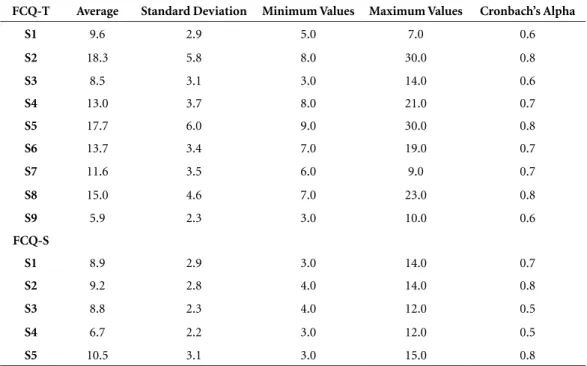
The tool showed satisfactory Cronbach’s alpha coefficient values (Table 1). Regarding FCQ-T, values ranged from 0.6 to 0.8. Subscales S8, S5 and S2 recorded a coefficient of 0.8; sub-scales S4, S6 and S7 scored a coefficient of 0.7 and subscales S1, S3 and S9 achieved a coefficient of 0.6. As for the FCQ-S, values ranged from 0.5 to 0.8. Subscales S3 and S4 recorded a coefficient of 0.5; subscales S2 and S5 scored a coefficient of 0.8 and subscale S1 achieved a coefficient of 0.7. Table 1 also shows the results of mean values, SD and minimum and maximum values obtained by university students for FCQ-T and FCQ-S sub-scales.
Intraclass Correlation Coefficient
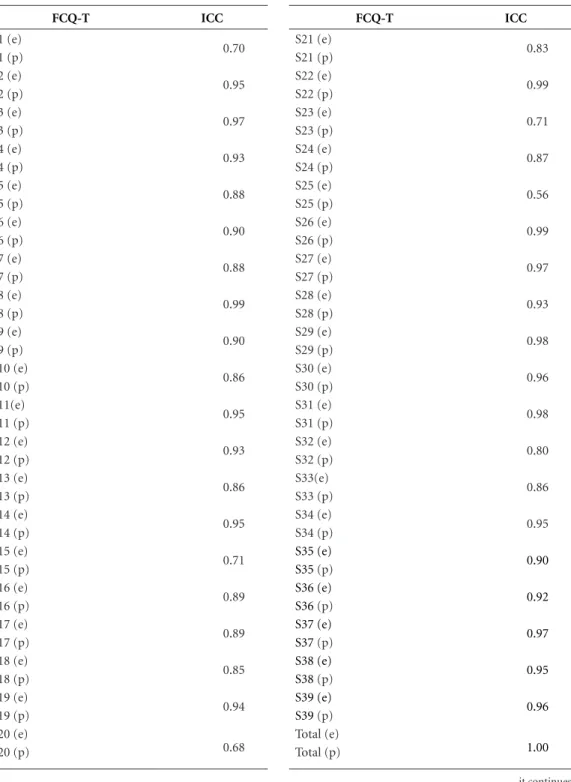
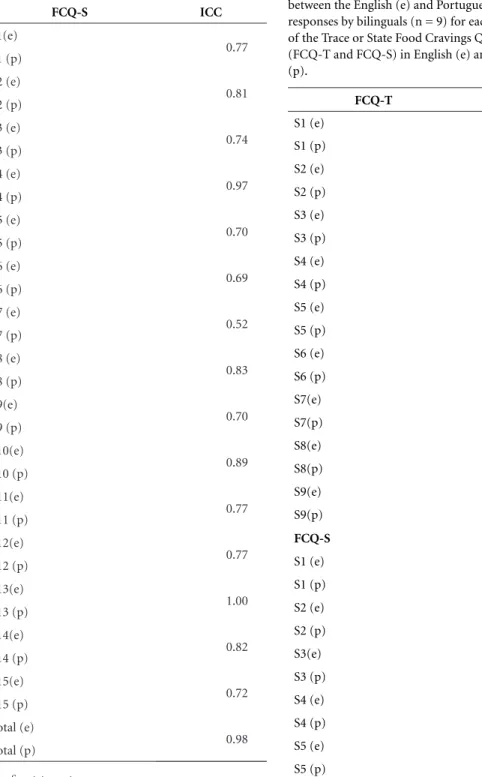
Tables 2 and 3 show the results of the ICC used to verify the conceptual, semantic and item equivalence for the pairs of each question in Portuguese and English and for the FCQ-T and FCQ-S subscales, respectively. Regarding answers in Portuguese and English, in the FCQ-T, ICC ranged from 0.70 to 0.99; as for the FCQ-S, this coefficient ranged from 0.52 to 1.00. As regards subscales, in the FCQ-T, the ICCs were high-er than 0.80, varying from 0.87 to 1.00; in the
FCQ-S, this coefficient ranged from 0.77 to 0.96.
Discussion
This paper shows the initial stage of the cross-cul-tural adaptation process of the State and Trait Food Cravings Questionnaires (FCQ-S and FCQ-T). The questionnaires were translated and back-translated and were evaluated by experts from different areas and students. Five versions were developed before achieving the adapted fi-nal version.
In the translation and back-translation stage, in view of the concern to preserve contents of the original version within the Brazilian cultural context, some terms were not translated literal-ly. In some cases, the literal correspondence of a term would have implied a different and de-contextualized understanding of this culture. It is also important to be careful with the selection of easily understood and comprehensive expres-sions. One aspect that differs from the original version of the tools concerns their adaptation to the male population. The Portuguese gen-der identifier extension “(a)” was included in all questions to ensure understanding by both sexes. The assessment of verbal comprehension was excellent, considering that both the experts
Table 1. Descriptive and internal consistency analyzes about university students’ evaluation of Trace or State Food Cravings Questionnaires (FCQ-T and FCQ-S) subscales (S).
FCQ-T Average Standard Deviation Minimum Values Maximum Values Cronbach’s Alpha
S1 9.6 2.9 5.0 7.0 0.6
S2 18.3 5.8 8.0 30.0 0.8
S3 8.5 3.1 3.0 14.0 0.6
S4 13.0 3.7 8.0 21.0 0.7
S5 17.7 6.0 9.0 30.0 0.8
S6 13.7 3.4 7.0 19.0 0.7
S7 11.6 3.5 6.0 9.0 0.7
S8 15.0 4.6 7.0 23.0 0.8
S9 5.9 2.3 3.0 10.0 0.6
FCQ-S
S1 8.9 2.9 3.0 14.0 0.7
S2 9.2 2.8 4.0 14.0 0.8
S3 8.8 2.3 4.0 12.0 0.5
S4 6.7 2.2 3.0 12.0 0.5
S5 10.5 3.1 3.0 15.0 0.8
e C
ole
tiv
a,
22(2):403-416,
2017
FCQ-T ICC
S1 (e)
0.70 S1 (p)
S2 (e)
0.95 S2 (p)
S3 (e)
0.97 S3 (p)
S4 (e)
0.93 S4 (p)
S5 (e)
0.88 S5 (p)
S6 (e)
0.90 S6 (p)
S7 (e)
0.88 S7 (p)
S8 (e)
0.99 S8 (p)
S9 (e)
0.90 S9 (p)
S10 (e)
0.86 S10 (p)
S11(e)
0.95 S11 (p)
S12 (e)
0.93 S12 (p)
S13 (e)
0.86 S13 (p)
S14 (e)
0.95 S14 (p)
S15 (e)
0.71 S15 (p)
S16 (e)
0.89 S16 (p)
S17 (e)
0.89 S17 (p)
S18 (e)
0.85 S18 (p)
S19 (e)
0.94 S19 (p)
S20 (e)
0.68 S20 (p)
Table 2. Intraclass correlation coefficient (ICC) between English (e) and Portuguese (p) responses by bilinguals (n = 9) for each statement (S) of the Trait or State Food Cravings Questionnaires (FCQ-T and FCQ-S).
FCQ-T ICC
S21 (e)
0.83 S21 (p)
S22 (e)
0.99 S22 (p)
S23 (e)
0.71 S23 (p)
S24 (e)
0.87 S24 (p)
S25 (e)
0.56 S25 (p)
S26 (e)
0.99 S26 (p)
S27 (e)
0.97 S27 (p)
S28 (e)
0.93 S28 (p)
S29 (e)
0.98 S29 (p)
S30 (e)
0.96 S30 (p)
S31 (e)
0.98 S31 (p)
S32 (e)
0.80 S32 (p)
S33(e)
0.86 S33 (p)
S34 (e)
0.95 S34 (p)
S35 (e)
0.90
S35 (p)
S36 (e)
0.92
S36 (p)
S37 (e)
0.97
S37 (p)
S38 (e)
0.95
S38 (p)
S39 (e)
0.96
S39 (p)
Total (e)
1.00
Total (p)
U
lian MD
Table 2. continuation Table 3. Intraclass correlation coefficient (ICC)
between the English (e) and Portuguese (p) responses by bilinguals (n = 9) for each subscale (S) of the Trace or State Food Cravings Questionnaires (FCQ-T and FCQ-S) in English (e) and Portuguese (p).
FCQ-T ICC
S1 (e)
0.87 S1 (p)
S2 (e)
0.93 S2 (p)
S3 (e)
0.94 S3 (p)
S4 (e)
1.00 S4 (p)
S5 (e)
0.99 S5 (p)
S6 (e)
0.97 S6 (p)
S7(e)
0.94 S7(p)
S8(e)
0.97 S8(p)
S9(e)
0.95 S9(p)
FCQ-S ICC
S1 (e)
0.90 S1 (p)
S2 (e)
0.92 S2 (p)
S3(e)
0.96 S3 (p)
S4 (e) 0.86
S4 (p) S5 (e)
0.77 S5 (p)
Note: S = subscale.
FCQ-S ICC
S1(e)
0.77 S1 (p)
S2 (e)
0.81 S2 (p)
S3 (e)
0.74 S3 (p)
S4 (e)
0.97 S4 (p)
S5 (e)
0.70 S5 (p)
S6 (e)
0.69 S6 (p)
S7 (e)
0.52 S7 (p)
S8 (e)
0.83 S8 (p)
S9(e)
0.70 S9 (p)
S10(e)
0.89 S10 (p)
S11(e)
0.77 S11 (p)
S12(e)
0.77 S12 (p)
S13(e)
1.00 S13 (p)
S14(e)
0.82 S14 (p)
S15(e)
0.72 S15 (p)
Total (e)
0.98 Total (p)
e C
ole
tiv
a,
22(2):403-416,
2017
consulted and students reported almost no dif-ficulty in understanding the tools. Regarding the evaluation of the conceptual, semantic and item equivalence performed by bilinguals, moderate intra-class correlation coefficients were noted in some questions (FCQ-T: statement 25; FCQ-S: statement 7). This was probably because transla-tion had not been entirely clear in relatransla-tion to the original English version. These statements were reviewed and adjusted. In the final version of the tool, the Likert point scale was used to facilitate participants’ understanding and data analysis, as well as the format and sequence of questions in the same way as in the original version. Among the limitations of this study is the fact that pre-test was limited to female participants of a small age group, of high schooling and in a single re-gion of Brazil.
Regarding the internal consistency analysis, FCQ-T and FCQ-S showed total values equiva-lent to 0.93 and 0.86, respectively, similar to those found in the original version (0.97 and 0.94, re-spectively)16. Thus, we can affirm that the
Por-tuguese version of the tool preserved the coher-ence and integration of their underlying items. While these tools seek to measure a phenomenon
strongly influenced by cultural aspects, the sta-tistical analyzes proved the clarity and compre-hension of the statements and their good internal relationship.
We can conclude that the Brazilian version of tools can be recommended for future appli-cations. These tools will be useful for future psy-chometric analyzes and the implementation and evaluation of food cravings in different popu-lation groups and covering different behavioral (cognitive and psychological) aspects. They can be implemented, for example, to study obesity and eating disorders and to evaluate the impact of nutritional interventions.
In the case of eating disorders, one could observe how individual weight gain would in-fluence the response profile of questionnaires; in the case of obesity, one could observe how behav-ioral changes would influence the response pro-file of the questionnaires. Considering increased obesity and overweight in recent years and the prevalence of food cravings in obese people, this research – currently scarce in Brazil – is very rel-evant. We emphasize the need for construct and factorial validation analyzes, as well as evaluation of their reproducibility.
Collaborations
U
lian MD
References
1. Tiffany ST, Wray JM. The clinical significance of drug craving. Ann N Y Acad Sci 2012; 1248:1-17.
2. Meule A, Hermann T, Kübler A. A short version of the Food Cravings Questionnaire – Trait: The FCQ-T-re-duced. Front Psychol 2014; 5:190.
3. Lee S, Kim KR, Ku J, Lee J, Namkoong K, Jung Y. Rest-ing-state synchrony between anterior cingulate cor-tex and precuneus relates to body shape concern in anorexia nervosa and bulimia nervosa. Psychiatry Res
2014; 221(1):43-48.
4. Kemps E, Tiggemann M. Approach bias for food cues in obese individuals. Psychology & Health 2015; 30(3):370-380.
5. Klatzkin RR, Gaffney S, Cyrus K , Bigus E, Brownley KA. Binge eating disorder and obesity: Preliminary evidence for distinct cardiovascular and psychological phenotypes. Physiol Behav 2015; 142:20-27.
6. World Health Organization (WHO). Obesity: prevent-ing and managprevent-ing the global epidemic: report of a WHO
consultation. Geneva: WHO; 2000. WHO Technical
Re-port Series 894.
7. Instituto Brasileiro de Geografia e Estatística (IBGE).
Antropometria e estado nutricional de crianças, adoles-centes e adultos no Brasil: Pesquisa de Orçamentos
Fami-liares 2008-2009. Rio de Janeiro: IBGE; 2010.
8. Brasil. Ministério da Saúde (MS). Secretaria de Vigilân-cia em Saúde. VIGITEL. Brasil 2012: Vigilância de fato-res de risco e proteção para doenças crônicas por inquérito telefônico. Brasília: MS; 2013.
9. Bamford B, Barras C, Sly R, Stiles-Shields C, Touyz S, Le Grange D, Hay P, Crosby R, Lacey H. Eating disorder symptoms and quality of life: Where should clinicians place their focus in severe and enduring anorexia ner-vosa? Int J Eat Disord 2015; 48(1):133-138.
10. Mitchison D, Mond J. Epidemiology of eating disor-ders, eating disordered behaviour, and body image dis-turbance in males: a narrative review. Int J Eat Disorder
2015; 3:20.
11. Ferreira JES, Veiga GV. Eating disorder risk behavior in Brazilian adolescents from low socio-economic level.
Appetite 2008; 51(2):249-255.
12. Nunes MA, Barros FC, Olinto MTA, Camey S, Mari JDJ. Prevalence of abnormal eating behaviors and inappropriate methods for weight control in young women from Brazil: a population – based study. Eat
Weight Disord 2003; 8(2):100-106.
13. Vilella JEM, Lamounier JA, Dellaretti Filho MA, Neto JRB, Horta GM. Transtornos alimentares em escolares.
J Pediatr 2004; 80(1):49-54.
14. Prisco APK, Araújo TM, Almeida MMG, Santos KOB. Prevalência de transtornos alimentares em trabalhado-res urbanos de município do Nordeste do Brasil. Cien
Saude Colet 2013; 18(4):1109-1118.
15. Alves TCHS, de Santana MLP, Silva RCR, Pinto EJ, As-sis AMO. Fatores associados a sintomas de transtornos alimentares entre escolares da rede pública da cidade do Salvador, Bahia. J Bras Psiquiatr 2012; 61(2):55-63 16. Benton D, Greenfield K, Morgan M. The development
of the attitudes to chocolate questionnaire. Pers Indiv Differ 1998; 24(4):513-520.
17. Cartwright F, Stritzke WG. A multidimensional ambiv-alence model of chocolate craving: construct validity and associations with chocolate consumption and dis-ordered eating. Eat Behav 2008; 9(1):1-12.
18. White MA, Whisenhunt BL, Williamson DA, Green-way, FL, Netemeyer RG. Development and valida-tion of the Food-Craving Inventory. Obes Res 2002; 10(2):107-114.
19. Cepeda-Benito A, Gleaves DH, Williams TL, Erath S A. The development and validation of the State and Trait Food-Craving Questionnaires. Behav Ther 2000; 31(1):151-173.
20. Cepeda-Benito A, Gleaves DH, Fernandez MC, Vila J, Reynoso J. The development and validation of Spanish versions of the state and trait food cravings question-naires. Behav Res Ther 2000; 38(11):1125-1138. 21. Franken IHA, Muris P. Individual differences in reward
sensitivity are related to food craving and relative body weight in healthy women. Appetite 2005; 45(2):198-201. 22. Noh J, Kim JH, Nam H, Lim M, Lee D, Hong K. Valida-tion of the Korean version of the General Food Crav-ings Questionnaire-Trait (G-FCQ-T). KoreanJournal of Clinical Psychology 2008; 27:1039-1051.
23. Meule A, Lutz A, Vögele C, Kübler A. Food cravings discriminate differentially between successful and un-successful dieters and non-dieters. Validation of the Food Craving Questionnaires in German. Appetite
2012; 58(1):88-97.
24. Reichenheim ME, Moraes CL. Operacionalização de adaptação transcultural de instrumentos de aferição usados em epidemiologia. Rev Saude Publica 2007; 41(1):665-673.
Article submitted 22/05/2015 Approved 17/12/2015