Prevention of Atrial Fibrillation with Moderate Doses of Amiodarone
in the Postoperative Period of Cardiac Surgery is Safe and Effective
in Patients with High Risk for Developing this Arrhythmia
Renato Jorge Alves, Glaucylara Reis Geovanini, Gisele de Brito, Gabriel A. S. Miguel, Valéria A. Glauser, Kenji Nakiri
Real e Benemérita Associação Portuguesa de Beneficência de São Paulo - Hospital Santa Cruz - São Paulo, SP - BrazilSummary
Objective: To assess if prophylaxis with moderate doses of amiodarone in the postoperative period of cardiac surgery
(coronary artery bypass grafting and/or valve surgery), reduces the incidence of atrial fibrillation in patients with high risk for developing this arrhythmia.
Methods: A randomized and prospective clinical study involving 68 patients who underwent elective cardiac surgery.
Mean age was 64 years and 59% of participants were males. Patients with three or more risk factors for atrial fibrillation, according to the literature, were randomized into two groups to receive or not prophylaxis with amiodarone in the first postoperative day. The dose administered ranged from 600 mg/day to 900 mg/day, intravenously, on the first postoperative day, followed by 400 mg/day orally until hospital discharge or until completing seven days. The other patients, who presented two or fewer risk factors, were followed up until hospital discharge. All patients were evaluated by means of cardiac and/or electrocardiographic monitoring.
Results: In the group treated with amiodarone, 7% of patients presented atrial fibrillation, whereas in the control group 70% of patients developed arrhythmia. Among the non-randomized individuals (with two or fewer risk factors), only 24% presented atrial fibrillation.
Conclusion: The prophylactic use of amiodarone was effective in the prevention of atrial fibrillation in patients with three or more risk factors for this arrhythmia. This treatment can be useful to reduce stay at the Intensive Care Unit and, consequently, the complications originating from longer hospitalization. (Arq Bras Cardiol 2007; 89(1) : 20-24)
Key words: Atrial fibrillation/therapy; amiodarone; thoracic surgery; postoperative care.
Mailing address: Renato Jorge Alves •
Unidade Coronariana - Rua Santa Cruz, 398 - 04122-000 - São Paulo, SP - Brazil
E-mail: [email protected]
Manuscript received November 23, 2006; revised received January 23, 2007; accepted March 13, 2007.
Introduction
Atrial fibrillation is the most common arrhythmia in the postoperative period of cardiac surgery. It can occur due to multiple mechanisms1.
The prevalence of this arrhythmia is approximately of 11% to 40% after coronary artery bypass grafting, but it can reach 50% of cases after valve surgery2-4. It generally occurs between
the first and fifth postoperative days, and it is more prevalent in patients over 65 years5-8 of age.
Although spontaneous recovery of sinus rhythm may occur after 6 to 8 weeks9, this arrhythmia increases the time spent
at the Intensive Care Unit (ICU), thus increasing the risk of nosocomial infections and hemodynamic instability10.
Among the main risk factors contributing to the onset of this arrhythmia are: old age, male gender, valve disease, increased atrial size, previous arrhythmias, chronic
obstructive pulmonary disease, previous cardiac surgery, discontinuation of betablockers, use of digoxin, ventricular dysfunction and anemia11.
It is known that the more risk factors, the greater the likelihood of atrial fibrillation in the postoperative period of cardiac surgery12,13.
Prophylaxis of atrial fibrillation can be effectively performed using betablockers or amiodarone. On the other hand, the use of verapamil, digoxin and/or procainamide has not brought any benefits12,14-17.
widening of QT interval and appearance of the U-wave. It can be indicated to treat ventricular arrhythmias, supraventricular paroxysmal tachycardia, fibrillation and atrial flutter. Moreover, it has also shown to be safe and effectivve in the prevention of atrial fibrillation in cardiac surgery postoperative period18.
Contrary to previous studies carried out with prophylactic treatment as early as in the preoperative period, there are no scientific studies demonstrating the benefits for high risk patients - who are therefore more susceptible to this arrhythmia - of pharmacological intervention started only in the postoperative period.
Methods
A prospective clinical study carried out between August 2004 and February 2005 in 68 patients, with 59% males and a mean age of 64 years. The patients underwent elective cardiac surgery (coronary artery bypass graft and/or valve surgery) with cardiopulmonary bypass.
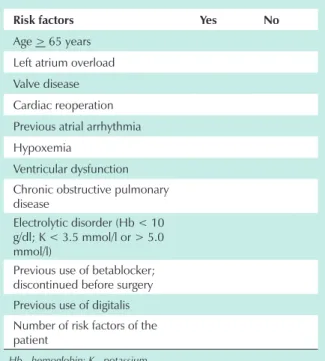
The inclusion criteria were defined for patients presenting three or more risk factors for atrial fibrillation according to the literature (Table 1). This criterion was adopted from a statistical method (a multivariate analysis known as CART – Classification and Regression Tree) used in a previous study performed but not yet published, which stated that the presence of three or more risk factors among those listed in the literature would increase the incidence of this arrhythmia in the postoperative
period of cardiac surgery.
After inclusion, patients were selected for a second randomization and were divided into two groups: Amiodarone (Group 1) and Control (Group 2). The exclusion criteria and the stratification model used to select patients are described in Tables 2 and 3, respectively.
On the first postoperative day, Group 1 patients received intravenous amiodarone at a dose between 600 mg and 900 mg, in 24 hours, followed by 400 mg/day, orally, until completion of seven-day treatment or hospital discharge. Group 2 patients followed the conventional treatment. Those with two or fewer risk factors and who would not be randomized for prophylaxis with the study medication were followed up until hospital discharge.
All patients were evaluated by means of electrocardiography and/or cardiac monitoring.
Statistical analysis - To evaluate the association between the occurrence of atrial fibrillation and risk factors we used the Fisher’s exact test. Student’s t test was used to compare the mean age of patients. The evaluation of amiodarone efficacy in the prevention of atrial fibrillation was carried out using Fisher’s exact test. To compare the mean age between the groups (groups with up to two, groups with three or more risk factors, and groups with and without amiodarone), we used the variance analysis (ANOVA). The significance level in this study was 5% (p < 0.05).
Results
Of the 68 patients analyzed, 33 (49%) presented two or fewer risk factors and were followed up until hospital discharge.
Table 1 – Study inclusion criteria
Age > 65 years
Valve disease
Left atrium overload
Ventricular dysfunction
Cardiac reoperation
Electrolyte disorder
Previous atrial arrhythmia
Hypoxemia
Chronic obstructive pulmonary disease
Discontinuation of betablocker 24 hours before surgery
Previous use of digitalis
Table 2 – Study exclusion criteria
Persistent atrial fibrillation
Thyroid disease
Pulmonary fibrosis
Atrioventricular block
Decompensated heart failure (ejection fraction < 25%)
Previous use of amiodarone
Pacemaker use
Table 3 – Stratification model used to select patients in the search of risk factors for atrial fibrillation
Risk factors Yes No
Age > 65 years
Left atrium overload
Valve disease
Cardiac reoperation
Previous atrial arrhythmia
Hypoxemia
Ventricular dysfunction Chronic obstructive pulmonary disease
Electrolytic disorder (Hb < 10 g/dl; K < 3.5 mmol/l or > 5.0 mmol/l)
Previous use of betablocker; discontinued before surgery Previous use of digitalis Number of risk factors of the patient
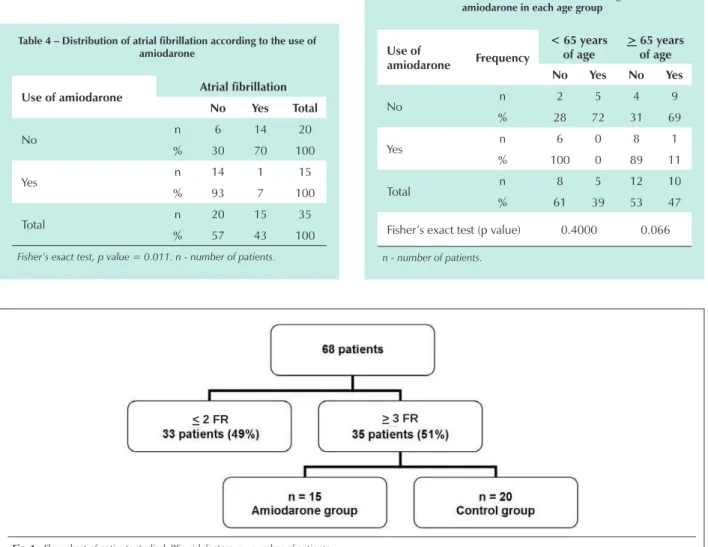
The remaining 35 (51%) patients who had three or more risk factors were randomized to receive or not amiodarone (Figure 1). In the group treated with amiodarone (n = 15), only one patient (7%) developed atrial fibrillation, whereas in the control group (n = 20), without prophylaxis, 14 patients (70%) developed arrhythmia (Table 4). Hence, it was observed that the group treated with amiodarone presented lower incidence of atrial fibrillation (significance level of 5%).
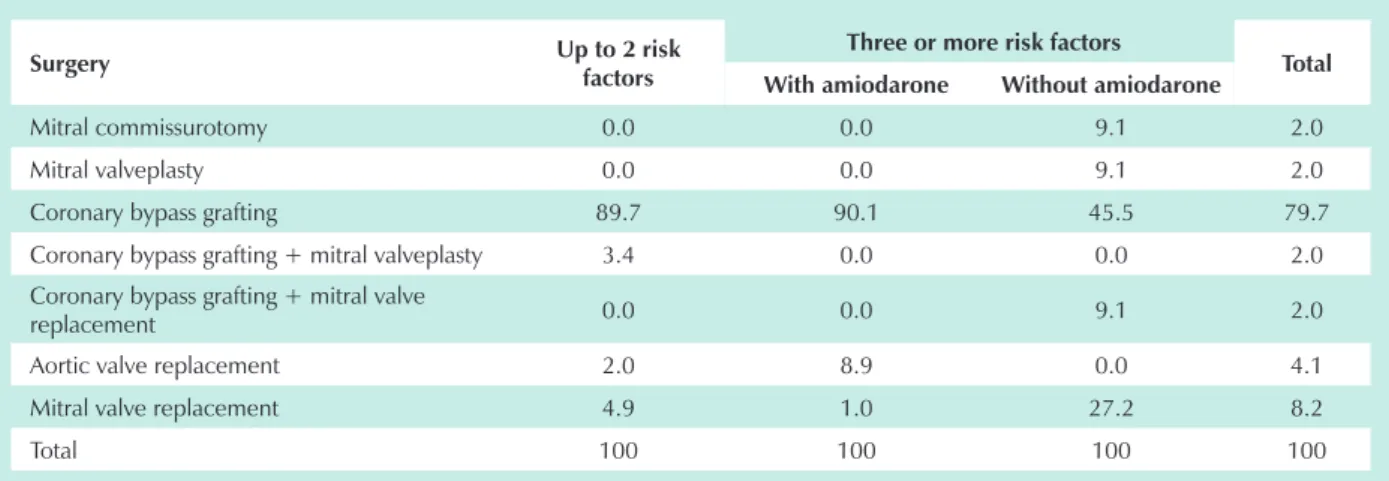
Among those patients not randomized to receive amiodarone for presenting two or fewer risk factors, only 8 patients (24%) presented atrial fibrillation, while 25 (76%) did not develop this condition. The age factor, already established in the literature as a relevant risk factor for the occurrence of atrial fibrillation in the postoperative period of cardiac surgery, was high in this case series, but there was no statistically significant difference between the groups (Tables 5 and 6). This finding probably occurred due to the advanced age of this population. Coronary artery bypass grafting was the most prevalent type of surgery, occurring in 79.7% of the cases analyzed (Table 7).
Discussion
Atrial fibrillation remains the most frequent complication in the postoperative period of cardiac surgery. According to
Table 4 – Distribution of atrial fibrillation according to the use of amiodarone
Use of amiodarone Atrial fibrillation
No Yes Total
No n 6 14 20
% 30 70 100
Yes n 14 1 15
% 93 7 100
Total n 20 15 35
% 57 43 100
Fisher’s exact test, p value = 0.011. n - number of patients.
Table 5 – Distribution of atrial fibrillation according to the use of amiodarone in each age group
Use of
amiodarone Frequency
< 65 years of age
> 65 years of age
No Yes No Yes
No n 2 5 4 9
% 28 72 31 69
Yes n 6 0 8 1
% 100 0 89 11
Total n 8 5 12 10
% 61 39 53 47
Fisher’s exact test (p value) 0.4000 0.066
n - number of patients.
the literature, its incidence ranges from 20% to 50% of cases, depending on the type of surgery (more frequent in valve surgeries)1-4. This comorbidity prolongs hospital stay, which
can lead to several clinical complications.
Patients with advanced age and the association of risk factors contribute to higher rate of atrial fibrillation in the postoperative period15,19. In this study, the number of risk
factors (three) was the determining factor in the selection of individuals for the prophylaxis - or not - with amiodarone.
Several clinical trials have evaluated the effectiveness of pharmacological interventions in reducing the incidence of this arrhythmia18-22. However, these trials are generally not much
statistically significant when the effects of these treatments on shorter hospital stay or on the occurrence of stroke are estimated to estimate. The main indication in the prophylaxis of atrial fibrillation in the postoperative period of cardiac surgery is still a reduced hospital stay and less complications, such as strokes16,17.
Some randomized studies assessed the prophylaxis of this arrhythmia with drugs such as amiodarone, betablocker, sotalol and a biatrial pacemaker. The effectiveness of these
Fig. 1 - Flow chart of patients studied. RF - risk factors; n - number of patients.
Table 6 - Distribution of atrial fibrillation according to the risk factors, use of amiodarone and the summary measures of patients’ ages
Risk factors
Atrial
fibrillation Mean
age SD
No Yes
< 2 RF n 25 8 61.9 10.2
% 75.8 24.2
> 3 RF withwith amiodarone
n 14 1 65 3,5
% 91 9
> 3 RF without amiodarone
n 6 14 61.1 14.6
% 30 70
SD - standard deviation; RF - risk factors.
Table 7 – Percentile distribution of groups according to surgery performed
Surgery Up to 2 risk
factors
Three or more risk factors
Total
With amiodarone Without amiodarone
Mitral commissurotomy 0.0 0.0 9.1 2.0
Mitral valveplasty 0.0 0.0 9.1 2.0
Coronary bypass grafting 89.7 90.1 45.5 79.7
Coronary bypass grafting + mitral valveplasty 3.4 0.0 0.0 2.0
Coronary bypass grafting + mitral valve
replacement 0.0 0.0 9.1 2.0
Aortic valve replacement 2.0 8.9 0.0 4.1
Mitral valve replacement 4.9 1.0 27.2 8.2
Total 100 100 100 100
drugs in the reduction of atrial fibrillation in the postoperative period of cardiac surgery was confirmed. However, a decreased incidence of strokes is still inconclusive15.
A study with intravenous administration of amiodarone up to 1 g/day compared with placebo has already shown safety and effectiveness of this drug in reducing atrial fibrillation in the postoperative period of cardiac surgery19.
The efficacy of oral administration has also been analyzed in a placebo-controlled study at a dose of 2 g/day, from one to four days before surgery, and 400 mg/day up to seven days after surgery20.
This study did not require previous admission of patients to show the effectiveness of amiodarone in the prevention of atrial fibrillation. The drug was initiated only on the first postoperative day in selected patients (high risk). Additionally, what differentiates this study from other previous studies is the fact that the dose of amiodarone used, both the loading dose (600 mg/24 hours to 900 mg/24 hours, intravenously) and the maintenance dose (400 mg/day orally until hospital discharge or completion of seven days), was lower; therefore, with fewer risks of adverse events to the patients.
The comparison between antiarrhythmic drugs, such as betablockers, sotalol and amiodarone, either as combination therapy or not, has also shown significant reduction in atrial fibrillation in the cardiac surgery postoperative period. In studies where the antiarhythmic agent used was amiodarone, there was a reduction in hospital stay21,22.
In this study we also observed a shorter hospital stay in the group receiving prophylaxis with amiodarone, as compared to the control group (two and five days, respectively).
The intravenous administration of amiodarone to prevent atrial fibrillation in patients selected according to risk factors (such as advanced age, valve surgery, patients with chronic obstructive pulmonary disease and other risk factors analyzed) showed a good cost-effectiveness ratio favoring prophylaxis23,24.
The efficacy of prophylactic amiodarone against atrial
fibrillation in the postoperative period of cardiac surgery was confirmed in this study. The drug regimen used protected 93% of patients with three or more risk factors, whereas in the control group, 70% of individuals presented atrial fibrillation.
In addition to confirming the need of a more strict selection including patients at a higher risk (with three or more of the above-mentioned risk factors), this study showed the benefit of this drug treatment at a moderate dose, initiated only in the postoperative period.
Conclusion
It was demonstrated that amiodarone is safe and effective in prevention of atrial fibrillation in the postoperative period of cardiac surgery in patients with three or more risk factors for arrhythmia. This prophylaxis proved to be safe and it may reduce hospitalization periods as well as the clinical complications resulting from prolonged stay at ICU.
Potential Conflict of Interest
References
1. Costa R, Costa SPL, Peres AK, Seixas TN. Prevention of atrial fibrillation after cardiac surgery. REBLAMPA. 2003;16(2):87-92.
2. Leitch JW, Thomsom D, Baird DK, Harris PJ. The importance of age as a predictor of atrial fibrillation and flutter after coronary bypass grafting. J Thorac Cardiovasc Surg. 1990;100:338-42.
3. Hashimoto K, Listrup DM, Schaff HV. Influence of clinical and hemodynamic variables on risk of supraventricular tachycardia after bypass. J Thorac Cardiovasc Surg. 1991;101:56-65.
4. Janusz S, Rogowski J, Anisimowiscz L, Lango R, Narkiewicz M. Atrial fibrillation after coronary artery bypass grafting without cardiopulmonary bypass. Eur J Cardio-Thorac Surg. 2000;17:520-3.
5. Reed GL, Singer DE, Picard EH, DeSanctis RW. Stroke following coronary-artery bypass surgery: a case control estimate of the risk from carotid bruits. N Engl J Med. 1988;319:246-50.
6. Fuller JA, Adams GG, Buxton AE. Atrial fibrillation after coronary artery bypass grafting. J Thorac Cardiovasc Surg. 1990;98:821-5.
7. Yousif H, Davies G, Oakley CM. Peri-operative supraventricular arrhythmias in coronary surgery. Int J Cardiol. 1990;26:313-8.
8. Piegas LS, Gun C. Fibrilação atrial no pós-operatório de revascularização miocárdica. Rev Soc Cardiol Estado de São Paulo. 1994;4:305-11.
9. Maisel WH, Rawn JD, Stevenson WG. Atrial fibrillation after cardiac surgery. Ann Intern Med. 2001;135:1061-73.
10. Hogue CW Jr, Domitrovich PP, Stein PK, Despotis GD, Re L, Schuessler RB, et al. RR interval dynamics before atrial fibrillation in patients after coronary artery bypass graft surgery. Circulation. 1998;98(5):429-34.
11. Zaman AG, Archhold RA, Helft G, Paul EA, Curzen NP, Mills PG. Circulation. 2000;101(12):1403-8.
12. Mathew JP, Parks R, Savino JS, Friedman AS, Koch C, Mangano DT, et al. Atrial fibrillation following coronary artery bypass graft surgery. JAMA. 1996;276:300-6.
13. Crystal E, Connolly SJ, Sleik K, Ginger TJ, Yusuf S. Interventions on prevention of postoperative atrial fibrillation in patients undergoing heart surgery. Circulation. 2002;106:75-80.
14. Aranki SF, Shaw DP, Adams DH, Rizzo RJ, Couper GS, VanderVliet M, et al. Predictors of atrial fibrillation after coronary artery surgery: current trends and impact on hospital resources. Circulation. 1996;94:390-7.
15. Frost L, Molgaard H, Christiansen EH, Hjortholm K, Paulsen PK, Thomsen PEB. Atrial fibrillation and flutter after coronary artery bypass surgery: epidemiology, risk factors and preventive trials. Int J Cardiol. 1992;36:253-61.
16. Rubin DA, Nieminski KE, Reed GE, Herman MV. Predictors, prevention and long-term prognosis of atrial fibrillation after coronary artery bypass graft operations. J Thorac Cardiovasc Surg. 1987;94:331-5.
17. Mendes LA, Connelly GP, McKenney PA, Podrid PJ, Cupples LA, Shemin RJ, et al. Right coronary artery stenosis: an independent predictor of atrial fibrillation after coronary artery bypass surgery. J Am Coll Cardiol. 1995;25(1):198-202.
18. Alcalde RV, Guaragna JC, Bodanese LC, Castro I, Sussenbach E, Noer R, et al. Alta dose de amiodarona em curto período reduz incidência de fibrilação atrial no pós-operatório de cirurgia de revascularização miocárdica. Arq Bras Cardiol. 2006;87(3):236-40.
19. Guarnieri T, Nolan S, Gottlieb SO, Dudek A, Lowry DR. Intravenous amiodarone for the prevention of atrial fibrillation after open heart surgery: The Amiodarone Reduction in Coronary Heart (ARCH) Trial. J Am Coll Cardiol. 1999;34:343-7.
20. Redle JD, Khurana S, Marzan R, McCullough PA, Stewart JR, Westveer DC, et al. Prophylactic oral amiodarone compared with placebo for prevention of atrial fibrillation after coronary artery bypass surgery. Am Heart J. 1999;138:144-50.
21. Auer J, Weber T, Berent R, Puschmann R, Hartl P, Ng CK, et al. A comparison between oral antiarrhythmic drugs in the prevention of atrial fibrillation after cardiac surgery: the pilot study of prevention of postoperative atrial fibrillation (SPPAF), a randomized, placebo-controlled trial. Am Heart J. 2004;147(4):636-43.
22. Coleman CI, Perkerson KA, Gillespie EL, Kluger J, Gallagher R, Horowitz S, et al. Impact of prophylactic postoperative beta-blockade on post-cardiothoracic surgery length of stay and atrial fibrillation. Ann Pharmacother. 2004;38(12):2012-6.
23. Mahoney EM, Thompson TD, Veledar E, Williams J, Weintraub WS. Cost-effectiveness of targeting patients undergoing cardiac surgery for therapy with intravenous amiodarone to prevent atrial fibrillation. J Am Coll Cardiol. 2002;40(4):737-45.
24. Kerstein J, Soodan A, Qamar M, Majid M, Lichstein E, Hollander G, et al. Giving IV and oral amiodarone perioperatively for the prevention of postoperative atrial fibrillation in patients undergoing coronary bypass surgery: the GAP study. Chest. 2004;126:716-24.
Sources of Funding
This study was funded with the investigator´s own resources.
Study Association with Graduate Work