ISSN 1553-6203
© 2011 Science Publications
Corresponding Author: Balafama Abinye Alex-Hart, Department of Paediatrics and Child Health, University of Port Harcourt Teaching Hospital, P.M.B 6173, Port Harcourt, Rivers State, Nigeria Tel: +234-8033-91084
Handwashing Practices amongst Health Workers in a Teaching Hospital
Balafama Abinye Alex-Hart and Peace Ibo Opara
Department of Pediatrics and Child Health, Faculty of Clinical Sciences,
University of Port Harcourt, East West Road, Choba, Port Harcourt, Rivers State, Nigeria
Abstract: Problem statement: Hand washing with soap is an important means of preventing hospital acquired infections .However the rate of hand washing with soap and water is unacceptably low amongst health workers. Few studies on this subject have been done amongst health workers in Nigeria. The aims of this study were to explore perceptions, attitudes and hand washing practices amongst health workers in a tertiary health institution in Port Harcourt, Nigeria. Approach: This was a descriptive cross sectional survey carried out amongst randomly selected doctors and nurses in University of Port Harcourt Teaching Hospital. A simple questionnaire exploring perceptions, attitudes and self reported behavior was used. Information obtained included bio data, awareness information and practice. Data were analyzed using descriptive statistics. Results: A total of 258 health workers (139 doctors and 119 nurses) participated in this study. Male to female ratio was 1: 3.3. The rate of hand washing before and after interacting with patients were 9.3 and 51.2% respectively (χ2=105.19, p-value=0.000). The rate of hand washing before and after simple procedures were 13.6 and 59.7% respectively (χ2 = 116.25, p-value = 0.000). Soapy water in a basin was most frequently (55.8%) used for hand washing. Doctors were more likely than nurses to wash hands before interacting with patients (χ2 = 7.98, p-value = 0.005) and before simple procedures (χ2 = 4.29, p-value = 0.039). The rates of hand washing before meals and after defaecation were 69.0% and 58.1% respectively. Soap and running water were more frequently used after defecation (61.6%) than before meals and snacks (46.5%).The greatest motivation for hand washing was fear of contracting disease, whilst constraints included lack of soap and water. Conclusion/Recommendations: Hand washing rates are low amongst health workers in Port Harcourt. There is need for regular education and re-education and provision of facilities for hand washing.
Key words: Health workers, Disease Control and Prevention (CDC), hand hygiene, washing techniques, occasionally washed
NTRODUCTION
Hospital acquired infections complicate 7-10% of hospital admissions. Haley et al. (1985) these infections result from the transmission of microorganisms from the hands of health workers in health institutions. (Haley et al., 1985; Sepehri et al., 2009; Masadeh and Jaran, 2009) The spread of these health care associated infections can be controlled if health workers wash their hands at appropriate times with soap and water. (Bischoff et al., 2000; Garner and Favero, 1986) The Guidelines for Hand washing and Hospital Environmental Control from the Center for Disease Control and Prevention (CDC); the Hospital infection Control Practices Advisory Committee and the Association for Professionals in Infection Control and
Epidemiology (APIC) have each highlighted specific indications for hand washing compliance (Garner and Favero, 1986; Larson and Kretzer, 1995; CDC, 2010; Garner, 1996).
prevention of endemic intensive care unit infections, the overall hand washing rate was noted to be 22%. After 6 months of interventions to increase the rate of hand washing, it increased to 29.9% (Simmons et al., 1990).
Factors reported to contribute to poor hand washing compliance include unavailability of hand washing sinks, time required to perform hand hygiene, patient’s condition, effect of hand-hygiene products on the skin and inadequate knowledge of the guidelines (Larson and Kretzer, 1995; Simmons et al., 1999; Meengs et al., 1994; Doebbeling et al., 1992; Voss and Widmer, 1997). Whilst most of these studies were done in foreign countries, very few, if any has been done in Nigeria. This study aims to explore perceptions, attitudes and hand washing practices amongst health workers in a tertiary institution in Port Harcourt, Nigeria.
MATERIALS AND METHODS
This was a descriptive cross sectional hospital based study, carried out amongst doctors and nurses in University of Port Harcourt Teaching Hospital. The Teaching Hospital is the largest tertiary hospital in Rivers state, Nigeria in West Africa. It functions as both a general and a tertiary hospital and teaching center for both undergraduate and postgraduate medicine. It caters for patients within the state and serves as a referral centre for neighboring states. It is a large 800 bedded hospital, with each of the clinical specialties having wards for in-patient management. Each ward is provided with at least 2 wash hand basins, running water, soap (liquid and bar) and cloth towels for hand drying. These towels are changed at least three times a day. Large vessels are also provided in each ward to store water for hand washing when due to fluctuations in electricity supply, running water is not available. The teaching hospital has four major departments which run both in-patient and out-patient services. These are Departments of Surgery, Medicine, Paediatrics and Obstetrics and Gynaecology. Doctors and nurses were randomly selected from these four departments for the study, only those who gave consent participated in the study.
A simple structured questionnaire was used for data collection. Information obtained included bio data, perceptions, attitudes and self reported behaviors concerning hand washing techniques and hand washing practices in the hospital. Where appropriate, participants were allowed to tick more than one option. Questionnaires were retrieved immediately after filling to avoid bias. Data were entered into a Microsoft excel spread sheet and analyzed using SPSS version 15.0. Chi square test was used to test for significance. Level of significance was set at p<0.05.
RESULTS
A total of 258 health workers participated in this study. There were 60 (23.3%) males and 198 (76.7%) females with male to female ratio of 1:3.3. The participants were between the ages of 20 years to 70 years (Table 1).Mean age was 36.2±8.634 SD. One hundred and thirty nine (53.9%) were doctors and 119 (46.1%) were nurses.
Perceived components of good hand washing techniques included; use of soapy water in a basin (55.4%), use of cold running water (39.1%), use of warm running water (30.6%) and rubbing soap on wet hands for about 20 seconds before rinsing (26.0%) Table 2. The most practiced hand washing technique is use of soapy water in the basin (55.8%). This is followed by washing front and back of hands including under the nails (41.0) and use of cold running water (36.4%) as shown in Table 3.
Table 1: Age and sex distribution of health workers Sex
--- Age group Female Male Total (%)
20-24 7 3 10 (3.9)
25-29 38 19 57(22.1
30-34 45 15 60(23.3)
35-39 39 9 48(18.6)
40-44 17 6 23(8.9)
45-49 21 5 26(10.1)
50-54 22 2 24(9.3)
55-59 9 0 9(3.5)
60& above 0 1 1(0.3)
Total (%) 198 (76.7) 60 (23.3) 258 (100)
Table 2: Identified techniques of good hand washing
Technique Frequency Percent (%) Use of soapy water in a basin 143 55.4 Use of cold running water 101 39.1 Use of warm running water 79 30.6 Rubbing soap on wet hands for about 67 26.0 20 sec before rinsing
Washing front and back of hands 62 24.0 including under the nails
Rinsing under cold running water 31 12.0 Rinsing under warm running water 8 3.1
Table 3: Self reported hand washing practices amongst health workers Hand washing practices Frequency Percent (%) Use of soapy water in a basin 144 55.4 Washing front and back of 106 41.0 hands including under the Nails
Use of cold running water 94 36.4 Use of warm running water 68 26.4 Rubbing soap on wet hands for
Table 4: Frequency of hand washing before interacting with patients and before simple procedures
Before interacting with patients Frequency Percentage (%)
Never 198 76.7
Always 24 9.3
Sometimes 15 5.8
Occasionally 14 5.5
No response 7 2.7
Total 258 100.0
Before simple procedures
Never 180 69.7
Always 35 13.6
Sometimes 23 8.9
Occasionally 16 6.2
No response 4 1.6
Total 258 100.0
Table 5: Frequency of hand washing after interacting with patients, after simple procedures and after the day’s work
After interacting with patients Frequency Percentage (%)
Always 132 51.2
Sometimes 64 24.8
Never 34 13.2
Occasionally 18 7.0
No response 10 3.8
Total 258 100.0
After simple procedures
Always 154 59.7
Sometimes 85 32.9
Occasionally 13 5.0
Never 4 1.6
No response 2 0.8
Total 258 100.0
After the day’s work
No 184 71.3
Yes 65 25.2
No response 9 3.5
Total 258 100.0
Table 4 Shows frequency of hand washing before interacting with patients and before simple procedures. Before interacting with patients (clerking, routine nursing procedures), 198 (76.7%) health workers never wash their hands, while 24 (9.3%) always washed their hands. Before performing simple procedures (e.g., sitting iv lines, wound dressing, glucose check), 180 (69.7%) health workers never wash their hands, while 35 (13.6%) always washed their hands.
Table 5 shows frequency of hand washing of the health workers after interacting with patients, after simple procedures and after the day’s work. After interacting with patients (clerking and routine nursing procedures), 51.2% always washed their hands, while 24.8% sometimes washed their hands. Similarly 59.7% always washed their hands after carrying out simple procedures (e.g., sitting iv lines, wound dressing, glucose check), while 32.9% sometimes washed their hands. Health workers washed their hands more often after interacting with patients than before ( 2=105.19, pvalue = 0.000, Yates corrected). There is
Table 6: Comparison of hand washing frequency between doctors and nurses before interacting with patients and before simple procedures
Hand washing before
interacting with patients Doctors (%) Nurses (%) χ2 pvalue
Always 20 (14.4) 4 (3.4) 7.98 0.005 Never 100 (71.9) 98 (82.4)
Occasionally 8 (5.8) 6 (5.0) Sometimes 10 (7.2) 5 (4.2) No response 1(0.7) 6 (5.0) Total 139 (100) 119 (100) Before simple procedures
Always 25 (18.0) 10 (8.4) 4.24 0.039 Never 90 (64.7) 90 (75.7)
Sometimes 11 (7.9) 10 (8.4) Occasionally 10 (7.2) 6(5.0) No response 3 (2.2) 3 (2.5) Total 139 (100) 119 (100)
Table 7: Comparison of hand washing frequency between doctors and nurses after interacting with patients and after simple procedures
Hand washing after
interacting With patients Doctors (%) Nurses (%) χ2 P value
Always 77(55.4) 77(64.7) 1.94 0.16
Sometimes 52(37.4) 33(27.7) Occasionally 7 (5.1) 6 (5.1)
Never 2 (1.4) 2(1.7)
No response 1(0.7) 1(0.8) Total (%) 139 (100) 119 (100) After simple procedures
Always 71(51.1) 61(51.3) 0.01 0.92
Sometimes 33 (23.7) 31(26.0) Never 22 (15.8) 12 (10.1)
Occasionally 8 (5.8) 10 (8.4) No response 5 (3.6) 5 (4.2) Total 139 (100) 119 (100)
also statistically significant difference between the number of health workers who always washed hands before and after simple procedures (χ2=116.25, p-value=0.000. Yates corrected). After the day’s work, 25.2% wash their hands before going home.
Table 6 shows a comparison of hand washing practices between doctors and nurses before interacting with patients and before carrying out simple procedures. Twenty (14.4%) doctors and 4 (3.4%) nurses always washed their hands before interacting with patients. The difference is statistically significant (χ2=7.98, p-value=0.005. Yates corrected). Twenty-five (18%) doctors and 10 (8.4%) nurses always washed their hands before simple procedures. The difference is also statistically significance (χ2=4.24, p-value=0.039)
Table 8: Hand washing and hand drying techniques in the clinic Hand washing in the clinic/ward Frequency Percent Use of soap and running water 174 67.4 Use of running water alone 39 15.1 Use of soapy water in a basin 25 9.8 Use of water in a basin 13 5.0
No response 7 2.7
Total 258 100.0
Hand drying techniques
Use of personal handkerchief 92 35.7 Allow hands dry on their own 77 29.8 Use of common towels 58 22.5 Use of disposal paper towels 18 7.0
Use of hand dryer 12 4.7
No response 1 0.3
Total 258 100.0
Table 9A: Hand washing at critical periods (before meals and snacks) Frequency of hand washing before meals Frequency Percent (%)
Always 178 69.0
Sometimes 58 22.5
Occasionally 22 8.5
Never 0 0.0
Total 258 100.0
Frequency of hand washing before snacks
Always 108 41.9
Sometimes 64 24.0
Occasionally 41 15.9
Never 40 15.5
No response 7 2.7
Total 258 100.0
Hand washing technique before meals and snacks
Use of soap and running water 120 46.5 Use of water in a basin 76 29.5 Use of running water alone 46 17.8 Use of soapy water in a basin 10 3.9
No response 6 2.3
Total 258 100.0
Table 9B: Hand washing at critical times (after defalcation) Frequency of hand
washing after defalcation Frequency Percent (%)
Always 150 58.1
Sometimes 62 24.0
Occasionally 30 11.6
Never 13 5.1
No response 3 1.2
Total 258 100.0
Hand washing technique after defalcation
Use of soap and running water 159 61.6 Use of running water alone 64 24.8 Use of water in a basin 24 9.3 Use of soapy water in a basin 11 4.3
Total 258 100.0
always washed their hands after performing simple procedures. The difference is not statistically significant (χ2=0.01, p-value=0.92, Yates corrected).
Table 8 shows hand washing and hand drying techniques in the clinic. After seeing patients in the clinic, 174 (67.4%) of the health workers reportedly washed their hands with soap and running water, 39
Table 10: Motivations and constraints to hand washing
Motivations to hand washing Frequency Percent Fear of contracting disease 125 48.4
Culture/habit 76 29.5
Disgust of filthy environment 27 10.5 Enhances social status 14 5.4
Disgust of faeces 8 3.1
No response 8 3.1
Total 258 100.0
Constraints to hand washing
Lack of soap 89 34.6
Lack of water 85 33.0
Forgetfulness 38 14.7
Inconveniently located sink 21 8.1
Lack of motivation 14 5.4
Lack of time 6 2.3
No response 5 1.9
Total 258 100.0
(15.1%) used running water alone. Ninety two (35.7%) health workers reportedly used personal handkerchief to dry their hands after washing, while 58(22.5%) dry their hands with common towels.
Tables 9A and B show hand washing practices at critical times (before meals and snacks and after defecation). One hundred and seventy eight (69.0%) health workers always washed their hands before meals, while 22 (8.5%) occasionally washed before taking their meals. One hundred and eight (41.9%) participants always washed their hands before snacks, 40 (15.5%) never wash their hands before snacks. One hundred and twenty (46.5%) participants wash their hands with soap and running water before meals and snacks, while 76 (29.5%) use water in a basin (Table 9A). After defecation, 150 (58.1%) participants always washed their hands, while 30 (11.6%) occasionally washed their hands. The hand washing technique used most frequently after defecation was the use of soap and running water. This was reported by 159 (61.6%) health workers (Table 9B).
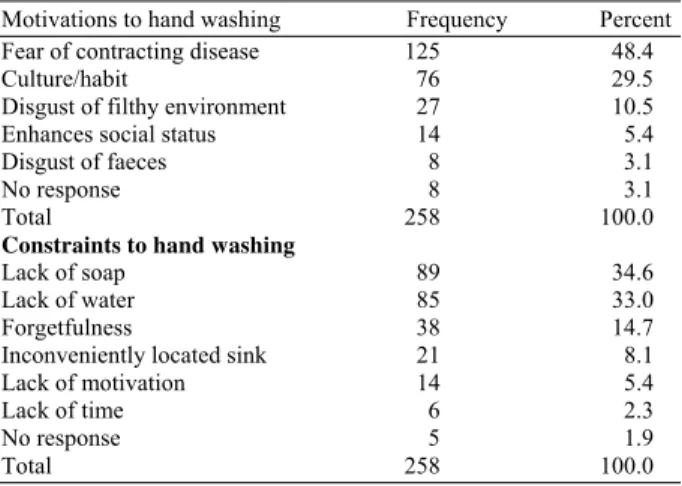
Table 10 shows motivations and constraints to hand washing. The greatest motivation to hand washing was fear of contracting disease. This was reported by 125(48.4%) participants. Lack of soap was the most indentified constrain to hand washing. This was reported by 89 (34.6%) participants.
DISCUSSION
reflected in their self reported hand washing practice) instead of the use of soap with running water which was reportedly practiced by very few (24.4%) health workers.
Our study supports findings by other studies that rates of hand washings with soap and water before interacting with patients are low (Bischoff et al., 2000; Pittet et al., 1999a; Lankford et al., 2003; Sproat and Inglis, 1994; Fadeyi et al., 2010). The rates were higher after patients interactions, confirming the suggestions of some authors that health workers hand washing rates increases when there is perceived risk for their own health (Bischoff et al., 2000; Pittet et al., 1999a; Lankford et al., 2003). Whereas patients may be protected from acquisition of pathogenic organisms if health workers perform hand hygiene before patient contact, health workers perceive a risk to themselves after patient contact and respond by hand washing. Hand washing was found to be low amongst nurses in this study. This is in contrast to the study by Pittet et al. (1999a) and Gould (1996) who found higher rates amongst nurses.
One very important finding is the low hand washing rate following the day’s work. During daily activity, health workers progressively accumulate microorganisms on their hands from direct patient contact or contact with contaminated environmental surfaces and devices. These organisms are easily removed by hand washing with soap (Masadeh and Jaran, 2009; Larson and Kretzer, 1995; Pittet et al., 1999b; Fadeyi et al., 2010; Chakraborty et al., 2010). Failure to wash hands appropriately (as was revealed in this study) could predispose these health workers to diseases caused by the organisms.
The study also revealed conflicting responses amongst health workers when reporting their hand washing techniques while running the outpatient clinics. Majority (67.4%) of the health workers reported washing their hands with soap and running water. This contrasts with their earlier response of using soapy water in a basin, reported by 55.4% of the health workers. This supports previous reports that self reporting has its flaws as it is not as reliable as the actual observation (Pritchard and Raper, 1996).
The study also shows that a large percentage of the health workers use either personal handkerchiefs (35.7%), allowed their hands to dry on their own (29.8%) or use common cloth towels (22.5%) to dry their hands . Experts argue that hand drying is as important as hand washing in maintaining hand hygiene (Pittet et al., 1999b; Tibballs, 1996). Despite conflicting findings, the general opinion seems to be that single-use
paper towels are the most appropriate hand drying method. They are said to rub away transient organisms and dead skin cells and remove bacteria from deeper layers due to associated friction from rubbing (Tibballs, 1996). They also lack the potential electric hazards associated with electric hand dryers. Common cloth towels and handkerchiefs which become damp and contaminated can act as reservoirs for bacteria and therefore have the potential to become significant sources of infection (Tibballs, 1996; Gould, 1994; WHO, 2008). However hand dryers and study towels are expensive and were not available in most of the wards at the time of this study. The easy availability of personal handkerchiefs and cloth towels provided on the wards would explain their use by the health workers. One study reported that one of the barriers to hand washing among health care workers was lack of clean towels where staff had to share common cloth towels (Lyle, H., 1997).
Critical moments in hand washing are before meals and snacks and after defecation (WHO, 2008). Around the world, the observed rates of hand washing with soap at critical moments range from 0-34% (WHO, 2008). In this study, though the frequency of hand washing is greater before meals than before snacks, the rate of hand washing with soap and running water before snacks and meals was below average (46.5%). This is a very disturbing finding among health workers who are supposed to know the causal relationship between good hand hygiene and the prevention of diarrhoeal diseases. It is further disturbing that a large percentage (47.3%) of the participants reported washing their hands with water alone. The belief that washing with water alone to remove visible dirt is sufficient to make hand clean is common place in most countries (Samuel et al., 2005). Washing hands with water alone is significantly less effective than washing hands with soap in terms of removing germs. Although using soap in hand washing breaks down the grease and dirt that carry most germs, using soap also means additional time consumed during the massaging, rubbing and friction to dislodge them from fingertips and between the fingers, in comparison with just using water for hand washing (Samuel et al., 2005).
health implications of not washing hands with soap and running water after defecation. Additionally, the participants in the above mentioned studies were directly observed and this may have been responsible for the low rates of hand washing reported in these studies. Studies have shown that rates are lower when the participants are directly observed than when self reporting is done (Pittet et al., 2004; Pritchard and Raper, 1996).
The greatest motivating factor for hand washing among the health workers was fear of contracting disease. This has been recorded in other studies among health personnel (Bischoff et al., 2000; Pittet et al., 2004; Pritchard and Raper, 1996). This finding could be attributed to their knowledge of disease transmission. Culture/habit was another motivating factor. Studies done amongst mothers of young children in hand washing with soap show that they ascribed hand washing habits to what they were taught when they were young. Amongst them, the habit of hand washing with plain water was more frequent than hand washing with soap and sometimes occurred as part of a religious habit (Curtis et al., 2001). Similarly, in a survey of what motivates hand washing in Ghana, the strongest motivators for hand washing with soap were related to nurturance, social acceptance and disgust of faeces. Protection from disease was mentioned as a driving force but was not a key motivator of hand washing (Scott et al., 2007b).
Lack of soap and water are the commonest constraints to hand washing in this study. Others were forgetfulness, lack of time, inconveniently located sinks and lack of motivation. These factors and many others have been reported in other studies as barriers to hand washing among health workers (Doebbeling et al., 1992; Voss and Widmer, 1997; Kretzer and Larson, 1998; Sharma et al., 2005; Gould, 1996; Dubbert et al., 1990; Harris et al., 2000; Larson, 1995; Jarvis, 1994). Some of these constraints are beyond the control of the health workers because if facilities such as soap and water are not provided, then the health workers cannot be blamed for not washing their hands.
CONCLUSION
In conclusion, the rate of hand washing is low amongst health workers in Port Harcourt, especially before patient contact. Doctors are significantly more likely than nurses to wash hands before patient contact. The greatest motivation for hand washing was fear of contracting disease, whilst lack of soap, water and forgetfulness were the major constraints to hand washing.
It is therefore recommended that health workers in University of Port Harcourt Teaching Hospital undergo regular education and re-education on the importance of hand washing. Facilities like soap and water should also be provided in the hospital to enhance hand washing Practices.
REFERENCES
Bischoff, W.E., T.M. Reynolds, C.N. Sessler, M.B. Edmond and R.P. Wenzel, 2000. Handwashing compliance by health care workers: The impact of introducing an accessible, alcohol-based hand antiseptic. Arch. Intern. Med., 160: 1017-1021. PMID: 10761968
CDC, 2010. Hand hygiene in healthcare settings. Centers for Disease Control and Prevention. http://www.cdc.gov/handhygiene/
Chakraborty, D., S. Basu and S. Das, 2010. A study on infections caused by metallo beta lactamase producing gram negative bacteria in intensive care unit patients. Am. J. Infect. Dis., 6: 34-39. DOI: 10.3844/ajidsp.2010.34.39
Curtis, V., B. Kanki, S. Cousens, I. Diallo and A. Kpozehouen et al., 2001. Evidence of behaviour change following a hygiene promotion programme in Burkina Faso. Bull. World Health. Org., 79: 518-527. PMID: 11436473
Doebbeling, B.N., G.L. Stanley, C.T. Sheetz, M.A. Pfaller and A.K. Houston et al., 1992. Comparative efficacy of alternative hand-washing agents in reducing nosocomial infections in intensive care units. N. Engl. J. Med., 327: 88-93. PMID: 1285746
Dubbert, P.M., J. Dolce, W. Richter, M. Miller and S.W. Chapman, 1990. Increasing ICU staff handwashing: Effects of education and group feedback. Infect. Control Hosp Epidemiol., 11: 191-193. PMID: 2332602
Fadeyi, A., B.O. Bolaji, O.O. Oyedepo, O. O. Adesiyun and M.A.N. Adeboye et al., 2010. Methicilin resistant staphylococcus aureus carriage amongst healthcare workers of the critical care units in a Nigerian hospital. Am. J. Infect. Dis., 6: 18-23. DOI: 10.3844/ajidsp.2010.18.23
Garner, J.S., 1996. Guideline for isolation precautions in hospitals. The Hospital infection control practices advisory committee. Infect. Infect. Control Hosp. Epidemiol., 17: 53-80. PMID: 8789689
Gould, D., 1994. Infection control. Making sense of hand hygiene. Nurs. Times, 90: 63-64. PMID: 8058520
Gould, D., 1996. Hand-washing. Can ward-based learning improve infection control? Nurs. Times, 92: 42-43. PMID: 8716194
Haley, R.W., D.H. Culver, J.W. White, W.M. Morgan and T.G. Emori et al., 1985. The efficacy of infection surveillance and control programs in preventing nosocomial infections in US hospitals. Am. J. Epidemiol., 121: 182-205. PMID: 4014115 Harris, A.D., M.H. Samore, R. Nafziger, K. Dirosario
and M.C. Roghmann et al., 2000. A survey on handwashing practices and opinions of healthcare workers. J. Hosps Infect., 45: 318-321. PMID: 10973750
Hoque, B.A., D. Mahalanabis, M.J. Alam, M.S. Islam, 1995. Post-defecation handwashing in Bangladesh: practice and efficiency perspectives. Public Health, 109: 15-24. PMID: 7871142
Jarvis, W.R., 1994. Handwashing--the Semmelweis lesson forgotten? Lancet, 344: 1311-1312. PMID: 7968023
Kretzer, E.K. and E.L. Larson, 1998. Behavioral interventions to improve infection control practices. Am. J. Infect. Control., 26: 245-253. PMID: 9638287
Lankford, M.G., T.R. Zembower, W.E. Ttrck, D.M. Hacek and G.A. Noskin et al., 2003. Influence of role models and hospital design on hand hygiene of healthcare workers. Emerg. Infect. Dis., 9: 217-223. PMID: 12603993
Larson, E. and E.K. Kretzer, 1995. Compliance with handwashing and barrier precautions. J. Hosp. Infect., 30: 88-106. PMID: 7561001
Larson, E.L., 1995. APIC guidelines for handwashing and hand antisepsis in health care settings. Am. J. Infect. Control, 23: 251-269. DOI: 10.1016/0196-6553(95)90070-5
Lyle, H., 1997. Infection control--the situation in hand. Nurs. Times, 93: 76-78. PMID: 9348954
Masadeh, H.A. and A.S. Jaran, 2009. Determination of the antibacterial efficacy of common chemical agents in cleaning and disinfection in hospitals of North Jordan. Am. J. Applied Sci., 6: 811-815. DOI: 10.3844/ajassp.2009.811.815
Meengs, M.R., B.K. Giles, C.D. Chisholm, W.H. Cordell and D.R. Nelson, 1994. Hand washing frequency in an emergency department. J. Emerg. Nurs., 20: 183-188. PMID: 8007493
Pittet, D., A. Simon, S. Hugonnet, C.L. Pessoa-Silva and V. Sauvan et al., 2004. Hand hygiene among physicians: performance, beliefs, and perceptions. Ann. Intern. Med., 141: 1-8. PMID: 15238364 Pittet, D., P. Mourouga and T.V. Perneger, 1999.
Compliance with handwashing in a teaching hospital. Infection Control Program. Ann. Intern. Med., 130: 126-130. PMID: 10068358
Pittet, D., S. Dharan, S. Touveneau, V. Sauvan and T.V. Perneger, 1999. Bacterial contamination of the hands of hospital staff during routine patient care. Arch. Intern. Med., 159: 821-826. PMID: 10219927
Pittet, D., S. Hugonnet, P. Mourouga, V. Sauvan and S. Touveneau et al., 2000. Effectiveness of a hospital-wide programme to improve compliance with hand hygiene. Lancet, 356: 1307-1312. DOI: 10.1016/S0140-6736(00)02814-2
Pritchard, R.C. and R.F. Raper 1996. Doctors and handwashing: Instilling Semmelweis’message. Med. J. Austral., 164: 389-390. PMID: 8609844 Samuel, R., A.M. Almedom, G. Hagos, S. Albin and A.
Mutungi, 2005. Promotion of handwashing as a measure of quality of care and prevention of hospital-acquired infections in Eritrea: The Keren study. Afr. Health Sci., 5: 4-13. PMID: 15843125 Scott, B., V. Curtis, T. Rabie and N. Garbrah-Aidoo,
2007b. Health in our hands, but not in our heads: understanding hygiene motivation in Ghana. Health Policy Plan, 22: 225-233. DOI: 10.1093/heapol/czm016
Scott, B.E., D.W. Lawson and V. Curtis, 2007. Hard to handle: Understanding mothers’ handwashing behaviour in Ghana. Health Policy Plan, 22: 216- 224. DOI: 10.1093/heapol/czm014
Sepehri, G., N. Talebizadeh, A. Mirzadeh, T.R. Shekari and E.Sepehri.,2009. Bacterial contamination and resistance to commonly used antimicrobials of healthcare workers’ mobile phones in Teaching Hospitals, Kerman, Iran. Am. J. Applied Sci., 6: 806-810. DOI: 10.3844/ajassp.2009.806.810 Sharma, B.R., V.P. Singh, S. Bangar and N. Gupta,
Simmons, B., J. Bryant, K. Neiman, L. Spencer and K. Arheart, 1990. The role of handwashing in prevention of endemic intensive care unit infections. Infect. Control Hosp. Epidemiol., 11: 589-594. PMID: 2258599
Sproat, L.J. and T.J. Inglis, 1994. A multicentre survey of hand hygiene practice in intensive care units. J. Hosp. Infect., 26: 137-148. PMID: 7911148 Tibballs, J., 1996. Teaching hospital medical staff to
handwash. Med. J. Aust., 164: 395-398. PMID: 8609848
Voss, A. and A.F. Widmer, 1997. No time for handwashing!? Handwashing versus alcoholic rub: Can we afford 100% compliance? Infect. Control. Hosp. Epidemiol., 18: 205-208. PMID: 9090551 WHO, 2008. global handwashing day. World Health
Organization.