STEMMING OF PUNJABI WORDS BY
USING BRUTE FORCE TECHNIQUE
ABSTRACT
Stemming is an operation that conflates morphologically similar terms into a single term without doing complete morphological analysis. Stemming is used in information retrieval systems to improve performance. We describe a method to get the stem from the given word. Stemming is a technique which is required in information retrieval system and it is used to increase the performance of the retrieval result. All natural language processing systems must require a stemmer for it. The common goal of stemming is to standardize words by reducing a word to its base. Porter's stemmers have been used as a standard for English language. In this paper we have used Brute force technique with suffix stripping approach. Here we are using two approaches to get the maximum accuracy from the stemmer. For a language like Punjabi it is not easy to create a stemmer for it. Well known techniques for stemming are suffix removal, brute force technique, rule based technique and hybrid approaches. The need for good stemming algorithms for these languages has increased in the wake of search and retrieval system. In this we have created a huge database and a list of suffixes. With the help of big database we are getting higher accuracy than the other stemmers. We also reduce the over-stemming and under-stemming errors by finding number of words which causes these errors. We have already added these words in our database so to avoid the errors.
KEYWORDS:- Brute Force, Pattern Matching, Suffix Stripping, Over-stemming, Under-stemming
1. INTRODUCTION
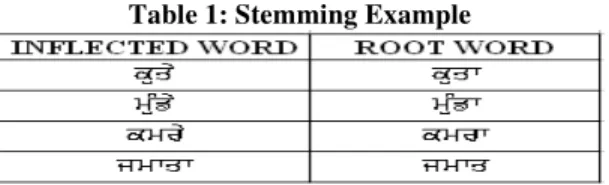
1.1 Stemming: Stemming is well known technique in information retrieval system to improve the ability to match query and document vocabulary. Stemming is used to find the root word from an inflected word. It cut the inflection from the word and we will get the root word. Stemming is used in various languages. All the languages like English, Hindi, Marathi, Nepali, Bengali uses stemming in their information retrieval systems. Stemming is done to improve the efficiency of various search engines to get the result. Stemming has also been applied to text classifications. Stemming is an attempt to make the Search engines more effective in information retrieval. For grammatical reasons, documents are going to use different forms of a word, such as table, tables. In many situations, it seems as if it would be useful for a search for one of these words to return documents that contain another word in the set. Stemming makes group of derivationally related words with similar meanings represented single meaning. The first paper on the stemmer was published in 1968.It was written by Julie Beth Lovins [1]. A later stemmer was written by Martin Porter and was published in the July 1980 issue of the journal Program [2].E.g. table 1 shows the stemming examples.
Table 1: Stemming Example Dinesh Kumar
Assistant Prof. & Head Department of Information Technology
DAVIET, Jalandhar
Prince Rana
Student – M.Tech Department of Computer Science
DAVIET, Jalandhar
1.2 Stemmer: Stemmer is a system in which we are giving the input as an inflected word and get the output in the form of root word. The inflected word may be singular, plural or containing some other affixes. The root word is the correct word which has some dictionary meaning. Stemmer is used by various languages.
1.3 Stemming Algorithms: Stemming Algorithmis a technique which is used by stemmer. There are various stemming techniques which depends on the application where stemmer to be used. These algorithms contains pattern matching algorithm, stochastic algorithms, hybrid algorithm, porter stemming algorithm, dictionary based algorithm, rule based algorithms, corpus base algorithm, n-gram techniques etc. These stemming algorithms are used by different languages and they have differed in accuracy and effectiveness. A basic characteristic of stemming algorithm is whether it is context-free or context sensitive.Context-free Stemming Algorithm is those where no restriction is placed on the removal of a suffix and if any ending matches with then the matched ending is stripped. Context sensitive algorithms are those where various restrictions are placed when we are removing the suffix of the word. [4] These algorithms have to construct some dictionary set and some rules for the removal of suffixes from the words. Dictionary tells us whether the word is present or not and rules tells us which suffix to be removed and how. One of the widely used context sensitive rule based stemmer is that of Porter Stemmer. However by applying these techniques we will get the maximum accuracy and speed.
2. OVERVIEW OF PUNJABI
The name Gurmukhi is derived from the Old Punjabi term "gurumukhi", literally meaning "from the mouth of the Guru". The Gurmukhi script is derived from the Later Sharada script and was standardized by the second Sikh guru, Guru Angad Dev, in the 16th century for writing the Punjabi language. The whole of the Guru Granth Sahib's 1430 pages are written in this script. Gurmukhi is a system of writing called an abugida, where each consonant has an inherent vowel that can be changed using vowel signs. Modern Gurmukhi has forty-one consonants (ivAMjn), nine vowel symbols (lgw mwqrw), two symbols for nasal sounds (ivMdI and il~pI), and one symbol which duplicates the sound of any consonant (A~dk). In addition, four conjuncts are used: three subjoined forms of the consonants rwrw, hwhw and vvw, and one half-form of jjw. Use of the conjunct forms of
vwvw and jwjw is increasingly scarce in modern contexts. Like most of the North Indian writing systems, the Gurmukhi script is a descendant of the Brahmi script. The traditional accounts, such as the references found in the Janamsakhi literature, say that the Gurmukhi script was invented by the second Sikh Guru, Guru Angad Dev. Gurus adopted the Proto-Gurmukhi script to write the Guru Granth Sahib, the religious scriptures of the Sikhs. Other contemporary scripts used in the Punjab were Takri and the Laṇḍā alphabets. Also Takri was a script that developed through the Devasesha stage of the Sharada script, and is found mainly in the Hill States, such as Chamba, where it is called Chambyali and in Jammu, where it is known as Dogri. Later in the 20th century, the script was given the authority as the official script of the Eastern Punjabi language. Meanwhile, in Western Punjab a form of the Urdu script, known as Shahmukhi is still in use. The word Gurmukhi is commonly translated as "from the Mouth of the Guru". However, the term used for the Punjabi script has somewhat different connotations. The opinion given by traditional scholars is that as the Sikh holy writings, before they were scribed, were uttered by the Gurus, they came to be known as Gurmukhi or the "Utterance of the Guru". And consequently, the script that was used for scribing the utterance was also given the same name. However, the prevalent view among Punjabi linguists is that as in the early stages the Gurmukhi letters were primarily used by Gurmukhs, or the Sikhs devoted to the Guru, the script came to be associated with them. Another view is that as the Gurmukhs, in accordance with the Sikh belief, used to meditate on the letters ਵ, ਹ, ਗ, ਰ which jointly form Wahiguru or God in Sikhism, these letters were called Gurmukhi or the "speech of the Gurmukhs". Subsequently, the whole script came to be known as Gurmukhi. [16]. Table 2 shows the list of various characters used in Punjabi language.
3. AVAILABLE STEMMING TECHNIQUES
Many theories and experiments have been developed to evaluate the efficiency and the stability of the stemming process in information retrieval. There are several techniques used for word stemming, developed within the time. The first approach was Dictionary-Based approach then Corpus-Based Technique and then the rule based techniques.
3.1 Dictionary-Based Technique
Historically, stemmers have often been thought of as either dictionary-based or algorithmic. In the Dictionary-based stemmers it matches every word with a word on a proper digitalized dictionary, correspond each word to its stem. This method seems to be effective but inadequate to deal with unlimited words and their formation. This was the main reason that led him to evaluate algorithmic stemmers and conclude that “despite the errors they can be seen to make, they still give good practical results”. Dictionary-based stemmers require dictionary maintenance, to keep up with an ever-changing language, and this is actually quite a problem. It is not only that a dictionary created to assist stemming nowadays will probably require major updating in a few years time, but also that a dictionary in use for this purpose today. [15]
3.2 Rule-Based Technique
This is the widest applied stemming technique, with most representative the algorithm introduced by Porter (1980). With specific rules for the English language, this algorithm removes iteratively suffixes from a given word, reducing it on its stem. Even if the algorithm has its limitations, it is the most commonly accepted for its high precision and recall. Lovin’s stemmer (1968) follows the same rule-based technique but it does not apply its rules iteratively and it is more conservative than Porter’s algorithm. On this path Paice & Husk (1990) have also worked introducing one more English stemmer with different rules. For Scandinavian languages we have also based stemmers presented on 2001. Finally, applying the same philosophy, there are implemented rule-based stemmers for Romance languages (English, French, Spanish, Portuguese, Italian), Germanic Languages (German, Dutch), Scandinavian Languages (Swedish, Norwegian, Danish), Other Languages like Russian [15]
3.3 Light-Stemming Technique
Today there are plenty of rule-based algorithms and stemmers, developed for various languages. Most of the times, for each of them, a different algorithm is used to reach higher precision in the results. So lately we have light-stemmers, referred to the process of stripping off a small set of prefixes and/or suffixes without trying to deal with infixes or recognize patterns and find roots. [15]
3.4 Corpus-Based Technique
An algorithmic stemmer uses lists of words either for suffix removal or exclusion. The more advanced is the algorithm the longer are these lists. On the other hand, a dictionary-based stemmer needs to remove some basic suffixes before starts the look-up process in the extended dictionary. Trying to improve the effectiveness of these stemmers we are driven to the rule-based technique. This hybrid perspective was applied in many stemming algorithms. The hypothesis of that work is that the word forms that should be conflated will co-occur in documents from the corpus. Corpus-based stemming was found to provide moderate improvement over existing rule-based stemmers. [15]
3.5 Lovins Stemmer
The lovin stemmer is a single pass stemmer, context sensitive and longest match stemmer. Lovins stemmer maintains a list of most frequent suffixes, 250 in number and removes the longest suffix ensuring that the stem is at least three characters long. It is unreliable and frequently fails to produce the correct stem. [6]
3.6 Porter Stemmer
This is the conflation stemmer. This was designed for English language. This is made up of a combination of smaller and simpler suffixes. It has 5 steps applying rules with each step. If any suffix rule matches the word, then the condition attach to it are tested and stem is obtained by removing the suffix. It is mostly used stemmer. [6]
3.7 Dawson Stemmer
This stemmer is based on the Lovins stemmer. It extends the suffix list to 1200 suffixes. It keeps the longest match and single pass of Lovins stemmer.
3.8 Krovertz Stemmer
4. PROPOSED STEMMING TECHNIQUE
4.1 Brute Force Algorithms
The term brute force is the concept of artificial intelligence research and problem solving concept in mathematics denoted as brute force search. Brute force stemmers employ a lookup table which contains relations between root forms and inflected forms. To stem a word, the table is queried to find a matching inflection. If a matching inflection is found, the associated root form is returned. Brute force approaches are criticized for their general lack of elegance in that no algorithm is applied that would more quickly converge on a solution. In other words, there are more operations performed during the search than should be necessary. The algorithm is only accurate to the extent that the inflected form already exists in the database. Given the number of words in a given language, like English, it is unrealistic to expect that all word forms can be captured and manually recorded by human action alone. Manual training of the algorithm is overly time-intensive and the ratio between the effort and the increase in accuracy is marginal at best. Brute force algorithms do overcome some of the challenges faced by the other approaches. Brute force algorithms are initially very difficult to design given the immense amount of relations that must be initially stored to produce an acceptable level of accuracy. However, brute force algorithms are easy to improve in that decreasing the stemming error is only a matter of adding more relations to the table. Someone with only a minor experience in linguistics is capable of improving the algorithm, unlike the suffix stripping approaches which require a good knowledge. This term is also same as pattern matching algorithm in which word is matched word by word. The result depends on the matching of word.
4.2 Suffix Stripping Algorithms
Suffix stripping algorithms do not rely on a lookup table that consists of inflected forms and root form relations. Instead, a typically smaller list of “rules” is stored which provide a path for the algorithm, given an input word form, to find its root form. Some examples of the rules include:
If the word ends in ' w ', remove the ' w '. If the word ends in ' W ', remove the ' W '. If the word ends in 'IAw', remove the ' IAw '.
Suffix stripping approaches enjoy the benefit of being much simpler to maintain than brute force algorithms, assuming the maintainer is sufficiently knowledgeable in the challenges of linguistics and morphology and encoding suffix stripping rules. Suffix stripping algorithms are sometimes regarded as crude given the poor performance when dealing with exceptional relations (like 'dosq' and 'dosqI’).
5. DATABASE REPRESENTATION
We have created a database of Punjabi words. We have created a database of 52000 words. In which we have covered the words from various fields. We have added words in database from Punjabi newspapers, dictionaries and from various Punjabi articles. We tried to cover all the words that are regularly used. To collect the data we have referred different sites like
www.punjabionlinedictionary.com www.ajitjalandhar.com
www.shurli.com
http://forum.desicomments.com Pardeep Punjabi to English Dictionary Ajit Newspaper
Jag Bani Newspaper
6. WORKING OF PUNJABI STEMMER
on stemmer we faces number of problem. Here word causes over-stem and under-stem when they are tested. Therefore we will check these words and created a list of these words that can cause over-stemming and under-stemming. We will remove these errors by entering these words into our database. Therefore by finding those words we have maximize the performance of our stemmer. Because when we find these words in the database it will not cause any problem. We have worked on three parts. In the input part we have to give an input. The input is in the form of any Punjabi word. We are also providing a Punjabi keyboard on the screen. Punjabi keyboard is beneficial for new users. We have number of control present on the screen. In theProcessing part the processing will be done on the base of input entered. Here the input is processed through the database else by the suffixes present in the list. If the word is not present in the list then it will go to suffix stripping and give us the probable answer. In the last output part it will show us the desired output as per our input. The processing of the inflected word for stemming is done in number of steps. The steps are shown below. The inflected word is entered as an input .The word is searched by the technique of brute force searching. Brute force search try to match the input word with the number of words present in the list. If the matching word is found then it will give the output as a root word. If the match not found then it look for the list of suffixes. It removes the matching suffix from the end of the word.
7. EXPERIMENTAL RESULTS
For evaluating the proposed stemmer following parameters are used:
7.1 Correctness
Correctness of a stemmer depends on the word present in the look up table. We have entered 52000 words in our lookup table therefore it reduces the chances of going to the second option of suffix stripping. Bigger database causes more correctness.
7.2 Effectiveness
Effectiveness of the stemmer depends on the behavior of the system. Behavior means what stemmer will do whenever an abnormal condition occur. Abnormal condition means whenever somebody tries to enter a word which does not exists. Our stemmer is very effective if anybody tries to enter a word that does not exists it just shows that word in the output box. Our stemmer effectively adjusts in different type of environment. Over-stemming and under-Over-stemming problem are also controlled in the stemmer. These errors are more whenever we are using suffix removal technique. By using brute force technique we have controlled these errors. If the word found in the database then there is no chance of these errors to occur.
7.3 Performance
Performance of stemmer will be high if the result is positive. The conflation class of stemmer is 4.Here in the above calculation it shows that we have 52000 words entered in the list and 14400 words are root type words we can calculate mean number of words by dividing the number of unique words with the number of unique stem after stemming.
MWC=Mean Number of Words. WC is given by the following equation. MWC = N/S --- (1) N=Number of unique words before stemming S=Number of unique stem after stemming
In our stemmer number of unique word before stemming are 52000 and the number of unique words after stemming are 12700. By substituting these values in equation no 1 we get
MWC=52000/12700 MWC=4.09
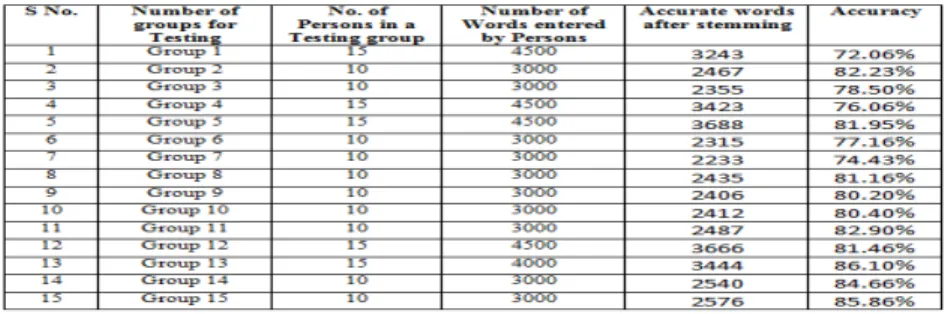
We have tested our stemmer with the help of ten groups of persons. Results are shown in Table 3.
Table 3 Experimental Results
7.4 Mean removal rate
Mean Removal Rate is measured by calculating the number of suffixes attached with any word. e.g. if a word in Punjabi like muMfw is used the various variations for muMfw is muMfy, muMfIAw. muMfIAw have three suffixes at end, muMfy have one and muMfw itself has no suffix therefore total number of suffixes are 3.
Table 4 Suffixes present with word
Mean Removal Rate=Sum of all the suffixes/Number of suffixes Mean Removal rate for word ask is=0+1+3/3 =1.33
7.5 Over-stemming and under-stemming
Over-Stemming and Under-Stemming are the two error measurements in stemming algorithms. Over-stemming is an error where two separate inflected words are stemmed to the same root. Over-stemming occurs when words that are not morphological variants are conflated. Under-stemming is an error where two separate inflected words should be stemmed to the same root. Under-stemming occurs when words that are indeed morphological variants are not conflated. We have created a list of Punjabi words in which these over and under stemming error come if we are using a suffix stripping approach. The list of words contains approximately 200 words. We are minimizing these errors by entering these 200 words with a best solution in the database. We have shown the list of words in Table 5.
Table 5 List of some words (Over-stemming and Under-stemming errors)
8. COMPARISON WITH OTHER STEMMERS
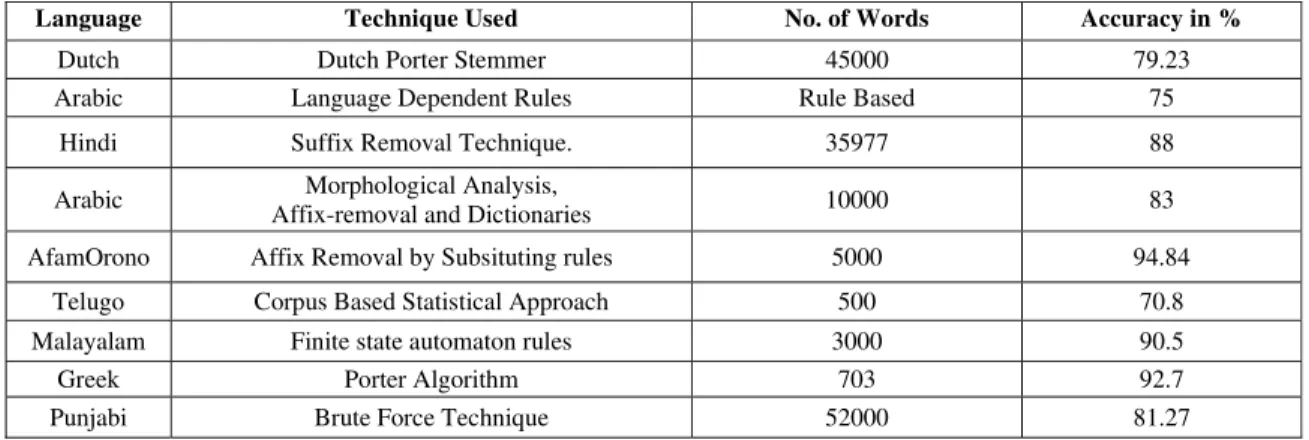
Table 6 Stemmer Comparison
Language Technique Used No. of Words Accuracy in %
Dutch Dutch Porter Stemmer 45000 79.23
Arabic Language Dependent Rules Rule Based 75
Hindi Suffix Removal Technique. 35977 88
Arabic Morphological Analysis,
Affix-removal and Dictionaries 10000 83
AfamOrono Affix Removal by Subsituting rules 5000 94.84
Telugo Corpus Based Statistical Approach 500 70.8
Malayalam Finite state automaton rules 3000 90.5
Greek Porter Algorithm 703 92.7
Punjabi Brute Force Technique 52000 81.27
We can measure accuracy very well whenever we are working on the database of words. When we are using rule base strategies and suffix stripping approaches then we will measure the accuracy in terms of over-stemming and under-over-stemming errors. Suffix stripping approaches also gives accuracy whenever we are entering a countable amount of words.
9. CONCLUSION AND FUTURE SCOPE
Our stemmer works for Punjabi and this is a simplified version of stemmer. Brute force technique requires no preprocessing of text before stemming a word. It basically emphasizes on brute force techniques. Brute force technique emphasis on the word to be found in the database. There is a very little influence of suffix stripping algorithm in our stemmer. There is a problem of over-stemming and under-stemming comes under suffix stripping approach. We can also do suffix substitution with suffix stripping to avoid the problem of over-stemming and under-over-stemming. We have tested our system by creating groups of person. In which we have created 10 to 15 people in a group. Each group has different number of words to test. They tested their words and each group have calculates different accuracy. Here the accuracy depends on the accurate words to be stemmed. Some groups find out the simple words and other finds out the complex words to stem, therefore their accuracy differs. Our recommendation about this is that we have created a big database. It consumes lot of time. Accuracy depends on the size of the database. More words more accuracy. Big database also requires huge amount of storage capacity. Future scope of our research work is that we can create stemmer for Punjabi by using some other stemming algorithm. We can also increase the accuracy of stemmer by maximizing size of database. We can also compare the accuracy of our stemmer with other stemmers.
REFERENCES
[1] David A Hull Gregory Grefenstette (1996)” A Detailed Analysis of English Stemming Algorithms “Rank Xerox research Centre 6 chemin day mauperutis, 38240 Melyanfrance,pp 1-16.
[2] Julie Beth Lovins, (1968)”Development of a Stemming Algorithm*”Mechanical Translation and Computational Linguistics, Vol No.11, Issue No.1, pp 22-31.
[3] Ananthakrishnan Ramanathan and Durgesh D Rao(2003) “A Lightweight Stemmer for Hindi” In Proceedings of the 10th Conference of the European Chapter of the Association for Computational Linguistics (EACL), on Computatinal Linguistics for South Asian Languages (Budapest, Apr.) Workshop,pp 42-48.
[4] Debela Tesfaye and Ermias Abebe (2010) ” Designing a Rule Based Stemmer for Afaan Oromo Text” Iinternational Journal of Computer Linguistics, Vol. No.1, Issue No.2 , pp 1-11.
[5] Tanja Gaustad and Goose Bauma (2000)”Accurate Stemming of Dutch for Text Classification” Language Computing. Vol No.45, Issue No. 1, pp 104-117.
[6] M. Santosh Kumar and Kavi Narayana (2006)“Corpus Based Statistical approaches for stemming telugo” Journal of quantative linguistic, Vol. No.16, Issue No.1 ,pp 130-133.
[7] Tuomo Korenius, Jorma Laurikkala, Kalervo Järvelin, Martti Juhola (2009) “Stemming and Lemmatization in the Clustering of Finnish Text Documents”Proceedings of 13th
ACM international conference on information and knowledge management Vol. No. 45,Issue No. 6, pp 714-723.
[8] Eiman Tamah Al-Shammari (2008)”KTOWARDS AN ERROR-FREE STEMMING” URL: www.iadis.net/dl/final_uploads/200812R027.pdf, pp 160-163.
[9] Payas Gupta (2006)”Stemmer for Indo-Aryan Languages: A survey” URL: www.mysmu.edu/phdis2008/payas.gupta.2008/papers/IS701.pdf.
[10] Lily Suryana Indradjaja and Stephane Bressan (2003)”Automatic Learning of Stemming Rules for the Indonesian Language”In the Proceedings of the 17th Pacific Asia Conference, pp 62-68.
[11] Vijay Sundar Ram R, Pattabhi R K Rao T and Sobha Lalitha Devi(2010) “Malayalam Stemmer “in Computational Linguistics Research Group Vol No. 14, issue No. 3, pp 130-137.
[12] Mudassar M. Majgaonker and Tanveer J Siddiqui (2010) “Discovering suffixes: A Case Study for MarathiLanguage” (IJCSE) International Journal on Computer Science and Engineering Vol. No. 02, Issue No. 08, pp 2716-2720.
[14] Abduelbaset M. GOoweder, Husien A. Alhammi , Tarik Rashed,and Abdulsalam Musrati “ A Hybrid Method for Stemming Arabic Text ” Journal of computer Science,URL:http://eref.uqu.edu.sa/files/eref2/folder6/f181.pdf.
[15] Georgios Ntais (2006)”Development of a Stemmer for the Greek Language”Department of Computer and Systems SciencesMaster Thesis at Stockholm University / Royal Institute of Technology, pp1-40.