193 M a r ia H e le n a M a ia a n d Ale x a n dr a Ca r doso
CEAA | Cent r o de Est udos Arnaldo Araúj o
Escola Superior Art íst ica do Port o, ( ESAP) Port ugal
Abst r a ct
The Port uguese delegat ion at CI AM X present ed a proposal for a rural com m unit y. This w as an innovat ive at t it ude t hat r eflect ed t he r approch em ent t o vernacular archit ect ure. The sam e appr oach t hat is present in t he surv ey t o folk ar chit ect ur e, car ried out in t he 50s by som e of t h e Port uguese m odern archit ect s.
This paper focuses on t he charact erist ics of t h e Port uguese proposal on Drubr ovnick in 1956 and w hat it r epr esent ed in t erm s of nat ion al and int ernat ional archit ect ural cult ur e.
St art ing from coev al docum ent at ion – let t ers, dr aw ings, r eport s, not es and ot her m anuscript s – it w as int end t o re- read t h e choice of t he Port uguese t eam in it s art iculat ion w it h t he ru ral w orld. This choice r epr esent s an innovat iv e cont ribut ion t hat com bine m ult iple appr oaches, w hich going t hrough ant hropology culm inat e in t he archit ect ure.
On t he one hand, it is im port ant t o deepen insight of t he level of r elat ionship of t his proj ect w it h t he Arnaldo Araúj o's CODA ( Cont est for Obt aining t he Diplom a of Archit ect u re) . On t he ot her hand is im port ant t o explor e conn ect ion s w it h t he urban int erv ent ions t hat w er e running on t he count ryside.
Ke y w or ds: CI AM 10; CI AM Port o; Vernacular; Rural Habit at ; New Regionalism
Por t u gu e se s in CI AM
194
t im e, Viana de Lim a w as inv it ed by S. Giedion and JL Sert t o be t he CI AM’s Port uguese delegat e.
This is precisely t he dat e t hat t he ODAM1, a group of m odern archit ect s, exist ing since 1947 in Oport o, j oins t he CI AM. As a consequence, in 1952 t he ‘ODAM’s proj ect for a new st at us2
The set t ling in Oport o of all archit ect s of t he Port uguese group gave it s nam e - CI AM Port o - , despit e not hav ing ex ist ed no ot her group in t he count ry. Though, t here w as an int ent ion t o form " w it h m odern archit ect s from around t he count ry, a unique nat ional group, w it h t he sam e obj ect ives and purposes" and " est ablish t he m ost convenient liaison w it h CI AM"
’ w as draw n up, in w hich archit ect s and archit ect ure st udent s, w ho w ere adm it t ed, should be t ot ally int egrat ed “ in t he obj ect ives and purposes of t he organizat ion and t ake t he responsibilit ies t hat are required also as m em bers of CI AM” . I n addit ion, anot her ODAM’s int ent ion w as “ Prom ot ing t he values in w hich Modern Archit ect ure and Urbanism m ust be est ablished t hat have been form ulat ed by CI AM and st ruggle for it s adopt ion” , w hich show s t he dependence of ODAM relat ing t o CI AM and som e overlapping obj ect ives bet w een ODAM and CI AM Port uguese delegat ion.
3
Upon it s form at ion, CI AM Port o w ill be act ively involved bot h at CI AM Council Meet ings and t he lat t er 3 CI AM congresses t hat follow ed
, aspire w hich did not happen.
4
aft er it s accept ance, CI AM Port o, st ill “ in organizat ion” , leaves Port ugal for t he first t im e t o at t end t he CI AM Council Meet ing held in Sigt una, ( Sw eden) , relat ed t o t he preparat ory w ork of CI AM 9, around t he definit ion of Habit at as w ell as it s
.A year
1
Organização dos Arquitectos Modernos [Organization of Modern Architects]. Upon its entry to the CIAM, the intention was to change the initial designation to the Organization for the Defense of a Modern Architecture, maintaining the original acronym, ODAM. Vd handwritten note on the document ODAM -Projecto para um novo estatuto. Typewritten document, 18/XI/1952. CEAA Archive
2
ODAM -Projecto para um novo estatuto. Typewritten document, 18/XI/1952. CEAA Archive
3
ODAM -Projecto para um novo estatuto. Typewritten document, 18/XI/1952. CEAA Archive
4
195 guiding pr inciples and form of represent at ion, w it h t he aim of draw ing up a Chart er. Fost ering t his debat e, t he Port uguese group present s a proposal of
int ent , draft ed under Viana de Lim a’s responsibilit y and guidance5
The st art ing point w as t o est ablish a " m et hod of analysis" , w it h full im plem ent at ion of each part icular case and w it h reference t o each nat ional group. Considerat ions draw n from t he case st udies in different count ries of t he w orld w ould prov ide to achieve com m on obj ect ives t o define t he Chart er of Habit at, t hus cont r ibut ing t o accom plish t he “ desired universal scale”
, w hich focuses on t w o m ain aspect s: ( 1) " Analysis of Habit at ’s funct ions " and ( 2) " Suggest ion for a Gr id" .
6
Follow ing t his proposal, Viana de Lim a hav e been inv it ed t o be part of one of t he t w o preparat ory com m issions of CI AM 9, est ablished t o define t he “ Habit at Gr id” , t oget her w it h Eccochard, Forbat , Hovens Greve and Tyrw hit t and chaired by Bodiansky
.
7
I n ‘Housing Consider at ions’ .
8
I n t he follow ing m eet ings, t he Port uguese group led by Viana de Lim a, w ill present not only successive input s t o t he Chart er of Habit at but also som e , CI AM Port o suggest s t hat t he Chart er of Habit at should pursue " on our social realit ies, on t he urgent needs of our populat ion, w it h t he purpose t o aw aken in all w ho are responsible t he desir e of housing for everyone." Consequent ly t he not ion of m inim um scale ar ises: t he obj ect ives, t he concept s, t he analysis but forem ost " t he desire t o see t he 'Chart er of Habit at ' not a form of t echno- aest het ic- philosophical direct ives, but above all a chart er of right s t o det erm ine t he m inim um housing condit ions applicable t o all count r ies" , are now depending on t hat scale.
5
Pr esent at ion of t he Por t uguese pr oposal at CI AM Council Meet ing, Sigt una, Sweden. Viana de Lim a Typewr it t en docum ent . CEAA Ar chive
6
CI AM X/ Rappor t du Gr oupe CI AM por t ugais à la Réunion CI RPAC du 4 Julliet 1955. Typewr it t en docum ent . CEAA Ar chive
7 The ot her com m ission est ablished t o define Habit at , chair ed by Wogensky , consist ed of Alaur ant ,
Ahr én, van Eest er en, Em er y, van Eyck, Laur it zen and Rot h . CEAA Ar chive
8 Considér at ions sur le logem ent . Typewr it t en docum ent of Por t uguese CI AM gr oup, undat ed.
196
approaches t o t he Grille CI AM d’Urbanism e, over w hich recognizes qualit y but also som e r igidit y t hat w ould need t o be sm oot hed.
Moreover, t he discussion about t he const raint s of t he Grille CI AM w ould be also addressed w it hin t he ODAM, w hich used an im proved version, from t he point of view of t heir aut hors, in t he group exhibit ion held in Oport o precisely in 19529
The applicat ion of t he Grille as a reasonable t ool in t he analysis of t he cit y, div ided by t he At hens Chart er’s four funct ions, w as a lively debat e t hat w ent far beyond t he CI AM 9.
.
The Port uguese CI AM group reaffirm ed t heir proposals t o adapt t his w ork ing t ool in addressing issues of urbanism and habit at10, against t he new solut ion w idespread by Team 1011, w hich proposed a m ore synt het ic approach, now considering each problem as an ent it y , and t hus in t ot al rupt ure w it h t he ancient analyt ical m et hod, expressed by t he Grille CI AM. I n relat ion t o t his solut ion, w hich CI AM Port o accept ed losers, but w it hout m uch convict ion12
9
Oct ávio Lixa FI LGUEI RAS, Adit am ent o à Gr ille C.I .A.M. d’ Ur banism e, paper pr esent ed in XXI V Congr esso Luso- Espanhol par a o Pr ogr esso das Ciências. Madr id: Novem ber 1958, p.10. Typewr it t en docum ent . CEAA Ar chive
, st ressed t he fact t hat not seem s feasible, " t he analysis of Habit at , according t o t he schem e
10
For t he Habit at funct ions init ially defined - Healt h, Act ivit y and Thought - it was pr oposed by CI AM Por t o anot her new one, ent it led Affect ivit y. CI AM X / Gr oupe CI AM Por t uguais / Réunion CI RPAC du 4 Julliet 1955 / Rappor t sur le schem e de Gr illes proposées. Typewr it t en docum ent . CEAA Ar chive
11 Designat ion t hat CI AM X Com m it ee, com posed init ially Bakem a, Sm it hson, Candilis and Gut m an
cam e t o adopt dur ing t he pr epar at ion of t he congr ess. This init ial group, incor por at ed new elem ent s, and ended up get t ing quit e wider and whose act ivit y was far beyond t hat for which it was or iginally cr eat ed.
12
197 proposed by Team 10 [ ...] because it does not form a st ruct ure of proposit ions t hrough a careful analysis."13
One can recall t hat in t he Report present ed t o t he CI RPAC14 m eet ing of July 4, 1955, t he Port uguese group openly expressed his disagreem ent w it h t he direct ion follow ed by Team 10, even com plaining t hat t heir proposals w ere never considered. At t hat t im e, and in a last at t em pt , t hey propose a solut ion w hich brings t oget her t he guidelines present ed at t he Paris Council m eet ing, in 1954, w it h t hose now under discussion for t he CI AM 10 Congress15
One hypot hesis could be raised: since t he Team 10’s proposals w ere focused in ident it y and com m unit y issues w it h great em phasis on hum an relat ions, m aybe t hey can som ehow have rem oved t he ‘securit y blanket ’ from a w hole “ est ablished” process of reading and doing cit y, root ed in a funct ionalist approach.
.
So far, t he analysis of each of t he four funct ions w as underst ood as t ot ally w it hin it self, w it hout allow ing ot her relat ionships t han t hose est ablished by t he plot of t he Grille d'Urbanism16
The Port o Port uguese group also t ook part in t he choice of venue and dat e of t he CI AM X. When it w as recognized t hat t his could not be held in Algiers, an at t em pt w as m ade t o hold t his congress in Port ugal in Braga cit y. For t his, CI AM Port o got t he official support of t he governm ent , specifically by t he Minist er of Public Works of t he Salazar governm ent
.
17
13
CI AM X / Rappor t dui Gr oupe CI AM por t uguais à la Réunion CI RPAC du 4 Juillet 1955. Typewr it t en docum ent , 29- 06- 55. CEAA Ar chive
.
14 Com it é I nt er nat ional pour la Résolut ion des Pr oblèm es de l’Ar chit ect ure Cont em por aine
[ I nt er nat ional Com m it t ee for t he Resolut ion of Pr oblem s in Cont em por ar y Ar chit ect ur e] .
15
CI AM X / Rappor t dui Gr oupe CI AM por t uguais à la Réunion CI RPAC du 4 Juillet 1955. Typewr it t en docum ent , 29- 06- 55. CEAA Ar chive
16
We t hought t he Por t uguese t eam was awar e of t he lim it at ions of t he Gr ille CI AM d’ Ur banism , as can be seen fr om t he obser vat ion by O.L. Filgueir as: " t hat which r efer s t o t he or ganizat ion of life escapes t hr ough t he m eshes of t he four funct ions - and is, in fact , bey ond t he scope of an analyt ical t hought " ( Oct ávio Lixa Filgueir as, Adit am ent o à Grille C.I .A.M. d’ Ur banism e, paper pr esent ed t o XXI V Congr esso Luso- Espanhol par a o Pr ogresso das Ciências. Madr id: Novem ber 1958, p.10. Typewr it t en docum ent . CEAA Ar chives
17 Vd. Mem or andum , July, 1 8, 1955. Typewr it en docum ent . Handwr it t en: “ Ass. Távor a / Viana de
198
This at t em pt t urned out t o be inconsequent ial because t he Yugoslav group had first subm it t ed t he proposal for t he m eet ing be held in Dubrovnik, w hich effect ively has happened.
The only consequence of t he Port uguese proposal w as t he post ponem ent of it for one year lat er. This is because, t he preparat ion of t he m eet ing w as t ransform ed int o a field of discussion, crit ique and disrupt ion ar ising from w hat som e perceived t o be t he lack of CI AM 9 result s, t o launch a Chart er of Habit at and t he inadequacy of analyt ical m et hods addressing t he problem s of t he post w ar cit y .
I t should also be not ed t hat t he dynam ism show n by CI AM Port o in int ernat ional m eet ings, had no par allel in t he nat ional cont ext .
As already m ent ioned, t he CI AM group ended up confined t o Oport o, w here quick ly absorbed t he ODAM group18.There w ere periods of som e int ernal disagreem ent , as reflect ed in t he group m eet ings’ m inut es w hich result ed in changes, am ong ot hers, of it s init ial const it ut ion19. Moreover, t he m om ent t hat CI AM Port o w as creat ed precisely corresponded w it h t he beginning of t he discussions t hat w ill lead t o int ernal cleavage and cont est at ion w it hin t he int ernat ional CI AM. This process has sufficient ly already st udied t o abst ain from developing it in t his paper ( vd. E.P. MUMFORD, 2002) .
Pr e pa r in g CI AM X
As is w ell know n, t he CI AM 10 result ed in adopt ing t he TEAM 10 proposals, inst ruct ed by CI RPAC t o prepare “ t he program , t he st andards of present at ion and t he m et hod of w ork” 20
18 To t he r eplacem ent of t he ODAM gr oup by t he CI AM Por t o, it was alr eady called at t ent ion by P.
Vieir a de Alm eida e M.H. Maia ( 1986) e P. Vieir a de Alm eida ( 1996) . Lat er , Alexandr a Tr evisan ( 2013) will specify t hat t he r eplacem ent will not have been im m ediat e, and t he t wo gr oups coexist ed unt il 1953. Towar ds a bet t er under st anding of t he r elat ionship bet ween t he t wo gr oups see Alexandr a Tr evisan ( 2 013).
, and “ all of t hem agreed t o work as a group and
19 The st udy of t he Minut es of t he CI AM Por t o m eet ings in it s m ult iple im plicat ions is cur r ent ly
under way in t he CEAA.
20 CI AM/ Par is, June 30t h, 1954. CI AM Council Meet ing m inut e. Typewr it t en docum ent . CEAA
199 m eet as frequent ly as necessary, m aint aining close cont act w it h an Adv isory Group” 21
On t he w ay, t he idea of get t ing a Chart er of Habit at w as lost .
. I t is also w ell know n t hat t hese proposals const it ut e a split in relat ion t o previous congresses and reflect t he crit ical rev iew of t he At hens Chart er doct rine, st art ed w it h Doorn’s m anifest in 1954.
How ever, t he t hem e of Habit at rem ains on CI AM 10, but now w it h t he sub t it le: 'Problem of I nt er- Relat ionships: First CI AM proposals – St at em ent s and Recom m endat ions', w hich refers t o a new t heoret ical universe m ore focused in ident ify ing problem s and solut ions at differ ent scales, rat her t han concern for t he est ablishm ent of univ ersal pr inciples.
From Team 10’s point of view , t he st udy of hum an associat ions should be const it ut ed t he aim of urbanism , and also should “ consider every com m unit y as a part icular t ot al com plex” , despit e it s dim ension. This led t o t he ident ificat ion of four fields w ork ing scales: ( 1) cit y, ( 2) t ow n, ( 3) v illage, ( 4) isolat e22
I n t he guidelines sent t o all nat ional gr oups, Team 10 clar ifies t hat it is not int ended t o present “ ent ire proj ect s for villages, t ow ns or cit ies, but j ust proj ect s w it h ideas for [ ideal] habit at , w hich could be int egrat ed w it hin t hose st ruct ures”
.
23
Sim ult aneously, t he m ain relat ionships are defined t o be discussed w it hin each scale of associat ion t o est ablish t he phy sical condit ions of t he habit at : ( 1) housing and it s ext ensions ( 2) old t ype’s houses and it s archit ect ural expression ( 3) height and low buildings ( 4) free vehicles t raffic and pedest rians circulat ion ( 5) regional elem ent s and current m eans of expression ( 6) dayt im e and night -t im e habi-t a-t .
.
21
Consist ing of: J.L.Ser t ( Pr esident ) , S. Giedion ( Gener al Secr et ar y) , Le Cor busier ( Vice-Pr esident ) , W. Gr opius ( Vice- Vice-Pr esident ) and J. Tyr whit t ( Liaison Officer ) ” ( CI AM/ Par is, June 30t h, 1954. Typewr it t en docum ent . CEAA Ar chive
22
St r uct ur al schem e / CI AM X. Guidelines t o t he groups. Typewr it t en docum ent , Decem ber 1954. CEAA Ar chive
23
200
Finally , t hese guidelines cont ained a new m et hod of w ork present at ion, w hich w ant ed t o be synt het ic, in opposit ion t o t he previous analyt ical m et hod, accused of reading t he cit y as a fragm ent .
The proj ect s had t o be condensed int o 4 st andard panels, w it h different levels of t reat m ent : " Panel 1 – The Problem " ; " Panel 2 - General Solut ion" ; " Panel 3 - Det ailed Solut ion" ; " Panel 4 - Cont r ibut ions" .
The graphic docum ent at ion and t he nat ure of inform at ion t hat should be on each panel w ere also predet erm ined.
The Port uguese t eam – consist ing by A. Viana de Lim a, F. Távora and O.L. Filgueiras, w it h t he collaborat ion of 1 engineer ( Napoleão Am orim ) , 2 t rainees archit ect s, ( Arnaldo Araúj o and C. Carvalho Dias) and 1 ESBAP st udent , ( Albert o Neves) – chose t o cont ribut e t o t he v illage w orking scale by proposing t he ‘Plan for a Rural Com m unit y’24
The w ork w ill be present ed in Dubrovnik Modern Art Gallery, in August in Trás- os- Mont es.
25 by t he Port uguese delegat es, Viana de Lim a and Fernando Távora.
Th e Por t u gu e se Pr oj e ct
Regarding t he proj ect s displayed at CI AM 10, five of t hem w ere direct ly relat ed w it h t he rural w or ld, alt hough t heir approaches had been different . I t s aut hors w ere t he Sm it hsons, John Voelcker, Aldo van Eyck, t he Norw egian PAGON ( Progressive Arkit ekt ers Gruppe Oslo Norge) group and t he one present ed by CI AM Port o, ( vd. N. Mot a, 2012) .
The Port uguese t eam , despit e it s declared disagreem ent w it h t he adopt ed grid, responded in a qualified w ay w it h a pr oposal t hat fost ered t he relat ionship bet w een m odern language and feat ures of vernacular t radit ion of t he region.
24
The pr oposal was pr esent ed in Fr ench wit h t he t it le ‘HABI TAT RURAL – Nouv elle Com m unaut é
Agr icole’
25
201 Maybe it w as not j ust a coincidence t hat m ost of t he t eam m em bers w ere at t hat t im e involved in t he Survey on Port uguese Regional Archit ect ure, in part icular zone 1 – Minho and zone 2 – Trás- os- Mont es.
I n fact , it is also not by chance t hat t he village under st udy is locat ed in Trás- os-Mont es. Perhaps t he survey w as m ore developed in t his ar ea, or t he dat a collect ed w as m ore conducive t o t he w ork in quest ion.
I n addit ion, not only t he t eam of Trás- os- Mont es w as especially sensit ive t o ant hropological issues, but also had t he support of t he previous w ork, w hich in t his region cam e t o be developed by Jorge Dias, t he m ost im port ant Port uguese ant hropologist at t hat t im e.
Rio de Onor, com m unit y village, crossed by t he Port uguese- Spanish border, m ade know n by t his ant hropologist ( J. Dias, 1952) , has a large presence in t he Port uguese proposal. The im ages of t his village are dom inant in t he 4 panels t hat w ere displayed, providing a reference on m orphology, im plant at ion, m odes of dw ell and also in building m at er ials. Most of t hem w ere subsequent ly published in Popular Archit ect ure in Port ugal ( 1961) w hich show s t he engagem ent bet w een t his w ork and t he sur vey.
Moreover, it seem s t hat t he proposal has a great freshness in approach t o t he problem , w hen clear ly t he CI AM Port o archit ect s t ake t he rural dim ension of t he count ry.
" Port ugal is st ill a count ry w it h a pr im ar ily agricult ural nat ure ( ...) and t he rural case is, as is com m on t hroughout t he w orld, t he ult im at e concern of t hose w ho are responsible, even ver ify ing t hat t he predom inance of urban over rural is m anifest even in t he field our professional and doct rinal act iv it y” ( Panel 1) .
This aw areness, possibly due t o t he Survey , led t o t he choice of t he region – t he Port uguese nort heast ern - and t he scale of int ervent ion – t he v illage.
202
from urban cent ers, and in w hich cult ural st ruct ures are m ore archaic, finding a t errit or ial m echanism t hat w ill fost er it s relat ionship w it h t he rest of t he count ry.
Figu r e 1 . I m age of t he w hole village. Panel 2
( fragm ent ) CEAA Archive
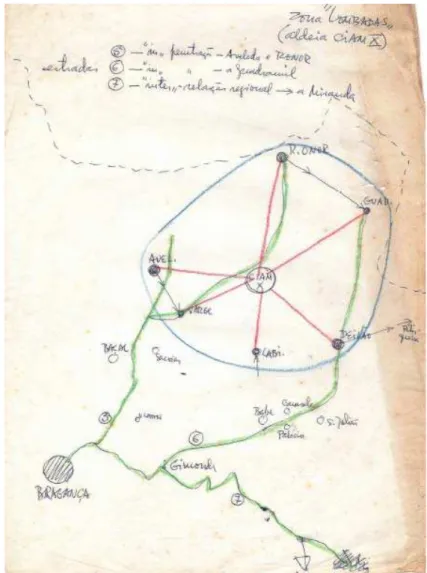
203 Locat ed in t he cent er of a st rat egic area, it w ould act as a st ruct ural pivot bet w een ot her exist ing villages of t he region, and bet w een t hem and t he t ow ns of t he region. I n t urn, t hese w ould connect t o ot her urban cent ers and from t hese t o t he m ain decision cent ers, w hich in t urn are connect ed w it h t he largest cit y – t he Port uguese capit al26
Essent ially, a lit t le schem e is planned, applied in a rem ot e region of t he count ry, a k ind of solut ion t hat connect s local, regional and nat ional scales. Wit h t his new village, t he group draw s a solut ion t hat crosses t he different scales of associat ion proposed by Team 10.
.
Figu r e 2 . CI AM X village schem e. CEAA Ar chive
26 Ther e ar e sever al schem es t hat docum ent t his solut ion. CEAA Ar chive. See also t he C. Car valho
204
According t o t he one of t he aut hor’s t est im ony, t his proposal also presum ed t he renovat ion of t he villages w hich t he new clust er w as associat ed w it h ( C. Carvalho Dias, 2013) . This refers t o t he m easures t hat cam e t o be t aken at t his level by Junt a de Colonização I nt erna ( JCI ) [ I nt ernal Colonizat ion Depart m ent ] ( see MH Maia; I .Mat ias, 2013) .
The new village is locat ed in a valley, on bot h m argins of t he r iv er, as is com m on in t he region. The Civic Cent re t akes t he cent ral part of t he v illage in one side and is connect ed t o t he church, across t he bridge, w hich is on t he opposit e m argin. Also on t he slopes, t he housing unit is locat ed in organic lines, parallel t o t he river pat h, t hus leav ing available t he fert ile land along t he w at er t o fam ily farm s.
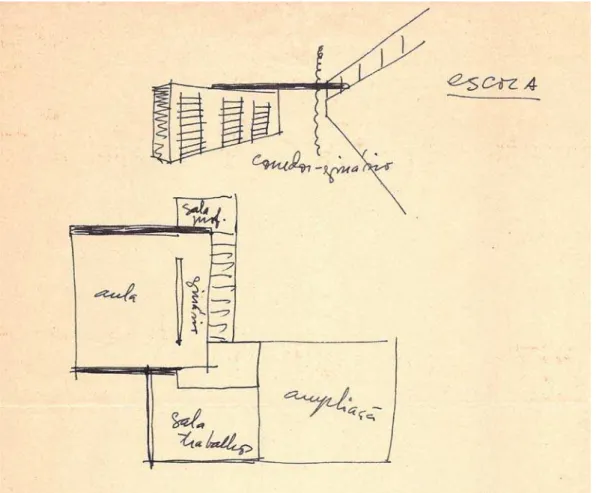
A lit t le furt her aw ay st ands a " cooperat ive group" t hat includes diverse equipm ent for collect ive use, w hich includes t he school, and t he great buildings of agr icult ural product ion.
The plan provides for dw elling an evolut ionary layout w hich group 2, 4 or 6 m odules of houses, int erspersed w it h sm all collect ive st ruct ur es w hich support t hem , giv ing som e breat h t o t he w hole set .
Th e a r ch it e ct u r a l pr oposa l
Alt hough t he inform at ion cont ained in t he panels included only t he part s relat ed t o t he housing t ype solut ion, in t he docum ent at ion t eam exist s a set of docum ent s w hich allow us t o bet t er underst and t he idea of t he village and t he concerns w hich have inspired it s design.
205 I n fact , som e of t hese equipm ent s are designed w it h surpr ising m odernit y in t he Port uguese cont ext of t he t im e.
This is t he case of t he healt h care cent re in w hose st udy concludes t hat , in addit ion t o m edical support , t his w ould also support social care and t he creat ion of a kindergart en. This is clear in env isaging housing for professionals w ho w ere involved: m edical, social w orkers and t eachers.
I n t urn, in t he explanat ions relat ing t o t he Casa del Popolo a v ery r ich program act iv it ies, w it h clear ly urban charact erist ics, are m ent ioned - " cinem a, radio, t elev ision, t heat re, recit als, lect ures, sem inars, [ ...] exhibit ions" - w hich w ould t ake place in a m eet ing room for 200 people, w here also w ould perform t he t radit ional councils of rural com m unit ies in t he region. This equipm ent also includes a library, liv ing room , gam e room , and som e facilit ies.
206
Figu r e 3 . Prim ary school schem e. CEAA Archive
This concern w it h t he possible need t o increase t he building is also present in t he proposal of an evolut ionary t ype of housing, included in panel 3.
Moreover, t he proposed floor plan w as designed t o allow for a w ide range of t ypes of housing t hat could easily grow depending on fam ily needs, by filling som e voids, st rat egically placed for t he purpose. I t is not an archit ect ural process by at t aching new st ruct ures, but t he creat ion of expansion zones in it s int ernal com posit ional st ruct ure.
207 Figu r e 4 . Evolut ionary t ype of housing. Panel 3 ( fragm ent ) .
CEAA Archive
Furt herm ore, it w as envisaged t hat t he houses w ere built “ using local m at er ials w henever possible” and t hat could grow t hrough a process of self- const ruct ion t hat w as sim ult aneously a process of appropriat ion t hat “ w ould allow convert such housing [ - t ype] in his hom e” 27
On t he ot her hand, t here is a clear concern in underst anding t he int ernal st ruct ure of t radit ional housing and m odes of inhabit ing t he region. This led t o t he valuing of t he fireplace as " core of dom est ic life" and t hus as t he focal point of t he house. I n parallel, t his also led t o t he valuing t he role of t he square as t he core " of life in societ y " and cent ral part of t he village.
.
The const ant presence of porches ensures t he areas of t ransit ion- space, " space t hat is neit her inside nor out side and reflect s an ancest ral form of dw elling" ( P. Vieira de Alm eida, 1963, 2010) and prov ides t he form al prox im it y t o som e Rio de Onor’s houses.
The closeness t hat was sought bot h in t erm s of form and funct ional st ruct ure of vernacular housing, did not st op t he focus on it s im provem ent , part icular ly w it h
27
208
regard t o t he int roduct ion of sanit ary facilit ies and a clear separat ion bet w een resident ial areas and t hose t hat w ere int ended for anim als.
This proposal is part of a debat e on rural housing t hat arose at nat ional and int ernat ional level and, in t he Port uguese case led t o t he reinvent ion of rural housing, in w hich div ersified solut ions ranging from adopt ing a clear ly m odernist language t o t he redesign of t radit ional form s.
Pr oposa l’s e ffe ct s
The relat ionships t hat w ere m ore direct ly est ablished w it h t he Port uguese proposal t o CI AM X are relat ed t o I nquérit o à Arquit ect ura Regional Port uguesa ( 1955- 1961) ( Port uguese Regional Archit ect ure Survey) and t o final t hesis degree by Arnaldo Araúj o ( 1957) ent it led Form as do Habit ar Rural – Nort e de Bragança. Cont ribuição para a est rut ura da com unidade ( Form s of rural habit at –
Nort h of Bragança. Cont ribut ion t o t he com m unit y st ruct ure) , m ainly st udied t he first case t han t he second.
I n fact , in his t hesis, Arnaldo Araúj o develops t he assum pt ion t hat t he accom plishm ent of t he program present ed in Dubrovnik could cont ribut e “ t o t he creat ion of a new regionalism ” , t hrough t he " effort in analysis and det ect ion of specific needs of specific populat ions, as w ell as com m it t ed t o local proposals for int ervent ion" . I n addit ion, " t he Port uguese archit ect , w it hout having t o abandon or reduce ( and w it hout being able t o do so) his relat ions w it h t he universal lines ( t echnical and aest het ic) of m odern archit ect ure, should be close t o t he realit ies of his people, t o int erpr et t heir v irt ues and build a root ed Port uguese archit ect ure" ( A. Araúj o, 1957) .
209 Figu r e 5 . Arnaldo Araúj o CODA ( 1957) . CEAA Archive
I n it s resolut ion dat ed from 06.12.1956, t he Minist er of Public Works praised t he w ork of t he Port uguese t eam , specifically Viana Lim a, Távora and Filgueiras and expressed t he Governm ent 's int erest in t his st udy.
210
Unit ed St at es, how ev er recom m ending t he cont act w it h SPN/ SNI28
Finally , t he Minist er inform ed t hat t he Report subm it t ed by t he archit ect s w ould be direct ed t o DGSU [ General Depart m ent of Urban Developm ent Services] t o report on " pract ical course" t hat could result from t heir suggest ions.
for t he lat t er proposal.
Consequent ly, t he Depart m ent 's opinion considers t he w ork as being of nat ional int erest and point s out " t w o possible pr act ical course" - " t he possibilit y of a broader regional planning, or t he part icular case of a village ( in t he sam e region or elsew here) " – giv ing pr ior it y t o t he first hypot hesis.
Alt hough being an unst udied subj ect , it is not ed t hat one year aft er t he proposal t o CI AM X, t he developm ent of a Regional Plan for Trás- os- Mont es29 w as delivered t o t his t eam30
The underlying ent husiasm t o t he DGSU´ s opinion as w ell as t he m anifest int erest of t he Minist er reflect s t he im pact t hat t he Port uguese proj ect had at t he nat ional level.
.
Choosing t ak ing up t he problem s inside t he rural realit y, t he solut ion for a new com m unit y v illage, w hich it w as present ed by t he Port uguese delegat ion in CI AM X, is a st rong exam ple of a dynam ic " planning of non- urban areas" , w it h clear advant ages for regional developm ent and for t he " defence of t heir cult ural herit age and nat ural values relat ed t o it ." 31
We believe t hat t his connect ion w it h t he rural landscape found by t his t eam in t radit ional regional archit ect ure w as influent ial in t he pat hs t rodden by t he Port uguese archit ect ure.
28
The Secr et ariat of Nat ional Pr opaganda ( SPN) was cr eat ed in 1933, and in 1945 was re- nam ed Nat ional Secr et ariat for I nfor m at ion, Tour ism and Popular Cult ur e, m ost com m only known sim ply as t he Nat ional Secr et ariat of I nfor m at ion ( SNI ) . Because of t his, t he depar t m ent is usually r efer r ed t o as t he SPN/ SNI .
29 As can be infer r ed fr om t he t ext of t wo com plem ent ar y cont r act ual docum ent s, dat ed fr om
Oct ober 1957 and Apr il 1958. CEAA Ar chive
30 Specifically Viana de Lim a, Fer nando Távor a and Oct ávio Lixa Filgueir as. 31
211 Ack n ow le dgm e n t s
This w ork w as conduct ed under t he follow ing proj ect s:
Port uguese Part icipat ion in CI AM X ( ESAP/ 2 013/ P06/ SATH) – Secção Aut ónom a de
Teoria e Hist ória ( SATH) [ Aut onom ous Sect ion of Theory and Hist ory] / Cent r o de Est udos Arnaldo Araúj o ( CEAA) [ Arnaldo Araúj o Research Cent er] of Escola Superior Art íst ica do Port o ( ESAP) and as such, funded bot h by t he ESAP budget and by nat ional funds by FCT - Foundat ion for Science and Technology ( PEst - OE/ EAT/ UI 4041/ 2014) under t he Dev elopm en t , Consolidat ion and St rengt hening of Nat ional I D I nst it ut ions Net w ork ( OE)
Sout hern Modernism s ( EXPL/ CPC- HAT/ 0191/ 2013) , funded by nat ional funds t hrough
FCT under Proj ect 3599 - Prom ot ing t he Research Product ion, Technological Dev elopm ent and I nnov at ion.
Re fe r e n ce s
AA.VV. ( 1961) Arquit ect ura Popular em Port ugal. Sindicat o Nacional dos Arquit ect os, Lisboa
Alm eida, P. Vieira de; MAI A, M. H. ( 1986) " As décadas pós- Congr esso – Os anos 50" in
Hist ória da Art e em Port ugal, 14, Arquit ect ura Moderna. Lisboa: Alfa, p. 147- 153
Alm eida, Pedr o Vieira de ( 1963) . Ensaio sobr e algum as Caract eríst icas do Espaço em
Arquit ect ura e Elem ent os que o I nfor m a. C.O.D. A. Port o, ESBAP.
Alm eida, Pedro Vieira de ( 1996) . “ Viana de Lim a” in Viana de Lim a arquit ect o
1913-1991. S.l.: Fundação Caloust e Gulbenkian / Árvor e - Cent r o de Act ividades Art íst icas,
C.R.L. , p. 51- 96
Alm eida, Pedro Vieira de ( 2010) . Dois Parâm et ros de Arquit ect ura Post os em Su rdina. O
Propósit o de Um a I nv est igação. Docum ent o zer o. Port o: CEAA, Edições Caseiras / 14
Araúj o, Arnaldo ( 1957) . Form as do Habit ar Rur al – Nort e de Bragança. Cont ribuição para
a est rut ura da com unidade. C.O.D.A. Port o, ESBAP.
Dias, C. Carvalho ( 2013) . Mem órias de Trás- os- Mont es e Alt o- Dour o. Nos 55 Anos do
I nquérit o à Arquit ect ura Regional Port uguêsa. Opera Om nia
Dias, Jorge ( 1952) . Rio de On or Port o: Tip. I m p. Moderna
Filgueiras, Oct ávio Lixa ( 1953) . Urbanism o – Um Tem a Rural. C. O.D.A. Port o, ESBAP. Filgueiras, Oct ávio Lixa ( 1958) . “ Adit am ent o à Grille CI AM d’Urbanism e” Com unicação apresent ada ao XXI V Congresso Lu so- Espanhol para o Pr ogr esso das Ciências. Madrid, Nov . 1958 in Arquit ect ura, 66 , Nov. 1959
212
Maia, Maria Helena; Mat ias, I sabel ( 2013) . Set t lers and Peasant s. The ( re) const ruct ion of t he Port uguese landscape Paper pr esent ed at Prom ised Lands. I nt er nal colonisat ion in 20t h cent ury Medit erranean hist ory,Rom a - Sabaudia, 2013. Accept ed for publicat ion ( 2014) in t he j ournal St oria Urbana.
Mot a, Nelson ( 2013) . “ The Vernacular in Dubrovnik, 1956: Fet ishism or Com m it m ent ?” in A. Cardoso, J. C. Leal and M.H. Maia ed., Survey s on Vernacular Archit ect u re. Their
significance in 20t h cent ury archit ect ural cult ure. Conference pr oceedings. Port o: CEAA,
p. 356- 370
Mum ford, E. P. ( 2002) . The CI AM Discou rse on Urbanism , 1928- 1960. Cam bridge, Mass: MI T Press
Tr evisan, Alexandra ( 2013) . I nfluências I nt ernacionais na Arquit ect ura Moderna no Port o
( 1926- 1956) . Tese de dout oram ent o. Universidad de Valladolid
Lim a, Alfredo Viana de ( 1996) . Ano Europeu do Pat rim ónio Arquit ect ónico – V Confr ont at ion 1977 in Viana de Lim a arquit ect o 1913- 1991. S.l.: Fundação Caloust e Gulbenkian / Árvor e - Cent ro de Act ividades Art íst icas, C.R. L.
Ale x a n dr a Ca r doso. Archit ect ( FAUP, 1994) . I nt egrat ed r esearcher and board m em ber of Cent ro de Est udos Arnaldo Araúj o ( CEAA) , R&D unit 4041 ( FCT) ; Direct or of CEAA ( 2003- 2010) . Has been w orking w it h Pedr o Vieira de Alm eida since 199 5, in t he st udy of t he w ork of som e Por t uguese archit ect s, such as Viana de Lim a, Arnaldo Araúj o e Oct ávio Lixa Filgueiras. From t hese st udies result ed in sev eral exhibit ions and publicat ions. Mem ber of t he proj ect s Th e " Popular Archit ect ur e in Port ugal." A Crit ical Look ( PTDC/ AUR- AQI / 099063/ 2008 / FCOMP- 01- 0124- FEDER- 00 8832) , Sout hern Modernism s ( EXPL/ CPC- HAT/ 0191/ 2013) and and Port uguese Part icipat ion in CI AM X ( ESAP/ 2013/ P06/ SATH) . Last r elat ed publicat ions, include t he paper O I nquérit o à Arquit ect ura Regional: cont ribut o para um a hist oriografia crit ica do Movim ent o Moderno em Port ugal ( w it h MH Maia, 2012) , t he books Dois parâm et ros de Ar quit ect ura Post os em Surdina. Leit ur a crít ica do I nquérit o à arquit ect ura r egional. Caderno 3 and 4 and t he edit ion of t he To and Fro: Modernism and Vernacular Ar chit ect ur e ( all t hree w it h MH Maia and JC Leal, 2013)