PHYTOPHILOUS CHIRONOMIDAE (DIPTERA) AND
OTHER MACROINVERTEBRATES IN THE OX-BOW
INFERNÃO LAKE (JATAÍ ECOLOGICAL STATION, LUIZ
ANTÔNIO, SP, BRAZIL)
TRIVINHO-STRIXINO, S.,1 CORREIA, L. C. S.2 and SONODA, K.
1Depto. de Hidrobiologia, UFSCar, C.P. 676, CEP 13.565-905, São Carlos, SP, Brazil 2PPG-ERN/UFSCar, C.P. 676, CEP 13.565-905, São Carlos, SP, Brazil
Correspondence to: Depto. de Hidrobiologia, UFSCar, São Carlos, C.P. 676, CEP 13.565-905, São Carlos, SP, Brazil, e-mail: [email protected]
Received August 4, 1999 – Accepted December 13, 1999 – Distributed August 31, 2000 (With 4 figures)
ABSTRACT
Infernão Lake, located within the Jataí Ecological Station in Luiz Antônio Municipal district (São Paulo State, Brazil), is one of the most typical ox-bow lake of the Mogi-Guaçu River, and it presents, as the main feature, its great quantity of aquatic macrophytes, whose intensive development, in the last years practically covered the whole mirror of water. With the purpose to point out the compo-sition and to establish the relative participation of the phytophilic zoocoenosis that inhabits the different macrophytes of that lake, a collection program of the main vegetation stands was established. The collections, were carried out randomly, during dry season (1994), in stands of Salvinia auriculata, Utricularia sp., Cabomba piauhyensis, Eichhornia azurea and Scirpus cubensis being used specific
methodology for each vegetable type. The analysis of the different macrophytes showed the pres-ence of 4,130 macroinvertebrates of 28 families, in which Chironomidae (Diptera) and Naididae (Oligo-chaeta) were the most representative, contributing on the average with 51% and 25% of the total fauna.
Asheum, Beardius, Chironomus, Goeldichironomus, Parachironomus and Polypedilum were the most
abundant Chironomidae genera. Species of the genus Dero (Dero) and D. (Aulophorus) represented
the most typical Naididae of the phytofauna. With clear faunistic gradient from the shore to the center of the lake, the taxocoenosis indicated low similarity (PSc < 50%), evidencing its own characteris-tics of each biotope. On the contrary, there was a high similarity (PSc > 60%) among the associated communities on different vegetables, when grouped into feeding guilds, with expressive participa-tion, in most of the macrophytes, of the collector-gatherers category, except on S. auriculata, whose
predators (> 50%) and collector-filterers (> 20%) dominance turned that zoocoenosis distinct from the others.
Key words: Chironomidae (Diptera), aquatic macroinvertebrates, aquatic phytofauna.
RESUMO
Chironomidae (Diptera) Fitófilos e outros Macroinvertebrados da Lagoa do Infernão (Estação Ecológica de Jataí, Luiz Antônio, SP, Brasil)
estiagem (1994), foram efetuadas ao acaso, em “stands” de Salvinia auriculata, Utricularia sp., Cabo-mba piauhyensis, Eichhornia azurea e Scirpus cubensis utilizando-se metodologia específica para
cada tipo de vegetal. A análise das diferentes macrófitas indicou a presença de 4.130 macroinvertebra-dos de 28 famílias, das quais Chironomidae (Diptera) e Naididae (Oligochaeta) foram as mais repre-sentativas, contribuindo em média com 51% e 25% da fauna total. Asheum, Beardius, Chironomus, Goeldichironomus, Parachironomus e Polypedilum foram os gêneros mais abundantes entre os
Chi-ronomidae. Espécies do gênero Dero (Dero) e D. (Aulophorus) representaram os Naididae mais
caracte-rísticos da fitofauna. Com nítido gradiente faunístico das margens para o centro da lagoa, as taxocenoses indicaram baixa similaridade (PSc < 50%), evidenciando características próprias de cada biótopo. Ao contrário, houve elevada similaridade (PSc > 60%) entre as comunidades associadas aos diferentes vegetais quando agrupadas em guildas de alimentação, com significativa participação, na maioria das macrófitas, da categoria de coletores-roçadores, exceto em S. auriculata, cuja predominância de
predadores (> 50%) e coletores-filtradores (> 20%) tornou essa zoocenose distinta das demais.
Palavras-chave: Chironomidae (Diptera), macroinvertebrados aquáticos, fitofauna aquática.
INTRODUCTION
In consequence of a geological fissure, and of the combined and constant erosion and sedi-mentation activity, the Mogi Guaçu River presents meandrous surface in its medium section, asso-ciated to numerous typical horseshoe lagoons (ox-bow lakes), frequently disconnected of its main channel (Gandolfi, 1968) (Fig.1b). According to Esteves (1988), these lacustrine systems maybe the most common within the Brazilian territory. Among the 15 riverside lagoons located in the Jataí Ecological Station, in the Luiz Antônio Municipal district (21033' – 21037'S and 47045' – 47051'W)
(Fig. 1a), the Infernão Lake seems to be one of the oldest. It is an infiltration lake, which presents, as its main characteristic, many aquatic ma-crophytes (Fig. 1c). According to some authors, these macrophytes occupy, in the rain season, 65% of the total area of the lake (Nogueira, 1989; Cou-tinho, 1989). In the last years these macrophytes practically covered most of the mirror of water, mainly for the accelerated growth of Scirpus cu-bensis (Correia & Trivinho-Strixino, 1998).
Previous studies carried out in this lake indicated low contents of dissolved O2 in all water-column (Antônio, 1996), a virtual absence of a typical macrobenthic fauna (Strixino et al., 1997) and the
presence of a rich phytophilous fauna (Trivinho-Strixino et al. 1998; Correia & Trivinho-Strixino,
1998). With the objective of analyzing the fau-nistic composition and of comparing the structure of the phytophylic zoocoenosis that inhabits diffe-rent macrophytes a study was done about this
community associate in a vegetable gradient from the margin to the middle of the lake.
SAMPLING AND ANALYSIS
The macrophytes were collected following a profile and general features of macrophyte stands zonation, from the margins to the center of the lake (Fig. 2a). They were elected the predominant
Scirpus cubensis, Eichhornia azurea, Cabomba piauhyensis, Utricularia sp. and Salvinia auri-culata. Other macrophytes are found in the lake,
even so with more scattered occurrence (Eleocharis
sp., Ceratophyllum demersum, Panicum pernam-bucensis and Ludwigia sp.).
The collections were carried out during dry season (May/94 – July/94), being used differentiated methodology for each vegetable. Thus, for the emer-gent and rooted macrophytes (S. cubensis and E. azurea), they were removed after the separation of
the buoyant parts; submerged macrophytes (C. piauhyensis and Utricularia sp.) were collected
whole, in the same way that S. auriculata. With the
purpose of making more uniform analysis, in the numeric estimates, were considered together the plant volume and the volume of the surrounding water. For each vegetable, 3 units of sampling were removed defined this way: S.auriculata – volume
of each sample = 0.004 m3; Utricularia sp. and C. piauhyensis – volume of each sample = 0.002 m3; E. azurea – volume of each sample = 0.004 m3 and S. cubensis – volume of each sample = 0.006 m3.
+ water). Furthermore, the communities were ana-lyzed according to community indexes such as faunistic taxa richness (no of taxonomic operational
units – OTUs), Margalef’s index of richness (IMG) and Shannon’s index of diversity (H’). Coenotic affinity was analyzed through the Similarity Per-centage (PSc) (Whittaker & Fairbanks, 1958). The functional feeding group classification followed Merritt & Cummins (1995).
RESULTS AND DISCUSSION
Faunistic composition
In the different macrophyte stands were sepa-rated 4,130 individuals from 28 macroinvertebrate families (twenty-five of the which Insecta). In spite of the great variety of families, the majority had
little contribution, almost always presenting low participation (< 1%). Chironomidae (Diptera) and Naididae (Oligochaeta) had more significant parti-cipation in most of the macrophytes, contributing together with 76% of the total phytofauna. Nymphs of Odonata (Coenagrionidae and Libellulidae) and larvae of Culicidae (Diptera) had expressive parti-cipation in the faunistic structure of S. auriculata,
contributing with approximately 40% of its phy-tofauna. The submerged macrophytes (C. piau-hyensis and Utricularia sp.) sheltered the largest
numeric density of individuals, respectively 1,079.8 and 746.9 individuals. 0.01 m–3, followed by the
emergent ones (S. cubensis and E. azurea) with
565.4 and 570.4 individuals. 0.01 m–3; S. auriculata
presented the smallest average numeric density with 354.8 individuals. 0.01 m–3 (Table 1).
Fig. 1 — (a) Jataí Ecological Station localization in São Paulo State-BR. (b) Mogi-Guaçu River section in Jataí
Salvinia
Utricularia
Cabomba Eichhornia
Scirpus Panicum
0 5 10 15 20 25 30 35 40 45
Scirpus Eichhornia Cabomba Utricularia Salvinia
OTUs
n
o
0 1 2 3 4 5 6 7
Comunity
index
No OTUs No gen. CHIRON. IMG H'
B
A
0% 20% 40% 60% 80% 100%
Scirpus Eichhornia Cabomba Utricularia Salvinia
CO PRE FI SC SH
C
The faunistic gradient of the phytofauna in the lake vegetation is shown in Fig. 2b; it clearly indicates, in the direction margin-center of the lake of, a reduction, not only in the number of taxo-nomic units, as well as in the community indexes values.
Chironomidae and Naididae
The macrophytes presented associations and numerical densities differentiated (Table 2):
l S. cubensis, with mean numeric density of 244.4 larvae. 0.01 m–3, was represented by
15 genera, of the which Chironomus (121.4
larvae. 0.01 m–3) and Beardius (25.5
lar-vae . 0.01 m–3) were dominant (> 10%);
l E. azurea with mean numeric density lightly higher (276.3 larvae . 0.01 m–3) distributed
in 14 genera, had Goeldichironomus (105.3
larvae . 0.01m-3) and Asheum (66.0 larvae .
0.01 m–3) as the most representative taxa;
Taxa Scirpus Eichhornia Cabomba Utricularia Salvinia
Libellulidae 25.1 6.3 16.6 88.6 25.0
Coenagrionidae 0.4 2.5 5.0 2.5 46.6
Gomphidae 12.7
Aeshnidae 0.4 1.2
Baetidae 0.4 3.8
Caenidae 10.8 10.2 15.0 10.1 5.0
Ephemerellidae 0.4
Hydroptilidae 1.62 0.8
Nepidae 2.5
Pleidae 4.5 6.3 6.6 65.8 5.8
Corixidae 0.4 5.1 8.3
Notonectidae 4.5
Belostomatidae 2.5
Hydrophilidae 0.4 1.2 7.5
Curculionidae 0.4
Dytiscidae 0.7 2.5
Noteridae 7.5 8.3 3.3
Helodidae 1.2 3.3
Pyralidae 5.0
Dixidae 5.1
Tabanidae 2.3
Culicidae 0.4 11.4 3.3 2.5 69.2
Ceratopogonidae 21.0 44.4 38.4 45.6 35.0
Chironomidae 244.4 276.3 634.9 235.5 139.2
Naididae 231.2 144.6 336.8 258.4 12.4
Tubificidae 2.3
Glossiphoniidae 5.3 26.7 5.1
Planorbiidae 2.6 16.5 20.2 1.7
n. . 0.01 m–3 565.4 570.4 1079.8 746.9 354.8
Families n. 21 16 12 14 13
TABLE 1
l C. piauhyensis was the vegetable that shel-tered the largest number of Chironomidae (634.9 larvae . 0.01 m–3) distributed in 15
genera, with dominance of Parachironomus
(126.7 larvae . 0.01 m–3), Asheum (118.4
larvae . 0.01 m–3) and Beardius (74.9
lar-vae . 0.01 m–3);
l Utricularia sp., in spite of the morpho-logical likeness with Cabomba, presented
smaller numeric density (235.5 larvae . 0.01 m–3), with Beardius (55.7 larvae .
0.01 m–3) and Chironomus (40.6 larvae .
0.01 m–3) being predominant;
l S. auriculata was the vegetable with the smallest numeric density and smaller taxa number; Polypedilum (74.2 larvae . 0.01
m–3), Labrundinia (34.2 larvae . 0.01 m–3)
and Monopelopia (22.5 larvae . 0.01 m–3)
were the dominant genera in this vegetable.
Although the tribe Chironomini has been predominant in all the macrophytes, it is observed a discreet increase of Tanytarsini participation in
C. piauyhensis and Utricularia sp. and of
Penta-neurini (Tanypodinae) in S. auriculata (Fig. 3).
The family Naididae was represented by 8 species, which Dero (Dero) nivea was the most
abundant in most of the macrophytes (Table 3);
Dero (Aulophorus) lodeni was dominant in S. cu-bensis and E. azurea. S. auriculata was the
ve-getable that presented the smallest number of these worms.
Genera Scirpus Eichhornia Cabomba Utricularia Salvinia
Ablabesmyia 6.0 16.5 71.6 10.1
Labrundinia 8.6 15.2 31.6 15.2 34.2
Larsia 0.4 1.2 7.6
Monopelopia 0.7 7.6 13.3 5.1 22.5
Pentaneura 0.4
Fittkauimyia 0.4 1.2
Nimbocera 0.4 6.7
Tanytarsus 3.4 1.2 58.3 35.4
Tanyt. Gênero A 2.6 29.2 50.0 30.4 5.8
Tanyt. Gênero C 3.3
Asheum 15.0 66.0 118.4 17.7
Beardius 25.5 8.8 74.9 55.7 Chironomus 121.4 40.1 40.6
Dicrotendipes 6.3
Goeldichironomus 14.6 105.3 6.7
Nilothauma 3.3
Parachironomus 24.4 10.2 126.7 7.6
Polypedilum 20.6 3.8 2.5 74.2
Tribelos 8.3
Cricotopus 3.8 21.7 7.6
Corynoneura 2.5
n. . 0.01 m–3 244.4 276.3 634.9 235.5 139.2
Genera n. 15 14 15 12 5
TABLE 2
Coenotic likeness
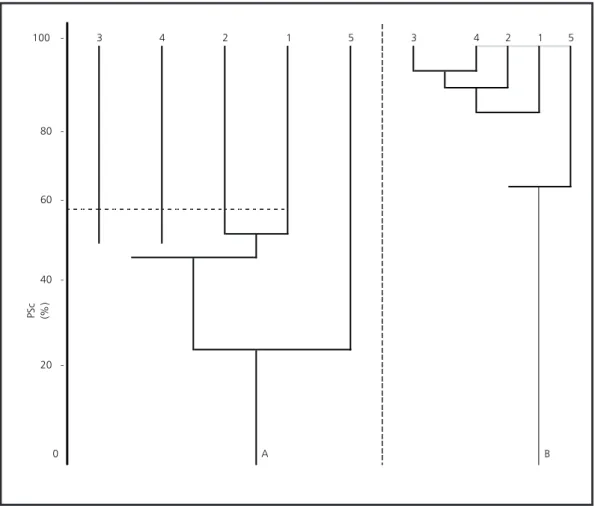
Through the analysis of the diverse taxonomic categories, and of the Chironomidae and Naididae taxa, it was obtained a reduced taxocoenotic simi-larity among the aquatic macrophytes (PSc < 50%) (Fig. 4a), which suggests peculiar characteristic of each biotope. Despite of this low similarity, the dendrogram gathered the most alike macrophytes, according to foundation manners (S. cubensis x
E. azurea – emergent and rooted; C. piauhyensis
x Utricularia sp. – submerged; S. auriculata –
fluctuant).
Unlike the taxocoenotic differences, the feeding guilds analysis indicated high similarity among the community’s functional categories in most of the macrophytes (PSc > 60%) (Fig. 4b). As shown in Fig. 2c, the phytophilic community was composed, in its majority, by collector forms.
Species Scirpus Eichhornia Cabomba Utricularia Salvinia
A. paraguaiensis 11.2 13.3 15.2 4.1
Dero (D.) nivea 83.6 54.6 256.7 238.0 6.7
Dero (D.) evelinae 11.6 31.7 18.5 0.8 Dero (A ) borelli 0.4
Dero (A ) carteri 0.4 5.2
Dero (A ) lodeni 121.4 58.3 0.8
Nais comunis 48.3
Slavina evelinae 2.6
n. . 0.01 m –3 231.2 144.6 336.8 258.4 12.4
Species n. 7 3 4 3 4
TABLE 3
Mean numeric densities (no . 0.01m-3) of aquatic macrophyte Naididae species in Infernão Lake.
0% 10% 20% 30% 40% 50% 60% 70% 80% 90% 100%
Scirpus Eichhornia Cabomba Utricularia Salvinia
Tanypodinae Tanytarsini Chironomini Orthocladiinae
This fact is due to the high participation of Naididae and Chironominae that are predominantly detritivores. Among the predators groups, Libellu-lidae, Coenagrionidae, Ceratopogonidae and Tany-podinae, were the taxa with more contribution, although the larvae of this last one are not obligated predators, frequently presenting in its diet, other food categories, as great algae (Desmidiaceae and Ba-cillariophyceae), a fact already pointed out by different authors (Roback, 1969; Trivinho-Strixino & Strixino, 1993). Furthermore, a collectors decrease tendency was found, and predators and filterers increase tendency as well, in the direction margin-center of the lake. This is explained by the mor-phologic characteristics and of establishment of the macrophytes. S. cubensis and E. azurea, with long
and tangle roots, forming a “rug” that favors the detritus accumulation and, therefore the presence of collectors; opposed S. auriculata being a flotation
macrophyte with small roots, it gives little surface of detritus retention. This sheltered groups, which possibly use the vegetable as a support, or refuge, as it is the case of the nymphs of Odonata and of the larvae of Ceratopogonidae and Tanypodinae. It also explains, the high filtrators participation, in particular of Culicidae larvae, which use this vegetable only as a support, and filter materials in suspension in the open water. The small contribution of the shredders is in agreement with other studies (Glowacka et al., 1976; Lamberti & Moore, 1984;
Strixino & Strixino, 1984; Trivinho-Strixino & Trivinho-Strixino, 1993).
100 - 3 4 2 1 5 3 4 2 1 5
80
60
40
-(%
)
20
-0 A B
PSc
The macroinvertebrate collectors dominance indicates the prevalence of a detritivore chain in the macrophytes, and, as pointed out by Mastran-tuono (1986), this could be constituted in an indica-tion of trophic enrichment of the lake, fact this already detected in Infernão lake by the invasion of S. cubensis that in the last years has been
occu-pied great part of the lake. In addition, the phe-nological characteristic of S. cubensis, with only
renewing of the emergent parts, results in the increasing accumulation of organic deposits in its rizosphere (Carlos, 1991). It is assumed that this invasion will result in the decrease or disappearance of the others macrophytes, and consequently, will change the whole macroinvertebrate community structure. Probably this community will be cha-racterized by the predominance of tolerant detritivore forms.
The accelerated senescence and eutrophi-cation in this lake seems to have been able to ori-ginate an analogous situation investigated by Dvorák (1996), in the shallow eutrophic Lake Loosdrecht, where the process results in selecting and supporting detritivore and filtering forms.
Thus, although a taxocoenotic differentiation is exhibited, according to macrophyte pattern, the operational likeness is maintained.
REFERENCES
ANTÔNIO, R. M., 1996, Estimativa da capacidade heterotrófica da Lagoa do Infernão (Estação Ecológica de Jataí – Luiz Antônio, SP). Dissertação de Mestrado. São Carlos, UFSCar, 79p.
CARLOS, V. M., 1991, Aspectos ecológicos da associação vegetal de Scirpus cubensis na Lagoa do Infernão, SP. Dissertação de Mestrado, São Carlos, UFSCar, 87p. CORREIA, L. C. S. & TRIVINHO-STRIXINO, S., 1998,
Macroinvertebrados da rizosfera de Scirpus cubensis na
Lagoa do Infernão (Estação Ecológica de Jataí, SP): estrutura e função. Acta Limnologica Brasiliensia,10 (in press).
COUTINHO, M. E., 1990, Ecologia populacional de Eichhornia azurea e sua participação na dinâmica da vegetação aquática da Lagoa do Infernão, SP. Dissertação de Mestrado, UFSCar, São Carlos, 145p. DVORÁK, J., 1996, An example of relationships between
macrophytes, macroinvertebrates and their food resources in a shallow eutrophic lake. Hydrobiologia, 339: 27-36.
ESTEVES, F. A., 1988, Fundamentos de Limnologia. Rio de
Janeiro, Interciência/FINEP, 575p.
GANDOLFI, N., 1968, Bacia do Rio Mogi-Guaçu: morfo-metria da drenagem, sedimentologia e investigações físico-químicas. Ph. D. thesis, EESC-USP, São Carlos, SP, 124p.
GLOWACKA, I., SOSZKA, G. J. & SOSZKA, H., 1976,
Invertebrates associated with macrophytes. In: E. Pieczynska (ed.), Selected problems of lake littoral ecol-ogy. Wydawnictwa Uniwersytetu Warszawskiego,
Warszawskiego, Warszawa, 238p.
LAMBERTI, G. A. & MOORE, J. W., 1984, Aquatic insects as primary consumers. In: V. H. Resh & D. M. Rosenberg (eds.), The ecology of aquatic insects. Praeger Publishers,
N.Y., 625p.
MASTRANTUONO, L., 1986, Community structure of zoobenthos associated with submerged macrophytes in the eutrophic Lake Nemi (Central Italy). Boll. Zool., 53:
41-47.
MERRITT, R. W. & CUMMINS, K. W. (eds.), 1995, An in-troduction to the aquatic Insects of North America. Dubuque: Kendall/Hunt Publ. Co., 861p.
NOGUEIRA, F. M. B., 1989, Importância das macrófitas aquáticas E. azurea e S. cubensis na ciclagem de nutrientes e nas principais características limnológicas da Lagoa do Infernão, SP. Dissertação de Mestrado,
UFSCar, São Carlos, 130p.
ROBACK, S. S., 1969, Notes on the food of Tanypodinae larvae. Ent. News, 80: 13-18.
STRIXINO, G. & TRIVINHO-STRIXINO, S., 1984, Macroinvertebrados associados a tapetes flutuantes de
Eichhornia crassipes (Mart.) Solms, de um reservatório. An. Sem. Reg. Ecol., IV: 375-397.
STRIXINO, G., TRIVINHO-STRIXINO, S. & ALVES, G. R., 1997, Macroinvertebrados bentônicos de lagoas margi-nais da planície de inundação do Rio Mogi-Guaçu (Estação Ecológica de Jataí). An. VIII Sem. Reg. Ecol. V.,
I: 33-42.
TRIVINHO-STRIXINO, S. & STRIXINO, G., 1993, Estru-tura da comunidade de insetos aquáticos associados à
Pontederia lanceolata Nuttal. Rev. Brasil. Biol., 53(1): 103-111.
TRIVINHO-STRIXINO, S., GESSNER, F. A. & CORREIA, L., 1998, Macroinvertebrados associados a macrófitas aquáticas das lagoas marginais da Estação Ecológica de Jataí (Luiz Antônio, SP). An. VIII Sem. Reg. Ecol.,V.III:
1189-1198.