Arq Bras Oftalmol. 2005;68(3):397-400
Neovascularização coroidiana associada à oftalmia simpática: relato de caso
Trabalho realizado no Setor de Uveites, Departamento de Oftalmologia Royal Victoria Hospital, McGill Uni-versity Health Center, Montreal, Quebec, Canada. 1Post-Doctorate Fellow, Uveitis and Ocular
Immunolo-gy Service, Royal Victoria Hospital, McGill University, Montreal, Canada. Post-Doctorate Fellow, The Henry C. Witelson Laboratory of Ocular Pathology and Onco-logy, McGill University, Montreal, Canada. Associate Professor of Ophthalmology, Head Retina and Vitreous Unit, Fluminense Federal University. Niterói (RJ) Brazil.
2Post-Doctorate Fellow, The Henry C. Witelson Labo-ratory of Ocular Pathology and Oncology, McGill Uni-versity, Montreal, Canada.
3Doctorate-Fellow, Department of Ocular Pathology, McGill University, Montreal, Canada. Staff-member, Department of Ophthalmology, Jundiaí Medical School. Jundiaí (SP), Brazil.
4Professor, Department of Ophthalmology, McGill Uni-versity Health Center, Montreal, Quebec, Canada. Address to correspondence: Raul Nunes Galvarro Vianna, MD, PhD. Av. Ary Parreiras, 438 - Niterói (RJ) CEP 24230-322 - Brazil
E-mail: [email protected] Recebido para publicação em 07.12.2003 Versão revisada recebida em 31.01.2005 Aprovação em 04.03.2005
Raul Nunes Galvarro Vianna1 Pinar Özdal2
João Pessoa Souza Filho3 Jean Deschênes4
INTRODUCTION
Sympathetic ophthalmia (SO) is a diffuse granulomatous uveitis occur-ring in patients who have sustained a previous penetrating ocular injury either as a result of trauma, or, rarely as a consequence of ocular surgery(1).
Choroidal neovascularization (CNV) is a common clinical manifestation associated with numerous diseases that affect the posterior segment. Es-sentially any pathologic process that disturbs the retinal pigment epithe-lium (RPE) and Bruch’s membrane can result in CNV(2). However, CNV is
usually accompanied by fibrous tissue. Often, over time, this fibrovascular tissue destroys the plane of the RPE, so the location of the CNV with respect to the RPE can no longer be readily identified(2). When located in
the macula, this pathologic process often leads to severe visual loss. In this paper we report a patient with SO secondary to penetrating ocular trauma who developed CNV and, subsequently, a fibrovascular scar in the macular region of the sympathizing eye. CNV associated with SO has rarely been described and, in our case, definitively compromised the pa-tient’s visual acuity (VA)(3-8).
CASE REPORT
A 7-year-old boy had a sharp trauma to his right eye, which resulted in corneal laceration, uveal prolapse and traumatic cataract. His VA was light
Choroidal neovascularization associated with
sympathetic ophthalmia: case report
A 7-year-old boy with sympathetic ophthalmia secondary to penetrating ocular trauma developed choroidal neovascularization in the macular region of the sympathizing eye. Posterior segment biomicroscopy disclosed a single, round, small, slightly elevated yellow-white lesion temporal to the fovea, linked to the temporal edge of the optic disc by a fibrotic band. On fluorescein angiography the round lesion showed a gradual hyperfluorescence, with late staining and leakage, and was interpreted as a fibrovascular scar from previous choroidal neovascu-larization. Despite intense immunosuppressive therapy, the patient’s final visual acuity was 20/400. Although rarely associated with sympa-thetic ophthalmia, choroidal neovascularization and its cicatricial stages can occur and compromise the visual prognosis of an already debilitated eye. The best course of treatment for choroidal neovascularization in these types of cases has not yet been determined.
ABSTRACT
Keywords: Ophthalmia, sympathetic; Choroidal neovascularization, Immunosuppressive
agents; Wound healing
Arq Bras Oftalmol. 2005;68(3):397-400
398 Choroidal neovascularization associated with sympathetic ophthalmia: case report
perception in the right eye and 20/30 in the left eye. The patient developed SO 45 days following the repair of the wound. Enucleation of the right (exciting) eye was completed 8 days after the diagnosis of SO, in the patient’s hometown. It was at this point that the patient came to be evaluated in our Uveitis Clinic. His corrected VA was 20/30 in the left eye. Slit-lamp examination of the anterior and posterior segments re-vealed mutton fat keratic precipitates, +2 cells in the anterior chamber, +2 vitreous cells, and some confluent patches of yellow-white choroidal infiltrates. The inflammation in this eye was initially controlled with topical and systemic
corticos-teroids (oral prednisone, 50 mg/day). However, after four mon-ths the inflammation increased and the patient’s VA dropped to 20/80. Cyclosporine (100 mg/day) was then added to the therapeutic scheme, and the inflammation eventually became controlled. The patient was able to taper and discontinue oral prednisone within six months, but he continued with cyclos-porine therapy (100 mg/day). However, after three years of follow-up the patient’s VA dropped to 20/200 secondary to a posterior subcapsular cataract. At this period, the fundus details could not be evaluated. The decision to operate was reached one year following the cataract diagnosis.
Phaco-Figure 1 - A: Red-free fundus photograph revealing the small, round, whitish disciform lesion (arrow) linked to the temporal edge of the optic disc by a fibrotic tissue; B, C and D: Fluorescein angiography reveals progressive fluorescence with late staining and leakage of the disciform lesion
(arrow), consistent with the diagnosis of fibrovascular scar from previous CNV
A
B
Arq Bras Oftalmol. 2005;68(3):397-400
Choroidal neovascularization associated with sympathetic ophthalmia: case report 399
emulsification with an in-the-bag posterior chamber lens im-plantation was successfully performed and the patient’s vi-sion improved to 20/40. Ophthalmoscopy at that time showed a diffusely depigmented fundus, as well as Dallen-Fuchs spots in the macular region. However, six months post-surge-ry, his VA dropped to 20/200. Ophthalmoscopy then revealed a small, round, slightly elevated whitish lesion temporal to the foveal region, which was linked by a fibrotic band to the edge of the optic disc (Figure 1A). Fluorescein angiography sho-wed a gradual hyperfluorescence of the round lesion, with late staining and leakage (Figure 1B, C and D). This was interted as fibrovascular tissue in the subretinal layer from pre-vious choroidal neovascularization. Given the advanced cica-tricial stage of the process, no treatment was proposed.
The patient was followed up regularly. When last seen, he was on cyclosporine (150 mg/day), azathioprine (75 mg/day) and prednisone (30 mg/day), the ocular inflammation was con-trolled, but his VA was 20/400.
DISCUSSION
The pathogenesis of SO is unknown. Light and electron microscopic studies in eyes with SO have shown breaks in Bruch’s membrane(9).Discontinuities in Bruch’s membrane are
likely secondary to the inflammatory nature of SO and presu-mably allow for CNV to develop. Moreover, it has been de-monstrated that CNV may arise from Dalen-Fuchs nodules, which correspond to granulomas composed of a mixture of histiocytic cells, depigmented pigment epithelial cells, and a few scattered T lymphocytes, located between Bruch’s mem-brane and an attenuated covering of RPE(1).These nodules
may also cause an interruption of Bruch’s membrane, thus leading to CNV. Sharp et al. showed that the histopathological changes surrounding these nodules consisted of obliteration of the underlying choriocapillaries with multiple breaks in Bruch’s membrane(10).
CNV has been reported in approximately 10% of patients with Vogt-Koyanagi-Harada (VKH) syndrome, a disease with clinical and histopathological features similar to SO(11). CNV in
VKH syndrome is reported more commonly in eyes with
severe inflammation, greater pigmentary disturbance in the retina, and more frequent relapses. All these clinical and oph-thalmoscopic features were seen in our patient.
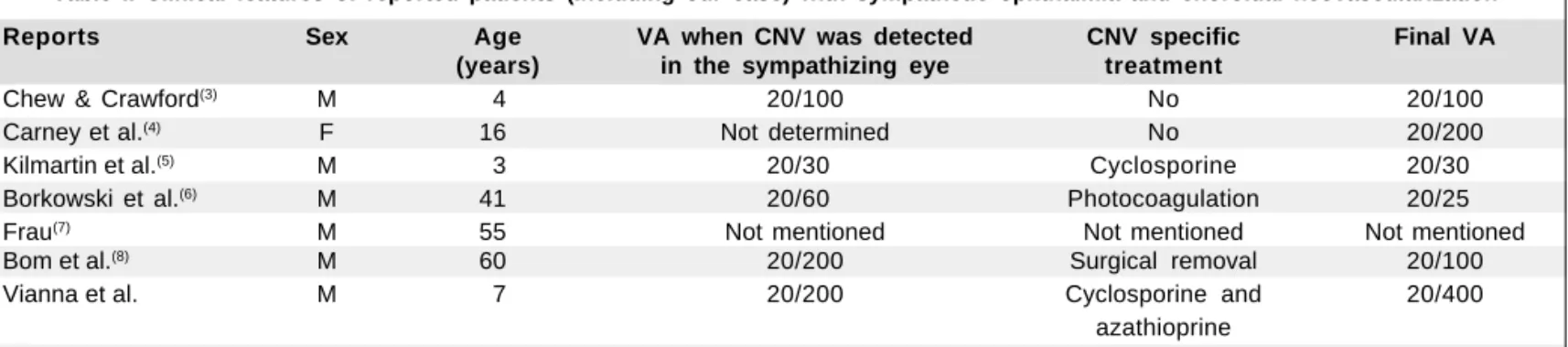
To the best of our knowledge, six patients with SO and CNV have been reported to date(3-8). Table I summarizes the
clinical features of previously reported patients, and also includes the data of our case.
The first report was on a 4-year-old boy who developed SO three months following a sharp ocular trauma(3). The patient
developed a CNV in the sympathizing eye that regressed spon-taneously, and the final VA was 20/30. A second case of CNV in SO was reported in a 16-year-old girl(4). She developed a posterior
subcapsular cataract in the sympathizing eye during the evo-lution of SO. The patient then underwent a pars plana lensectomy and vitrectomy, following this procedure a subfoveal CNV was detected. Her final VA was 20/200, but the authors did not men-tion any specific treatment for the CNV. In a third patient with SO and CNV, cyclosporine induced the resolution of the CNV(5). The
final VA in this particular case (a three-year-old boy) was 20/30. In the fourth reported case, laser photocoagulation was success-fully used to destroy the CNV in a 41-year-old man with SO(6).
Four years after laser treatment, his VA was 20/25 with no eviden-ce of recurreneviden-ce of CNV. In the fifth case, a 55-year-old male developed SO after pars plana vitrectomy in the fellow eye(7). SO
has been succesfully treated with corticosteroids, cyclosphos-phamide and cyclosporine. However, within one year the patient developed choroidal neovascularization in the sympathizing eye. Unfortunately, the author did not give details about the visual outcome of the patient. In the sixth case, a 60-year-old man with SO, the CNV was surgically removed(8). His final VA was
appro-ximately 20/100. In fact, unlike the CNV seen in age-related macu-lar degeneration, in which the neovascumacu-lar membrane develops in the subpigment epithelial space (type 1 CNV), the CNV associa-ted with SO is likely locaassocia-ted in the plane anterior to the RPE (type 2 CNV)(12). Successful surgical results have been reported in
patients with this latter type of membrane(13).
Our 7-year-old boy with SO developed a fibrovascular scar from previous CNV located in the macular region, which led to a final VA of 20/400. Due to the severe inflammation, our patient has been on immunosuppressive drugs during most of his treatment. We do not know if these agents played any role
Table I. Clinical features of reported patients (including our case) with sympathetic ophthalmia and choroidal neovascularization
Reports Sex Age VA when CNV was detected CNV specific Final VA
(years) in the sympathizing eye treatment
Chew & Crawford(3) M 4 20/100 No 20/100
Carney et al.(4) F 16 Not determined No 20/200
Kilmartin et al.(5) M 3 20/300 Cyclosporine 20/300
Borkowski et al.(6) M 41 20/600 Photocoagulation 20/250
Frau(7) M 55 Not mentioned Not mentioned Not mentioned
Bom et al.(8) M 60 20/200 Surgical removal 20/100
Vianna et al. M 7 20/200 Cyclosporine and 20/400
Arq Bras Oftalmol. 2005;68(3):397-400
400 Choroidal neovascularization associated with sympathetic ophthalmia: case report
in the clinical course of the CNV. Interestingly, it has been observed that immunosuppressive therapy may decrease the incidence of choroidal neovascularization in inflamed eyes(14).
Some authors have successfully used these drugs to treat CNV associated with endogenous posterior uveitis(5,14).
Whe-ther immunosuppressive agents decrease the rate or cause involution of CNV in SO is unclear. Because this is a rare association, a randomized and prospective study of CNV treatment in SO would probably not be feasible.
The value of immunosuppressive agents, laser photoco-agulation or surgical resection in the treatment of CNV in eyes with SO is unknown, since the neovascularization in these cases can resolve spontaneously. Factors such as the young age of some affected patients and the small area of involvement by the CNV may be important in this spontaneous regression.
We conclude that although rarely associated with SO, CNV can be a catastrophic complication in an already debilita-ted eye. To date, the best option for treatment of CNV in these cases has not yet been determined.
ACKNOWLEDGMENT
We would like to thank Ms. Janet B. Scullion and Mr. Stephen Riopel for helping with the editing of the manuscript.
RESUMO
Paciente com oftalmia simpática (OS) desenvolveu neovas-cularização coroidiana (NVC) na região macular do olho sim-patizado. A biomicroscopia do segmento posterior do olho afetado revelou uma pequena lesão branco-amarelada, discre-tamente elevada, localizada na região temporal à fóvea. Uma banda fibrosa ligava o disco óptico à lesão foveal. À angiogra-fia fluoresceínica, a lesão revelou hiperfluorescência progres-siva, com impregnação e extravazamento tardio do corante, achados esses característicos de uma cicatriz fibrovascular. Apesar de intenso tratamento com medicação
imunossupres-sora, a acuidade visual final do paciente foi de 20/400. Embora raramente associada à oftalmia simpática a neovascularização coroidiana pode ocorrer e comprometer o prognóstico visual de um olho já debilitado. A melhor opção para o tratamento da neovascularização coroidiana em casos de oftalmia simpática ainda não está determinada.
Descritores: Oftalmia simpática; Neovascularização coroidal; Drogas imunossupressoras; Cicatrização de feridas
REFERENCES
1. Rao N. Sympathetic ophthalmia. In: Ryan SJ, editor. Retina. St Louis, MO: Mosby; 2001. p.1756-61.
2. Ryan SJ, Hinton DR, Murata T. Choroidal neovascularization. In: Ryan SJ, editor. Retina. St. Louis, MO: Mosby; 2001. p.1003-23.
3. Chew EY, Crawford J. Sympathetic ophthalmia and choroidal neovasculariza-tion. Case report. Arch Ophthalmol. 1988;106(11):1507-8.
4. Carney MD, Tessler HH, Peyman GA, Goldberg MF, Williams DP. Sympa-thetic ophthalmia and subretinal neovascularization. Ann Ophthalmol. 1990; 22(5):184-6.
5. Kilmartin DJ, Forrester JV, Dick AD. Cyclosporine-induced resolution of cho-roidal neovascularization associated with sympathetic ophthalmia. Arch Ophthalmol. 1998;116(2):249-50.
6. Borkowski LM, Weinberg DV, Delany CM, Milsow L. Laser photocoagula-tion for choroidal neovascularizaphotocoagula-tion associated with sympathetic ophthalmia. Am J Ophthalmol. 2001;132(4):585-7.
7. Frau E. [Sympathetic ophthalmia complicated by subretinal neovasculariza-tion]. J Fr Ophtalmol. 2001;24(6):672-3.French.
8. Bom S, Young SF, Gregor Z, Lightman S. Surgery for choroidal neovascula-rization in sympathetic ophthalmia. Retina. 2002;22(1):109-11.
9. Rao N, Xu S, Font RL. Sympathetic ophthalmia. An immunohistochemical study of epithelioid and giant cells. Ophthalmology. 1985;92(12):1660-2. 10. Sharp DC, Bell RA, Patterson E, Pinkerton MH. Sympathetic ophthalmia:
histopathologic and fluorescein angiographic correlation. Arch Ophthalmol. 1984;102(2):232-5.
11. Moorthy RS, Chong LP, Smith RE, Rao NA. Subretinal neovascular membrane in Vogt-Koyanagi-Harada syndrome. Am J Ophthalmol. 1993;116(2):164-70. 12. Gass JD. Biomicroscopic and histopathologic considerations regarding the
feasibility of surgical excision of subfoveal neovascular membranes. Am J Ophthalmol. 1994;118(3):285-98.