Panorama do câncer de mama em mulheres no norte do Tocantins – Brasil
Nader Nazir SuleimaN, TCBC-TO1; NaNCi NaSCimeNTO2; JOãO maNuel SaNTOS BOTelhO1; raChel CarvalhO COelhO1.
INTRODUCTION
B
reast cancer is one of the non-transmissiblediseases with challenging characteristics of the world population, that is changing demographically, nutritionally and socially1. This public health scenario is worse in locals with bad health care2. Global statistics show that almost 60% of deaths related to breast cancer are observed in developing countries3. This is explained by the precarious health system of these countries, where patients have limited access to early diagnosis and without efficient treatment4. Thus, even with the great progress of early detection and treatment of breast cancer over the last years, this disease still imposes an onus to World population due to its progressive incidence and epidemiologic complexity4. In this context, epidemiologic analysis according to specific regions are essential for the development of individual health actions.
The objectives of the present work were to evaluate the temporal variation of percentage of breast cancer in women, categorized as early stage or late stage, related to socio-demographic aspects, at the first consultant at Araguaína Regional Hospital TO, Brazil (HRA/TO).
METHODS
This is an analytical study of secondary data of the program sis-RHC of the Hospital Regional de Araguaína, TO, Brazil (HRA/TO), of women with breast cancer from January 2000 to December 2015. Clinical staging used the system proposed by International Union against Cancer5. Later, these data were grouped in two groups for analysis: early stage disease (0, I and II) and late stage (III and IV).
Socio-demographic variations were described according to categories proposed by the National Institute of Cancer of Brazil, using the sheet for tumor registry6,7, that includes: age, race/color of the skin, schooling, marital status, origin, alcohol abuse, smoking and referral center.
For analysis, it was used the statistics software SPSS version 20.0. To verify association between two categories variables it was used Chi-square test, or, alternatively for small samples, Fisher exact test. When distribution differences were detected, it was used adjusted standardized residual to identify local differences (casellas): absolute values above 1.96 indicated association (local) between categories related
1 - Tocantinense Institute Presidente Antônio Carlos – ITPAC, UNACON – Araguaína Regional Hospital, Araguaína, TO, Brasil. 2 - Institute of Energy and Nuclear Research – IPEN/USP, Nuclear Technology – Applications, São Paulo, SP, Brasil.
A B S T R A C T
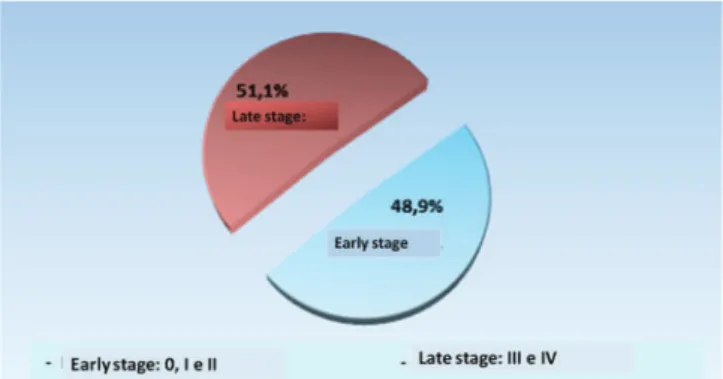
Objective: to evaluate the temporal variation of the percentages of female breast cancer in early and late stages and analyze socio-demo-graphic variables associated with these stages. Methods: study of secondary data performed between the years of 2000 and 2015 in the Araguaína Regional Hospital - Araguaína - TO – Brasil. Results: breast cancer in advanced stages were diagnosed in 51.1% of the cases and at an early stage in 48.9%. There was no difference between the percentages of patients with early and late stages over the years. Women of race/black, illiterate and origin of the southeast of Pará presented a higher percentage of late staging at diagnosis. Conclusions: most women was diagnosed with advanced disease; the time evolution of the proportion of cases (advanced/early) did not demonstrate variational changes over the years; association of the disease has been identified in advanced stage in women of race/black, illiterate and from the southeast of Pará state.
to those casellas. Comparison of media between both groups were made by t Student test for independent samples. For comparison of more than two groups, it was used the non-parametric Kruskal-Wallis test in view of the violation of the assumption of normality of data necessary for ANOVA (analysis of variance). When media differences were identified, their analysis was performed by Dunn-Bonferroni multiple comparison. For all statistical tests, it was used a significant level of 5%. This study was registered at Plataforma Brasil
and was analyzed by the Research Ethical Committee # 639460.
RESULTS
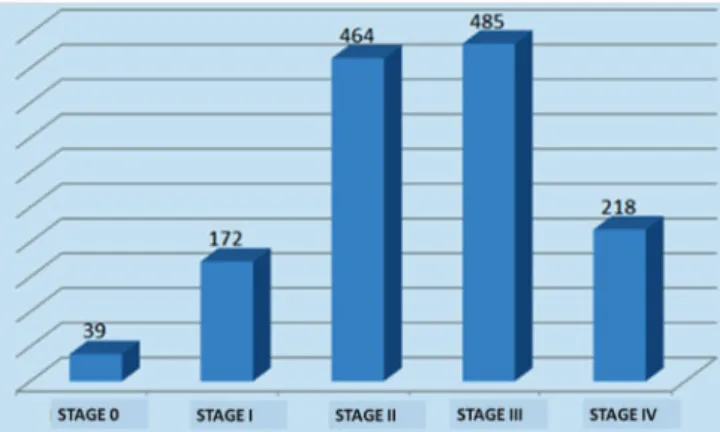
In the studied period (2000 to 2015), 1409 analytical and non-analytical women with breast cancer were registered at Sis-RHC/HRA. At first consultation, the most frequent stages were: IIA, IIB, IIIB and IV (Figure 1). In consequence, the more frequent stage group of women with breast cancer at HRA was stage III, followed by stage II, 35.2% and 33.7%, respectively (Figure 2). When stages 0,I and II were grouped as early stages, and II and IV as late stages, it was observed that 51.8% of patients were diagnosed with late disease, while 48.25 with early tumor at diagnosis over the studied years (Figure 3). Evolutionary analysis of breast cancer stages did not show any significant difference of percentage proportions (p=0.757) between early and late stages at diagnosis over the studied years (Figure 4).
Of the total of 1409 women, only 2.2% (28 patients) had no information about stage at the register, and the same was observed among some
demographic and social variables. Thus, the analysis of correlation of socio-demographic variables and stage (early or late) shows distinct quantity of registers. Women with race/black color (p=0.012), illiterate (p=0.003) and from southeast of Para state showed higher percentage of late stage. On the other hand, white women, with higher education, from other regions, showed higher percentage of early diagnosis. Other variables such as age range, referral center, marital status, family history, alcohol abuse and smoking did not show any association with early or late stage of the disease (Table 1).
DISCUSSION
This analysis highlighted some epidemiologic characteristics of women with breast cancer at the High Complexity Oncology Unit at Araguaína – TO, Brazil, over 16 years (2000 to 2015). It is important to stress that the Araguaina Regional Hospital is a referral center for oncology at the state of Tocantins, southeast of Para state and south of Maranhão state. Also, HRA had available only one public service of radiotherapy in the state until 2015.
Considering possible limitations of this work, during the studied period, the percentage of women with breast cancer in late stages in this region of the country is elevated (around 50% of patients). Similar results or even worse were found in Indian women and from Sub-Saharan Africa. In those countries, 70 to 90% of patients are diagnosed with stages III and IV8,9. In many parts of the planet, high percentages of breast cancer Figure 1. Breast cancer stage in HRA from 2000 to 2015.
patients diagnosed with late stage are usually observed in underdeveloped areas8-10.
In particular, the state of Tocantins in Brazil (former north part of Goias state) is a underdeveloped region and has been considered one of the most vulnerable health areas in Brazil for decades. However, after the creation of the Tocantins state in 1988, a gradual growth of several economic sectors such as commerce, civil construction, and improvement of health care and education, was observed, in special at the city of Araguaína11. Due to this apparent development of the region, it would be expected that the number of advanced breast cancer over the years would slow down, but this did not happen. Detailed analysis of staging showed that high percentages of advanced cases persisted over the years, with little variation (more or less) of 50% over the 16 years studied. These results showed that local and regional health actions to control cancer were inefficient over the years.
Some Brazilian researches verified that, even in most developed regions of the country, it may be found high percentages of advanced breast cancer12. And others had showed significant improvement in the reduction of late stage diagnosis and mortality rates12,13. In general, the percentage of patients with late stage cancer and the mortality rate due to breast tumor are lowering in south, southeast and central-west Brazilian regions. However, it is important to stress that in many of those studies, it was discussed the reality of single Health Centers and with better
qualification for oncologic attention15,16. When
broader studies involving public institutions with regional representativeness are analyzed, it is verified that the percentage of patients diagnosed with late
stage of the disease is considerably higher than that observed in health centers dedicated to oncologic treatment16.
Several factors may contribute to late diagnosis of women with breast cancer. For example, difficult access to medical care, low number of specialized centers, and scarce knowledge of breast cancer among health care professionals9,14,17,18. For improvement, it is necessary a well-structured health system, with pro-active professionals, that can anticipate the occurrence of the disease in a participative society with active citizens.
In developed countries, with good health system, mortality rate due to breast cancer is lowering over the last years and is closely related to early diagnosis. The development of efficient programs to treat breast cancer includes screening with mammography of target population, exams with good quality and adequate treatment of the disease19,20. There should be equivalent attention from promotion to palliative care in late stages. In those countries, less than 10% of tumors are detected in late stages21.
In Brazil, actions against breast cancer have been inefficient and without correct comprehensiveness, leading to higher rate of diagnosis in late stages, and high mortality of Brazilian women due to breast cancer17. In northern region of Brazil, it is observed the lowest coverage of mammography screening of target women 22.
It was also observed in this study that there is a strong association between late stage and race/ black color (p=0,012). Similar results were also found by other authors, that verified that black women Figure 3. Breast cancer status at HRA from 2000 to 2015.
Early Stage Late stage Total p value
N % N % N %
Race/color 652 47.9 709 82.1 1361 100.0 0.012¤
White 137 53.1 122 46.9 259 100.0
Black 24 31.3 52 68.7 76 100.0
Yellow 05 20.0 20 80.0 25 100.0
Brown 466 48.0 504 52.0 970 100.0
Indigenous 13 43.5 18 56.5 31 100.0
Schooling 614 48.7 646 51.3 1260 100.0 0.003
Illiterate 63 37.8 103 62.2 166 100.0
Incomplete fundamental 264 49 275 51.0 539 100.0
Complete fundamental 77 48.6 82 51.4 159 100.0
Complete high school 117 49.1 122 509 239 100.0
Incomplete superior 18 33.3 35 66.7 53 100.0
Complete superior 68 65.2 36 34.8 104 100.0
Origin 649 47.4 721 52.6 1370 100.0 0.009
RS Augustinópolis 47 43.5 60 56.5 107 100.0
RS Araguaína 209 49.6 212 50.4 421 100.0
RS Guaraí 63 45.1 76 54.9 139 100.0
RS Paraíso 33 72.4 12 27.6 45 100.0
Palmas 77 53.3 68 46.7 145 100.0
RS Porto Nacional 27 60.9 17 39.1 44 100.0
RS Gurupi 15 38.6 25 61.4 40 100.0
RS Dianópolis 13 50.0 13 50.0 26 100.0
Pará 70 36.8 121 63.2 191 100.0
Maranhão 74 42.3 100 57.7 174 100.0
Others 24 63.9 14 36.1 38 100.0
Referral center 669 48.2 719 51.8 1388 100.0 0.424¤
SUS 542 47.5 598 52.5 1140 100.0
No SUS 115 53.3 100 46.7 215 100.0
On its own 11 33.3 22 66.7 33 100.0
Alcoholintake 590 48.4 628 51.6 1218 100.0 0.543
Never 407 49.4 416 50.6 823 100.0
Formerconsumption 35 38.9 56 61.1 91 100.0
Yes 142 46.7 162 53.3 304 100.0
Smoking 594 48.3 635 51.7 1229 100.0 0.434
Never 345 50.1 344 49.9 689 100.0
Formersmoker 74 43.6 96 56.4 170 100.0
Yes 172 46.5 198 53.5 370 100.0
Age range 703 49.9 706 50.1 1409 100.0 0.413
Upto 29 anos 34 50.8 32 49.1 66 100.0
30-39 years 93 49.7 94 50.3 187 100.0
40-49 years 189 50.5 185 49.5 374 100.0
50-59 years 207 51.4 195 48.6 402 100.0
60-69 years 99 45.4 119 54.6 218 100.0
70 or more years 83 51.2 79 48.8 162 100.0
Positive familiar history 590 50.0 591 50 1181 100.0 0.363
Yes 278 46.7 31.8 53.3 596 100.0
No 312 53.3 273 46.7 585 100.0
Marital status 618 45.8 731 54.2 1349 100.0 0.063
Single 110 37.7 182 62.3 292 100.0
Married/consensual union 370 48.2 398 51.8 768 100.0
Widow 100 47.2 112 52.8 212 100.0
Divorced 38 50.0 39 50.0 77 100.0
miscegenation is less evident, white women present higher incidence of breast cancer in comparison to other races and ethnicity. However, African-American women are more prone to die due to the disease. These differences are caused by difference of access to health care and treatment21,23.
However, data collection about trace/color of patients with breast cancer is still faulty, since it is recommended self-classification. It must be pointed out that the high grade of miscegenation in Brazil, as well as the subjectivity to determine the color of the skin, may cause bias in the interpretation of collected data13. Also, another aspect of the more aggressiveness of breast cancer in black women may be related to the phenotype triple-negative that seems to occur with higher frequency in young African-American women, particularly during pre-menopause24.
In relation to schooling, in this study, we observed a significant association with clinical stage (p=0.003): illiterate women showed higher percentage of late stage disease, while patients with complete higher education showed more early stage disease. These findings are in accordance to others in literature, including studies that showed a direct relation of schooling and mortality rate due to breast cancer. Most deaths in women with low schooling are associated with diagnosis of breast cancer in late stage25.
In the poorest regions of the planet and with very low schooling rates, stigma associated with cancer slows down the search for medical care. Survival rate in 5 years is less than 50% in Gambia, Uganda and Algeria, compared to almost 99% in the USA4. On the other hand, women with higher grade of schooling look for more early diagnosis of breast cancer, attending medical offices and performing mammography26.
In this analysis, it is also possible to observe that patients from the southeast region of Para State showed higher percentage of late stage cancer (p=0.009), maybe due to some particularities of this regions. Southeast region of Para State has no medical care, low social development and poor economics and schooling11. Data from IPEA (Instituto de Pesquisa
Econômica Aplicada- Applied Economics Research
(13.8%), reaching 23% in rural areas and 7% in urban areas. There is also a difference between white illiterates (5.9%) and black illiterate people (13.4%). Another aspect that reinforces disparity is per capita income that, in that population, is less than half of national media11. Therefore, such aspects associated to the low quality of health care, difficult access to specialized health oncologic centers and referral inefficacy, justify the results here described. Similar results were presented by other authors, that stated that the difficulty to access the public health care is higher in low socio-economic and lower schooling patients, making also difficult health actions for early diagnosis27. In regions with low human development index, such as Western Africa, more than 70% of patients with breast cancer were diagnosed at stages III or IV27,28. Similar results were verified in Libya and Nigeria28. However, in more developed regions such as Europe and USA, women are more frequently diagnosed with early stage disease28.
The importance of early diagnosis of breast cancer in public health services is been highlighted, by promotion of discussion about access and inclusion of those patients. In order to face these challenges, it is important to involve society, researchers, medical professionals and health managers.
REFERENCES
1. Hunter DJ, Reddy KS. Noncommunicable diseases. N Engl J Med. 2013;369(14):1336-43.
2. Mills A. Health care systems in low- and middle-income countries. N Engl J Med. 2014;370(6):552-7. 3. Torre LA, Bray F, Siegel RL, Ferlay J, Lortet-Tieulent
J, Jema A. Global cancer statistics, 2012. CA Cancer J Clin. 2015;65(2):87-108.
4. World Health Organization. Cancer 2016. [Internet]. Geneva: WHO; 2016. Available from: http://www.who.int/cancer/en/
5. Brasil. Ministério da Saúde. Instituto Nacional do Câncer José Alencar Gomes da Silva. Classificação de tumores malignos. 7ª ed. Rio de Janeiro: INCA; 2012.
6. Brasil. Ministério da Saúde. Instituto Nacional de Câncer José Alencar Gomes da Silva. Rotinas e Procedimentos. 1ª ed. Rio de Janeiro: INCA; 2000. 7. Brasil. Ministério da Saúde. Instituto Nacional de
Câncer José Alencar Gomes da Silva. Manual de procedimentos do registro hospitalar de câncer. 2ª ed. Rio de Janeiro: INCA; 2011.
8. Ezeome ER. Delays in presentation and treatment of breast cancer in Enugu, Nigeria. Niger J Clin Pract. 2010;13(3):311-6.
9. Chintamani, Tuteja A, Khandelwal R, Tandon M, Bamal R, Jain S, et al. Patient and provider delays in breast cancer patients attending a tertiary care centre: a prospective study. JRSM Short Rep. 2011;2(10):76.
10. Espinosa de Los Monteros K, Gallo LC. The relevance of fatalism in the study of Latinas’ cancer screening behavior: a systematic review of the literature. Int J Behav Med. 2011;18(4):310-8.
11. IBGE. Pesquisa nacional por amostra de domicílios 2014. Rio de Janeiro: IBGE; 2014. Disponível em: http://www.ibge.gov.br/home/estatistica/populacao/ trabalhoerendimento/pnad2014/default.shtm 12. Soares PBM, Quirino Filho S, Souza WP, Gonçalves
RCR, Martelli DRB, Silveira MF, et al. Características das mulheres com câncer de mama assistidas em serviços de referência do Norte de Minas Gerais. Rev Bras Epidemiol. 2012;15(3):595-604.
13. Leite TKM, Fonseca RMC, França NM, Parra EJ, Pereira RW. Genomic ancestry, self-reported “color” and quantitative measures of skin pigmentation in Brazilian admixed siblings. PLoS One. 2011;6(11):1-9.
14. Gonzaga CMR, Freitas-Junior R, Curado MP, Sousa AL, Souza-Neto JA, Souza MR. Temporal trends in female breast cancer mortality in Brazil and correlations with social inequalities: ecological time-series study. BMC Public Health. 2015;15(1):96.
15. Haddad CF. Características clínico-patológicas e estadiamento ao diagnóstico de pacientes com câncer de mama em um centro de saúde do interior de Minas Gerais. Rev Bras Mastol. 2014;24(4):103-8.
16. Tiezzi DG. [Breast cancer screening in Brazil: there is still time to rethink]. Rev Bras Ginecol Obstet. 2013;35(9):385-7. Portuguese.
17. Gebrim LH, Shida JY, Hegg R, Topis T, Mattar A. Avaliação do tempo de início do tratamento, estadiamento histopatológico e positividade dos biomarcadores (RE, RP, HER-2) em 3.566 pacientes tratadas pelo SUS no período de 2012 a 2014, no Hospital Pérola Byington. Rev Bras Mastol. 2014;24(3):65-9.
Objetivo: avaliar a variação temporal dos percentuais de câncer mamário feminino em estádios precoce e tardio e analisar as variáveis sócio-demográficas associadas com esses estádios. Métodos: estudo de dados secundários realizado entre 2000 e 2015 no Hospital Regional de Araguaína, Araguaína, TO, Brasil. Resultados: foram diagnosticados 51,1% de casos de câncer mamário em fase avançada e 48,9% em fase precoce. Não houve diferença significativa dos percentuais de pacientes com estádios precoces e tardios ao longo dos anos avaliados. As mulheres de raça/cor preta, analfabeta e de procedência do sudeste do Pará apresentaram maior porcentagem de estadiamento tardio no momento do diagnóstico. Conclusões: a maioria das mulheres foi diagnosticada com doença avançada; a evo-lução temporal da proporção de casos (avançado/precoce) não demonstrou mudanças variacionais ao longo dos anos; foi identificado associação da doença em estádio avançado nas mulheres de raça/cor preta, analfabetas e provenientes do sudeste do Pará.
um Hospital de Oncologia. Rev Bras Cancerol. 2013;59(3):379-90.
19. Coldman A, Phillips N, Wilson C, Decker K, Chiarelli AM, Brisson J, et al. Pan-Canadian study of mammography screening and mortality from breast cancer. J Natl Cancer Inst. 2014;106(11). 20. Renck DV, Barros F, Domingues MR, Gonzalez
MC, Sclowitz ML, Caputo EL, et al . Equidade no acesso ao rastreamento mamográfico do câncer de mama com intervenção de mamógrafo móvel no sul do Rio Grande do Sul, Brasil. Cad Saúde Pública. 2014;30(1):88-96.
21. Siegel R, Ward E, Brawley O, Jemal A. Cancer statistics, 2011: the impact of eliminating socioeconomic and racial disparities on premature cancer deaths. CA Cancer J Clin. 2011;61(4):212-36.
22. Azevedo e Silva G, Teixeira MTB, Aquino EML, Tomazelli JG Silva SI. Acesso à detecção precoce do câncer de mama no Sistema Único de Saúde: uma análise a partir dos dados do Sistema de Informações em Saúde. Cad Saúde Pública. 2014;30(7):1537-50.
23. U.S. Department of Health and Human Services. National Cancer Institute. Estimated new cases and deaths from breast cancer in the United States in 2014 [Internet]. Bethesda: NCI; 2015. Available from: http://www.cancer.gov/types/breast
triple negative threats to breast cancer survival: a population-based study in Atlanta, GA. Breast Cancer Res Treat. 2009;113(2):357-70.
25. Barros AF, Uemura G, Macedo JLS. Tempo para acesso ao tratamento do câncer de mama no Distrito Federal, Brasil Central. Rev Bras Ginecol Obstet. 2013;35(10):458-63.
26. Pedraza AM, Pollán M, Pastor-Barriuso R, Cabanes A. Disparities in breast cancer mortality trends in a middle income country. Breast Cancer Res Treat. 2012;134(3):1199-207.
27. Brinton LA, Figueroa JD, Awuah B, Yarney J, Wiafe S, Wood SN, et al. Breast cancer in Sub-Saharan Africa: opportunities for prevention. Breast Cancer Res Treat. 2014;144(3):467-78. 28. Abdulrahman GO Jr, Rahman GA. Epidemiology
of breast cancer in europe and Africa. J Cancer Epidemiol. 2012;2012:1-6.
Received in: 04/02/2017
Accepted for publication: 30/03/2017 Conflict of interest: none.
Source of funding: none.
Mailing address:
Nader Nazir Suleiman