Fisioter Mov. 2016 July/Sept;29(3):609-22 Licenciado sob uma Licença Creative Commons DO): http://dx.doi.org. . / - . . .AO
[T]
The Pilates method in the rehabilitation of
musculoskeletal disorders: a systematic review
[)]
O método Pilates na reabilitação de distúrbios
musculoesqueléticos: uma revisão sistemática
[A]
Josiane Cristiane Cruz[a, b], Rafaela Liberali[c], Ticiane Marcondes Fonseca da Cruz[d], Maria Ines Artaxo Netto[d]*
[a] Universidade Gama Filho UGF , Rio de Janeiro, RJ, Brazil
[b] Universidade Federal dos Vales do Jequitinhonha e Mucuri UFVJM , Diamantina, MG, Brazil [c] Universidade Estácio de Sá, Florianópolis, SC, Brazil
[d] Universidade Estácio de Sá, São Paulo, SP, Brazil
Abstract
Introduction: Joseph Pilates created an authentic method of physical and mental conditioning, which he called Contrology and de ined as the complete coordination of body, mind and spirit. Recent studies in-dicate that the Pilates Method is a useful tool in rehabilitation can improve overall health, sports perfor-mance and help in the prevention and attenuation of injuries and disorders of the musculoskeletal system. Musculoskeletal disorders are prevalent and costly conditions that develop gradually, presenting a chronic course and often remain untreated. Objective: This study aimed to identify the effects of the Pilates Method in the rehabilitation of musculoskeletal disorders through a systematic review. Methods: An active search was performed in the PubMed, PEDro, Scielo and Bireme databases. A total of studies were pre-selected and their methodological quality was evaluated based on the PEDro scale. Of these, ful illed the selec-tion criteria. Results: The studies analyzed indicate that Pilates can be effective both for the treatment of
Fisioter Mov. 2016 July/Sept;29(3):609-22 610
conditions such as scoliosis, back pain, ankylosing spondylitis and breast cancer, and for preventing injuries in adults, elderly people and athletes. Conclusion: The high methodological variability requires that these studies be viewed with caution. )t indicates the need for the performance of new studies with high metho-dological quality and standardization of evaluation instruments.
Keywords: Pilates Method. Musculoskeletal Diseases. Rehabilitation.
Resumo
Introdução: Joseph Pilates criou um método autêntico de condicionamento ϔísico e mental, que chamou de Contrologia e o deϔiniu como a completa coordenação de corpo, mente e espírito. Estudos recentes indicam que o Método Pilates é uma ferramenta útil na reabilitação, podendo melhorar a saúde geral, o desempenho esportivo, além de ajudar na prevenção e atenuação de lesões e disfunções do sistema musculoesquelético. As disfunções musculoesqueléticas são condições prevalentes e onerosas, que se desenvolvem gradualmente, apresentando um curso crônico e muitas vezes permanecem sem tratamento. Objetivo: Este estudo tem como objetivo identiϔicar os efeitos do Método Pilates na reabilitação de distúrbios musculoesqueléticos através de uma revisão sistemática. Métodos: A busca ativa foi realizada nas bases de dados: PubMed, PEDro, Scielo e Bireme. Foram pré-selecionados 24 estudos, que tiveram sua qualidade metodológica avaliada com base na es-cala PEDro. Destes, 14 se adequaram aos critérios de seleção. Resultados: Os estudos analisados indicam que o Pilates pode ser eϔicaz tanto para o tratamento de afecções como escoliose, lombalgia, espondilite anquilosante e câncer de mama, quanto para a prevenção de lesões em adultos, idosos e atletas. Conclusão: A alta variabi-lidade metodológica exige que esses estudos sejam vistos com cautela. E indica a necessidade de realização de novos estudos com alta qualidade metodológica e padronização dos instrumentos de avaliação.
Palavras-chave: Método Pilates. Doenças Musculoesqueléticas. Reabilitação.
Introduction
Joseph (ubertus Pilates was born in , near D“sseldorf in Germany . During childhood, he suf-fered a multitude of illnesses resulting in muscular weakness. Determined to overcome his weakness, he dedicated his life to become more physically strong . During the First World War, while he was in-terned, his experiences allowed him to develop an authentic method of physical and mental condition-ing, which he perfected over the subsequent years, until his death in .
Joseph ( Pilates called his method Contrology and de ined it as the complete coordination of body, mind and spirit. Contrology was created in order to develop the body uniformly, restore physical vitality, correct wrong postures, invigorate the mind and elevate the spirit . Recent studies indicate that Pilates is a use-ful tool in rehabilitation , , and can improve overall health, sports performance, proprioception, the level of pain , lexibility , the degree of
depression, strength and muscular endurance , encourage the control of the mobility of the trunk and pelvic segments, as well as help in prevention and mitigation of injuries and dysfunctions of the musculoskeletal system .
Musculoskeletal disorders are prevalent and costly conditions for primary healthcare . They develop gradually, presenting a chronic course, and often go untreated. Although many symptoms are as-sociated, the most notable is pain, which can worsen gradually and progress to incapacity . Repetitive movements and inadequate long-term posture alter the characteristics of the muscle tissue and can cause muscle dysfunction, altered movement pattern, pain and movement disorders . To change this condi-tion, strength training can prevent disuse atrophy and additional deconditioning, as well as improve muscle and cardiorespiratory function in people with muscular disease .
Fisioter Mov. 2016 July/Sept;29(3):609-22 glucose homeostasis, bone health, psychological
well-being and overall quality of life and is inversely associated with the risk of falls, disease and prema-ture death. This evidence provides direct support for the recent recommendation for resistance training and lexibility exercises, carried out at least twice a week, to maintain functional status, promote physi-cal activity throughout life and improve the overall quality of life . )t is also important to mention that a lack of coordination in the core muscles can lead to a loss of movement ef iciency and compensatory patterns, causing stress and overuse injuries. Thus, the motor relearning of inhibited muscles may be more important than strength in patients with mus-culoskeletal injuries . )n this context, the Pilates method appears to be an interesting alternative for the treatment of musculoskeletal disorders, and for the maintenance of health and quality of life.
The aim of this study was to investigate, through a systematic review, the Pilates method in the reha-bilitation of musculoskeletal disorders.
Methods
A systematic review was used as the methodol-ogy, which identi ies, selects and critically evaluates studies considered relevant, to give theoretical and practical support for the classi ication and analysis of the bibliographic study .
A review of articles was performed with nation-al [ ] and internationnation-al studies [ ] and disserta-tions [ ], for the years to . The databas-es searched were: U.S. National Library of Medicine
PubMed , Physiotherapy Evidence Database PEDro , Scienti ic Electronic Library Online SciELO and Virtual (ealth Library B)REME . The descriptors used in the search for the articles were: Pilates, mus-culoskeletal disorders, lumbar spine, cervical spine, chronic pain, rehabilitation, and occupational diseases.
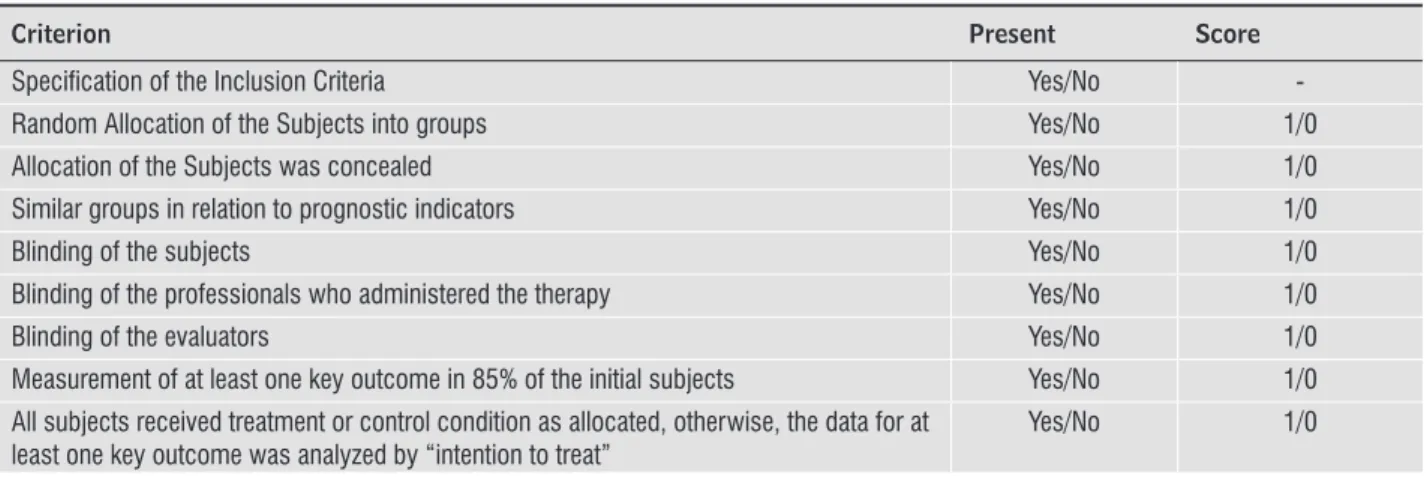
After detailed reading of the studies n = se-lected, those that had no protocols volume and in-tensity reported in the article n = , evaluated only qualitative measures n = , were literature reviews n = or quasi-experimental studies n= , had low methodological quality n = or did not have a control group compared to the Pilates n = were excluded. The methodological quality of studies was assessed based on the PEDro scale Table . The inclusion criteria of the articles were: randomized clinical trials that evaluated the ef icacy of the Pilates method for prevention or treatment of musculoskeletal disorders, that obtained a score greater than on the PEDro scale and that were published in journals with rating greater than or equal to B in the webqualis of CAPES.
The studies potentially appropriate for inclusion in the review n = consisted of doctoral dissertation of the University of Miami and articles found in the following journals: Motriz [ ]; Revista Brasileira de Medicina do Esporte [ ]; Archives of Physical Medicine and Rehabilitation [ ]; Rheumatology )nternational [ ]; Journal of Strength and Conditioning Research [ ]; Journal of Bodywork & Movement Therapies [ ]; European Journal of Physical and Rehabilitation Medicine [ ]; Journal of Orthopaedic & Sports Physical Therapy [ ]; Asian Journal of Sports Medicine [ ]; Clinical Biomechanics [ ]; Journal of Sport Rehabilitation [ ]; and BMC Geriatrics [ ].
Table 1 - PEDro scale of Methodological Classification
Criterion Present Score
Specifi cation of the Inclusion Criteria Yes/No
-Random Allocation of the Subjects into groups Yes/No 1/0
Allocation of the Subjects was concealed Yes/No 1/0
Similar groups in relation to prognostic indicators Yes/No 1/0
Blinding of the subjects Yes/No 1/0
Blinding of the professionals who administered the therapy Yes/No 1/0
Blinding of the evaluators Yes/No 1/0
Measurement of at least one key outcome in 85% of the initial subjects Yes/No 1/0
All subjects received treatment or control condition as allocated, otherwise, the data for at least one key outcome was analyzed by “intention to treat”
Yes/No 1/0
Fisioter Mov. 2016 July/Sept;29(3):609-22 612
Results
The results of studies investigating the Pilates
method in the rehabilitation of musculoskeletal
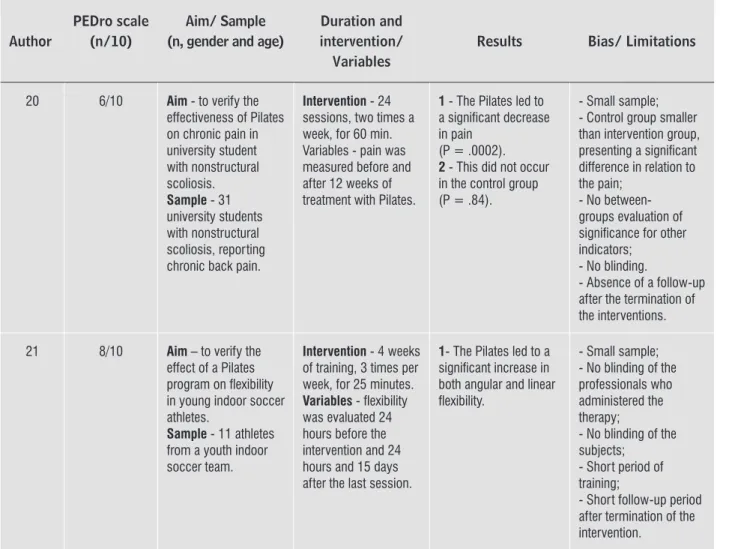
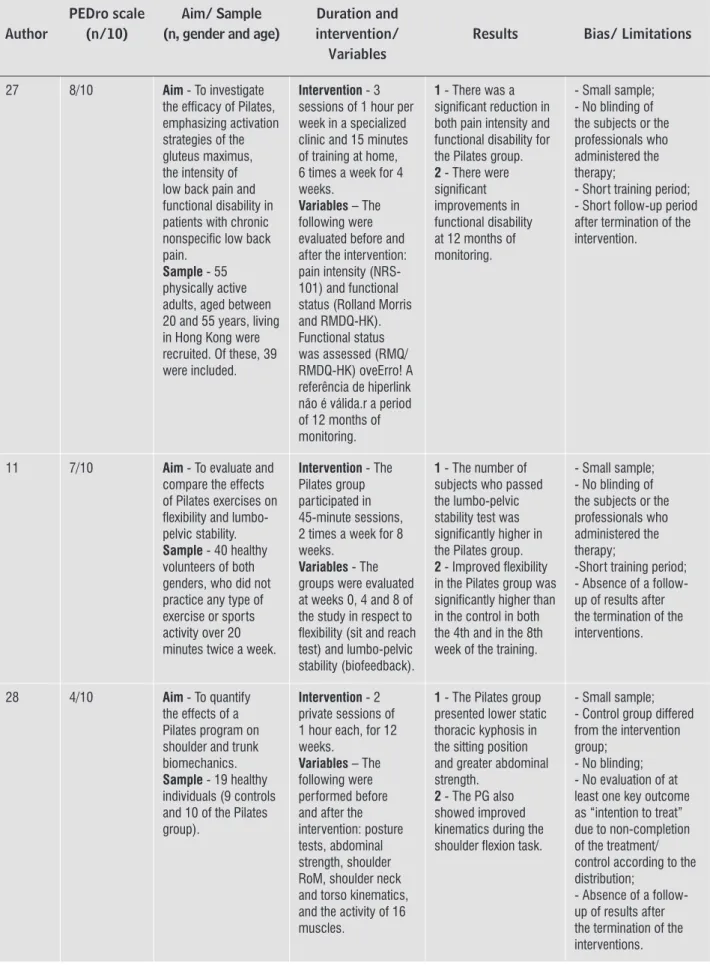
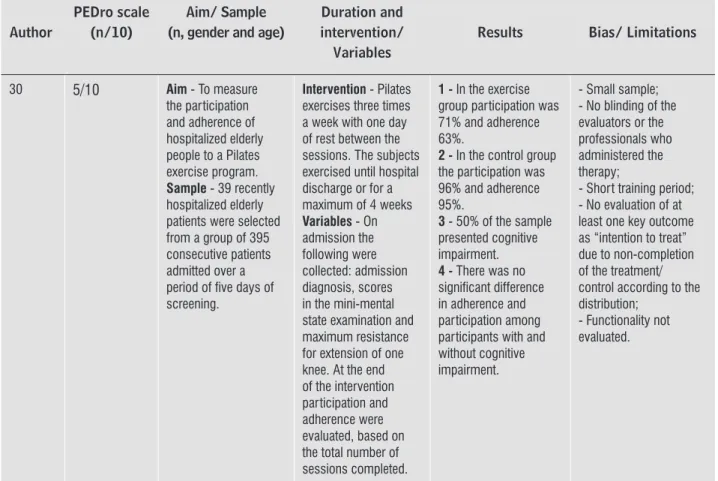
disorders are described below and summarized in Table a; b; c; d; e; f.
All the studies analyzed in table were classi-ied as randomized and controlled. The studies included the following populations and samples:
university students of ± years of age ;
athletes aged between and years, mean . ±
. anos ; elderly people living in the
com-munity, aged . ± . years ; volunteers
aged between and years, mean . ± . ; volunteers aged between and years ; elderly people between and years of
age mean ± years ; volunteers aged
be-tween and years ; patients with breast
ncer aged between and years ;
physi-cally active adults with a mean age of ± years for the control group and ± years for the
exer-cise group ; healthy men and women with
a mean age of . ± . years ; healthy
subjects with a mean age of . ± . years in the Pilates group and healthy individuals with a mean
age of . ± . years in the Control group ;
healthy adults equally divided into two groups, with a mean age of . ± years in the control group and
. ± . years of age in the Pilates group ;
patients with chronic lower back pain and a mean age of . ± . years ; recently hospitalized,
elderly patients . )n the study of Gladwell et al.
, there were signi icant differences between the Pilates and Control groups in terms of age, however, not for the initial measures.
The aims of the studies of Table , were to eval-uate the ef icacy of the Pilates Method regarding
pain , , , , , lexibilidade , , , ,
strength , , balance , , , ,
function-ality , , , , , , quality of life , ,
, muscular resistance , posture , fatigue
, lumbo-pelvic stability , to quantify the
ef-fects of a Pilates program in the biomechanics of the
shoulder and trunk , and to measure the par-ticipation and adherence to Pilates exercises .
Of the studies analyzed, evaluated pain, evaluated lexibility, strength, balance, func-tionality, quality of life, posture, fatigue, lum-bo-pelvic stability, the biomechanics of shoulder and trunk and evaluated participation and adher-ence. The following instruments were used to eval-uate pain: Borg CR scale , Bath Ankylosing Spondylitis Disease Activity )ndex BASDA) , Oswestry Low Back Pain Disability Questionnaire , pain sub-scale of the Miami Back )ndex , pain sub-scale of the SF- Numerical Rating Scale of points NRS- , and Roland Morris pain rating visual-analog scale . Flexibility was evaluated through: lexibility test on the Wells bench , , , leximeter , supine ham-string lexion test , and modi ied sit and reach test . Muscular strength of knee extensors was measured in a sitting position with hips and knees at ° through the maximum extension effort against an elastic resistance in a device capable of record-ing this effort in kilograms. Dorsi lexor muscular strength was also measured in kilograms with the maximum effort against an elastic resistance. With the foot stabilized on a mobile platform and a strap secured around the metatarsal heads, participants were instructed to raise the front of the foot keeping the heel resting on the plate . The strength of the lower abdominals was evaluated with the aid of a goniometer, used to measure the smallest angle in which volunteers could keep the legs suspended iso-metrically for seconds . The following meth-ods were used to evaluate balance: Four Square Step Test FSST , Timed Up and Go TUG test , mediolateral sway range , modi ied balance board , Tinetti test , and functional reach test . Functionality was evaluated through: Timed Up and Go TUG test , Bath Ankylosing Spondylitis Functional )ndex BASF) , GDLAM Protocol Latin-American Development Group for Maturity for Assessment of Functional Autonomy Table 1 - PEDro scale of Methodological Classification
Criterion Present Score
Reporting of between-groups statistical comparisons of at least one key outcome Yes/No 1/0 Presentation both point measures and measures of variability for at least one key outcome Yes/No 1/0
Total Total score/10 Note: BD = Bone densitometry. HAP = Human Activity Profile questionnaire.
Fisioter Mov. 2016 July/Sept;29(3):609-22 postural analysis . Fatigue was evaluated using the Brief Fatigue )nventory BF) . Lumbo-pelvic stability was evaluated with the aid of a biofeedback device. The evaluation of shoulder and trunk biome-chanics was performed with the aid of an electronic dynamometer and goniometer system for the evalu-ation of the passive RoM of the shoulder . The participation and adherence to a Pilates exercise program was evaluated through the total number of sessions concluded . The studies of Bertolla et al. , Bird et al. , Altan et al. and Rydeard et al. presented better methodological quality, scoring / on the PEDro scale. While the studies of Eyigor et al. , Emery et al. and Gladwell et al. presented the worst methodological qual-ity, scoring / .
, Oswestry scale , , incapacity sub-scale
of the Miami Back )ndex , Roland Morris and
Roland Morris (ong Kong questionnaire ,
SF-, and a brief sports functionality question-naire . To evaluate the Quality of Life the follow-ing instruments were used: Ankylosfollow-ing Spondylitis Quality of Life Questionnaire ASQoL , World (ealth Organization Quality of Life Questionnaire version
for elderly people W(OQoL-OLD , European
Organization for Research and Treatment of Cancer
Quality of Life Questionnaire EORTC QLQ -C and
the EORTC Questionnaire Speci ic for Breast Cancer
EORTC QLQ BR . Muscular resistance and
posture were evaluated through: YMCA minute
sit-up test , leg-lowering test , performance
of the maximum number of push-ups in accordance with the ACSM protocol of evaluation and grade of
Table 2a- Field studies
Author
PEDro scale (n/10)
Aim/ Sample (n, gender and age)
Duration and intervention/
Variables
Bias/ Limitations Results
20 6/10 Aim - to verify the
effectiveness of Pilates on chronic pain in university student with nonstructural scoliosis. Sample - 31 university students with nonstructural scoliosis, reporting chronic back pain.
Intervention - 24 sessions, two times a week, for 60 min. Variables - pain was measured before and after 12 weeks of treatment with Pilates.
1 - The Pilates led to a signifi cant decrease in pain
(P = .0002). 2 - This did not occur in the control group (P = .84).
- Small sample; - Control group smaller than intervention group, presenting a signifi cant difference in relation to the pain;
- No between-groups evaluation of signifi cance for other indicators;
- No blinding.
- Absence of a follow-up after the termination of the interventions.
21 8/10 Aim – to verify the
effect of a Pilates program on fl exibility in young indoor soccer athletes.
Sample - 11 athletes from a youth indoor soccer team.
Intervention - 4 weeks of training, 3 times per week, for 25 minutes. Variables - fl exibility was evaluated 24 hours before the intervention and 24 hours and 15 days after the last session.
1- The Pilates led to a signifi cant increase in both angular and linear fl exibility.
- Small sample; - No blinding of the professionals who administered the therapy;
- No blinding of the subjects;
- Short period of training;
Fisioter Mov. 2016 July/Sept;29(3):609-22 614
Table 2b- Field studies (continuation)
Author
PEDro scale (n/10)
Aim/ Sample (n, gender and age)
Duration and intervention/
Variables
Bias/ Limitations Results
22 8/10 Aim - To evaluate
the effects of Pilates on the balance and function of elderly people living in the community. Sample - 32 elderly people living in the community were recruited and 27 completed the program.
Intervention - 5 weeks of training, 2 times per week
Variables - Static and dynamic balance, as well as leg strength were evaluated before and after the intervention in the 1st group, after an interval of 6 weeks and after the intervention in the 2nd group.
1- There was no signifi cant difference between the control and Pilates groups. 2 - The Pilates led to signifi cant improvements in the static and dynamic balance measures. 3 - There was no signifi cant improvement in leg strength. 4 - The improvements caused by the Pilates had not returned to baseline levels after 6 weeks.
- Small sample; - No blinding of the professionals who administered the therapy;
- No blinding of the subjects;
- Short training period; - Absence of a follow-up after the termination of the intervention.
23 8/10 Aim - To evaluate
the effects of Pilates on pain, functional level and quality of life in patients with Ankylosing Spondylitis. Sample - 55 participants, 30 men and 25 women diagnosed with Ankylosing Spondylitis, who were in regular monitoring at a Rheumatology Clinic.
Intervention - Exercise program of 1 hour, 3 times per week, for 12 weeks.
Variables – Subjects were evaluated before, immediately after and 12 weeks after the treatment regarding: functional capacity (BASFI), disease activity (BASDAI), spinal mobility (BASMI), chest expansion and quality of life (ASQoL).
1 - The Pilates led to a signifi cant improvement in functional capacity at 12 and 24 weeks in comparison with the control group. 2 - The Pilates led to a signifi cant improvement in BASMI, in BASDAI and the chest expansion at week 12. 3 - Comparing the groups, the Pilates signifi cantly improved BASDAI (week 12) and BASMI (week 24).
- Small sample; - No blinding of the professionals who administered the therapy;
- No blinding of the subjects;
- Short follow-up period after termination of the intervention.
9 6/10 Aim - To determine
the effect of Pilates on abdominal strength, hamstring fl exibility, upper body strength, posture and balance. Sample - Of the 50 healthy, active volunteers, aged between 25 and 65 enrolled, 44 completed the study.
Intervention - 1 hour classes, 2 times per week, for 12 weeks. Variables – The following were evaluated: abdominal resistance, pelvic stability, hamstring fl exibility, upper limb endurance, posture and balance.
1- The Pilates led to signifi cant improvements in all the variables except balance.
Fisioter Mov. 2016 July/Sept;29(3):609-22
Table 2c- Field studies (continuation)
Author
PEDro scale (n/10)
Aim/ Sample (n, gender and age)
Duration and intervention/
Variables
Bias/ Limitations Results
24 6/10 Aim - To evaluate the
effects of Pilates on personal autonomy, static balance and quality of life of healthy elderly women. Sample - 52 elderly women, sedentary for at least 6 months, who had never participated in Pilates classes.
Intervention - Program of 1 hour, 2 times a week, for 8 consecutive weeks. Variables - GDLAM Protocol
Evaluation of Functional Autonomy, Tinetti test (balance), WHOQoL-OLD (quality of life).
1- The dependent Student’s t-test showed signifi cant post-test differences in the areas of balance and general index of the GDLAM protocol;
2 - The Wilcoxon test showed a signifi cant post-test difference in the quality of life index.
- Small sample; - No blinding; - Short training period; - Absence of a follow-up of results after the termination of the interventions.
25 6/10 Aim - To compare the
effi cacy of an active approach (Pilates) with a passive approach (massage) to improve pain and activity limitations associated with chronic low back pain (CLBP) and recurrent low back pain (RLBP). Sample - 21 volunteers, recruited from back pain clinics of Miami and south of Miami.
Intervention - 6 weeks of Pilates or massage intervention, carried out 2 times a week, with the Pilates lasting 50 minutes and the massage 30 minutes. Variables - Before and after the intervention, activity limitation, pain, physical factors and psychosocial factors were evaluated.
1- There was a signifi cant improvement in the Pilates group compared to the Massage group for the trunk extension strength and vitality measures of the SF-36. 2- Both groups showed improvement in the majority of the other outcomes.
3 - The improvements were greater for the subjects receiving Pilates, except in functional self-effi cacy.
- Small sample; - No blinding of the subjects or the professionals who administered the therapy;
- Final evaluation in less than 85% of the initial subjects;
- No evaluation of at least one key outcome as “intention to treat” due to non-completion of the treatment/ control according to the distribution;
- Short follow-up period after termination of the intervention.
26 4/10 Aim - To evaluate the
impact of Pilates on physical performance, fl exibility, fatigue, depression and quality of life of women treated for breast cancer.
Sample - 60 breast cancer patients were pre-selected, 52 were included, of these 42 completed the study.
Intervention – The I group performed Pilates exercises for 1 hour, 3 times per week, for 8 weeks. Variables – The following were evaluated before and after the intervention: functional capacity (6-minute walk test), fl exibility (modifi ed sit and reach test), fatigue (brief fatigue inventory), quality of life (EORTC QLQ-C30 and EORTC QLQ BR23) and complications.
1- The Pilates group presented signifi cant improvements in the 6-minute walk test and functional scores of the EORTC QLQ-C30 and EORTC QLQ BR23 questionnaires. 2 - The control group showed a signifi cant reduction in the 6-minute walk test. 3 - In the between-groups comparison there was a signifi cant difference in the 6 minute walk test in favor of the Pilates group.
- Small sample; - No blinding; - Short training period; - Final evaluation in less than 85% of the initial subjects;
- No evaluation of at least one key outcome as “intention to treat” due to non-completion of the treatment/ control according to the distribution;
Fisioter Mov. 2016 July/Sept;29(3):609-22 616
Table 2d- Field studies (continuation)
Author
PEDro scale (n/10)
Aim/ Sample (n, gender and age)
Duration and intervention/
Variables
Bias/ Limitations Results
27 8/10 Aim - To investigate
the effi cacy of Pilates, emphasizing activation strategies of the gluteus maximus, the intensity of low back pain and functional disability in patients with chronic nonspecifi c low back pain.
Sample - 55 physically active adults, aged between 20 and 55 years, living in Hong Kong were recruited. Of these, 39 were included.
Intervention - 3 sessions of 1 hour per week in a specialized clinic and 15 minutes of training at home, 6 times a week for 4 weeks.
Variables – The following were evaluated before and after the intervention: pain intensity (NRS-101) and functional status (Rolland Morris and RMDQ-HK). Functional status was assessed (RMQ/ RMDQ-HK) oveErro! A referência de hiperlink não é válida.r a period of 12 months of monitoring.
1 - There was a signifi cant reduction in both pain intensity and functional disability for the Pilates group. 2 - There were signifi cant improvements in functional disability at 12 months of monitoring.
- Small sample; - No blinding of the subjects or the professionals who administered the therapy;
- Short training period; - Short follow-up period after termination of the intervention.
11 7/10 Aim - To evaluate and
compare the effects of Pilates exercises on fl exibility and lumbo-pelvic stability. Sample - 40 healthy volunteers of both genders, who did not practice any type of exercise or sports activity over 20 minutes twice a week.
Intervention - The Pilates group participated in 45-minute sessions, 2 times a week for 8 weeks.
Variables - The groups were evaluated at weeks 0, 4 and 8 of the study in respect to fl exibility (sit and reach test) and lumbo-pelvic stability (biofeedback).
1 - The number of subjects who passed the lumbo-pelvic stability test was signifi cantly higher in the Pilates group. 2 - Improved fl exibility in the Pilates group was signifi cantly higher than in the control in both the 4th and in the 8th week of the training.
- Small sample; - No blinding of the subjects or the professionals who administered the therapy;
-Short training period; - Absence of a follow-up of results after the termination of the interventions.
28 4/10 Aim - To quantify
the effects of a Pilates program on shoulder and trunk biomechanics. Sample - 19 healthy individuals (9 controls and 10 of the Pilates group).
Intervention - 2 private sessions of 1 hour each, for 12 weeks.
Variables – The following were performed before and after the intervention: posture tests, abdominal strength, shoulder RoM, shoulder neck and torso kinematics, and the activity of 16 muscles.
1 - The Pilates group presented lower static thoracic kyphosis in the sitting position and greater abdominal strength.
2 - The PG also showed improved kinematics during the shoulder fl exion task.
- Small sample; - Control group differed from the intervention group;
- No blinding; - No evaluation of at least one key outcome as “intention to treat” due to non-completion of the treatment/ control according to the distribution;
Fisioter Mov. 2016 July/Sept;29(3):609-22
Table 2e- Field studies (continuation)
Author
PEDro scale (n/10)
Aim/ Sample (n, gender and age)
Duration and intervention/
Variables
Bias/ Limitations Results
29 6/10 Aim – To determine
whether Pilates based exercises could improve the dynamic balance in healthy adults.
Sample - 40 healthy adults who had never done Pilates were selected. The results of 34 subjects were analyzed.
Intervention - 10 Pilates sessions performed over fi ve weeks.
Variables - The functional range test (FRT) was performed before and after the procedure (7 days after termination).
1- The Pilates group presented a signifi cant improvement in the post-intervention FRT. 2 - The Control group presented no signifi cant change after fi ve weeks.
- Small sample; - No blinding of the subjects or the professionals who administered the therapy;
- No evaluation of at least one key outcome as “intention to treat” due to non-completion of the treatment/ control according to the distribution;
- Short training period; - Absence of a follow-up of results after the termination of the interventions.
8 4/10 Aim - To evaluate the
effect of a modifi ed Pilates program for active individuals with chronic non-specifi c low back pain. Sample - 49 individuals with chronic low back pain were selected, these 34 completed the study.
Intervention - 6 weeks of Pilates classes, performed 1 time per week for 1 hour. 2 sessions of 30 minutes were also performed weekly at home without supervision. Variables – The following were evaluated before and after the intervention: pain (Rolland Morris visual analog scale), specifi c functional status of the spine (Oswestry questionnaire), general functional status (SF-12), subjective and sports function improvement.
1- In the pre and post-intervention comparison, the Pilates group showed signifi cant improvement in general functional status, sports function, pain, fl exibility and proprioception. 2 - The mean daily pain scores decreased signifi cantly between the 1st and 6th week in the Pilates group and were signifi cantly lower than those of the control group. 3 - In the control group there was a signifi cant reduction in the Oswestry questionnaire and this reduction was signifi cantly greater than that of the Pilates group.
4 - Increased fl exibility was signifi cantly higher in the Pilates group, compared to the Control group.
-Small sample; - No blinding of the subjects or the professionals who administered the therapy;
- Short training period; - Final evaluation in less than 85% of the initial subject;
- No evaluation of at least one key outcome as “intention to treat” due to non-completion of the treatment/ control according to the distribution;
Fisioter Mov. 2016 July/Sept;29(3):609-22 618
Discussion
Musculoskeletal disorders are present in a wide variety of health problems. )n the studies analyzed, Pilates was used to treat these disorders in patients with Non-structural Scoliosis, Ankylosing Spondylitis, low back pain and breast cancer, as well as for the prevention of injuries in adults, elderly people and athletes.
Scoliosis is a postural change characterized by alterations of the spine in all three planes of move-ment, with lateral deviation in the frontal plane, lor-dosis in the sagittal plane and vertebral rotation in the axial plane . There are many known causes of scoliosis, which may be congenital or acquired, result from disease or injury as well as from changes in bone structure or neuromuscular problems. (owever, the majority of cases are of unknown origin and are therefore called idiopathic . Recent evidence indi-cates that physical exercises are able to treat Juvenile )diopathic Scoliosis, reducing the Cobb angle and pro-ducing secondary effects such as improved strength,
Table 2f- Field studies (continuation)
Author
PEDro scale (n/10)
Aim/ Sample (n, gender and age)
Duration and intervention/
Variables
Bias/ Limitations Results
30 5/10 Aim - To measure
the participation and adherence of hospitalized elderly people to a Pilates exercise program. Sample - 39 recently hospitalized elderly patients were selected from a group of 395 consecutive patients admitted over a period of fi ve days of screening.
Intervention - Pilates exercises three times a week with one day of rest between the sessions. The subjects exercised until hospital discharge or for a maximum of 4 weeks Variables - On admission the following were collected: admission diagnosis, scores in the mini-mental state examination and maximum resistance for extension of one knee. At the end of the intervention participation and adherence were evaluated, based on the total number of sessions completed.
1 - In the exercise group participation was 71% and adherence 63%.
2 - In the control group the participation was 96% and adherence 95%.
3 - 50% of the sample presented cognitive impairment. 4 - There was no signifi cant difference in adherence and participation among participants with and without cognitive impairment.
-Small sample; - No blinding of the evaluators or the professionals who administered the therapy;
- Short training period; - No evaluation of at least one key outcome as “intention to treat” due to non-completion of the treatment/ control according to the distribution;
- Functionality not evaluated.
Note: BD = Bone densitometry. HAP = Human Activity Profile questionnaire.
balance and mobility . )n relation to the Pilates, despite the positive results indicating improvement in pain and function, the evidence is still limited ,
, .
be promising in the rehabilitation and quality of life of patients with AS, especially for those in the early stages of the disease , , .
Low back pain with or without pain in the lower limbs is the most common chronic pain disorder, with a signi icant impact on health, economy and society. )t is a multifactorial disorder with many pos-sible causes. )ntervertebral discs, joints, ligaments, fasciae, muscles and nerve roots were identi ied as tissues capable of transmitting low back pain . Therapeutic exercise is currently the irst-line treatment recommended in clinical guidelines for non-speci ic chronic low back pain . Evidence indicates that Pilates based exercises are superior to minimum interventions for reducing non-speci ic low back pain, although they are no more effective than other forms of pain reduction exercise . Nor are they more ef icient than the minimum intervention or other exercises to reduce disability related to chronic low back pain .
Breast cancer is the most common cancer among women . )t is a heterogeneous disease with multiple clinical, pathological and molecular forms . The most important risk factors for the disease include gender, age and ethnicity . )ts incidence and mortality rates generally increase with age, so that women over present greater risk . (owever, in young women it is more often associ-ated with a positive family history and genetic muta-tions than in older women . Current treatment strategies for breast cancer rely on the characteriza-tion of the level of protein expression of estrogen and progesterone receptors [estrogen receptor ER / progesterone receptor PR ], and more recently, the protein expression or gene ampli ication of human epidermal growth factor (ER . Breast tumors that cannot express ER/PR and (ER triple-negative breast cancer account for % to % of all breast cancers . The experience of each woman with breast cancer is unique, however, they share com-mon perspectives related to the physical and func-tional side effects of the breast cancer treatment
. Limitation of activity, reduced range of motion of the upper limbs, lymphedema, fatigue, pain and chemotherapy-induced peripheral neuropathy are well documented concerns of breast cancer survivors . Rehabilitation and exercises are effective in pre-venting and treating many of these side effects . Exercises that cover both physical and psychological
such as improving the quality of life QoL and func-tionality, reducing fatigue and depression. (owever, research in relation to Pilates is still scarce and in-volves studies with small samples .
Chronological aging, or senescence, is associ-ated with increased risk of chronic diseases, such as cognitive dysfunction, cardiovascular disease, and metabolic syndrome. Due to the extended life expectancy, age-related diseases have increased at an alarming rate in recent decades . Frailty is an increasingly recognized geriatric syndrome, in which the individual enters a state of vulnerability caused by the functional reduction of multiple systems . Furthermore, it is an independent predictor of mor-tality, morbidity and institutionalization after surgery
. Evidence indicates that physical exercise can be used in the treatment of fragility and depression , as well as in the prevention of age-related cog-nitive decline and neurodegenerative diseases . The Pilates method appears to have positive effects on neuromotor ability, especially regarding the static and dynamic balance. (owever, compared to other components of physical itness cardiorespiratory endurance, muscle strength, body composition and lexibility , the results are still inconclusive, requiring more studies with high quality methodology , .
All studies showed positive and negative as-pects for health, such as: reduction of pain, increased
Fisioter Mov. 2016 July/Sept;29(3):609-22 620
. Kloubec JA. Pilates for improvement of muscle endur-ance, lexibility, balendur-ance, and posture. J Strength Cond
Res. ; : - .
. (assan EA(, Amin MA. Pilates Exercises )n luence on the Serotonin (ormone, Some Physical Variables and the Depression Degree in Battered Women. World J
Sport Sci. ; : - .
. Phrompaet S, Paungmali A, Pirunsan U, Sitilertpisan P. Effects of Pilates Training on Lumbo-Pelvic Stability and Flexibility. Asian J Sports Med. ; : - . . Bolton, JE, (urst (.C. Prognostic factors for short-term
improvement in acute and persistent musculoskeletal pain consulters in primary care. Chiropr Man Therap.
; .
. Coury, (JCG, Moreira RFC, Dias NB. Efetividade do exercício ísico em ambiente ocupacional para con-trole da dor cervical, lombar e do ombro: uma revisão
sistemática. Rev Bras Fisioter. ; : - .
. Arab AM, Ghamkhar L, Emami M, Nourbakhsh MR. Al-tered muscular activation during prone hip extension in women with and without low back pain. Chiropr
Man Therap. ; : .
. Voet NB, van der Kooi EL, Riphagen )),Lindeman E,van Engelen BG,Geurts ACh. Strength training and aerobic exercise training for muscle disease. Cochrane
Database Syst Rev. ; :CD .
. Warburton DE, Nicol CW, Bredin SS. (ealth ben-e its of physical activity: thben-e ben-evidben-encben-e. CMAJ.
; : - .
. Akuthota V,Ferreiro A,Moore T,Fredericson M. Core stability exercise principles. Curr Sports Med Rep.
; : - .
. Liberali R. Metodologia Cientí ica Prática: um saber-fazer competente da saúde à educação. nd ed. Flo-rianópolis Brazil : Postmix; . p. Portuguese. . PEDro – Physiotherapy Evidence Database. Austra-lian: The center for evidence-based physiotherapy.
[cited Feb ]. Available from: www.pedro.org. au.
. Araújo MEA, Silva EB, Vieira PC, Cader AS, Mello DB, Dantas E(M. Redução da dor crônica associada à es-coliose não estrutural, em universitárias submetidas
ao método Pilates. Rev Motriz. ; : - .
than the Pilates group. )n the study of Mallery et al. the hospitalized elderly patents were able to perform the Pilates program.
Conclusion
Field studies with samples of various characteris-tics, which favors the generalization of the data, were analyzed. The studies analyzed indicate that Pilates can be effective both for treating conditions such as scoliosis, low back pain, ankylosing spondylitis and breast cancer, and for the prevention of injuries in adults, elderly people and athletes.
(owever, due to the high methodological vari-ability, these studies should be viewed with caution. This indicates the need for new studies with high methodological quality and standardization of evalu-ation instruments.
References
. Selby A, (erdman, A. Pilates: Como Criar o Corpo que Você Deseja. São Paulo: Manole; . Portuguese. . Anderson BD, Spector A(. )ntroduction to
pilates-based rehabilitation. Orth Phys Ther Clin. North
Am. ; : - .
. Muscolino JE, Cipriani S. Pilates and the power-house - ). J Bodyw Mov Ther. ; : - .
. Pilates J(, Miller W. Pilates’ Return to Life through Contrology. Boston: Christopher Publishing (ouse; [cited Sep ]. Available from: http://www. hermit.com/hermit/art/control.pdf.
. Mcneill W. Decision making in Pilates. J Bodyw Mov
Ther. ; : - .
. Silva ACLG, Mannrich G. Pilates na reabilitação: uma
re-visão sistemática. Fisioter Mov. ; :p. - .
. Bryan M, (awson S. The bene its of Pilates exer-cise in orthopaedic rehabilitation. Tech Orthop.
; : - .
. Gladwell V, (ead S, (aggar M, Beneke R. Does a pro-gram of Pilates improve chronic non-speci ic low back
Fisioter Mov. 2016 July/Sept;29(3):609-22 . )unes D(, Cecílio MBB, Dozza MA, Almeida PR. Análise
quantitativa do tratamento da escoliose idiopática com o método klapp por meio da biofotogrametria
computadorizada. Rev Bras Fisioter. ; :
-. Portuguese-.
. Ferreira DMA. Análise da in luência do calço e do movimento de inclinação lateral da coluna vertebral em indivíduos com escoliose idiopática [dissertation]. Rio Claro Brazil : Universidade Estadual Paulista;
. p. Portuguese.
. Kendall FP, Mccreary EK, Provance PE. Músculos: provas e funções. th ed. São Paulo: Manole; . p.
- . Portuguese.
. Fusco C, Zaina F, Atanasio S, Romano M, Negrini A, Negrini S. Physical exercises in the treatment of ado-lescent idiopathic scoliosis: An updated systematic
review. Physiother Theory Pract. ; : - .
. Blum CL. Chiropractic and Pilates Therapy for the Treatment of Adult Scoliosis. J Manipulative Physiol
Ther. ; :E .
. Kim (S. Evidence-Based of Nonoperative Treat-ment in Adolescent )diopathic Scoliosis. Asian Spine
J. ; : - .
. van der Weijden MA,Claushuis TA,Nazari T,Lems WF, Dijkmans BA, van der (orst-Bruinsma )E. (igh prevalence of low bone mineral density in patients within years of onset of ankylosing spondylitis: a systematic review. Clin Rheumatol.
; : - .
. Dag inrud (,(alvorsen S,Vøllestad NK,Niedermann K,Kvien TK,(agen KB. Exercise Programs in Trials for Patients With Ankylosing Spondylitis: Do They Really (ave the Potential for Effectiveness? Arthritis
Care Res (oboken . ; : - .
. Ribeiro F, Leite M, Silva F, Sousa O. Exercício Físico no Tratamento da Espondilite Anquilosante: Uma Revisão Sistemática. Órgão O icial da Sociedade Portuguesa de Reumatologia.Acta Reumatol Port.
; : - .
. Giannotti E,Trainito S,Arioli G,Rucco V,Masiero S. Effects of physical therapy for the management of pa-tients with ankylosing spondylitis in the biological era.
Clin Rheumatol. ; : - .
. Bertolla F, Baroni BM, Junior ECPL, Oltramari JD. Efeito de um programa de treinamento utilizando o método Pilates ® na lexibilidade de atletas juvenis de futsal.
Rev Bras Med Esporte. ; : - .
. Bird ML, (ill KD, Fell JW. A randomized controlled study investigating static and dynamic balance in older adults after training with Pilates. Arch Phys
Med Rehabil. ; : - .
. Altan L,Korkmaz N,Dizdar M,Yurtkuran M. Effect of Pilates training on people with ankylosing spondylitis.
Rheumatol )nt. ; : - .
. Rodrigues BGS, Cader AS, Torres NVOB, Oliveira EM, Dantas E(M. Pilates method in personal au-tonomy, static balance and quality of life of elderly
females. J Bodyw Mov Ther. ; : - .
. Anderson BD. Randomized clinical trial comparing active versus passive approaches to the treatment of recurrent and chronic low back pain [dissertation]. Coral Gables: University of Miami; .
. Eyigor S,Karapolat (,Yesil (,Uslu R,Durmaz B. Ef-fects of Pilates exercises on functional capacity, lex-ibility, fatigue, depression, and quality of life in female breast cancer patients: a randomized controlled study.
Eur J Phys Rehabil Med. ; : - .
. Rydeard R, Leger A, Smith D. Pilates-Based Thera-peutic Exercise: Effect on Subjects With Nonspe-ci ic Chronic Low Back Pain and Functional Disabil-ity: A Randomized Controlled Trial. J Orthop Sports
Phys Ther. ; : - .
. Emery K, De Serres SJ, Mcmillan A, Côté JN. The ef-fects of a Pilates training program on arm–trunk posture and movement. Clin Biomech Bristol,
Avon . ; : - .
. Johnson EG, Larsen A, Ozawa (, Wilson CA, Kenne-dy KL. The effects of Pilates-based exercise on Kenne- dy-namic balance in healthy adults. J Bodyw Mov Ther.
; : - .
Fisioter Mov. 2016 July/Sept;29(3):609-22 622
. Bherer L, Erickson K),Liu-Ambrose T. A Review of the Effects of Physical Activity and Exercise on Cog-nitive and Brain Functions in Older Adults. J Aging
Res. ; : .
. Theou O,Stathokostas L,Roland KP,Jakobi JM, Patter-son C,Vandervoort AA, et al. The Effectiveness of Exer-cise )nterventions for the Management of Frailty: A
Sys-tematic Review. J Aging Res. ; : .
. Partridge JS,(arari D,Dhesi JK. Frailty in the older sur-gical patient: a review. Age Ageing. ; : - . . Bridle C,Spanjers K,Patel S,Atherton NM,Lamb SE.
Ef-fect of exercise on depression severity in older people: systematic review and meta-analysis of randomised
controlled trials. Br J Psychiatry. ; : - .
. Cancela JM, Oliveira )M, Rodríguez-Fuentes G. Ef-fects of Pilates method in physical itness on older adults: A systematic review. Eur Rev Aging Phys
Act. 2014; : - .
. Francisco CO, Fagundes AA, Gorges B. Effects of Pilates method in elderly people: Systematic re-view of randomized controlled trials. J Bodyw Mov
Ther. ; : - .
Received in / / Recebido em 29/10/2013
Approved in / / Aprovado em 03/09/2015 . Vieira FT,Faria LM,Wittmann J),Teixeira W,Nogueira
LA. The in luence of Pilates method in quality of life of
practitioners. J Bodyw Mov Ther. ; : - .
. Berea S, Ancuţa C, Miu S, Chirieac R. The Pilates method in ankylosing spondylitis. Revista Română
de Reumatologie. ; : - .
. Parr AT, Diwan S, Abdi S. Lumbar )nterlaminar Epi-dural )njections in Managing Chronic Low Back and Lower Extremity Pain: A Systematic Review. Pain
Physician. ; : - .
. Jensen RK,Leboeuf-Yde C,Wedderkopp N,Sorensen JS,Manniche C. Rest versus exercise as treatment for patients with low back pain and Modic chang-es. A randomized controlled clinical trial. BMC Med.
; : .
. Lim EC,Poh RL, Low AY,Wong WP. Effects of Pilates-Based Exercises on Pain and Disability in )ndividuals with Persistent Nonspeci ic Low Back Pain: A System-atic Review with Meta-analysis. J Orthop Sports Phys
Ther. ; : - .
. Chopra ), Kamal KM. A systematic review of quality of life instruments in long-term breast cancer survivors. (ealth Qual Life Outcomes. ; : .
. (ynes NE, Dey J(. Potential for targeting the ibroblast growth factor receptors in breast cancer. Cancer Res.
; : - .
. Dolle JM,Daling JR,White E,Brinton LA,Doody DR, Por-ter PL, et al. Risk Factors for Triple-Negative Breast Cancer in Women Under the Age of Years. Cancer
Epidemiol Biomarkers Prev. ; : - .
. Cardoso F,Loibl S,Pagani O,Graziottin A,Panizza P,Martincich L, et al. The European Society of Breast Cancer Specialists recommendations for the man-agement of young women with breast cancer. Eur J
Cancer. ; : - .
. Binkley JM,(arris SR,Levangie PK, Pearl M, Gug-lielmino J,Kraus V, et al. Patient Perspectives on Breast Cancer Treatment Side Effects and the Prospective Surveillance Model for Physical Rehabilitation for Women With Breast Cancer. Cancer. ;
Suppl : - .
. Stan DL, Collins NM,Olsen MM,Croghan ), Pruthi S. The Evolution of Mindfulness-Based Physical )n-terventions in Breast Cancer Survivors. Evid Based