RBCCV 44205-1431 DOI: 10.5935/1678-9741.20120106
Off-pump versus on-pump coronary artery bypass
surgery: meta-analysis and meta-regression of
13,524 patients from randomized trials
Cirurgia de revascularização miocárdica com CEC versus sem CEC: meta-análise e meta-regressão
de 13.524 pacientes de estudos randomizados
Michel Pompeu Barros de Oliveira Sá
1, Paulo Ernando Ferraz
2, Rodrigo Renda Escobar
2, Wendell
Nunes Martins
2, Pablo César Lustosa
2, Eliobas de Oliveira Nunes
2, Frederico Pires Vasconcelos
2,
Ricardo Carvalho Lima
31. MD, MSc, Division of Cardiovascular Surgery of Pronto Socorro Cardiológico de Pernambuco (PROCAPE) and University of Pernambuco (UPE), Recife, PE, Brazil.
2. MD, Division of Cardiovascular Surgery of Pronto Socorro Cardiológico de Pernambuco (PROCAPE) and University of Pernambuco (UPE), Recife, PE, Brazil.
3. MD, MSc, PhD, ChM, Division of Cardiovascular Surgery of Pronto Socorro Cardiológico de Pernambuco (PROCAPE) and University of Pernambuco (UPE), Recife, PE, Brazil.
Work carried out at Division of Cardiovascular Surgery of Pronto Socorro Cardiológico de Pernambuco (PROCAPE) and University of Pernambuco (UPE), Recife, PE, Brazil.
Correspondence address:
Michel Pompeu Barros de Oliveira Sá
Av. Eng. Domingos Ferreira, 4172 – Edf. Paquetá – apto. 405 – Recife, PE, Brazil – ZIP Code 51021-040
E-mail: [email protected]
Author Contributions: All authors had full access to all the data in the study and take responsibility for the integrity of the data and the accuracy of the data analysis. Study concept and design: Sá, Ferraz, and Escobar. Acquisition of data: Ferraz, Escobar, Martins, Lustosa and Nunes. Analysis and interpretation of data: Sá, Vasconcelos, Lima, Ferraz and Escobar. Drafting of the manuscript: Sá. Critical revision of the manuscript for important intellectual content: Sá, Ferraz, Escobar, Martins, Nunes, Lustosa, Vasconcelos, Lima. Statistical analysis: Sá. Administrative, technical, and material support: Vasconcelos and Lima. Study supervision: Sá, Lima, Vasconcelos.
Financial Disclosure: All authors have no conlict of interests.
Funding/Support: All authors have no relationship to commercial funding or support.
Article received on September 3rd, 2012 Article accepted on November 8th, 2012 Abstract
Background: Most recent published meta-analysis of randomized controlled trials (RCTs) showed that off-pump coronary artery bypass graft surgery (CABG) reduces incidence of stroke by 30% compared with on-pump CABG, but showed no difference in other outcomes. New RCTs were published, indicating need of new meta-analysis to investigate pooled results adding these further studies.
Methods: MEDLINE, EMBASE, CENTRAL/CCTR, SciELO, LILACS, Google Scholar and reference lists of relevant articles were searched for RCTs that compared outcomes (30-day mortality for all-cause, myocardial
infarction or stroke) between off-pump versus on-pump CABG until May 2012. The principal summary measures were relative risk (RR) with 95% Conidence Interval (CI) and P values (considered statistically signiicant when <0.05).
The RR’s were combined across studies using DerSimonian-Laird random effects weighted model. Meta-analysis and meta-regression were completed using the software Comprehensive Meta-Analysis version 2 (Biostat Inc., Englewood, New Jersey, USA).
Results: Forty-seven RCTs were identiied and included
off-pump and on-off-pump CABG groups in RR for 30-day mortality or myocardial infarction, but there was difference about stroke in favor to off-pump CABG (RR 0.793, 95% CI 0.660-0.920, P=0.049). It was observed no important heterogeneity of effects about any outcome, but it was observed publication bias about outcome "stroke". Meta-regression did not demonstrate inluence of female gender, number of grafts or age in outcomes.
Conclusion: Off-pump CABG reduces the incidence of post-operative stroke by 20.7% and has no substantial effect on mortality or myocardial infarction in comparison to on-pump CABG. Patient gender, number of grafts performed and age do not seem to explain the effect of off-pump CABG on mortality, myocardial infarction or stroke, respectively.
Descriptors: Meta-Analysis. Coronary artery bypass, off-pump. Cardiopulmonary bypass.
Resumo
Introdução: A meta-análise mais recente de estudos randomizados controlados (ERC) mostrou que cirurgia de revascularização (CRM) sem circulação extracorpórea (CEC) reduz a incidência de acidente vascular cerebral em 30% em comparação com CRM com CEC, mas não
mostrou diferença em outros resultados. Novos ERCs foram publicados, indicando necessidade de nova meta-análise para investigar resultados agrupados adicionando esses estudos.
Métodos: MEDLINE, EMBASE, CENTRAL / CCTR, SciELO, LILACS, Google Scholar e listas de referências de artigos relevantes foram pesquisados para ERCs que compararam os resultados de 30 dias (mortalidade por todas as causas, infarto do miocárdio ou acidente vascular cerebral - AVC) entre CRM com CEC versus sem CEC até maio de 2012. As medidas sumárias principais foram o risco relativo (RR) com intervalo de coniança de 95% (IC) e os valores de
P (considerado estatisticamente signiicativo quando <0,05).
Os RR foram combinados entre os estudos usando modelo de efeito randômico de DerSimonian-Laird. Meta-análise e meta-regressão foram concluídas usando o software versão Meta-Análise Abrangente 2 (Biostat Inc., Englewood, Nova Jersey, EUA).
Resultados: Quarenta e sete ERCs foram identiicados
e incluíram 13.524 pacientes (6.758 sem CEC e 6.766 com CEC). Não houve diferença signiicativa entre CRM com CEC e sem CEC no RR de mortalidade em 30 dias ou infarto do miocárdio, mas houve diferença em favor da CRM sem CEC no desfecho AVC (RR 0,793, IC 95% 0,660-0,920, P = 0,049). Não foi observado importante heterogeneidade dos efeitos sobre qualquer resultado, mas observou-se um viés de publicação sobre o desfecho "AVC". Meta-regressão não demonstrou inluência do sexo feminino, o número de pontes ou idade nos resultados.
Conclusão: CRM sem uso da CEC reduz a incidência de acidente vascular cerebral pós-operatória de 20,7% e não tem efeito signiicativo sobre a mortalidade ou infarto do miocárdio em comparação com CRM com CEC. Sexo do paciente, número de enxertos realizados e idade não parecem explicar o efeito de RM sem CEC sobre a mortalidade, infarto do miocárdio ou acidente vascular cerebral, respectivamente.
Descritores: Metanálise. Ponte de artéria coronária sem circulação extracorpórea. Ponte cardiopulmonar.
Abbreviations, Acronyms & Symbols
CABG Coronary artery bypass graft surgery CENTRAL/CCTR Cochrane Central Register of Controlled Trials CI Conidence Interval
LILACS Literatura Latino-Americana e do Caribe em Ciências da Saúde
MeSH Medical Subject Heading
PRISMA Preferred Reporting Items for Systematic Reviews and Meta-Analyses
RCTs Randomized controlled trials
RR Risk Ratio
SciELO Scientiic Electronic Library Online
INTRODUCTION
Rationale
The most recent published meta-analysis examined
randomized controlled trials (RCTs) comprising a total
of 8,961 patients and showed that off-pump coronary
artery bypass graft surgery (CABG) reduces the
incidence of stroke by 30% compared with on-pump
CABG, but showed no difference in 30-day mortality
and myocardial infarction, which were not affected by
age, gender or number of grafts [1]. After the publication
of this meta-analysis [1], two new RCTs were published
– CORONARY [2] and On-Off Study [3], which
contributed over 4,752 and 411 patients, respectively.
This represents a substantial increase of new patient data
available in literature from RCTs as compared to what
already exists, which indicates the need for execution
of a new meta-analysis to investigate the pooled results
adding these further studies.
Our meta-analysis attempts to determine if there is any
real difference between off-pump and on-pump CABG in
terms of outcomes.
Objectives
according to Preferred Reporting Items for Systematic
Reviews and Meta-Analyses (PRISMA) statement [4].
METHODS
Eligibility criteria
Using PICOS strategy, studies were considered if:
(1) population comprised patients undergoing CABG;
(2) compared outcomes between off-pump versus
on-pump CABG; (3) outcomes studied included 30-day
mortality (all-cause), myocardial infarction or stroke;
(4) were prospective randomized controlled trials.
The exclusion criteria were: (1) concomitant surgical
intervention other than CABG, (2) concomitant
medical intervention in one but not both of the two
groups, (3) zero events in both groups, so that they
could not contribute to the pooled analysis for a
specific outcome.
Information Sources
The following databases were used (until May 2012):
MEDLINE, EMBASE, Cochrane Central Register of
Controlled Trials (CENTRAL/CCTR), ClinicalTrials.gov,
SciELO (Scientiic Electronic Library Online), LILACS
(Literatura Latino-Americana e do Caribe em Ciências
da Saúde – The Latin American and Caribbean Health
Sciences), Google Schoolar and reference lists of relevant
articles.
Search
We conducted the search using Medical Subject Heading
(MeSH) terms (‘coronary artery bypass, off-pump’ OR
‘off-pump coronary artery bypass’ OR ‘off pump coronary
artery bypass’ OR ‘off-pump’ OR ‘coronary artery bypass,
beating heart’ OR ‘beating heart cardiopulmonary bypass’
OR ‘cardiopulmonary bypass’ OR ‘cardiopulmonary
bypasses’ OR ‘bypass, cardiopulmonary’ OR ‘bypasses,
cardiopulmonary’) AND (‘randomized controlled trial’ OR
‘clinical trial’ OR ‘controlled clinical trials, randomized’
OR ‘clinical trials, randomized’ OR ‘trials, randomized
clinical’).
Study Selection
The following steps were done: (1) identiication of
titles of records through databases searching; (2) removal
of duplicates; (3) screening and selection of abstracts; (4)
assessment for eligibility through full-text articles; (5)
inal inclusion in study.
One reviewer followed the steps 1 to 3. Two independent
reviewers followed step 4 and selected studies. Inclusion
or exclusion of studies was decided unanimously. When
there was disagreement, a third reviewer took the inal
decision.
Data Items
The endpoints were Risk Ratio (RR) for 30-day
mortality (all-cause), myocardial infarction and stroke
after off-pump versus on-pump CABG.
Data Collection Process
Two independent reviewers extracted the data. When
there was disagreement about data, a third reviewer
(the irst author) checked the data and took the inal
decision about it. From each study, we extracted patient
characteristics, study design, and outcomes (number of
events and number of total groups).
Risk of Bias in Individual Studies
Included studies were assessed for the following
characteristics: (1) sequence generation, (2) allocation
concealment, (3) blinding, (4) incomplete outcome data,
(5) selective outcome reporting, and (6) other sources of
bias. Taking these characteristics into account, the papers
were classiied into A (low risk of bias), B (moderate risk
of bias) or C (high risk of bias).
Two independent reviewers assessed risk of bias.
Agreement between the two reviewers was assessed
using kappa statistics for full text screening, and rating of
relevance and risk of bias. When there was disagreement
about risk of bias, a third reviewer (the irst author) checked
the data and took the inal decision about it.
Summary Measures
The principal summary measures were RR’s with
95% Conidence Interval (CI) and
P
values (considered
statistically signiicant when <0.05). The meta-analysis
was completed using the software Comprehensive
Meta-Analysis version 2 (Biostat Inc., Englewood, New Jersey,
USA).
Synthesis of Results
Forest plots were generated for graphical presentations
for clinical outcomes and we performed the I2 test and
Chi2 test for assessment of heterogeneity across the studies
[5]. Each study was summarized by the RR for off-pump
CABG compared to on-pump CABG. The RR’s were
combined across studies using weighted
DerSimonian-Laird random effects model [6]. The model was weighted
by number of events in each study.
Risk of Bias Across Studies
To assess publication bias, a funnel plot was generated
(for each outcome), being statistically assessed by Begg
and Mazumdar’s test [7] and Egger’s test [8].
Meta-regression Analysis
whether the effects of off-pump CABG were modulated by
pre-speciied factors. Meta-regression graphs describe the
effect of off-pump CABG on the outcome (plotted as a log
RR on the y-axis) as a function of a given factor (plotted
as a mean or proportion of that factor on the x-axis).
Meta-regression coeficients show the estimated increase in
log RR per unit increase in the covariate. Since log RR
>0 corresponds to RR >1 and log RR <0 corresponds to
RR<1, a negative coeficient would indicate that as a given
factor increases, the RR decreases.
The pre-determined modulating factors to be examined
were: sex (for mortality), number of bypass grafts (for
myocardial infarction) and age (for stroke). Sex was
represented as the proportion of females in the RCT.
Number of bypass grafts was represented as the difference
between the mean number of grafts (arterial and venous
combined) performed in the off-pump CABG group minus
the mean number of grafts performed in the on-pump
CABG group in the RCT. Age was represented as the mean
age of the patients participating in the RCT.
RESULTS
Study Selection
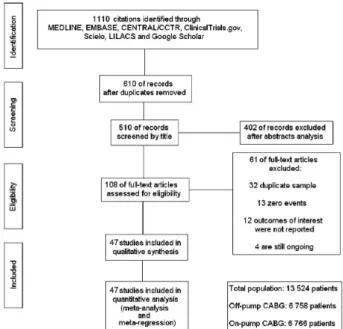
A total of 1110 citations were identiied, of which 108
studies were potentially relevant and retrieved as full-text.
Forty-seven [2,3,9-52] publications fulilled our eligibility
criteria. Interobserver reliability of study relevance was
excellent (Kappa = 0.85). Agreement for decisions related
to study validity was very good (Kappa = 0.81). The search
strategy can be seen in Figure 1.
Study Characteristics
Characteristics of each study are shown in Table
1. A total of 13,524 patients were studied with 6,758
undergoing off-pump CABG and 6,766 undergoing
on-pump CABG, including the years 2000 to 2012. We
observed that most studies consisted of patients whose
mean age was around the sixth decade of life, mostly male
and on-pump CABG presenting higher mean coronary
bypasses. The overall internal validity was considered
moderate risk of bias.
Synthesis of Results
The RR of the risk of 30-day mortality in the off-pump
group compared with on-pump group in each study is
reported in Figure 2. There was no evidence for important
heterogeneity of treatment effect among the studies for
death. The overall RR (95% conidence interval) of
30-day mortality showed no statistical signiicant difference
between off-pump CABG compared to on-pump CABG
(random effect model: RR 0.938, 95% CI 0.731 to 1.203,
P
= 0.612).
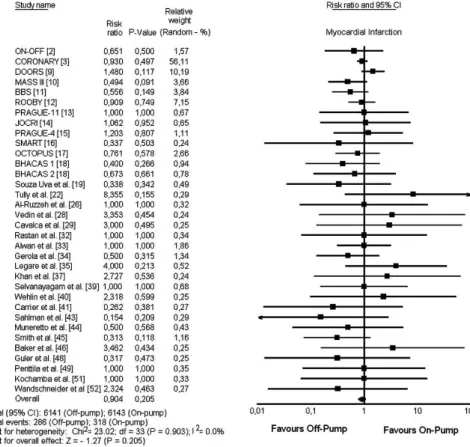
The RR of the risk of myocardial infarction in the
off-pump group compared with on-pump group in each
study is reported in Figure 3. There was no evidence for
important heterogeneity of treatment effect among the
studies for myocardial infarction. The overall RR (95%
conidence interval) of myocardial infarction showed no
statistical signiicant difference between off-pump CABG
compared to on-pump CABG (random effect model: RR
0.904, 95% CI 0.773 to 1.057,
P
= 0.205).
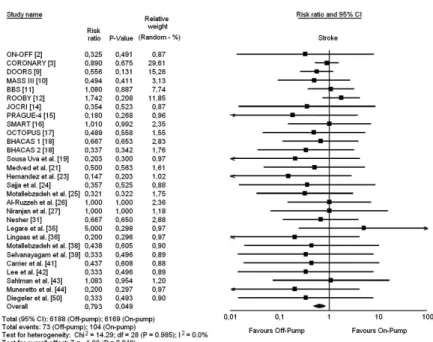
The RR of the risk of stroke in the off-pump group
compared with on-pump group in each study is reported
in Figure 4. There was no evidence for important
heterogeneity of treatment effect among the studies
for stroke. The overall RR (95% CI) of stroke showed
statistical signiicant difference in favor to off-pump
CABG compared to on-pump CABG (random effect
model: RR 0.793, 95% CI 0.660 to 0.920,
P
= 0.049).
Risk of Bias Across Studies
Begg and Mazumdar’s and Egger’s tests did not reveal
any evidence of publication bias, with the exception of
stroke for which both tests were statistically signiicant
(Figure 5).
Meta-regression Analysis
Meta-regression coeficients were not statistically
signiicant for death and proportion of females
(coeficient -0.02, 95% CI -0.05 to 0.01,
P
= 0.103),
myocardial infarction and graft differential (coeficient
-0.59, 95% CI -0.63 to 1.81,
P
= 0.344), stroke and
mean age (coeficient 0.00, 95% CI -0.06 to 0.06,
P
=
0.984) - Figure 6.
Risk of Bias A A B A A C B B B A B B B B A B B B B C A B B B B C B B B B B B B B B B A B B B B C C B C B B Table 1. Study characteristics
Trial
CORONARY [2] ON-OFF [3] DOORS [9] MASS III [10] BBS [11] ROOBY [12] PRAGUE-11 [13] JOCRI [14] PRAGUE-4 [15] SMART [16] OCTOPUS [17] BHACAS-1 [18] BHACAS-2 [18] Souza Uva et al. [19] Fattouch et al. [20] Medved et al. [21] Tully et al. [22] Hernandez Jr. et al. [23] Sajja et al. [24]
Motallebzadeh et al. [25] Al-Ruzzeh et al. [26] Niranjan et al. [27] Vedin et al. [28] Cavalca et al. [29] Paparella et al. [30] Nesher et al. [31] Rastan et al. [32] Alwan et al. [33] Gerola et al. [34] Légaré et al. [35] Lingaas et al. [36] Khan et al. [37]
Motallebzadeh et al. [38] Selvanayagam et al. [39] Wehlin et al. [40] Carrier et al. [41] Lee et al. [42] Sahlman et al. [43] Muneretto et al. [44] Smith et al. [45] Baker et al. [46] Covino et al. [47] Güler et al. [48] Penttila et al. [49] Diegeler et al. [50] Kochamba et al. [51] Wandschneider et al. [52]
Off-Pump (n) 2375 208 450 155 176 1104 40 81 204 98 142 100 100 73 63 30 30 99 56 108 84 40 33 25 15 60 20 35 80 150 60 54 15 30 21 28 30 24 88 21 12 21 19 11 20 29 41 On-Pump (n) 2377 203 450 153 163 1099 40 86 184 99 139 100 101 74 65 30 36 102 60 104 84 40 37 25 16 60 20 35 80 150 60 49 20 30 16 37 30 26 88 23 14 16 18 11 20 29 67 Age (mean) 67.5 73.5 74.0 60.0 75.4 62.8 66.0 59.5 62.5 62.4 61.3 62.0 62.5 65.3 62.0 60.7 65.5 NR 60.3 64.5 63.1 66.9 65.0 65.7 NR 67.5 64.2 63.5 59.0 62.9 64.5 63.3 63.9 60.5 64.9 70.0 65.8 62.7 66.5 61.0 64.0 NR 56.0 59.4 64.6 58.6 65.4 Female Gender (%) 19.1 30.7 23.0 21.0 35.5 0.6 20.0 13.2 18.8 22.8 28.5 19.5 16.4 16.3 31.3 28.3 24.1 19.9 11.2 10.8 16.1 17.5 20.0 25.5 NR 25.0 20.0 30.0 34.4 19.7 21.7 12.6 8.6 13.3 18.9 23.1 23.3 18.0 39.2 15.9 19.2 10.8 NR 0.0 35.0 22.4 21.3 Off-Pump Grafts Per Patient (mean) 3.0 3.0 2.9 2.5 3.2 2.9 1.9 3.5 2.3 3.4 2.4 2.4 2.9 3.5 2.6 2.3 2.2 3.2 3.1 NR 2.7 3.9 3.0 2.5 2.7 2.3 3.0 2.3 1.7 2.8 2.6 3.0 2.2 2.8 3.0 3.0 3.1 3.2 2.7 2.7 2.2 1.5 NR 2.8 2.0 2.5 2.3 On-Pump Grafts Per Patient (mean) 3.2 3.3 3.0 3.0 3.3 3.0 2.4 3.6 2.7 3.4 2.6 2.5 3.0 3.5 2.8 2.5 2.5 3.2 3.9 NR 2.8 3.8 3.0 3.1 3.3 2.9 2.9 2.5 1.8 3.0 2.8 3.4 3.2 2.9 2.5 3.4 3.6 3.0 2.8 3.0 2.5 1.8 NR 3.3 3.5 2.5 3.1 Differential Number of Grafts Per Patient - 0.2 - 0.3 - 0.1 - 0.5 - 0.1 - 0.1 - 0.5 - 0.1 - 0.4 0.0 - 0.2 - 0.1 - 0.1 0.0 - 0.2 - 0.2 - 0.3 0.0 - 0.8 NR - 0.1 0.1 0.0 - 0.6 - 0.4 - 0.6 0.1 - 0.2 - 0.1 - 0.2 - 0.2 - 0.4 - 1.0 - 0.1 0.5 - 0.4 - 0.5 0.2 - 0.1 - 0.3 - 0.3 - 0.3 NR - 0.5 - 1.5 0.0 - 0.8
Fig. 2 - Risk ratio and conclusions plot of 30-day mortality associated with off-pump versus on-pump CABG
Fig. 5 - Publication bias analysis by funnel plot graphic for the outcomes
Fig. 6 - Meta-regression analysis by representative plots
REFERENCES
1. Ailalo J, Rasti M, Ohayon SM, Shimony A, Eisenberg MJ.
Off-pump vs. on-pump coronary artery bypass surgery: an updated meta-analysis and meta-regression of randomized trials. Eur Heart J. 2012;33(10):1257-67.
DISCUSSION
Summary of Evidence
The results of this meta-analysis demonstrate that there
was statistical signiicant difference in favor to off-pump
CABG compared to on-pump CABG in RR for stroke
and no difference about death or myocardial infarction,
being the summary measures free from the inluence of
heterogeneity of the effects. Only the outcome “stroke”
was under the inluence of publication bias.
Meta-regression did not demonstrate any inluence of female
gender, number of grafts performed and age on mortality,
myocardial infarction or stroke, respectively.
Considerations about this Meta-Analysis
To our knowledge, this is the largest meta-analysis of
RCTs performed to date, providing incremental value by
demonstrating that off-pump CABG reduces the incidence
of post-operative stroke compared with on-pump CABG.
Furthermore, this analysis conirms that off-pump CABG
does not signiicantly reduce the incidence of
short-term all-cause mortality and post-operative myocardial
infarction. The potential beneits of off-pump CABG on
these outcomes do not appear to be determined by patient
gender, number of grafts performed or age.
The effect of off-pump CABG on stroke has been a
polemical topic, with most reports showing no beneicial
effect [53-55]. The two largest trials to date – CORONARY
[2] with 4,752 patients and ROOBY [12] with 2,143
patients – showed no effect or trend for reduction in stroke.
The most recent trial published – On-Off Study with 411
patients – also did not show any beneit on incidence of
stroke. Ailalo et al. [1] emphasize that it would take more
than 10,000 patients in a trial to obtain a probabilistic sample
and detect statistically signiicant differences regarding the
outcome “stroke”, which explains why no trial to date has
been able to demonstrate substantial differences between
the groups regarding this outcome. Something that could
explain the lower incidence of stroke in off-pump CABG
is less manipulation of the aorta in comparison to on-pump
CABG. El Zayat et al. [56] demonstrated in a RCT the
importance of avoiding clamp during off-pump CABG
using clampless facilitating devices to reduce cerebral
embolic events, which proves that the less manipulation of
the aorta decreases the incidence of stroke.
According to some authors [57,58], female and elderly
patients are thought to face higher risks associated with
on-pump CABG and therefore beneit more from off-on-pump
CABG. The meta-regression analysis in this study refutes
these hypotheses that differences in study population are
responsible for the treatment effects observed across trials.
Although other meta-analyses have been published
on this ield, this analysis is important for some reasons.
The pooled sample size was 66% larger than the largest
previous published meta-analysis [1]. Our larger sample
size translated into greater statistical power and precision,
reducing the amount of uncertainty surrounding treatment
effects. Two recently published trials – CORONARY [2] and
On-Off Study [3] – had not been included in the largest prior
meta-analysis and were included in this analysis (published
in 2012 and contributed 5,163 out of the 13,524 patients).
Our meta-analysis summarized the results of best studies in
medical literature regarding hard outcomes, strengthening
the concept of off-pump CABG. Furthermore, the
meta-regression enhances consistency of pooled results.
Risk of Bias and Limitations
This meta-analysis did not included data from
nonrandomized and/or observational studies, which
relects the “real world”, but they are limited by treatment
bias, confounders, and a tendency to overestimate
treatment effects. Patient selection alters outcome and thus
makes nonrandomized studies obviously less robust.
Although it was not observed statistical heterogeneity
between trials, the differences in terms of operative
technique and volume may have led to an inluence of
clinical heterogeneity not capable of perception by
meta-analysis. Other factors not taken into consideration, for
not being reported in trials and that may inluence results,
are the level of manipulation of the aorta and the level of
atheromatosis of the aortic wall, which favors embolic
cerebrovascular events during partial clamping.
There are inherent limitations with meta-analyses,
including the use of cumulative data from summary
estimates. Patient data were gathered from published data,
not from individual patient follow-up. Access to individual
patient data would have enabled us to conduct further
subgroup analysis and propensity analysis to account for
differences between the treatment groups.
CONCLUSIONS
2. Lamy A, Devereaux PJ, Prabhakaran D, Taggart DP, Hu S, Paolasso E, et al; CORONARY Investigators. Off-pump or on-pump coronary-artery bypass grafting at 30 days. N Eng J Med. 2012;366(16):1489-97.
3. Lemma MG, Coscioni E, Tritto FP, Centofanti P, Fondacone C, Salica A, et al. On-pump versus off-pump coronary artery bypass surgery in high-risk patients: operative results of a prospective randomized trial (on-off study). J Thorac Cardiovasc Surg. 2012;143(3):625-31.
4. Moher D, Liberati A, Tetzlaff J, Altman DG; PRISMA Group. Preferred reporting items for systematic reviews and meta-analyses: the PRISMA statement. Ann Intern Med. 2009;151(4):264-9.
5. Higgins JP, Thompson SG, Deeks JJ, Altman DG. Measuring inconsistency in meta-analyses. BMJ. 2003;327(7414):557-60.
6. DerSimonian R, Laird N. Meta-analysis in clinical trials. Control Clin Trials. 1986;7(3):177-88.
7. Begg CB, Mazumdar M. Operating characteristics of a rank correlation test for publication bias. Biometrics. 1994;50(4):1088-101.
8. Egger M, Davey Smith G, Schneider M, Minder C. Bias in meta-analysis detected by a simple, graphical test. BMJ. 1997;315(7109):629-34.
9. Houlind K, Kjeldsen BJ, Madsen SN, Rasmussen BS, Holme SJ, Nielsen PH, et al; DOORS Study Group. On-pump versus off-pump coronary artery bypass surgery in elderly patients: results from the Danish on-pump versus off-pump randomization study. Circulation. 2012;125(20):2431-9.
10. Hueb W, Lopes NH, Pereira AC, Hueb AC, Soares PR, Favarato D, et al. Five-year follow-up of a randomized comparison between off-pump and on-pump stable multivessel coronary artery bypass grafting. The MASS III Trial. Circulation. 2010;122(11 Suppl):S48-52.
11. Møller CH, Perko MJ, Lund JT, Andersen LW, Kelbaek H, Madsen JK, et al. No major differences in 30-day outcomes in high-risk patients randomized to off-pump versus on-pump coronary bypass surgery: the best bypass surgery trial. Circulation. 2010;121(4):498-504.
12. Shroyer AL, Grover FL, Hattler B, Collins JF, McDonald GO, Kozora E, et al; Veterans Affairs Randomized On/Off Bypass (ROOBY) Study Group. On-pump versus off-pump coronary-artery bypass surgery. N Engl J Med. 2009;361(19):1827-37.
13. Bednar F, Osmancik P, Vanek T, Mocikova H, Jares M, Straka
Z, et al. Platelet activity and aspirin eficacy after off-pump
compared with on-pump coronary artery bypass surgery: results from the prospective randomized trial PRAGUE 11-Coronary Artery Bypass and REactivity of Thrombocytes (CABARET). J Thorac Cardiovas Surg. 2008;136(4):1054-60.
14. Kobayashi J, Tashiro T, Ochi M, Yaku H, Watanabe G, Satoh T, et al; Japanese Off-Pump Coronary Revascularization Investigation (JOCRI) Study Group. Early outcome of a randomized comparison of off-pump and on-pump multiple arterial coronary revascularization. Circulation. 2005;112(9 Suppl):I338–43.
15. Straka Z, Widimsky P, Jirasek K, Stros P, Votava J, Vanek T,
et al. Off-pump versus on-pump coronary surgery: inal results
from a prospective randomized study PRAGUE-4. Ann Thorac Surg. 2004;77(3):789-93.
16. Puskas JD, Williams WH, Duke PG, Staples JR, Glas KE, Marshall JJ, et al. Off-pump coronary artery bypass grafting provides complete revascularization with reduced myocardial injury, transfusion requirements, and length of stay: a prospective randomized comparison of two hundred unselected patients undergoing off-pump versus conventional coronary artery bypass grafting. J Thorac Cardiovasc Surg. 2003;125(4):797-808.
17. Nathoe HM, van Dijk D, Jansen EW, Suyker WJ, Diephuis JC, van Boven WJ, et al; Octopus Study Group. A comparison of on-pump and off-pump coronary bypass surgery in low-risk patients. N Engl J Med. 2003;348(5):394-402.
18. Angelini GD, Taylor FC, Reeves BC, Ascione R. Early and midterm outcome after off-pump and on-pump surgery in Beating Heart Against Cardioplegic Arrest Studies (BHACAS 1 and 2): a pooled analysis of two randomised controlled trials. Lancet. 2002;359(9313):1194-9.
19. Sousa Uva M, Cavaco S, Oliveira AG, Matias F, Silva C, Mesquita A, et al. Early graft patency after off-pump and on-pump coronary bypass surgery: a prospective randomized study. Eur Heart J. 2010;31(20):2492-9.
20. Fattouch K, Guccione F, Dioguardi P, Sampognaro R, Corrado E, Caruso M, et al. Off-pump versus on-pump myocardial revascularization in patients with ST-segment elevation myocardial infarction: a randomized trial. J Thorac Cardiovasc Surg. 2009;137(3):650-6.
21. Medved I, Anic D, Zrnic B, Ostric M, Saftic I. Off-pump versus on-pump--intermittent aortic cross clamping: myocardial revascularization. Single center experience. Coll Antropol. 2008;32(2):381-4.
22. Tu l l y P J , B a k e r R A , K n e e b o n e A C , K n i g h t J L . Neuropsychologic and quality-of-life outcomes after coronary artery bypass surgery with and without cardiopulmonary bypass: a prospective randomized trial. J Cardiothorac Vasc Anesth. 2008;22(4):515-21.
24. Sajja LR, Mannam G, Chakravarthi RM, Sompalli S, Naidu SK, Somaraju B, et al. Coronary artery bypass grafting with or without cardiopulmonary bypass in patients with preoperative
non-dialysis dependent renal insuficiency: a randomized
study. J Thorac Cardiovasc Surg. 2007;133(2):378-88.
25. Motallebzadeh R, Bland JM, Markus HS, Kaski JC, Jahangiri M. Neurocognitive function and cerebral emboli: randomized study of on-pump versus off-pump coronary artery bypass surgery. Ann Thorac Surg. 2007;83(2):475-82.
26. Al-Ruzzeh S, George S, Bustami M, Wray J, Ilsley C, Athanasiou T, et al. Effect of off-pump coronary artery bypass surgery on clinical, angiographic, neurocognitive, and quality of life outcomes: randomised controlled trial. BMJ. 2006;332(7554):1365.
27. Niranjan G, Asimakopoulos G, Karagounis A, Cockerill G, Thompson M, Chandrasekaran V. Effects of cell saver autologous blood transfusion on blood loss and homologous blood transfusion requirements in patients undergoing cardiac surgery on- versus off-cardiopulmonary bypass: a randomised trial. Eur J Cardiothorac Surg. 2006;30(2):271-7.
28. Vedin J, Nyman H, Ericsson A, Hylander S, Vaage J. Cognitive function after on or off pump coronary artery bypass grafting. Eur J Cardiothorac Surg. 2006;30(2):305-10.
29. Cavalca V, Sisillo E, Veglia F, Tremoli E, Cighetti G, Salvi L, et al. Isoprostanes and oxidative stress in off-pump and on-pump coronary bypass surgery. Ann Thorac Surg. 2006;81(2):562-7.
30. Paparella D, Galeone A, Venneri MT, Coviello M, Scrascia G, Marraudino N, et al. Activation of the coagulation system during coronary artery bypass grafting: comparison between on-pump and off-pump techniques. J Thorac Cardiovasc Surg. 2006;131(2):290-7.
31. Nesher N, Frolkis I, Vardi M, Sheinberg N, Bakir I, Caselman F, et al. Higher levels of serum cytokines and myocardial tissue markers during on-pump versus off-pump coronary artery bypass surgery. J Card Surg. 2006;21(4):395-402.
32. Rastan AJ, Bittner HB, Gummert JF, Walther T, Schewick CV, Girdauskas E, et al. On-pump beating heart versus off-pump coronary artery bypass surgery-evidence of pump-induced myocardial injury. Eur J Cardiothorac Surg. 2005;27(6):1057-64.
33. Alwan K, Falcoz PE, Alwan J, Mouawad W, Oujaimi G, Chocron S, et al. Beating versus arrested heart coronary revascularization: evaluation by cardiac troponin I release. Ann Thorac Surg. 2004;77(6):2051-5.
34. Gerola LR, Buffolo E, Jasbik W, Botelho B, Bosco J, Brasil LA, et al. Off-pump versus on-pump myocardial revascularization in low-risk patients with one or two vessel disease: perioperative results in a multicenter randomized controlled trial. Ann Thorac Surg. 2004;77(2):569-73.
35. Légaré JF, Buth KJ, King S, Wood J, Sullivan JA, Hancock Friesen C, et al. Coronary bypass surgery performed off pump does not result in lower in-hospital morbidity than coronary artery bypass grafting performed on pump. Circulation. 2004;109(7):887-92.
36. Lingaas PS, Hol PK, Lundblad R, Rein KA, Tønnesen TI, Svennevig JL, et al. Clinical and angiographic outcome of coronary surgery with and without cardiopulmonary bypass: a prospective Randomized Trial. Heart Surg Forum. 2004;7(1):37-41.
37. Khan NE, De Souza A, Mister R, Flather M, Clague J, Davies S, et al. A randomized comparison of off-pump and on-pump multivessel coronary-artery bypass surgery. N Engl J Med. 2004;350(1):21-8.
38. Motallebzadeh R, Kanagasabay R, Bland M, Kaski JC, Jahangiri M. S100 protein and its relation to cerebral microemboli in on-pump and off-pump coronary artery bypass surgery. Eur J Cardiothorac Surg. 2004;25(3):409-14.
39. Selvanayagam JB, Petersen SE, Francis JM, Robson MD, Kardos A, Neubauer S, et al. Effects of off-pump versus on-pump coronary surgery on reversible and irreversible myocardial injury: a randomized trial using cardiovascular magnetic resonance imaging and biochemical markers. Circulation. 2004;109(3):345-50.
40. Wehlin L, Vedin J, Vaage J, Lundahl J. Activation of complement and leukocyte receptors during on- and off pump coronary artery bypass surgery. Eur J Cardiothorac Surg. 2004;25(1):35-42.
41. Carrier M, Perrault LP, Jeanmart H, Martineau R, Cartier R, Pagé P. Randomized trial comparing off-pump to on-pump coronary artery bypass grafting in high-risk patients. Heart Surg Forum. 2003;6(6):E89-92.
42. Lee JD, Lee SJ, Tsushima WT, Yamauchi H, Lau WT, Popper
J, et al. Beneits of off-pump bypass on neurologic and clinical
morbidity: a prospective randomized trial. Ann Thorac Surg. 2003;76(1):18-25.
43. Sahlman A, Ahonen J, Nemlander A, Salmenperä M, Eriksson H, Rämö J, et al. Myocardial metabolism on off-pump surgery; a randomized study of 50 cases. Scand Cardiovasc J. 2003;37(4):211-5.
44. Muneretto C, Bisleri G, Negri A, Manfredi J, Metra M, Nodari S, et al. Off-pump coronary artery bypass surgery technique for total arterial myocardial revascularization: a prospective randomized study. Ann Thorac Surg. 2003;76(3):778-82.
46. Baker RA, Andrew MJ, Ross IK, Knight JL. The Octopus II stabilizing system: biochemical and neuropsychological outcomes in coronary artery bypass surgery. Heart Surg Forum. 2001;4(Suppl 1):S19-23.
47. Covino E, Santise G, Di Lello F, De Amicis V, Bonifazi R, Bellino I, et al. Surgical myocardial revascularization (CABG) in patients with pulmonary disease: beating heart versus cardiopulmonary bypass. J Cardiovasc Surg (Torino). 2001;42(1):23-6.
48. Güler M, Kirali K, Toker ME, Bozbuğa N, Omeroğlu SN,
Akinci E, et al. Different CABG methods in patients with chronic obstructive pulmonary disease. Ann Thorac Surg. 2001;71(1):152-7.
49. Penttila HJ, Lepojärvi MV, Kiviluoma KT, Kaukoranta PK, Hassinen IE, Peuhkurinen KJ. Myocardial preservation during coronary surgery with and without cardiopulmonary bypass. Ann Thorac Surg. 2001;71(2):565-71.
50. Diegeler A, Doll N, Rauch T, Haberer D, Walther T, Falk V, et al. Humoral immune response during coronary artery bypass grafting: a comparison of limited approach, “off-pump” technique, and conventional cardiopulmonary bypass. Circulation. 2000;102(19 Suppl 3):III95-100.
51. Kochamba GS, Yun KL, Pfeffer TA, Sintek CF, Khonsari S. Pulmonary abnormalities after coronary arterial bypass grafting operation: cardiopulmonary bypass versus mechanical stabilization. Ann Thorac Surg. 2000;69(5):1466-70.
52. Wandschneider W, Thalmann M, Trampitsch E, Ziervogel G,
Kobinia G. Off-pump coronary bypass operations signiicantly
reduce S100 release: an indicator for less cerebral damage? Ann Thorac Surg. 2000;70(5):1577-9.
53. Feng ZZ, Shi J, Zhao XW, Xu ZF. Meta-analysis of on-pump and off-pump coronary arterial revascularization. Ann Thorac Surg. 2009;87(3):757-65.
54. Takagi H, Tanabashi T, Kawai N, Umemoto T. Off-pump surgery does not reduce stroke, compared with results of on-pump coronary artery bypass grafting: a meta- analysis of randomized clinical trials. J Thorac and Cardiovasc Surg. 2007;134(4):1059-60.
55. Wijeysundera DN, Beattie WS, Djaiani G, Rao V, Borger MA, Karkouti K, et al. Off-pump coronary artery surgery for reducing mortality and morbidity: meta-analysis of randomized and observational studies. J Am Coll Cardiol. 2005;46(5):872-82.
56. El Zayat HE, Puskas JD, Hwang S, Thourani VH, Lattouf OM, Kilgo P, et al. Avoiding the clamp during off-pump coronary artery bypass reduces cerebral embolic events: results of a prospective randomized trial. Interact Cardiovasc Thorac Surg. 2012;14(1):12-6.
57. Sá MP, Lima LP, Rueda FG, Escobar RR, Cavalcanti PE, Thé EC, et al. Comparative study between on-pump and off-pump coronary artery bypass graft in women. Rev Bras Cir Cardiovasc. 2010;25(2):238-44.