Quality of mortality information
in a diabetes cohort – State of
Rio de Janeiro, 2000 to 2003*
Qualidade da informação sobre
mortalidade numa coorte de
diabéticos – Estado do Rio de
Janeiro, 2000 a 2003*
Angela Maria Cascão
I,IIAntônio José Leal Costa
IIIPauline Lorena Kale
IIII Assessoria de Dados Vitais da Secretaria de Saúde do Estado do Rio de Janeiro
(SVS/ SES-RJ).
II Programa de Pós-Graduação em Saúde Coletiva do Instituto de Estudos em
Saúde Coletiva da Universidade Federal do Rio de Janeiro (IESC-UFRJ)
III Instituto de Estudos em Saúde Coletiva da Universidade Federal do Rio de
Janeiro (IESC-UFRJ).
*Parte da dissertação apresentada pela aluna de pós-graduação Angela Maria Cascão para obten-ção do título de Mestre em Saúde Coletiva, IESC/UFRJ.
Projeto de Pesquisa aprovado pelo Comitê de Ética em Pesquisa do Instituto de Estudos em Saúde Coletiva da Universidade Federal do Rio de Janeiro – IESC/UFRJ,sob o parecer Nº. 46/2006 de 13 de fevereiro de 2006.
Correspondence: Angela Maria Cascão. Instituto de Estudos em Saúde Coletiva da UFRJ.Praça Jorge Machado Moreira (próximo à Prefeitura Universitária da UFRJ), Ilha do Fundão - Cidade Uni-versitária, Rio de Janeiro, RJ. E-mail: [email protected] e [email protected]
Abstract
Objective: The aim of this study was to demons trate the quality of the National Mortality Information System (SIM) in a special cohort of inpatients submitted to lower limb amputation (LLA) as a result
of diabetes mellitus (DM), and compare
the mortality pattern by causes for the cohort and for the population base of the State of Rio de Janeiro, from 2000 to 2003.
Methods: Data were generated from the
linkage of the National Hospital Admittance Authorization - SIH-SUS (2000) and SIM (2000-2003) databases. Individuals under 30 years were excluded from the study, and deaths due to violent causes were also ex-cluded in order to analyze the mention of DM as cause of death. Analyses of causes of death were conducted both in the cohort and the population base. Quality markers of SIM in the cohort were the frequency of mention of diabetes mellitus in the death certificate and the proportion of deaths classified as specific causes of death, and non-specific causes of death in the population base. Results: 38.0% in the special cohort (n = 977) died during the four years following
LLA as a result of diabetes mellitus (DM),
and 49.1% of these deaths occurred during the first year. Endocrine, nutritional meta-bolic (41.5%), and cardiovascular diseases (28.5%), and non-specific causes of death (8.1%) were the main underlying causes of death (UC). DM was mentioned as UC for 41.0%, as a sequential cause for 1.6%, and as contributive cause for 10.0%, among the other natural underlying causes of death be-sides DM on death certificates. Non-specific underlying causes of death accounted for 11.8% of death certificates in the population base. Conclusions: The high risk of death, the causes of death and the underreporting of DM on death certificates of adults with dia-betes were similar to other population-based mortality studies. In the special cohort, the quality of the causes of death on certificates was considered bad. The improvement in the reliability of cause-of-death depends on the ability of physicians to register, and of healthcare facilities to codify correctly the causes of death on death certificates. The method (linkage of data and multiple causes of death) applied in this study to qualify death information was efficient and effective.
Keywords: Mortality. Underlying cause of death. Quality of information. Multiple causes of death. Hospitalization. Diabetes
Resumo
Objetivo: Avaliar a qualidade do Sistema de Informações sobre Mortalidade (SIM) em uma coorte especial de pacientes hospita-lizados pelo Sistema Único de Saúde (SIH-SUS) que sofreram amputação de membros
inferiores (AMI) devido ao diabetes mellitus
(DM) em 2000, e comparar a mortalidade por causas da coorte com a da base popu-lacional do Estado do Rio de Janeiro (ERJ)
de 2000 a 2003. Métodos: Os dados foram
gerados a partir do relacionamento entre as bases de dados do SIH-SUS (2000) e do SIM (2000-2003). Foram excluídos os regis-tros de indivíduos com menos de 30 anos e para análise de menção de DM, óbitos por causa básica (CB) não natural. A mor-talidade foi analisada segundo causas da coorte especial e da base populacional. Os marcadores de qualidade do SIM na coorte foram a proporção de causas mencionadas de morte por DM e a proporção de CB mal definidas (MD) e, na base populacional,
apenas o último. Resultados: 38,0% dos
indivíduos da coorte (n = 977) morreram nos quatro anos subsequentes à AMI devido ao DM, sendo que 49,1% desses no primeiro ano. As doenças endócrinas, nutricionais e metabólicas (41,5%), do aparelho circula-tório (28,5%) e as causas MD (8,1%) foram as primeiras CB de morte. O DM foi men-cionado 41,0% como CB, 1,6% como causa consequencial e 10,0% como contribuinte entre os óbitos pelas demais CB naturais nas declarações de óbito. Na base populacional, a mortalidade proporcional por causas MD
foi 11,8% . Conclusão: O elevado risco de
morte, o perfil de causas de morte e a sub--declaração do DM no atestado de óbito dos diabéticos tiveram resultados semelhantes aos de outros estudos de base populacional. A qualidade da certificação das causas de morte preenchidas nas declarações de óbito da coorte especial foi considerada ruim. É necessário um grande investimento para melhorar a qualidade da certificação das causas de mortes com o correto preenchi-mento do atestado de óbito pelos médicos e da codificação das causas de morte e seleção da CB pelos técnicos dos serviços de saúde. A metodologia desenvolvida neste estudo visando qualificar o SIM (relacionamento de base de dados e causas múltiplas de morte) mostrou-se efetiva e eficiente.
Palavras-chave: Mortalidade. Classificação da causa de morte. Causa múltipla. Quali-dade da informação. Internação. Diabetes
mellitus.
Introduction
The description of the profile of morta-lity of a population guides the application of specific preventive measures and health resources, based on the epidemiological profile1. The correct certification and
codi-fication of causes of death are essential to guarantee the reliability of mortality data2.
The following are among the metho-dologies used to analyze the reliability of information about mortality: the traditional indicator of proportional mortality from ill--defined causes (causes reported as “symp-toms” or “signs” or by expressions such as “undetermined cause”, “ignored cause” and “without medical care”, grouped in chapter XVIII of the International Statistical Classification of Diseases and Related
Health Problems, 10th revision – ICD-10);
proportional mortality from incomplete diagnoses (residual categories of ICD-10 chapters, non-specific causes, “residual” in-side each chapter of “well-defined” causes)
and special studies3. The latter comprise a
diversity of methodologies, namely: com-parison between death certificate (DC) data and clinical information, necropsy findings and information about morbidity in special cohorts of individuals with the same disea-se; linkage between the hospital morbidity database and mortality database; and, lastly, studies on multiple causes of death.
The methodology of multiple causes of death uses information about all the causes reported in death certificates, enabling a
better profile of mortality4.When
mentio-ned in the Cause-of-Death Section of the Death Certificate, diabetes mellitus (DM) does not usually appear as an underlying cause, but rather as other significant con-ditions contributing to death (Part II of the Death Certificate). This is mainly due to the routine completion of these certificates by doctors, rather than due to the rules of
selection of the underlying cause2,5. In a
this disease as the underlying cause in
death certificates6 among those whose
condition led to death.
When there is the death of diabetic individuals who have been amputated, information about the procedure and/or disease that caused the amputation are expected to be found in item IV of the death certificate – “Cause-of-Death Section”. The resulting disability and diabetes mellitus must be mentioned in the death certificate. In the case of a diabetic individual who dies of a different cause, diabetes mellitus has to be mentioned in the death certificate as other significant conditions contributing to death). Thus, in a population comprised of individuals who had their lower limb(s) amputated due to diabetes mellitus, such information is expected to be reported in the death certificate, consequently
re-sulting in the good quality of the Sistema
de Informações sobre Mortalidade (SIM – Mortality Information System).
Lower limb amputations resulting from diabetes mellitus are performed in a hospital environment. When performed in the Sistema Único de Saúde (SUS – Unified Health System) hospitals or those affiliated with it, data are generated, providing input
to the Sistema de Informações Hospitalares
(SIH-SUS – Hospital Information System). The coverage of this information system is not universal like that of the SIM, because the SIH-SUS does not include privately fun-ded hospitalizations. However, due to the strong association between lower limb am-putations resulting from diabetes mellitus
and low socioeconomic level6, it is believed
that the SIH-SUS has a high coverage for this type of event. In the city of Rio de Janeiro, in 2000, 76% of lower limb amputations perfor-med in the public health network occurred in diabetic patients7.
The present study aimed to assess the quality of the certification of causes of death and to describe the profile of mortality by cause in a special cohort of individuals who had undergone lower limb amputation re-sulting from diabetes mellitus, during hos-pitalization in SUS health establishments in
2000, and in the population base of the state of Rio de Janeiro, between 2000 and 2003.
Methods
Data on mortality (SIM) and hospita-lizations (SIH-SUS) were obtained from the Secretaria de Saúde do Estado do Rio de Janeiro (SESDEC – State of Rio de Janeiro Department of Health. The source of
po-pulation data in 2000 was the Instituto
Brasileiro de Geografia e Estatística (IBGE – Brazilian Institute of Geography and Statistics), based on its Demographic Census from 2000 and the remaining
ye-ars, according to population estimates8.
Information about morbi-mortality and population was restricted to the age group of 30 years and more, due to the low frequency of deaths that mention DM in the age groups younger than 30 years7.
The data bank of the special cohort of diabetic individuals resulted from the linka-ge between the database of patients whose hospitalization was due to the procedure of lower limb amputation (LLA) resulting from DM (“primary diagnosis” or “secondary diagnosis” fields completed with the codes E10.0 to E14.9 of Chapter IV – Endocrine, Nutritional and Metabolic Diseases –
ICD-10)9 in 2000 and the database of deaths of
residents who lived in the state of Rio de Janeiro, between 2000 and 2003. The ob-servation period of up to four years after lower limb amputation to identify deaths corresponded to the maximum survival rate estimated for diabetic patients submitted to LLA in the city of Rio de Janeiro6. A total of
369 mortality reports were obtained from the 977 hospitalizations for LLA resulting from DM informed. The detailed descrip-tion of the linkage between the databases
can be found in a previous publication10.
(diseases related to the chain of pathological events that led directly to death, where the last sequential cause informed was descri-bed as the terminal cause) in the remaining lines; in Part II, other significant conditions contributing to death must be recorded (diseases that aggravated the health status of individuals, although not participating in the causal relationship between underlying and terminal causes). With the exception of the underlying cause, the remaining causes reported in Parts I and II (sequential and contributing) are known as associated
causes9. Laurenti and Buchalla11 showed
new proposals to define multiple causes that were not adopted in the present study, because they were not included in the ICD. Reports of DM or multiple cause DM (to die with DM) was considered whenever this diagnosis was recorded in the death certificate.
The risk of death and the distribution of deaths by cause of the special cohort were compared with those of the population base living in the state of Rio de Janeiro, between 2000 and 2003. Researchers calculated the annual coefficients of general mortality standardized by sex and age (standard po-pulation of the state of Rio de Janeiro betwe-en 2000 and 2003) per thousand inhabitants and the proportional mortality according to
underlying cause (ICD-10 chapters)9. The
proportional mortality according to under-lying cause and the proportion of reports of DM were calculated for the special cohort and population base (residents of the state of Rio de Janeiro between 2000 and 2003). The main specific causes of death by sex per most frequent ICD-10 chapter were described. Researchers analyzed the reports of DM in the death certificates by excluding those whose underlying causes of death were categorized as non-natural or external causes (Chapter XX – External Causes of Morbidity and Mortality – ICD-10), because sometimes, in the case of deaths from exter-nal causes, forensic doctors only declare the nature of lesions, not the circumstances of accidents or violence which are the actual
underlying causes12.
Quality markers of the SIM in the cohort studied corresponded to the proportions of deaths with a report of DM and those from ill-defined or undetermined causes (cases in which there was medical care, but it was not possible to determine the underlying cause of death or the doctor declared only one symptom or signal, and cases in which there
was no medical care)13, grouped in chapter
XVIII – Symptoms, Signs and Abnormal Clinical and Laboratory Findings not Elsewhere Classified – ICD-10 (ill-defined causes). This last quality marker of the SIM was also calculated for the population base. The present study was approved by the Research Ethics Committee of the
Instituto de Estudos em Saúde Coletiva da Universidade Federal do Rio de Janeiro
(IESC/UFRJ), under official opinion number
46/2006 of February 13th 2006.
Results
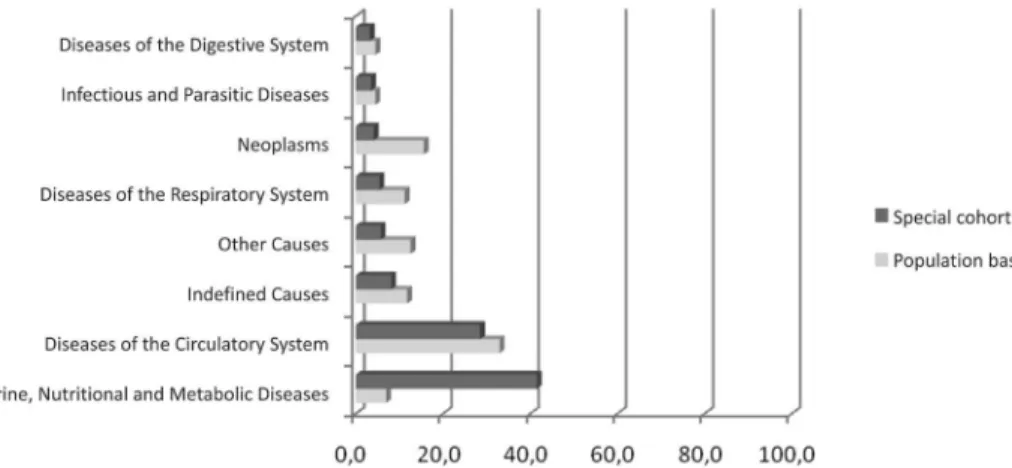
were due to “other ill-defined”, “unspeci-fied” or “unknown causes of death” (code R99) for both sexes. Among the deaths from Diseases of the Respiratory System (chapter X: 5.4%), which ranked fourth, there was no expressive predominance by specific cause or sex. In the population base, Endocrine, Nutritional and Metabolic Diseases (6.9%) were the sixth most important cause of de-ath per ICD-10 chapter, with an emphasis on DM (code E14.5), responsible for 77.7% of these deaths. Deaths from Diseases of the Circulatory System (chapter IX) were the first most important cause of death in the population base (approximately 33.0%), especially due to stroke (I64) in both sexes (32.0% for males and 35.0% for females). Next came Deaths from Neoplasms (chapter II: 15.6%), with an emphasis on neoplasm of trachea (C33); bronchus or lung (C34.9), affecting 18.6% of men; and breast (C50.9), affecting 8.7% of women, while Deaths from Ill-defined Causes ranked third (R00 to R99: 11.8%). Proportional deaths according to underlying cause of death (ICD-10 chapters) of the cohort and population base were shown in Figure 1.
Table 1 shows the distribution of dea-ths by natural causes with a report of DM,
according to the place where this was men-tioned in the death certificate (underlying cause or associated cause) of individuals of the special cohort (363) and of the popu-lation base (381,646). In the cohort, 41.0% of deaths had DM as the underlying cause, nearly seven times that corresponding to the population base of the state of Rio de Janeiro (5.6%). Among the deaths whose un-derlying cause was categorized in the group comprised of the remaining natural causes of death other than DM, this specific cause of death (associated cause) was only repor-ted in 11.6% of the death certificates of the special cohort and 4.4% of the population base. The highest frequency of reports of this cause was found in Part II (other significant conditions contributing to death) of the DC, when compared to Part I (diseases related to the chain of pathological events that led directly to death), both in the cohort and the population base. Considering all DC with a report of DM (underlying cause and asso-ciated cause), an increase in proportional mortality of nearly 30.0% and 80.0% was observed in the special cohort and popu-lation base respectively, compared to the values obtained when only DM is analyzed as underlying cause of death.
Figure 1 - Proportional mortality according to underlying cause of death (Chapter of the International Classiication of Diseases 10th Revision) in a special cohort of inpatients aged 30
or more submitted to lower limb amputation (LLA) as a result of diabetes mellitus, and in the population base of the State of Rio de Janeiro (RJS) – 2000 to 2003.
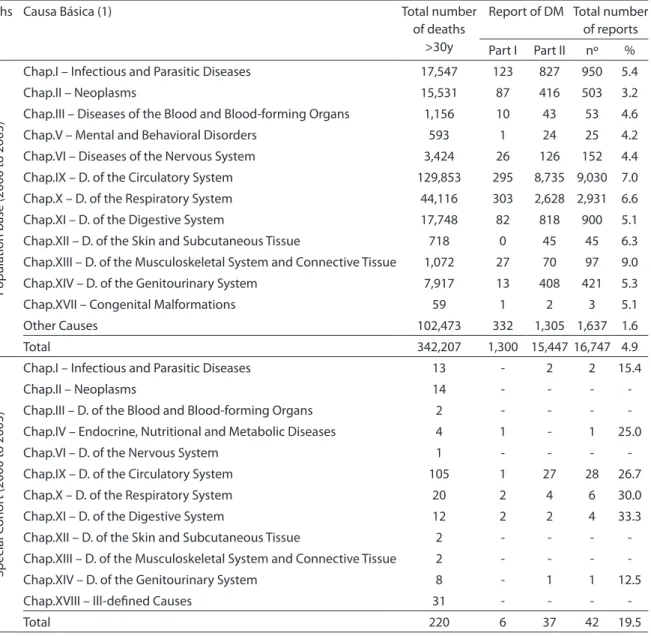
Reporting DM in the DC of the special cohort was more frequent among the deaths from underlying causes belonging to the group of diseases of the digestive system (33.3%), respiratory system (30.0%) and circulatory system (26.7%) (Table 2). In the population base, the highest percentage re-lative frequencies of report of DM occurred among deaths from causes whose absolute frequencies were irrelevant: Diseases of the Eye and Adnexa (two reports of DM in a to-tal of six deaths, nearly 33%) and Diseases of the Ear (13 reports of DM in 41 deaths, nearly 32%) (Table 2). Considering the total number of reports of DM in the DC, 41 in the special cohort and 16,747 in the population base, the most frequent underlying causes belonged to the chapter of Diseases of the Respiratory System, totaling 68.2% and 53.9%, respectively.
Discussion
In the special cohort, the risk of death from all causes was 22 times higher than that of the population base and the main causes of death (ICD-10 chapters) were endocrine, nutritional and metabolic diseases (essen-tially because of the specific DM cause), followed by diseases of the cardiovascular
system, the first cause of death in the po-pulation base. DM was mentioned 7.0 and 2.6 times more as an underlying cause and associated cause of death, respectively, in the special cohort than in the population base. These results are expected, as this was a cohort of individuals who were hospita-lized in the SUS to have their lower limbs amputated as a result of DM, thus being in an advanced stage of disease. Similar results
were found in a population-based study14-17.
In the Wisconsin Epidemiologic Study of Diabetic Retinopathy, diabetic individuals had excessive general mortality from DM and cardiovascular diseases, when compa-red to the general population (standardized mortality rates were 7.5, 191 and 9.1 times higher, respectively)15.
The aging of the population associated with the higher prevalence of chronic--degenerative comorbidities, which usually have a long duration, may make it difficult for researchers to select a single underlying
cause at the moment of death18, which can
partly explain the underestimation of DM in the statistics of mortality by underlying cause of death. The methodology of mul-tiple causes (MC) enabled an increase in the frequency of DM among deaths of 30% and 80%, when compared to the statistics
Table 1 - Proportional mortality according to mention of diabetes mellitus (DM) as cause of death in a special cohort of inpatients aged 30 or more submitted to lower limb amputation as a result of DM, and in the population base of the State of Rio de Janeiro (RJS) – 2000 to 2003.
Tabela 1 - Mortalidade Proporcional segundo menção de diabetes mellitus (DM) em indivíduos com 30 anos ou mais na coorte de indivíduos com amputação de membros inferiores consequentes ao DM em 2000 e na base populacional do Estado do Rio de Janeiro - 2000 a 2003.
Causes of Natural Deaths* Cohort Population Base
No % No %
Underlying cause diabetes mellitus (DM) 149 41.0 21,238 5.6
DM 42 11.6 16,746 4.4
Part I of the Death Certiicate** 6 1.7 1,300 0.3
Part II of the Death Certiicate *** 36 9.9 15,446 4.0
Multiple Cause DM 191 52.6 37,984 10.0
Other natural causes without a report of DM 172 47.4 343,662 90.0
Total number of Deaths* 363 100.0 381,646 100.0
* deaths due to injuries excluded from the analysis / excluídos óbitos por causas externas
** consequential causes of deaths / causas consequenciais
Table 2 - Frequency of total natural cause deaths and of deaths with mention of diabetes mellitus (DM) according to the underlying natural cause (Chapter of the International Classiication of Diseases 10thRevision - CID-10) in individuals aged 30 or more in a special cohort of inpatients submitted to lower limb amputation as a result of DM, and in the population base of the State of Rio de Janeiro (RJS) – 2000 to 2003.
Tabela 2 – Frequência de óbitos por causas naturais total e com menção de diabetes mellitus (DM) entre os óbitos segundo causa básica natural por capítulo da Classiicação Internacional de Doenças 10a Revisão (CID-10), em indivíduos com 30 anos ou mais na coorte de pacientes com amputação de membros inferiores consequentes ao DM e na base populacional do Estado do Rio de Janeiro - 2000 a 2003.
Deaths Causa Básica (1) Total number
of deaths >30y
Report of DM Total number of reports
Part I Part II nº %
Popula
tion base (2000 t
o 2003)
Chap.I – Infectious and Parasitic Diseases 17,547 123 827 950 5.4
Chap.II – Neoplasms 15,531 87 416 503 3.2
Chap.III – Diseases of the Blood and Blood-forming Organs 1,156 10 43 53 4.6
Chap.V – Mental and Behavioral Disorders 593 1 24 25 4.2
Chap.VI – Diseases of the Nervous System 3,424 26 126 152 4.4
Chap.IX – D. of the Circulatory System 129,853 295 8,735 9,030 7.0
Chap.X – D. of the Respiratory System 44,116 303 2,628 2,931 6.6
Chap.XI – D. of the Digestive System 17,748 82 818 900 5.1
Chap.XII – D. of the Skin and Subcutaneous Tissue 718 0 45 45 6.3
Chap.XIII – D. of the Musculoskeletal System and Connective Tissue 1,072 27 70 97 9.0
Chap.XIV – D. of the Genitourinary System 7,917 13 408 421 5.3
Chap.XVII – Congenital Malformations 59 1 2 3 5.1
Other Causes 102,473 332 1,305 1,637 1.6
Total 342,207 1,300 15,447 16,747 4.9
Special C
ohor
t (2000 t
o 2003)
Chap.I – Infectious and Parasitic Diseases 13 - 2 2 15.4
Chap.II – Neoplasms 14 - - -
-Chap.III – D. of the Blood and Blood-forming Organs 2 - - -
-Chap.IV – Endocrine, Nutritional and Metabolic Diseases 4 1 - 1 25.0
Chap.VI – D. of the Nervous System 1 - - -
-Chap.IX – D. of the Circulatory System 105 1 27 28 26.7
Chap.X – D. of the Respiratory System 20 2 4 6 30.0
Chap.XI – D. of the Digestive System 12 2 2 4 33.3
Chap.XII – D. of the Skin and Subcutaneous Tissue 2 - - -
-Chap.XIII – D. of the Musculoskeletal System and Connective Tissue 2 - - -
-Chap.XIV – D. of the Genitourinary System 8 - 1 1 12.5
Chap.XVIII – Ill-deined Causes 31 - - -
-Total 220 6 37 42 19.5
*Excluded Chapter IV (ICD- 10) - Endocrine, Nutritional and Metabolic Diseases. *Excluído o Capítulo IV (CID-10) – Doenças Endócrinas, Nutricionais e Metabólicas.
of mortality from underlying cause (UC) in the special cohort (UC: 41.0% and MC: 52.6%) and population base (UC: 5.6% and MC: 10.0%) respectively. However, 52.0% of reporting of DM in the DC in the special cohort of diabetics was considered to be low.
DM in the DC of American diabetics was approximately 36% and 47% among males and females, respectively14.
Considering the peculiarity of the cohort analyzed, the quality of certification of cau-ses of death completed in the DC was consi-dered to be poor due to the low percentage of reporting of DM, 41.0% as an underlying cause and 11.6% among the deaths from the remaining natural underlying causes, and due to the high proportion of deaths from ill-defined underlying causes, 8.1%. If all the DC with a certified ill-defined underlying cause had a report of DM in the Cause-of-Death Section (Part I or II), their underlying cause would be DM rather than ill-defined, increasing the proportional mortality from DM (underlying cause) to approximately 49.0%. The situation of lack of information about DM in the death certificate becomes worse when considering the fact that, in the special cohort, 49 out of every 100 deaths occurred in the first year after amputation resulting from DM. Even if the doctor com-pleting the certificate does not consider DM as an underlying cause of death, they should record it as a contributing cause in Part II of the Cause-of-Death Section of the DC, as these cases showed a concrete aspect of development of the disease, the lower limb amputation resulting from DM. Another piece of information that should be included in death certificates is the ampu-tation of lower limb(s), not assessed in the present study. This study retrieved informa-tion about underlying cause defined for all deaths categorized as ill-defined underlying cause in the special cohort.
With regard to the population base, the quality of certification of causes of death completed in the DC was assessed by the percentage of ill-defined underlying causes,
11.8% in the four years analyzed, a percen-tage considered to be satisfactory. Although it was impossible to reduce mortality from ill-defined causes in the population to zero3,
the value found was approximately two to three times higher than the acceptable values.
In conclusion, despite the development in the information from SIM in recent deca-des, great investment is required to improve the quality of certification of causes of death, promoting a continuous debate on the correct completion of death certifica-tes with doctors and medical students an on the codification of causes of death and selection of underlying causes with health service technicians. The alternative for the investigation of deaths to improve the qua-lity of information must complement other methodologies that have a lower cost and greater feasibility of implementation by he-alth services. The methodology developed in the present study was adequate, aiming to qualify the SIM in terms of causes of death in death certificates, according to the linkage between the hospitalization database (SIH-SUS) and the mortality database (SIM). After associating the databases with each other, researchers found that individuals whose underlying cause of death was recorded as “undetermined” had been submitted to a medical procedure (5.6%) in 2000, the same year of their death. Other official databases
have also been used, such as the Sistema
de Informações de Agravos de Notificação
(SINAN – Information System for Notifiable Diseases). In addition, it is necessary to include the hospital investigation of deaths into the activities of the services responsible for vital data in cities, especially when the term “undetermined cause” is declared as the underlying cause of death.
References
1. Mello Jorge, MHP, Gotlieb, SLD. As condições de saúde no Brasil: retrospecto de 1979 a 1995. Rio de Janeiro: Ed. FioCruz; 2000.
3. Laurenti R, Mello Jorge MHP, Gotlieb SLD. A
confiabilidade dos dados de mortalidade e morbidade por doenças crônicas não-transmissíveis. Ciência & Saúde Coletiva 2004; 9(4): 909-20.
4. Ishitani LH, França E. Uso das Causas Múltiplas de Morte em Saúde Pública. Informe Epidemiológico do SUS 2001; 10(4): 163-74.
5. Navarro N, Santos SP, Cascão AM. Mortalidade por causas múltiplas em idosos no município do Rio de Janeiro em 1993 e 2000. In: IV Bienal de Pesquisas FioCruz 2004, Rio de Janeiro, RJ. CD. Resumos IV Bienal de Pesquisa FioCruz, 2004). Disponível em http://www. sbis.org.br/cbis9/arquivos/155.dochttp://www.sbis.org. br/cbis9/arquivos/155.doc [Acessado em 23/01/11]
6. Spichler D. Amputações maiores de membros inferiores no Município do Rio de Janeiro, por doença arterial periférica e diabetes mellitus: incidência, mortalidade hospitalar e tardia. Período 1990 – 2000 [tese de doutorado] São Paulo: Escola Paulista de Medicina da Universidade Federal de São Paulo; 2003
7. Maya LG. Confiabilidade do diabetes mellitus referido como causa de morte: análise comparativa da mortalidade segundo método de causas múltiplas, Niterói (RJ), 1993 a 2000 [dissertação de mestrado]. Rio de Janeiro: Escola Nacional de Saúde Pública – FioCruz; 2003.
8. Ministério da Saúde. DATASUS. Informações em Saúde. Demográficas e Socioeconômicas. Disponível em http:// tabnet.datasus.gov.br/cgi/deftohtm.exe?ibge/cnv/ poptrj.def [Acessado em 23/01/11]
9. Organização Mundial da Saúde. Classificação Estatística Internacional de Doenças e Problemas Relacionados à Saúde-10a Revisão. São Paulo: CBCD/EDUSP; 1995.
10. Cascão AM, Kale PL. Relacionamento das bases de dados de amputação de membros inferiores por diabetes mellitus: uma estratégia para melhoria da qualidade da informação sobre causas de morte no Estado do Rio de Janeiro. Cad Saúde Coletiva 2006; 14(2): 361-74. Disponível em http://www.iesc.ufrj.br/csc/ indice_0602.htm.
11. Laurenti, R, Buchalla, CM. A elaboração de estatísticas de mortalidade segundo causas múltiplas. Rev Bras Epidemiol 2000; 3(1-3): 21-8.
12. Laurenti R, Mello Jorge MHP, Gotlieb SLD. Informação em mortalidade: o uso das regras internacionais para a seleção da causa básica. Rev Bras Epidemiol 2009; 12(2): 192-203.
13. Mello Jorge MH, Laurenti R, Gotlieb SLD. Análise da qualidade das estatísticas vitais brasileiras: a experiência de implantação do SIM e do SINASC. Ciência e Saúde Coletiva 2007; 12(3): 643-54.
14. Gu K, Cowie CC, Harris MI. Mortality in adults with and without diabetes in a National Cohort of the U.S. Population, 1971–1993. Diabetes Care 1998; 21(7): 1138-45.
15. Scot E, Moss MA, Klein R, Klein BEK. Cause-specific mortality in a population-based study of diabetes. Am J Public Health 1991; 81(9): 1158-62.
16. Melo MS, Lolio CA, Lucena MAF, Kizner CF, Martins SM, Barros MNDS. Causas múltiplas de morte em diabéticos no município de Recife, 1987. Rev Saúde Pública 1991; 25(6): 435-42.
17. Laurenti R, Fonseca LAM, Costa Junior ML. Mortalidade por diabetes mellitus no município de São Paulo (Brasil). Evolução num período de 79 anos (1900-1978) e análise de alguns aspectos sobre associação de causas. Rev Saúde Publica 1982; 16: 77-91.
18. Oliveira BZ, Gotlieb SLD, Laurenti R, Mello Jorge MHP. Mortalidade feminina por hipertensão: análise por causas múltiplas. Rev Bras Epidemiol 2009; 12(4): 556-65.