a systemaic review
Mariana Parreiras Reis de Castro 1, Guilherme Cafure Antunes 2, Lívia Maria Pacelli Marcon 3, Lucas Silva Andrade 4, Sarah Rückl 5, Vera Lúcia Ângelo Andrade 6
Abstract
In 2015 the issue of assisted death was widely publicized by the internaional media ater the irst legal eu
-thanasia case was held in Colombia. Also in this same year, assisted suicide was legalized in Canada and in the
state of California in the United States. Currently, assisted death is allowed in four Western European coun
-tries: Netherlands, Belgium, Luxembourg and Switzerland; two North American coun-tries: Canada and the
US, in the states of Oregon, Washington, Montana, Vermont and California; and Colombia, the sole represen
-taive in South America. From a systemaic literature review, this work aims to establish the prevalence and the criteria adopted for the pracice of euthanasia and assisted suicide in western countries and to discuss the posiion of similar countries where this pracice is not recognized. A beter understanding of the subject appears to be criical to the formaion of opinions and the encouragement of further discussions.
Keywords: Assisted death. Euthanasia. Assisted suicide. Palliaive care.
Resumo
Eutanásia e suicídio assisido em países ocidentais: revisão sistemáica
Em 2015 a temáica da morte assisida foi amplamente divulgada pela mídia após o primeiro caso legal de eutanásia ter sido realizado na Colômbia. Além disso, no mesmo ano, o suicídio assisido foi legalizado no Canadá e no estado da Califórnia, nos Estados Unidos. Atualmente, a morte assisida é permiida em quatro países da Europa Ocidental: Holanda, Bélgica, Luxemburgo e Suíça; em dois países norte-americanos: Canadá e Estados Unidos, nos estados de Oregon, Washington, Montana, Vermont e Califórnia; e na Colômbia, único representante da América do Sul. A parir de revisão sistemáica da literatura, objeivou-se estabelecer a prevalência e os critérios adotados para a práica da eutanásia e do suicídio assisido em países ocidentais e discuir a posição de países onde essa práica não é reconhecida. Uma melhor compreensão do assunto mostra-se fundamental para a formação de opiniões e fomento de futuros debates.
Palavras-chave:Morte assisida. Eutanásia. Suicídio assisido. Cuidado paliaivo.
Resumen
Eutanasia y suicidio asisido en países occidentales: una revisión sistemáica
En 2015, el tema de la muerte asisida fue ampliamente difundida por los medios del mundo después de que el primer caso de la eutanasia legal haya sido realizado en Colombia. También, ese año el suicidio asisido fue legalizado en Canadá y en el estado de California en Estados Unidos. Actualmente, el suicidio asisido está permiido en cuatro países de Europa occidental: Países Bajos, Bélgica, Luxemburgo y Suiza; dos países de América del Norte: Canadá y Estados Unidos, en el estado de Oregon, Washington, Montana, Vermont y California; y Colombia, único representante de América del Sur. A parir de una revisión sistemáica de la literatura, se planteo como objeivo determinar la prevalencia y los criterios adoptados para la prácica de la eutanasia y el suicidio asisido en los países occidentales y discuir la posición de países similares donde no se
reconoce esta prácica. Una mejor comprensión de la materia parece ser críica para la formación de opinio
-nes y el fomento de las futuras discusio-nes.
Palabras clave:Muerte asisida. Eutanasia. Suicidio asisido. Cuidado paliaivo.
1. Graduanda [email protected] – Universidade José do Rosário Vellano (Unifenas), Belo Horizonte/MG 2. Graduando gc_ [email protected] – (Unifenas), Belo Horizonte/MG 3. Graduanda [email protected] – (Unifenas), Belo Horizonte/MG 4. Graduando [email protected] – (Unifenas), Belo Horizonte/MG 5. Doutora [email protected] – Universidade de Heidelberg, Heidelberg, Alemanha 6. Doutora [email protected] – Universidade Federal de Minas Gerais, Belo Horizonte/MG, Brasil.
Correspondência
Lívia Maria Pacelli Marcon – Rua Aimorés, 2165, apt 301 Bairro Lourdes CEP 30140-072. Belo Horizonte/MG, Brasil.
Declaram não haver conlitos de interesse.
R
esear
Historically, the word euthanasia means “good
death”, in other words, death without pain,
with-out sufering. In the twenieth century, during the Third Reich, the word gained a negaive connotaion when it was improperly used in Nazi policies aimed at eliminaing lives that were considered not worthy
to exist 1. Subsequently, ater the word was demy
-siied, discussions on the topic resurfaced, and, currently, the pracice of euthanasia, in its classic
sense, is allowed in some countries. In a more con
-temporary deiniion, euthanasia can be understood
as employment or abstenion of procedures that al
-low acceleraing or inducing the death of incurably ill paients, in order to free them from the extreme
sufering that torments them 1.
As for the paient’s consent, euthanasia can be classiied into non-voluntary and voluntary – the
irst takes place without knowing the will of the pa
-ient, and the second in response to the expressed
wishes of the paient 1. The later difers from assist
-ed suicide as it is perform-ed by a physician, while in assisted suicide the paient is the one who performs the inal acion.
Both from the medical and from the legal point of views, there is a big diference between “killing”
and “leing die” 2. Therefore, regarding the act,
euthanasia is divided into acive and passive, the
irst of which denotes the deliberate act of induc
-ing death without the paient sufer-ing (us-ing, for example, lethal injecion), and the second refers to death by deliberate omission to start medical acion that would guarantee the prolongaion of survival. It is worth noing the vagueness of the disincion
between passive euthanasia and orthothanasia,
which refers to “death at the right ime”, since there
is no real boundaries between” not intervening and
simply leing die” and “leing die in the seemingly
correct ime” 1.
The term “assisted death” or “assisted dy
-ing” encompasses both the concept of euthanasia
and assisted suicide 2, both subjects of ongoing de
-bates in today’s society. Four European, one South American and two North Americans countries have legalized euthanasia and/or assisted suicide, but the law of these countries difer considerably regarding
the pracices 3.
In July 2015, the topic was widely reported
by the media ater the irst legal case of euthana
-sia was performed in Colombia 4. In the same year,
assisted suicide was legalized in Canada and in the
state of California, in the United States (US) 4. Given
the divergent views and the general interest of the
community on the subject, having knowledge of the
experience and the views of various countries
re-garding the issue is essenial to form opinions 3. This
is sill a very controversial debate and - regardless
of poliical, religious or moral aspects– it is funda
-mentally a human issue 2. Thus, the objecive of this
work is to establish the prevalence and the criteria adopted for the pracice of euthanasia and assisted
suicide in Western countries and to discuss the
po-siion of other countries where the pracice is not recognized.
Method
This work consists of a systemaic review of the literature. The words “euthanasia,” “assisted suicide”, “Netherlands”, “Belgium”, “Luxembourg”,
“Switzerland”, “United Kingdom”, “Brazil”, “Co
-lombia” “Canada” and “United States” were used,
in English and Portuguese, as keywords for the re
-search. To idenify the publicaions that composed
this study, an online search was done in the follow
-ing databases: Scieniic Electronic Library Online
(SciELO), Naional Center for Biotechnology Infor
-maion (PubMed) and Google Scholar. The MeSH tool was used to help the search and categorizaion of aricles.
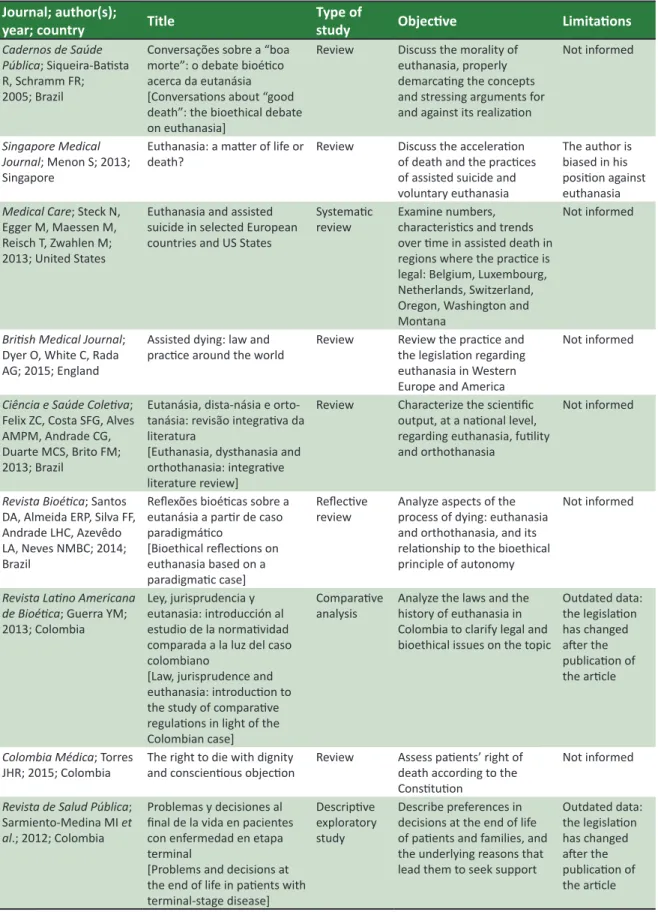
The research was based on 19 publicaions relevant to the topic invesigated. A list with these publicaions is presented at the end in Appendix 1.
The following previously established inclusion cri
-teria were considered: original works or reviews, available in full, published between 2005 and 2015. The aricles that did not it the inclusion criteria
were removed from the sample. Regarding the ex
-clusion criteria, we considered duplicated aricles, publicaions prior to 2005 and those that, despite
having the selected descriptors, did not directly ad
-dress the proposed topic. In addiion, recent news
aricles, websites and oicial reports from the coun
-tries menioned were consulted to update data. Moreover, some aricles were suggested by experts.
Method and results
The selecion of items for systemaic review was done according to the low chart (Figure 1).
Based on these publicaions, Table 1 briely de
-scribes informaion regarding the journal, author, year of publicaion, aricle itle, type of study,
objecive and limitaions presented by the publica
-ions studied.
R
esear
Databases
Pubmed, SciELO, Google Scholar
Criteria for inclusion
- Aricles available in full
- Published between 2005 and 2015
- Original or review
Criteria for exclusion
- Duplicity in aricles - Publicaion prior to 2005 - Did not directly address the proposed theme: exclusion made through the itle and the summary
Keywords
Euthanasia, assisted suicide, Brazil, Colombia, Canada, United
States, Belgium, Luxembourg, Switzerland and United Kingdom
Aricles selected: 422
Aricles selected: 15
Aricles used: 19
Total referencess: 49
Aricles recommended by experts: 4
* Other sources
- Oicial sites of the countries surveyed
- Oicial reports, documents
and database
- Recent newspaper aricles
Figure 1. Selecion of studies
Discussion
Assisted death is allowed in four Western European countries: the Netherlands, Belgium, Luxembourg and Switzerland; two North American countries: Canada and the United States, in the
states of Oregon, Washington, Montana and Ver
-mont; and in South America: in Colombia 4. The laws
and criteria adopted for the purposes of this
prac-ice difer in each country. Explaining how assisted death occurs in these locaions and compare their
legislaion to that of other similar countries in so
-cio-economic and cultural aspects allows a beter understanding of the subject, and works as a basis
for future discussions 2. The situaion in Brazil and
the UK has been addressed at the end of this paper in order to compare the posiion of other countries and enrich the discussion. The imeline with key
milestones regarding assisted death in the world is
presented in Appendix 2 to facilitate understanding.
Colombia
Colombia is the only country in Lain Ameri
-ca where euthanasia is permited. Although it was
decriminalized in 1997 by the Consituional Court,
only in April 2015 the Ministério da Saúde (Minis
-try of Health) deined how it might occur. Unil that date, it was classiied as “murder by compassion” according to Aricle 326 of the Criminal Code, and
the lack of well-established criteria for its realiza
-ion, coupled with the controversial legisla-ion, generated ambiguity, conlicing interpretaions and
uncertainies regarding the mater 4,5.
Currently, the pracice is regulated by Reso
-luion 12116/2015 from the Ministério da Saúde e Proteção Social (Ministry of Health and Social
Protecion), which establishes criteria and proce
-dures to ensure the right to death with dignity 6,7.
Intravenous drugs can be administered by physi
-cians, in hospitals, to adult paients with terminal diseases that cause intense pain and sufering that cannot be relieved. The paient must consciously request assisted death, which must be authorized and supervised by a specialist doctor, a lawyer, and a psychiatrist or psychologist. Moreover, the current
legislaion does not prohibit this procedure for for
-eign paients 4.
Only one case of euthanasia has been re
-ported so far in the country, on the 3rd July 2015.
R
esear
It was Ovídio Gonzáles (79) who was stricken by a rare facial cancer that, although not metastasized,
caused intense chronic pain 4. Therefore, in view of
the recent legalizaion, it is necessary to invest in the training of physicians and health professionals
to deal with end of life ethical dilemmas 5,8.
United States
Assisted suicide is legal in ive of the ity US states: Oregon, Washington, Montana, Vermont and
California 4,9. In 2014, New Mexico passed legislaion
consistent with the pracice, but the decision was
reversed on appeal in August 2015 4. On the other
hand, euthanasia is banned in all states 2.
The irst state to legalize assisted suicide was
Oregon, on the 27th October 1997, with the approval
of the “Death with Dignity Act” 10, which allows
com-petent (able to consciously express their will) adults
(from the age of 18), residents in Oregon, with ter
-minal illnesses and life expectancy of less than six months, to receive medicaions in lethal doses, through voluntary self-administraion, expressly prescribed by a doctor for this purpose. According to the Act, the self-administraion of these lethal drugs
is not considered suicide, but death with dignity 3,11.
It is worth noing that many Catholic hospitals have
opted out from this pracice 4.
Since the law was passed in 1997 unil the
end of 2014, 1,327 people received the prescrip
-ion of lethal medica-ion, and of those, 859 died ater self-administraion. Six people woke up ater
the procedure, and most died within days. Some pa
-ients for whom the medicaion was prescribed died before administraion, others waited to receive it,
and some cases were not properly noiied 12.
Of the 859 people who received lethal medi
-caion, 52.7% were men, predominantly in the age group between 65 and 74, with higher educaion or
post-graduaion degree (45.9%). In 78% of the cas
-es, the disease was cancer, followed by amyotrophic lateral sclerosis (ALS) at 8.3%. Most paients died at home (94.6%) and received palliaive care. The most
common concerns of these paients were loss of au
-tonomy, menioned by 91.5% of them, loss of ability to paricipate in aciviies that make life enjoyable
(88.7%) and loss of dignity (79.3%) 12.
In March 2009, the State of Washington ap
-proved its “Death with Dignity Act”, almost idenical to the one from Oregon, by which competent adults living in the area, with a life expectancy of six months or less, may require self-administraion of a lethal
medicaion prescribed by a doctor 3,4,13. From 2009
to 2014, 724 people received prescripions for lethal
medicaion, of these, 712 died ater self-adminis
-traion. The situaion of paients who received the
prescripions but did not use them is unknown 13. As
in Oregon, the staisics show, among the deaths, a higher incidence of men between 65 and 74 of age, with high educaion. The predominant underlying
disease was also cancer, followed by neurodegener
-aive diseases 13.
In the state of Montana, the Supreme Court
ruled on the 31st December 2009, that assisted sui
-cide was not illegal, ater the case of the paient Robert Baxter, a 76 year-old reired truck driver,
carrying a terminal form of lymphocyic leuke
-mia 14. Unlike other states, Montana law is not as
well-regulated on the subject. According to the
Supreme Court, paients should be adults, men
-tally competent and sufer from terminal illnesses to request lethal medicaion. The act is secured by rights of privacy and dignity established by the consituion, and the doctors who assist are also
protected by law 3,14,15.
In Vermont, assisted suicide was legalized on
the 20th May 2013 by Act 39 – regarding “paient
choice and control at end of life”. The Departamen
-to de Saúde estadual (state Department of Health) suggested that by 2016, physicians and paients were gradually adhering to the proposal of the Act, since many hospitals opted out, staing they were not ready to implement it. In any case, the right to
assisted death is reserved for adult paients, resi
-dents of Vermont, with life expectancy shorter than six months, who are able to voluntarily request and
self-administer the medicaion dose 4,16.
On the 5th October 2015, Jerry Brown, gover
-nor of California, signed the Assembly Bill No. 15, also referred to as the “End of Life Opion Act”,
allowing assisted suicide for competent adults, res-idents in the state, with terminal illnesses and life
expectancy of less than six months 17. The law, which
came into force in 2016, was based on the Act from
Oregon, from 1997. Its approval resumed old discus
-sions about assisted death 18,19. At the ime the law
was passed, the governor stated that, in the end, he
was led to relect on how he would act in the face of his own death. The governor declared that he would not know what to do if he was dying with prolonged and excruciaing pain. Also, he pointed out that it was comforing to be able to consider the opions ofered by the Oregon Act and would not deny that
right to others
R
esear
Canada
In February 2015, ater six years of debate in the
Supreme Court, with the cases of paients Kay Car
-ter and Gloria Taylor, Canada suspended the ban on
euthanasia and assisted suicide 4, 20-22. A grace period
of one year was established, during which the feder
-al and provinci-al government of Canada, as well as
health professionals, were to prepare themselves to
implement the new law. In January 2016, the deadline was extended for four months, extending the oicial legalizaion of assisted death and the deadline for
provincial governments to establish their guidelines to the 6th June. If this does not happen, the acivity is
going to be legal in the country, but not regulated in certain provinces, which will give physicians freedom to modify their own behaviour. Moreover, by that
date, in un-regulated territories, aid to assisted death
can be obtained through legal concessions 22-24.
Quebec was the irst province to regulate assisted death through the “Act Respecing End-of-Life Care”, which entered into force in December 2015. Approved in the previous year, and based on Oregon’s legislaion, the Act covers capable adults
who were diagnosed with serious and incurable diseases, advanced and irreversible decline of their
capabiliies, and intense physical and psychological sufering. However, it does not require a maximum
life expectancy of six months 4,24,25. According to the
Act, “medical aid in dying” is the administraion by a physician, of a lethal substance, following the
paient’s request 25. This pracice characterizes ac
-ive voluntary euthanasia, although the term is not
used explicitly in the document. The Canadian me
-dia announced in January 2016 that the irst case of assisted death was conirmed by health authoriies in Quebec, which did not provide informaion about
the procedure and the paient’s proile 26,27.
The other Canadian territories have also mobi
-lized themselves for the regulaion of assisted death.
In November 2015, a group created by the provin
-cial government issued an advisory report to the
provinces, aiming to draw up their own guidelines 28.
In January 2016, the College of Physicians and Surgeons of Ontario published the “Interim Guidance on Physician-Assisted Death”, regulaing euthanasia
and assisted suicide, with criteria similar to those
adopted by Quebec 22. In the same month, in a press
aricle 29, a lawyer from the Canadian Jusice De
-partment expressed his concerns regarding the new
changes. According to him, the country will face a
major challenge in the management of issues relat
-ed to assist-ed death, as the country’s health policies are regulated by provincial laws, while criminal laws
are under naional jurisdicion. To avoid problems, authoriies suggested uniied naional guidelines,
despite the short ime to regulate 29.
The Netherlands
In April 2002, both euthanasia and the assisted
suicide were regulated and became no longer
pun-ishable in the Netherlands, ater more than thirty years of debate. Before legalizaion, these pracices
were tolerated for a few decades, having been
re-ported by Dutch doctors since 1991 3,4,30.
The process of assisted death should it into
several criteria very similar to those applied in Bel
-gium and Luxembourg. In all three countries, the paient must be competent, carry out the request voluntarily, and have chronic condiions that cause
intense physical or psychological sufering. The phy
-sician should inform the paient about his or her health status and life expectancy and, together,
reach the conclusion that there is no reasonable
al-ternaive. Also, another doctor should be consulted
about the case, and all procedures should be
report-ed to the authoriies 3,4,30.
People with demenia are also eligible, as well as children, aged between 12 and 17, with proven mental capacity. Parents or guardians must also agree to act in the case of paients between 12 and 15 years old, and join the discussions for
paients between 16 and 17 years old. In some spe
-ciic circumstances, assisted death may also apply to newborns, according to the regulaions of the
“Groningen Protocol”, from 2005 4,31.
Between September 2002 and December 2007, 10,319 cases were reported. Of these, 54% were male, 53% were between 60 and 79 years old
and 87% were diagnosed with cancer 30. In 2013,
4,829 cases were reported, and 78.5% of these oc
-curred at home. In recent years, ive doctors (0.1% of cases) were judged for not fulilling the criteria
set out in the legislaion 4,30.
Belgium
Since September 2002, voluntary euthanasia
has been allowed in Belgium for mentally compe
-tent people, sufering from incurable condiions,
including mental illness, which cause unbearable
physical or psychological sufering. The assisted
suicide is not explicitly regulated by law, but cas
-es reported to the Comissão Federal de Controle e Avaliação de Eutanásia (Federal Evaluaion and Control Commission for Euthanasia) are treated the
same as euthanasia 3,4.
R
esear
The Belgian legislaion is similar to the Dutch one, however, if the paient is not terminal, the
doctor should consult an independent third
par-ty specialist, and at least one month should pass between the paient’s request and the euthanasia
procedure 3,30.
On the 13th February 2014, Belgium removed
the age restricion for euthanasia, despite strong opposiion from religious people and from some members of the medical profession. Before this change, the legislaion of euthanasia already applied
to adolescents over 15 years old, legally emancipat
-ed by legal decree. In any case, in the last twelve years, the Federal Commission reported only four cases involving paients younger than 20, and none
of them was a child 32.
With the new legislaion, children of any age may require euthanasia, provided they are able to understand the consequences of their decisions, as ceriied by a child psychologist or psychiatrist. The child must be in terminal condiion, with constant and unbearable physical sufering, which cannot be relieved. The child’s decision should be supported by their parents or legal guardians, who have veto
rights 31. Although the age restricion is not imposed
by law, the child must show discernment capacity and be conscious at the ime of making the request. These prerequisites limit the range of children who might qualify, and the forecast is that the changes,
although very important, will not have such a signif
-icant impact 31.
According to the Federal Commission between
2010 and 2014, reported cases almost doubled, in
-creasing from 953 to 1,807. The prevalence remains
men, aged between 60 and 79, with cancer; howev
-er, a recent study showed increased requests from paients older than 80 and with other diseases. Furthermore, it is esimated that 44% of assisted deaths occur in hospitals, 43% at home and 11% in
nursing homes 4,30,32.
Luxembourg
On the 16th March 2009, euthanasia and as
-sisted suicide were legalized in Luxembourg, and are currently regulated by the Comissão Nacional de Controle e Avaliação (Naional Commission for Control and Assessment). The law covers competent
adults, people with incurable and terminal diseases
that cause physical or psychological constant and
unbearable sufering, with no possibility of relief 4, 34.
The paient must request the procedure
through his or her “end-of-life provisions”, which is a
writen document that is obligatorily registered and analysed by the Comissão Nacional de Controle e
Avaliação (Naional Commission for Control and As
-sessment). The document also allows the paient to
record the circumstances in which he or she would
like to be submit to assisted death, which is per
-formed by a physician who the applicant trusts. The request may be revoked by the paient at any ime,
and in this case will be removed from the medical
record 34. Before the procedure, the physician should
consult another independent expert, the paient’s health team, and a “trusted person” appointed by the paient; ater its compleion, the death must be
reported to the Commission within eight days 4,34.
According to the Commission’s last report, between 2009 and 2014, 34 cases of assisted death
had been registered. Of these, 21 were female, pre
-dominantly aged between 60 and 79; 27 had cancer
and 22 underwent the procedure in a hospital 35.
Switzerland
Assisted suicide is permited in Switzerland
and, in accordance with Aricle 115 of the Códi
-go Penal (Penal Code) of 1918, the pracice is only punishable when performed for “non-altruisic”
reasons 3,4. Unlike other countries, such as the Neth
-erlands, and some US states, assisted suicide is not clearly regulated, and there are no speciic laws that
determine under what condiions a person can re
-quest assistance 36.
Although Aricle 115 was not originally devel
-oped for the regulaion of this pracice, from the
1980s onwards many insituions who support as
-sisted death used it as a basis to jusify their acions. Currently, six acive insituions are responsible for most cases of assisted suicide in the country, with
diferent criteria for selecing candidates 3, 36.
Only three insituions restrict the procedure
for terminally ill paients, and in four of them for
-eigners can also undertake the procedure. It is
esimated that between 2008 and 2012, 611 for
-eigners, including a Brazilian, 268 from Germany and 126 from the UK, received lethal medicaion. During this period, foreigners accounted for almost
two-thirds of all cases 4,36. The service has atracted
a considerable number of paients, called “suicide tourists”, to the country. In the UK, for example, the
term “going to Switzerland” has become a euphe
-mism for assisted suicide 36.
The procedure is also allowed for people with mental illness, but the Supreme Court requires a psychiatric report staing that the paient’s suicide
R
esear
desire was self-determined and well considered,
and is not part of their mental disorder 3.
Doctors who prescribe the drug are respon
-sible for the process and should always inform
paients about their condiion and possible alter
-naives. However, a well-established doctor-paient relaionship is not prerequisite for pracice, and usually these doctors are not present at the ime
of death 3.
All countries, except Switzerland and the state
of Montana (US) require noiicaion of cases of as
-sisted suicide and regular release of public reports 3.
However, recent studies show that the user’s proile
difers from other countries: assistance is predomi
-nant amongst women, and the percentage of cancer
paients is lower 3, 35. Euthanasia is prohibited in
Switzerland in accordance with Aricle 114 of the
Código Penal (Penal Code) 3.
Brazil
Although not yet regulated in Brazil, the topic
has been widely discussed among physicians, phi
-losophers, religious people and legal professionals
who seek the best way to insert the issue in our
legal system 37. Euthanasia is considered a crime of
murder, according to the Aricle 121 of the Código
Penal (Criminal Code), and, depending on the cir
-cumstances, the conduct of the agent can also be
conigured as a crime of inducement, insigaion or
assistance to suicide, as stated in Aricle 122 38. Fur
-thermore, in accordance with Aricle 41 of the sixth Código de Éica Médica (Code of Medical Ethics), it is forbidden for physicians to shorten the paient’s
life, even if upon their request or that of their le
-gal representaive. The Code also points out that,
in cases of incurable and terminal illness, the physi
-cian should ofer all palliaive care available without
undertaking useless or obsinate diagnosic or ther
-apeuic acions 39, 40.
It is noteworthy that, as claimed by Felix, Cos
-ta, Alves Andrade, Duarte and Brito, orthothanasia
(someimes used as a synonym for “passive eutha
-nasia”) is well secured by the Consituion, as it aims to ensure a digniied death for the terminal paient,
who has the autonomy to refuse inhuman and de
-grading treatment 37.
The Conselho Federal de Medicina (Fed
-eral Council of Medicine) also made its posiion clear on the subject. Resoluion 1805/2006 allows the physician to limit or suspend procedures and treatments that prolong the life of terminally ill paients, respecing the will of the person or their
legal representaive. It also ensures that the paient coninues to receive all the care necessary to relieve sufering, assuring them comfort, comprehensive
care and right to be discharged 40, 41. Resoluion
1995/2012, valuing the principle of paient autono
-my, provides for an advance direcive (or living will),
ensuring its prevalence over any other non-medi
-cal opinion, including the wishes of the family. The
direcives are deined by the resoluion as a set of
desires, previously and expressly manifested by the paient, regarding the care and treatment they want, or do not want, to receive when they are unable to freely and autonomously express their will 40,42.
United Kingdom
The UK does not oicially allow assisted death, although in recent years discussions on the subject
have been very frequent 43. Recent research shows
that the majority of the populaion, including much
of the medical profession, is in favour of assisted
suicide 43. However, in the last decade, the Briish
Parliament rejected several proposals for its regu
-laion 2. The last of them, the “Assisted Dying Bill”,
prepared by Lord Falconer, was rejected by the
lower house in September 2015 44. The document,
based on the Oregon legislaion, proposed the le
-galisaion of assisted suicide (but not of euthanasia) for competent paients, over 18 years old, with a life
expectancy of less than six months 43,45.
Acive euthanasia is considered a crime of murder, and according to secion 2 of the Suicide Act 1961, assising it is punishable by up to 14 years
in prison 2,46. However, in February 2010, the Crown
Prosecuion Service introduced new guidelines on assisted suicide, ater the case of Debbie Purdy. She was diagnosed with muliple sclerosis in 1994, and wanted to know if her husband would be charged if he accompanied her to Switzerland to receive lethal medicaion. The new guidelines state that assising a suicide may, in some cases, be decriminalized,
for example, if the assistance is out of compassion,
and the decision of death is voluntary, conscious,
well thought out and communicated to the
author-iies 2,47. Even ater this resoluion, legal conlicts
coninue to occur. In 2013, for example, the wife and the son of a man were arrested for trying to take
him to a clinic of assisted death in Switzerland 42.
Final consideraions
With the increase in populaion life expectan
-cy, the cases of chronic and disabling diseases also
R
esear
increase. Added to this, a stronger focus on human
-ized medicine and palliaive care prompted debates
on quality of death in many countries. In this sce
-nario, assisted death is a current, and sill very controversial, topic.
In the Western World, euthanasia and/or as
-sisted suicide are legal in some countries. Although the criteria adopted for these pracices are diferent
in each locaion, the proile of paients who seek as
-sistance is almost invariably the same.
In Brazil, assisted death is not legalized, but the debate is imely, among other reasons, due to the anicipated growth of the elderly populaion in
the coming years, which will also increase the num
-ber of chronic and disabling diseases. It is esimated that in 2020 the country will be the sixth largest in
the number of elderly 48. This data is worrying, since
the quality of death in Brazil is considered poor and
undeveloped 48,49. Therefore, we consider that im
-provements in terminal paient care are imperaive, regardless of the debate in quesion.
The UK also criminalizes assisted death. However, in recent years, discussions on the subject have become increasingly frequent. The Briish Parliament refused various legalizaion
proposals, although surveys indicate that the ma
-jority of the populaion is in favour of change. Sill, unlike Brazil, the UK leads the ranking of the most
developed countries in the care of paients at the
end of life and is considered a world reference in
palliaive care 48,49.
During the wriing of this paper, the irst case
of euthanasia in Colombia took place, assisted sui
-cide was recognized in Canada and in the state of California in the United States, and the state of New Mexico repealed the decision of legalizaion. That
said, we suggest updated research be done at
reg-ular intervals.
The issue of assisted death is broad and mul
-ifaceted; therefore, the analysis of the data from
the countries presented should consider the
con-text in which they are, valuing historical, religious, socioeconomic and cultural aspects. Moreover,
the discussion raises awareness regarding human
initude, making room for the imely and favour
-able development of palliaive care services, and simulaing consideraion of important bioethical issues such as the right to death and the paient’s
autonomy; the sacredness of life; the doctor-pa
-ient relaionship; the principles of beneicence and
non-maleicence; and issues related to the regula
-ion of the pracice itself.
Finally, we hope that this review represents
an updated source of assisted death scenario in the Western World, allowing for more comprehensive
and criical view on the subject.
The authors are grateful to the Conselho Nacional de Desenvolvimento Cieníico e Tecnológico - CNPQ (Naio
-nal Council for Scieniic and Technological Development) for the inancial support given and for the PhD grant provided to the co-author Sarah Rückl.
Referências
1. Siqueira-Baista R, Schramm F. Conversações sobre a “boa morte”: o debate bioéico acerca da eutanásia. Cad Saúde Pública. 2005;21(1):111-9.
2. Menon S. Euthanasia a mater of life and death. Singapore Med J. 2013;54(3):116-28.
3. Steck N, Egger M, Maessen M, Reisch T, Zwahlen M. Euthanasia and assisted suicide in selected european countries and US States. Med Care. 2013;51(10):938-44.
4. Dyer O, White C, Garcia Rada A. Assisted dying: law and pracice around the world. BMJ. 2015;351:h4481.
5. Guerra YM. Ley, Jurisprudencia y Eutanasia: introdución al estudio de la normaividade comparada a la luz del caso comlombiano. Rev Lainoam Bioét. 2013;13(2):70-85.
6. Torres JHR. The right to die with dignity and conscienious objecion. Colomb. Med. 2015;46(2):52-3. 7. Colombia. Ministerio de Salud y Protección Social. Resolución nº 1216, del 2015. Por medio de
la cual se da cumplimiento a la orden cuaria de la sentencia T-970 de 2014 de la Honorable Corte Consitucional en relación con las directrices para la organización y funcionamiento de los Comités para hacer efecivo el derecho a morir con dignidade. Bogotá; 2015 [acesso 20 out 2015]. Disponível: htp://bit.ly/1Uwfy7D
8. Sarmiento-Medina M I, Vargas-Cruz S L, Velasquez-Jimenez, Claudia M, Sierra de Jaramillo M. Problemas y decisiones al inal de la vida en pacientes con enfermedad en etapa terminal. Rev Salud Pública. 2012;14(1):116-28.
R
esear
9. McGreevy P. Ater struggling, Jerry Brown makes assisted suicide legal in California. Los Angeles Time. [Internet]. 5 out 2015 [acesso 28 out 2015]. Disponível: htp://lat.ms/1PfpV0Y
10. Loggers ET, Starks H, Shannon-Dudley M, Back AL, Appelbaum FR, Stewart FM. Implemening a death with dignity program at a comprehensive cancer center. New Engl J Med. 2013;368:1417--24.
11. Oregon Public Health Division. Death with Dignity Act Requirements. 1997 [acesso 30 out 2015]. Disponível: htp://1.usa.gov/1XT4sAO
12. Oregon Public Health Division. Death with Dignity Act. [Internet]. [acesso 2 nov 2015]. Disponível: htp://1.usa.gov/1p9mUPV
13. Washington State Department of Health. Washington State Department of Health 2014 Death with Dignity Act Report. [Internet]. 2014 [acesso 2 nov 2015]. Disponível: htp://1.usa.gov/1DaWEB1 14. Knaplund KS. Montana becomes third u.s. state to allow physician aid in dying. Soc Sci Res.
[Internet]. 2010 [acesso 2 nov 2015]:1-10. Disponível: htp://bit.ly/1Omdenc
15. Breitbart W. Physician-Assisted suicide ruling in Montana: struggling with care of the dying, responsibility, and freedom in big sky country. Palliat Support Sare. 2010;8(1):1-6.
16. Vermont. Department of Health. Paient choice and control at end of life. [Internet]. 2013 [acesso 2 nov 2015]. Disponível: htp://1.usa.gov/1OGe9bd
17. Botelho G. California governor signs ‘right to die’ bill. [Internet]. CNN. 6 out 2015 [acesso 2 nov 2015]. Disponível: htp://cnn.it/1U4Insd
18. California. California Legislaive Informaion. Assembly Bill nº 15. [Internet]. out 2015 [acesso 2 nov 2015]. Disponível: htp://bit.ly/1T3ejBe
19. Siders D, Kosef A. Jerry Brown signs doctor-assisted death bill. The Sacramento Bee. [Internet]. 5 out 2015 [acesso 15 nov 2015]. Disponível: htp://bit.ly/1j9JyeR
20. Canada. Supreme Court of Canada. Supreme Court Judgments 2015 SCC 5 (2015). [Internet]. [acesso 15 nov 2015]. Disponível: htp://bit.ly/1j9JyeR
21. Ataran A. Unanimity on death with dignity — legalizing physician-assisted dying in Canada. N Engl J Med. 2015;372(22):2080-2.
22. The College of Physicians and Surgeons of Ontario. CPSO Interim Guidance on Physician-Assisted Death. [Internet]. 2016 [acesso 26 fev 2016]. Disponível: htp://bit.ly/1nKql5N
23. CBC News. Supreme Court gives federal government 4-month extension to pass assisted dying law. [Internet]. 15 jan 2016 [acesso 26 fev 2016]. Disponível: htp://bit.ly/1UxNCAg
24. Canada. Judgments of the Supreme Court of Canada. Supreme Court of Canada. [Internet]. 15 jan 2016 [acesso 26 fev 2016]. Diponível: htp://bit.ly/1swaJ8p
25. Assemblee Naionale Québec. Bill nº 52: an act respecing end-of-life care. [acesso 26 fev 2016]. Diponível: htp://bit.ly/Kn9aTa
26. Rukavina S. Quebec paient receives doctor-assisted death in Canadian legal irst. CBC News. [Internet]. 15 jan 2016 [acesso 26 fev 2016]. Disponível: htp://bit.ly/1PwAokX
27. Hamilton G. First Quebec euthanasia case conirmed, two others reported. Nacional Post. [Internet]. 15 jan 2016 [acesso 26 fev 2016]. Disponível: htp://bit.ly/1OomqE4
28. Canadá. End-of-Life Law and Policy in Canada. Health Law Insitute. [Internet]. [acesso 26 fev 2016]. Diponível: htp://eol.law.dal.ca/
29. Kirkup K. Assisted-death commitee warned about Canada’s jurisdicional patchwork. CBC News. 18 jan 2016 [acesso 26 fev 2016]. Diponível: htp://bit.ly/1sERYzm
30. Rurup ML, Smets T, Cohen J, Bilsen J, Onwuteaka-Philipsen BD, Deliens L. The irst ive years of euthanasia legislaion in Belgium and the Netherlands: Descripion and comparison of cases. Palliat Med. 2012;26(1):43-9.
31. Vizcarrondo FE. Neonatal euthanasia: the Groningen Protocol. Linacre Q. 2014;81(4):388-92. 32. Dierickx S, Deliens L, Cohen J, Chambaere K. Comparison of the expression and graning of
requests for euthanasia in Belgium in 2007 vs 2013. Jama Intern Med. 2015;175(10):1703-6. 33. Samanta J. Children and euthanasia: Belgium’s controversial new law. Diversity and Equality in
Health and Care. 2015;12(1):4-5.
34. Portail Santé. Fin de vie. [Internet]. 2015 [acesso 15 nov 2015]. Disponível: htp://bit.ly/1tuCKxv 35. Portail Santé. Troisième rapport de la loi du 16 mars 2009 sur l’euthanasie et l’assistance au
suicide (années 2013 et 2014). [acesso 15 nov 2015]. Disponível: htp://bit.ly/292Me89 36. Gauthier S, Mausbach J, Reisch T, Bartsch C. Suicide tourism: a pilot study on the Swiss
phenomenon. J Med Ethics. 2014;0:1-7.
37. Felix ZC, Costa SFG, Alves AMPM, Andrade CG, Duarte MCS, Brito FM. Eutanásia, distanásia e ortotanásia: revisão integraiva da literatura. Ciênc. saúde coleiva. 2013;18(9):2733-46. 38. Brasil. Presidência da República. Decreto-Lei nº 2.848, de 7 de dezembro de 1940. Código Penal.
1940 [acesso 20 out 2015]. Disponível: htp://bit.ly/18kAH0G
39. Conselho Federal de Medicina. Código de Éica Médica. [acesso 20 out 2015]. Disponível: htp://bit.ly/1RAU0ou
40. Santos DA, Almeida ERP, Silva FF, Andrade LHC, Azevêdo LA, Neves NMBC. Relexões bioéicas sobre a eutanásia a parir de caso paradigmáico. Rev. Bioét. (Impr.). 2014;22(2):367-72. 41. Conselho Federal de Medicina. Resolução nº 1.805, de 28 de novembro de 2006. Na fase terminal
de enfermidades graves e incuráveis é permiido ao médico limitar ou suspender procedimentos e tratamentos que prolonguem a vida do doente, garanindo-lhe os cuidados necessários para aliviar os sintomas que levam ao sofrimento, na perspeciva de uma assistência integral,
R
esear
respeitada a vontade do paciente ou de seu representante legal. Brasília: CFM; 2006 [acesso 4 jun 2016]. Disponível: htp://bit.ly/1URTl3S
42. Brasil. Conselho Federal de Medicina. Resolução nº 1.995, de 31 agosto de 2012. Dispõe sobre as direivas antecipadas de vontade dos pacientes. [Internet]. Brasília: CFM; 2012 [acesso 04 jun 2016]. Disponível: htp://bit.ly/207VBbw
43. Frost TDG, Sinha D, Gilbert BJ. Should assisted dying be legalized? Philos Ethics Humanit Med. 2014;9:3.
44. Mason R. Assisted dying bill overwhelmingly rejected by MPs. The Guardian. [Internet]. 11 set 2015 [acesso 15 nov 2015]. Disponível: htp://bit.ly/1ES50P5
45. Londres. Care Not Killing. Lord Falconer’s Assisted Dying Bill. [Internet]. [acesso 16 nov 2015]. Disponível: htp://bit.ly/1Lxb9C1
46. Simillis C. Euthanasia: a summary of the law in England and Wales. Med Sci Law. 2008;48(3):191-8. 47. The Crown Prosecuion Service. Policy for prosecutors in respect of cases of encouraging or
assising suicide. [Internet]. 2014 [acesso 20 nov 2015]. Disponível: htp://bit.ly/1XnPSQZ 48. Kovács MJ. A caminho da morte com dignidade no século XXI. Rev. bioét. (Impr.).
2014;22(1):94--104
49. Economist Intelligence Unit. Quality of death Ranking end-of-life care across the world. Lien Foundaion: 2010.
Paricipaion of the authors
All authors contributed in the research of the subject, and wriing and revising of the aricle.
Recebido: 14.1.2016 Revisado: 31.5.2016 Aprovado: 13.6.2016
R
esear
Journal; author(s);
year; country Title
Type of
study Objecive Limitaions
The New England Journal
of Medicine; Loggers ET;
2013; England
Implemening a Death with Dignity Program at a
comprehensive cancer center
Review Describe the implementaion of the “Death with Dignity Program” at the Seatle Cancer Care Alliance
Not informed
Internaional Journal
of Law and Psychiatry;
Schafer A; 2013; Canada
Physician assisted suicide: the great Canadian euthanasia
debate
Review Provide criical arguments
and describe the outlines of
the current Canadian debate.
Legal and ethical issues are raised with respect to
physician assisted suicide
Not informed
The New England Journal
of Medicine; Ataran A,
Phil D; 2015; England
Unanimity on death with dignity – Legalizing physician-assisted dying in Canada
Review Discuss the morality and legalizaion of assisted
suicide, according to the
Canadian Consituion
Not informed.
Palliaive medicine;
Rurup ML, Smets T, Cohen J, Bilsen J, Onwuteaka-Philipsen BD, Deliens L; 2012; England
The irst ive years of euthanasia legislaion in Belgium and the Netherlands: descripion and comparison
of cases
Descripive
and
comparaive study
Describe and compare the
reported cases of euthanasia
and physician-assisted suicide in the irst ive years of legislaion
Only reported
cases were
analyzed. In the
Netherlands, most cases
(about 80%)
are reported, whereas in
Belgium only about 53%
JAMA Internal Medicine;
Dierickx S, Deliens L, Cohen J, Chambaere K; 2015; Belgium
Comparison of the expression and graning
of requests for euthanasia in Belgium in 2007 vs 2013
Cross-secional study
Compare the prevalence and graning of euthanasia requests in Belgium in 2007 and 2013
Not informed
Seminars in Fetal &
Neonatal Medicine;
Vizcarrondo FE; 2014;
Netherlands
Neonatal euthanasia: The
Groningen Protocol Review Discuss neonatal euthanasia
Not informed
Diversity and Equality
in Health and Care;
Samanta J; 2015; England
Children and euthanasia: Belgium’s controversial new
law
Review Analyze the laws and the history of euthanasia in
children worldwide, with a
focus on Belgium
Not informed
Journal of Medical Ethics;
Gauthier S et al.; 2015; England
Suicide tourism: a pilot study
on the Swiss phenomenon
Review Detail assisted suicide,
discover the origin of suicide tourists and compare the results with those of previous
studies in Zurich
Not informed
Philosophy, Ethics, and
Humaniies in Medicine;
Frost TDG, Sinha D, Gilbert BJ; 2014; England
Should assisted dying be
legalized? Review Describe the impact of assisted suicide on the
paient, the doctor and society, and the potenial need for this pracice within
the current medicolegal structure
Not informed
Medicine, Science and
the Law; Simillis C; 2008;
England
Euthanasia: a summary of the
law in England and Wales Review Analyze the law in England and Wales regarding the
diferent categories of
euthanasia
Not informed Table 1. Characterisics of selected aricles [coninuaion]
R
esear
Appendix 2
Figure 2. Timeline
1980
1990
2000
2010
2015
Since the 1980s
Switzerland: Emergence of the first instuons for assisted death
May 2013
USA (Vermont): Legalizaon of assisted suicide
February 2014
Belgium: Removal of age restricon for the pracce of euthanasia
January 2016
Canada (Quebec): The first case of assisted case occurs
June 2016
Canada: Deadline for the regulaon of assisted death in the provinces
February 2015
Canada: Legalizaon of assisted suicide and acve voluntary euthanasia
April 2015
Colombia: Legalizaon of euthanasia
July 2015
Colombia: The first euthanasia occurs
March 2009
Luxemburg: Legalizaon of euthanasia and assisted suicide
September 2015
United Kingdom: Rejecon of the “Assisted Dying Bill”, which proposed the legalizaon
October 2015
USA (California): Legalizaon of assisted suicide (“End of Life Opon Act”)
September 2002
Belgium: Legalizaon of euthanasia
April 2002
The Netherlands: Legalizaon of euthanasia and of assisted suicide (pracces that have already been tolerated for a few decades)
March 2009
USA (Washington): Legalizaon of assisted suicide (“Death with Dignity Act”)
December 2009
USA (Montana): Decriminalizaon of assisted suicide
1997
Colombia: Decriminalizaon of euthanasia (which is consid-ered as “murder for mercy”)
October 1997
USA - Oregon: Legalizaon of assisted suicide (Approval of the “Death with Dignity Act”)
December 2015
Canada (Quebec):
Regulaon of assisted death (“Act Respecng End-of-Life Care”)
R
esear
Appendix 1
Table 1. Characterisics of selected aricles Journal; author(s);
year; country Title
Type of
study Objecive Limitaions
Cadernos de Saúde
Pública; Siqueira-Baista
R, Schramm FR; 2005; Brazil
Conversações sobre a “boa morte”: o debate bioéico acerca da eutanásia [Conversaions about “good death”: the bioethical debate on euthanasia]
Review Discuss the morality of euthanasia, properly demarcaing the concepts
and stressing arguments for
and against its realizaion
Not informed
Singapore Medical
Journal; Menon S; 2013;
Singapore
Euthanasia: a mater of life or
death?
Review Discuss the acceleraion of death and the pracices
of assisted suicide and
voluntary euthanasia
The author is
biased in his
posiion against
euthanasia
Medical Care; Steck N,
Egger M, Maessen M, Reisch T, Zwahlen M; 2013; United States
Euthanasia and assisted suicide in selected European countries and US States
Systemaic
review
Examine numbers, characterisics and trends over ime in assisted death in regions where the pracice is legal: Belgium, Luxembourg, Netherlands, Switzerland,
Oregon, Washington and
Montana
Not informed
Briish Medical Journal;
Dyer O, White C, Rada AG; 2015; England
Assisted dying: law and
pracice around the world Review Review the pracice and the legislaion regarding
euthanasia in Western
Europe and America
Not informed
Ciência e Saúde Coleiva;
Felix ZC, Costa SFG, Alves AMPM, Andrade CG, Duarte MCS, Brito FM; 2013; Brazil
Eutanásia, dista-násia e orto-tanásia: revisão integraiva da
literatura
[Euthanasia, dysthanasia and orthothanasia: integraive literature review]
Review Characterize the scieniic output, at a naional level, regarding euthanasia, fuility
and orthothanasia
Not informed
Revista Bioéica; Santos
DA, Almeida ERP, Silva FF, Andrade LHC, Azevêdo LA, Neves NMBC; 2014; Brazil
Relexões bioéicas sobre a eutanásia a parir de caso paradigmáico
[Bioethical relecions on
euthanasia based on a
paradigmaic case]
Relecive
review
Analyze aspects of the process of dying: euthanasia
and orthothanasia, and its
relaionship to the bioethical principle of autonomy
Not informed
Revista Laino Americana
de Bioéica; Guerra YM;
2013; Colombia
Ley, jurisprudencia y eutanasia: introducción al estudio de la normaividad comparada a la luz del caso
colombiano
[Law, jurisprudence and euthanasia: introducion to the study of comparaive regulaions in light of the Colombian case]
Comparaive
analysis Analyze the laws and the history of euthanasia in Colombia to clarify legal and
bioethical issues on the topic
Outdated data: the legislaion has changed ater the publicaion of the aricle
Colombia Médica; Torres
JHR; 2015; Colombia The right to die with dignity and conscienious objecion Review Assess paients’ right of death according to the
Consituion
Not informed
Revista de Salud Pública;
Sarmiento-Medina MI et
al.; 2012; Colombia
Problemas y decisiones al inal de la vida en pacientes
con enfermedad en etapa terminal
[Problems and decisions at the end of life in paients with terminal-stage disease]
Descripive exploratory study
Describe preferences in
decisions at the end of life
of paients and families, and the underlying reasons that lead them to seek support