Association of killer cell immunoglobulin-like receptor polymorphisms
with chronic hepatitis C and responses to therapy in Brazil
Janaina Mota de Vasconcelos
1, Lizomar de Jesus Maués Pereira Móia
2,3, Ivanete do Socorro Abraçado
Amaral
3, Esther Castello Branco Mello Miranda
2, Louise Yukari CicaliseTakeshita
1, Layanna Freitas de
Oliveira
1, Lilian de Araújo Melo Mendes
1, Danuta Sastre
1, Bruna Pedroso Tamegão-Lopes
1, Larysse Santa
Rosa de Aquino Pedroza
1, Sidney Emanuel Batista dos Santos
1, Manoel do Carmo Pereira Soares
4, Marialva
Tereza Ferreira de Araújo
2, Camila Lucas Bandeira
2, Adriana Maria Paixão de Sousa da Silva
2, Zilene
Lameira de Medeiros
2, Leonardo Sena
1, Samia Demachki
2and Eduardo José Melo dos Santos
11
Instituto de Ciências Biológicas, Universidade Federal do Pará, Belém, PA, Brazil.
2
Instituto de Ciências da Saúde, Faculdade de Medicina, Universidade Federal do Pará, Belém, PA, Brazil.
3
Centro de Ciências Biológicas e da Saúde, Universidade do Estado do Pará, Belém, PA, Brazil.
4Instituto Evandro Chagas, Seção de Hepatologia, Belém, PA, Brazil.
Abstract
Soroprevalence for Hepatitis C virus is reported as 2.12% in Northern Brazil, with about 50% of the patients exhibit-ing a sustained virological response (SVR). Aimexhibit-ing to associate polymorphisms in Killer Cell Immunoglobulin-like Receptors (KIR) with chronic hepatitis C and therapy responses we investigated 125 chronic patients and 345 con-trols. Additionally, 48 ancestry markers were genotyped to control for population stratification. The frequency of the KIR2DL2 and KIR2DL2+HLA-CAsp80
gene and ligand was higher in chronic infected patients than in controls (p < 0.0009, OR = 3.4; p = 0.001, OR = 3.45). In fact, KIR2DL3 is a weaker inhibitor of NK activity than KIR2DL2, which could explain the association of KIR2DL2 with chronic infection. Moreover, KIR2DS2 and KIR2DS2+HLA-CAsp80
(p < 0.0001, OR = 2.51; p = 0.0084, OR = 2.62) andKIR2DS3 (p < 0.0001; OR = 2.57) were as-sociated with chronic infection, independently fromKIR2DL2. No differences in ancestry composition were observed between control and patients, even with respect to therapy response groups. The allelic profile KIR2DL2/KIR2DS2/KIR2DS3 was associated with the chronic hepatitis C (p < 0.0001; OR = 3). Furthermore, the pa-tients also showed a higher mean number of activating genes and a lower frequency of the homozygous AA profile, which is likely secondary to the association with non-AA and/or activating genes. In addition, theKIR2DS5 allele was associated with SVR (p = 0.0261; OR = 0.184).The ancestry analysis of samples ruled out any effects of population substructuring and did not evidence interethnic differences in therapy response, as suggested in previous studies.
Keywords: HCV, KIR, HLA-C, hepatitis C, KIR2DL2.
Received: April 11, 2012; Accepted: October 31, 2012.
Introduction
The infection by hepatitis C virus (HCV) is an impor-tant cause of chronic liver disease, whose prevalence varies from 0.01% to 26% worldwide (Irshadet al., 2008). In this context, Brazil shows an intermediary prevalence (around 1.23%), with the highest rate (2.12%) in the northern region (Martinset al., 2011). Regarding the clinical evolution of hepatitis C, viral clearance occurs in 20-30% of the cases (Melloet al., 2007), and over 30% of the chronic infections may evolve to severe forms, like cirrhosis and hepato-cellular carcinoma (Bodeet al., 2008; Paranáet al., 2008).
The 2002 NIH Consensus Development Conference on the Management of Hepatitis C strongly propagated a combination therapy of ribavirin with pegylated alpha in-terferon (Peg-IFN). Nonetheless, therapeutic protocols de-pend on HCV genotype, with genotypes 1 and 4 demanding a more time-consuming therapy (48 weeks) than others which demand only 24 weeks, thus highlighting the role of viral genetic factors in therapy response modulation.
Although the influence of the viral genotype is well established and mainly determining the response to treat-ment (Vidal-Castiñeiraet al., 2010), the influence of the host’s genetic background on the evolution of HCV infec-tion and the outcome of hepatitis C treatment is still a mat-ter of current studies (Grünhage and Natmat-termann, 2010). Concerning the evolution of the infection, polymorphisms Send correspondence to Eduardo José Melo dos Santos.
in Killer Cell immunoglobulin-like receptors (KIR) and their HLA-C ligands have consistently been associated with viral clearance and chronic infection (Khakooet al., 2004; Knappet al., 2010; Romeroet al., 2008), as well as with response to treatment (Carneiroet al., 2010; Knappet al., 2010; Vidal-Castiñeiraet al., 2010). Even though there is a consensus that KIR genes are involved in modulating the course of the HCV infection, the question of exactly which KIR gene (or genes) is responsible for the primary association is still a matter of debate.
The KIR gene complex, which has 14 genes and is localized in a region of approximately 150 kb within the Leukocyte Receptor Complex, exhibits considerable poly-morphism, greatly due to large gene rearrangements that generate differences in gene composition among chromo-somes. The presence or absence of specific KIR genes has been a major focus in association studies. For instance, the presence ofKIR2DL3was frequently associated with viral clearance (Khakooet al., 2004; Knappet al., 2010; Romero
et al., 2008), except for one study (Montes-Cano et al., 2005). Additional phenotypes, such as the presence and
KIR2DS5, and the absence ofKIR2DS2have also been de-scribed as associated with HCV clearance, but these associ-ations are not as clear (Paladinoet al., 2007). The influence of KIR on the modulation of the response to therapy was only recently approached, and two studies reported an asso-ciation of KIR2DL3 homozygosis, in combination with their respective HLA-C ligand, with response to treatment (Knappet al., 2010; Vidal-Castiñeiraet al., 2010), while a third study failed to do so and instead reported an additional association of the presence of KIR2DL5 with non-responsiveness (Carneiroet al., 2010).
Such disagreements may reflect differences in link-age disequilibrium patterns among the populations investi-gated in the different studies, as well as an effect of popula-tion substructuring or stratificapopula-tion. However, since linkage disequilibrium trends have been demonstrated to be mostly homogeneous across different regions of the world (Single
et al., 2008), substructuring remains as the likely cause of disagreement between such studies.
In our study we investigated 125 chronic hepatitis C patients, infected with HCV genotypes 1 and 3, and com-pared them to 345 healthy and non HCV-infected controls in order to investigate the association of HCV chronic in-fection and response to therapy with KIR polymorphism. To our knowledge, the present study is the first one that controls for population stratification when evaluating the association between response to therapy and KIR gene cluster polymorphism. Moreover, we also controlled for the independence of the associations observed, thus ruling out putative linkage disequilibrium biases. Finally, the use of ancestry estimates allowed us to testing for putative eth-nic differences in the response to therapy, as reported in the literature (Liuet al., 2008; Geet al., 2009).
Subjects and Methods
Patients and controls
Blood samples of HCV patients and control were col-lected from admixed population from the city of Belém, Pará, in the Northern Region of Brazil. HCV patients com-prised 125 individuals diagnosed with chronic hepatitis C from a special Chronic Liver Disease Program of the Santa Casa de Misericórdia do Pará, a public hospital. Thus, diag-nosis and treatment were always conducted by the same group of physicians (Liver Workgroup) following homoge-neous and well established diagnosis criteria and therapeu-tic protocols. All patients had a chronic HCV infection. The characterization of chronic infection comprised the detec-tion of seropositivity by means of an ELISA using anti-HCV antibodies, detection of RNA-anti-HCV by PCR, and de-termination of viral load by quantitative real time PCR (Mirandaet al., 2004) Besides serological and molecular detection of HCV, all patients had chronic hepatitis diag-nosed according to clinical and histopathologic criteria, as well as laboratorial evaluation of liver function. Co-infection with hepatitis B virus and/or HIV, and association with metabolic or autoimmune disorders were used as ex-clusion criteria in this study.
All patients had their HCV genotype determined by reverse hybridization (VERSANT HCV Genotype Assay LiPA). Genotype 1 was detected in 82% of the patients, while genotypes 3 (17%) and 2 (1%) constituted a small fraction of the sample. Following the Brazilian therapeutic protocol, all patients carrying genotype 1 were treated with peguilated interferon (PEG-IFN) associated with Ribavirin (RBV) for 48 to 72 weeks, while those bearing genotype 2 or 3 were treated with conventional IFN also associated to RBV for 24 weeks. The response to treatment was evalu-ated afterwards, allowing to classify the patients according to the following groups: i) Sustained Viral Response (SVR), when HCV RNA was no longer detectable by quali-tative PCR at 24 weeks after the end of the treatment; ii) Non-respondents (NR), when HCV RNA was still detected at 24 weeks after treatment (Brasil, 2011). The control sam-ple consisted of 345 healthy unrelated individuals, repre-sentative of the same population as the patients. The control sample was the same as the one used in a previous study from our group (Pedrozaet al., 2011). The mean age and proportion of females were, respectively, 41.7 years and 59% in controls, and 57.4 years and 40% in patients. In-formed consent was obtained from all individuals and the study protocol met the ethical demands defined by the Bra-zilian legislation and was approved by the Ethic Committee from the Health Sciences Institute from the Federal Univer-sity of Pará: registration 148/09.
Individual ancestry markers
Belém, Pará, revealed proportions of African, Amerindian and European ancestry ranging from 0.12 to 0.33, 0.16 to 0.3 and 0.48 to 0.61, respectively (Ayres et al., 1976; Schneider and Salzano, 1979; Guerreiro and Chautard-Freire-Maia, 1988; Santoset al., 2010). Hence, to avoid a bias in population substructuring we evaluated the individ-ual proportion of ethnic admixture using 48 unlinked inser-tion/deletion polymorphisms, previously validated as opti-mal ancestry markers for the population of Belém (Santos
et al., 2010).
Ancestry markers met two main criteria: i) great dif-ferences in allele frequencies (³ 40%) between African, European and/or Amerindian ethnicities, and ii) location in different chromosomes or in distinct physical regions on the same chromosome (Santoset al., 2010). Primer concen-trations and sequences, as well as multiplex PCR condi-tions and capillary electrophoresis on ABI PRISM 3130 Genetic Analyzer (Applied Biosystems), are described elsewhere (Santoset al., 2010).
Laboratory procedures
Venous blood samples (5 mL) were collected from all individuals, and DNA was isolated from white cells follow-ing a protocol by Sambrooket al.(1989).
KIR phenotypic profiles were obtained by perform-ing 29 PCR-SSP reactions for each individual: two differ-ent pairs of primers for 13 KIR loci (KIR2DL1,KIR2DL2,
KIR2DL3, KIR2DL4, KIR2DL5, KIR2DS2, KIR2DS3,
KIR2DS4, KIR3DL1, KIR3DS1, KIR3DS2, KIR3DS3,
KIR2DP1), a pair of primers forKIR2DS1andKIR2DS5, and an additional pair of internal control primers (Martinet al., 2002). Each reaction contained 15 ng of DNA, 0.1 mM dNTPs, 1.5 mM MgCl2, 67 mM Tris-HCl (pH 8.8), 16 mM
(NH4)2SO4, 0.25 mM of each primer, and 1 UTaq
polymer-ase (Invitrogen®) to a total volume of 10mL. Negative reac-tions without sample DNA were done to confirm non-amplification, while 30% of samples were randomly repeated in order to control for the accuracy and repro-ducibility of genotyping. No discordances were observed and all genotyping reactions were validated. Visualization of the PCR products was done by electrophoresis (120 V, 2 h) in polyacrylamide gels followed by staining with silver nitrate.
The HLA-C ligand groups (HLA-CAsp80 and
HLA-CLys80) were genotyped by real time PCR according to
Honget al.(2011).
Statistical analysis
Frequencies of KIR genes in controls and patients were compared utilizing a chi-square test with the p value obtained by Monte Carlo simulations (Sham and Curtis, 1995) equivalent to Fisher’s Exact Test. A correction for multiple testing was done whenever necessary by multiply-ing the p value by the number of tests, accordmultiply-ing to the
hy-cant associations. Differences in the number of activating receptors between samples and subsamples were tested by Mann-Whitney test.
The criterion to designate an individual as homozy-gous for haplogroup A (AA) was the absence ofKIR2DL2,
KIR2DL5,KIR3DS1,KIR2DS1,KIR2DS2,KIR2DS3, and
KIR2DS5genes, according to what is preconized by Gon-zalez-Galarza et al. (2011). Control and patient samples were tested for differences between individual ancestry proportions using the Mann-Whitney test. The same proce-dure was used to test for differences in African, European, and Amerindian ancestry proportions between SVR and NR subgroups of patients; these also being matched for ge-notype 1 HCV and treatment protocol. Individual ancestry proportions were estimated using the program Structure ver. 3.2.
Results
Association between KIR polymorphism and chronic hepatitis C
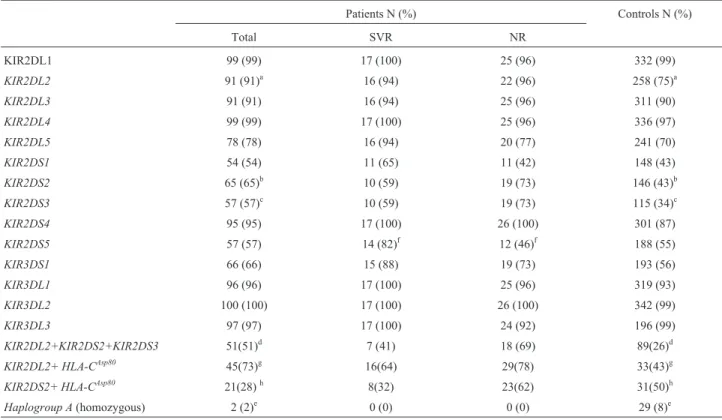
Three KIR genes showed an association with chronic hepatitis C:KIR2DL2(p = 0.0009 pc= 0.0126; OR = 3.4
95%CI 1.64-7.05), KIR2DS2 (p < 0.0001 pc = 0.0014;
OR = 2.51 95%CI 1.58-4.00), andKIR2DS3(p < 0.0001 pc= 0.0014; OR = 2.57 95%CI 1.63-4.05). The joint
analy-sis of KIR2DL2 and KIR2DS2 with their HLA-CAsp80 ligand revealed an association of both combinations with a predisposition to HCV infection (Table 1). However, after correction for multiple testing the association with
KIR2DS2+HLA-CAsp80was no longer statistically signifi-cant.
Since KIR2DL2was already reported as associated with chronic hepatitis C, and bothKIR2DS2andKIR2DS3
have been described as being in linkage disequilibrium withKIR2DL2(Singleet al., 2008), the association of both activating genes with chronic hepatitis C were re-tested us-ing a subsample ofKIR2DL2positive controls (257 indi-viduals) and patients (91). The associations remained significant for both KIR2DS2 (p = 0.0083 pc = 0.1162;
OR = 2.06; 95%CI = 1.2-3.4) andKIR2DS3 (p = 0.0008 pc= 0.0112; OR = 2.37; 95%CI = 1.4-3.9), and the KIR
pro-file composed of all three genes was also highly significant, showing an even higher OR (p < 0.0001 pc = 0.0014;
OR = 3 95%CI 1.8-4.7). In addition, the frequency of AA profiles was higher in controls (8%) than in patients (2%). Nonetheless, the statistical significance of this association was modest (p = 0.0267; OR = 0.222 95%CI 0.05-0.95), probably due to the absence of the KIR2DL2,KIR2DS2, andKIR2DS3genes in the haplogroup A profile.
These associations, in particular those involving
significantly higher than in controls (3.16; Mann-Whitney Z(U) = 4.07, p < 0.0001).
KIR genes and therapeutic response
Concerning the response to treatment, 43% of the pa-tients had SVR. However, when stratifying according to virus genotype, SVR was observed among 43% of the ge-notype 1 infected patients and among 20% of the gege-notype 3 infected patients. Among the genotype 1 infected ones, the KIR2DS5 gene was more frequent in the SVR subsample (p = 0.0261 pc = 0.3654; OR = 0.184 95%CI
0.042-0.795).
Ethnic heterogeneity between controls and patients
The average proportions of European, African and Amerindian ancestries were identical in the patient (0.49, 0.21 and 0.28) and control group (0.5, 0.21 and 0.28, re-spectively). This was also the case for the SVR (0.48, 0.22 and 0.29) and NR (0.49, 0.22 and 0.286) subsamples.
Discussion
The association of the presence of theKIR2DL2gene with chronic hepatitis C, observed in our study, agrees with what is established in the literature. Moreover, the associa-tion of the combinaassocia-tionKIR2DL2+HLA-CAsp80with HCV infection corroborates previous studies (Vidal-Castiñeiraet
al., 2010; Vejbaesyaet al., 2011) and highlights the role of this receptor in the predisposition to HCV infection. This has been interpreted as the result of the higher affinity of KIR2DL2 for its HLA-C ligand when compared to the af-finity of KIR2DL3 for the same ligand, which confers higher inhibitory activity against the cytolytic function of natural killer (NK) cells (Khakoo et al., 2004; Parham, 2005). The presence ofKIR2DL2is, thus, used as a marker for indicating a worse prognostic for the hepatitis infection followed by chronification and HCV persistence (Khakoo
et al., 2004; Knappet al., 2010; Romeroet al., 2008). The association of KIR2DS2 and KIR2DS3 with chronic hepatitis C is not consensual. For example, Ma-rangonet al.(2011) did not find any statistically significant association with KIR, despite the fact thatKIR2DS2 and
KIR2DS3 showed slightly higher frequencies in patients. Nonetheless, viral non-clearance turned out to be associ-ated withKIR2DS2 (Paladinoet al., 2007) andKIR2DS3
(Dringet al., 2011) in different populations. Such disagree-ment could theoretically be attributed to substructuring and heterogeneous linkage disequilibrium (LD) patterns across different populations. However, Single et al. (2008) showed that LD patterns are homogeneous across different regions of the world, making population substructuring the more probable cause of this lack of consensus. Singleet al.
(2008) reported a strong positive LD betweenKIR2DL2
andKIR2DS2worldwide and a weak but constant positive
Table 1- Frequencies of KIR genes and profiles in controls, patients, and subsamples according their response to therapy.
Patients N (%) Controls N (%)
Total SVR NR
KIR2DL1 99 (99) 17 (100) 25 (96) 332 (99)
KIR2DL2 91 (91)a 16 (94) 22 (96) 258 (75)a
KIR2DL3 91 (91) 16 (94) 25 (96) 311 (90)
KIR2DL4 99 (99) 17 (100) 25 (96) 336 (97)
KIR2DL5 78 (78) 16 (94) 20 (77) 241 (70)
KIR2DS1 54 (54) 11 (65) 11 (42) 148 (43)
KIR2DS2 65 (65)b 10 (59) 19 (73) 146 (43)b
KIR2DS3 57 (57)c 10 (59) 19 (73) 115 (34)c
KIR2DS4 95 (95) 17 (100) 26 (100) 301 (87)
KIR2DS5 57 (57) 14 (82)f 12 (46)f 188 (55)
KIR3DS1 66 (66) 15 (88) 19 (73) 193 (56)
KIR3DL1 96 (96) 17 (100) 25 (96) 319 (93)
KIR3DL2 100 (100) 17 (100) 26 (100) 342 (99)
KIR3DL3 97 (97) 17 (100) 24 (92) 196 (99)
KIR2DL2+KIR2DS2+KIR2DS3 51(51)d 7 (41) 18 (69) 89(26)d
KIR2DL2+ HLA-CAsp80 45(73)g 16(64) 29(78) 33(43)g
KIR2DS2+ HLA-CAsp80 21(28)h 8(32) 23(62) 31(50)h
Haplogroup A(homozygous) 2 (2)e 0 (0) 0 (0) 29 (8)e
a
p = 0.0009 pc= 0,0126 OR = 3.4 CI 95%1.64-7.05;bp < 0.0001 pc= 0.0014 OR = 2.51 CI 95% 1.58-4.00;cp < 0.0001 pc= 0,0014 OR = 2.57 CI 95%
1.63-4.05;dp < 0.0001 p
c= 0.0014 OR = 3 CI 95% 1.8-4.7;ep = 0.0267 OR = 0.222 CI 95% 0.05-0.95;fp = 0.0261 OR = 0.184 CI 95% 0.042-0.795; g
to investigate the influence of these LD patterns on the as-sociations we found herein, and to discriminate possible secondary or non-independent associations we tested whether the association ofKIR2DS2 andKIR2DS3 with chronic infection was independent of the presence of
KIR2DL2. As it turned out,KIR2DS2andKIR2DS3 associ-ations remained indeed significant in a subsample of the
KIR2DL2carriers, ruling out the influence ofKIR2DL2in theKIR2DS2andKIR2DS3associations. Additionally, the association of the profiles resulting from the presence of these three genes highly significant, reinforcing the inde-pendence of the associations observed for those genes sepa-rately. The AA profile was also associated with a protection against HCV infection. It is worthy of note that the KIR2DL2, KIR2DS2 and KIR2DS3 genes are absent in AA. The strength of association with these genes and/or with a combination of these is far more significant than those observed for AA and non-AA profiles. Thus it is in-ferred that the association with AA merely reflects the role ofKIR2DL2,KIR2DS2, andKIR2DS3.
The higher frequencies of the activating KIR2DS2 and KIR2DS3 gene products in patients could also be re-flected in the mean number of activating receptors, which was greater in patients than in controls.
With respect to the response to therapy, the presence of KIR2DS5 was associated with SVR. Interestingly, the presence of this gene was associated with viral clearance in a previous study (Paladino et al., 2007). In addition,
KIR2DS5was not the sole gene related with viral clearance that was also associated with SVR; particularly the pres-ence ofKIR2DL3was also reported as associated with SVR (Knappet al., 2010; Vidal-Castiñeiraet al., 2010). Hence, KIR with a stimulatory trend and involved in the HCV clearance could also play a key role in the response to ther-apy. In agreement with this idea, the inhibitory KIR2DL5 was associated with non-response in a recent study (Car-neiroet al., 2010).
Population stratification is a common source of bias in association studies. Only one previous study (Romeroet al., 2008) reported an association between KIR polymor-phisms and HCV clearance while controlling for popula-tion substructuring. In our study we used a rigorous control to exclude the influence of the stratification in the associa-tions with chronic infection and response to therapy, clearly showing that all samples and subsamples were practically identical in their ethnic composition. Thus the ancestry analyses also allowed testing whether ethnicity had any in-fluence on the response to therapy. Data reported by Geet al.(2009) suggested that African descendents have the low-est rate of response to therapy and East Asians the highlow-est ones, while European descendents and Hispanics showed intermediary rates. Our results did not show any evidence of differences in the average ethnic proportions of African, European, and Amerindian in both SVR and non
respon-such disagreement, like socio-economic differences among the samples (Ge et al., 2009). Our study carefully con-trolled for such bias. Because treatment in Brazil is public and free of costs for the patient and all the patients were evaluated by a defined number of physicians, it was implic-itly controlled for both socio-economic level and access to health care.
In conclusion, our study strengthens the reports on the association of theKIR2DL2gene with chronic hepatitis C and corroborates previous reports on the association of KIR genes and their profiles. Moreover,KIR2DS5was associ-ated for the first time with SVR. The analysis of the ethnic composition of the samples ruled out any population substructuring as a possible source of bias, anf furthermore showed that there were no interethnic differences in re-sponse to therapy.
Acknowledgments
The present study was financially supported by a PPSUS-MS/CNPq/FAPESPA/SESPA research grant. We are also very grateful to all patients for participating in the study and Ms. Dayse Alencar for her helpful technical as-sistance.
References
Ayres M, Salzano FM, Franco MHLP and Barros RMS (1976) The association of blood groups, ABH secretion, hapto-globins and hemohapto-globins with filariasis. Hum Hered 26:105-109.
Bode JG, Brenndörfer ED and Häussinger D (2008) Hepatitis C virus (HCV) employs multiple strategies to subvert the host innate antiviral response. Biol Chem 389:1283-1298. BRASIL, Ministério da Saúde (2011) Protocolo Clínico e
Dire-trizes Terapêuticas para Hepatite Viral C e Coinfecções. Série A. Normas e Manuais Técnicos. Secretaria de Vigilân-cia em Saúde, Brasília, pp 1-84.
Carneiro VL, Lemaire DC, Bendicho MT, Souza SL, Cavalcante LN, Angelo AL, Freire SM, Mendes CM, Santana N, Lyra LG, et al.(2010) Natural killer cell receptor and HLA-C gene polymorphisms among patients with hepatitis C: A comparison between sustained virological responders and non-responders. Liver Int 30:567-573.
Dring MM, Morrison MH, McSharry BP, Guinan KJ, Hagan R, Irish HCV Research Consortium, O’Farrelly C and Gardiner CM (2011) Innate immune genes synergize to predict in-creased risk of chronic disease in hepatitis C virus infection. Proc Natl Acad Sci USA 108:5736-5741.
Ge D, Fellay J, Thompson AJ, Simon JS, Shianna KV, Urban TJ, Heinzen EL, Qiu P, Bertelsen AH, Muir AJ,et al.(2009) Genetic variation in IL28B predicts hepatitis C treatment-induced viral clearance. Nature 461:399-401.
Grünhage F and Nattermann J (2010) Viral hepatitis: Human genes that limit infection. Best Pract Res Clin Gastroenterol 24:709-723.
Guerreiro JF and Chautard-Freire-Maia EA (1988) ABO and blood groups, migration and estimates of racial admixture for the population of Belem, State of Para, Brazil. Rev Bras Genet 11:171-186.
Hong HA, Loubser AS, de Assis Rosa D, Naranbhai V, Carr W, Paximadis M, Lewis DA, Tiemessen CT and Gray CM (2011) Killer-cell immunoglobulin-like receptor genotyping and HLA killer-cell immunoglobulin-likereceptor-ligand identification by real-time polymerase chain reaction. Tis-sue Antigens 78:185-194.
Irshad M, Khushboo I and Singh S (2008) Hepatitis C Virus (HCV): A review of immunological aspects. Int Rev Im-munol 27:497-517.
Khakoo SI, Thio CL, Martin MP, Brooks CR, Gao X, Astem-borski J, Cheng J, Goedert JJ, Vlahov D, Hilgartner M,et al.
(2004) HLA and NK cell inhibitory receptor genes in resolv-ing hepatitis C virus infection. Science 305:872-874. Knapp S, Warshow U, Hegazy D, Brackenbury L, Guha IN,
Fowell A, Little AM, Alexander GJ, Rosenberg WM, Cramp ME, et al.(2010) Consistent beneficial effects of killer cell immunoglobulin-like receptor 2DL3 and group 1 human leukocyte antigen-C following exposure to hepatitis C virus. Hepatology 51:1168-1175.
Liu CH, Liu CJ, Lin CL, Liang CC, Hsu SJ, Yang SS, Hsu CS, Tseng TC, Wang CC, Lai MY,et al.(2008) Pegylated inter-feron-alpha-2a plus ribavirin for treatment-naïve Asian pa-tients with hepatitis C virus genotype 1 infection: A multi-center, randomized controlled trial. Clin Infect Dis 47:1260-1269.
Marangon AV, Silva GF, de Moraes CF, Grotto RM, Pardini MI, de Pauli DS, Sell AM, Visentainer JE and Moliterno RA (2011) KIR genes and their human leukocyte antigen lig-ands in the progression to cirrhosis in patients with chronic hepatitis C. Hum Immunol 72:1074-1078.
Martin MP, Nelson G, Lee JH, Pellett F, Gao X, Wade J, Wilson MJ, Trowsdale J, Gladman D and Carrington M (2002) Cut-ting edge: Susceptibility to psoriatic arthritis: influence of activating Killer Ig-like Receptor genes in the absence of specific HLA-C Alleles 1. J Immunol 169:2818-2822. Martins T, Narciso-Schiavon JL and Schiavon LL (2011)
Epide-miologia da infecção pelo virus da hepatite C. Rev Assoc Med Bras 57:107-112.
Mello LA, Melo-Junior MR, Albuquerque ACC and Coelho MRCD (2007) Soroprevalência da hepatite C em pacientes hemodialisados. Rev Soc Bras Med Trop 40:290-294. Miranda EC, Moia L de J, Amaral Ido S, Barbosa MS, Conde SR,
de Araújo MT, da Cruz Edo R, Demachki S, Bensabath G, Soares MC (2004) Hepatitis B and C virus infection and the hepatocellular carcinoma in the East Amazon, Brazil. Rev Soc Bras Med Trop 37:47-51.
Montes-Cano MA, Caro-Oleas JL, Romero-Gómez M, Diago M, Andrade R, Carmona I, Aguilar Reina J, Núñez-Roldán A and González-Escribano MF (2005) HLA-C and KIR genes in hepatitis C virus infection. Hum Immunol 66:1106-1109. Paladino N, Flores AC, Marcos CY, Fainboim H, Theiler G,
Arruvito L, Williams F, Middleton D and Fainboim L (2007) Increased frequencies of activating natural killer
re-ceptors are associated with liver injury in individuals who do not eliminate hepatitis C virus. Tissue Antigens 69:109-111. Paraná R, Vitvitsk L and Pereira JE (2008) Hepatotropic viruses
in the Brazilian Amazon: A health threat. Braz J Infect Dis 12:253-256.
Parham P (2005) MHC class I molecules and KIRs in human his-tory, health and survival. Nat Rev Immunol 5:201-214. Pedroza LS, Sauma MF, Vasconcelos JM, Takeshita LY,
Ribei-ro-Rodrigues EM, Sastre D, Barbosa CM, Chies JA, Veit TD, Lima CP,et al.(2011) Systemic lupus erythematosus: Association with KIR and SLC11A1 polymorphisms, ethnic predisposition and influence in clinical manifestations at on-set revealed by ancestry genetic markers in an urban Brazil-ian population. Lupus 20:265-273.
Romero V, Azocar J, Zúñiga J, Clavijo OP, Terreros D, Gu X, Husain Z, Chung, RT, Amos C and Yunis EJ (2008) Interac-tion of NK inhibitory receptor genes with HLA-C and MHC class II alleles in hepatitis c virus infection outcome. Mol Immunol 45:2429-2436.
Santos NP, Ribeiro-Rodrigues EM, Ribeiro-Dos-Santos AK, Pe-reira R, Gusmão L, Amorim A, Guerreiro JF, Zago MA, Matte C, Hutz MH,et al.(2010) Assessing individual inte-rethnic admixture and population substructure using a 48-insertion-deletion (INSEL) ancestry-informative marker (AIM) panel. Hum Mutat 31:184-190.
Sambrook J, Fritch EF and Maniatis T (1989) Molecular cloning: A Laboratory Manual. 2ndedition. Cold Spring Harbor
Lab-oratory, Cold Spring Harbor.
Schneider H and Salzano FM (1979) Gm allotypes and racial ad-mixture in two Brazilian populations. Hum Genet 53:101-105.
Sham PC and Curtis D (1995) Monte Carlo tests for associations between diseases and alleles at highly polymorphic loci. Ann Hum Genet 59:97-105.
Single RM, Martin MP, Meyer D, Gao X and Carrington M (2008) Methods for assessing gene content diversity of KIR with examples from a global set of populations. Immunogenetics 60:711-725.
Vidal-Castiñeira JR, López-Vázquez A, Díaz-Peña R, Alonso-Arias R, Martínez-Borra J, Pérez R, Fernández-Suárez J, Melón S, Prieto J, Rodrigo L,et al.(2010) Effect of killer immunoglobulin-like receptors in the response to combined treatment in patients with chronic hepatitis C virus infection. J Virol 84:475-481.
Vejbaesya S, Nonnoi Y, Tanwandee T and Srinak D (2011) Killer cell immunoglobulin-like receptors and response to antiviral treatment in Thai patients with chronic hepatitis C virus ge-notype 3a. J Med Virol 83:1733-1737.
Internet Resources
Software package for using multi-locus genotype data to investigate population structure, STRUCTURE ver. 3.2, http://pritch.bsd.uchicago.edu/software.html.
Associate Editor: Maria Rita Passos Bueno