A DNA POOLING BASED SYSTEM TO DETECT ESCHERICHIA COLI VIRULENCE FACTORS IN FECAL AND
WASTEWATER SAMPLES
Luz María Chacón J1*, Lizeth Taylor C2, Carmen Valiente A3, Irene Alvarado P2, Ximena Cortés B2
1
Sección Infección-Nutrición, Instituto de Investigaciones en Salud (INISA), University of Costa Rica, Montes de Oca, Costa Rica; 2Virology Division, Microbiology Department, University of Costa Rica, Montes de Oca, Costa Rica;3Laboratorio Nacional
de Aguas, Instituto Costarricense de Acueductos y Alcantarillados (AyA), La Unión, Costa Rica.
Submitted: July 15, 2011; Returned to authors for corrections: December 22, 2011; Approved: June 07, 2012.
ABSTRACT
The availability of a useful tool for simple and timely detection of the most important virulent varieties of
Escherichia coli is indispensable. To this end, bacterial DNA pools which had previously been categorized were obtained from isolated colonies as well as selected in terms of utilized phenotype; the pools were assessed by two PCR Multiplex for the detection of virulent E. coli eaeA, bfpA, stx1, stx2, ipaH, ST, LT, and
aatA genes, with the 16S gene used as DNA control. The system was validated with 66 fecal samples and 44 wastewater samples. At least one positive isolate was detected by a virulent gene among the 20 that were screened. The analysis of fecal samples from children younger than 6 years of age detected frequencies of 25% LT positive strains, 8.3% eae, 8.3% bfpA, 16.7% ipaH, as well as 12.5 % aatA and ST. On the other hand, wastewater samples revealed frequencies of 25.7% eaeA positive, 30.3% stx1, 15.1% LT and 19.7%
aatA. This study is an initial step toward carrying out epidemiological field research that will reveal the presence of these bacterial varieties.
Key words: virulence genes, wastewater, fecal, screening system, Escherichia coli
INTRODUCTION
Diarrhea continues to be a major cause of illness and death worldwide. According to the World Health Organization (WHO), 1.4 million pre-school children die annually due to diarrhea resulting from intestinal infection (19).
The Pan-American Health Organization (PAHO) reports that the average rate of death from acute diarrhea in children younger than 5 years of age in Latin America and the
Caribbean is 4.1%. The regions with the highest rates are Central America (7.8%), the Caribbean (5.5%), and 5.1% in the Andean region (23). Costa Rica, for example, recorded 450 deaths due to diarrhea during 2001-2005, of which only 20 were found to have an identified causal agent (18).
Escherichia coli is a Gram negative bacillus, a normal microorganism in humans, but one which can produce symptoms of diarrhea when virulent factors are acquired, among which are enterotoxins, adhesines, and colonization
factors (33).
Diarrheogenic varieties of E. coli exhibit a wide range of
clinical symptoms that include traveler´s diarrhea and hemorrhagic
diarrhea (24) as well as cases produced by zoonosis (14).To date,
six varieties have been clearly described and characterized by
virulence factors capable of causing diarrhea in humans: 1)
enterotoxigenic E. coli or ETEC, whose most distinctive genes are
the stable thermotoxin -st- and thermolabile -lt-; 2)
enteropathogenic E. coli or EPEC, whose characteristic genes are
the intimine –eaeA- and the bundle forming pilus –bfp-); 3)
shiga-toxin E. coli or STEC, whose toxins are encoded in the stx1 y stx2
genes, 4) enteroinvasive E. coli or EIEC, one of whose
characteristic virulence traits is the ipaH, which belongs to the
invasion plasmid; 5) enteroaggregative E. coli or EAEC, with the
pCVD432 plasmid, for which the aatA gene is one of the most
stable regions; and 6) diffusely adherent E. coli or DAEC, whose
virulence genes have yet to be fully profiled (11, 22).
A number of different procedures have been described for
identifying these pathogens since this cannot be carried out based
on their phenotypical features. These strategies have ranged from
cultivating cells to bio-molecular identification, such as Multiplex
PCR (1, 3, 11, 20, 21).This means that routine detection of these
varieties is costly. Moreover, the literature demonstrates that the
frequency of virulent E. coli varieties is much lower than that of
non-virulent varieties, thus making it necessary to screen various
isolates per sample in order to detect them (10).Costa Rica and
most other Latin American countries lack epidemiological data on
the circulation of diarrheogenic E. coli as well as on its impact on
public health. The main goal of the present study was to design a
quick and easy screening system that would make analysis of the
greatest number of E. coli isolates possible, as well as to determine
the applicability of the system in both fecal samples from children
less than 6 years of age and in wastewater samples taken from
stabilization or settling ponds.
METHODOLOGY
Samples
Sixty six fecal samples were collected through a community
project at the University of Costa Rica (TCU-350) with children
younger than 6 years of age in Montes de Oca county in San José
province, Costa Rica, during February and March of 2007. These
samples were inoculated in MacConkey agar (Oxoid®)within 12
hours after collection, and were incubated at 35 ºC for 24 hours.
Moreover, 24 water samples were collected for over a year (from
September of 2007 until December of 2008) from inlet and outfall
points of the Costa Rican Water Supply and Sewer Institute´s
settling ponds located in Nicoya, Cañas, Liberia, Santa Cruz, and
Pérez Zeledón. The wastewater samples were processed by the
most probable number (MPN) technique for fecal coliforms as
described by the American Public Health Association (2). After
the presumptive phase, a mix was made of all tubes that tested
positive by dilution. Each subsample (subsamples being
understood as each dilution of an analyzed sample that had tested
positive) was then inoculated into MacConkey agar (Oxoid®)and
incubated at 35 ºC for 24 hours.
Gene pool system
Twenty colonies from the bacterial cultures of the feces and
wastewater samples obtained in MacConkey agar (Oxoid®) were
inoculated in a single tube of soy trypticase broth (Oxoid®) and
then incubated at 35 ºC for 24 hours. In order to include atypical
E. coli morphotypes, all the pools were prepared with 25% lactose
negative colonies and 75% lactose positive colonies.To be able to
assess the detection limit of the method, bacterial pools containing
positive control colonies and strains with no virulence factors were
utilized; the ratio used was 1:19 (1 positive colony was inoculated
with a known virulence factor, along with 19 bacterial strains with
not known virulence factors). Pools with 1+1:18 ratios, in which
colonies that were carriers of different virulence factors were
mixed with strains with not known virulence factors, were also
evaluated.
DNA extraction and quantification
The extraction of the DNA was carried out in accordance
with the Franck thermic protocol (7). The extracted DNA material
was stored at -70 ºC until being used. The quantification of the
DNA from each pool was carried out with an Epependorff Plus®
Polymerase Chain Reaction (PCR)
Two Multiplex PCR and one simple PCR, which had been standardized in the laboratory, were used to process the gene pool samples. For the PCR Multiplex, the following reagent concentration was utilized: free buffer Mg 1X Fermentas®, MgCl2 1.75 mM Fermentas®, dNTP 200 µM Fermentas®, 0.6 U of Taq polymerase Fermentas® per reaction, and 4 µl of bacterial DNA. The primers utilized for the PCR Multiplex 1 were as follows: 5´GAC CCG GCA CAA GCA TAA GC 3´ and 5´CCA CCT GCA GCA ACA AGA GG 3’ for the eaeA
gene (384 pb, 0.04 µg/reaction), 5´AAT GGT GCT TGC GCT TGC TGC 3´ and 5´ GCC GCT TTA TCC AAC CTG GTA3´ for the bfpA gene (324 pb, 0.03 µg/reaction), 5´CTG GATTTA ATG TCG CAT AGT G3´ and 5´AGA ACG CCC ACT GAG ATC ATC3´ for the stx1 gene (150 pb, 0.045 µg/reaction),
5´GGC ACT GTC TGA AAC TGC TCC 3´ and 5´TCG CCA GTT ATC TGA CAT TCT G3´ for the stx2 gene (250 pb, 0.06 µg/reaction) (13) and 5’GTTCCTTGACCGCCTTTCCGATA CCGTC3’ and 5’GCCGGTCAGCCACCCTCTGAGAGTAC 3’ for the ipaH gene (600 pb, 0.05 µg/reaction) (4). The primers utilized for the Multiplex PCR 2 were as follows: 5´ TCT GTA TTG TCT TTT TCA CC 3´ and 5´ TTA ATA GCA CCC GGT ACA AGC 3´ for the st toxin (186 pb, 0.4 µg/reaction) (8), 5’ TCT CTA TGT GCA TAC GGA GC 3’ and 5’ CCA TAC TGA TTG CCG CAA T 3’ for the lt toxin (322 pb, 0.02 µg/reaction) (30) and 5´CTG GCG AAA GAC TGT ATC AT 3´ and 5´CAATGTATAGAAATCCGCTGTT 3´ for a segment of the pCVD423 aatA gene (630 pb, 0.045 µg/reaction) (27). Finally, a simple PCR with MasterMix Fermentas® 2X was used for the 16S; as primers, 5’GGGATGAAAGTTAATACCTTTGCTC 3’ and 5’ TTCCCGAAGGCACATTCT 3’ (584 pb) were used (31). The amplification was done in a DNA thermal cycler (Applied BioSystem®) using 5 min at 95 °C for initial denaturation followed by 35 cycles of 92°C (denaturation), 55 °C (annealing) and 72 °C (primer extension), for 45 seconds each, with a final 10 min extension at 72°C). For the simple PCR, the amplification conditions were a initial denaturation for 5
minutes at 94 ºC, followed by 35 cycles of PCR divided in 94 ºC (denaturation), 56 ºC (annealing) and 72 ºC (primer extension), for 30 seconds each, with a final extension of 2 minutes at 72 ºC. The detection limit for all the PCR Multiplex and simple PCR reactions was assessed byutilizing quantified bacterial DNA dilutions (between 10 and 60 ng/µl) and the specificity of the PCR was assessed by using other members of the family Enterobacteriaceae. PCR products were visualized by 2% agarose gels (TopVisionTM Fermentas®) with 0.05% ethydium bromide. The electrophoresis processes were carried out in a Fisher Scientific® electrophoresis chamber at 13.5 V/cm for 60 minutes. DNA fragment sizes were compared to a molecular weight marker (Fermentas®), with a 50 base pair ladder.
RESULTS
PCR
The optimum conditions of each PCR reaction were standardized in the laboratory and detailed in the methodology. The minimum concentration of DNA detected was of 20 µg/ml for the 16S, the stx1, stx2, and ipaH genes, and 30 µg/ml for the eaeA and bfpA genes. In the Multiplex 2 reaction, the minimum concentration of DNA detected was 40 µg/ml. For which extractions of DNA with concentrations of between 60 and 200 µg/ml were used. In the specificity assays amplification was observed only for the 16S gene of Shigella
sp. strain, whereas no amplification was observed in any of the other genes and strains.
Gene pool system
pools in which only one strain was the carrier of virulence factors (1:19); this was done in quintuplicate for each gene under study (Figure 1). To evaluate the simultaneous detection of the genes, mixed pools were prepared from the positive
control strains, an effective detection was achieved for each one of the specific genes. This was carried out in quintuplicate for the eaeA+/bfpA+, stx1, stx2, ipaH combinations, and for the ST+/LT+, aatA combination.
Figure 1. A. Multiplex PCR for bacterial positive pool of genes ST, LT y aatA in the ratio 19:1. 1. Molecular weight marker, 2.DNA pool eae+/bfpA+, 3. DNA pool ST+/LT+, 4. DNA pool aatA+, 5. DNA pool eae+/stx1+, 6. DNA pool eae+/stx2+, 7. DNA pool ipaH+, 8.DNA pool STt+/LT+/aatA+, 9. Reagent control. B. Multiplex PCR for bacterial positive pool of genes eae, bfpA, stx1, stx2 e ipaH in the ratio 19:1. 1. Molecular weight marker, 2.DNA pool eae+/bfpA+, 3. DNA pool ST+/LT+, 4. DNA pool aatA+, 5. DNA pool eae+/stx1+, 6. DNA pool eae+/stx2+, 7. DNA pool ipaH+, 8.DNA pool eae+/ bfpA+/stx1+/stx2+/ ipaH+, 9. DNA pool ST+/LT+/aatA+, 10. DNA E. coli ATCC 25922, 11. DNA Enterobacter cloacae, 12.Reagent control
Fecal samples
Of the 66 samples analyzed, 1 was discarded since the 16S
gene was not detected by PCR; samples showing negative results for the 16S gene were excluded since with the established conditions, their detection would be found to be
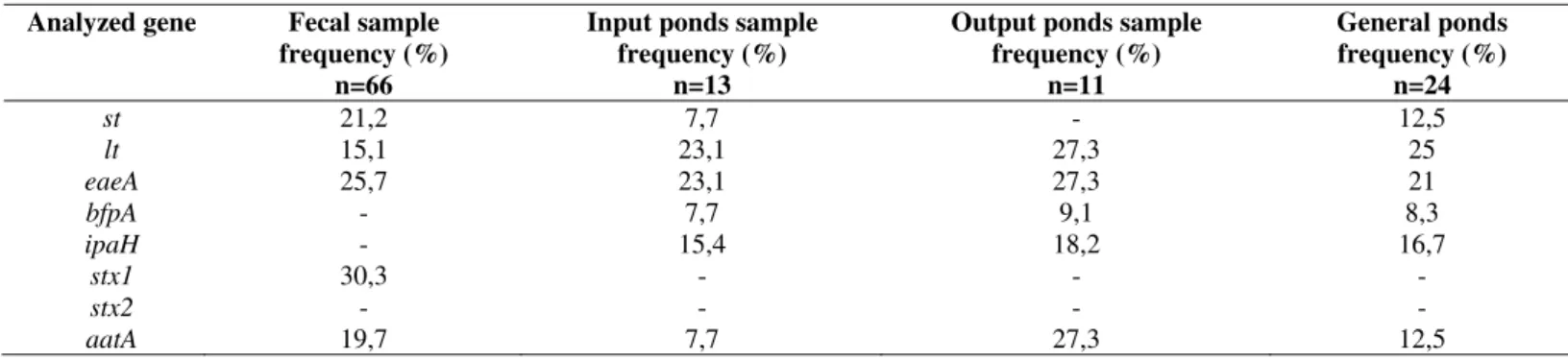
below the sensitivity limit. Thirty-seven percent of the samples yielded negative results, 34% of the samples tested positive for more than one virulence factor, and 24% of the samples tested positive for just one virulence factor. The specific results are detailed in Table 1.
Table 1. Detection frequency (%) in fecal and wastewater samples (input and output of ponds) analyzed virulence genes of
Escherichia coli.
Analyzed gene Fecal sample
frequency (%) n=66
Input ponds sample frequency (%)
n=13
Output ponds sample frequency (%)
n=11
General ponds frequency (%)
n=24
st 21,2 7,7 - 12,5
lt 15,1 23,1 27,3 25
eaeA 25,7 23,1 27,3 21
bfpA - 7,7 9,1 8,3
ipaH - 15,4 18,2 16,7
stx1 30,3 - - -
stx2 - - - -
Wastewater samples
Of the 24 samples taken from settling ponds, which were analyzed as 77 subsamples, no samples were discarded since in every case at least one subsample showed amplification of the
16S gene. Thirteen samples were taken from pond inlets, and 11 were taken from their out fall points. Of the total of samples analyzed, 46% were negative for all virulence factors under study, 33.3% were positive for at least one virulence factor, and 12.5% were positive for just one virulence factor. The relative frequencies found are detailed in Table 1.
DISCUSSION
The gene pool system is an innovative element in this study. It has been widely documented that detection of diarrheagenic varieties of E.coli is methodologically complex because this bacterial group is found in low concentrations in fecal samples, and then as a result, analysis from 1 to 5 isolates can yield low detection frequencies (10, 16). We propose that this newly described tool can be used to overcome this limitation.
To work adequately, the gene pool system requires adjustments and standardization of the quantity of genetic material obtained in order to generate reproducible results (28). In the case of this PCR, to standardize the optimum conditions for amplification and to prevent false negatives because of low DNA concentration, assays were carried out to determine the minimum concentration of DNA necessary for detection of the expected products (between 60 and 200 µg/ml); thus, the results obtained are reproducible.
Moreover, the implemented detection system was assayed in two distinct matrixes in order to evaluate its versatility. Fecal samples were chosen due to the fact that in Latin America it is common to find these bacterial groups among, both symptomatic and asymptomatic populations (26). On the other hand, settling ponds were selected because they are ecosystems with a great variety of microorganisms where it is likely to find potentially virulent strains (32).
The feasibility of detecting diarrheagenic E. coli in the analysis of samples from wastewater in settling ponds by enhancing the most probable number (MPN) approach is evident. This is what makes this procedure much more accessible than current alternatives, such as concentration techniques by “in situ” filters, or filtering through membranes (2).
An important thing to note is that all the positive dilutions have to be analyzed by the enhanced approach since, the presence of microorganisms does not follow a statistically normal distribution (2). This fact was corroborated in this study upon finding the presence of microorganisms in different dilutions of a given sample, regardless of the composition of dilutions themselves.
The settling ponds studied have retention periods of approximately three months, and their effectiveness, from the microbiological standpoint, is measured by the capacity to diminish the microbial load in at least three logarithms (25). Nevertheless, the survival of pathogenic microorganisms has not been studied in detail. In addition to the detection of the genes under analysis, differences were found among the profiles of genes across the samples taken from the pond inlet and outfall points (Table 1).
found across the ponds inlet and outfall points.
On the other hand, the system proved capable of detecting diarrheagenic E. coli in fecal samples as well. It is important to emphasize that although that the samples were taken from asymptomatic children, the frequencies detected were greater than those usually described, in which only 1 to 3 isolations per sample are analyzed (6). Among the hypotheses to explain this finding are the following: improved detection thanks to the use of gene pools, a high prevalence of pathotypes in the population, and the fact that these pathogenic varieties are regulated by the surroundings (17, 9). However, future studies are needed in order to analyze this phenomenon in detail.
In the fecal and wastewater samples analyzed, genes were simultaneously found that are characteristic of both ETEC and EPEC; this is a trend that has been described for a number of years, and which at the clinical level produces more severe symptoms than those generated by either of these varieties individually (5). These findings can serve as a guide for better treatment in the health sector for patients with acute diarrhea that present these co-infections. Nonetheless, studies of this nature are scarce, as mentioned previously, due to routine analysis being carried out by means of profiling 1 to 3 isolations on an individual basis, which could overlook identification of other pathogenic varieties present in a given sample.
Another important finding is the high frequency at which the eaeA gene was detected, both in wastewater and fecal samples; this could indicate the presence of atypical ECEP varieties in the country, which is congruent with findings worldwide, where the atypical EPEC varieties are more frequent than typical ones (1).
Finally, although methodologies currently exist to analyze microorganisms directly in the sample which improves response time, with this system, the cultivation of microorganisms ensures their viability and avoids the problems created by substance inhibitors in the sample for detection by PCR. (12, 29)
To summarize, the present study demonstrates the
efficiency of implementing a gene pool system for detecting diarrheagenic E. coli. This tool is useful for analysis of wastewater and fecal samples, and its implementation in the field is an initial step toward carrying out epidemiological studies to assess the incidence, prevalence, and persistence of certain diarrheagenic E. coli varieties. This information can make it possible to orient authorities as to the proper means of environmental control when handling wastewater, as well as to guide those in the clinical field as to the best course of treatment for patients infected with one or more pathogenic varieties of E. coli.
ACKNOWLEDGEMENTS
To the Unidad de Aguas Residuales del Laboratorio Nacional de Aguas, Instituto Costarricense de Acueductos y Alcantarillados (AyA). To Dra. Elizabeth Abrahams for donation of fecal samples collected by TCU-350 “Diagnóstico parasitológico en comunidades costarricenses” of Parasitology Section of Microbiology Faculty of the Costa Rica University. To Dra. Olga Torres of Instituto de Nutrición de Centro América y Panamá (INCAP) y Dra Mercedes Cáceres de la Universidad de León for donation control strains for this study. To Harlan Wolfe and Clyde McCoy from CDRC/University of Miami for kind suggestions to improve the paper and to the Scientific Publications Workshop, INISA, UCR/CDRC,UM, for advice and support.
Project 04-N-2003 “Characterization of enterotoxigenic
Escherichia coli (ETEC) isolates from Guatemala and Costa Rican children” for Network for Research and Training in Tropical Diseases in Central America (NeTropica).
Project “Desarrollo de métodos moleculares y de cultivo celular para el estudio de factores de virulencia de E. coli
patogénicas” for “Fondo de Incentivo para Reinserción de Investigadores de la Comisión Nacional para Investigaciones Científicas y Tecnológicas (CONICIT)”
REFERENCES
R.M.F.; Elias, W.P. (2009). Virulence features of atypical enteropathogenic Escherichia coli identified by the eae(+) EAF-negative stx(-) genetic profile. Diagn Microbiol Infect Disease. 64 (4), 357-365.
2. American Public Health Association; American Water Works Association; Water Environment Federation. (2005). Standard Methods for the Examination of Water and Wastewater. American Public Health
Association, Washington, D.C.
3. Anbazjagan D, Seok Mui W, Mansor M, Siok Yan GO, Yasim Yusof M, Devi Sekaran S. (2011). Development of Conventional and Real-Time Multipex PCR Assays for the detection of nosocomial pathogens. Braz. J. Microbiol.;42:448–458
4. Aranda K, Fagundes-Neto U, Scaletsky A. (2004). Evaluation of Multiplex PCRs for diagnosis of Infection with Diarrheagenic Escherichia coli and Shigella spp. J Clin Microbiol.; 42 (12), 5849-5853
5. Crane, J.; Choudhari S, Naeher, T.; Duffey, M. (2006). Mutual enhacenment of virulence by Enterotoxigenic and Enteropathogenic Escherichia coli. Infect Immun. 74 (3), 1005-1515
6. Estrada-García, T.; Lopez-Saucedo, C.; Thomson-Bonilla, R.; Abonce, M..; Lopez-Hernandez, D.; Santos, J.I.; Rosado, J.L. (2009). Association of Diarrheagenic Escherichia coli pathotypes with infection and diarrhea among Mexican children and association of atypical enteropathogenic E. coli with acute diarrhea. J Clin Microbiol. 47 (1), 93-98
7. Franck, S.; Bosworth, B.; Moon H.W. (1998). Multiplex PCR for Enterotoxigenic, Attaching and Effacing, and Shiga Toxin-Producing Escherichia coli Strains from Calves. J Clin Microbiol. 36, 1795-1797.
8. Frankel, G.; Girón, J.A.; Valmassoi, J.; Schoolnik G.K. (1989). Multi-gene amplification: simultaneous detection of three virulence Multi-genes in diarrhoeal stool. Mol Microbiol. 3, 1724-1734.
9. Garmendia, J.; Frankel, G.; Crepin V. (2005). Enteropathogenic and Enterohemorrhagic Escherichia coli intections: Translocation, translocation, translocation. Infect Immun. 73 (5), 2573-2585
10. Iijima, Y.; Tanaka, S.; Miki, K.; Kanamori, S.; Toyokawa, M.; Asari, S. (2007). Evaluation of colony-based examinations of diarrheagenic Escherichia coli in stool specimens: low probability of detection because
of low concentrations, particularly during the early stage of gastroenteritis. Diagn Microbiol Infect Dis. 58, 303-308
11. Karper, J.; Nataro, J.; Mobley H. (2004). Pathogenic Escherichia coli. Nat Rev Microbiol. 2, 123-14
12. Kong, R.Y.C.; Lee, S.K.Y.; Law, T.W.F; Wu, R.S.S. (2002). Rapid detection of six types of bacterial pathogens in marine waters buy multiplex PCR. Water Res. 36 (11), 2802-2812
13. López-Saucedo, C.; Cerna, J.F.; Villegas-Sepulveda, N.; Thompson, R.; Velazquez, F.R.; Torres, J.; Tarr, P.I.; Estrada-Gacía, T. (2006). Single Multiplex polymerase chain reaction to detect diverse loci associated diarrheagenic Escherichia coli. Emerg Infect Dis. 9 (1), 127-131 14. Loukiadis, E.; Kérourédan, M.; Beutin, L.; Oswald, E.; Brugère, H.
(2006). Characterization of Shiga Toxin gene (stx)-positive and Intimin
gene (eae)-positive Escherichia coli isolates from wastewater of slaughterhouses in France. Appl Environ Microbiol. 72 (5), 3245-3251 15. Lui, Y.; Gilchrist, A.; Zhang, J.; Li, X. (2008). Detection of viable but
nonculturable Escherichia coli O157:H7 bacteria in drinking water and river water. Appl Environ Microbiol. 74 (5), 1502-1507
16. Manning, S.; Madera, R.; Schneider, W.; Dietrich, S.E.; Khalife, W.; Brown, W.; Whittan, T.S.; Somsel, P.; Rudrik, T. (2007). Surveillance for Shiga Toxin-producing Escherichia coli, Michigan, 2001-2005. Emerg Infect Dis. 13 (2), 318-321
17. Mellies, J.; Barron, A.; Carmona, A. (2007). Enteropathogenic and Enterohemorrhagic Escherichia coli virulence gene regulation. Infect Immun. 75 (9), 4199-4210
18. Ministerio de Salud de Costa Rica y Organización Panamericana de la Salud. (2006) Mortalidad por enfermedades de declaración obligatoria en Costa Rica: Año 2005. Available at: http://www.ministeriodesalud. go.cr/mortalidad/mortalidad2005.pdf. Accesed 5 August 2010
19. Moyo, S.J.; Maselle, S.Y.; Matee, M.I.; Langeland, N.; Mylvaganam, H. (2007). Identification of diarrheagenic Escherichia coli isolated from infants and children in Dar es Salaam, Tanzania. BMC Infectious Diseases. 7 (92). Available at:
http://www.biomedcentral.com/1471-2334/7/92.
20. Müller, D.; Greune, L.; Heusipp, G.; Karch, H.; Fruth, A.; Tschäpe, H; Schmidt, M.A. (2007). Identification of unconventional intestinal pathogenic Escherichia coli isolates expressing intermediate virulence factor profiles by using a novel single-step multiplex PCR. Appl Environ Microbiol. 73 (10), 3380-90.
21. Nataro, J.; Kaper, J.B. (1998). Diarrheagenic Escherichia coli. Clin Microbiol Rev. 11, 142-201.
22. Nishi, J.; Sheiikh, J.; Mizuguchi, K.; Luisi, B.; Burland, V.; Boutin, A.; Rose, D.J.; Blattner, F.; Nataro, J. (2003). The export of coat protein from Enteroaggregative Escherichia coli by specific ATP-binding cassette transporttes system. J Biol Chem. 278 (46), 45680-45689 23. Organización Panamericana de la Salud. (2009) Situación de Salud en
las Américas: Indicadores Básicos 2009. Washington, D.C., Estados Unidos de América. Available at: http://new.paho.org/hq/dmdocuments/ 2009/IB_SPA_2009.pdf. Accessed: 12 July 2011
24. Qadri, F.; Svennerholm, A.; Faruque, S.; Sack, B. (2005). Enterotoxigenic Escherichia coli in developing countries: epidemiology, microbiology, clinical features, treatment, and prevention. Clin Microbiol Rev. 18 (3), 465-483
25. Ramírez, J.; Valiente, C. (2010). Informe Anual 2009: Calidad de Aguas residuales en los sistemas de tratamiento operados y administrados por
AyA y estudios especiales de interés institucional. Instituto Costarricense
de Acueductos y Alcantarillados, Laboratorio Nacional de Aguas, AyA. 26. Rúgeles, L.C.; Bai, J.; Martínez, A.J.; Vanegas, M.C.; Gómez-Duarte,
Food Microbiol. 138 (3), 282-286
27. Schmidt, H.; Knop, C.; Franke, S.; Alesksic, S.; Heesemann, J.; Karch, H. (1995). Development of PCR for screening of enteroaggregative Escherichia coli. J Clin Microbiol. 33 (3), 701-705
28. Sham, P.; Bader, J.S.; Craig, I.; O’Donova, M.; Owen, M. (2002). DNA Pooling: a tool for large-scale association studies. Nat Rev Genet. 3, 862-871
29. Stacy-Phipps, S.; Mecca, J.J.; Weiss, J. (1995). Multiplex PCR assay and simple preparation method for stool specimens detect Enterotoxigenic Escherichia coli DNA during course of infection. J Clin Microbiol.
33(5), 1054-1059
30. Toma, C.; Lu, Y.; Higa, N.; Nakasone, N.; Chinen, I.; Baschkier, A.;
Rivas, M; Iwanaga, M. (2003). Multiplex PCR assay for identification of human diarrheagenic Escherichia coli. J Clin Microbiol. 41 (6), 2669-2671
31. Tsen, H.; Lin, C.; Chi, W. (1998). Development and use of 16S rRNA gene targeted PCR primers for the identification of Escherichia coli cells in water. J Appl Microbiol. 85, 554-560
32. Weintraub A. (2007). Enteroaggregative Escherichia coli: epidemiology, virulence and detection. J Med Microbiol. 56 (1), 4-8
33. Wolf-Rainer A. (2011). Megacities as source for pathogenic bacteria in rivers and their fate downstream. Int J Microbiol. Available at: http://www.hindawi.com/journals/ijmb/2011/798292/.