AR
TICLE
1 Departamento de Ciências Sociais, Escola Nacional de Saúde Pública, Fiocruz. Leopoldo Bulhões 1480, Manguinhos. 21041-210 Rio de Janeiro RJ Brasil. nilsondorosario@ terra.com.br
Brazilian healthcare in the context of austerity:
private sector dominant, government sector failing
Abstract This paper presents the arguments in favor of government intervention in financing and regulation of health in Brazil. It describes the organizational arrangement of the Brazilian health system, for the purpose of reflection on the austerity agenda proposed for the country. Based on the literature in health economics, it discuss-es the hypothdiscuss-esis that the health sector in Brazil functions under the dominance of the private sector. The categories employed for analysis are those of the national health spending figures. An international comparison of indicators of health expenses shows that Brazilian public spending is a low proportion of total spending on Brazilian health. Expenditure on individuals’ health by out-of-pocket payments is high, and this works against equitability. The private health services sector plays a crucial role in provision, and financing. Contrary to the belief put forward by the austerity agenda, public expenditure cannot be constrained because the government has failed in adequate provision of services to the poor. This paper argues that, since the Constitution did not veto activity by the private sector segment of the market, those interests that have the greatest capacity to vocalize have been successful in imposing their preferences in the configuration of the sector.
Key words Austerity, Health insurance, Out-of-pocket payments, Health plans, Public expendi-ture
Introduction
Vocalization of concepts of fiscal adjustment and control of public expenditure has grown to an ex-traordinary degree in the political-crisis context
that has affected Brazilian democracy this year1.
The formulators of the austerity agenda have ar-gued for the financing of a basic health package, bringing back into consideration an agenda from the 1990s of unrestricted focus on government intervention in the social area.
Lisboa2, for example, argues for austerity in
the following terms: “I would separate whatever is basic education, whatever is basic health care, whatever is transfer of income to the poorest 10%. These funds should be preserved. They can even grow by more than inflation – not by a lot, but by a little. But all the rest need to be reviewed”.
Defense of containment of expenditures on the scale imagined by this author causes enor-mous discomfort, because it is a consensus among analysts of public policies that in con-temporary society the social compact is unfea-sible without active governmental participation in financing and coordination of the provision of public goods. Further, due to the singular nature of the health sector, the scope and scale of reg-ulatory intervention by the government should go much further than the provision of basic care.
One can have recourse to Arrow3 to show
that, in contrast to the demand for common goods, such as health and clothing or other pri-vate assets, the demand for health services is un-predictable. Indeed, since illness is so very unpre-dictable, individual demand for medical services, with the exception of their preventive aspects, tends to largely reflect the uncertainties inherent in the functioning of unregulated markets. Also, demand for healthcare may be directly associated with the risk of loss of capacity to work, and in-deed in extreme cases loss of life itself, and is not
something that can be postponed3.
The supply of healthcare also has significant differences in relation to traditional products, in two aspects: the first is the high dependence of the patient on professional intervention, especially medical care. Arrow believes that it is necessary to highlight that medical activity, which is sup-posedly oriented by the concern with the well-being of the patient and of the collective, can be influenced by the quest for income, with import-ant effects on the effectiveness of the treatment. Secondly, the access to diagnostic and input ser-vices (laboratory tests, imaging, consumption
of medication) is determined by a professional decision, in such a way that the patient does not have control over important components of the
treatment process3.
Healthcare is, thus, a good which differs sub-stantially from other essential services. In most situations, there is a low probability that an in-dividual will have a serious or chronic illness during the course of their life. But if they do, it is highly unlikely that they will be in a position to finance the treatment with their own funds or
those of family members4.
The cost of contemporary medicine (diagno-ses, treatments, surgery and hospitalization) is in no way financeable from the pocket of the ma-jority of individuals. Studies in the 1990s already showed that in countries of average income such as Brazil, between 20% and 30% of families had to take a loan or sell assets to pay medical
expens-es5. A family’s decision to go into debt for health
treatment produces a catastrophic pattern in the
family’s spending6.
Thus, it is not possible to individually plan the future consumption of healthcare that is of high cost, due to the devastating
consequenc-es for familiconsequenc-es and individuals7. This is why, as
Hsiao5 has warned, it is extremely worrying that
targets for public spending and fiscal burden for-mulated by political leaders and economists do not explain and make clear the regressive effects on availability of services and inputs and, in the last analysis, on the financial and health condi-tions of the population.
The existence of a market in health services that is not regulated, or is incompletely regulat-ed by the government, favors: (i) development of the private insurance sector; and (2) transfer of the burden of financing of expenses on health to out-of-pocket expenditure by families.
The problems associated with deregulation of healthcare are thus in no way trivial. Private healthcare plan companies and insurance com-panies are oriented to achieving profitability. For this reason, the cost of the insurance premium has to be greater than the actual cost of possible healthcare that the insured person might come to need. However, the health plans and the insur-ance companies do not know the risks for each individual and calculate the value of the
premi-um based on an average risk7.
aúd
e C
ole
tiv
a,
22(4):1065-1074,
2017
When the insured people with lower risk stop participating, it increases the average risk of the group that continues to be interested and, conse-quently, the final premium price. This situation repeats itself indefinitely for those who remain,
because the risks will never be the same for all7.
As a way of getting around the effects of this process, companies and health plans create in-surances that evaluate the risk of each individual based on personal and family history. The direct result of the strategy of risk selection is increased in the value of the premium for the groups of highest risk (chronic sufferers, the elderly) who, normally, do not have the ability to pay the cost
of insurance and will remain without cover7,
de-manding government care.
The out-of-pocket expenditure mode of paying for healthcare is associated with the lib-eral scheme of organization of financing – the starting point of every experience of developing a provision for healthcare in any country. The liberal provision rests, on the supply side, on ample autonomy of health professionals and of companies, who hold the monopoly of compe-tence in provision of the services. On the demand side, the liberal model is sustained by the format of acquisition of health services by individuals or families through out-of-pocket expenditure. Ex-penditure by out-of-pocket exEx-penditure results in the catastrophic expenditure patterns referred to above, and leads to the impoverishment of
families6.
Faced with the limitations of market-based options, the democratic societies adopted public financing for health services as a way of avoiding the bankruptcy of individuals and families in re-sponse to the risk of serious, chronic or
incapaci-tating illness. Esping-Andersen8 identifies, in this
experience, the process of de-mercantilization, indicating that countries choose the construction of ‘regimes’ of social protection against families’ dependence on the dynamics of the market in ar-eas that are considered to be critical.
The construction of public welfare systems after the Second World War, and the crises and reforms of the 1990s, produced a vast compara-tive bibliography on the national health systems
in the context of the protection regimes9. The
lit-erature identifies two ideal types of government financing regime. The first is based on the idea of universal right, in which societies delegate to the instances of government the decision to allo-cate the majority of the funds in the sector. The second is associated with the scheme of public
health insurance10.
In the first model, governmental intervention in the financing is the variable that determines the level of de-mercantilization in the field of health. The dominance of government expenses, financed by taxes and contributions, indicates the adoption of institutional market coordination mechanisms, reducing the options of individu-als, professionals and companies for achieving
improved conditions of access11.
The countries with regimes of instituted so-cial protection finance the health services using
the coordination of the government11.
Paradox-ically, this is the model adopted in the central economies where the access to health services is not limited to a basic basket of health services, and restricted to preventive interventions of low complexity.
The second social protection regime based on health insurance also has wide-ranging govern-mental intervention, and is adopted in the rich continental countries of Europe. This
arrange-ment is based on the corporate compact12, where
workers and government employees are protect-ed by the national government from liberal prac-tices in healthcare through the institutions of so-cial security/insurance. The source of funds is the financial contribution by employers, employees and governments to parastatal entities that man-age social security.
When social security was put in place in the medium-income countries, the access to health-care took place in a highly stratified form due to the informality of the labor market. In these countries, employees with formal employment have the exclusivity in the use of the health ser-vices provided by the social security, which is not the case in the central economies with cor-porate systems. The population of the informal sector of the medium-income countries accesses healthcare through out-of-pocket expenditure or through basic and focal health programs. The
ex-ample of Mexico is a paradigm in this regard13.
In Brazil, two and a half decades have gone by since a universal health access system was
ap-proved by the federal constitution in 198814. Over
the course of the democratic transition of the 1980s, the members of the Constitutional Assem-bly accepted the model based on the predomi-nance of public financing and direct provision by
healthcare by the government15.
univer-sal and equitable access – the Single Health
Sys-tem (Sistema Único de Saúde, or SUS)16.
The 1988 Constitution innovated in that it created the Social Security Budget to finance the activities of social security, social assistance
and health17. In the light of these changes,
Dra-ibe18 suggests that the 1988 Constitution made a
break with the social protection system built over the course of the Republican regime, due to the emphasis given to the dimension of ‘security’ in social policies as a whole. The social security di-mension, he said, was defined by the condition of financing through taxes and contributions and through the criterion of universal access to the benefits.
Contemporary studies on the development of the Brazilian health system describe it, how-ever, as a system that is fragmented and under
the predominance of the private sector19,20. The
present format of the Brazilian health sector does not correspond to the configurations delineated by the 1988 Constitution, due to the limitation of government activity and the role of the private sector in the financing and provision of services.
The 1988 Constitution did not constrain the action of the market in the health sector with the intensity necessary for institutionalization of a universal access model for health services. On the contrary, it ratified the composition between the government and the market, developed in the country since the 1970s, by declaring that ‘pri-vate initiative is free to operate in healthcare’. The members of the constitutional assembly did not at the time have sufficient information to identify the structural dynamic of the market in health-care in Brazil, and attributed to the private sec-tor only functions that were ‘complementary’ to
public intervention in the provision of services17.
What happened in the organization of health-care in Brazil as a result of the institutional lim-itations defined by the 1988 Constitution? Did governmental regulation of healthcare become so significant that it merits being restrained in the form proposed by the austerity agenda?
Design of the study
The principal theoretical argumentation in this paper is that the regime of governmental fi-nancing conditions the social reach of the provi-sion of healthcare. The notion of ‘regime’ aims to refer to the principles, laws, regulations, rules and procedures that constrain the expectations and
choices of the social actors21. It is thus considered
that the magnitude of governmental
expens-es is an adequate indication of the condition of de-mercantilization of a national health system.
Based on the secondary information of the Health Ministry’s DATASUS and of the Federal Comptroller’s Office, this paper exemplifies the profile of Brazilian public and private expenses with data from temporal and transversal series.
The paper uses the classification categories of the WHO, which describe national health ac-counts. The descriptors of the WHO expenses comprise the funds that enter the health system for acquisition of goods and services financed by taxes, social security contributions, companies, civil society organizations, families or
interna-tional agencies22. The central categories of the
national accounts of the WHO are: government expenditure – including public health insurance; and private expenditure on private health insur-ance and out-of-pocket expenditure.
The source for the analysis of Brazil and other economies, in terms of normative comparison, is the site http://who.int/nha/database. The health system of the central economies is taken as a nor-mative reference to describe the Brazilian
experi-ence of de-mercantilization of health care10.
The information produced by the Brazil-ian Geography and Statistics Institute (Instituto Brasileiro de Geografia e Estatística, or IBGE) through the Medical Healthcare Survey (AMS), the Family Budget Survey (POF), and the Nation-al Households Sample Survey (PNAD – HeNation-alth Supplement) enable us to describe the effects of the dynamics of the private sector market on the Brazilian health system. The data are analyzed by descriptive statistics.
Segmentation and focalization in healthcare
In a manner that was not anticipated by the members of the Constituent Assembly, since the late 1980s the private sector has assumed a more wide-ranging configuration than that of simply
provider23,24. The segment of health insurance
and the private healthcare plans has strengthened and established itself, favored by a low degree of regulation, tax incentives, absence of entry barri-ers, and exit barribarri-ers, for companies, and by the wide liberty for differentiation of contracts and
provision of services25,26.
aúd
e C
ole
tiv
a,
22(4):1065-1074,
2017
and limitation of segmentation in coverage27.
Even so, the regulatory regime restricted to the health insurance industry and private health plans made it possible for companies to become stronger economically, instituting private health-care consumption by employees with formal em-ployment and by government workers.
It is possible to consider, then, that a new cor-porate standard/pattern was inaugurated in the
area of healthcare in Brazil during the 1990s28.
The segment succeeded in determining that the population occupied in the formal employment market was its preferred clientele, promoting col-lective plans financed by companies, to the de-terment of individual plans, and adopting selec-tion of risk. The Naselec-tional Supplementary Health Agency has ratified companies’ strategy of selec-tion of clientele.
In the ambit of provision of health services, the hospitals, diagnostic support services and specialized outpatient providers are used exclu-sively by the private clientele (individuals who have health insurance or with out-of-pocket
expenditure capacity)20. Only in small towns do
private health services have, even if only residu-ally, a pattern of combined use by both the clien-tele of the SUS, clients of health plans and those who purchase medical services by out-of-pocket expenditure .
In the majority of the medium-sized and large cities, the dominant trend is distinction between (a) the services linked to health insur-ance or acquired by out-of-pocket expenditure, and (b) the government services of the SUS, due to the contractual rules of coverage prevented by the private market as a differential of quality of provision of service.
The institutionalization of the health reform was not sufficient to impose governmental co-ordination on the totality of Brazilian spending on healthcare. As Table 1 shows, since the 1990s government and private expenses have been sta-ble. One thing that especially calls the attention is
the fact that private expenditure has continued to be the larger proportion in the 1990s and 2000s, with out-of-pocket expenditure dominant. The exuberant scale of out-of-pocket expenditure on health in Brazil reflects the ambiguity of the country’s decisions in the sector, which is demonstrated below.
The unchanging relative percentages of gov-ernment and private expenditure in the 1990s and 2000s is due essentially to funds being
in-put by the municipal governments29. The
par-ticipation of specifically municipal expenditure on healthcare underwent a significant expan-sion within government expenses as a whole: in 1995 the municipal percentage was 12.3%; and in 2012, it had risen to 18% of total public ex-penditures – while the exex-penditures of the state governments remained stable at around 25% of total Brazilian public expenditures on health. At the same time, there was a reduction in the proportion of the total coming from the federal government between 1995 and 2012, from 61.7%
to 57%30. The dynamic face of the Brazilian
pub-lic sector has been the development of primary
care by the municipal governments31. Financing
has ceased to be led, as a priority, by the federal
Executive in recent years30.
The activity of the Brazilian government in financing of health has, even so, federal charac-teristics that are not completely irrelevant: (1) incorporation of the interests that originated ter-ritorially into the decisions of the central govern-ment; (2) the high quantity, and highly hetero-geneous nature, of agents focalizing regional and local ideas and interests; (3) government jurisdic-tions that share responsibility for formation and implementation of health policy; (4) fiscal trans-fer arrangements; and (5) vertical and horizontal arrangements for informal cooperation between
the levels of government32. This federal
compo-nent in arrangements has a direct impact on the development and diffusion of health policy, on the scale and generosity of programs, and on the
Table 1. Brazil - % distribution on governmental and private health expenditure – 1995 and 2008.
Source: World Health Organization National Health Account database (see http://apps.who.int/nha/database for the most recent update).
Indicator 1995 2008
Government expenditure, % 43 42
Private expenditure by out-of-pocket expenditure, % 39 39 Private expenditure on health insurance, % 18 19
redistributive scope of the central government’s allocation of funds. The pattern of governmen-tal development based on the municipality indi-cates, in this aspect, the focalization on provision of a simplified portfolio of public services mainly directed to infancy and women’s health. The SUS has been especially successful with this scope of
services33.
Falleti34 argues as follows:
Brazil had some of the best-designed, most encompassing, innovative, and pro-poor social policies in Latin America. It is indeed very likely that universal health coverage and a decentralized structure that is funded with guaranteed federal transfers and that promotes users’ participation in health councils are largely responsible for the im-provement of Brazil’s health outcomes. The evolu-tion of health care reforms in Brazil shows that it is possible to break away, in a gradual and incremen-tal manner, from the historical institutional pre-conditions that preclude universalization of health. They also appear to indicate that such institutional evolution leads to significantly better public health outcomes.
Studies on the impact of decentraliza-tion have, indeed, shown the positive results of healthcare activity through infant health figures
over the 1990s and 2000s35,36.
It is necessary, however, to call attention to the fact that the Brazilian central government allocates only a small portion of its financial allo-cation as an incentive to municipalities to devel-op primary care. In 2013, only 18% of the federal funds were allocated to primary care – especially for financing of the Family Health Strategy (Ta-ble 2). This is a fact that does not receive the ap-propriate critical treatment in the literature on health policies in Brazil, especially in literature on the field of collective health.
The stagnation of the process of decentraliza-tion in the present decade resulted in a further
37% of federal health funding being executed in 2013 directly by the Health Ministry through the National Health Foundation, and the remaining 45% also allocated to purchasing by the central, state and municipal governments of hospitaliza-tions, services, and high-cost medication.
If the decentralization for primary care had
recognized redistributive effects at local levels37,
there are two considerable limitations attached to the funding distributed centrally by the Health Ministry or in which the payment decision is shared, federally:
1) The National Health Foundation allocates a considerable portion of the funding to federal hospitals in the city of Rio de Janeiro, which are functionally of little use to the SUS due to their organizational insulation. Paradoxically, decades after the implementation of the health reform, almost nothing is known about the allocation ef-ficiency, technique, quality and equity guidelines of these hospitals.
2) The payment of specialized private and public hospitalizations and services by the Health Ministry, state governments and municipal gov-ernments has for decades been made in an iner-tial, and obscure, manner by a confusing web of procedures which does not favor development of any strategic guideline for guaranteeing future access and transparency in the use of the funds allocated by the Health Ministry to healthcare.
Another factor that stands out is that, even when the federal Executive places on the agenda the proposal for regionalization through Public Health Action Contracts (Contratos Organiza-tivos da Ação Pública da Saúde, or COAPs), no new idea of governance of the use of the strategic funds is placed on the table for public
consulta-tion and decision by society38.
Due to this deficit of governance, in these later years of the present decade the principal strategy for provision of health services of all the
Table 2. Health ministry expenses in 2003 (R$ million, nominal).
Category of expense Amount %
Direct execution (National Health Foundation and other activities) 30.929 37 Execution by states and municipalities (especially remuneration of
hospitalizations and specialized outpatient services)
46.823 45
Execution by municipalities (basic care, Family Health Strategy and other activities)
15.144 18
Total 82896 100
aúd
e C
ole
tiv
a,
22(4):1065-1074,
2017
instances of government in the country has been the Family Health Strategy – which focused, pri-marily, on poor families, in all regions. In 2009, 54% of people with income of up to two times the minimum wage were registered in the Fami-ly Health Strategy, while onFami-ly 16% of those with income above five times the minimum wage were
registered39.
At the same time, in most of the large cities – with population of over 100,000 – there has been a high deficit in the supply of specialized services and diagnoses and in free distribution of medica-tion. Also, there has been development of public hospitals and specialized services in only a few
of the states of the federation40. It is the habitual
practice of state governments to take decisions which result in erratic and discontinuous supply of public emergency services, dissociated from any articulated structure of follow-up of patients
and support in access to medications41.
Thus, the government’s policy for focus indi-rectly encourages development of private expen-diture either out-of-pocket of through health
in-surance, in all the country’s income strata40. Since
the 1980s tax incentives have existed for families to acquire health insurance through direct pur-chase or through the intermediation of private or
government employers26.
It is also necessary to remember that, in spite of the formal responsibility of implementing and development of the SUS, the federal, state and municipal governments are also active purchas-ers of health insurance for government workpurchas-ers. In 2010 a significant proportion of all people insured by private health systems – 22.5% – was financed by the three levels of the government of
the federation39.
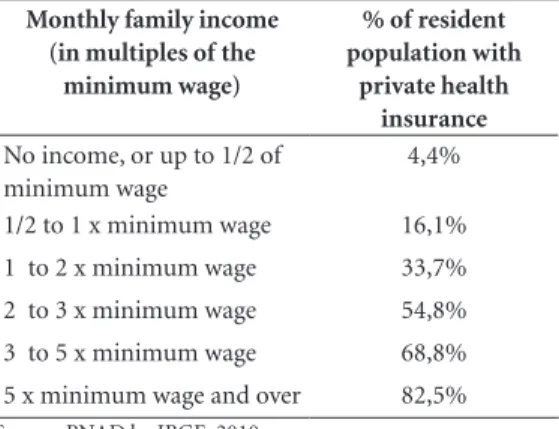
In 2011, 79.5% of those insured after the cre-ation of the ANS had a collective or corporate
plan42. As shown by Table 3, proportions of
in-dividuals and families with private health insur-ance in Brazil are directly associated with family income. In 2008, the percentage of individuals with a health plan was 82.5% in the income range above five times the minimum wage – while at the other end of the scale, it was only 4.4% for families with income of up to one half of the minimum wage.
The significant differentiation by income group in access to the health insurance market supports a pessimistic prognosis for public pol-icy for universalization of Brazilian healthcare, formalized in the SUS – namely that implemen-tation of the universality of access to the SUS, without rapid expansion of the supply of public
services, would lead to the population in the for-mal market, or those with labor union
negotia-tion capacity, leaving the public health system16.
Indeed, the focusing and centralization of governmental financing in the federal govern-ment – which produces scarcity of hospital beds and specialized services – explains why the Bra-zilian population chooses, as preference, to leave the SUS whenever a person achieves a change in position in the income structure. The social mo-bility made possible by the country’s econom-ic growth in the years 2003-2011, for example, caused a substantial increase in the number of insured families, comprising the new workers in the formal labor market who had changed
income level43. This change is understandable
because, on the one hand, the private insurance sector has a larger supply of specialized services and tests than the public sector (Table 4); and on the other, because the availability of use of the service network of the insurance companies and private health plans reduces exposure to the ra-tioning found in the public sector.
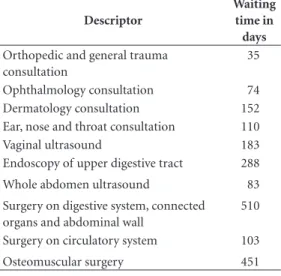
Consultations in medical specialties, med-ical tests and surgeries are the main interven-tions that are the subject of rationing by the SUS, which imposes long waiting times on users. As an example Table 5 shows the very high delay in the SUS for provision of various types of specialized medical consultation, tests or surgeries in Octo-ber 2012 in São Paulo, the country’s richest mu-nicipality. On that date, 660,000 people were on the waiting list for these procedures.
Table 3. Per capita monthly family income and
proportion of private health insurance coverage – Brazil, 2003.
Monthly family income (in multiples of the
minimum wage)
% of resident population with
private health insurance
No income, or up to 1/2 of minimum wage
4,4%
1/2 to 1 x minimum wage 16,1% 1 to 2 x minimum wage 33,7% 2 to 3 x minimum wage 54,8% 3 to 5 x minimum wage 68,8% 5 x minimum wage and over 82,5%
Final considerations
Paim et al.19 are completely right when they say
that the health sector in Brazil has become dom-inantly private. The argument that the SUS was the result of a process of democratic mobiliza-tion is acceptable. However, the various mecha-nisms of participation created by the health re-form did not prevent consolidation of an
insti-tutional arrangement led by the private sector20.
Many authors already accept the uncomfortable idea that the Brazilian health sector is iniquitous and regressive in terms of families’ expenses, due to the dominant role played by out-of-pocket
ex-penditure44.
Overcoming the deficit of equity in the pro-vision of health service is still a challenge for the country. The proposal of the 1988 Constitution was an efficient solution by the political elites for
the social debt in health during the redemocra-tization of the 1980s. It was considered that the universalizing reform for the sector would pro-duce a systemic solution for the question of fi-nancing, access and provision of collective and individual healthcare.
The significant growth in strength of the private-sector interests in the new democracy, however, was an event that the reformers did not
anticipate15. The growing focalization of
provi-sion by the SUS in the strata of lowest income in the country indicates that public action, today, carries out merely distributive functions which abdicate from the project for a wide-ranging and systemic reform of the sector. The distrib-utive intervention of the federal government does not seek even to put in place new regulatory functions, as is seen in the health systems of the central economies, but development of public policies that are focused on and selective for the
poor45.
The Brazilian health sector is, thus, very sin-gular when compared to emerging countries, due to its significant participation of private health-care insurance and the scale of out-of-pocket
expenditure in its configuration20. Unfortunately,
the development of the SUS is not the distinctive trait of the Brazilian experience in health, as Bra-zilian intellectual output would have us believe. There is no doubt that the combination of focal-ization of primary healthcare on the poorest stra-ta, with the practice of risk selection by the health insurance companies and health plans, imposes the burden of out-of-pocket expenditure as the solution for those who need healthcare at all lev-els of complexity. The evidence of the waiting list proves that the population is not being served in the area of health, in spite of the institutional ori-entation for universal and free services in Brazil. With such a large scale of systemic deregulation, we submit that the governmental failings in pro-vision of healthcare will not be overcome only with the silver bullet of austerity, as the thinking of Brazilian liberal economists supposes.
Table 4. Availability of support and diagnostic establishments in the SUS and the health insurance sector – Brazil
2009.
Source: IBGE/AMS, 2010.
Frequency Population covered Establishments per 10,000 population
SUS 63.401 161.804.365 3,40
Health insurance 30.669 29.676.265 10,33
Table 5. Waiting time for specialized consultations,
tests and surgery in the SUS public system in the municipality of São Paulo - October 2012.
Descriptor
Waiting time in days
Orthopedic and general trauma consultation
35
Ophthalmology consultation 74 Dermatology consultation 152 Ear, nose and throat consultation 110 Vaginal ultrasound 183 Endoscopy of upper digestive tract 288 Whole abdomen ultrasound 83 Surgery on digestive system, connected
organs and abdominal wall
510
Surgery on circulatory system 103 Osteomuscular surgery 451
aúd
e C
ole
tiv
a,
22(4):1065-1074,
2017
References
1. Ames B. Os entraves da democracia no Brasil: uma cri-se antevista? Folha de S. Paulo 2016 maio 13.
2. Lisboa M. Entrevista. Valor Econômico 2016 jun 23; p. 8. 3. Arrow KJ. Uncertainty and the Welfare Economics
of Medical Care. American Economic Review 1963; 53(5):941-973.
4. Hsiao W. Comparing Health Care Systems: What Na-tions Can Learn from One Another. Journal of Health Politics, Policy and Law 1992; 17(4):613-636.
5. Hsiao W, Heller PS. What Should Macroeconomists Know about Health Care Policy? IMF Working Papers
2013.
6. Xu K, Evans DB, Kawabata K, Zeramdini R, Klavus J, Murray CJ. Household catastrophic health expenditure: a multicountry analysis. Lancet 2003; 362(9378):111-117.
7. Castro JD. Regulação em saúde: análise de conceitos fundamentais. Sociologias 2002; 1(7):122-135. 8. Esping-Anderser G. As Três Economias Políticas do
Welfare State. Lua Nova 1991; 1(24):85-115.
9. Moran M. Understanding the welfare state: the case of health care British Journal of Politics and International Relations 2000; 2(2):135-160.
10. Organization for Economic Cooperation and Devel-opment (OECD). Proposal for a Taxonomy of Health Insurance. OECD Study on Private Health Insurance, OECD Health Project. June 2004. [acessado 2013 dez 23]. Disponível em: http://www.oecd.org/dataoe-cd/24/52/31916207.pdf
11. Savedoff WD, de Ferranti D, Smith AL, Fan V. Politi-cal and economic aspects of the transition to universal health coverage. Lancet 2012; 380(9845):924-932. 12. Schmitter PC. Still the Century of Corporatism? The
Review of Politics 1974; 36(1):85-131
13. Costa NR. Estudo de Caso: México. In: Biasoto G, Silva PLB, Dain S, organizadores. Regulação do Setor Saúde nas Américas: As Relações Entre o Público e o Privado. Brasília: Organização Panamericana de Saúde, Agência Nacional de Saúde Suplementar; 2006. p. 375-392. 14. Weyland K. Social Movements and the State: The
Pol-itics of Health Reform in Brazil. World Development
1995; 23(10):1699-1712.
15. Costa NR. Comunidade epistêmica e a formação da reforma sanitária no Brasil. Physis 2014; 24(3):809-829. 16. Faveret Filho P, Oliveira PJ. A universalização exclu-dente: reflexões sobre as tendências do sistema de saúde. Planejamento e Políticas Públicas 1990; 3(1):139-162.
17. Brasil. Constituição da República Federativa do Brasil de 1988. Diário Oficial da União 1988; 5 out.
18. Draibe SM. Há Tendências e Tendências: Com que Estado de Bem Estar Social Haveremos de Conviver?
Cadernos de Pesquisa NEPP Unicamp 1989; 1(10):1-89. 19. Paim J, Travassos C, Almeida C, Bahia L, Macinko J. The Brazilian health system: history, advances, and challenges. Lancet 2011; 1(377):1778 -1797.
20. Costa NR, Vaitsman J. Universalization and Privat-ization: How Policy Analysis Can Help Understand the Development of Brazil’s Health System. Journal of Comparative Policy Analysis: Research and Practice
2014; 16(5):441-456.
21. Krasner SD. International Regimes. Ithaca: Cornell Uni-versity Press; 1983.
22. Poullier JP, Hernandez P, Kawabata K. National Health Accounts. Concepts, Sources, and Methodology. Genebra: WHO; 2002.
23. Braga JC, Paula SG. Saúde e Previdência: Estudos de Po-lítica Social. São Paulo: Cebes/Hucitec; 1981.
24. Bahia L. O mercado de planos e seguros de saúde no Brasil: tendências pós-regulamentação In: Negri B, Giovanni G, organizadores. Radiografia da Saúde no Brasil. Campinas: Editora Unicamp; 2001. p. 325-362 25. Lewis MA, Medici AC. Private Payers of Health Care in
Brazil: characteristics, costs and coverage. Health Policy Plan 1995; 10(4):362-375.
26. Costa NR, Castro AJW. O regime regulatório e estrutu-ra do mercado de planos de assistência à saúde no Bestrutu-ra- Bra-sil. Regulação e Saúde. Rio de Janeiro: Agência Nacional de Saúde Suplementar; 2003.
27. Costa NR. O regime regulatório e o mercado de planos de saúde no Brasil. Cien Saude Colet 2008; 13(5):1453-1462.
28. Dias Filho PPS. Neocorporativismo e Saúde Suplemen-tar: as bases sociais da privatização da Saúde no Brasil
[tese]. Rio de Janeiro: Escola Nacional de Saúde Públi-ca; 2016.
29. Dain S. Os vários mundos do financiamento da Saúde no Brasil: uma tentativa de integração Cien Saude Colet
2007; 12(Supl.):1851-1864.
30. Costa NR. A Estratégia de Saúde da Família, a atenção primária e o desafio das metrópoles brasileiras. Cien Saude Colet 2016; 21(5):1389-1398.
31. Macinko J, Marinho de Souza Mde F, Guanais FC, da Silva Simões CC. Going to Scale with Communi-ty-based primary care: an analysis of the family heath program and infant mortality in Brazil 1999 – 2004.
Sco Sci Med 2007; 65(10):2070-2080.
32. Obinger H, Castles FG, Leibfried S. Introduction: fed-eralism and the welfare state. In: Obinger H, Castles FG, Leibfried S, editors. Federalism and the Welfare State. New World and European Experiences. Cambrid-ge: Cambridge University Press; 2006. p. 1-46. 33. Arretche MTS. Financiamento federal e gestão local
de políticas sociais: o difícil equilíbrio entre regulação, responsabilidade e autonomia. Cien Saude Colet 2003; 8(2):331-345.
34. Falleti TG. Infiltrating the State. The Evolution of Health Care Reforms in Brazil, 1964-1988. In: Ma-honey J, Kathleen T, editors. Explaining Institutional Change: Ambiguity, Agency, and Power. Cambridge: Cambridge University Press; 2009. p. 38-62.
35. Guanais FC, Macinko J. The Health Effects of De-centralizing Primary Care. Brazil Health Affairs 2009; 28(4):1127-1135.
36. Victora CG, Aquino EML, Leal MC, Monteiro CA, Barros FC, Szwarcwald CL. Maternal and child health in Brazil: progress and challenges Lancet 2011; 1(377):1863-1876.
37. Costa NR, Pinto LF. Avaliação de programa de atenção à saúde: incentivo à oferta de atenção ambulatorial e a experiência da descentralização no Brasil. Cien Saude Colet 2002; 7(4):907-923.
39. Controladoria Geral da União – Portal da Transparên-cia. [acessado 2016 jun 1]. Disponível em: http://www. portaldatransparencia.gov.br/PortalFuncoes_Detalhe. asp?Exercicio=2013&codFuncao=10&Pagina=1 40. Instituto Brasileiro de Geografia e Estatística (IBGE).
Pesquisa Nacional de Amostra de Domicílios. Rio de Ja-neiro: IBGE; 2010.
41. Instituto Brasileiro de Geografia e Estatística (IBGE).
POF - Pesquisa de Orçamento Familiar. Rio de Janeiro: IBGE; 2010.
42. Dourado DA, Elias PEM. Regionalização e Dinâmica Política do Federalismo Sanitário Brasileiro. Rev Saude Publica 2011; 45(1):204-211.
43. Agência Nacional de Saúde Suplementar (ANS). Dados do Setor. [acessado 2016 jun 13]. Disponível em: http:// www.ans. gov.br. portal/site/dados setor/dados_setor. asp
44. Classe C entra em Planos de Saúde e superlota hospi-tais. Valor Econômico 2012; 3 dez.
45. Ugá MAD, Santos IS. An Analysis of Equity in Bra-zilian Health System Financing. Health Affairs 2007; 26(4):1017-1028
46. Hunter W, Sugiyama NB. Democracy and Social Poli-cy in Brazil: Advancing Basic Needs, Preserving Privi-lege Interests. Latin American Politics and Society 2009; 51(2):29-58.
Article submitted 29/05/2016 Approved 04/08/2016