The influence of patient’s motivation on reported pain
during orthodontic treatment
Marcio José da Silva Campos1, Robert Willer Farinazzo Vitral2
Introduction:Patients usually experience pain during orthodontic treatment. This fact can afect cooperation and the development of treatment. Reporting pain during treatment seems to be inluenced by emotional aspects such as the patient’s motivation. Objective: To assess the relationship between patient’s motivation and the intensity of reported pain during two stages of treatment. Methods: Twenty males (11-37 years old) answered a questionnaire divided into ive categories regarding their motivation towards treatment. The subjects were studied for 14 days (7 days with bonded brackets and 7 days with the initial arch inserted) and the intensity of pain was evaluated on a daily basis. All the issues, including the intensity of pain, were measured through the visual analog scale (VAS). Results: The VAS-associated questionnaire proved to have good temporal reliability and reasonable internal consistency, being that the “perceived severity” domain had the greatest, although not signiicant (p = 0.196) correlation with pain intensity. Only the question asking the patients if they thought that their teeth were too uneven showed a positive correlation with pain intensity (p = 0.048). Conclusion: The results seem to indicate that the ive categories related to treatment motivation cannot be used to predict discomfort during treatment. In addition, patients who think their teeth are too uneven may experience more severe pain due to greater force application ater insertion of the initial arch.
Keywords:Pain. Orthodontics. Motivation.
How to cite this article: Campos MJS, Vitral RWF. The inluence of patient’s motivation on reported pain during orthodontic treatment. Dental Press J Or-thod. 2013 May-June;18(3):80-5.
Submitted: January 10, 2010 - Revised and accepted: August 09, 2010
Contact address: Marcio José da Silva Campos
Rua Paracatu, 568 – Bairro Santa Terezinha – Juiz de Fora/MG – Brazil CEP: 36.046-040 – E-mail: [email protected]
1 Professor, Specialization Course in Orthodontics, UFJF.
2 Associate Professor, Department of Orthodontics and Pediatric Orthodontics,
UFJF.
» The authors report no commercial, proprietary or financial interest in the products or companies described in this article.
Introdução:experiências de dor são relatadas rotineiramente pelos pacientes durante o tratamento ortodôntico, o que pode prejudicar a cooperação e o desenvolvimento do tratamento. Os relatos de dor parecem ser inluenciados por fatores emocionais, como a motivação para o tratamento. Objetivo: avaliar a correlação existente entre a motivação para o tratamento ortodôntico e a intensidade de dor relatada pelos pacientes durante duas fases iniciais do tratamento. Métodos: vinte indivíduos homens, com 11 a 37 anos de idade, foram avaliados por meio de um questionário dividido em cinco domínios relacionados à motivação para tratamento ortodôntico. Os indivíduos foram acompanhados duran-te 14 dias, sendo 7 dias apenas com os braqueduran-tes colados e 7 dias com o arco inicial inserido, sendo a induran-tensidade de dor avaliada diariamente. Todas as questões, assim como intensidade da dor, foram mensuradas por meio da Escala Visual Análoga (EVA). Resultados: o questionário associado à EVA apresentou boa coniabilidade temporal e consistência interna razoável, sendo que o domínio “Severidade percebida” apresentou a maior correlação com a intensidade de dor, apesar de não signiicativa (p = 0,196). Na análise das questões, apenas a que avaliou se os pacientes julgavam seus dentes muito tortos apresentou correlação positiva com a intensidade de dor (p = 0,048). Conclusão: os resultados indicam que os cinco domínios relacionados à motivação para o tratamento ortodôntico não podem ser utilizados para predizer o desconforto durante o tratamento, porém o fato de o indivíduo julgar seus dentes tortos pode indicar expe-riências de dor mais intensas devido à maior aplicação de força após a inserção do arco inicial.
INTRODUCTION
Success of orthodontic treatment is often depen-dent on the use of devices and techniques to mini-mize patient’s discomfort, once pain and discomfort hamper cooperation, leading to poor adherence to
follow-up and treatment interruption.22 Pain is
com-monly assessed through the Visual Analogue Scale
(VAS),2,7,8,9,15,17,21,24,25,27,29 which records the subjective
experience of pain.
Pain during orthodontic treatment is reported by up
to 95% of the patients,20,25 being associated with trauma
to the buccal mucosa2,20,21 and application of force to the
teeth.2,3,7,8,13,15,21,22,25 Yet, because pain is strongly related
to emotional, cognitive and cultural factors,2,12 the
in-tensity is modulated by the individual’s personality.15,16
Subjective factors, such as self-perception of dental status and esthetic, greatly influence the individual’s
willingness to undergo orthodontic treatment.1,16,21
These factors, along with the patient’s information on the orthodontic treatment, make up treatment motivation. The degree of motivation may influence pain perception during treatment, with patients who are willing to undergo treatment or find their
maloc-clusion severe enough reporting lower pain levels.26
This study aimed to assess the correlation between patient’s motivation and pain intensity, reported dur-ing the initial phases of orthodontic treatment.
MATERIAL AND METHODS
Twenty male individuals, aged from 11 to 37 years (mean age 18.5 ±6.2 years), who sought orthodontic treatment, were selected ater the following criteria were satisied: Absence of deciduous teeth; no previ-ous orthodontic treatment; good general health; and no periodontal disease.
Because pain experience is influenced by emo-tional, cognitive and motivational characteristics,
and also by family behavior patterns,2,18 the
follow-ing subjects were excluded from the study: Dentists; dental students; close relatives or partners of Dentists or individuals who had used a fixed appliance in the preceding 12 months; individuals who feared dental treatment; and those on psychotropic drugs (antipsy-chotics, benzodiazepines, anticonvulsants or antide-pressants), anti-inflammatory drugs and analgesics.
This study was approved by the Research Ethics Committee of the Federal University of Juiz de Fora.
All participants were volunteers and signed their in-formed consent after a thorough explanation of the procedures to be undertaken.
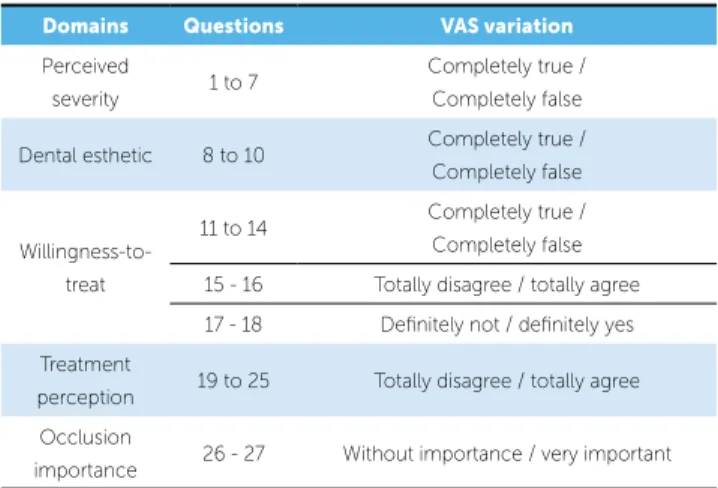
In the initial consultation, patient’s motivation to undergo orthodontic treatment was assessed through a 27-question questionnaire, divided into 5 domains: Perceived Severity, Dental Esthetic, Willingness-to-Treat, Treatment Perception and Occlusion Im-portance. The questions were answered through a
100 mm VAS,11 (Fig 1) which varied according to
Table 1. Only one examiner applied the question-naire, informing the participants about the way to fill it in, but without providing further information on the questions. The VAS value was calculated as the distance in millimeters from the left end of the horizontal line to the center of the mark made by the patient, the value for each domain consisting of the arithmetic mean of the corresponding answers.
In order to assess the reliability of the 27 questions, and determine their temporal stability, a pre-question-naire was applied twice, to 20 individuals, with a mean interval of 42.7 days between applications.
Perceived severity:
1. In general, my teeth are worse than other people’s teeth.
Completely false Completely true
Figure 1 - Question 1 of the 100 mm Visual Analogue Scale.
Table 1 - Questionnaire domains and VAS variations.
Domains Questions VAS variation
Perceived
severity 1 to 7
Completely true / Completely false
Dental esthetic 8 to 10 Completely true / Completely false
Willingness-to-treat
11 to 14 Completely true / Completely false
15 - 16 Totally disagree / totally agree
17 - 18 Deinitely not / deinitely yes
Treatment
perception 19 to 25 Totally disagree / totally agree
Occlusion
Patient assessment lasted 14 days and was divided into 2 phases: Bonding (days 1-7) and initial arch (days 8-14). On the morning of the day preceding assessment onset, brackets and tubes (Mini Stan-dard Edgewise, American Orthodontics, Wisconsin, USA) were bonded to the vestibular surfaces of the maxillary incisors, canines, premolars and first mo-lars. On the morning of day 7, a 0.014-in pre-formed archwire (Titanium Memory Wire, American Or-thodontics, Wisconsin, USA) was totally inserted in the slots of all brackets and tubes, being then fixed with a 0,010-in steel ligature wire.
Pain intensity was recorded daily during the 14 study days, at wake-up time. Two 100 mm VAS were used, one for tooth pain and the other for buccal mucosa pain, with a range from “without pain” to “worst pain ever”, measurements being taken simi-larly to the procedure used in the questionnaire. Pain intensity was the arithmetic mean of the VAS for tooth pain and buccal mucosa pain.
STATISTICAL ANALYSIS
The test-retest reliability of the questions from each domain of the pre-questionnaire was assessed by the Interclass Correlation Coefficient (ICC), based on variance analysis. The internal consistency of each domain was assessed through Cronbach’s alpha coefficient. Pearson’s Correlation Coefficient assessed the relationship between the questionnaire domains and pain intensity means, and between
each question and pain intensity means. The
Statis-tical Package for the Social Sciences (SPSS 11.0.0) pro-gram was used for the analyses.
RESULTS
Analysis of the pre-questionnaire, which de-termined the ICC, showed excellent reliability (ICC > 0.75) for the Dental Esthetic, Treatment Perception and Occlusion Importance domains, and good reliability (0.4 < ICC < 0.75) for the Perceived Severity and Willingness-to-Treat domains (Table 2).
Based on the applied questionnaire, Cronbach’s alpha coefficient was calculated for the estimation of the internal consistency of each domain (Table 2). The Occlusion Importance domain had very good
internal consistency (α > 0.9), the Perceived Severity
and Treatment Perception domains had good
consis-tency (α between 0.8 and 0.9), the
Willingness-to-Treat domain had regular consistency (α between 0.7
and 0.8), and the Dental Esthetic domain had weak
consistency (α between 0.6 and 0.7).23
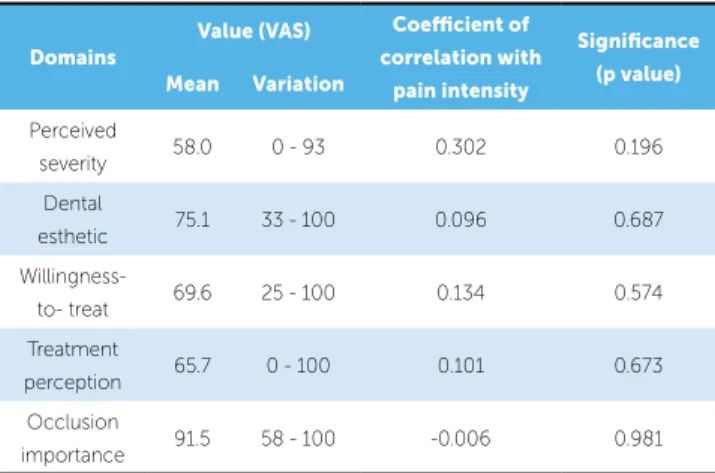
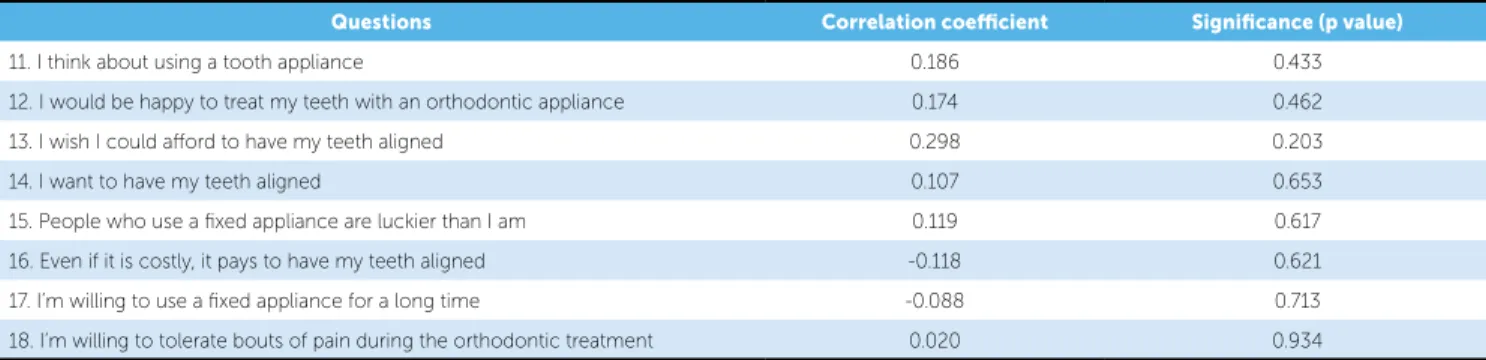
The pain intensity means reported by the patients every day of the study period are shown in Figure 2. The correlations between each domain of the ques-tionnaire of assessment of treatment motivation and the pain intensity means are shown in Table 3. No significant correlation was found for any domain. Ta-bles 4 to 8 show the correlation between each ques-tion and pain intensity. Only quesques-tion 2 showed a significant positive correlation.
Table 3 - Correlation between the questionnaire domains and pain intensity.
Domains ICC* α**
Perceived severity 0.71 (0.60 – 0.80) 0.83
Dental esthetic 0.79 (0.65 – 0.88) 0.62
Willingness-to-treat 0.71 (0.60 – 0.79) 0.70
Treatment perception 0.81 (0.73 – 0.86) 0.83
Occlusion importance 0.83 (0.67 – 0.91) 0.98 Table 2 - Test-retest reliability and internal consistency of each questionnaire domain.
* Interclass correlation coeicient with 95% conidence interval; ** Cronbach’s alpha coeicient.
Domains
Value (VAS) Coeicient of correlation with
pain intensity
Signiicance (p value) Mean Variation
Perceived
severity 58.0 0 - 93 0.302 0.196
Dental
esthetic 75.1 33 - 100 0.096 0.687
Willingness-to- treat 69.6 25 - 100 0.134 0.574
Treatment
perception 65.7 0 - 100 0.101 0.673
Occlusion
Figure 2 - Intensity of patients’ reported pain during the bonding (days 1 to 7) and initial arch (days 8 to 14) phases.
Days
Intensity o
f pain (
V
AS)
20
18
16
14
14 12
12 13 10
10 11 9 8
8 7 6
6 4
4 5
2
2 3
1 0 Table 4 - Correlation between the questions of the Perceived Severity
do-main and pain intensity.
* p < 0.05 according to Pearson’s test
Questions Correlation coeicient
Signiicance (p value)
1. In general, my teeth are worse than
the teeth of other people -0.124 0.602
2. My teeth are too crooked 0.447 0.048*
3. My teeth really need correcting 0.261 0.267
4. I am not happy with the appearance
of my teeth when I bite 0.013 0.955
5. I am worried about the appearance of
my teeth when I bite 0.308 0.187
6. My crooked teeth bother me 0.266 0.258
7. My teeth don’t look nice the way
they are 0.289 0.216
Table 5 - Correlation between the Dental Esthetic domain questions and pain intensity.
Questions Correlation coeicient Signiicance (p value)
8. A beautiful smile is important -0.005 0.982
9. The teeth are the most important contributor to the beauty of people’s faces 0.372 0.106
10. When I see people’s faces, the irst point I’m generally drawn to are the teeth -0.069 0.773
Table 6 - Correlation between the Willingness-to-treat domain questions and pain intensity.
Questions Correlation coeicient Signiicance (p value)
11. I think about using a tooth appliance 0.186 0.433
12. I would be happy to treat my teeth with an orthodontic appliance 0.174 0.462
13. I wish I could aford to have my teeth aligned 0.298 0.203
14. I want to have my teeth aligned 0.107 0.653
15. People who use a ixed appliance are luckier than I am 0.119 0.617
16. Even if it is costly, it pays to have my teeth aligned -0.118 0.621
17. I’m willing to use a ixed appliance for a long time -0.088 0.713
18. I’m willing to tolerate bouts of pain during the orthodontic treatment 0.020 0.934
Table 7 - Correlation between the Treatment Perception domain questions and pain intensity.
Questions Correlation coeicient
Signiicance (p value)
19. People who use ixed appliances don’t
look silly 0.212 0.370
20. A ixed appliance doesn’t make the
teeth look ugly -0.067 0.780
21. I can see myself using a ixed appliance 0.238 0.311
22. Using a ixed appliance is not worse
than wearing glasses -0.210 0.374
23. Using a ixed appliance would not
bother me at all 0.275 0.241
24. People who use a ixed appliance seem
not to perceive them 0.099 0.678
25. The ixed appliance is not going to
bother me 0.023 0.924
Questions Correlation coeicient
Signiicance (p value)
26. In your opinion, what is the
importance of having aligned teeth that articulate correctly?
-0.046 0.847
27. In your opinion, for a person whose
teeth are crooked and do not articulate correctly, what is the
importance of having aligned teeth?
were analyzed by domains or individually, except for question 2. These results agree with other stud-ies, which failed to find a correlation between pain intensity and dentofacial esthetic, or with the
self-perceived treatment need.1,8
Although no domain was significantly correlated with pain intensity, Perceived Severity had the lowest p value (0.196), with a positive correlation. Contrary
to this trend, Sergl et al26 found a negative correlation,
indicating that patients who perceived their maloc-clusion to be more severe reported less intense pain.
The significance of the Perceived Severity do-main was influenced by question 2, the only one that showed a significant positive correlation with pain intensity. Because this question assessed whether the patient considers their teeth to be “very crooked”, the result highlights the hypothesis that the intensity of force application to the teeth, gardless of the degree of tooth crowding, has a re-lationship with pain reported during the alignment
and leveling phase,2 although other studies have not
confirmed this relationship.14,15
The existence of a relationship between the degree of dental crowding and pain intensity is a reminder of the importance of educating patients on the possibil-ity of more intense pain, proportional to the sever-ity of dental crowding, chiefly after insertion of the initial arch during the alignment and leveling phase.
CONCLUSION
The results indicate that the intensity of reported pain during orthodontic treatment is not related to treatment motivation, evidencing no rationale to use the degree of a patient’s motivation to predict dis-comfort experienced after installation and activation of the orthodontic appliance.
DISCUSSION
The high prevalence rates of pain reported by
patients during orthodontic treatment2,3,7,8,13,15,19-22,25
may lead to treatment failure due to lack of
adher-ence5,22 and treatment drop-out.22 Thus, it is
im-portant to search for factors that may influence the prevalence and intensity of the pain experienced by these patients.
Authors3,15 suggested that psychological factors
might somehow influence the reports of pain and dis-comfort. Among such factors, patient’s motivation to undergo orthodontic treatment seems to be the most relevant.1,16,26
Patient’s motivation has been studied through
self-assessment of the dental condition,10,28 esthetic
perception1,10,16,21 and knowledge about the
orth-odontic treatment.10 In this study, patient’s
motiva-tion was assessed through a quesmotiva-tionnaire based on
the works of Clemmer and Hayes4 and Fox et al.10
The 27 questions addressed: 1) perception of the se-verity of the dental problem; 2) importance of dental esthetic; 3) willingness to undergo orthodontic cor-rection; 4) impressions about the orthodontic treat-ment; and 5) importance of good occlusion.
The questions were answered according to a VAS, a widely used scale to assess pain intensi-ty,2,7,8,9,15,17,21,24,25,27,29 and which has been used in some
questionnaires.2,6,30 The reliability test showed a good
to excellent precision for all questionnaire domains, pointing to the good assessment stability of VAS-as-sociated questions at different times.
1. Bergius M, Berggren U, Kiliaridis S. Experience of pain during an orthodontic procedure. Eur J Oral Sci. 2002 Apr;110(2):92-8. 2. Bergius M, Kiliaridis S, Berggren U. Pain in orthodontics: a review and
discussion of the literature. J Orofac Orthop. 2000;61(2):125-37. 3. Brown DF, Moerenhout RG. The pain experience and psychological
adjustment to orthodontic treatment of preadolescents, adolescents, and adults. Am J Orthod Dentofacial Orthop. 1991;100(4):349-56.
4. Clemmer EJ, Hayes EW. Patient cooperation in wearing orthodontic headgear. Am J Orthod. 1979;75(5):517-24.
5. Egolf RJ, BeGole EA, Upshaw HS. Factors associated with orthodontic patient compliance with intraoral elastic and headgear wear. Am J Orthod Dentofacial Orthop. 1990;97(4):336-48.
6. Feldmann I, List T, John MT, Bondemark L. Reliability of a questionnaire assessing experiences of adolescents in orthodontic treatment. Angle Orthod. 2007;77(2):311-7.
7. Fernandes LM, Ogaard B, Skoglund L. Pain and discomfort experienced after placement of a conventional or a superelastic NiTi aligning archwire. A randomized clinical trial. J Orofac Orthop. 1998;59(6):331-9.
8. Firestone AR, Scheurer PA, Bürgin WB. Patients’ anticipation of pain and pain-related side efects, and their perception of pain as a result of orthodontic treatment with ixed appliance. Eur J Orthod. 1999;21(4):387-96. 9. Fleming PS, Dibiase AT, Sarri G, Lee RT. Pain experience during initial
alignment with a self-ligating and a conventional ixed orthodontic appliance system – a randomized controlled clinical trial. Angle Orthod. 2009;79(1):46-50.
10. Fox RN, Albino JE, Green LJ, Farr SD, Tedesco LA. Development and validation of a measure of attitudes toward malocclusion. J Dent Res. 1982;61(9):1039-43.
11. Huskisson EC. Measurement of pain. Lancet. 1974;9(7889):1127-31. 12. International Association for the Study of Pain. Pain terms: a list with
deinitions and notes on usage. Pain. 1979;6(3):249-52.
13. Jones ML. An investigation into the initial discomfort caused by placement of an archwire. Eur J Orthod. 1984;6(1):48-54.
14. Jones ML, Richmond S. Initial tooth movement: force application and pain: a relationship? Am J Orthod. 1985;88(2):111-6.
15. Jones M, Chan C. The pain and discomfort experienced during orthodontic treatment: a randomized controlled clinical trial of two initial aligning arch wires. Am J Orthod Dentofacial Orthop. 1992;102(4):373-81. 16. Kiliaridis S, Bergius M. Pain and discomfort in orthodontics. In: Graber TM,
Eliades T, Athanasiou A. E. Risk management in Orthodontics: experts guide to malpractice. Chicago: Quintessence; 2004. p. 131-43. 17. Kluemper GT, Hiser DG, Rayens MK, Jay MJ. Eicacy of a wax containing
benzocaine in the relief of oral mucosal pain caused by orthodontic appliances. Am J Orthod Dentofacial Orthop. 2002;122(4):359-65. 18. Krishnan V. Orthodontic pain: from causes to management—a review. Eur
J Orthod. 2007;29(2):170-9.
19. Kvam E, Bondevik O, Gjerdet NR. Traumatic ulcers and pain in adults during orthodontic treatment. Community Dent Oral Epidemiol. 1989;17(3):154-7. 20. Kvam E, Gjerdet NR, Bondevik O. Traumatic ulcers and pain during
orthodontic treatment. Community Dent Oral Epidemiol. 1987;15(2):104-7.
REFERENCES
21. Ngan P, Kess B, Wilson S. Perception of discomfort by patients undergoing orthodontic treatment. Am J Orthod Dentofacial Orthop. 1989;96(1):47-53. 22. Oliver RG, Knapman YM. Attitudes to orthodontic treatment. Br J Orthod.
1985;12(4):179-88.
23. Pestana MH, Gagueiro JN. Análise de dados para Ciências Sociais. 4a ed. Lisboa: Síbalo; 2005.
24. Polat O, Karaman AI. Pain control during ixed orthodontic appliance therapy. Angle Orthod. 2005;75(2):214-9.
25. Scheurer PA, Firestone AR, Burgin Wl. Perception of pain as a result of orthodontic treatment with ixed appliances. Eur J Orthod. 1996;18(4):349-57.
26. Sergl HG, Klages U, Zentner A. Pain and discomfort during orthodontic treatment. Causative factors and efects on compliance. Am J Orthod Dentofacial Orthop. 1998;114(6):684-91.
27. Seymour RA, Simpson JM, Charlton JE, Phillips ME. An evaluation of length and end-phrase of visual analogue scales in dental pain. Pain. 1985;21(2):177-85.
28. Shaw WC, Addy M, Ray C. Dental and social efects of malocclusion and efectiveness of orthodontic treatment: a review. Community Dent Oral Epidemiol. 1980;8(1):36-45.
29. Shirasaki S, Fujii H, Takahashi M, Sato T, Ebina M, Noto Y, Hirota K. Correlation between salivary — amylase activity and pain scale in patients with chronic pain. Reg Anesth Pain Med. 2007;32(2):120-3.