ISSN 0104-6632 Printed in Brazil
www.abeq.org.br/bjche
Vol. 25, No. 01, pp. 119 - 127, January - March, 2008
Brazilian Journal
of Chemical
Engineering
STUDY OF ANTIOXIDANT PROPERTY OF A
THIOPHOSPHORATED COMPOUND DERIVED
FROM CASHEW NUT SHELL LIQUID IN
HYDROGENATED NAPHTHENICS OILS
A. A. S. Lopes
1*, E. A. Carneiro
1, M. A. S. Rios
2, J. J. Hiluy Filho
2, J. O. B. Carioca
2,
G. G. Barros
2and S. E. Mazzetto
21
Departamento de Engenharia Química, Universidade Federal do Ceará, Campus do Pici, Bloco 709, Fax: +(55) (85) 3244-0707, CEP: 60455-760, Fortaleza - CE, Ceará, Brazil.
E-mail: [email protected] 2
Parque de Desenvolvimento Tecnológico, Universidade Federal do Ceará, Avenida do Contorno s/n, Fortaleza - CE, Brazil.
(Received: January 24, 2007; Accepted: August 9, 2007)
Abstract - The present work shows the aspects related to the synthesis and thermogravimetric analysis of
thiophosphorated and phosphorated compounds from hydrogenated cardanol. Studies on thermal-oxidative stability were investigated, using a classical thermoanalytical-thermogravimetric method (TG/DTG) in an air atmosphere. Its use as an antioxidant additive in hydrogenated naphthenic NH10, NH20 and NH140 oils was evaluated. The addition of 1.2% synthesized compounds to the oils has improved their thermal-oxidative stability by 5-15oC. The occurrence of major thermal degradation events at higher temperatures (Tmax) in
additivated oils is a good indication of the antioxidant properties of the thiophosphorated and phosphorated cardanol compounds antioxidant properties.
Keywords: CNSL; Thiophosphorated compound; Antioxidant.
INTRODUCTION
Sulphur-phosphorus compounds have been used as antiwear additives (Bansal, et. al., 2002) and antioxidants (Lopes, 2005) in mineral based oils. The oxidation stability and performance of these additives is dependent upon the chemistry of the compound and formation of soluble decomposition products during usage (Bala, et. al., 1998). The increasing interest of petrochemical industries in improving the performance of their products (gear lubricants, gasoline, among others) has been simultaneously generating great incentives in several research groups. The development of automotive engine lubricant additives derived from
natural sources (cashew nut shell liquid - CNSL) is the main reason of interest, because they satisfy legislative and environmental demands (Green, et. al., 2003).
The shell of the cashew nut (Anacardium
occidentale L.) contains alkyl-substituted phenolic
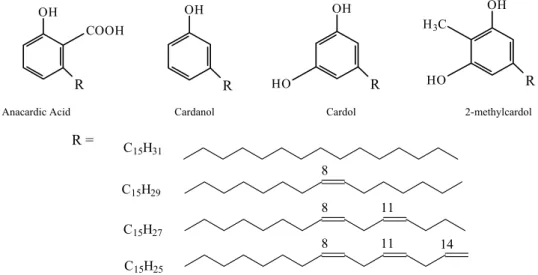
compounds Internationally named CNSL, this oil is obtained as a by-product from mechanical processing for edible use of cashew kernel and its composition is a mixture of anacardic acid, cardanol and smaller amounts of cardol and 2-methylcardol (Attanasi, et. al., 2006) Figure 1. One of its highest-yield derivatives cardanol is currently being used as an antioxidant in the petrochemical industry (Trevisan, et. al., 2006) and such studies have more and more consolidated a research program based on green chemistry. Since cardanol is an important natural source of phenolic compounds and thus possesses antioxidant properties, many synthetic mechanisms involving this type of additive have been developed
based on CNSL derivatives
(
Kuman, et. al., 2002; Paramashivappa, et. al., 2001).Considering the great importance of this group of additives and their multifunctional properties (antioxidant, antiwear additive, extreme pressure additive, corrosion inhibitor) thiophosphorated compounds have not lost their dominant role as standard additives of modern tribology (Mang, et. al., 2001). In the present work we obtain an organothiophosphorus antioxidant based on hydrogenated cardanol and diethyl thiochlorophosphate. The synthesized compound was investigated using a classical thermoanalytical-thermogravimetric method (TG/DTG) parallel to NH10, NH20 and NH140 oils, in comparison with previous work (Rios, et. al., 2007).
R OH
COOH
R OH
HO R
OH
R OH
HO H3C
Anacardic Acid Cardanol Cardol 2-methylcardol
C15H31
C15H29
8
C15H27
8 11
C15H25
11
8 14
R =
Figure 1: Structure of the constituents of CNSL
MATERIALS AND METHODS
Materials
Cashew nut shell liquid (CNSL) was supplied by Irmãos Fontenele S.A. Industry, (Fortaleza, Brazil). The hydrogenated cardanol used in this work is in accord with analytical analysis and literature data (Paramashivappa, et. al., 2001). The hydrogenated naphthenic oils NH10, NH20 and NH140 were supplied by Petrobras (Brazilian Oil Company, Brazil) with no further treatment procedure. The reagents and solvents were supplied by Aldrich (analytical grade).
Product Analyses
IR spectra were obtained by use of a FTIR spectrophotometer Perkin Elmer, mod. Spectrum one.
NMR (1H and 31P) spectra were recorded on an AVANCE DRX 500 BRUKER spectrometer, at a frequency of 500MHz under the following conditions: solvent, CDCl3; tetramethylsilane (TMS)
as an internal standard for 1H and phosphoric acid (H3PO4) for 31P.
column. Sample of 1 µL was injected into the column.
Thermoanalytical measurements were carried out using a SHIMADZU TGA–50H thermogravimetric analyzer. Thermogravimetric (TG) measurements were performed at a scanning rate of 10ºC/min. Samples of approximately 10mg were heated from 30 to 700ºC. The measurements were carried out in a synthetic air atmosphere (50mL/min).
Experimental Procedure
CNSL was hydrogenated by catalytic hydrogenation (Castro Dantas, et. al, 2003; Avellar, et. al., 2000). The product was analyzed by GC-MS,
1H and 31P-NMR and FTIR to prove the identity and
purity of the hydrogenated cardanol.
The analysis by 1H- NMR, showed the following (C3D6O, ppm): 0.9, 3H, R-CH3; 1.3, 8H, –(CH2)n–;
1.5, 9H, –(CH3)3; 2.5, 2H, -CH2–Ar; 6.6, 1H, Ar-OH;
7.2, 1H, Ar-H; 7.5, 1H, Ar-H; in accord with literature data (Castro Dantas, et. al, 2003; Koh, et.al., 1995).
FTIR spectral (ν, cm-1) data were: 3412 (OH); 2917 and 2849 (CH2, CH3); 1619, 1587 e 1463 (C=C
aromatic ring vibrations); 747 (angular C-H deformation of the aromatic ring), in accord with literature data (Castro Dantas, et. al, 2003; Koh, et.al., 1995).
The thiophosphorated compound was synthesized by an optimization of the method described in the literature
(
Lopes, 2005). A reflux system under constant agitation at 60ºC and inert atmosphere was used, because of the intermoleculecular migration of P-O-R to P-S-R, sulphur transfer and oxidation of P=S to P=O can take place during thermaldegradation
(
Bansal, et.al., 2002). The stoichiometric ratio of the reaction system was 1.0 mol of hydrogenated cardanol/1.0 mol of sodium hydroxide/1.0 mol of diethyl thiochlorophosphate, respectively. After the reaction time of 9h viscous orange oil was obtained. The obtained product was purified by column chromatography followed by its characterization using 1H and 31P- NMR, FTIR and GC-MS.(
Lopes, 2005; Attanasi et.al., 1995)Thermal-oxidative stability studies were carried out using thermoanalytical measurements (TG/DTG).
RESULTS AND DISCUSSION
Characterization
The characterization of the synthesized product (thiophosphorated cardanol derivative) is summarized below.
NMR 1H, (CDCl3, ppm) data were: 0.9, 3H,
R-CH3; 1.4-1.3, 2H, –CH2; 2.6, 2H, -CH2–Ar; 4.4 –
4.2, 2H, 3H, CH3CH2O-; 7.0, 1H, 2H, H1- H2-Ar;
7.3, H3-Ar.
NMR 31P (ppm): 64, P, S=P-O.
FTIR spectra (ν, cm-1): 2923 and 2853 (CH2,
CH3); 1608 and 1443 (C=C aromatic ring
vibrations); 1239 (Ar-O aromatic vibrations); 1147 (P-O-C2H5); 1015 (P-O-C aliphatic) 963 (P-O-Ar);
792 (P=S); 733 (angular C-H deformation of the aromatic ring).
GC-MS profile shows the appearance of a characteristic peak confirming the purity of the thiophosphorated compound (456g/mol).
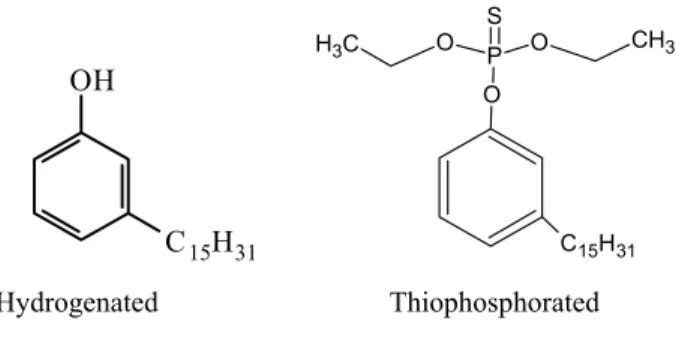
Figure 2 shows the structures of hydrogenated cardanol and thiophosphorated cardanol.
C15H31 O
P O
O S
CH3 C
H3
C15H31 OH
Hydrogenated Thiophosphorated
Thermal-oxidative stability studies
a) Hydrogenated, Phosphorated and Thiophosphorated
The thiophosphorated compounds are typical peroxide decomposers and numerous types of sulphur-phosphorus have been evaluated as antioxidants (Mang, et. al., 2001), so the present work studied the antioxidant potentiality of the synthesized compound by thermogravimetric analysis or TG. This type of testing that is performed on samples to determine the mass loss of a particular sample versus time or temperature is very useful for the evaluating additive performance of organic materials. The degradation starting points of the materials observed by TG/DTG can provide data regarding events of mass loss with temperature at which these events are most significant
(
Rios, 2007).Previous to the TG of compound, the authors began the analyses of thermal-oxidative stability of hydrogenated cardanol, Figure 3. The TG curve showed a simple degradation step starting at 200°C and ending at 320°C due to probably to the loss of aliphatic and aromatic hydrocarbon groups, Table 1. A comparative thermal study of phosphorated and thiophosphorated cardanol compounds is given in
Figure 4. The phosphorated compound showed an initial degradation at 56°C finishing at 159°C probably due to volatile products (5wt%) remained from the synthesis reaction. The second degradation step observed at 174°C and finished at 350°C was a complex mechanism with superposition of three different events (83wt%). The maximum degradation rate of the main degradation event was observed at 290°C. The residue of 12% (wt %) was attributed to inorganic material (phosphorus), Table 2.
The TG curve of thiophosphorated compound showed five steps of degradation, Figure 5. The first initial degradation step occurs at 25°C finishing at 160°C probably due to loss of water, because of hydrophilicity of the sulfur atom (13wt%). The second degradation step observed at 230°C and finished at 310°C was a complex mechanism with superposition of different events (42wt%). The maximum degradation rate of the main degradation event was observed at 285°C. The third degradation step observed at 320°C and finished at 350°C showed of mass loss of 11wt% the fourth and fifth steps were less significant steps and are given in Table 3. The residue of 5% (wt%) was attributed to inorganic material (phosphorus). Table 4 shows the thermoanalytical comparative data of two derivative compounds.
0 100 200 300 400 500 600 700
0 20 40 60 80 100
Temperature oC
dm
/d
T
(
m
g
/ o
C)
W
ei
g
h
t
lo
ss
%
Hydrogenated Cardanol
C15H31
OH
-3 -2 -1 0 1
Figure 3: TG/DTG curve of hydrogenated cardanol.
Table 1: Thermal degradation data of hydrogenated cardanol.
Sample Degradation
step (nº)
Degradation temperature (°C)
Mass loss (wt%)
Residue (wt%)
Ti Tf Tmax
Hydrogenated cardanol
0 100 200 300 400 500 600 700 0
20 40 60 80 100
Phosphorated cardanol
P O O O O CH2
CH3
CH2
CH3
C1 5H31
C15H31 O P O O
S CH3 C
H3
W
e
ig
h
t
lo
ss
%
Temperature oC
Thiophosphorated cardanol
Figure 4: TG curves of phosphorated and thiophosphorated cardanol derivatives.
Table 2: Thermal degradation data of phosphorated cardanol.
Sample Degradation
step (nº)
Degradation temperature (°C)
Mass loss (wt%)
Residue (wt%)
Ti Tf Tmax
I 56 159 - 5
Phosphorated cardanol
II 174 350 290 83 12
0 100 200 300 400 500 600 700
-1,0 -0,5 0,0
440o
C
370oC
330o
C
235o
C
d
m
/d
T
(
m
g
/
o C
)
Temperature oC 118o
C
Figure 5: DTG curve of thiophosphorated cardanol.
Table 3: Thermal degradation data of thiophosphorated cardanol.
Degradation temperature (°C)
Sample Degradation
step (nº)
Ti Tf Tmax
Mass loss (wt%)
Residue (wt%)
I 25 160 110 13
II 230 310 285 42
III 320 350 330 11
IV 360 380 370 12
Thiophosphorated cardanol
V 400 450 440 17
Table 4: Thermoanalytical comparative data of thiophosphorated and phosphorated compounds in NH10, NH20 and NH140 oils.
TMAX (0C)
Thiophosphorated cardanol
TMAX (0C)
Phosphorated cardanol Hhydrogenated
Naphthenics Oils 0
(wt%)
1.2 (wt%)
0 (wt%)
1.2 (wt%)
NH10 251 255 256 278
NH20 250 265 262 290
NH140 300 310 340 340
b) Hydrogenated Naphthenics Oils - NH10, NH20 and NH140
Figure 6 shows the TG/DTG curves of hydrogenated naphthenics oil (NH10). The oil showed a simple degradation step starting at 100°C and ending at 289°C due probably to loss of organic material (99 %). The maximum degradation rate was observed at 251°C.
Similar degradation profile TG/DTG curves were observed for NH10 oil after addition of 1.2% (wt%) of thiophosphorated cardanol compound. However, the temperature of the maximum degradation rate was shifted to higher value (255oC), Figure 7, Table 5.
The NH20 oil showed a simple degradation step starting at 133°C and ending at 305°C probably due
to loss of organic material (99wt%), Figure 8. The maximum degradation rate was observed at 250°C.
The onset temperatures in oils containing the thiophosphorated compound were shifted to higher temperatures as compared with the absence of additive, Figure 9 shows the TG/DTG curve of NH20 oil after addition of 1.2% (wt%) of thiophosphorated cardanol compound. It proves that the presence of thiophosphorated compound in the oil improves the oxidative stability as given in Table 6. Figure 10 shows the TG/DTG curves of NH140 oil and Figure 11 shows the curves after addition of 1.2% (wt%) of additive. Data are given in Table 7, and the degradation was shifted to higher temperature when compared with NH140 oil without additive.
0 100 200 300 400 500 600 700
0 20 40 60 80 100
Temperature oC
W
e
ig
th
l
o
ss
%
251o
C
-1,5 -1,0 -0,5 0,0
d
m/
d
T
(mg
/ o
C
)
Figure 6: TG/DTG curves of NH10 oil.
Table 5: Thermal degradation data of NH10 oil with and without additive (1.2 wt% of thiophosphorated cardanol).
Sample Degradation
step (nº)
Degradation temperature (°C)
Mass loss (wt%)
Residue (wt%)
Ti Tf Tmax
NH10 oil I 100 289 251 99 1
0 100 200 300 400 500 600 700 0
20 40 60 80 100
Temperature oC
W
e
ig
h
t
lo
ss
%
255o
C -1,2
-1,0 -0,8 -0,6 -0,4 -0,2 0,0 0,2
d
m/
d
T
(mg
/ o
C
)
Figure 7: TG and DTG curves of NH10 oil with 1.2% of thiophosphorated cardanol.
0 100 200 300 400 500 600
0 20 40 60 80 100
Temperature 0C
W
e
ig
h
t
lo
s
s
%
250O
C
-1,4 -1,2 -1,0 -0,8 -0,6 -0,4 -0,2 0,0
d
m/
d
T
(mg
/ 0
C
)
Figure 8: TG and DTG curves of NH20 oil.
0 100 200 300 400 500 600
0 20 40 60 80 100
Temperatura oC
W
e
ig
h
t
lo
ss
%
265o
C -1,0
-0,8 -0,6 -0,4 -0,2 0,0
d
m
/d
T
(
m
g
/ o
C
)
Table 6: Thermal degradation data of NH20 oil with and without additive (1.2 wt% of thiophosphorated cardanol).
Sample Degradation
step (nº)
Degradation temperature (°C)
Mass loss (wt%)
Residue (wt%)
Ti Tf Tmax
NH20 oil I 133 305 250 99 1
NH20 oil with additive I 135 315 265 100 -
0 100 200 300 400 500 600
0 20 40 60 80 100
d
m/
d
T
(mg
/ o
C
)
Temperature o
C
W
e
ig
h
t
lo
s
s
%
300o
C
-1,5 -1,0 -0,5 0,0
Figure 10: TG and DTG curves of NH140 oil
0 100 200 300 400 500 600
0 20 40 60 80 100
Temperature o
C
W
e
ig
h
t
lo
ss
%
310o
C
-1,5 -1,0 -0,5 0,0
d
m
/d
T
(m
g
/ o
C
)
Figure 11: TG and DTG curves of NH140 oil with 1.2% of thiophosphorated cardanol.
Table 7: Thermal degradation data of NH140 oil with and without additive (1.2 wt% of thiophosphorated cardanol).
Sample Degradation
step (nº)
Degradation temperature (°C)
Mass loss (wt%)
Residue (wt%)
Ti Tf Tmax
NH140 oil I 175 350 300 98 2
CONCLUSIONS
Addition of phosphorus and phosphorus-sulfur compounds to hydrogenated naphthenic oils provides superior thermal stability for lubricants, greases and fuels and/or superior functionalized lubricants with multifunctional properties. In this work, we studied the antioxidant potentiality of two synthesized molecules - thiophosphorated and phosphorated compounds from hydrogenated cardanol which presented even better stability. The addition of specific amounts of synthesized compounds in NH10, NH20 and NH140 oils improves their thermal-oxidative stability by 5-15oC. The occurrence of major thermal degradation events at higher temperatures (Tmax) for additivated
hydrogenated naphthenics oils
(
Mascolo et. al., 2005) retarding their thermal degradation process, is an excellent indication of the antioxidant properties of the thiophosphorated and phosphorated cardanol compounds (Haines, 1995).REFERENCES
Bansal,V., Dohhen, K.C., Sarin, R., Sarpal, A.S., Bhatnagar, A.K., Sulphur-phosphous components in gear oils. Part 1, oxidation stability studies by [31]P-NMR spectroscopic techniques. Tribology International, 35, pp. 819-828 (2002).
Lopes, A.A.S., Síntese de um Aditivo Tiofosforado a partir do Líquido da Casca da Castanha de Caju
(Anacardium occidentale Linn) Dissertation
(Master). Universidade Federal do Ceará: CE, Brazil; (2005).
Bala, V., Saathaff, L., Oxidative stability of automotive gear lubricants. NLGI Spokesman, 12 (12), (1998).
Green, J. H., Morina, A., Priest, M., Neville,A., Lubricant Additive Interactions, Surface Reactions and the Link to Tribological Performance in Engines. Institute of Tribology, School of Mechanical Engineering, University of Leeds. (2003).
Technical Regulations ANP Nº 004/99 (1999). Ohgake, R., Sunami, M., Yoshida T., Watanabe, H.,
ASTM Special Techn. Publ. 32, (1989).
Attanasi,O., Berretta, S., Fiani, C., Filippone,P., Mele, G., Saladino,R., Synthesis and reactions of nitro derivativesof hydrogenated cardanol. Tetrahedron 62, pp. 6113–6120 (2006).
Trevisan M T, Pfundstein B, Haubner R, Würtele G, Spiegelhalder B, Bartsch H, Owen R W. Characterization of alkyl phenols in cashew
(Anacardium occidentale) products and assay of
their antioxidant capacity. Food Chem Toxicol, 44, pp.118-197 (2006).
Kumar, P. P., Paramashivappa, R., Vithayathil, P. J., Rao, P. V. S., Rao, A. S., Process for Isolation of Cardanol from Technical Cashew (Anacardium
occidentale L.) Nut Shell Liquid. J Agric Food
Chemistry, 50, pp.4705-4708 (2002).
Paramashivappa, R., Kumar,P. P., Vithayathil, P. J., Rao, A. S., Novel Method for Isolation of Major Phenolic Constituents from Cashew (Anacardium
occidentale L.) Nut Shell Liquid. J Agric Food
Chemistry, 49, pp. 2548-2551 (2001)
Mang,T., Dresel,W., Lubricants and Lubrications, Wiley-VCH, Weinheim, New York (2001). Rios, M.A.F., Mazzetto, S.E., Carioca,J.J.B., Barros,
G.G., Evaluation of antioxidant properties of a phosphorated cardanol compound on mineral oils (NH10 and NH20). Fuel, accepted for publication (2007).
Dantas, T. N., Dantas, M. S. G., Dantas Neto, A. A., D´Ornellas, C. V., Queiroz, L. R., Novel antioxidants from cashew nut shell liquid applied to gasoline stabilization. Fuel, 82, pp.1465-1469 (2003).
Koh, C. S., Butt, J. B., Experimental and Modeling Study of Kinetics and Selectivity in the Oxidation of a Poly (α-olefin) Lubricant. Ind. Eng. Chem. Res., 34 pp.524-535 (1995).
Attanasi O, Filippone P, Grossi M. Synthesis of Some Phosphorus Derivatives of Cardanol. Phosp. Súlfur, 35, pp. 63-65 (1998).
Mascolo G, Rausa R, Bagnuolo G, Mininni G, Tinucci L. Thermal degradation of synthetic lubricants under oxidative pyrolytic conditions. J Anal Appl Pyrolysis, 75, pp. 167-1773 (2005).