INTRODUCTION
Cities occupy approximately 2% of the Earth’s surface, and their inhabitants consume 75% of world energy resources. Under certain conditions, the heat of solar radiation in different urban activities can raise temperatures in some areas, simply because of the way a city is structured. These effects are known as urban heat islands (UHI) [1]. Buchin
et al. [2] reported a monitoring of the internal temperatures
inside buildings in Germany that are inhabited by over 65 years old individuals, and the results showed that the risk to health increases progressively with increasing temperature
Evaluation of the thermal performance of different
cold materials for urban paving
(Avaliação do desempenho térmico de diferentes materiais frios para
pavimentação urbana)
L. C. Castro, K. M. Degues, M. G. Cypriano, M. R. Rocha, O. R. K. Montedo, E. Angioletto*
Programa de Pós-Graduação em Ciência e Engenharia de Materiais, Universidade do Extremo Sul Catarinense, Av. Universitária, 1105, P.O. Box 3167, Criciúma, SC, Brazil 88806-000
[email protected], [email protected], [email protected], [email protected], [email protected], *[email protected]
Abstract
The phenomenon of the warming of cities at high temperature levels, the so-called “heat island”, has been studied around the world. Apart from generating thermal discomfort, this urban phenomenon has been causing an increase in the demand for energy for cooling the environments. In response to the environmental impact generated by this phenomenon, researchers from different nations have developed techniques for warming mitigation, developing new materials, technologies, and constructive systems. In this context, urban paving is responsible for a signiicant contribution to the occurrence of heat islands in cities. The use of pavements called “cold materials”, which help to lower the surface temperature, constitutes an important solution to mitigate the effects of the heat low in cities and the planet. Thus, the purpose of this study was to develop, test and evaluate new cold materials for use in paving. Such cold materials proved to present better thermal performance than conventional ones, such as asphalt and reference concrete (commercial paver). In fact, this work showed that the composition with 90% concrete+10% talc can be considered cold material, with energy savings of up to 16% in comparison to asphalt.
Keywords: cold materials, thermal performance, heat islands, relection, emissivity.
Resumo
O fenômeno do aquecimento das cidades a patamares de temperatura elevados, as chamadas “ilhas de calor”, vem sendo estudado no mundo todo. Além de gerar desconforto térmico urbano, provocam maior demanda de energia para refrigerar os ambientes. Em resposta ao impacto ambiental gerado por esse fenômeno, pesquisadores de diferentes nações vêm desenvolvendo técnicas para atenuação do aquecimento, desenvolvendo novos materiais, tecnologias e sistemas construtivos para os elementos construídos do
espaço urbano. Neste sentido, a pavimentação urbana é responsável por signiicativa contribuição para a ocorrência das ilhas de calor nas cidades. A utilização de pavimentos chamados “frios” apresenta menor temperatura supericial e constitui-se numa solução importante para mitigar os efeitos do luxo de calor sensível nas cidades e no planeta. Diante desse panorama, o propósito
desse trabalho foi desenvolver, testar e avaliar novos materiais frios para uso em pavimentação. Tais materiais frios provaram apresentar melhor desempenho térmico que aqueles materiais convencionais, tais como asfalto e concreto de referência (paver comercial). De fato, este trabalho mostrou que a composição com 90% concreto+10% talco pode ser considerada material frio, com economia de energia de até 16% em comparação com asfalto.
Palavras-chave: materiais frios, desempenho térmico, ilhas de calor, relexão, emissividade.
and approximately double with every 1 K increase in environment temperature. They used four building models to it their experimental data named EnergyPlus, Linear, Physical and Recursive. Quantitative risk analysis was evaluated. The hazard was calculated with threshold temperatures in the range of 16 to 30 °C for outdoor air
temperatures and 21 to 33 °C for indoor temperatures. The
daily mortality rates increased from 1.3x10⁻⁴ to 1.6x10⁻⁴ for
the indoor temperature increasing from 30 to 32 °C. Buchin
et al. [3] have found that the median mortality increased as
well for high indoor temperatures (>28 °C).
an increasingly popular option in urban planning, mitigating the UHI effect and its environmental impacts, especially those involving large-scale urban-atmosphere interactions, which are not clearly understood. Gago et al. [5] established
as urban planning strategies, contemplating the increase of green spaces, increasing the albedo of the buildings, and greater concern for pavement surfaces. Dimoudi et al. [6],
in their study in Greece, found that the materials used in street paving, sidewalks and urban spaces, and the surfaces of buildings [external vertical seals (facades) and horizontal (lat roofs)] are the “skin” of a city. These materials play a decisive role in the heat transfer processes that takes place between the city and the environment. Materials inluence the absorption of solar radiation, the emission of thermal radiation in heat storage, and the evaporation processes that occur in virtually the entire surface of the city.
The effect of the “heat island” has been documented in hundreds of cities worldwide. Studies on the subject provide a complete picture of the problem and a deep understanding of its characteristics [1, 7]. Heat islands occur because the materials that make up buildings and pavements in urban areas absorb solar radiation in all frequency bands, including those in the infrared, which in turn heats the materials, storing heat and then dissipating it to the urban environment in the form of long waves [8]. Santamouris [8] suggested improving the thermal performance of pavement to promote an effective mitigation of urban heat and heat islands. The urban envelope plays an important role in heat gains and overheating of cities according to [9]. Taking into account these reported works and the idea of sustainability, this study aimed to evaluate the thermal performance of different materials for urban paving to reduce the UHI, thereby providing energy savings and increasing quality of life.
MATERIALS AND METHODS
Some guidelines and conceptual strategies were established for this work, where the main premise was to contribute to reducing energy costs and the use of natural resources. Among the materials used in the construction of cities, the pavement used on sidewalks and streets represents a large proportion. Thus, those constructive materials made of cold materials were chosen to be developed in this work. The experiments were divided into two steps, as seen in Fig. 1. The irst step was to test materials typically used in urban looring, while the second step involved the use of new materials developed for comparison. Asphalt, commercial
paver (reference concrete), granite, and tile were used to obtain initial data of the thermal performance. São Tomé stone was also used, since this material is used in external paving due to its good thermal performance and is usually used in paving pool edges and garden sidewalks. São Tomé stone is quartzite and has high contents of micaceous minerals (quartzite São Tomé) that may have very well-developed foliation due to the preferential phyllosilicates disposal.
After the tests conducted on conventional materials, concrete (commercial paver) as reference material was chosen as the industrial material to be prepared, developed, and improved. For the new materials, the compositions given in Table I were formulated. The composition of the commercial paver (reference concrete) was determined to meet the requirements of Brazilian standard ABNT NBR 9781:2013 - Concrete paving parts: compressive strength test [10]. The reference concrete was composed by 16 wt% of cement CP V-ARI (Itambé, Brazil), 41 wt% of standard sand (ine aggregate, zone 3 according to ABNT NBR 7211:2005 [11]), 25 wt% of crushed stone (coarse aggregate, zone 4.75/12.5 according to ABNT NBR 7211:2005 [11]) and 8 wt% of water. Cement CP V-ARI is a high early strength Portland cement (>27 MPa) and resistant to sulfates which shows high reactivity at low ages due to high degree of grinding that is submitted. For the obtainment of the reference concrete (commercial paver), the mix design was not changed. Talc and mica were milled and sieved (32 mesh) to produce powders (<0.5 mm).
Talc and mica were chosen to be used in the composition of the new materials. Talc, because of its thermal properties, is widely used in the industry of insulating ceramics, where the presence of magnesium oxide (MgO) controls the thermal expansion, increasing the resistance to thermal shock, according to [12]. Mica is a generic term applied Figure 1: Schematic diagram of the steps of the work development.
[Figura 1: Diagrama esquemático das etapas de desenvolvimento do trabalho.]
Composition Talc Mica Cement SandConcreteCrushed stone Water
Commercial paver 0 0 17.8 45.5 27.8 8.9
A 10 0 16 41 25 8
B 0 10 16 41 25 8
Table I - Composition (wt%) of the new materials.
[Tabela I - Composição (% em massa) dos novos materiais.] Conventional paving materials
First Step
Second Step
Development of new materials for paving
Test in the lab thermal
performance Analysis and
interpretation of results
Formulation of the compoisitions
Test in the lab thermal perfomance
Mechanical compression test laboratory
Analysis and interpretation of results Environmetal
to a group of minerals consisting of hydrous silicates of aluminum, potassium, sodium, iron and magnesium, which presents good physical properties, such as low thermal conductivity and high resistance to thermal shock. Mica was used in this study because it is one of the constituents of São Tomé stone, a natural material that shows excellent thermal performance [13]. In addition, the use of raw materials, such as talc and mica, is justiied because they are cheap minerals that are available in abundance in Brazil and they make up part of the constitution of excellent cementitious aggregates in the construction industry. The use of an aggregate added to the new material instead a surface ink is because of the necessity of frequent maintenance of the latter.
Specimens were prepared from different materials, mentioned previously, in dimensions of 200 mm x 100 mm x 80 mm. Samples in triplicate were homogeneous in size and composition. In the laboratory, these specimens were subjected to radiation of artiicial light and were then left in the open environment, where they were exposed to solar radiation. In the experiment that used artiicial light, a device was developed containing 35 incandescent lamps with 100 W tungsten ilaments, as shown in Fig. 2. The manner of distribution of the lamps allowed the incidence of light of the same intensity on all of the bodies submitted to exposure for 15 min with measurements at 3 min intervals. This exposure time was adopted based on previous studies that demonstrated that 15 min was suficient to signiicantly change the temperature of the samples with radiation. For 6 h exposure in natural light with measurement intervals of 2 h, the specimens were randomly distributed in the assembly on a sunny day.
A thermal imager (FLIR) was used to measure the surface temperatures. Additionally, a data-logger with thermocouples was also used to collect the data of the surface temperature as a function of time. The temperature was measured during exposure to incident radiation on the test specimens at different time intervals. The main evaluated parameter was the emissivity in the infrared range, which was measured using one of the functions of the thermal imager (FLIR). These temperature values also served to establish guidelines and information for the development of materials with new compositions to provide superior thermal performance to those presented by conventional materials. For the characterization of the materials, X-ray diffraction (XRD) analyses were performed on the reference concrete (commercial paver), São Tomé stone, and compositions
A (concrete+talc) and B (concrete+mica) to determine the mineralogical phases and the types of chemical bonds present. The XRD patterns were obtained with the Shimadzu XRD-6000 (CuKa radiation, 30 mA, 30 kV); the phases were identiied by comparison of measured proile with the diffraction pattern set of the Joint Committee on Powder Diffraction Standards (JCPDS). Compression tests were also performed to verify whether the developed materials had mechanical characteristics suitable for use in looring. An EMIC PC200 universal machine with Trd30 load cell and speed of 370 kPa/s were used, as established by the Brazilian standard ABNT NBR 9781/13 [10]. The energy savings obtained by the use of the investigated materials were evaluated in comparison to asphalt by using the heat emitted by radiation of the surfaces, according to [14]:
(Qrad) asphalt - (Qrad) new mat
(Qrad) asphalt
Energy saving = (A)
Qrad = σAT4 (B)
where, σ is the Stefan-Boltzmann constant (5.67x10⁻⁸ W/m2K4),
A is the heat exchange surface (m2) and T is the absolute surface
temperature (K). Surface temperatures of the different materials and the reference (asphalt) exposed to solar radiation were measured by using a thermographic camera. The maximum measured temperatures were considered. The maximum time of exposure was 6 h a day.
RESULTS AND DISCUSSION
Thermal performance: Figs. 3 and 4 show the thermal
behavior of the materials usually used as paving (irst step of the procedure, Fig. 1). Fig. 3 shows the development of the test for verifying the thermal performance of the samples after 6 h of exposure to direct sunlight. In Fig. 3b, the thermographic imaging shows that the asphalt samples reached the highest temperatures and São Tomé stone samples showed the lowest temperature, as shown in the color gradient image from the thermographic camera. Fig. 4 shows the results of the temperatures obtained with the thermal imager for the Figure 2: Schematic diagram of the developed device for measuring
the effects of artiicial radiation.
[Figura 2: Diagrama esquemático do aparato desenvolvido para
exposure of the specimens to artiicial light and sunlight, respectively. As seen in Fig. 4a, the materials that had the best performance under exposure to artiicial light in 15 min periods were granite and stone, reaching 36.4 and 36.9
°C, respectively. The material with the worst performance
during testing with artiicial light was asphalt, reaching 40.6
°C. Thus, the gap presented between granite and asphalt
(lower and higher temperature) was 4.2 °C. This difference
in temperature between the materials in the urban space was signiicant because it causes an environmental impact on micro and mesoclimate cities. Fig. 4b shows that the material with the best performance in sunlight was the São Tomé stone, reaching 47.4 °C. The worst performance was
achieved by asphalt, reaching 59.8 °C. Thus, the difference
between the materials in sunlight conditions was even more evident at 12.4 °C. The temperature drop in a time interval
between 11 and 12 h was due to the concealment of sunlight by clouds during the experiment.
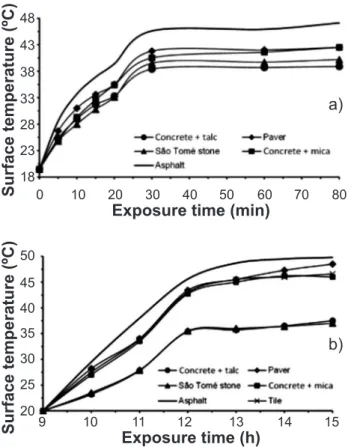
In the second stage of the study, the thermal performance presented by the developed materials was compared with some previously tested materials: asphalt (reference), paver (reference concrete) and São Tomé stone. Fig. 5 shows the results obtained with a thermographic camera for materials heated using artiicial light and sunlight, respectively. Fig. 5a shows the typical curves of materials under heating.
From 30 min, the tested materials underwent a thermal stability process, where the temperature differences remained constants. The best performing materials were A (concrete+talc) and São Tomé stone, reaching temperatures of 40.5 and 39 °C, respectively. The worst performing
material was asphalt, which reached 47.1 °C. Thus, the
difference between the evaluated materials with the best and worst performers in artiicial light was 8.1 °C. According
to Fig. 5b, the materials that showed the best performance when exposed to sunlight were the São Tomé stone and material A (concrete+talc), reaching temperatures of 37 and 37.5 °C, respectively, and again, the material with the
worst performance was asphalt, reaching 49.8 °C. Thus, the
difference between the materials with the best and worst performance was 12.8 °C.
However, there was a difference in the temperature measurement for the methods of artiicial light and sunlight. For São Tomé stone, temperatures of 39 and 37 °C were obtained (difference of 2 °C), whereas for material A (concrete+talc), the temperatures were 40.5 and 37.5 °C
(difference of 3 °C). The largest difference was obtained for asphalt, with 47.1 and 49.8 °C. Such differences were
justiied by the difference in the methods employed, including the exposure time of the samples to sunlight and artiicial radiation. The measurement methods have many variables and many authors indicate dificulty in the reproducibility of results [15]. To remedy this problem, various measures were conducted, and the observed behavior was similar to that presented by modifying the absolute values of day, wind, and season. However, taking into account the main variable tested in this work (use of mica and talc to obtain cold materials), one can say that, according to Fig. 5, composition A showed better thermal performance than those materials usually used as paving, especially asphalt and commercial paver (reference concrete). Because of this, energy savings and thermal comfort in indoor buildings is to be achieved, in accordance to another researches [2, 3, 8]. In fact, data of emissivity and energy savings conirmed that.
Emissivity: the emissivity of the samples was measured
using a thermographic camera. The results are shown in Table II. The bodies with lower values of emissivity Figure 3: Exposure of samples to sunlight (a), and appearance of
the samples observed in the thermal image during exposure (b).
[Figura 3: Exposição das amostras à luz solar (a) e aparência das amostras observadas na imagem térmica durante a exposição (b).]
Figure 4: Surface temperature of materials: (a) tested in artiicial light; (b) exposed to sunlight.
[Figura 4: Temperatura da superfície de materiais: (a) testados em luz artiicial; (b) expostos à luz solar.]
40 60
36
52
32
44
38 56
34
48
30
40
28 32
36
0 0
Exposure time (min) Exposure time (h)
Surface temperature (ºC) 3 6 9 12 15 Surface temperature (ºC) 2 4 6 8 10 12 a)
b)
silicate hydroxide (talc, Mg3Si4O10(OH)2, JCPDS 29-1493)
and quartz (SiO2, JCPDS 46-1045) are observed. The
crystalline phases present in the concrete are typically found in this kind of material. The addition of talc to the concrete (composition A) resulted in a whiter material; therefore, the emissivity decreased signiicantly (Table II), which resulted in different thermal behavior and better performance. On the other hand, no signiicant change in emissivity occurred for the addition of mica because of the presence of hematite, which has a reddish color; moreover, the presence of dark colored biotite maintained the high emissivity index.
Compressive strength: the results of the compressive
strength of the samples showed that composition A (concrete+talc) reached 23.4 MPa (114.5 kN) and composition B (concrete+mica) reached 28.7 MPa (140.8 kN). According to the Brazilian standard ABNT NBR 9781/13 [10], (concrete+talc, São Tomé stone and granite) also have the
best thermal performances (lower temperatures), as noted in the graphic representations of the temperature, Figs. 4 and 5. Considering only the emissivity, such materials showed good thermal properties for use as urban paving. The use of materials with lower emissivity contributes to making new materials with thermal properties to achieve higher albedo for cities. For [13], emissivity is a measure of how much the surface approaches a black body, for which emissivity is equal to one. Thus, taking account the aim of this work, among the materials listed in Table II, material A (concrete+talc) showed the best performance (lowest emissivity).
Analysis of the crystal structures: Fig. 6 shows the
XRD patterns of the studied materials. Reference concrete showed the presence of two crystalline phases: quartz (SiO2,
JCPDS 46-1045) and calcium hydroxide [Ca(OH)2, JCPDS
04-0733]. Composition A (concrete + talc) contained three crystalline phases: quartz (SiO2, JCPDS 46-1045), hydrated
calcium silicate (Ca1.5SiO3.5X.H2O, JCPDS 33-0306), and
magnesium silicate hydroxide (talc, Mg3Si4O10(OH)2,
JCPDS 29-1493). Composition B (concrete+mica) showed the presence of the crystalline phases quartz (SiO2, JCPDS
46-1045) and calcium carbonate (CaCO3, JCPDS 5-0586).
Mica (XRD pattern “d”) had two crystalline phases: iron oxide (hematite, Fe2O3, JCPDS 33-0664) and biotite. In the
XRD pattern “e” (talc), the crystalline phases of magnesium Figure 5: Surface temperature of samples exposed to: (a) artiicial radiation; (b) solar radiation.
[Figura 5: Temperatura da superfície de amostras expostas a: (a)
radiação artiicial; (b) radiação solar.]
Table II - Emissivity data of the specimens.
[Tabela II - Dados de emissividade das amostras.]
Material Emissivity
Black background 0.95
Asphalt 0.94
Reference concrete 0.90
Concrete + talc 0.49
Concrete + mica 0.79
São Tomé stone 0.62
Granite 0.71
48
50 38
40 28
30 43
45 33
35 23
25 18
20 0
9
Exposure time (min)
Exposure time (h)
Surface temperature (ºC)
Surface temperature (ºC)
20
11
40
13 60
15 10
10
30
12
80 50
14 70
a)
b)
Figure 6: X-ray diffraction patterns of the studied samples: a) commercial paver; b) concrete+talc; c) concrete+mica; d) mica; e) talc.
[Figura 6: Difratogramas de raios X das amostras estudadas: a) paver comercial; b) concreto+talco; c) concreto+mica; d) mica; e) talco.]
2q (degree)
Intensity (cps)
4000
1500
3000
600
18000 3000
1000
2000
400
12000 2000
500
1000
200
6000 1000 0
0
0
0
which regulates the mechanical resistance of concrete pavements, such values are below the recommended level of minimum compressive strength of 35 MPa for light vehicle applications. The best performance was found for the reference concrete, with compressive strength of 37.5 MPa (183.6 kN). However, the other compositions could be used in applications with lower demands such as sidewalks, squares and parks, gardens and recreational areas, whose mechanical demands (compression) are not so high.
Considerations of energy savings: relective materials
have good performance on the hottest days and during the period close to the winter solstice, demanding an increase in energy consumption for heating rooms. Synnefa et al. [15]
reported that the energy used for heating the environment is less than that spent for cooling, resulting in a positive balance in net savings for buildings located in hot and temperate regions. This can be explained by the fact that the sunlight trajectory in the winter solstice has a smaller sunlight angle, and the sun’s rays pass through a higher layer of the atmosphere, reaching the surface of the land less intensely, as described by [16]. Among the various ways to address a possible decrease in energy consumption is a loor that radiates heat to the environment. Thus, Table III presents the results of heat transfer by radiation to the tested materials obtained from the measurements performed using the thermographic camera and the materials exposed to solar radiation. The highest measured temperatures are reported. The exposure time was 6 h up to the maximum temperature. When analyzing the energy savings for each material in relation to asphalt, the use of São Tomé stone or reference concrete with the addition of talc generates energy savings of up to 16%.
CONCLUSIONS
This study aimed to evaluate the thermal performance of different materials for urban paving to reduce the surface temperatures of buildings in addition to the environmental temperature. Considering the satisfactory results of the performance of the new material under study, this paper achieved its goal to innovate and advance the ield of materials engineering. The application of materials with relective properties in paving showed good thermal performance, and this concept, principle, or use may be incorporated into other areas of the construction of buildings and building
elements, such as opaque fences, walls and roofs. Materials with whiter pigmentation additives have a broader range of electromagnetic frequencies that are no longer absorbed, especially in the infrared range. The goal of this work was the search for new urban paving material with good thermal properties. After laboratory studies, composition A (concrete+talc) demonstrated better thermal performance than the conventional ones, such as asphalt and reference concrete (commercial paver). This material showed similar thermal performance to São Tomé stone. Because of this, such material could be used in the sidewalks, for example. Thus, concrete+talc can be considered cold material with energy saving of up to 16% in comparison to asphalt. The next step is to improve its mechanical performance in order to meet the standard speciications.
REFERENCES
[1] P.A. Mirzaei, F. Haghighat, Build. Environ. 45 (2010) 2192.
[2] O. Buchin, M.-T. Hoelscher, F. Meier, T. Nehls, F. Ziegler, Energ. Build. 114 (2016) 27.
[3] O. Buchin, B. Jänicke, F. Meier, D. Scherer, F. Ziegler, Nat. Hazards Earth Syst. Sci. 16 (2016) 963.
[4] J. Yang, Z.H. Wang, K.E. Kaloush, Renew. Sustain. Energ. Rev. 47 (2015) 830.
[5] E.J. Gago, J. Roldan, R. Pacheco-Torres, J. Ordóñez, Renew. Sustain. Energ. Rev. 25 (2013) 749.
[6] A. Dimoudi, S. Zoras, A. Kantzioura, X. Stogiannou, P. Kosmopoulos, C. Pallas, Sustain. Cities Soc. 13 (2014) 89. [7] M. Santamouris, Energ. Rev. 103 (2014) 682.
[8] M. Santamouris, Renew. Sustain. Energ. Rev. 26 (2013) 224.
[9] N.L. Alchapar, E.N. Correa, M.A. Cantón, Energ. Build. 69 (2014) 22.
[10] ABNT - Assoc. Brasil. Normas Téc., NRB 9781, “Peças de concreto para pavimentação - especiicação e métodos de ensaio”, Rio de Janeiro (2013).
[11] ABNT - Assoc. Brasil. Normas Téc., NRB 7211, “Agregados para concreto - especiicação”, Rio de Janeiro (2005).
[12] R. Papitha, M. Buchi Suresh, D. Das, R. Johnson, J. Ceram. 2013 (2012) 1.
[13] H. Akbari, S.J. Konopacki, Energ. Policy 33, 6 (2005) 721.
Material temperature (K)Measured temperature (K)Environment Energy (W/m2) compared to asphaltEnergy saving (%)
Reference concrete (paver) 319 295 587.15 4.6
Concrete + mica 318 295 579.82 5.8
Concrete + talc 309 295 516.91 16.0
Asphalt 323 295 615.63 0.0
São Tomé stone 309 295 513.57 16.6
Table III - Energy savings for the studied materials.
[14] Y.A. Çengel, Transferência de calor e massa: uma
abordagem prática, Porto Alegre: AMGH (2012).
[15] A. Synnefa, M. Santamouris, K. Apostolakis, Solar Energ. 8, 4 (2007) 488.
[16] A.B. Frota, Geometria da insolação, S. Paulo: Geros
(2004).