E
ND OF
E.U.:
S
FI
Ş
TOFCA
STEPS FOR SAVING A TRADITIONAL COMMUNITY
Marius VOICA Lecturer, Ph.D., „Ion Mincu” University of Architecture and Urbanism, Bucharest, e-mail: [email protected]
Elena Cristina MÂNDRESCU Teaching assistant, Ph.D., „Ion Mincu” University of Architecture and Urbanism, Bucharest, e-mail: [email protected]
Ioana Cătălina VĂRZARU Teaching assistant, Ph.D.res., „Ion Mincu” University of Architecture and Urbanism, Bucharest, e-mail: [email protected]
Meinhard BREILING Lecturer, Ph.D., Technical University, Vienna,
e-mail: [email protected]
Abstract. Located next to the border of Romania and Ukraine, Sfiştofca is
one of the five villages of C.A. Rosetti Municipality of Tulcea County. The strategic geographic location helped the wildness preservation and kept it untouched by the influences of modern times and so it seems to stand aside from the rest of the country’s economic, administrative and social aspect. The study is developing the concept of reconstruction bringing to public opinion the serious risk of village dissolution. The case study approaches the following: introduction in the economic, cultural and social issues, spatial and architectural analysis, tourist opportunities, development and strengthening of the village by presenting solutions and revitalization programs. Finally, the paper presents a practice guide of attendee students. The intended purpose of the paper is to highlight the necessity of interventions in order to prevent the process of community disappearance and bring up solutions to support and preserve features area.
Key words: Danube Delta, Lipovans, sustainability, eco village, workshop.
1. Introduction
University of Architecture and Urbanism “Ion Mincu” in partnership with
Technical University of Vienna,
represented by Ph.D. Meinhard Breiling, with the support of „Sfiştofca Art
The study goal was to familiarize the students with constr uction techniques using organic materials and learn more
about long-term environmental
conservation programs (Ianoş el al.,
2009). The workshop comprise d several seminars of the lecturers, teachers and local craftsmen as well, in order to
reveal traditional technique s of
construction as distinctive features of
this rural area (Şerban, 2014; Mendes el
al., 2015). They have presente d
traditional craftsmanship of reed’s cutting and knitting, wood joining and various techniques of iron working and
glass engraving. Along with
understanding of all its geographic
features, (Stan el al., 2013), the attendees
discusse d and expre ssed their support for developing a strategy of e co village, giving the fact there is a real problem regarding the pro cess of de population and hard life conditions people are
exposed to (Buhociu e l al., 2013a, b).
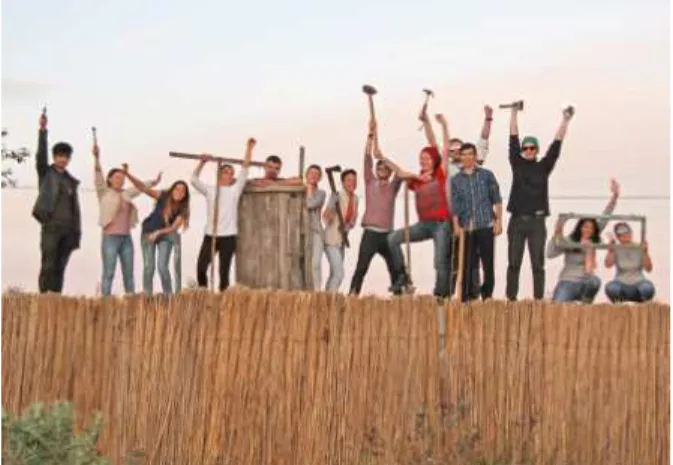
For students there was a great opportunity to exercise team working skills and to improve their practical abilities (Fig. 1). They’ve learned about wood and reed manufacturing techniques (igloomedia, 2008) and how to recycle building materials. Students understood the concept of autonomy and self management of a village with only fifty inhabitants and discovered its elements of local architecture
(Van Assche el al., 2009, 2011a, b, 2012).
2. Spatial analysis
Sfiştofca – our host, is one of the five villages of the C.A.Rosetti Municipality of Tulcea County. Inhabited by Lipovans ethnic, there are about sixty houses. Just a quarter of them are still inhabited and the process of building construction is very low. Nowadays the village seems to be deserted, but the few local peoples that are still living there can’t wait to tell you the
story of their life, only if you got time enough to listen (Fig.2).
Fig. 1. Students who participated at the workshop
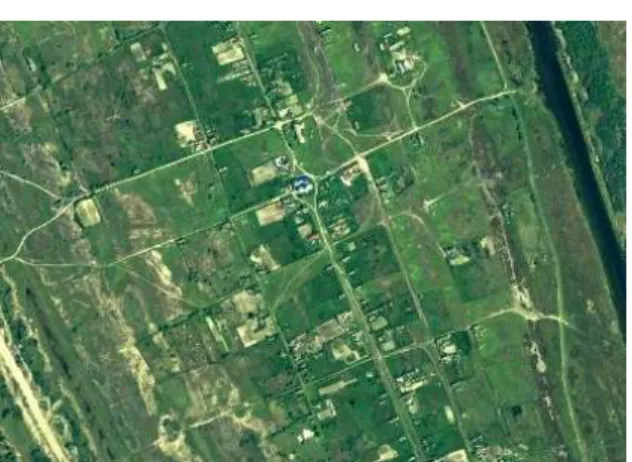
Fig. 2. The village street structure with the main axis
2.1. Overall analysis
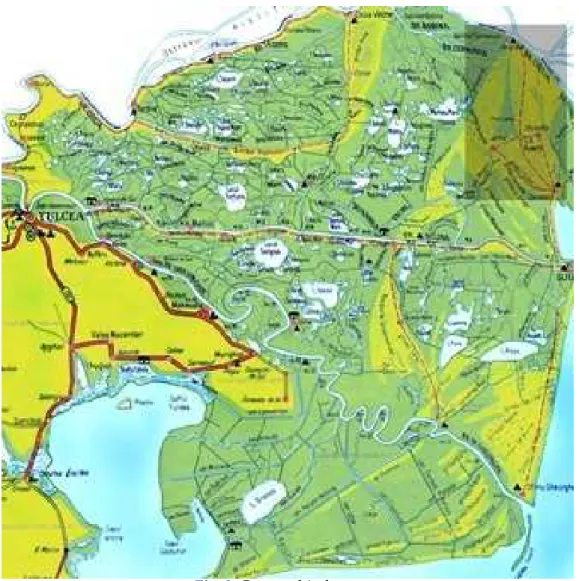
Fig. 3. Geographical context
Detached in Danube Delta Biosphere Reservation (Fig. 3), Sfiştofca along with other four villages, except the residence
commune, is connected to the
watercourse. Sfiştofca and Cardon village are connected to Sulina Channel and Popina Fisheries Facility. Due to the poor roads conditions, car access might be very difficult, especially in the rainy season.
The village is located 102 km from Tulcea town and Sulina – the nearest urban center - is 18 km away. Over the years, remoteness of this rural village proved to be a relevant element considering the complexity of the trade volume is related to adjacent seaport activities (Voica, 2013, 2014).
The village layout displays the main road that follows the Sulina Channel (Fig. 4). Right in the middle of this road you’ll find the Church of Russian Old believers. Road’s width is about eight meters and point to animal breeding as the main activity of local peoples.
Church rises over the house ridges and reveals the village’s edge (Fig. 5). As a promise for a better life, moonlight covers the church’s walls, the only building lighted up around here during night time.
road lost its configuration as a result of depopulation process.
Fig. 4. Spatial and urban connection
Fig. 5. Sunset church profile
Fig. 6. Traditional atmosphere of the village
2.2. Economic development
Over the years, animal breeding was the main activity of Danube Delta’s local peoples (Fig. 6). Its geographic location’s favorable for winter stay and Letea Grind’s quality made human to settle in C.A. Rosseti village.
Sandy soil structure lacks of minerals is a result of former dunes, therefore it
couldn’t be conducive to agriculture. Even there is a wide land - local people might use just a small part of it, where the soil structure is unsalted. Moreover, local grazing even on small scale narrows vegetation. Because of that, the wild vegetation is poor and briar, and this represents a complementary issue when it comes to stabilizing the land (Manea, 2003). Still, there is a good thing locating the village in a remote area because the soil was kept away from pesticide. In outher places, over the time, a wide and valuable habitat was destroyed and cultivated land was infested harming the environment (Hanganu, 2013).
2.3. The tourist potential
Nowadays, Sfiştofca locals are aware of access difficulties in the area and low
development of tourism and
accommodations.
While traveling on a budget tourists might find a great experience to local’s homestay.
When we arrived, a group of 30 persons, local people were quite amazed and they were interested to meet and chat with us. Most of Sfiştofca’s Lipovans are aged so they are nostalgic for their old time beautiful village. While we’ve talk to them we found out about their origin. Now we know that the first lipovans settled here in a basswood area - so they call themselves – ‘lipova’. We’ve got the opportunity to visit their homes and yards and we were welcomed to sleep overnight.
2.4. Spatial structure
characteristic of lipovans’ house is a central so-called “prispa” – sometimes encased and turned into a distribution hall. The construction has a stone socle and a structure based on wooden pillars and beams. The house has adobe walls and thatched roof.
Lipovans use local recycling materials for building their homes. Reed is used for
roofs, mats and for construction
insulation boards, fence building, fuel, fodder and cellulose feedstock (Kirby and Rayner, 2001; Hanganu, 2013).
Fig. 7. Lipovan traditional houses
In the first layer towards the public space the lipovans’ traditional house has a window provided with wooden shutters. At the roof level we’ve noticed a beautiful wooden sculptured tympanon, decorated with floral elements and various symbols (Fig. 8).
Fig. 8. Carved wooden details
The house yard invites you to discover different enclosed spaces where lipovans use to prepare dinner. Next you’ll find a small stable and a storage place for fire woods. The internal partition of the rooms is simple. Usually, there is one small room in front of the primary access and other two rooms side to side, a bedroom and a so called ‘clean room” – that looks more like a guest room. The heating system is – lijanca – a bunker stove – built in the common wall of the adjacent rooms. During the cold winter nights – lijanca serves also as a bed.
In the inside of the households owned by some well-off locals there is also a bathroom that looks more like a sauna. Because of the dark smoke the sauna’s walls are mostly covered in black. This room has a small hall used for cooling and another one for humid sauna – where water temperature rise up to 100 degree Celsius. The steam came up from a small lijanca where heated stones are covered with cold water. When necessary the same stove is use to heat bathing water. Next to the stove you’ll find a small oak leaves broom used for massage and a homemade soap boiled with wormwood and iris roots. City Council is located in center of the village (Fig. 9) in the former school building.
Fig. 9. The village center dominated by the church
size, it‘s easy to imagine that once, here used to learn many students. We were welcomed inside with old lipovan songs and invited to taste traditional fish borsch. The walls inside are decorated with pictures showing important events of the community. In another corner of the room we admired an exhibition of traditional costume worn by local peoples during the Sunday church service. Right next to the entrance we saw a beautiful doily with embroidered letters reminding everyone about the “Sfiştofca – White Seagull Chess Cup”, from August 2011.
2.4. Social issue
Romanian Danube Delta is well known for its wild landscape, but also for its decreasing depopulation process and low living standards. Unemployment became an issue with important psychological effects as human’s lack of self esteem. In a small and abandoned community people could easily become hopeless and lose the feeling for their art and tradition. Moreover, the lack of interest concerning their environment is not helpful for tourist’s attraction in order to lead the village to a sustainable development.
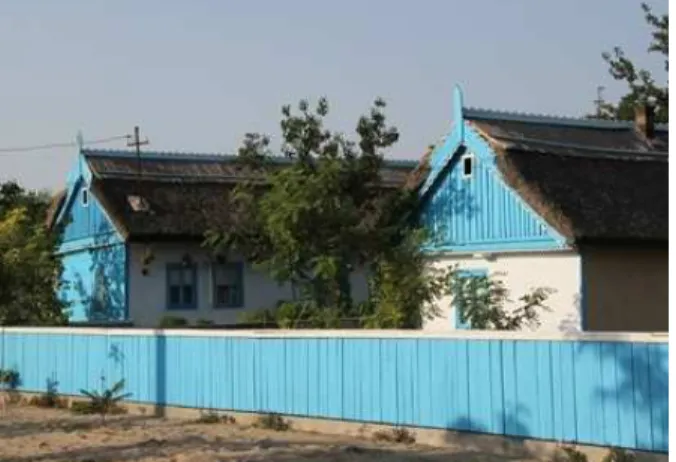
Fig. 10. Lipovan traditional houses painted in blue and green
This is one of many reasons we should try to change this reality and draw attention to the issue. Every detail you’ll see
around the village gives you a short-lived feeling. Only the houses painted in blue and green hues gives a joyful feeling and a hope for a better future. In lipovan’s tradition, the lovely colors of blue and green (Fig. 10) are a symbol for hope, as the church’s priest explained us later.
3. Development methods
For a better analysis of current situation and social context, the workshop began with a site visit and discussions with local inhabitants. Afterward we gathered information, we made suggestions of development instruments and pointed steps for saving the community:
a. An important aspect of the
discussion was the process of
depopulation. Steps must be taken to prevent depopulation and preserve the area for future generation (Boja and
Popescu, 2001; Petrişor el al., 2014b).
Local authorities show their interest for village’s economic development and proposed different facilities in order to draw investments in the area such as: reduction of taxesor free land in the concession in order to develop economic activities. Still, there is a little focus on employment issue and a low interest for new local job opportunity. Only that way we might prevent depopulation and help the village reconstruction.
b. On a small scale, ecotourism is a
development method already used by locals. Besides, uninhabited houses should become part of a rental system with self-management for tourists who wants to visit Danube Delta. Another suggestion was a layout camping area where local people could provide traditional dishes for visitors. Some of the locals could guide tourists around the village, show them the stunning scenario, using local cars, boats or walking (Singh
c. The workshop emphasized the necessity of preserving the artistic community of Sfiştofca and its traditions
(Văidianu el al., 2014). Our team –
architects, glass blowers, blacksmiths and weavers – together with local peoples show audience traditional techniques of working.
In present day there are no children in Stiftofca so there is no school program. People used to breathe life their customs and traditions only if they are motivated to improve living standards both for them and for their community (Petrişor and Petrişor, 2014). Plus, the village authorities could provide an easy access to information technology and facilitate an easy communication with neighbor villages in order to solve different issues. A cultural center could become a pull factor not only for education but for people too. So they’ll regain self respect and new job opportunities. Moreover, an artistic center may become a prime attraction of the village in spite of hard living conditions of Sfiştofca.
From an architect’s position, Sfiştofca cultural community could facilitate the recognition of valuable architectural elements, in order to make an inventory of buildings and preserve this heritage through architectural surveys. Outside - shape and proportion of the houses follows an order. The consecutive courtyards are describing a hierarchy of
domesticities. Wonderfull wooden
symbols decorate the exterior of the houses. Inside – the distribution of the spaces is quite simple – a bedroom, a guest room, a bunker stove, bathroom – (humid sauna system) are just another valuable elements.
Sfiştofca community is a good place where future artists, tourists and locals
could meet and discuss their new projects. Also, Sfiştofca is the perfect
place for festivals and concerts.
Nowadays there is no audience, but the local peoples still use to dress up in their traditional costumes for Sunday church service or other traditional events, usually hosted by the former school building.
The ecological standard of construction is the main reason why abandoned houses vanished from village’s profile (Meiţă,
2010; Meiţă el al., 2014).
Along with that, there are only a few people left who are aware of the
traditional culture of building
construction using local organic
materials. It’s a fact that many European countries seek to preserve traditional construction method using reed, clay, straw and sand – in order to prevent disappearance of this valuable handicraft by lack of practice. Therefore, we’ve proposed the conservation of a strong community and co-operating with other European countries in order to achieve
and regain traditional construction
methods. Moreover, this could be a great
opportunity for cultural and
informational exchanges. That also
implies within – practice study – a restoration of inhabited houses, even their extension. Abandoned houses must be rehabilitated and renovated and finally integrated in a rental system for tourists. Now, there are a few intentions in that direction as it was presented in the Album – Stuf - Case traditionale din Delta Dunarii – edited by Igloo Magazine.
d. Another way to draw attention to
a community that’s standing to lose its
roots is material recycling from
traditional details on village’ scale using recycling materials could be an useful exercise for students. This implies as well a direct communication with locals in
order to accustom students with
materials and procedure used in
traditional construction by lipovans. This method was applied in our workshop by architecture students.
e. The Municipals should follow up
the next step and dispose an available transportation device able to connect neighbor villages in all weathers. Today here are only three personal cars serving the entire village.
f. Attendees emphasized the
significance of a sustainable agriculture, on a small scale - focused on herbs and plants such as - chamomile,buckthorn, shepherd’s purse, most of them suitable to existing soil. Because the soil was not infected with pesticide, the accessibility inconvenient might become an advantage. Beekeeping as regional brand of Sfiştofca was another student suggestion. There is a
clear link between the wonderful
landscape, species of flora and fauna and agricultural activities, even on a small scale. Therefore is of a great importance implementing a sustainable model of agriculture considering the possible damage it could be done to the environment (Nicolescu, 2011).
4. Practical study
The workshop began in Bucharest. The Projects proposed by UAUIM students were simple constructions, having as a focal element the tissue of Dobrogea villages – highlighting history ages, diversity of the materials used in construction and everyday activities. The purpose of the theme presented within architectural - designing studio to student was to demonstrate its practical use and prove responsibility for future architects
in understanding of construction
methods using materials from the Danube Delta (Fig. 12-15).
Searching for the right answer - regarding the relationship between architecture, nature and environment - we found out that it’s based on eco-friendly architecture concept. This concept suggests designing
as a continuity of ecosystem, a
relationship between designing concept, human and nature, even men and nature
(Petrişor el al., 2014a).
Fig. 11. Abandoned houses
Students used construction materials as wood, clay, reeds - same materials used in construction by local inhabitants of Dobrogea area. They were seeking solutions for best capitalization of local resources - construction materials.
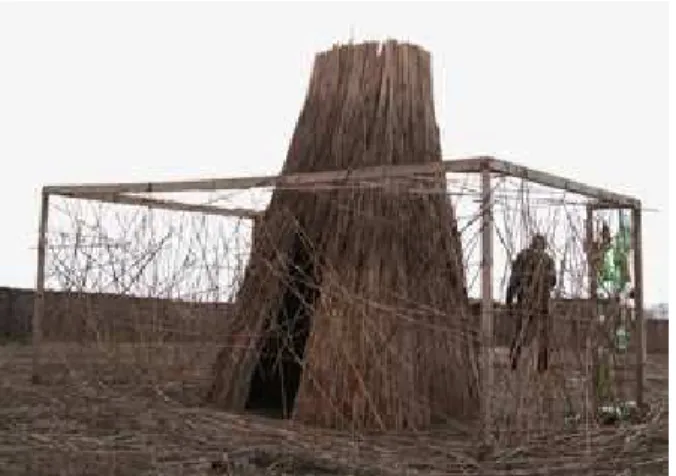
Fig. 12. Eco installation built by students
also revealed elements of traditional architecture distinctive for this area. All of that makes this charming place a promise for a unique architectural language.
During workshop, student’s ideas
materialized in a conical shaped tent. From outside the tent looks like a reed haystack, an illustrative picture of Sfiştofca village.
Fig. 13. Detail from inside of the proposed project
In fact, this constr uction is a metaphor of the foremost shelter. Inside, a stub and a lamp – seems to be an invitation to a moment of rest. The erection of the tent itself has proved to be a useful practice for students of first academic year of Architecture University. They procured construction materials from abandoned houses and from local inhabitants as well.
Fig. 14. Sunset constructi on profile
Local peoples from Sfiştofca were opened to their ideas and showed them how to joining wood and how to weave reed in the ridge line to prevent the rotting process. Student learned how to thatch the roof of the tent. This was quite a huge event for everyone – local peoples were very friendly offering us their help.
Fig. 15. Photo taken half a year after we attended the workshop
At the end of the day, we were invited to watch a traditional dance and songs show and tasted some delicious fish dishes. Finally, evening ended with our promise to return soon.
5. Conclusion
Sfiştofca needs urgent help to preserve its cultural identity in the near future so it’s
necessary a rapid and effective
implementation of the reconstruction programs above mentioned (Fig. 16).
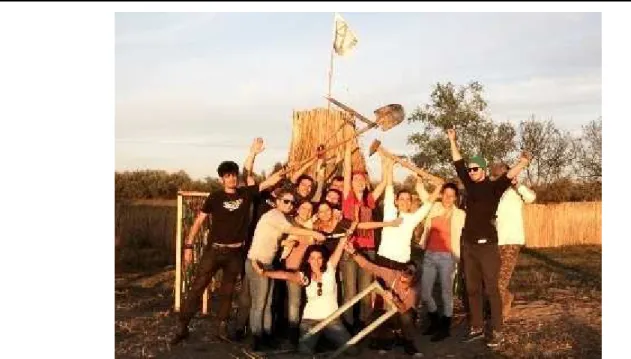
Fig. 17. Group picture at the end of the construction process
The main instrument is stopping the degradation process of abandoned house, conserving local traditions and creating new job opportunities. Sfiştofca tourism sector needs to be supervised in order to prevent a clash between landscape conservation and future hotels facilities
(Văidianu, 2013; Stan el al., 2014).
Tourism sector could become an
important asset for protected area and its community, if we display management programs, taking into account the features of the protected area, with low damage and minimum pollution. We dare to say that landscape’s beauty might be due to the absence of men. That’s way, measures need to be adopted to prevent nature’s invasion of human’s built space,
without taking into account the
architectural features of this area (Barta,
2011; Iojă el al., 2010).
Beyond practice, Workshop in Stiftofca, from September 2014, was a good opportunity for the first Academic year of University of Architecture’s students to familiarize themselves with cultural, social and architectural issues (Fig. 17). In
the near future it’s important to carry on the study till all directions and steps presented here meet our target to help Sfiştofca’s reconstruction.
REFERENCES
Barta A. I. (2010), Tourism and environment, Case studies [in Romanian], Universitary Press, Cluj Napoca.
Boja V., Popescu I (2001), Social ecology in the Danube Delta: Theory and practice, Lakes & Reservoirs: Research & Management 5(2): 125-131.
Buhociu D. H., Florescu T. C., Crăciun C., Popa A (2013a), The Environmental and Social Development of Human Settlements near the Danube, in: Sandu A., Caras A., International Scientific Conference Tradition and Reform Social Reconstruction of Europe, November 7-8, 2013 - Bucharest (Romania), Medimond International Proceedings, Bologna, Italy, pp. 75-78.
Buhociu D. H., Rahoveanu A. T., Florescu T. C., Crăciun C., Popa A (2013), Rural waterfronts, green areas and natural landscape at the Danube, Journal of Food, Agriculture and Environment 11(3-4): 1692-1696.
Information and Technological Development Danube Delta, Tulcea, ISBN 978-973-88117-4-4, p. 197.
Ianoş I., Peptenatu D., Zamfir D (2009), Respect for environment and sustainable development, Carpathian Journal of Earth and Environmental Sciences 4(1): 81-93. igloomedia (2008), Reed. Traditional houses in the
Danube Delta, Igloo Heritage Collecti on, Bucharest, pp. 208, ISBN 978973884048. Iojă I. C., Pătroescu M., Rozylowicz L., Popescu V.,
Zotta M., Vergheleţ G., Felciuc M (2010), The efficacy of Romania`s protected areas network for conserving biodiversity, Biological Conservation 143(11): 2468-2476.
Kirby J. J. H., Rayner A. D. M (2001), The deterioration of thatched roofs, International Biodeterioration & Biodegradation 48(1-4):153-158.
Manea G (2003), Naturalness and anthropization in Porţile de Fier Natural Par k [in Romanian], Universitary Press, Bucharest.
Meiţă V (2010), Ecological materials for Danube Delta constructions, Urbanism. Arhitectură. Construcţii 1(1): 31-36.
Meiţă V., Petrişor A.-I., Georgescu E.-S (2010), Planning, architecture, seismic, construction and energy-related criteria for sustainable spatial development in the Danube Delta Biosphere Reserve area, Urbanism. Arhitectură. Construcţii 5(3): 55-68. Mendes M. T., Pereira S., Ferreira T., Mirao J.,
Candeias A (2015), In Situ Preservation and Restoration of Architectural Tiles, Materials and Procedures: Results of an International Survey, International Journal of Conservation Science 6(1): 51-62.
Nicolescu A (2011), Ecotourism in Romania. Case study: Rodna Mountains National Park [in Romanian], Christian University „Dimitrie Cantemir”, Faculty of Tourism and Commercial Management, Bucharest. Petre R., Chifelea C (2012), Public consultation in spatial and urban plans. Case study: Galaţi built protected areas [in Romanian], Urbanism. Arhitectură. Construcţii 3(2):51-62
Petrişor A.-I., Grigorovschi M., Meiţă V., Simion-Melinte C.-P (2014a), Long-term environmental changes analysis using CORINE data, Environmental Engineering and Management Journal 13(4):847-860. Petrişor A.-I., Petre R., Meiţă V (2014b), Difficulties in
achieving social sustainability in a biosphere reserve, in: The International Academic Forum, ACSEE 2014. The Asian Conference on Sustainability, Energy & the Environment Proceedings, Osaka, Japan, pp. 131-146.
Petrişor A.-I., Petrişor L. E (2013), Jan Gehl – Cities for people, 269 pp., translation. S. Gugu, igloomedia, 2012, ISBN 978-606-8026-16-9, Urbanism. Arhitectură. Construcţii 4(1): 41-44.
Singh M., Sinha A. K., Singh P (2015), Maintaining the Biodiversity of Informal Protected Are as: A Collaborative Conservational Approach, International Journal of Conservation Science 5(1): 107-116.
Stan M.-I., Ţenea D., Vintilă D (2013), Urban regeneration in Protected Areas – Solution for Sustainable Development of Cities in Romania, Analele Universităţii Ovidius Constanţa Seria Construcţii 15: 189-194. Stan M.-I., Ţenea D., Vintilă D (2014), Developing a
strategy for sustainable tourism. Case Study: Constanta Metrop olitan Area, Urbanism. Arhitectură. Construcţii 5(3):5-16.
Şerban D.-L (2014), Vernacular Evolutions at the Center of Landscape Change, Acta Technica Napocensis: Civil Engineering & Architecture 57(2): 175-185.
Van Assche K., Bell S., Teampau P (2012), Traumatic Natures of the Swamp: Concepts of Nature in the Romanian Danube Delta, Environmental Values 21(2):163-183. Van Assche K., Beunen R., Jacobs J., Teampau P
(2011a), Crossing trails in the marshes: rigidity and flexibility in the governance of the Danube Delta, Journal of Environmental Planning and Management 54(8): 997-1018.
Van Assche K., Devlieger P., Teampau P., Verschraegen G (2009), Forgetting and remembering in the margins: Constructing past and future in the Romanian Danube Delta, Memory Studies 2(2): 211-234. Van Assche K., Duineveld M., Beunen R., Teampau
P (2011b), Delineating Locals: Transformations of Knowledge/Power and the Governance of the Danube Delta, Journal of Environmental Policy & Planning 13(1): 1-21.
Văidianu M- N., Pavel O., Călin I.-E (2014), Promoting Arts-based Activities for Local Sustainability: Danube Delta Case Study, Procedia - Social and Behavioral Sciences
122: 105-109.
Văidianu M.-N (2013), Fuzzy cognitive maps: diagnosis and scenarios for a better management process of visitors flows in Romanian Danube Delta Biosphere Reserve, Journal of Coastal Research 65:1063-1068. Voica M., Meiţă V., Stancu E (2013), Danube area
RESPAG 2013 Book of Abstracts, Institute of Architecture and Urban & Spatial Planning of Serbia, Printed Grafo Nin d.o.o., Belgrade, Serbia, 1169 pp., ISBN 978-86-80329-76-5, pp. 791-806.
Voica M., Meiţă V., Stancu E (2014), Danube area spatial integration by stimulating the Romanian port cities regeneration, Urbanism. Arhitectură. Construcţii 5(3): 41-54.
Received: 22 April 2015 • Revised: 2 July 2015 • Accepted: 2 July 2015