PHYSICAL EDUCATION OF STUDENTS
IMPROVING PHYSICAL HEALTH INTERNATIONAL STUDENTS ENROLLED IN A TECHNICAL COLLEGE IN BAIKAL REGION
Kolokoltsev M.M., Ambartsumyan R.A. National Research Irkutsk State Technical University
Annotation. Purpose: to improve the physical health of foreign students enrolled in a technical college Baikal region
using an extended motor mode. Material: in the experiment participated 57 students attending the training of South-East Asia, 74 - from Central Asia and 455 - Slavs, natives of the Irkutsk region. Results: it was found poor fitness and low functional performance among foreign students. For this purpose they had used advanced motoring. It included, besides training curriculum additional group activities in the form of sports, participating in sports events and guided independent study physical education. Conclusion: the end of follow foreign students involved in the extended motor mode, significantly outperform their peers engaged on normal functional parameters (heart rate, a test with 20 squats, the recovery time after exercise, dynamometry hands, breath tests, adaptive capacity) as well as motor qualities.
Keywords: students, foreign, physical development, physical, preparedness, security, and culture.
Introduction1
At the present time the foreign student training in higher educational foundations has received national importance and is an important component of foreign trade and foreign policy activities of the Russian state. Russian higher education system brought new challenges and conditions of export development in educational services. This is due to increasing the competitiveness of higher school on international education market, as well as economic benefits for both university and state [3,7].According to the Federal State Statistics Service the number of foreign students studying in Russia increased from 58992 (in the 2001-2002 academic years) to 126,319 people (2011-12 academic year) in the past decade, ie more than twofold.The National Research Irkutsk State Technical University (Irkutsk Technical University) is one of the universities offering modern educational services. It ranks among the top five high schools run by the Ministry of Education and Science of the Russian Federation, in amount of foreign students.Currently in Irkutsk Technical University are studying 1270 foreign students from 30 countries, 1200 of them having a full-time course of study. Russia’s accession to the Bologna process involves the activities of universities in the training of high-skilled personnel up to the world standards and in the searching of modern methods and tools optimizing the adaptation process of foreign students. It requires to study the adaptation process of students to teaching and the information professionally oriented university environment [1,5,13,15].In this context, the searching of new ways to improve health and to enhance the physical capacity, to increase the body's capability of future highly qualified specialists becomes a significant importance. Many researchers consider the physical education as an essential factor in the formation of young people's health and rehabilitation [4,10,12,16].Improving the physical health using the physical education of foreign students is of special interest. According to M. Y. Vilenskiy (2007) [6], it is impossible to increase the number of sport trainings in the nearest time because of economic reasons. And all that is left to do is increase the intensity of the regulated activities, make them more attractive by introducing innovative teaching technologies [8] or use self-study of students in their free time. The integration of foreign students to study in the universities of Russia are presented in a considerable amount of research papers [9,11,14]. However, in the literature about the Irkutsk region is considered only the physical development of foreign students studying in educational institutions of the region. [2]
Goal, tasks, data and methods of the research
Goal of research is to improve the physical health of students studying in Technical University of Baikal Region using the advanced motion state.
Methods and study management
586 young men studied in National Research Irkutsk State Technical University were surveyed in September 2011 and in May 2012. Among them were 57 students coming to study from South East Asian countries, 74 students from Central Asia and 445 Slavs born in Irkutsk Region. Students of international study groups attended the exercises 2 times a week lasting 90 minutes. The exercises were conducted in accordance with the SES - requirements of second generation - mainly physical training (OPT) with using the exercises designed to the raise basic motor abilities.
In 2012 was organized the experimental group (EG), which included 58 foreign students who trained on an advanced motion state. Besides training curriculum it included additional group activities in form of games (mostly basketball), physical exercises aimed at the correcting of lagging motion capacities, participation in sports events and controlled self-exercises. A control group (CG) of 56 foreign students was at normal the motion state.Surveys were made in September 2012 and in May 2013. Monitoring observations of the control and the experimental groups included: somatometric (height, weight, chest circumference) and phyziometric studies (dynamometry of muscle hands strength), as well as functional tests (respiratory tests by Stange and Genç, a test with 20 squats (Martinet Kushelevsky). Evaluation of cardio -respiratory system performed the characterization of heart rate, blood pressure, pulse pressure, with the expectation factor and endurance. Adaptation level was estimated by the value of the adaptation index (AI), whose calculation was made by the method of R.M. Baevsky in modification of A.P. Berseneva (1987).The basic motion capacities of students were assessed by using some tests: on speed endurance and agility (shuttle run 10 times x
35
lying position, count time 30 s), tests for strength and power endurance of the upper body muscles (pulling up on the bar), test on the dynamic strength of the lower limbs muscles (standing long jump, cm) test for active flexibility spine and hip joints (front bend, cm) and the total endurance test (run 1000 m, min , sec).Static data handling was carried through by conventional methods. In case of normal distribution of studied quantitative traits were used parametric methods of materials processing (computation the reliability of the Fisher - Student), and in different case - non-parametric methods of data processing using the Wilcoxon – Mann – Whitney test. Differences were considered significant at a significance level of P <0.05.
Research results
This work was performed in accordance with the statutes and objectives of the Federal Target Program "Youth of Russia. Physical education and health of children, teenagers and young people in the Russian Federation "(2000 -2005.), and interagency agreements " About the information cooperation of the Ministry of Health, the State Committee for Physical Culture, Sports and Tourism, the Ministry of Education in public health monitoring "of 26.04.2002.
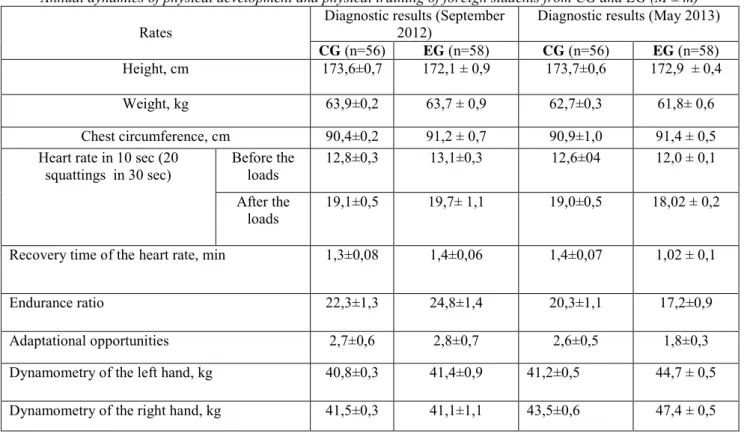
At the beginning of the study (2011-2012 academic year) was found out that the anthropometric parameters of Russian students (length, weight and Chest circumference) and a number of functions (strength of the hand muscles, breathing tests) are higher than by their counterparts from other countries.Indicator rates of speed and endurance tests indicate lower characteristics among foreign students compared with Slavic boys. Russian students and students from Central Asia have significantly higher speed endurance and agility, strength of the upper body and trunk flexors than their counterparts. However, the students from South- East Asia have a higher value in the flexibility test than Russian students and young people from Central Asia. A dynamic strength of the lower limbs muscle of young men from South- East Asia is much the same as Russian students and higher than the students from the Central Asia.By the end of the academic year were noticed a positive dynamics of physical training of Slavic boys in 5 of 7 motion tests, of the students from Central Asia in the 3 tests and students from South- East Asia in one of seven motion tests. It goes to prove that training physical education classes do not provide the gains of motion capacities among foreign students. It requires the removal and compensation identified lagging components of their physical training. Consider the lack of physical training among foreign students and their functions the experimental group was created, which was engaged in physical education at the advanced motion state. Foreign students from the control group engaged according to an exemplary curriculum for higher education institutions in the discipline "Physical Education ", 2000. (PCE primary).At the beginning of the experiment the data of physical development and physical training of foreign students in the experimental and control groups were similar (Table 1). At the end of experiment (May 2013) it was found out that students from experimental group had more expressed changes in functions, than the students from the control group. This applies especially to functional terms and tests characterizing the state of the cardiovascular system. Also the other researchers noted the similar trend [17].So, in the end of experiment in EG was found out significant (P <0.05) slowing of the heart rate "before the load" by 9.1% (compared with the beginning of observation), the recovery time after the loading decreased in 1.37 times. In CG such changes were not significantly expressed.
Table 1 Annual dynamics of physical development and physical training of foreign students from CG and EG (M ± m)
Rates Diagnostic results (September 2012) Diagnostic results (May 2013) CG (n=56) EG (n=58) CG (n=56) EG (n=58)
Height, cm 173,6±0,7 172,1 ± 0,9 173,7±0,6 172,9 ± 0,4
Weight, kg 63,9±0,2 63,7 ± 0,9 62,7±0,3 61,8± 0,6
Chest circumference, cm 90,4±0,2 91,2 ± 0,7 90,9±1,0 91,4 ± 0,5 Heart rate in 10 sec (20
squattings in 30 sec) Before the loads 12,8±0,3 13,1±0,3 12,6±04 12,0 ± 0,1 After the
loads 19,1±0,5 19,7± 1,1 19,0±0,5 18,02 ± 0,2
Recovery time of the heart rate, min 1,3±0,08 1,4±0,06 1,4±0,07 1,02 ± 0,1
Endurance ratio 22,3±1,3 24,8±1,4 20,3±1,1 17,2±0,9
Adaptational opportunities 2,7±0,6 2,8±0,7 2,6±0,5 1,8±0,3
Dynamometry of the left hand, kg 40,8±0,3 41,4±0,9 41,2±0,5 44,7 ± 0,5
PHYSICAL EDUCATION OF STUDENTS
Test by Stange, sec 47,5± 0,8 49,1 ± 1,5 44,3±0,5 56,6±1,8
Test by Genç, sec 33,2±0,6 35,6±1,2 31,7±0,6 42,3±0,6
Shuttle run, 10 times х 5 m,s 16,8±0,04 16,9±0,2 16,9±0,08 15,9 ± 0,05
Run 100m (sec) 15,2±0,2 15,3±0,3 15,6±0,2 13,9 ± 0,4
Run 1000m (min, sec) 4,7±0,2 4,5±0,1 4,4±0,1 4,8± 0,4
Pulling up, times 7,6±0,1 7,2±0,6 7,3±0,1 11,7 ± 0,3
Torso rising in 30 sec, times 25,4±0,2 24,9±0,5 23,7±0,3 35,2 ± 0,3
Front bend, cm 16,7±0,2 17,3±0,8 15,8±0,3 18,0 ± 0,5
Standing long jump, cm 233,4±2,5 231,0±2,4 238,3±2,7 243,6 ± 1,2
In EG was noticed a significant (P <0.05) decrease of endurance ratio value from 24,8 ± 1,4 till 17, 2 ± 0,9 conditional units, ie 1.4 times. According to the table, at the beginning of the experiment in both groups was detected intension of the adjustment mechanisms. By the end of the experiment in the EG was noticed decrease of adaptive capacity 1.5 times (up to 1,8 ± 0,3 conditional units). It can be recognized as satisfactory adaptation.In EG was noticed a positive changes in dynamometry of both hands, in tests by Stange and Genç (P <0.05). At the same time in the CG was found out a significant improvement of rate changes in dynamometry values only right hand and in the test by Stange.In the end of the experiment in the group of foreign students engaged in physical training using advanced motion state, was founded out more expressed changes in motion capacities. This is proved by the test results. However the foreign students from EG have shown significant improvement of motion capacities in 5 of 7 tests (Table 1), and the students from the CG - only in 2 tests.Any significant improvement among the students from EG in tests characterizing the overall endurance and flexibility was not detected.
Conclusions
1. Training sessions in physical education, conducted according to an exemplary training program for higher educational institutions in the discipline "Physical culture" do not provide the gains of motion capacities among the foreign students.
2. Among the foreign students was found out the unsatisfactory adaptation. It makes difficult their physical development, mental capacity and further successful professional career. The using of the advanced motion state allows reducing the negative impact of stress on the adjustment mechanisms among the students.
3. The foreign students following the advanced motion state outperform their counterparts following usual motion state in functions (heart rate, test with 20 squats, loading recovery time, dynamometry of hands, respiratory test, adaptive potential), and in athletic abilities.
37
1 Agadzhanian N. A. Etnicheskie problemy adaptacionnoj fiziologii [Ethnic problems of adaptation physiology],
Moscow, RUDN, 2007, 57 p.
2 Ambarcumian R.A., Kolokol'cev M.M. Vestnik Irkutskogo gosudarstvennogo tekhnicheskogo universiteta [Bulletin of the Irkutsk State Technical University], 2013, vol.2, pp. 216-220.
3 Arsen'ev D.G., Zinkovskij A.V. , Ivanova M.A. Social'no-psikhologicheskie i fiziologicheskie problemy
adaptacii inostrannykh studentov [Socio-psychological and physiological problems of adaptation of foreign students], Sankt Petersburg, SPbSPU, 2003, 160 p.
4 Apanasenko G.L., Popova L. A. Medicinskaia valeologiia [Medical valeology], Kiev, Health, 1998, 148 p. 5 Baevskij P.M., Berseneva A.P., Vakulin V.K. Zdravookhranenie Rossijskoj Federacii [Health of the Russian
Federation], 1987, vol.8, pp. 6-10.
6 Vilenskij M. Ia. Fizicheskaia kul'tura i zdorovyj obraz zhizni studenta [Physical culture and healthy lifestyles student], Moscow, Gardariki, 2007, 218 p.
7 Vitkovskaia M.I., Trocuk I.V. Vestnik RUDN [Herald RUDN], 2005, vol.6-7, pp. 267-283.
8 Gonsales S. E. Uchenye zapiski universiteta imeni P.F. Lesgafta [Scientific notes University of P.F. Lesgafta],
2011, vol.5(75), pp. 40-47.
9 Gruciak N.B., Gruciak V.I. Fiziceskoe vospitanie studentov [Physical Education of Students], 2010, vol.2, pp.
37-39.
10 Korolinskaia S.V. Fiziceskoe vospitanie studentov [Physical Education of Students], 2011, vol.4, pp. 48-51. 11 Litvinova N.A., Berezina M.G., Prokhorova A.M. Valeologiia [Valeology], 2004, vol.4, pp. 80-86.
12 Solov'ev V. N. Adaptaciia studentov k uchebnomu processu v vysshej shkole [Adaptation of students to the
educational process in higher education], Dokt. Diss., Izhevsk, 2003, 46 p.
13 Ushakova I.A. Zdorov'esberegaiushchaia socializaciia inostrannykh studentov v medicinskikh vuzakh Rossii
[Health-saving socialization of foreign students in medical universities in Russia], Dokt. Diss., Volgograd, 2012, 36 p.
14 Ushakova I. A., Mandrikov V. B. Vestnik Volgogradskogo medicinskogo universiteta [Bulletin of the
Volgograd Medical University], 2010, vol.№4(36), pp. 22-24.
15 Lazarus R.S. From psychological stress to the emotions: A history of chanding outlook. Annual review of Рsychology. 1993, vol.44, pp. 1-21.
16 Weyerer S., Kupfer B. Physical Exercise and Psychological Health. Sports Medicine. 1994, vol.2, pp. 108–
116.