Submitted1 October 2014 Accepted 30 October 2014 Published13 November 2014
Corresponding author Gustavo A. de Souza, [email protected]
Academic editor Richard Emes
Additional Information and Declarations can be found on page 10
DOI10.7717/peerj.673
Copyright 2014 Kroll et al.
Distributed under
Creative Commons CC-BY 4.0
OPEN ACCESS
Identification of rare alternative splicing
events in MS/MS data reveals a
significant fraction of alternative
translation initiation sites
Jos´e E. Kroll1,2, Sandro J. de Souza2and Gustavo A. de Souza3 1Institute of Bioinformatics and Biotechnology, Natal, Brazil
2Brain Institute, UFRN, Natal, Brazil
3Department of Immunology and Centre for Immune Regulation, Oslo University Hospital HF Rikshospitalet, University of Oslo, Oslo, Norway
ABSTRACT
Integration of transcriptome data is a crucial step for the identification of rare protein variants in mass-spectrometry (MS) data with important consequences for all branches of biotechnology research. Here, we used Splooce, a database of splicing variants recently developed by us, to search MS data derived from a variety of human tumor cell lines. More than 800 new protein variants were identified whose corresponding MS spectra were specific to protein entries from Splooce. Although the types of splicing variants (exon skipping, alternative splice sites and intron reten-tion) were found at the same frequency as in the transcriptome, we observed a large variety of modifications at the protein level induced by alternative splicing events. Surprisingly, we found that 40% of all protein modifications induced by alternative splicing led to the use of alternative translation initiation sites. Other modifications include frameshifts in the open reading frame and inclusion or deletion of peptide sequences. To make the dataset generated here available to the community in a more effective form, the Splooce portal (http://www.bioinformatics-brazil.org/splooce) was modified to report the alternative splicing events supported by MS data.
Subjects Bioinformatics, Genomics
Keywords Mass spectrometry, Proteomics, Alternative splicing events, Peptide identification, Translation initiation sites
INTRODUCTION
about the large variability found in the transcriptomes of eukaryotes due to alternative splicing and alternative polyadenylation. As a consequence of the emergence of these technologies, an explosion of this type of data in public databanks and data repositories is already occurring and exponential growth is expected for the next years. Improving bioinformatics capabilities is crucial for the processing, storage and interpretation of results from large-scale technologies.
While the technologies for sequencing of nucleic acids developed at an impressive speed, the same did not happen with technologies for sequencing amino acids and proteins. Recently, mass spectrometry-based proteomics achieved enough comprehensiveness and throughput to allow in-depth characterization of “complete proteomes” (Beck et al., 2011;
Nagaraj et al., 2011). However, proteomic data acquisition is still restricted to few groups, even though public availability of high depth proteomic data is increasing (Desiere et al., 2006;Perez-Riverol et al., in press;Vizcaino et al., 2013;Vizcaino et al., 2014).
Here, we investigated whether ASEs could be satisfactorily identified using size-limited FASTA database, built from repositories of expressed sequences, which was then challenged by MS data. Our group had recently developed Splooce, a database that integrates information from transcriptome analysis, including RNA-Seq, to identify splicing variants (Kroll et al., 2012). Protein entries created from Splooce were evaluated using MS/MS analysis, and a large number of novel proteins isoforms were identified. Surprisingly we found that around 40% of all modifications at the protein level were related to the use of alternative translation initiation sites (TIS).
MATERIALS & METHODS
Protein variants identification using mass spectrometry and MaxQuant
Predicted proteins were collected from the Splooce website. Since Splooce does not provide FASTA files and due to the complexity of our needs (large scale analysis), a robot-type script was developed to query alternative splicing events and their specific data, such as predicted proteins. Entries showing alternative splicing events supported only by ESTs and/or RNASeq expressed sequences were selected. Those events were tagged as rare since they were not found in the set of full-insert cDNA sequences (RefSeq, mRNA), which usually have well characterized coding sequences. Any pattern of combined alternative splicing event was allowed. As a default parameter, Splooce only reports events that are supported by at least two expressed sequences. For the prediction of protein sequences, Splooce uses a simple ab-initio strategy. Briefly, human entries from the Reference Sequence database (Pruitt et al., 2014) were modified by introducing alternative splicing patterns observed from the transcriptome data. Thus, full-length alternative cDNA sequences were created from expressed sequence fragments that often cover only a small fraction of coding sequences. As a final step, prior to the translation process, new open reading frames are predicted based on their length (largest one). Only alternative predicted proteins showing alterations on their amino acids composition were selected and, prior to be stored in the FASTA file, the sequences were tagged following the rule: REFSEQ NAME# (EVENT TYPE:SPLOOCE ID). Our final set of predicted proteins, containing 120,299 entries, can be downloaded fromhttp://www.bioinformatics-brazil.
org/∼jkroll/sploocemm. Additionally, we developed a simple tracking tool, available
inhttp://www.bioinformatics-brazil.org/cgi-jkroll/msretry.pl, which users can use to
easily recover information from any entry stored in the provided FASTA file. Human entries from Uniprot (Reference Proteome, including 89,628 canonical and isoform entries, downloaded 16th Dec 2013 fromhttp://www.uniprot.org) (Magrane & UniProt Consortium, 2011) were added to the Splooce database to facilitate the visualization of identified peptides that are not unique to the Splooce set. Original identifiers from Uniprot were maintained throughout all further analyses. The final database contained 209,927 entries (89,628 and 120,299 from Uniprot and Splooce, respectively).
available at the Tranche Network (currently discontinued (Perez-Riverol et al., in press)). The whole collection of MS data was derived from the laboratory of Dr. Mathias Mann (Geiger et al., 2012). Four RAW files from this dataset were not used because they were apparently corrupted in the depository. We submitted the remaining files to a MaxQuant (version 1.4.1.2) (Cox & Mann, 2008) search using the following parameters: trypsin with no proline restriction as enzyme, initial search with a precursor mass tolerance of 20 ppm that were used for mass recalibration; main search precursor mass and fragment mass were searched with mass tolerance of 6 ppm. The search included variable modifications such as Met oxidation, N-terminal acetylation (protein), and Pyro-Glu (Q)(E). Carbamidomethyl cysteine was added as a fixed modification. Minimal peptide length was set to 7 amino acids and a maximum of two miscleavages were allowed. The false discovery rate (FDR) was set to 0.01 for peptide and protein identifications. In the case of identified peptides that are shared between two proteins, these are combined and reported as one protein group. Protein table output was filtered to eliminate the identifications from the reverse database, and common contaminants.
Protein variants identification using ade novostrategy
We also decided to test the ability to identify peptides characterizing ASEs using ade novo approach rather than a probabilistic one using a database. MS raw files were submitted to de novosequence identification using the PEAKS software (Ma et al., 2003). Parameters were set as: (i) trypsin with no proline restriction as enzyme, (ii) two miscleavages allowed and (iii) precursor ion and fragment ion error of 10 ppm. Furthermore, carbamidomethyl (Cys) as fixed modification, while protein N-term acetylation, Met oxidation and pyro-Glu
(Q/E)were also allowed as variable modifications. Only peptide sequences with more than 80% average coverage certainty were selected for further analysis. Coverage certainty is calculated on an amino acid per amino acid basis, i.e., only in cases where the software was able to precisely detect mass of the amino acid removed from two neighboring daughter ions.
Identification of peptides supporting alternative splicing events The output file of identified peptides obtained from MaxQuant and PEAKS were filtered for peptides observed uniquely on Splooce entries. As described above, all MaxQuant peptides showing reversed and contaminant tags were removed from the data set. The resulting peptides were then compared against an unmodified set of RefSeq sequences, which Splooce uses as template for predicting new proteins. Any peptide observed for a Splooce entry, but not observed for its respective unmodified RefSeq, was classified as an ASE supporting peptide since it aligns uniquely to the alternative protein sequence. Additionally, any ASE supporting peptides matching the beginning of proteins were classified as alternative translation start sites.
less than the original publication, a variation of less than 5%. Since the original publication used a version of the discontinued International Protein Index database, we also submitted the dataset to Uniprot database without our in house Splooce sequences (data not shown), since Uniprot and IPI would have closer number of entries and therefore, similar search space (Griss et al., 2011). The Uniprot result identified approximately 200 proteins less than the original publication. Such differences are probably due to: (i) different identified unique entries in Uniprot or IPI, (ii) small differences in the parameters between our MaxQuant search and the original publication, and/or (iii) differences in MaxQuant performance since we used an updated version compared to the one used the original publication. Regardless, we concluded that even doubling the database size with Splooce entries, protein identification penalty was irrelevant for the approach efficiency.
RESULTS AND DISCUSSION
Identification of splicing variants in the MS/MS data
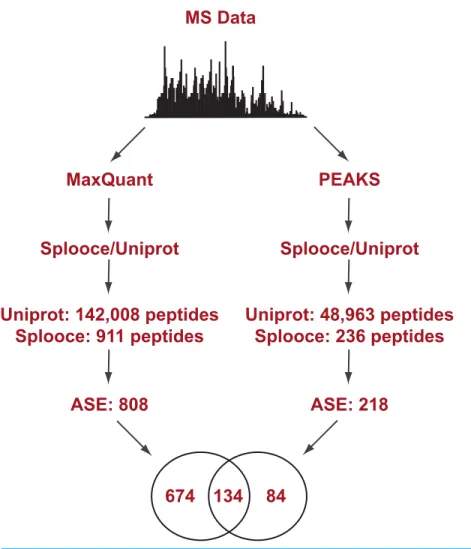
Splooce was used as a source to create a database of predicted protein isoforms in FASTA format, which was then searched against MS/MS spectra. A data set of 120,299 non-redundant protein sequences was created based on rare ASEs that were not observed for full-insert cDNA sequences (see Experimental Procedures for more details). That data set was merged to 89,602 Uniprot entries from the December 2013 release. A public collection of MS RAW files was then selected for protein identification. Only files from a publication that reported good level of instrument sensitivity and proteomic depth (Geiger et al., 2012) were used and the MS dataset was challenged against the Splooce-derived protein sequences using two peptide identification approaches, one based in probabilistic method and another one based onde novosequencing (Fig. 1). Both methods offer unique advantages and limitations.De novosequencing provides unbiased peptide identification, not limited to its theoretical existence in a database. On the other hand, sequence infor-mation can only be obtained from good to high quality MS/MS data, and partial sequence information is generally discarded. Algorithms using a protein database overall offer a higher identification rate, since partial sequence information, together with accurate mass measurement of the precursor peptide ion, can still provide positive identification.De novo data also offer additional possibilities since once a given sequence information is obtained it can be aligned against sequence repositories to provide protein identification.
Initial analysis using the probabilistic approach (MaxQuant) allowed us to identify a total of 142,926 unique peptides representing 11,237 protein groups.File S1reports the MaxQuant peptide output containing the identification features for both the total peptides identified and the ones identified only in the Splooce database. As expected, the vast majority (142,008) of these peptides are already present in Uniprot. However, 911 peptides, representing 808 ASE, were only observed for Splooce entries.
Figure 1 Experimental design flowchart.Briefly, public MS data from 11 cell lines (Geiger et al., 2012) were submitted to peptide identification using a Splooce database either by a probabilistic approach (MaxQuant) or ade novoapproach (PEAKS). Identified peptides were sorted and those characterizing alternative splicing events not present in Uniprot were compared.
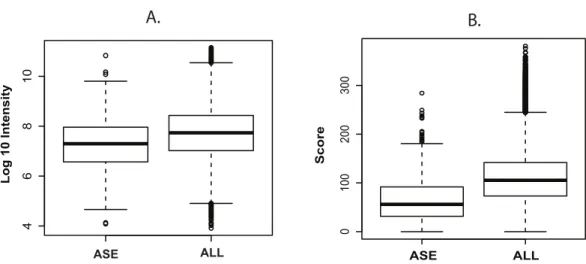
intensity distributions, with an average distribution approximately one order of magnitude lower than the complete Uniprot set (Fig. 2A). While the score distribution seemed similar, ASE-derived peptides, on average, had a lower distribution (Fig. 2B), which could be a consequence of poorer MS/MS from lower intensity ions.
Figure 2 Intensity and scoring distribution for all identified peptides.Peptide signal intensity (log10) (A) and scoring (B) distribution for all peptides (ALL) and sorted alternative splicing events (ASE) in the probabilistic approach. ASE peptides were on average close to an order of magnitude less abundant than the whole peptide population, consequently with lower average scoring.
de novoand probabilistic methods have their own FDR calculations, we did not perform any additional validation to avoid error propagation from merging results from the two different approaches. Our objective here was mostly to investigate the most efficient method based on the reported findings.
As expected, thede novomethod identified a smaller proportion of proteins and peptides than the probabilistic method when submitted to a BLAST-like alignment versus the same Splooce database. In fact, a smaller number of splicing events were detected in thede novomethod when compared to the probabilistic one. An explanation for this could be that since most ASE events characterized by the probabilistic method are seen in the bottom part of signal intensity, they most probably generated partial MS/MS information that did not fulfill the criteria required by us for reporting good qualityde novosequences. With this observation we therefore conclude that performing a probabilistic method using an in house database generates more information thande novosequencing.
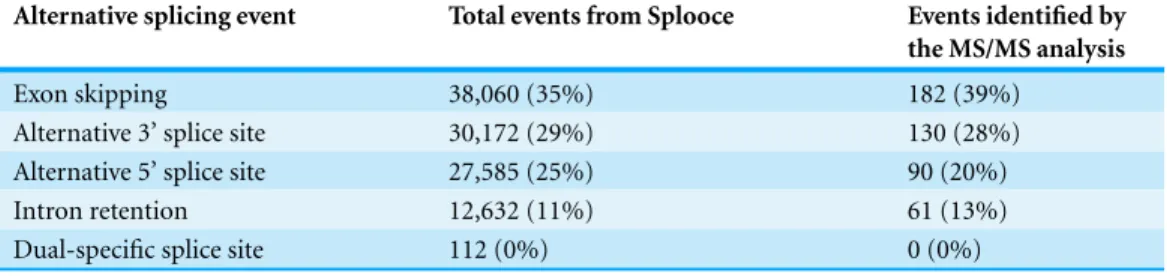
Table 1 Amount of simple alternative splicing events identified by the MS/MS analysis compared to the total number of corresponding events available from the Splooce database.
Alternative splicing event Total events from Splooce Events identified by the MS/MS analysis
Exon skipping 38,060 (35%) 182 (39%)
Alternative 3’ splice site 30,172 (29%) 130 (28%)
Alternative 5’ splice site 27,585 (25%) 90 (20%)
Intron retention 12,632 (11%) 61 (13%)
Dual-specific splice site 112 (0%) 0 (0%)
Alternative TIS represents the majority of events at the proteome level
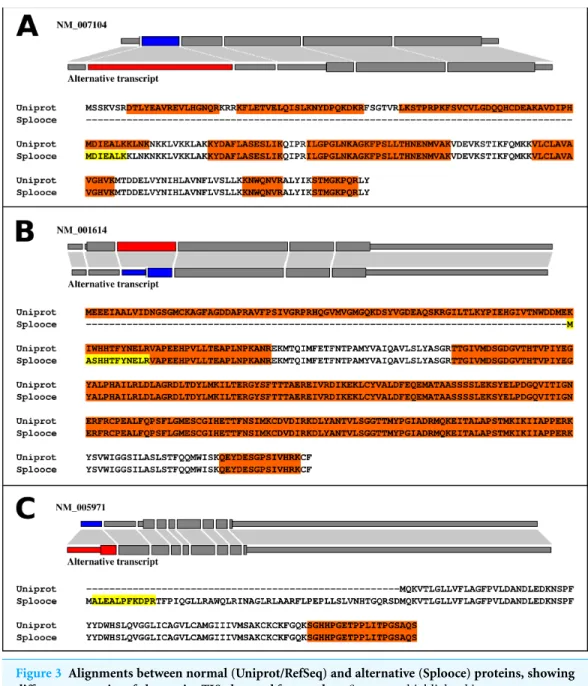
We further explored what types of events were observed in the identified peptides. Inter-estingly, 355 ASEs, out of the 892 (40%), showed a pattern consistent with the use of an alternative TIS due to an ASE (Fig. 3,File S2). The remaining 537 proteins showed different types of variations along their protein sequences (File S3).Files S2andS3not only contain a resumed version of the results described in this section, but also report protein sequence alignments for Uniprot and Splooce sequences of all proteins identified with a rare ASE. Peptides shared between both databases, in addition to the Splooce-specific peptide(s), are highlighted in the alignment. Most importantly, each alignment contains a link to the Splooce website where information and statistics for that rare ASE can be collected.
The high proportion of alternative TIS was further explored. All new protein isoforms showing an alternative TIS were searched against the TISdb database (Wan & Qian, 2014), a collection of TIS obtained from a genome-wide method (GTI-Seq) developed by the same authors (Lee et al., 2012). We found that only one TIS present in our list was present in the TISdb providing therefore a proteome validation for that respective TISdb entry. Several reasons could explain the small overlap between the two datasets such as: (i) the different nature of the samples used in both studies, (ii) the fact that most of the TIS present in TISdb are non-canonical and start with others codons than ATG (we restricted our analysis to ATG-associated TIS) and (iii) the lack of proteome validation in most of the studies that populated TISdb.
Wilson and colleagues have suggested that the association between ASE and TIS are restricted to the amino-terminus of proteins where both events are used to produce isoforms that differ at their amino end. Almost 2,000 events like that were identified at the transcriptome level but few (17 instances) were confirmed in a limited search against MS/MS data (Wilson et al., 2014). We wondered whether this type of event would be frequent in our dataset of 355 TIS. Visual inspection of all 355 cases identified only 29 instances (8%) that would fit the model fromWilson et al. (2014)(for more details, see
File S2). The low level of validation of such cases at the proteome level, also seen by the
Figure 3 Alignments between normal (Uniprot/RefSeq) and alternative (Splooce) proteins, showing different categories of alternative TIS observed for our data.Sequences highlighted in orange represent MS peptides found for the Uniprot/RefSeq proteins, and sequences highlighted in yellow represent peptides found exclusively in the alternative sequences from Splooce. Peptides that align specifically to a sequence from Splooce are supposed to characterize ASEs. (A) Alternative TIS is downstream the original one; (B) Same as A, although the beginning of the protein sequence is directly affected by the ASE. (C) Alternative TIS is upstream the original one.
CONCLUSIONS
A limitation one is facing in this type of analysis is the definition of a proper false discovery rate when adding entries in a databasead infinitum. Any observed MS/MS information in such approaches will be tagged to the “best-fit” theoretical peptide present in the database, regardless if that is the correct one. Even though identification engines such as Mascot and MaxQuant (Andromeda) have proof-check algorithms to quantify FDR rate, incorrect MS/MS information might still be reported as true. Therefore there will be always the risk that peptides that are present in the sample but not represented in the database are incorrectly assigned. In addition, there will be a size limit where adding more protein entries created by RNAseq information will be detrimental to the analysis, rather than beneficial. For a good isoform discovery phase study to reliably work, a compromise between database size and validation rounds using complementary databases must be created. A desirable strategy would be to create a collection of public, high quality datasets such as the one used in this work and use them for database-based splicing discovery using different versions of the Splooce database. Recently, similar approaches have been successfully implemented for mapping expressed genes, pseudogenes and characterization of new open reading frames (Kim et al., 2014;Wilhelm et al., 2014), but little was shown regarding splicing isoforms. Therefore, such an approach using Splooce databases with public MS data for ASE discovery is feasible and promising for further characterization of the human proteome draft. Our data demonstrate that by simply complementing routinely used databases with rare/unknown isoform entries predicted by nucleotide sequences approaches, together with already in-use protein identification engines such as MaxQuant/Andromeda can provide satisfactory identification rates without compromising the search engine capabilities.
In summary, a new strategy for the identification of splicing variants in MS/MS data is provided here allowing us to confirm at the proteome level more than 800 new variants. We extended previous observations linking ASE and TIS and provided validation for hundreds of new TIS events. We have upgraded the Splooce portal to take into account the integration of MS/MS data in the validation of splicing variants.
Abbreviations
ASE Alternative splicing events TIS Translational initiation site FDR False discovery rate
GTI-Seq Global translational initiation sequencing
ADDITIONAL INFORMATION AND DECLARATIONS
Funding
to SJS. GAdS is a Special Visiting Scientist to the Brain Institute – UFRN (supported by a CNPq grant 400392/2014-3 to SJS). GAdS and the Proteomics Core Facility are supported by grants from UiO and the Norwegian South-East Health Authority (Helse Sør-Øst). The funders had no role in study design, data collection and analysis, decision to publish, or preparation of the manuscript.
Grant Disclosures
The following grant information was disclosed by the authors: CNPq: 501891/2013-7.
CNPq: 483775/2012-6. CAPES: edital 051/2013. CNPq: 400392/2014-3. UiO.
Norwegian South-East Health Authority.
Competing Interests
The authors declare there are no competing interests.
Author Contributions
• Jos´e E. Kroll and Gustavo A. de Souza conceived and designed the experiments, performed the experiments, analyzed the data, contributed reagents/materials/analysis tools, wrote the paper, prepared figures and/or tables, reviewed drafts of the paper.
• Sandro J. de Souza conceived and designed the experiments, analyzed the data, contributed reagents/materials/analysis tools, wrote the paper, reviewed drafts of the paper.
Supplemental Information
Supplemental information for this article can be found online athttp://dx.doi.org/
10.7717/peerj.673#supplemental-information.
REFERENCES
Au KF, Sebastiano V, Afshar PT, Durruthy JD, Lee L, Williams BA, Van Bakel H, Schadt EE,
Reijo-Pera RA, Underwood JG, Wong WH. 2013.Characterization of the human ESC
transcriptome by hybrid sequencing.Proceedings of the National Academy of Sciences of the
United States of America110:E4821–E4830DOI 10.1073/pnas.1320101110.
Beck M, Schmidt A, Malmstroem J, Claassen M, Ori A, Szymborska A, Herzog F, Rinner O, Ellenberg J, Aebersold R. 2011.The quantitative proteome of a human cell line.Molecular Systems Biology7:1–6 Article 549.
Blakeley P, Siepen JA, Lawless C, Hubbard SJ. 2010. Investigating protein isoforms via proteomics: a feasibility study.Proteomics10:1127–1140DOI 10.1002/pmic.200900445.
Brosch M, Saunders GI, Frankish A, Collins MO, Yu L, Wright J, Verstraten R, Adams DJ,
Harrow J, Choudhary JS, Hubbard T. 2011.Shotgun proteomics aids discovery of novel
protein-coding genes, alternative splicing, and “resurrected” pseudogenes in the mouse genome.
Cork DMW, Lennard TWJ, Tyson-Capper AJ. 2012.Progesterone receptor (PR) variants exist in breast cancer cells characterised as PR negative.Tumour Biology33:2329–2340 DOI 10.1007/s13277-012-0495-z.
Cox J, Mann M. 2008.MaxQuant enables high peptide identification rates, individualized
p.p.b.-range mass accuracies and proteome-wide protein quantification.Nature Biotechnology 26:1367–1372DOI 10.1038/nbt.1511.
Desiere F, Deutsch EW, King NL, Nesvizhskii AI, Mallick P, Eng J, Chen S, Eddes J,
Loevenich SN, Aebersold R. 2006.The PeptideAtlas project. Nucleic Acids Research
34:D655–D658DOI 10.1093/nar/gkj040.
Geiger T, Wehner A, Schaab C, Cox J, Mann M. 2012.Comparative proteomic analysis of eleven
common cell lines reveals ubiquitous but varying expression of most proteins.Molecular &
Cellular Proteomics11:M111 014050DOI 10.1074/mcp.M111.014050.
Griss J, Martin M, O’Donovan C, Apweiler R, Hermjakob H, Vizcaino JA. 2011.Consequences of
the discontinuation of the International Protein Index (IPI) database and its substitution by the UniProtKB “complete proteome” sets.Proteomics11:4434–4438DOI 10.1002/pmic.201100363.
Kim MS, Pinto SM, Getnet D, Nirujogi RS, Manda SS, Chaerkady R, Madugundu AK, Kelkar DS, Isserlin R, Jain S, Thomas JK, Muthusamy B, Leal-Rojas P, Kumar P, Sahasrabuddhe NA, Balakrishnan L, Advani J, George B, Renuse S, Selvan LD, Patil AH, Nanjappa V, Radhakrishnan A, Prasad S, Subbannayya T, Raju R, Kumar M, Sreenivasamurthy SK, Marimuthu A, Sathe GJ, Chavan S, Datta KK, Subbannayya Y, Sahu A, Yelamanchi SD, Jayaram S, Rajagopalan P, Sharma J, Murthy KR, Syed N, Goel R, Khan AA, Ahmad S, Dey G, Mudgal K, Chatterjee A, Huang TC, Zhong J, Wu X, Shaw PG, Freed D, Zahari MS, Mukherjee KK, Shankar S, Mahadevan A, Lam H, Mitchell CJ,
Shankar SK, Satishchandra P, Schroeder JT, Sirdeshmukh R, Maitra A, Leach SD, Drake CG, Halushka MK, Prasad TS, Hruban RH, Kerr CL, Bader GD, Iacobuzio-Donahue CA,
Gowda H, Pandey A. 2014.A draft map of the human proteome.Nature509:575–581
DOI 10.1038/nature13302.
Kroll JE, Galante PA, Ohara DT, Navarro FC, Ohno-Machado L, de Souza SJ. 2012.SPLOOCE:
a new portal for the analysis of human splicing variants.RNA Biology 9:1339–1343 DOI 10.4161/rna.22182.
Smith DR, Doucette-Stamm L, Rubenfield M, Weinstock K, Lee HM, Dubois J, Rosenthal A, Platzer M, Nyakatura G, Taudien S, Rump A, Yang H, Yu J, Wang J, Huang G, Gu J, Hood L, Rowen L, Madan A, Qin S, Davis RW, Federspiel NA, Abola AP, Proctor MJ, Myers RM, Schmutz J, Dickson M, Grimwood J, Cox DR, Olson MV, Kaul R, Raymond C, Shimizu N, Kawasaki K, Minoshima S, Evans GA, Athanasiou M, Schultz R, Roe BA, Chen F, Pan H, Ramser J, Lehrach H, Reinhardt R, McCombie WR, de la Bastide M, Dedhia N, Blocker H, Hornischer K, Nordsiek G, Agarwala R, Aravind L, Bailey JA, Bateman A, Batzoglou S, Birney E, Bork P, Brown DG, Burge CB, Cerutti L, Chen HC, Church D, Clamp M, Copley RR, Doerks T, Eddy SR, Eichler EE, Furey TS, Galagan J, Gilbert JG, Harmon C, Hayashizaki Y, Haussler D, Hermjakob H, Hokamp K, Jang W, Johnson LS, Jones TA, Kasif S, Kaspryzk A, Kennedy S, Kent WJ, Kitts P, Koonin EV, Korf I, Kulp D, Lancet D, Lowe TM, McLysaght A, Mikkelsen T, Moran JV, Mulder N, Pollara VJ, Ponting CP, Schuler G, Schultz J, Slater G, Smit AF, Stupka E, Szustakowski J, Thierry-Mieg D, Thierry-Mieg J, Wagner L, Wallis J, Wheeler R, Williams A, Wolf YI, Wolfe KH, Yang SP, Yeh RF, Collins F, Guyer MS, Peterson J, Felsenfeld A, Wetterstrand KA, Patrinos A, Morgan MJ, de Jong P, Catanese JJ, Osoegawa K, Shizuya H, Choi S, Chen YJ, International
Human Genome Sequencing C. 2001.Initial sequencing and analysis of the human genome.
Nature409:860–921DOI 10.1038/35057062.
Lee S, Liu B, Lee S, Huang SX, Shen B, Qian SB. 2012.Global mapping of translation initiation sites in mammalian cells at single-nucleotide resolution.Proceedings of the National Academy of
Sciences of the United States of America109:E2424–2432DOI 10.1073/pnas.1207846109.
Ma B, Zhang K, Hendrie C, Liang C, Li M, Doherty-Kirby A, Lajoie G. 2003.PEAKS: powerful
software for peptide de novo sequencing by tandem mass spectrometry.Rapid Communications
in Mass Spectrometry17:2337–2342DOI 10.1002/rcm.1196.
Magrane M, UniProt Consortium. 2011.UniProt Knowledgebase: a hub of integrated protein
data.Database2011:bar009DOI 10.1093/database/bar009.
Nagaraj N, Wisniewski JR, Geiger T, Cox J, Kircher M, Kelso J, Paabo S, Mann M. 2011.Deep
proteome and transcriptome mapping of a human cancer cell line.Molecular Systems Biology 7:1–8 Article 548.
Peng Z, Cheng Y, Tan BC-M, Kang L, Tian Z, Zhu Y, Zhang W, Liang Y, Hu X, Tan X, Guo J,
Dong Z, Liang Y, Bao L, Wang J. 2012.Comprehensive analysis of RNA-Seq data reveals
extensive RNA editing in a human transcriptome.Nature Biotechnology30:253–260 DOI 10.1038/nbt.2122.
Perez-Riverol Y, Alpi E, Wang R, Hermjakob H, Vizcaino JA. 2014.Making proteomics data
accessible and reusable: current state of proteomics databases and repositories.Proteomics
In pressDOI 10.1002/pmic.201400302.
Perez-Riverol Y, Sanchez A, Ramos Y, Schmidt A, Muller M, Betancourt L, Gonzalez LJ, Vera R, Padron G, Besada V. 2011.In silico analysis of accurate proteomics, complemented by selective isolation of peptides.Journal of Proteomics74:2071–2082DOI 10.1016/j.jprot.2011.05.034.
Pruitt KD, Brown GR, Hiatt SM, Thibaud-Nissen F, Astashyn A, Ermolaeva O, Farrell CM, Hart J, Landrum MJ, McGarvey KM, Murphy MR, O’Leary NA, Pujar S, Rajput B, Rangwala SH, Riddick LD, Shkeda A, Sun H, Tamez P, Tully RE, Wallin C, Webb D,
Weber J, Wu W, DiCuccio M, Kitts P, Maglott DR, Murphy TD, Ostell JM. 2014.RefSeq:
an update on mammalian reference sequences.Nucleic Acids Research42:D756–D763 DOI 10.1093/nar/gkt1114.
Sheynkman GM, Shortreed MR, Frey BL, Smith LM. 2013.Discovery and mass spectrometric analysis of novel splice-junction peptides using RNA-Seq.Molecular & Cellular Proteomics 12:2341–2353DOI 10.1074/mcp.O113.028142.
The 1000 Genomes Project Consortium. 2012.An integrated map of genetic variation from 1,092
human genomes.Nature491:56–65DOI 10.1038/nature11632.
Tress ML, Bodenmiller B, Aebersold R, Valencia A. 2008. Proteomics studies confirm
the presence of alternative protein isoforms on a large scale. Genome Biology 9:R162DOI 10.1186/gb-2008-9-11-r162.
Venter JC, Adams MD, Myers EW, Li PW, Mural RJ, Sutton GG, Smith HO, Yandell M, Evans CA, Holt RA, Gocayne JD, Amanatides P, Ballew RM, Huson DH, Wortman JR, Zhang Q, Kodira CD, Zheng XH, Chen L, Skupski M, Subramanian G, Thomas PD, Zhang J, Gabor Miklos GL, Nelson C, Broder S, Clark AG, Nadeau J, McKusick VA, Zinder N, Levine AJ, Roberts RJ, Simon M, Slayman C, Hunkapiller M, Bolanos R, Delcher A, Dew I, Fasulo D, Flanigan M, Florea L, Halpern A, Hannenhalli S, Kravitz S, Levy S, Mobarry C, Reinert K, Remington K, Abu-Threideh J, Beasley E, Biddick K, Bonazzi V, Brandon R, Cargill M, Chandramouliswaran I, Charlab R, Chaturvedi K, Deng Z, Di Francesco V, Dunn P, Eilbeck K, Evangelista C, Gabrielian AE, Gan W, Ge W, Gong F, Gu Z, Guan P, Heiman TJ, Higgins ME, Ji RR, Ke Z, Ketchum KA, Lai Z, Lei Y, Li Z, Li J, Liang Y, Lin X, Lu F, Merkulov GV, Milshina N, Moore HM, Naik AK, Narayan VA, Neelam B, Nusskern D, Rusch DB, Salzberg S, Shao W, Shue B, Sun J, Wang Z, Wang A, Wang X, Wang J, Wei M, Wides R, Xiao C, Yan C, Yao A, Ye J, Zhan M, Zhang W, Zhang H, Zhao Q, Zheng L, Zhong F, Zhong W, Zhu S, Zhao S, Gilbert D, Baumhueter S, Spier G, Carter C, Cravchik A, Woodage T, Ali F, An H, Awe A, Baldwin D, Baden H, Barnstead M, Barrow I, Beeson K, Busam D, Carver A, Center A, Cheng ML, Curry L, Danaher S, Davenport L, Desilets R, Dietz S, Dodson K, Doup L, Ferriera S, Garg N, Gluecksmann A, Hart B, Haynes J, Haynes C, Heiner C, Hladun S, Hostin D, Houck J, Howland T, Ibegwam C, Johnson J, Kalush F, Kline L, Koduru S, Love A, Mann F, May D, McCawley S, McIntosh T, McMullen I, Moy M, Moy L, Murphy B, Nelson K, Pfannkoch C, Pratts E, Puri V, Qureshi H, Reardon M, Rodriguez R, Rogers YH, Romblad D, Ruhfel B, Scott R, Sitter C, Smallwood M, Stewart E, Strong R, Suh E, Thomas R, Tint NN, Tse S, Vech C, Wang G, Wetter J, Williams S, Williams M, Windsor S, Winn-Deen E, Wolfe K, Zaveri J, Zaveri K, Abril JF, Guigo R, Campbell MJ, Sjolander KV, Karlak B, Kejariwal A, Mi H, Lazareva B, Hatton T, Narechania A, Diemer K, Muruganujan A, Guo N, Sato S, Bafna V, Istrail S, Lippert R, Schwartz R, Walenz B, Yooseph S, Allen D, Basu A, Baxendale J, Blick L, Caminha M, Carnes-Stine J, Caulk P, Chiang YH, Coyne M, Dahlke C, Mays A, Dombroski M, Donnelly M, Ely D, Esparham S, Fosler C, Gire H, Glanowski S, Glasser K, Glodek A, Gorokhov M, Graham K, Gropman B, Harris M, Heil J, Henderson S, Hoover J, Jennings D, Jordan C, Jordan J, Kasha J, Kagan L, Kraft C, Levitsky A, Lewis M, Liu X, Lopez J, Ma D, Majoros W, McDaniel J, Murphy S, Newman M, Nguyen T, Nguyen N, Nodell M, Pan S, Peck J, Peterson M, Rowe W, Sanders R, Scott J, Simpson M, Smith T, Sprague A, Stockwell T, Turner R, Venter E, Wang M, Wen M, Wu D, Wu M, Xia A,
Zandieh A, Zhu X. 2001.The sequence of the human genome.Science291:1304–1351
DOI 10.1126/science.1058040.
Vizcaino JA, Cote RG, Csordas A, Dianes JA, Fabregat A, Foster JM, Griss J, Alpi E,
Birim M, Contell J, O’Kelly G, Schoenegger A, Ovelleiro D, Perez-Riverol Y, Reisinger F,
Rios D, Wang R, Hermjakob H. 2013. The PRoteomics IDEntifications (PRIDE)
Vizcaino JA, Deutsch EW, Wang R, Csordas A, Reisinger F, Rios D, Dianes JA, Sun Z, Farrah T, Bandeira N, Binz PA, Xenarios I, Eisenacher M, Mayer G, Gatto L, Campos A, Chalkley RJ, Kraus HJ, Albar JP, Martinez-Bartolome S, Apweiler R, Omenn GS, Martens L, Jones AR,
Hermjakob H. 2014.ProteomeXchange provides globally coordinated proteomics data
submission and dissemination.Nature Biotechnology32:223–226DOI 10.1038/nbt.2839.
Wan J, Qian SB. 2014.TISdb: a database for alternative translation initiation in mammalian cells.
Nucleic Acids Research42:D845–D850DOI 10.1093/nar/gkt1085.
Wang X, Slebos RJ, Wang D, Halvey PJ, Tabb DL, Liebler DC, Zhang B. 2012. Protein
identification using customized protein sequence databases derived from RNA-Seq data.Journal
of Proteome Research11:1009–1017DOI 10.1021/pr200766z.
Wilhelm M, Schlegl J, Hahne H, Moghaddas Gholami A, Lieberenz M, Savitski MM, Ziegler E, Butzmann L, Gessulat S, Marx H, Mathieson T, Lemeer S, Schnatbaum K, Reimer U,
Wenschuh H, Mollenhauer M, Slotta-Huspenina J, Boese JH, BantscheffM, Gerstmair A,
Faerber F, Kuster B. 2014.Mass-spectrometry-based draft of the human proteome.Nature
509:582–587DOI 10.1038/nature13319.
Wilson LO, Spriggs A, Taylor JM, Fahrer AM. 2014.A novel splicing outcome reveals
more than 2000 new mammalian protein isoforms. Bioinformatics 30:151–156 DOI 10.1093/bioinformatics/btt668.
Woo S, Cha SW, Merrihew G, He Y, Castellana N, Guest C, MacCoss M, Bafna V. 2014.
Proteogenomic database construction driven from large scale RNA-seq data.Journal of Proteome
Research13:21–28DOI 10.1021/pr400294c.
Xue J, Schmidt SV, Sander J, Draffehn A, Krebs W, Quester I, De Nardo D, Gohel TD, Emde M,
Schmidleithner L, Ganesan H, Nino-Castro A, Mallmann MR, Labzin L, Theis H, Kraut M,
Beyer M, Latz E, Freeman TC, Ulas T, Schultze JL. 2014.Transcriptome-based network
analysis reveals a spectrum model of human macrophage activation.Immunity40:274–288 DOI 10.1016/j.immuni.2014.01.006.
Zhang C, Hastings ML, Krainer AR, Zhang MQ. 2007.Dual-specificity splice sites function
alternatively as 5’ and 3’ splice sites.Proceedings of the National Academy of Sciences of the United