BGD
9, 17999–18038, 2012
Natural and anthropogenic hydrocarbons in deep EMS sediments
C. Parinos et al.
Title Page
Abstract Introduction
Conclusions References
Tables Figures
◭ ◮
◭ ◮
Back Close
Full Screen / Esc
Printer-friendly Version Interactive Discussion
Discussion
P
a
per
|
Dis
cussion
P
a
per
|
Discussion
P
a
per
|
Discussio
n
P
a
per
|
Biogeosciences Discuss., 9, 17999–18038, 2012 www.biogeosciences-discuss.net/9/17999/2012/ doi:10.5194/bgd-9-17999-2012
© Author(s) 2012. CC Attribution 3.0 License.
Biogeosciences Discussions
This discussion paper is/has been under review for the journal Biogeosciences (BG). Please refer to the corresponding final paper in BG if available.
Occurrence, sources and transport
pathways of natural and anthropogenic
hydrocarbons in deep-sea sediments of
the Eastern Mediterranean Sea
C. Parinos1, A. Gogou1, I. Bouloubassi2, R. Pedrosa-P `amies3, I. Hatzianestis1, A. S `anchez-Vidal3, G. Rousakis1, D. Velaoras1, G. Krokos1, and V. Lykousis1
1
Institute of Oceanography, Hellenic Centre for Marine Research (HCMR), 46.7 km Athens-Sounion Av., 19013 Anavyssos, Attiki, Greece
2
Laboratoire d’Oc ´eanographie et du Climat: Exp ´erimentation et Approches Num ´eriques (LOCEAN/IPSL), Universit ´e Pierre et Marie Curie-CNRS-IRD-MNHN, UMR 7159, 4 Place Jussieu, 75252 Paris CEDEX 05, France
3
GRC Geoci `encies Marines, Departament d’Estratigrafia, Paleontologia i Geoci `encies Marines, Facultat de Geologia, Universitat de Barcelona, Barcelona, Spain
Received: 27 November 2012 – Accepted: 29 November 2012 – Published: 13 December 2012
Correspondence to: C. Parinos ([email protected])
BGD
9, 17999–18038, 2012
Natural and anthropogenic hydrocarbons in deep EMS sediments
C. Parinos et al.
Title Page
Abstract Introduction
Conclusions References
Tables Figures
◭ ◮
◭ ◮
Back Close
Full Screen / Esc
Printer-friendly Version Interactive Discussion
Discussion
P
a
per
|
Dis
cussion
P
a
per
|
Discussion
P
a
per
|
Discussio
n
P
a
per
|
Abstract
Surface sediments collected from deep basins (22 stations, 1018–4087 m depth) of the Eastern Mediterranean Sea (EMS) were analyzed for aliphatic, triterpenoid and polycyclic aromatic hydrocarbons (PAHs) as tracers of natural and anthropogenic in-puts. Concentrations of total aliphatic hydrocarbons (TAHC),n-alkanes (NA) and the
5
Unresolved Complex Mixture (UCM) of aliphatic hydrocarbons ranged from 1.34 to 49.2 µg g−1, 145 to 4810 ng g−1and 0.73 to 36.7 µg g−1, respectively, while total PAHs (TPAH25) concentrations ranged from 11.6 to 223 ng g
−1
. Molecular profiles of aliphatic hydrocarbons and PAHs reflect the contribution of both natural (epicuticular plant waxes) and anthropogenic (degraded petroleum products, unburned fossil fuels and
10
combustion of petroleum, grass, wood and coal) compounds in deep EMS sediments, with hydrocarbon mixtures displaying significant regional variability. Hydrocarbon con-centrations correlated significantly with the Total Organic Carbon (TOC) content of sed-iments, indicating that organic carbon exerts an important control on their transport and fate in the study area, while strong sub-basin and mesoscale variability of water masses
15
also impact their regional characteristics. Major findings of this study support that deep basins/canyons of the EMS could act as traps of both natural and anthropogenic hy-drocarbons.
1 Introduction
Hydrocarbons are abundant components of both natural and anthropogenic organic
20
material introduced in coastal and open sites of the world’s oceans. They enter the ma-rine environment through both atmospheric (dry/wet deposition, gas exchange across the air–water interface) and aquatic pathways (continental run-offs, direct discharges, off-shelf export), or are produced autochtonougly from marine organisms. Due to their hydrophobic nature hydrocarbons tend to associate with particles resulting in
25
BGD
9, 17999–18038, 2012
Natural and anthropogenic hydrocarbons in deep EMS sediments
C. Parinos et al.
Title Page
Abstract Introduction
Conclusions References
Tables Figures
◭ ◮
◭ ◮
Back Close
Full Screen / Esc
Printer-friendly Version Interactive Discussion
Discussion
P
a
per
|
Dis
cussion
P
a
per
|
Discussion
P
a
per
|
Discussio
n
P
a
per
|
Castro-Jim ´enez et al., 2012; Dachs et al., 2002; Lipiatou et al., 1997; Parinos et al., 2012; Prahl and Carpenter, 1979).
Polycyclic aromatic hydrocarbons (PAHs) are included in lists of priority chemical pollutants by international environmental agencies (EEA, EPA), since certain homo-logues are highly carcinogenic and mutagenic, exhibiting tendency to bioaccumulate in
5
aquatic organisms (Samanta et al., 2002 and references therein). Similarly, the Unre-solved Complex Mixture (UCM), consisting of branched alicyclic hydrocarbons (Gough and Rowland, 1990; Killops and Al-Juboori, 1990), which is a commonly observed con-taminant of marine sediments in which it can persist for decades (Reddy et al., 2002), has been proven as toxic to sediment-dwelling organisms (Scarlett et al., 2007).
10
Natural sources of hydrocarbons in the marine environment include terrestrial plant waxes, diagenetic transformation of biogenic precursors, marine phytoplankton and bacteria (Gogou et al., 2000). Major anthropogenic sources are industrial outfalls, petroleum processing/seepage and accidental oil spills, since hydrocarbons are main constitutes of petroleum, pyrolysis/combustion of organic material (e.g. biomass
burn-15
ing, incomplete combustion of fossil fuels) and several industrial processes (Countway et al., 2003; Dachs et al., 1997; Laflamme and Hites, 1978; Leister and Baker, 1994; Neff, 1979; Simoneit, 1984; Tolosa et al., 1996; Yunker et al., 2002).
The Eastern Mediterranean Sea (EMS), and especially its coastal area, is a region under intense anthropogenic pressure from increasing industrial and urban activities,
20
resulting in pollutant discharges (EEA, 2006). Being an important geographical region for merchant shipping and oil transportation, the EMS receives substantial amounts of petroleum discharges, mainly along shipping routes (UNEP, 2010). Atmospheric depo-sition is also an important route for the introduction of hydrocarbons across the EMS (Castro-Jim ´enez et al., 2012; Gogou et al., 1996; Grimalt et al., 1988; Tsapakis 2003;
25
BGD
9, 17999–18038, 2012
Natural and anthropogenic hydrocarbons in deep EMS sediments
C. Parinos et al.
Title Page
Abstract Introduction
Conclusions References
Tables Figures
◭ ◮
◭ ◮
Back Close
Full Screen / Esc
Printer-friendly Version Interactive Discussion
Discussion
P
a
per
|
Dis
cussion
P
a
per
|
Discussion
P
a
per
|
Discussio
n
P
a
per
|
Aliphatic hydrocarbons and PAH burden of surficial sediments in the EMS has been studied over the past twenty five years in coastal or shallow basin sites, namely the Aegean Sea, Cretan Sea (Southern Aegean sea), northeastern Mediterranean coast, southern Italy, Egypt coast and Adriatic Sea (Aboul-Kassim and Simoneit, 1995; Alebic-Juretic, 2011; Annicchiarico et al., 2011; Barakat et al., 2011; Botsou and Hatzianestis,
5
2012; Cardellicchio et al., 2007; Gogou et al., 2000; Gonul and Kucuksezgin, 2012; Guzzella and De Paolis, 1994; Hatzianestis et al., 2001; Kucuksezgin et al., 2012; Marcomini et al., 1986; Nemr et al., 2007; Sklivagou et al., 2008; Yilmaz et al., 1998; Youssif, 2002). However, there is a lack of data regarding hydrocarbons occurrence in deep basins of the EMS. Unlike coastal settings, deep-sea sediments reflect averaged
10
deposition patterns and concentrations of natural and anthropogenic material of wider timeframes, due to the low sediment accumulation rates. In this study we focus on aliphatic, triterpenoid and polycyclic aromatic compounds as tracers of natural and anthropogenic inputs, reporting the first data set being addressed for surface sediments in deep EMS basins (22 stations, 1018–4087 m depth). Our main goal was to infer
15
conclusions regarding their occurrence, major sources and transport pathways and to examine the role of deep EMS basins as repositories of hydrocarbons.
2 Oceanographic setting
The EMS is a semi-enclosed basin that connects with the Western Mediterranean Sea through the straits of Sicily. It includes four major sub-basins, the Ionian and Levantine
20
basins, the Adriatic Sea and the Aegean Sea (Malanotte – Rizzoli et al., 1988; Robin-son et al., 1992, 2001). It has a complex circulation pattern with water masses distribu-tion being influenced by both large-scale and mesoscale variability (Malanotte-Rizzoli et al., 1997; Millot, 2005). As a concentration basin, it is characterized by an anties-tuarine circulation that transforms surface Atlantic Waters (AW), entering through the
25
BGD
9, 17999–18038, 2012
Natural and anthropogenic hydrocarbons in deep EMS sediments
C. Parinos et al.
Title Page
Abstract Introduction
Conclusions References
Tables Figures
◭ ◮
◭ ◮
Back Close
Full Screen / Esc
Printer-friendly Version Interactive Discussion
Discussion
P
a
per
|
Dis
cussion
P
a
per
|
Discussion
P
a
per
|
Discussio
n
P
a
per
|
a westward current through the Sicily strait at depths between 200 m and 500 m. The Aegean Sea occasionally contributes saline intermediate water masses to the EMS (Cretan Intermediate Water – CIW) with characteristics very close to those of LIW. Strong mesoscale variability, creating permanent and transient eddies and gyres, en-hances exchanges between the continental shelf waters and slope waters (Danovaro
5
et al., 2010).
Deep water layers of the EMS originate mainly in the Adriatic Sea and are exported by means of bottom-arrested currents toward the abyssal layers of the Ionian basin, flowing in an eastward path all the way towards the eastern Levantine basin. The Aegean Sea can also contribute in deep water formation and may even become more
10
effective than the Adriatic as a deep water source for the EMS, as in the case of the Eastern Mediterranean Transient (EMT) during the early ’90s (Civitarese et al., 2010; Roether et al., 1996; Theoharis et al., 1999).
Mean sedimentation rates in the EMS basins are low and generally do not exceed 5 cm kyr−1mainly due to the oligotrophic character of the area (Garcia-Orellana et al.,
15
2009).
3 Materials and methods
3.1 Sampling
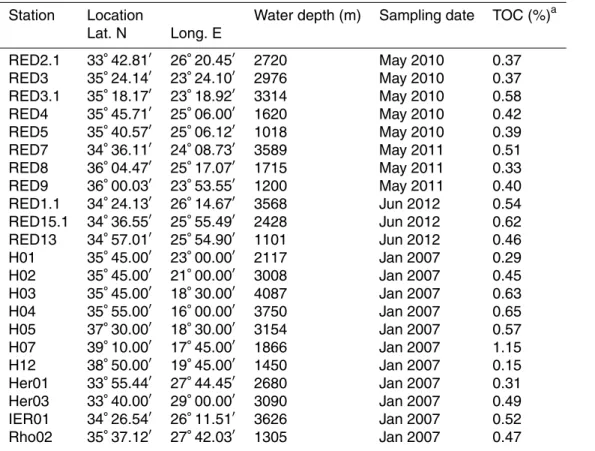
Surface sediments were collected with a multicorer at twenty two stations in deep basins (1018–4087 m depth) of the Ionian Sea, Cretan Sea (southern Aegean Sea)
20
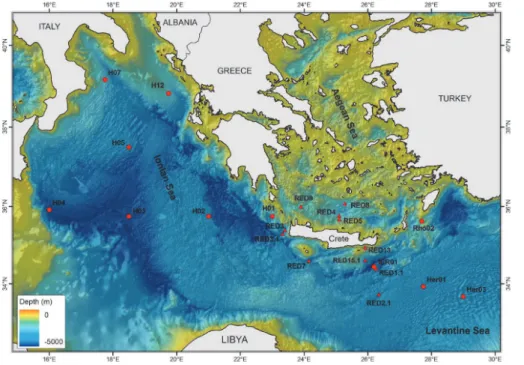
and Levantine Sea, during four oceanographic cruises conducted between January 2007 and June 2012 (Fig. 1; Table 1). January 2007 samples were collected during the M71 Leg. 3 cruise of the R/VMeteor (University of Hamburg, Germany). May 2010, 2011 and June 2012 samples were collected during cruises of the R/VAegaeo(HCMR, Greece). The undisturbed top centimeter (1 cm) of each core was recovered, wrapped
25
BGD
9, 17999–18038, 2012
Natural and anthropogenic hydrocarbons in deep EMS sediments
C. Parinos et al.
Title Page
Abstract Introduction
Conclusions References
Tables Figures
◭ ◮
◭ ◮
Back Close
Full Screen / Esc
Printer-friendly Version Interactive Discussion
Discussion
P
a
per
|
Dis
cussion
P
a
per
|
Discussion
P
a
per
|
Discussio
n
P
a
per
|
3.2 Methods
Freeze-dried sediments were spiked with a mixture of internal standards ([2H50]tetracosane, [
2
H10]phenanthrene, [ 2
H10]pyrene, [ 2
H12]chrysene, [ 2
H12]perylene
and [2H12]benzo[ghi]perylene) and solvent extracted three times by sonification with a dichloromethane : methanol mixture (4 : 1 v/v). Combined extracts were fractionated
5
on silica column, applying a modified protocol after Gogou et al. (1998). Aliphatic hy-drocarbons were eluted with 6 mLn-hexane and PAHs with 10 mL n-hexane/toluene (9 : 1, v/v). Both fractions were concentrated by vacuum rotary evaporation, transferred to a 1.5 mL amber vial and finally evaporated under a gentle nitrogen stream.
Instrumental analysis was carried out by Gas Chromatography–Mass
Spectrome-10
try (GC–MS) on an Agilent 7890 GC, equipped with an HP-5MS capillary column (30 m×0.25 mm i.d.×0.25 µm phase film), coupled to an Agilent 5975C MSD. For the analysis of aliphatic hydrocarbons the MSD operated in full scan mode and the GC oven temperature was initially held at 60◦C for 2 min, brought to 80◦C at a rate of 25◦C min−1, then to 300◦C at a rate of 5◦C min−1and finally held at 300◦C for 35 min.
15
PAHs were analyzed using a selected ion monitoring (SIM) acquisition program. The oven temperature program was the same as in the case of aliphatic hydrocarbons but with a 300◦C final isothermal of 6 min. Helium was used as carrier gas at a flow of 1.1 mL min−1.
Standard solutions of the targeted compounds, purchased from Dr. Ehrenstorfer
20
GmbH, were spiked with the internal standards and run on each injection set in or-der to or-derive relative response factors (RRFs) of the analytes. The precision of the analytical method used for PAHs was evaluated by analyzing the National Institute of Standards (NIST) standard reference sediment SRM 1941a (Organics in Marine Sed-iment). The determined values ranged between 93 and 106 % of the certified values
25
BGD
9, 17999–18038, 2012
Natural and anthropogenic hydrocarbons in deep EMS sediments
C. Parinos et al.
Title Page
Abstract Introduction
Conclusions References
Tables Figures
◭ ◮
◭ ◮
Back Close
Full Screen / Esc
Printer-friendly Version Interactive Discussion
Discussion
P
a
per
|
Dis
cussion
P
a
per
|
Discussion
P
a
per
|
Discussio
n
P
a
per
|
Spatial distributions of concentrations and characteristic parameters of aliphatic and polycyclic aromatic hydrocarbons were visualized using Ocean Data View – ODV (Schlitzer, 2011).
4 Results
4.1 Molecular profile of hydrocarbons
5
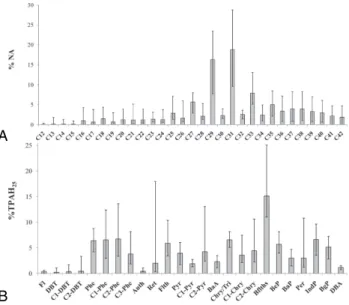
C12 to C42 n-alkanes (NA) were the main constituents of the resolved aliphatic com-pounds, representing on average 56 % of their total sum. Their molecular profile (Fig. 2a) was dominated by long chain homologues (Cn≥24) maximizing at C31with an
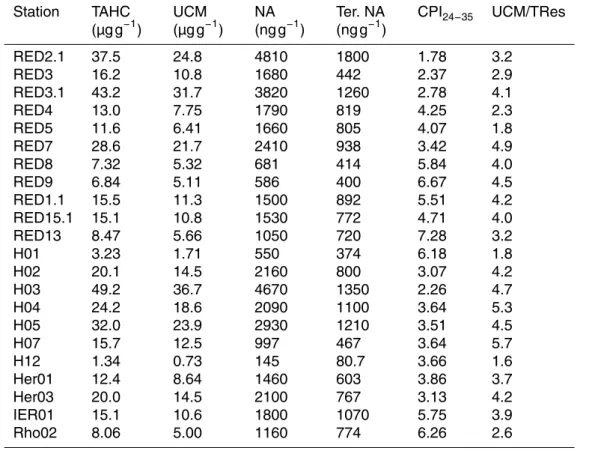
elevated odd/even carbon preference (CPI24−35>1.9, 4.3 on average; Table 2). NA with
Cn>35 constituted a large fraction (>30 %) at some stations, while NA with Cn≤23
10
were mostly minor constituents and did not exhibit any odd/even carbon preference (CPI14−23∼1). A UCM, present as a unimodal hump centered at C30, was the major
component of total aliphatic hydrocarbons (69 % on average).
25 PAHs comprising parent (unsubstitued) compounds with 2–6 aromatic rings and alkyl-substituted homologues were determined. A typical molecular profile of PAHs is
15
presented in Fig. 2b. Phenanthrene and its methyl, di- and tri- methyl homologues dominated the low-MW PAH (≤3 aromatic rings). Their sum, referred to hereafter as
P
Phe, accounted for 23±6 % of total PAHs. The high MW parent compounds (≥4
aromatic rings), which are of pyrolytic origin (Neff, 1979), were dominated by ben-zofluoranthenes, indeno[1,2,3-cd]pyrene and to a lesser degree chrysene. Their sum
20
BGD
9, 17999–18038, 2012
Natural and anthropogenic hydrocarbons in deep EMS sediments
C. Parinos et al.
Title Page
Abstract Introduction
Conclusions References
Tables Figures
◭ ◮
◭ ◮
Back Close
Full Screen / Esc
Printer-friendly Version Interactive Discussion
Discussion
P
a
per
|
Dis
cussion
P
a
per
|
Discussion
P
a
per
|
Discussio
n
P
a
per
|
4.2 Concentrations and spatial distribution of hydrocarbons
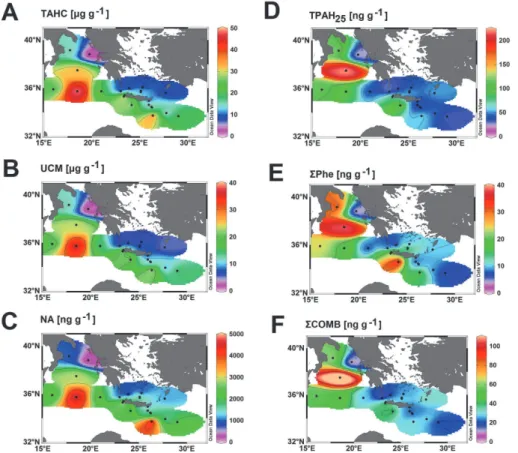
Concentrations of total aliphatic hydrocarbons (TAHC: sum of total resolved com-pounds and UCM), NA and UCM are presented in Table 2. TAHC and UCM concen-trations ranged from 1.34 to 49.2 µg g−1and 0.73 to 36.7 µg g−1, respectively, while NA concentrations ranged between 145 and 4810 ng g−1. Their spatial distribution shows
5
a generally increasing trend from Cretan Sea and Levantine Sea stations towards the deep stations of Ionian Sea (Fig. 3a–c). Maximum concentrations are found at station H03 while minimum at station H12, both located in the Ionian Sea.
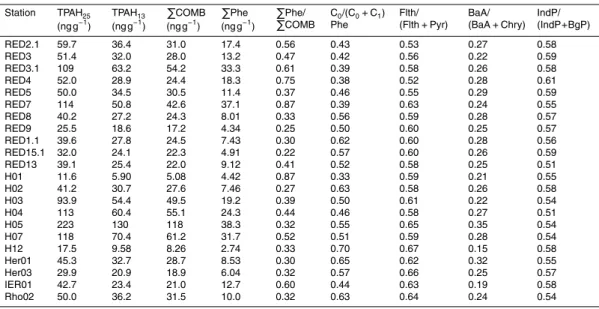
Table 3 summarizes concentrations of PAHs in surface sediments of the study area. TPAH25 refers to the total sum of compounds monitored while PPAH13 refers to the
10
sum of 13 parent compounds mainly considered in marine pollution studies, i.e. Fl, Phe, Anth, Flth, Pyr, BaA, Chry, BFlths, BeP, BaP, IndP, BgP and DBA (for abbreviations of PAH compounds see Fig. 2b). TPAH25 andPPAH13 concentrations ranged from 11.6 to 223 ng g−1and from 5.90 to 130 ng g−1, respectively. The concentrations ofPCOMB ranged from 5.08 to 118 ng g−1 while PPhe ranged between 2.74 and 38.3 ng g−1.
15
The spatial distribution of TPAH25,
P
Phe and PCOMB concentrations is presented in Fig. 3d–f. Highest TPAH25,
P
COMB and PPhe concentrations were recorded at station H05, while lowest ones were found at station H12, both located in the Ionian Sea. The spatial distribution of TPAH25(Fig. 3d) is similar to the one observed for TAHC
(Fig. 3a).
20
5 Discussion
5.1 Hydrocarbons levels
Table 4 summarizes concentrations of aliphatic and polycyclic aromatic hydrocarbons in the study area and data reported in deep-sea sediments of the Mediterranean Sea and other open sites of the world ocean. TAHC concentrations in the study area are
BGD
9, 17999–18038, 2012
Natural and anthropogenic hydrocarbons in deep EMS sediments
C. Parinos et al.
Title Page
Abstract Introduction
Conclusions References
Tables Figures
◭ ◮
◭ ◮
Back Close
Full Screen / Esc
Printer-friendly Version Interactive Discussion
Discussion
P
a
per
|
Dis
cussion
P
a
per
|
Discussion
P
a
per
|
Discussio
n
P
a
per
|
slightly higher than those reported in the Cretan Sea (Gogou et al., 2000) and com-parable to those reported in the Black Sea (Wakeham et al., 1996). As for UCM and NA, concentrations reported in this study are higher than those reported for the open Western Mediterranean Sea (Tolosa et al., 1996) and Cretan Sea (Gogou et al., 2000), but lower than those reported in the Arctic Ocean (Yunker et al., 2011). Total PAH
con-5
centrations are comparable to those reported for deep-sea settings such as Cretan Sea (Gogou et al., 2000), central Pacific Ocean (Ohkouchi et al., 1999) and South China Sea (Liu et al., 2012; Yang et al., 2000), while are considerably lower from those recorded in other deep oceanic sites: the Black Sea (Wakeham et al., 1996), the West-ern Mediterranean Sea (Lipiatou and Saliot, 1991; Tolosa et al., 1996), the Atlantic
10
Ocean (OSPAR QRS, 2000) and the Arctic Ocean (Yunker et al., 2011).
5.2 Sources of natural and anthropogenic hydrocarbons
5.2.1 Natural sources
The dominance of C25 to C35 n-alkanes (Fig. 2a) with an elevated odd/even carbon
preference shows the importance of natural terrestrial inputs, derived from epicuticular
15
plant waxes (Eglinton and Hamilton, 1967), throughout the study area. The sum of major terrestrial n-alkanes (C27, C29, C31 and C33), referred to hereafter as Ter.NA,
averaged 50 % of total NA (Table 2).
The low abundance of C15, C17and C19n-alkanes (<5 % of NA) reflects a minor con-tribution from marine sources. This is consistent with both the ultra-oligotrophic
char-20
acter of the Eastern Mediterranean Sea (Krom et al., 2003) and the preferential preser-vation of terrestrial over planktonic hydrocarbons in the marine environment (Prahl and Carpenter, 1984). Also, bacterial sources, evidenced by the presence of hopenes (hop-17(21)-ene, hop-13(18)-ene and 17β(H)-hop-22(29)-ene; Fig. 4) are also of minor im-portance.
25
BGD
9, 17999–18038, 2012
Natural and anthropogenic hydrocarbons in deep EMS sediments
C. Parinos et al.
Title Page
Abstract Introduction
Conclusions References
Tables Figures
◭ ◮
◭ ◮
Back Close
Full Screen / Esc
Printer-friendly Version Interactive Discussion
Discussion
P
a
per
|
Dis
cussion
P
a
per
|
Discussion
P
a
per
|
Discussio
n
P
a
per
|
1983). Retene represented less that 4 % of TPAH25 in all stations, except station H05
in which accounted for∼18 % of total PAHs (see below Sect. 5.3).
5.2.2 Anthropogenic sources
The elevated relative abundance of UCM compared to the total resolved aliphatic hy-drocarbons (TRes) (UCM/TRes=1.6–5.7; Table 2) is a positive indication of
contribu-5
tion from degraded petroleum products (Brassell and Eglinton, 1980; Farrington and Quinn, 1973). Consistently, a series of C29–C35 17α(H),21β(H)-hopanes were
identi-fied in all samples (Fig. 4). The extended, C31–C35, homologues were present as pairs
of the C22 diastereoisomers (22S and 22R), with a 22S/22S+22R ratio close to 0.6, typical for petrogenic hydrocarbons (Mackenzie, 1984). At some stations, low-MWn
-10
alkanes (Cn≤23) without odd/even carbon preference likely derive from fossil inputs
(light diesel), although they may also represent reworked algal material (Saliot, 1981; Wang et al., 1999), while large amounts ofn-alkanes with Cn>35 point to enhanced
contribution of heavy fuel oil residuals (Brooks et al., 1954; Hsieh et al., 2000).
Among PAHs, the dominance of alkylated phenanthrenes in the low-MW PAH and
15
the high abundance of parent PAH with ≥ 4 aromatic rings (Fig. 2b), reflect an ad-mixture of unburned fossil sources (petroleum) and combustion/pyrolysis of fossil fuels (LaFlamme and Hites, 1978; Sporstol et al., 1983; Wakeham et al., 1980). Source spe-cific diagnostic ratios have been used in order to further assess PAH sources (Yunker et al., 2002). The Flth/(Flth+Pyr) and IndP/(IndP+BgP) ratios exhibit values >0.50,
20
averaging 0.60±0.04 and 0.56±0.02 respectively, indicating grass, wood and coal
combustion as primary sources for these PAHs. The BaA/(BaA+Chry) ratio ranged between 0.15–0.35 (average 0.26±0.04), indicating an admixture of pyrolytic and fos-sil contributions. As for low-MW PAH compounds, the C0/(C0+C1) Phe ratio ranged between 0.33–0.70 (average 0.51±0.10) indicating a varying contribution of pyrolytic
25
BGD
9, 17999–18038, 2012
Natural and anthropogenic hydrocarbons in deep EMS sediments
C. Parinos et al.
Title Page
Abstract Introduction
Conclusions References
Tables Figures
◭ ◮
◭ ◮
Back Close
Full Screen / Esc
Printer-friendly Version Interactive Discussion
Discussion
P
a
per
|
Dis
cussion
P
a
per
|
Discussion
P
a
per
|
Discussio
n
P
a
per
|
0.45±0.19; Table 3), reflects dominant pyrolytic sources for PAH mixtures in the study
area (Bouloubassi and Saliot, 1993; Bouloubassi et al., 2001; Gogou et al., 2000; Pari-nos et al., 2012).
5.3 Regional characteristics of hydrocarbons
Cluster analysis (joining clustering method) was used to group stations with similarn
-5
alkanes or PAH profiles. Ward’s method was used for amalgamation of clusters while distances between objects were measured as Euclidean distances.
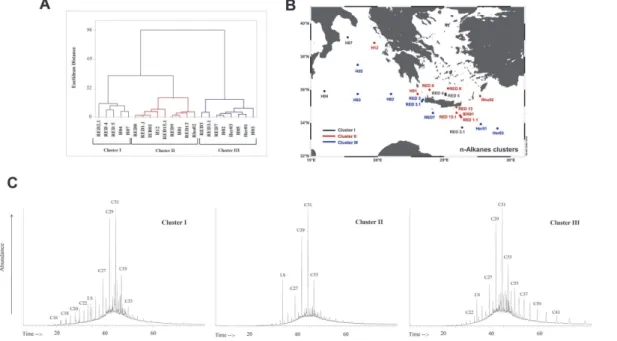
Figure 5 presents the hierarchical diagram obtained from the cluster analysis of sta-tions with regard to theirn-alkanes profile, using the relative homologues concentra-tions for the total sum of NA as starting data, clustered station sites and characteristic
10
GC chromatographs for each returning cluster. Stations are clustered into three main groups. Cluster I stations (RED2.1, RED4, RED5, H04 and H07) are characterized by high abundances of Ter.NA along with low-MW homologues (Cn≤23). Cluster II
sta-tions (RED8, RED1.1, IER01, H12, RED15.1, RED9, H01, RED13 and Rho02) are characterized by high abundances of Ter.NA and low concentrations of both low and
15
higher (Cn>35) molecular weight compounds. Stations in cluster III (RED3, RED3.1,
RED7, H02, Her01, Her03, H05 and H03) are characterized by high abundances of Ter.NA along with significant presence of long chain homologues (Cn>35).
Stations were also grouped using cluster analysis with regard to PAH profile charac-teristics (relative compounds concentrations for TPAH25). Figure 6 presents the
hier-20
archical diagram obtained from cluster analysis, clustered station sites and molecular profile for each returning cluster. Stations are also clustered into three main groups. Cluster I stations (RED2.1, RED3.1, RED3, RED4, RED5, RED7, H03, H07, H04, H01, IER01 and H12) are characterized by the elevated abundance of all alkylated homo-logues monitored within the phenanthrene, dibenzothiophene, pyrene and chrysene
25
BGD
9, 17999–18038, 2012
Natural and anthropogenic hydrocarbons in deep EMS sediments
C. Parinos et al.
Title Page
Abstract Introduction
Conclusions References
Tables Figures
◭ ◮
◭ ◮
Back Close
Full Screen / Esc
Printer-friendly Version Interactive Discussion
Discussion
P
a
per
|
Dis
cussion
P
a
per
|
Discussion
P
a
per
|
Discussio
n
P
a
per
|
less than 0.1 % of TPAH25 for dibenzothiophene and it’s alkylated homologues,
to-gether with maximum values for high-MW parent compounds, indicating dominant py-rolytic PAH contribution. Cluster III corresponding only to station H05 is characterized by the highest concentration of retene, while the distribution of other compounds, e.g. low abundance of alkylated compounds and PCOMB being>50 % of TPAH25, point
5
to dominant pyrolytic sources.
5.3.1 Ionian Sea
The PPhe/PCOMB ratio shows an increasing trend from Aegean Sea to Sicily straits (stations H02, H03 and H04; Fig. 7a) in agreement with decreasing trend of C0/(C0+C1) Phe ratio values for the same stations (Fig. 7b), indicating an increase in
10
the relative contribution of fossil fuels from east to west. Consistently, stations H02 and H03 display relatively elevated contribution of heavy oil residuals as inferred by Cn>35
n-alkanes (Fig. 5c), station H03 presents maximum UCM concentrations (Fig. 3b; Ta-ble 2) and station H04 is characterized by Cn≤23n-alkanes (Fig. 5c). The Ionian sea
stations H02, H03 and H04 are located close to the main shipping route from Greece
15
to Italy, displaying high oil spill density, with maximum in the area around station H04 (Ferraro et al., 2009). Additionally, atmospheric inputs should also be considered as a major source of fossil compounds at stations located in the open Ionian Sea, since the abundance of long chainn-alkanes (Cn>35) has been reported in rural aerosol
molecular profiles of the EMS (Gogou et al., 1996), while Castro-Jim ´enez et al. (2012)
20
also reported high diffusive deposition fluxes for Phe, DBT, C1-Phe and C1-DBT in the area.
Station H07, off the Gulf of Taranto in southern Italy, lies in an area subjected to strong anthropogenic pressure (Annicchiarico et al., 2011; Cardellicchio et al., 2007). Our hydrocarbon data show indeed strong fossil inputs, reflected in the abundance
25
of short chainn-alkanes (Cn≤23), PAHs profile and in the high
P
BGD
9, 17999–18038, 2012
Natural and anthropogenic hydrocarbons in deep EMS sediments
C. Parinos et al.
Title Page
Abstract Introduction
Conclusions References
Tables Figures
◭ ◮
◭ ◮
Back Close
Full Screen / Esc
Printer-friendly Version Interactive Discussion
Discussion
P
a
per
|
Dis
cussion
P
a
per
|
Discussion
P
a
per
|
Discussio
n
P
a
per
|
density of likely oil spills (Ferraro et al., 2009). However, this station displays minimum values for TAHC, UCM and TPAH25 concentrations (Tables 2 and 3; Fig. 3) and low
P
Phe/PCOMB ratio value (Table 3), indicating low pollutant load and pyrolytic PAH predominance. The low hydrocarbon content of this station is probably related to strong near bottom currents (Poulos et al., 1999) that favour resuspension and dispersal of
5
sedimentary material.
The renewal time of the Ionian deep and bottom waters is approximately 58 yr (Schlitzer et al., 1991). Thus, the deep Ionian basin may act as a long term depository of hydrocarbons exported from the Adriatic Sea, since the latter is the main deep water source (see Sect. 2). Supportive to this higher concentrations of particle-associated
10
PAHs are reported for near bottom rather than surface waters of the Otranto Straits (Parinos, unpublished data) while near bottom concentrations also display a decreas-ing trend movdecreas-ing from the Otranto Straits to the deep basins of the central Ionian Sea (stations H05 to H03 of this study).
5.3.2 Cretan Sea (southern Aegean) and western Cretan-Antikythera straits
15
For station RED7, maximum values forPPhe/PCOMB ratio along with low C0/(C0+
C1) Phe ratio values (Table 3), abundance of long chainn-alkanes (Fig. 5c) and finally,
PAHs profile (Fig. 6c), indicate enhanced fossil inputs. Stations RED3 and RED3.1 located in the western Cretan-Antikythera straits also display enhanced fossil inputs, in contrast with stations in neighboring regions (Ionian Sea and Levantine Sea) where
20
P
Phe/PCOMB and C0/(C0+C1) Phe ratio values indicate dominant pyrolytic sources (Fig. 7a, b).
Elevated concentrations for petrogenic PAHs (PPhe) have been reported in cen-tral Aegean Sea and Cretan Sea sediments (Hatzianestis and Sklivagou, 2001; Hatzianestis et al., personal communication). These data combined with our results
25
BGD
9, 17999–18038, 2012
Natural and anthropogenic hydrocarbons in deep EMS sediments
C. Parinos et al.
Title Page
Abstract Introduction
Conclusions References
Tables Figures
◭ ◮
◭ ◮
Back Close
Full Screen / Esc
Printer-friendly Version Interactive Discussion
Discussion
P
a
per
|
Dis
cussion
P
a
per
|
Discussion
P
a
per
|
Discussio
n
P
a
per
|
the circulation patterns of the Aegean Sea and the chemical characteristics of low-MW petrogenic PAHs.
The latter are less hydrophobic and occur mainly in the dissolved phase, thus they display longer residence time in the water column and could be transported at long distances. The general cyclonic circulation of the Aegean Sea and the net outflow, in
5
the upper 400 m of depth, towards the EMS observed in the western Cretan straits (Kontoyiannis et al., 1999, 2005) likely contribute to the transfer of petrogenic hydro-carbons from central Aegean Sea towards the western Cretan straits. This transfer may be enhanced during periods of deep water formation in the Aegean Sea, when dense water outflows through the eastern and especially the western Cretan strait canyons
10
(Lykousis et al., 2011). The western Cretan strait canyons (stations RED3.1 and RED7) may thus represent a significant sink of hydrocarbons (Tables 2 and 3), in agreement with earlier observations regarding the transfer and distributions of organic pollutants in deep canyon settings (Bouloubassi et al., 2012; Dachs et al., 1997; Fang et al., 2009; Liu et al., 2009; Salvad ´o et al., 2012).
15
5.3.3 Levantine Sea
The presence of long chain (Cn>35) n-alkanes (Fig. 5c) at stations located in Herodotus basin (Her01 and Her03) supports the importance of atmospheric depo-sition in this area. Her01 and Her03 also display a dominant pyrolytic PAH burden, as shown by the lowPPhe/PCOMB values (Table 3) and PAHs profile (Fig. 6c). In
con-20
trast, at stations around Ierapetra deep (IER01, RED1.1 and RED15.1) the values of
P
Phe/PCOMB and C0/(C0+C1) Phe and PAHs profile (Table 3; Fig. 6c) reflect an
elevated petrogenic PAH contribution. The presence of the well documented Ierapetra anticyclone (Larnicol et al., 2002; Taupier-Letage, 2008), a semi-permanent eddy, fur-ther acts to entrap water masses exiting the Cretan sea, increasing the residence time
25
BGD
9, 17999–18038, 2012
Natural and anthropogenic hydrocarbons in deep EMS sediments
C. Parinos et al.
Title Page
Abstract Introduction
Conclusions References
Tables Figures
◭ ◮
◭ ◮
Back Close
Full Screen / Esc
Printer-friendly Version Interactive Discussion
Discussion
P
a
per
|
Dis
cussion
P
a
per
|
Discussion
P
a
per
|
Discussio
n
P
a
per
|
5.4 Drivers of hydrocarbon’s distribution in deep-sea sediments of the Eastern
Mediterranean Sea
In order to assess the main processes driving hydrocarbon distributions in the study area, correlation analysis was performed for aliphatic and polycyclic aromatic hydro-carbons concentrations and Total Organic Carbon (TOC) content of sediments.
5
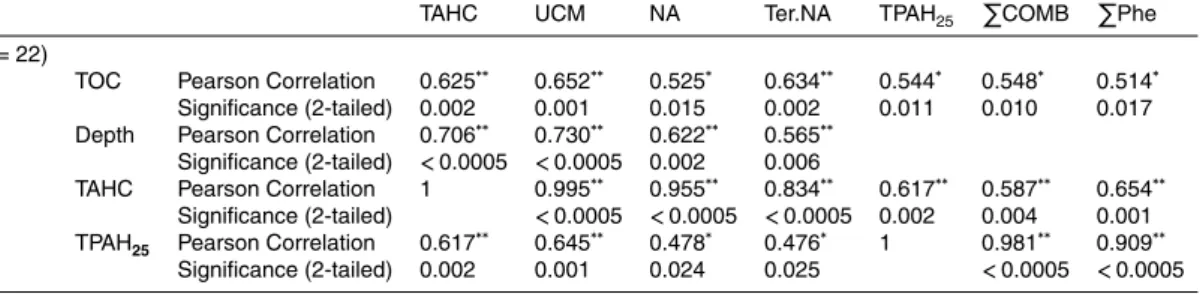
TAHC, UCM, NA, Ter.NA, TPAH25,
P
Phe andPCOMB concentrations show signif-icant correlation with TOC (Table 5), indicating that organic carbon exerts an impor-tant control on the distribution of both natural and anthropogenic hydrocarbons in the study area. This is in agreement with earlier observations in coastal and open sea ma-rine sediments (Bouloubassi et al., 2012; Charlesworth et al., 2002; De Luca et al.,
10
2004; Gogou et al., 2000; Mayer, 1993; Oros and Ross, 2004; Readman et al., 2002; Tsapakis et al., 2003; Witt et al., 1995; Yang et al., 2000) and is attributed to the high affinity of hydrophobic aliphatic and polycyclic aromatic hydrocarbons to organic matter. Overall, the concentrations of aliphatic hydrocarbons correlate with the water column depth indicating that sediments in the deep EMS basins act as their repository
(Ta-15
ble 5). The significant correlation of UCM/TRes ratio to depth (r =0.556, p=0.007), imply that the accumulation is stronger for chronic anthropogenic (petrogenic) pollutant burden rather than for natural, biogenic hydrocarbons.
Although TPAH25,PPhe and PCOMB concentrations correlate to organic carbon, they do not correlate with water column depth (Table 5). Also, as discussed in Sect. 4.3,
20
aliphatic and polycyclic aromatic hydrocarbons display different maximum concentra-tion points, i.e. staconcentra-tion H03 for aliphatic hydrocarbons and H05 for PAHs. The above imply that although organic carbon exerts the main control on the distribution of both TAHC and TPAH25in the study area, an additional factor affects the dispersal of PAHs.
Elemental (black) carbon and especially the partioning between natural organic
car-25
BGD
9, 17999–18038, 2012
Natural and anthropogenic hydrocarbons in deep EMS sediments
C. Parinos et al.
Title Page
Abstract Introduction
Conclusions References
Tables Figures
◭ ◮
◭ ◮
Back Close
Full Screen / Esc
Printer-friendly Version Interactive Discussion
Discussion
P
a
per
|
Dis
cussion
P
a
per
|
Discussion
P
a
per
|
Discussio
n
P
a
per
|
rather than organic carbon (Boehm and Farrington, 1984; Dachs and Eisenreich, 2000; Gustaffson et al., 1997), while low-MW PAH (mostly of fossil origin) as more soluble are more efficiently scavenged by organic rich particles e.g phytoplankton and fecal pellets (Dachs et al., 1996, 1997).
6 Conclusions
5
Aliphatic hydrocarbons and PAHs in surface deep-sea sediments of the Eastern Mediterranean Sea (EMS) occur at levels in the same order of magnitude as those found in deep-sea settings in the Western Mediterranean Sea and worldwide. Their distribution is characterised by an increasing trend moving from Cretan Sea (South-ern Aegean Sea) and Levantine Sea towards the deep basins of the Ionian Sea. Their
10
molecular profiles evidence contributions of both natural and anthropogenic inputs in the study area. The former derive from terrestrial vegetation while the latter are related to both intense maritime traffic and atmospheric inputs. The composition of hydrocar-bon mixtures displays significant regional variability reflecting the relative importance of sources.
15
Concentrations of both aliphatic and polycyclic aromatic hydrocarbons exhibit signif-icant correlations with organic carbon contents, indicating that the latter exerts a main control on the transport, fate and ultimate accumulation of both natural and anthro-pogenic chemical species in the deep basins of the EMS. Aliphatic hydrocarbon con-centrations correlate with water column depth, emerging the role of deep EMS basins
20
as repositories for these compounds, while the lack of correlation between PAH con-centrations and depth imply that PAHs distribution is not controlled by organic carbon alone, but probably from the partioning between natural organic carbon and combus-tion derived elemental (black or soot) carbon.
Distribution of hydrocarbons in the study area is also driven by strong sub-basin and
25
BGD
9, 17999–18038, 2012
Natural and anthropogenic hydrocarbons in deep EMS sediments
C. Parinos et al.
Title Page
Abstract Introduction
Conclusions References
Tables Figures
◭ ◮
◭ ◮
Back Close
Full Screen / Esc
Printer-friendly Version Interactive Discussion
Discussion
P
a
per
|
Dis
cussion
P
a
per
|
Discussion
P
a
per
|
Discussio
n
P
a
per
|
through the western Cretan-Antikythera straits to the western Cretan straits canyons, the latter acting as a sink of hydrocarbons. Further investigation is needed on the im-pact of organic pollutants to deep-sea biological communities.
Acknowledgements. This work has been supported by the HERMIONE IP (EU/FP7), MEDE-COS and REDECO (Marin-ERA, EU/FP6) Projects and a grant by Generalitat de Catalunya
5
to University of Barcelona (2009 SGR 1305). We sincerely thank chief scientists K.-C. Emeis, N. Lampadariou and the officers and crews of R/VAegaeo (Hellenic Centre for Marine Re-search, Greece) and R/V Meteor (University of Hamburg, Germany) for their precious help during cruises, and Chara Kyriakidou (HCMR, Athens) for preparation of the study area map.
References
10
Aboul-Kassim, T. A. T. and Simoneit, B. R. T.: Petroleum hydrocarbon fingerprinting and sed-iment transport assessed by molecular biomarker and multivariate statistical analyses in the Eastern Harbour of Alexandria, Egypt, Mar. Pollut. Bull., 30, 63–73, doi:10.1016/0025-326x(94)00102-f, 1995.
Accardi-Dey, A. and Gschwend, P. M.: Assessing the combined roles of natural organic
15
matter and black carbon as sorbents in sediments, Environ. Sci. Technol., 36, 21–29, doi:10.1021/es010953c, 2002.
Accardi-Dey, A. and Gschwend, P. M.: Reinterpreting literature sorption data considering both absorption into organic carbon and adsorption onto black carbon, Environ. Sci. Technol., 37, 99–106, doi:10.1021/es020569v, 2003.
20
Alebic-Juretic, A.: Polycyclic aromatic hydrocarbons in marine sediments from the Ri-jeka Bay area, Northern Adriatic, Croatia, 1998–2006, Mar. Pollut. Bull., 62, 863–869, doi:10.1016/j.marpolbul.2011.01.035, 2011.
Annicchiarico, C., Buonocore, M., Cardellicchio, N., Di Leo, A., Giandomenico, S., and Spada, L.: PCBs, PAHs and metal contamination and quality index in marine sediments
25
of the Taranto Gulf, Chem. Ecol., 27, 21–32, doi:10.1080/02757540.2010.536156, 2011. Barakat, A. O., Mostafa, A., Wade, T. L., Sweet, S. T., and El Sayed, N. B.: Distribution and
BGD
9, 17999–18038, 2012
Natural and anthropogenic hydrocarbons in deep EMS sediments
C. Parinos et al.
Title Page
Abstract Introduction
Conclusions References
Tables Figures
◭ ◮
◭ ◮
Back Close
Full Screen / Esc
Printer-friendly Version Interactive Discussion
Discussion
P
a
per
|
Dis
cussion
P
a
per
|
Discussion
P
a
per
|
Discussio
n
P
a
per
|
Boehm, P. D. and Farrington, J. W.: Aspects of the polycyclic aromatic hydrocarbon geochem-istry of recent sediments in the Georges Bank Region, Environ. Sci. Techcnol., 18, 840–845, 1984.
Botsou, F. and Hatzianestis, I.: Polycyclic aromatic hydrocarbons (PAHs) in marine sediments of the Hellenic coastal zone, eastern Mediterranean: levels, sources and toxicological
signif-5
icance, J. Soil. Sediment., 12, 265–277, doi:10.1007/s11368-011-0453-1, 2012.
Bouloubassi, I. and Saliot, A.: Investigation of anthropogenic and natural organic inputs in estu-arine sediments using hydrocarbon markers (NAH, LAB, PAH), Oceanol. Acta, 16, 145–161, 1993.
Bouloubassi, I., Lipiatou, E., Saliot, A., Tolosa, I., Bayona, J. M., and Albaiges, J.: Carbon
10
sources and cycle in the western Mediterranean – the use of molecular markers to deter-mine the origin of organic matter, Deep-Sea Res. Pt II, 44, 781–799, doi:10.1016/s0967-0645(96)00094-x, 1997.
Bouloubassi, I., Fillaux, J., and Saliot, A.: Hydrocarbons in surface sediments from there Changjiang (Yangtze River) Estuary, East China Sea, Mar. Pollut. Bull., 42, 1335–1346,
15
doi:10.1016/s0025-326x(01)00149-7, 2001.
Bouloubassi, I., M ´ejanelle, L., Pete, R., Fillaux, J., Lorre, A., and Point, V.: PAH transport by sinking particles in the open Mediterranean Sea: a 1 year sediment trap study, Mar. Pollut. Bull., 52, 560–571, doi:10.1016/j.marpolbul.2005.10.003, 2006.
Bouloubassi, I., Roussiez, V., Azzoug, M., and Lorre, A.: Sources, dispersal pathways and mass
20
budget of sedimentary polycyclic aromatic hydrocarbons (PAH) in the NW Mediterranean margin, Gulf of Lions, Mar. Chem., 142, 18–28, doi:10.1016/j.marchem.2012.07.003, 2012. Brassell, S. C. and Eglinton, G.: Environmental chemistry – an interdisciplinary subject.
Nat-ural and pollutant organic compounds in contemporary aquatic environments, in: Analytical Techniques in Environmental Chemistry, edited by: Albaiges, J., Pergamon, Oxford, 1980.
25
Brooks, B. T., Kurtz, S. S., Boord, C. E., and Schmerling, L. (Eds.): The Chemistry of Petroleum Hydrocarbons, Vol. 1, Chapt. 3., Reinhold Publishing Corp., New York, 1954.
Cardellicchio, N., Buccolieri, A., Giandomenico, S., Lopez, L., Pizzulli, F., and Spada, L.: Or-ganic pollutants (PAHs, PCBs) in sediments from the Mar Piccolo in Taranto (Ionian Sea, Southern Italy), Mar. Pollut. Bull., 55, 451–458, doi:10.1016/j.marpolbul.2007.09.007, 2007.
30
BGD
9, 17999–18038, 2012
Natural and anthropogenic hydrocarbons in deep EMS sediments
C. Parinos et al.
Title Page
Abstract Introduction
Conclusions References
Tables Figures
◭ ◮
◭ ◮
Back Close
Full Screen / Esc
Printer-friendly Version Interactive Discussion
Discussion
P
a
per
|
Dis
cussion
P
a
per
|
Discussion
P
a
per
|
Discussio
n
P
a
per
|
decoupling with settling fluxes in the water column, Environ. Pollut., 166, 40–47, doi:10.1016/j.envpol.2012.03.003, 2012.
Countway, R. E., Dickhut, R. M., and Canuel, E. A.: Polycyclic aromatic hydrocarbon (PAH) distributions and associations with organic matter in surface waters of the York River, VA Estuary, Org. Geochem., 34, 209–224, doi:10.1016/s0146-6380(02)00162-6, 2003.
5
Civitarese, G., Gaˇci´c, M., Lipizer, M., and Eusebi Borzelli, G. L.: On the impact of the Bi-modal Oscillating System (BiOS) on the biogeochemistry and biology of the Adriatic and Io-nian Seas (Eastern Mediterranean), Biogeosciences, 7, 3987–3997, doi:10.5194/bg-7-3987-2010, 2010.
Dachs, J., Bayona, J. M., Fowler, S. W., Miquel, J. C., and Albaig ´es, J.: Vertical fluxes of
poly-10
cyclic aromatic hydrocarbons and organochlorine compounds in the western Alboran Sea (southwestern Mediterranean), Mar. Chem., 52, 75–86, 1996.
Dachs, J., Bayona, J. M., Raoux, C., and Albaiges, J.: Spatial, vertical distribution and budget of polycyclic aromatic hydrocarbons in the Western Mediterranean seawater, Environ. Sci. Technol., 31, 682–688, 1997.
15
Dachs, J. and Eisenreich, S. J.: Adsorption onto aerosol soot carbon dominates gas-particle partitioning of polycyclic aromatic hydrocarbons, Environ. Sci. Technol., 34, 3690–3697, doi:10.1021/es991201, 2000.
Dachs, J., Lohmann, R., Ockenden, W. A., M ´ejanelle, L., Eisenreich, S. J., and Jones, K. C.: Oceanic biogeochemical controls on global dynamics of persistent organic pollutants,
Envi-20
ron. Sci. Technol., 36, 4229–4237, doi:10.1021/es025724k, 2002.
Danovaro, R., Company, J. B., Corinaldesi, C., D’Onghia, G., Galil, B., Gambi, C., Goo-day, A. J., Lampadariou, N., Luna, G. M., Morigi, C., Olu, K., Polymenakou, P., Ramirez-Llodra, E., Sabbatini, A., Sard ´a, F., Sibuet, M., and Tselepides, A.: Deep-sea biodiversity in the Mediterranean Sea: the known, the unknown, and the unknowable, PLoS ONE, 5,
25
e11832, doi:10.1371/journal.pone.0011832, 2010.
De Luca, G., Furesi, A., Leardi, R., Micera, G., Panzanelli, A., Costantina Piu, P., and Sanna, G.: Polycyclic aromatic hydrocarbons assessment in the sediments of the Porto Torres Harbor (Northern Sardinia, Italy), Mar. Chem., 86, 15–32, 2004.
Eglinton, G. and Hamilton, R. J.: Leaf epicuticular waxes, Science, 156, 1322–1335, 1967.
30
BGD
9, 17999–18038, 2012
Natural and anthropogenic hydrocarbons in deep EMS sediments
C. Parinos et al.
Title Page
Abstract Introduction
Conclusions References
Tables Figures
◭ ◮
◭ ◮
Back Close
Full Screen / Esc
Printer-friendly Version Interactive Discussion
Discussion
P
a
per
|
Dis
cussion
P
a
per
|
Discussion
P
a
per
|
Discussio
n
P
a
per
|
Fang, M. D., Chang, W. K., Lee, C. L., and Liu, J. T.: The use of polycyclic aromatic hydrocar-bons as a particulate tracer in the water column of Gaoping (Kaoping) Submarine Canyon, J. Marine Syst., 76, 457–467, 2009.
Farrington J. W. and Quinn, J. G.: Petroleum hydrocarbons in Narragansett Bay: I. Survey of hydrocarbons in sediments and clams (Mercenaria mercenaria), Estuar. Coast. Mar. Sci., 1,
5
71–79, 1973.
Ferraro, G., Meyer-Roux, S., Muellenhoff, O., Pavliha, M., Svetak, J., Tarchi, D., and Topouzelis, K.: Long term monitoring of oil spills in European seas, Int. J. Remote Sens., 30, 627–645, doi:10.1080/01431160802339464, 2009.
Garcia-Orellana, J., Pates, J. M., Masqu ´e, P., Bruach, J. M., and Sanchez-Cabeza, J. A.:
Dis-10
tribution of artificial radionuclides in deep sediments of the Mediterranean Sea, Sci. Total Environ., 407, 887–898, doi:10.1016/j.scitotenv.2008.09.018, 2009.
Gogou, A., Stratigakis, N., Kanakidou, M., and Stephanou, E. G.: Organic aerosols in Eastern Mediterranean: components source reconciliation by using molecular markers and atmo-spheric back trajectories, Org. Geochem., 25, 79–96, doi:10.1016/s0146-6380(96)00105-2,
15
1996.
Gogou, A. I., Apostolaki, M., and Stephanou, E. G.: Determination of organic molecular mark-ers in marine aerosols and sediments: one-step flash chromatography compound class fractionation and capillary gas chromatographic analysis, J. Chromatogr. A, 799, 215–231, doi:10.1016/s0021-9673(97)01106-0, 1998.
20
Gogou, A., Bouloubassi, I., and Stephanou, E. G.: Marine organic geochemistry of the East-ern Mediterranean: 1. Aliphatic and polyaromatic hydrocarbons in Cretan Sea surficial sedi-ments, Mar. Chem., 68, 265–282, doi:10.1016/s0304-4203(99)00082-1, 2000.
Gonul, L. T. and Kucuksezgin, F.: Aliphatic and polycyclic aromatic hydrocarbons in the sur-face sediments from the Eastern Aegean: assessment and source recognition of petroleum
25
hydrocarbons, Environ. Sci. Pollut. R., 19, 31–41, doi:10.1007/s11356-011-0524-2, 2012. Gough, M. A. and Rowland, S. J.: Characterization of unresolved complex mixtures of
hydro-carbons in petroleum, Nature, 344, 648–650, 1990.
Grimalt, J., Albaig ´es, J., Sicre, M. A., Marty, J. C., and Saliot, A.: Aerosol transport of polynu-clear aromatic hydrocarbons over the Mediterranean Sea, Naturwissenschaften, 75, 39–42,
30
BGD
9, 17999–18038, 2012
Natural and anthropogenic hydrocarbons in deep EMS sediments
C. Parinos et al.
Title Page
Abstract Introduction
Conclusions References
Tables Figures
◭ ◮
◭ ◮
Back Close
Full Screen / Esc
Printer-friendly Version Interactive Discussion
Discussion
P
a
per
|
Dis
cussion
P
a
per
|
Discussion
P
a
per
|
Discussio
n
P
a
per
|
Gustafsson, ¨O., Haghseta, F., Chan, C., Macfarlane, J., and Gschwend, P. M.: Quantification of the dilute sedimentary soot phase: implications for PAH speciation and bioavailability, Envi-ron. Sci. Technol., 31, 203–209, doi:10.1021/es960317s, 1997.
Guzzella, L. and De Paolis, A.: Polycyclic aromatic hydrocarbons in sediments of the Adriatic Sea, Mar. Pollut. Bull., 28, 159–165, doi:10.1016/0025-326x(94)90392-1, 1994.
5
Hatzianestis, I. and Sklivagou, E.: Distribution of Polycyclic Aromatic Hydrocarbons in Surface Sediments of the Aegean Sea (Eastern Mediterranean), presented at the 7th Greece-Cyprus chemistry conference, Nikosia, 55–59, 2001.
Hatzianestis, J., Sklivagou, E., and Georgakopoulou, E.: Hydrocarbons, pesticides and PCBs in sediments from Thermaikos Gulf, Greece, Fresen. Environ. Bull., 10, 63–68, 2001.
10
Hsieh, M., Philp, R. P., and Del Rio, J. C.: Characterization of high molecular weight biomarkers in crude oils, Org. Geochem., 31, 1581–1588, doi:10.1016/s0146-6380(00)00085-1, 2000. IOC, IHO, and BODC: Centenary Edition of the GEBCO Digital Atlas, published on CD-ROM
on behalf of the Intergovernmental Oceanographic Commission and the International Hy-drographic Organization as part of the General Bathymetric Chart of the Oceans, British
15
Oceanographic Data Centre, Liverpool, UK, 2003.
Jickells, T. D., An, Z. S., Andersen, K. K., Baker, A. R., Bergametti, C., Brooks, N., Cao, J. J., Boyd, P. W., Duce, R. A., Hunter, K. A., Kawahata, H., Kubilay, N., LaRoche, J., Liss, P. S., Mahowald, N., Prospero, J. M., Ridgwell, A. J., Tegen, I., and Torres, R.: Global iron con-nections between desert dust, ocean biogeochemistry, and climate, Science, 308, 67–71,
20
doi:10.1126/science.1105959, 2005.
Killops, S. D. and Al-Juboori, M. A. H. A.: Characterisation of the unresolved complex mixture (UCM) in the gas chromatograms of biodegraded petroleums, Org. Geochem., 15, 147–160, 1990.
Kontoyiannis, H., Theocharis, A., Balopoulos, E., Kioroglou, S., Papadopoulos, V., Collins, M.,
25
Velegrakis, A. F., and Iona, A.: Water fluxes through the Cretan Arc Straits, Eastern Mediter-ranean Sea: March 1994 to June 1995, Prog. Oceanogr., 44, 511–529, doi:10.1016/s0079-6611(99)00044-0, 1999.
Kontoyiannis, H., Balopoulos, E., Gotsis-Skretas, O., Pavlidou, A., Assimakopoulou, G., and Papageorgiou, E.: The hydrology and biochemistry of the Cretan Straits (Antikithira and
30
BGD
9, 17999–18038, 2012
Natural and anthropogenic hydrocarbons in deep EMS sediments
C. Parinos et al.
Title Page
Abstract Introduction
Conclusions References
Tables Figures
◭ ◮
◭ ◮
Back Close
Full Screen / Esc
Printer-friendly Version Interactive Discussion
Discussion
P
a
per
|
Dis
cussion
P
a
per
|
Discussion
P
a
per
|
Discussio
n
P
a
per
|
Krom, M. D., Groom, S., and Zohary, T.: The Eastern Mediterranean, in: The Biogeochemistry of Marine Systems, edited by: Black, K. D. and Shimmield, G. B., Blackwell Publishing, Oxford, 91–122, 2003.
Kucuksezgin, F., Pazi, I., and Gonul, L. T.: Marine organic pollutants of the Eastern Aegean: aliphatic and polycyclic aromatic hydrocarbons in Candarli Gulf surficial sediments, Mar.
Pol-5
lut. Bull., 64, 2569–2575, doi:10.1016/j.marpolbul.2012.07.019, 2012.
Ladji, R., Yassaa, N., Balducci, C., and Cecinato, A.: Organic components of Algerian desert dusts, Chemosphere, 81, 925–931, doi:10.1016/j.chemosphere.2010.07.059, 2010.
Laflamme, R. E. and Hites, R. A.: The global distribution of polycyclic aromatic hydrocarbons in recent sediments, Geochim. Cosmochim. Ac., 42, 289–303, 1978.
10
Larnicol, G., Ayoub, N., and Le Traon, P. Y.: Major changes in Mediterranean Sea level vari-ability from 7 years of TOPEX/Poseidon and ERS-1/2 data, J. Marine Syst., 33–34, 63–89, doi:10.1016/s0924-7963(02)00053-2, 2002.
Leister, D. L. and Baker, J. E.: Atmospheric deposition of organic contaminants to the Chesa-peake Bay, Atmos. Environ., 28, 1499–1520, doi:10.1016/1352-2310(94)90210-0, 1994.
15
Lipiatou, E. and Saliot, A.: Fluxes and transport of anthropogenic and natural polycyclic aro-matic hydrocarbons in the western Mediterranean Sea, Mar. Chem., 32, 51–71, 1991. Lipiatou, E., Tolosa, I., Sim ´o, R., Bouloubassi, I., Dachs, J., Marti, S., Sicre, M. A.,
Bay-ona, J. M., Grimalt, J. O., Saliot, A., and Albaig ´es, J.: Mass budget and dynamics of poly-cyclic aromatic hydrocarbons in the Mediterranean Sea, Deep-Sea Res. Pt II, 44, 881–905,
20
doi:10.1016/s0967-0645(96)00093-8, 1997.
Liu, J. T., Hung, J.-J., Lin, H.-L., Huh, C.-A., Lee, C.-L., Hsu, R. T., Huang, Y.-W., and Chu, J. C.: From suspended particles to strata: the fate of terrestrial substances in the Gaoping (Kaop-ing) submarine canyon, J. Marine Syst., 76, 417–432, doi:10.1016/j.jmarsys.2008.01.010, 2009.
25
Liu, L.-Y., Wang, J.-Z., Wei, G.-L., Guan, Y.-F., and Zeng, E. Y.: Polycyclic aromatic hydrocarbons (PAHs) in continental shelf sediment of China: implications for anthro-pogenic influences on coastal marine environment, Environ. Pollut., 167, 155–162, doi:10.1016/j.envpol.2012.03.038, 2012.
Lykousis, V., Smith, C., Salomidi, M., Stavrakakis, S., and Kontogiannis, H.: Hydro-sedimentary
30
BGD
9, 17999–18038, 2012
Natural and anthropogenic hydrocarbons in deep EMS sediments
C. Parinos et al.
Title Page
Abstract Introduction
Conclusions References
Tables Figures
◭ ◮
◭ ◮
Back Close
Full Screen / Esc
Printer-friendly Version Interactive Discussion
Discussion
P
a
per
|
Dis
cussion
P
a
per
|
Discussion
P
a
per
|
Discussio
n
P
a
per
|
Mackenzie, A. S.: Applications of biological biomarkers in petroleum geochemistry, in: Ad-vances in Petroleum Geochemistry, edited by: Brooks, J. and Welte, D., Academic Press, London, 115–214, 1984.
Malanotte-Rizzoli, P. and Hecht, A.: Large scale properties of the Eastern Mediterranean: a re-view, Oceanol. Acta, 11, 323–335, 1988.
5
Malanotte-Rizzoli, P., Manca, B. B., D’Alcal `a, M. R., Theocharis, A., Bergamasco, A., Bre-gant, D., Budillon, G., Clvitarese, G., Georgopoulos, D., Mlchelato, A., Sansone, E., Scaraz-zato, P., and Souvermezoglou, E.: A synthesis of the Ionian Sea hydrography, circula-tion and water mass pathways during POEM-phase I, Prog. Oceanogr., 39, 153–204, doi:10.1016/s0079-6611(97)00013-x, 1997.
10
Marcomini, A., Pavoni, B., Donazzolo, R., and Orio, A. A.: Combined preparative and analytical use of normal-phase and reversed-phase high-performance liquid chromatography for the determination of aliphatic and polycyclic aromatic hydrocarbons in sediments of the Adriatic Sea, Mar. Chem., 18, 71–84, 1986.
Mayer, L. M.: Organic matter at the sediment–water interface, in: Org. Geochem., Principles
15
and Applications, edited by: Engel, M. N. and Macko, S. A., Plenum Press, New York, 171– 184, 1993.
Millot, C. and Taupier-Letage, I.: Circulation in the Mediterranean Sea, Handbook Environ. Chem., 5K, 29–66, 2005.
Neff, J.: Polycyclic Aromatic Hydrocarbons. Sources, Fates and Biological Effects, Applied
Sci-20
ence Publ., London, 262 pp., 1979.
Nemr, A. E., Said, T. O., Khaled, A., El-Sikaily, A., and Abd-Allah, A. M. A.: The distribution and sources of polycyclic aromatic hydrocarbons in surface sediments along the Egyp-tian Mediterranean coast, Environ. Monit. Assess., 124, 343–359, doi:10.1007/s10661-006-9231-8, 2007.
25
Ohkouchi, N., Kawamura, K., and Wahata, H.: Distributions of three- to seven-ring polynuclear aromatic hydrocarbons on the deep sea floor in the Central Pacific, Environ. Sci. Technol., 33, 3086-3090, 1999.
Oros, D. R. and Ross, J. R. M.: Polycyclic aromatic hydrocarbons in San Francisco Estuary sediments, Mar. Chem., 86, 169–184, 2004.
30
BGD
9, 17999–18038, 2012
Natural and anthropogenic hydrocarbons in deep EMS sediments
C. Parinos et al.
Title Page
Abstract Introduction
Conclusions References
Tables Figures
◭ ◮
◭ ◮
Back Close
Full Screen / Esc
Printer-friendly Version Interactive Discussion
Discussion
P
a
per
|
Dis
cussion
P
a
per
|
Discussion
P
a
per
|
Discussio
n
P
a
per
|
Parinos, C., Gogou, A., Bouloubassi, I., Stavrakakis, S., Plakidi, E., and Hatzianestis, I.: Sources and downward fluxes of polycyclic aromatic hydrocarbons in the open southwestern Black Sea, Org. Geochem., submitted, 2012.
Poulos, S. E., Lykousis, V., Collins, M. B., Rohling, E. J., and Pattiaratchi, C. B.: Sedimentation processes in a tectonically active environment: the Kerkyra-Kefalonia submarine valley
sys-5
tem (NE Ionian Sea), Mar. Geol., 160, 25–44, doi:10.1016/s0025-3227(99)00016-x, 1999. Prahl, F. G. and Carpenter, R.: The role of zooplankton fecal pellets in the sedimentation of
polycyclic aromatic hydrocarbons in Dabob Bay, Washington, Geochim. Cosmochim. Ac., 43, 1959–1972, 1979.
Prahl, F. G. and Carpenter, R.: Hydrocarbons in Washington coastal sediments, Estuar. Coast.
10
Shelf Sci., 18, 703–720, 1984.
Ramdahl, T.: Retene – a molecular marker of wood combustion in ambient air, Nature, 306, 580–582, 1983.
Readman, J. W., Fillmann, G., Tolosa, I., Bartocci, J., Villeneuve, J.-P., Catinni, C., and Mee, L. D.: Petroleum and PAH contamination of the Black Sea, Mar. Pollut. Bull., 44, 48–62,
15
2002.
Reddy, C. M., Eglinton, T. I., Hounshell, A., White, H. K., Xu, L., Gaines, R. B., and Frysinger, G. S.: The West Falmouth oil spill after thirty years: the persistence of petroleum hydrocarbons in marsh sediments, Environ. Sci. Technol., 36, 4754–4760, doi:10.1021/es020656n, 2002.
20
Robinson, A. R., Malanotte-Rizzoli, P., Hecht, A., Michelato, A., Roether, W., Theocharis, A., ¨
Unl ¨uata, ¨U., Pinardi, N., Artegiani, A., Bergamasco, A., Bishop, J., Brenner, S., Christiani-dis, S., Gacic, M., Georgopoulos, D., Golnaraghi, M., Hausmann, M., Junghaus, H. G., Las-caratos, A., Latif, M. A., Leslie, W. G., Lozano, C. J., O ˘guz, T., ¨Ozsoy, E., Papageorgiou, E., Paschini, E., Rozentroub, Z., Sansone, E., Scarazzato, P., Schlitzer, R., Spezie, G. C.,
Tziper-25
man, E., Zodiatis, G., Athanassiadou, L., Gerges, M., and Osman, M.: General circulation of the Eastern Mediterranean, Earth-Sci. Rev., 32, 285–309, doi:10.1016/0012-8252(92)90002-b, 1992.
Robinson, A. R., Leslie, W. G., Theocharis A., and Lascaratos A.: Mediterranean Sea circu-lation, in: Encyclopedia of Ocean Sciences, Steelr, J., Turekian, K., Thorpe, S., Academic
30
BGD
9, 17999–18038, 2012
Natural and anthropogenic hydrocarbons in deep EMS sediments
C. Parinos et al.
Title Page
Abstract Introduction
Conclusions References
Tables Figures
◭ ◮
◭ ◮
Back Close
Full Screen / Esc
Printer-friendly Version Interactive Discussion
Discussion
P
a
per
|
Dis
cussion
P
a
per
|
Discussion
P
a
per
|
Discussio
n
P
a
per
|
Roether, W., Manca, B. B., Klein, B., Bregant, D., Georgopoulos, D., Beitzel, V., Kovaˇcevi´c, V., and Luchetta, A.: Recent changes in eastern Mediterranean deep waters, Science, 271, 333–335, 1996.
Saliot, A.: Natural Hydrocarbons in Sea Water, Chapt. 11, in: Elsevier Oceanography Series, Vol. 31, edited by: Duursma, E. K. and Dawson, R., Elsevier, 327–374, 1981.
5
Salvad ´o, J. A., Grimalt, J. O., L ´opez, J. F., Palanques, A., Heussner, S., Pasqual, C., Sanchez-Vidal, A., and Canals, M.: Role of dense shelf water cascading in the transfer of organochlorine compounds to open marine waters, Environ. Sci. Technol., 46, 2624–2632, doi:10.1021/es2038189, 2012.
Samanta, S. K., Singh, O. V., and Jain, R. K.: Polycyclic aromatic hydrocarbons:
environ-10
mental pollution and bioremediation, Trends Biotechnol., 20, 243–248, doi:10.1016/s0167-7799(02)01943-1, 2002.
Scarlett, A., Galloway, T. S., and Rowland, S. J.: Chronic toxicity of unresolved complex mixtures (UCM) of hydrocarbons in marine sediments, J. Soil. Sediment., 7, 200–206, doi:10.1065/jss2007.06.232, 2007.
15
Schlitzer, R., Roether, W., Oster, H., Junghans, H. G., Hausmann, M., Johannsen, H., and Michelato, A.: Chlorofluoromethane and oxygen in the Eastern Mediterranean, Deep-Sea Res. A, 38, 1531–1551, 1991.
Schlitzer, R.: Ocean Data View, http://odv.awi.de, 2011.
Simoneit, B. R. T.: Organic matter of the trophosphere – III. Characterization and sources of
20
petroleum and pyrogenic residues in aerosols over the western United States, Atmos. Envi-ron., 18, 51–67, 1984.
Sklivagou, E., Varnavas, S. P., Hatzianestis, I., and Kanias, G.: Assessment of aliphatic and polycyclic aromatic hydrocarbons and trace elements in coastal sediments of the Sa-ronikos Gulf, Greece (Eastern Mediterranean), Mar. Georesour. Geotechnol., 26, 372–393,
25
doi:10.1080/10641190802474554, 2008.
Sporstøl, S., Gjøs, N., Lichtenthaler, R. G., Gustavsen, K. O., Urdal, K., Oreld, F., and Skei, J.: Source identification of aromatic hydrocarbons in sediments using GC/MS, Environ. Sci. Technol., 17, 282–286, 1983.
Taupier-Letage, I.: On the use of thermal images for circulation studies: application to the
east-30
BGD
9, 17999–18038, 2012
Natural and anthropogenic hydrocarbons in deep EMS sediments
C. Parinos et al.
Title Page
Abstract Introduction
Conclusions References
Tables Figures
◭ ◮
◭ ◮
Back Close
Full Screen / Esc
Printer-friendly Version Interactive Discussion
Discussion
P
a
per
|
Dis
cussion
P
a
per
|
Discussion
P
a
per
|
Discussio
n
P
a
per
|
Theocharis, A., Nittis, K., Kontoyiannis, H., Papageorgiou, E., and Balopoulos, E.: Climatic changes in the Aegean Sea influence the Eastern Mediterranean thermohaline circulation (1986–1997), Geophys. Res. Lett., 26, 1617–1620, doi:10.1029/1999gl900320, 1999. Tolosa, I., Bayona, J. M., and Albaiges, J.: Aliphatic and polycyclic aromatic hydrocarbons and
sulfur/oxygen derivatives in Northwestern Mediterranean sediments: spatial and temporal
5
variability, fluxes, and budgets, Environ. Sci. Technol., 30, 2495–2503, 1996.
Tsapakis, M., Stephanou, E. G., and Karakassis, I.: Evaluation of atmospheric transport as a nonpoint source of polycyclic aromatic hydrocarbons in marine sediments of the Eastern Mediterranean, Mar. Chem., 80, 283–298, doi:10.1016/s0304-4203(02)00132-9, 2003. Tsapakis, M. and Stephanou, E. G.: Polycyclic aromatic hydrocarbons in the atmosphere of
10
the Eastern Mediterranean, Environ. Sci. Technol., 39, 6584–6590, doi:10.1021/es050532l, 2005.
UNEP/MAP/MEDPOL: Sub-Regional Assessment of the Status of Marine and Coastal Ecosys-tems and of Pressures to the Marine and Coastal Environment Eastern Mediterranean Sea, UNEP(DEPI)/MED WG.350/Inf.4, Barcelona, Spain, 37–38, 2010.
15
Venkatesan, M. I.: Occurrence and possible sources of perylene in marine sediments – a re-view, Mar. Chem., 25, 1–27, 1988.
Wakeham, S. G., Schaffner, C., and Giger, W.: Polycyclic aromatic hydrocarbons in recent lake sediments. I. Compounds having anthropogenic origins, Geochim. Cosmochim. Ac., 44, 403–413, 1980.
20
Wakeham, S. G.: Aliphatic and polycyclic aromatic hydrocarbons in Black Sea sediments, Mar. Chem., 53, 187–205, doi:10.1016/0304-4203(96)00003-5, 1996.
Wang, Z., Fingas, M., and Page, D. S.: Oil spill identification, J. Chromatogr. A, 843, 369–411, doi:10.1016/s0021-9673(99)00120-x, 1999.
Witt, G.: Polycyclic aromatic hydrocarbons in water and sediment of the Baltic Sea, Mar. Pollut.
25
Bull., 31, 237–248, 1995.
Yang, G. P.: Polycyclic aromatic hydrocarbons in the sediments of the South China Sea, Envi-ron. Pollut., 108, 163–171, doi:10.1016/s0269-7491(99)00245-6, 2000.
Yilmaz, K., Yilmaz, A., Yemenicioglu, S., Sur, M., Salihoglu, I., Karabulut, Z., Karakoc¸, F. T., Hatipoglu, E., Gaines, A. F., Phillips, D., and Hewer, A.: Polynuclear aromatic
hydro-30
BGD
9, 17999–18038, 2012
Natural and anthropogenic hydrocarbons in deep EMS sediments
C. Parinos et al.
Title Page
Abstract Introduction
Conclusions References
Tables Figures
◭ ◮
◭ ◮
Back Close
Full Screen / Esc
Printer-friendly Version Interactive Discussion
Discussion
P
a
per
|
Dis
cussion
P
a
per
|
Discussion
P
a
per
|
Discussio
n
P
a
per
|
Youssif, M. M. S.: Identification of petroleum hydrocarbon contamination in the Egyptian Mediterranean seashore, Water Stud. Ser., 11, 105–114, 2002.
Yunker, M. B., Macdonald, R. W., Vingarzan, R., Mitchell, R. H., Goyette, D., and Sylvestre, S.: PAHs in the Fraser River Basin: a critical appraisal of PAH ratios as indicators of PAH source and composition, Org. Geochem., 33, 489-515, doi:10.1016/s0146-6380(02)00002-5, 2002.
5