U
rban entrepreneUrialism in fifaW
orldC
Uphost Cities
:
the Case ofp
ortoa
legreClarice Misoczky de Oliveira* Maria Ceci Misoczky**
Abstract
T
he aim of the study that gave rise to this paper was to analyse thepractices in place in Porto Alegre in relation to Large Urban Projects (LUPs) linked to the 2014 FIFA World Cup. An instrumental case study was performed, incorporating three units of analysis: mobility, stadiums and the waterfront, comprising 18 projects. Following the introduction, a presentation on the methodological procedures and two theoretical sections are given: on the concepts of urban entrepreneurialism and urban marketing, and on deinitions and practices of planning and their expression in cities. The case of Porto Alegre then follows. Lastly, is an analysis indicating how each project is connected to urban entrepreneurial strategies. It concludes, indicating that the fact of being a host city was used to disseminate the image of a modern, developed and eicient city; the choice and management of projects was interconnected to economic growth, entrepreneurialism and the creation of an environment favourable for business; and the selection of LUPs led to a fragmented treatment of the territory. Under the aegis of speculation, urban planning lost relevance and the public administration renounced its position as market regulator.
Keywords: Urban entrepreneurialism, Large Urban Projects, the FIFA World Cup, Porto Alegre, Urban planning.
e
mpreendedorismo Urbano em Cidades sedes daC
opa dom
Undo:
o Caso dep
ortoa
legre.
Resumo
O
objetivo do estudo do qual se originou este artigo foi analisar as práticasvigentes em Porto Alegre em relação aos Grandes Projetos Urbanos (GPUs) vinculadas à Copa do Mundo 2014. Foi realizado um estudo de caso instrumental com três unidades de análise incorporadas - mobilidade, estádios e orla – na qual estão contidos 18 projetos. Após a Introdução seguem uma apresentação dos procedimentos metodológicos e duas seções teóricas – sobre os conceitos de empreendedorismo urbano e marketing urbano, e sobre deinições e práticas de planejamento e sua expressão nas cidades. Na sequência vem o caso de Porto Alegre. Por im, a análise, indicando como cada projeto se vincula às estratégias de empreendedorismo urbano. Conclui-se indicado que o fato de ser cidade sede foi utilizado para difundir a imagem de uma cidade moderna, desenvolvida e eiciente; que a escolha e a gestão dos projetos se articulou ao crescimento econômico, ao
*PhD Student in Urban and Regional Planning (PROPUR-UFRGS); Master’s in Urban and Regional Planning (PROPUR-UFRGS); Architect (Faculty of Architecture- UFRGS). PhD Student in the Program of Post-Graduation in Urban and Regional Planning (PROPUR) – Federal University of Rio Grande do Sul (UFRGS).
Email: [email protected]
** PhD in Administration (PPGA-UFRGS); Master’s in Urban and Regional Planning (PROPUR-UFRGS). Professor and Researcher at the School of Administration and Program of Post-Graduation in Ad-ministration (PPGA) – UFRGS.
empreendedorismo e à criação de um ambiente favorável aos negócios; e que a opção pelos GPUs levou a um tratamento fragmentado do território. Sob a égide da especulação, o planejamento urbano perdeu relevância e o poder público abdicou de regular o mercado.
Palavras-chave: Empreendedorismo urbano. Grandes Projetos Urbanos. Copa do Mundo. Porto Alegre. Planejamento urbano.
Introduction
T
he International Federation of Association Football (FIFA) announced thatPorto Alegre would be one of the 2014 FIFA World Cup host cities on 31st
May, 2009. Hosting mega-events is usually associated to beneits such as the improvement of urban infrastructure and gains for some economic sectors, mainly those involved with tourism and construction. However, it is necessary to consider a context in which, as Harvey (2007) summarises, the free market, by fostering competition, becomes a vehicle for the consolidation of monopoly power. In addition, this is a new scenario, unlike that of the 1990s, in which there was an important set of revitalisation projects of historical centres in various Brazilian cities (for example, see FERNANDES and GOMES, 1995; FISCHER et al., 1995; VIEIRA, 1999 and 2000; GONDIM, 2007; SOUZA and VIEIRA, 2011).
The expansion of monopoly power and incentives to competition on a global level had repercussions in urban organisation. Sassen (2010), based on Friedmann (2010), develops the theme of hierarchies in city networks: major cities, such as Tokyo, London and New York, compete on a global level; peripheral cities seek to gain prominence on a national scale and, simultaneously, have the functions of global cities, coniguring a peripheral geography of centralities. According to this reference, Porto Alegre could be classiied as a peripheral city. However, as it is located in the centre of the Southern Common Market (Mercado Comum do Sul - MERCOSUL) it holds a valued status to exercise the functions of a peripheral global-city.
Even before becoming a candidate for hosting matches, the Porto Alegre government had associated the mega-event to opportunities to invest in infrastructure and urban development, in addition to prestige and global dissemination of the city’s image. This process took place in a context of widespread adoption of business administration concepts and practices by the public administration, a movement that had also reached urban planning.
Fernandes, in 1977, already discussed how local governments developed actions in partnership with the business sector, aimed at the commodiication of urban life. He considered the case of Salvador between 1992 and 1994, showing the consolidation of a project for a tourism-based city directed towards the cultural and leisure consumption markets. This article is interesting because the author used Harvey (1989) as a reference, but mixing the concepts of ‘entreprisation1’ and ‘urban entrepreneurialism’
(a topic that will be covered later on in this paper).
A further set of studies was marked by the topic of Rio de Janeiro’s strategic planning from the case of Rio de Janeiro. Vainer (2000a) and Novais (2010) highlighted that this trend originated in Barcelona, when the strategic business planning model was used to plan interventions for the 1992 Olympic Games (a kind of model in the history of mega-events). In Brazil, a milestone of this trend was the Strategic Plan for Rio de Janeiro, inanced by a consortium of 46 companies and business associations who, in turn, hired a Catalan consultancy irm (VAINER, 2000a).
Focusing on the organisational aspect of the process to elaborate the above-mentioned plan, Guanais and Fisher (1999, p. 60) concluded that the fundamental prescriptions of the literature on “a model whose origins are found in the business world” were fulilled. In the same direction, Novais (2010, p. 21) examined “the ways
in which the strategic planning for cities became a reference for urban practices in the early 1990s”. The author reviewed the origins of urban planning at Harvard University and the transference of a business management model to the public sphere, in the pioneering case of the plan for San Francisco, California (1981). This was precisely the model disseminated in the cases of Barcelona and Rio de Janeiro.
Novais (2010, p. 21) examined “the ways in which the strategic planning for cities became a reference for urban practices in the early 1990s”. In turn, Vainer (2000b) discussed urban marketing as an aspect of strategic planning and the latter as a model in the globalised world. The author puts forward analogies in which the city appears as a commodity in its relation with urban marketing practices; as an enterprise that is submitted to market logic, under the aegis of productivity and competitiveness; and as a homeland, deined by depoliticisation and social peace, both needed to ensure increased eiciency.
Like Vainer (2000b), Compans (2005) adopted the analogy of the city-enterprise, studying the political-argumentative practices of the implementation process for the city of Rio de Janeiro project displayed in the 1996 Strategic Plan. To the author, it was a competitive entrepreneurial project that favoured the interests of the private real estate sector and elites in general. The concept of competitive entrepreneurialism came from Moura (1998, p. 2) and refers to “a movement that redeines local governments’ roles and activities, with emphasis given to developing comparative advantages and seeking greater eiciency in urban management, aiming for competitive integration in the global market”. This latter author highlighted other characteristic elements which appear as innovation, adding contributions by authors such as Harvey (1989) on urban entrepreneurialism, Borja (1993) on urban protagonism, and Osborne and Gaebler (1993) on entrepreneurial government. The aim of the study2 that gave rise
to this article - the analysis of the practices in place in Porto Alegre and their relation with Large Urban Projects (LUPs), linked to hosting the 2014 FIFA World Cup - was deined taking this context into consideration.
According to Lecroart and Palisse (2007, p. 6), a LUP “involves a relatively concentrated public action both in space and in time, and whose end purpose is to develop a chunk of city through renewal, intensiication, or new development from scratch”.Therefore, “the idea of a ‘large’ project is a convenient language to call very diverse realities”, which may be of a physical, symbolic, programmatic and political nature.
In the following sections, a description of the methodological procedures can be found. In the sequence, two sections deal with the theoretical object: the irst clarifying the concepts of managerialism and urban marketing, concluding with the deinition and choice of the reference of urban entrepreneurialism; and the second, covering the deinitions and practices of planning and its expression in cities. The next section deals with the case of Porto Alegre. Lastly, an analysis is made, indicating projects that are linked to entrepreneurial urban strategies.
Methodological procedures
The research strategy adopted was the single case study. A case study is “an empirical investigation which researches a contemporary phenomenon within its real context and speciically when the boundaries between phenomenon and context are not clearly deined” (YIN, 2002, p. 29). According to Stake (1995, p.134), “the decision to do a case study is not methodological”. In fact, according to the author, what we choose to study is the case, irrespective of the methodological nature. “We could study it analytically or holistically, entirely by repeated measures or hermeneutically, organically or culturally, and by mixed methods – but we concentrate, at least for the time being, on the case”. This study is analytical, with multiple data sources.
Stake (1995) identiies three types of case studies: (1) intrinsic – seeking the best understanding of a speciic case; (2) instrumental – a speciic case is examined, primarily in search of information on the topic, the case is of interest and plays a supporting role; (3) collective – it is an instrumental study extended to multiple cases. This is an instrumental case study, as it may shed light on similar processes that take place in other places, whether in the other eleven 2014 FIFA World Cup Brazilian host cities or in those which adopt LUPs as an intervention practice.
Therefore, a single case study was performed, incorporating three units of analysis which, in turn, contained sub-units. The units of analysis mobility (1), stadiums (2) and the waterfront (3) contain the 18 projects related to the 2014 FIFA World Cup in Porto Alegre. The criterion to deine these units was their urban-architectural typology.
The mobility unit (1) comprises fourteen sub-units (projects), and only one does not have a relation with the 2014 FIFA World Cup Responsibility Matrix signed by the City Hall with the Federal Government. The stadium unit (2) comprises facilities of Sport Clube Internacional and Grêmio Foot-Ball Porto Alegrense. The waterfront unit (3) comprises the Guaíba Waterfront Renewal and the Mauá Harbour projects sub-units.
The selection of sub-units was not related to a speciic period, as some projects have existed for 20, 30 or 40 years. It was done on account of their direct relation with the mega-event, as for projects which are listed in the Responsibility Matrix, or their indirect relation established by statements given by the Porto Alegre Municipal City Hall (Prefeitura Municipal de Porto Alegre - PMPA) airming the importance of these projects to host the championship in the city.
The ieldwork started in 2009, parallel to the conirmation of Porto Alegre as a host city. The database was established between May 2009 and December 2013. The data collection included semi-structured interviews; participant and non-participant observations at events, seminars, public hearings and meetings; and internet research on sites, blogs and social networks, public documents and legislation.
All of the interviews were semi-structured but there were two types: (1) focused – appropriate for obtaining responses from people exposed to a previously analysed situation, and (2) investigative – carried out with “competent people, in which it is sought to bring together both useful data for the hypotheses raised and possible results” (ROSA and ARNOLD, 2008, p. 32). Type 1 interviews were held with the delegate of the Planning Region 1 (Região de Planejamento 1 - RP1), the Head of Planning at the Urban and Environment Development Council (Conselho de Desenvolvimento Urbano e Ambiental - CDMUA); members of the MetrôPoA Oice team, at the Public Enterprise of Transportation and Circulation (Empresa Pública de Transporte e Circulação - EPTC); a technician at the Secretariat of Urbanisation (Secretaria de Urbanização - SMURB); a technician and project manager at EPTC. Type 2 interviews were held with John R. Gold, School of Social Science and Law at Oxford Brookes University; Mike Collins, associate researcher at the Centre for Olympic Studies and Research, Loughborough University; Graeme Evans, professor and director at The Cities Institute, London Metropolitan University; and Iain MacRury, associate dean at the School of Arts and Digital Industries, University of East London – all based in England.
with interventions during the activity: COSMAM work meeting and public hearing at the State Public Prosecution Oice (both on the cut of trees mentioned above); and the Relections on the Development of Porto Alegre – 2014 Cup Seminar held by the Economy, Finances, Budget and Mercosul Committee (Comissão de Economia, Finanças, Orçamento e do Mercosul - CEFOR) at the Council.
Documental sources related to actions by leading actors in the case study were consulted: Zero Hora newspaper – a printed form of information belonging to Grupo RBS, a company directly interested in the event and in the modernisation project for the city because construction entrepreneurs are among its controllers; alternative media blogs; PMPA site; PMPA transparency site; World Cup Transparency Site – focusing on Responsibility Matrix projects, participating companies, schedule and work statuses; Grêmio Foot-Ball Clube and Sport Clube Internacional sites; Cup Popular Committee blog; Ministry of Sports site; 2014 World Cup Management Executive Committee site; Citizen Support Service (SIC) site, in search of documents not available on the Transparency site; Urban Trains of Porto Alegre Enterprise site (Trensurb); State Government site; State Public Prosecution site; City Council site; federal and municipal laws; Master Plans; Bus Rapid Transit (BRT) System Manual; and Urban Mobility Master Plans prepared by the Ministry for the Cities.
The information was systematised in a database organised per speciic project and in further two, separately, for the political and institutional dimensions. The most relevant information to analyse the dimensions was highlighted, so as to visualise the speciics of each one. The logic for presenting the results was guided by the three units of analysis presented above: mobility, stadiums, and the waterfront.
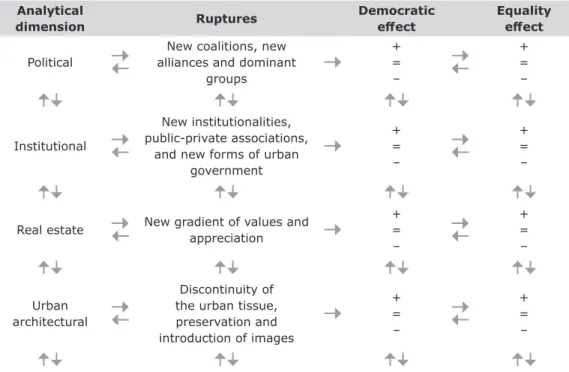
The units and their sub-units were analysed exploring the multiple dimensions which form the LUP: political; symbolic; urban-architectural; economic; institutional and social and environmental, following Vainer’s (2012) recommendations summarised in Figure 1. The political dimension deals with the context in which the project arises; the symbolic with the project justiication and the relation with the urban entrepreneurial strategies proposed by Harvey (2006); the urban-architectural with the design adopted as a reference and the projects’ relation with city planning; the economic with the investments needed and the funds origins; the institutional with new legal and institutional arrangements; and the socio-environmental with the participation and/or exclusion of the population and with possible socio-environmental impacts.
Figure 1 – Analytical matrix of evaluation proposed by Vainer (2012)
Analytical
dimension Ruptures
Democratic
efect
Equality
efect
Political
New coalitions, new alliances and dominant
groups
+ = –
+ = –
Institutional
New institutionalities, public-private associations,
and new forms of urban government
+ = –
+ = –
Real estate New gradient of values and appreciation
+ = –
+ = –
Urban architectural
Discontinuity of the urban tissue, preservation and introduction of images
+ = –
Analytical
dimension Ruptures
Democratic
efect
Equality
efect
Symbolic
New representations of values, identities and
diversities
+ = –
+ = –
Financial-economic
appropriation and distribution of costs and
beneits
+ = –
+ = –
Socio-environmental
social appropriation of urban and environmental
costs and beneits,
employment and income
+ = –
+ = –
Scale local, national and international relations
+ = –
+ = –
Source: Vainer (2012, p. 200).
As all of the dimensions comprise the same process, they are clearly related. Therefore, the analysis cannot be carried out in isolation and its combinations are made in accordance to the facts related to each unit. It is important to note that the aim is not to consider each dimension separately but to be guided by them, in order to understand the phenomenon. However, not all of the dimensions put forward were dealt with, as the focus was on the process itself and not on the impacts. Thus, the dimensions considered in the analysis were: political; institutional; urban-architectural; symbolic; inancial and economic; and socio-environmental.
Urban entrepreneurialism
The ield of public administration has been invaded by managerialism3 in
the context of the capitalist crisis during the 1970s. A marker was the Reinventing Government movement in the United States, whose key authors are Osborne and Gaebler (1993)4. To them, the bureaucratic model was suitable in periods of intense
crisis (the Great Depression and the Inter-War period) in which the North Americans’ interests converged on the same objective and mass culture did not exist. However, this setting changed and the public institutions needed lexible and adaptable practices, no longer responsible for serving citizens but for building environments in which they could create conditions for themselves.
Given the relevance of the Reinventing Government movement to understand urban entrepreneurialism processes as deined by Harvey (1989; 2006; 2012), its main characteristics should be summarised (Table 1).
3 To Murphy (2008, p. 154), managerialism deconstructs “issues of social life and organisations into a series of discreet problems that can be resolved through the application of technical expertise”. To Parker (2002), managerialism is the generalised ideology of management that, in turn, has multiple meanings. This concept could be related to a group of executives; a process or a management act, or an academic subject related to management and administration.
4 The dissemination and speciic diferences with the post-bureaucratic movement, with the New Pu
Table 1 – Principles of Reinventing Government, according to Osborne and Gaebler (1993)
Catalytic government
Steering rather than rowing – conducting and orientating, instead of providing services, privatisation, outsourcing and public-private partnerships (PPPs).
Community owned government
Empowering the citizens rather than serving – training and encouraging communities to take control of services, providing resources and technical assistance.
Competitive government
Injecting competition in services delivery – encouraging innovation and quality and strengthening organisations.
Mission-driven government
Transforming rule-driven organisations – making regulations lexible and
taking the mission and strategic planning as a reference, as carried out in private enterprises.
Results-oriented government
Funding outcomes, not inputs – replacing reward parameters, focusing on the control of results, not resources.
Customer-driven government
Meeting the needs of the customer, not bureaucracy – based on techniques of Total Quality Management (TQM), emphasising customer relation techniques.
Enterprising government
Earning rather than expending – creating means to make proit, charge taxes for services provision and investing in inancial return.
Anticipatory government
Prevention rather than cure – anticipating problems through managerial tools, such as budgetary control and strategic planning.
Decentralised government
From hierarchy to participation and teamwork – sharing decisions with customers, NGOs and communities, TQM and decentralising.
Market-oriented government
Leveraging change through the market – cities are vast and complex clusters of people in which each individual adjusts to the other’s behaviour, based on incentives and information and, therefore, should be structured as markets.
The idea of entrepreneurialism used by Osborne and Gaebler (1993) is in agreement with Schumpeter (2003), for whom the entrepreneur’s role is to revolutionise production standards, creating new means, materials or products.
Harvey (2011), also in dialogue with Schumpeter’s (2003) proposals, but in another direction, relates entrepreneurialism with modernity and its urban expression. Mentioning creative destruction as one of the characteristics of innovative entrepreneurialism in the modernist project, he shows the entrepreneur’s importance: “considered a heroic igure, he was the creative destroyer par excelence because he was prepared to take the consequences of technical and social innovation to vital extremes. And it was only through this creative heroism that human progress could be guaranteed” (HARVEY, 2011, p. 26).
The fascination for innovation, embellishment and modernisation is part of the logic of the production of cities and circulation of capital until today. However, this fascination reaches a new level when the competitive logic between cities is introduced. It is noted that a transition from the Fordist system to advanced capitalism, with its economy based on loating capital and third sector activities, transformed the cities’ role: no longer as a support for developing productive activities but as raw material to accumulate capital (HARVEY, 2006). In the same direction, Logan and Molotch (1993) consider that the space is a growth machine capable of increasing aggregate rent and ensuring wealth for the elites who use the growth consensus to eliminate any alternative. Therefore, the city must be prepared to become a favourable place for capital accumulation. As part of this context, marketing gurus have created the marketing of localities5.
Kotler, Haider and Rein (1994, p. 85) explain that urban marketing has abandoned the function of attracting industry since the 1990s, to focus on creating products and adhering to the competitive logic between cities. The authors present a set of tools to sell a place: business planning and four intervention strategies in the urban space to prepare “the setting for eforts that are generally riskier and more opportunistic, to compete for economic advantages” (KOTLER; HAIDER; REIN, 1994, p. 107). These four strategies are: urban design; improved infrastructure; basic services, such as safety and education; and speciic attractions (location, history, consumption, culture, sports, and events). These strategies may or may not be related to planning; if they are not, they will be riskier and more opportunistic.
The entrepreneurial government (OSBORNE and GAEBLER, 1993), urban marketing (KOTLER, HAIDER and REIN, 1994), and the city as a growth machine (LOGAN and MOLOTCH, 1993) are central approaches for Harvey’s (2006) formulation on urban entrepreneurialism, which has Public Private Partnerships (PPPs) as one of its basic elements. This is where the local government joins together with private enterprises, with the aim of generating investment for construction projects or even to maintain existing structures. Harvey (2006, p. 171) stresses that PPPs are “subject to all of the obstacles and risks associated to speculative development, as opposed to rationally planned and coordinated development”. It is also a common practice that risks are incurred by the public sector and proits are for the private sector. To Harvey (2006), entrepreneurialism focuses more on the political economy of the place than on the territory, stating that the construction of a place can generate impacts beyond its speciic territory and change the city’s image worldwide. The author systematised four basic strategies related to urban entrepreneurialism (Table 2), emphasising that they are justiied in isolation, but it is their combination which provides rapid and unequal changes in the urban system.
Table 2 – Summary of urban entrepreneurial strategies according to Harvey (2006)
Creating environments to exploit particular advantages for the production of goods and services
When they do not derive from resource base or location, they are created through public and private investments in physical and social infrastructures. For this, coalitions between the three levels of
government encourage private investments ofering packages of aids
and assistance, as well as investing in education and technology, and training the labour force with public funds.
Spatial division of consumption
Attracting consumption by the construction of sports stadia, shopping and convention centres, etc., and/or encouraging entertainment and cultural activities6.
Control and command functions
Heavy investments in transportation (such as airports) and communications technology are required. The provision of
infrastructure that make the speed and quality of internal and external connections viable is fundamental for inter-urban competition. Redistribution of
surpluses
Competitive edge with respect to redistribution of surpluses through central governments is still very important.
Harvey (2006) also shows concern with the rapid changes in urban space generated by innovative and competitive responses of the ruling class, resulting in a series of uncertainties and, as a consequence, instabilities in the urban system. These instabilities can be expressed in various ways, including the growth of social inequality and urban impoverishment.
6 In another formulation, Harvey (2011) explains the investments in this type of project as a search for
symbolic wealth, such as the gentriication of speciic areas, the restoration of urban landscapes and
recovering history using images. Thus, the fetishisation of the urban space takes place, emphasising exchange-value, instead of use-value. When the state acts as a partner in the promotion of fetishi-sation, through the privatisation of spaces, favourable constructive parameters and tax exemptions, among others, it promotes accumulation by dispossession. In other words, it actively takes part in resolving the problem of over-accumulation in processes that include the exploitation of depreciated
land, expulsion of the poorest sectors of society, gentriication and speculation in the inancial and real
The urban entrepreneurialism criticised by Harvey (2006) relates to Osborne and Gaebler’s (1993) prescriptions for entrepreneurial government. In addition, it also relates to the marketing of places. It is important to note that at no time does Harvey (2006) refer to the use of tools such as strategic planning but only to strategies that, without being part of a planning system, are riskier and more opportunistic (in Kotler, Haider and Rein’s (1994) terms). The strategy of urban marketing is connected to the turn to post-modernist styles of architecture and urban design, mentioned by Harvey (2006) when he refers to the spatial division of consumption. He also makes reference to the the improvement of infrastructure and basic services, such as safety, needed for the strategy of obtaining control activities; and to attractions, such as exploiting speciic advantages to produce goods and services.
At this point, it is necessary to clarify the speciic Brazilian context regarding the translation to Portuguese of Harvey’s From managerialism to entrepreneuralism: the transformation in urban governance in the late capitalism (Geograiska Annaler - 1989). In the irst translation, the idea of entrepreneurialism was confused with the idea of entreprisation7 (empresariamento, in Portuguese). Many Brazilian authors adopted
this translation as a reference, such as Vainer (2000b) and Compans (2004), already mentioned. Vainer (2000b) was key in popularising this confusion among Brazilian researchers. However, in 2005 it was released the book “A produção capitalista do espaço”, including a chapter with a new translation of the same text. This time, the idea of entrepreneurialism was included8. The use of the term ‘entreprisation’ instead
of ‘entrepreneurialism’ is relevant because it involves a conceptual diference. The term ‘urban entreprisation’ can lead to contradictory conclusions, such as treating the city as an enterprise. The problem with this idea is clearly stated by Harvey (2006, p. 167): “It makes it seem as if ‘cities’ can be active agents when they are mere things. Urbanisation should, rather, be regarded as a spatially grounded social process in which a wide range of diferent actors with quite diferent objectives and agendas interact through a particular coniguration of interlocking spatial practices”. Additionally, the deinition of urban entrepreneurialism goes beyond the use of business management technologies. What deines it is the organisation of coalitions that use the place to produce new spaces of accumulation.
Urban planning practices
To Souza (2010, p. 46), “planning always refers to the future”; it means “trying to foresee the evolution of a phenomenon” or “trying to simulate the developments of a process, with the aim of gaining better protection against probable problems or, to the contrary, with the aim of making the most of probable beneits”.
In Brazil, with the end of the dictatorship, the theme of popular participation gained strength and advocacy planning movements appeared, including the National Movement for Urban Reform. As a result, the 1988 Constitution deined the Master Plan as the basic instrument for policies of urban development and expansion. With this, as Ferreira (2010, p. 190) points out, “the municipal governments gained unprecedented autonomy to conduct urban policies”. In this new context, some developed progressive policies such as the Participative Budget (Orçamento Participativo - OP) but, simultaneously, implemented market-led policies. Some adopted urban planning practices related to strategic business planning; others followed the propositions of urban reform, seeking quality of life for the population and arranging legal instruments
7 The word ‘entreprisation’ has been used to refer to a process in which the enterprise is taken as a model for organising all human activities. It comes from the French and the main author of reference is Andreu Solé (see http://www.hec.fr/Faculte-Recherche/Membres-de-la-faculte/SOLE-Andreu). It
should be diferentiated from entrepreneurship or entrepreneurialism.
to do this. Ferreira (2010) analysis these contradictions and recognises that it is easy to understand that LUPs and PPPs appeared in that setting as a type of salvation for those who opposed urban reform and democratic urban instruments. The opportunity to implement great modernising projects also opened up a perspective for political-electoral success, in addition to favouring the real estate sector, traditionally involved in inancing electoral campaigns. Therefore, Ferreira (2010) identiies the phenomenon of “urbanism in reverse”, inspired by the idea of “hegemony in reverse” proposed by Oliveira (2010, p. 27). Urbanism in reverse expresses the ambiguity of government positions, said to be popular and democratic but adopting “market-led planning” (Table 3). In this, the regulatory role of “trying to domesticate or discipline capital” is substituted to the contrary, to the better adjustment to its interests, including immediate ones.
Table 3 – Sub-types of market-led planning, according to Brindley, Rydin and Stoker (2004)
Trend planning - lexibilisation
Although it is based on regulations, it should respond to private interests and land use policies, responding to market trends and forces.
Leverage planning – lexibilisation
and entrepreneuralism
The public sector should encourage weakened markets through, tax reductions, land donations and selling land under the market value, etc.
Private management planning The public sector transfers the management of urban
renewal processes to speciic areas of the private sector.
Another relevant concept comes from the French school of urban project or project planning (l’urbanism de projet), which arise from a criticism of regulatory planning. According to Avitabile (2005), project planning is associated to the notion of urban strategy and PPPs because it seeks immediate results and values the capacity to undertake them. It includes a city project (urban project) that integrates urban forms and landscaping, categories that are absent from regulatory planning. However, even if a city project exists, urban projects are for speciic areas in the expectation that its efects would expand to the territory as a whole, or to large sections of it as a minimum. This is what Ascher (1992) calls a city in pieces which is, therefore, contradictory to the idea of planning.
In this context, LUPs appear as tools for interventions which result in lexibilised planning, although it may formally co-exist with the master plan or master plans. Vainer (2012) conirms that LUPs cause ruptures in the city understood as a multiple social space.
The term LUP is used in this article, according to Lecroart and Palisse’s (2007) deinition presented in the Introduction. Therefore, the main characteristics of LUPs are: (1) procedures using management instruments and public-private partnerships; (2) being a political project, as well as a project in space and time; (3) considering the scale of social and spatial impacts, in addition to their immediate surroundings; (4) recognising the connection of multiple actors and complexity of uses. The multiple dimensions (presented in Figure 1) proposed by Vainer (2012) are added to these characteristics for the analysis of the case presented in the following item.
The case of Porto Alegre
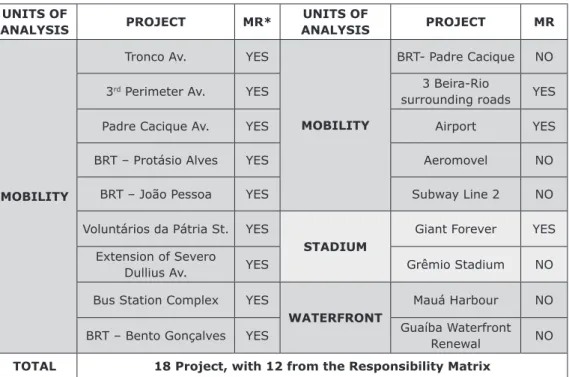
17 LUPs and a surrounding project, with 12 being part of the Responsibility Matrix (MR) and the remaining 6 because they were highlighted by leaders as being very important or even fundamental for the hosting FIFA World Cup. These projects were included into the three units of analysis mentioned above: mobility, stadiums and the waterfront (Table 4).
Table 4 – Summary of projects related to the FIFA World Cup in Porto Alegre
UNITS OF
ANALYSIS PROJECT MR*
UNITS OF
ANALYSIS PROJECT MR
MOBILITY
Tronco Av. YES
MOBILITY
BRT- Padre Cacique NO
3rd Perimeter Av. YES 3 Beira-Rio
surrounding roads YES
Padre Cacique Av. YES Airport YES
BRT – Protásio Alves YES Aeromovel NO
BRT – João Pessoa YES Subway Line 2 NO
Voluntários da Pátria St. YES
STADIUM
Giant Forever YES
Extension of Severo
Dullius Av. YES Grêmio Stadium NO
Bus Station Complex YES
WATERFRONT
Mauá Harbour NO
BRT – Bento Gonçalves YES Guaíba Waterfront
Renewal NO
TOTAL 18 Project, with 12 from the Responsibility Matrix
Source: prepared on the basis of Brazil (2010).
The recent trajectory of urban planning in Porto Alegre should be contextualised before progressing further. This city was governed for 16 consecutive years (1989-2003) by coalitions led by the Worker’s Party (PT). Olívio Dutra’s (1989-1992) period was marked by actions, such as confrontation with urban transport entrepreneurs, social housing policies that promoted the on-site urbanisation of shanty towns, and the creation of Participative Budget. He was followed by Tarso Genro’s (1993-1996) government, that started the revision of the 1st Urban Development Master Plan (1st
PDDU). The Porto Alegre Project – Constituent City was then introduced, with the aim of discussing the city’s future.
Borja’s inluence is noted in the elaboration of the 2nd Urban and Environmental
Development Master Plan (PDDUA). In the irst part, diferent strategies are described: urban structuring, environmental qualiication, economic promotion, the production of the city, and the planning system. One of these strategies is of particular interest for the aim of this paper: the production of the city. This sector comprises a framework of laws and two attachments: Social Housing Programme, in which the Special Areas of Social Interest (AEIS) and the Special Projects Programme are included. If, on one hand, a public policy for urban reform is formalised, on the other, lexibilisation towards market interests takes place. According to Article 55, Special Projects are those “which involve large areas (can cover a whole district); large projects carried out by a single company or even those in small areas which have special characteristics. This means that areas or pieces of land with problems or conlicts will be resolved through special projects, while normal situations will be analysed using general regulations” (PORTO ALEGRE, 1999). Therefore, it is observed that the 2nd PDDUA
makes the Master Plan lexible in order to avoid administrative controls that would limit opportunities for economic growth. Managerialism is also present, in the critique of the supposed inlexible public administration bureaucracy and in the adoption of practices that allow leverage planning – in Brindley, Rydin and Stoker’s (2004) terms. Perhaps this strategy is the one that best explains the practice of urbanism in reverse, in Ferreira’s (2010) terms.
From Fogaça’s government, which started in 2005, the PMPA adopted a management model based on the so-called integrative organisation of programmes, in order to gain agility. Part of this model was the transformation of the OP into Local Solidarity Governance and the support of PPPs, even if informal. To clarify, according to Lawless (1994), there are also informal PPPs – variable inancial and administrative legal arrangements between various partners which, generally, are represented by the government, economic world, local media and higher education institutions.
The modiications of the PMPA organisation can be understood as part of the set of projects related to hosting the FIFA World Cup, including the creation of new institutions. One of these was the Special Secretariat for the Cup (Secretaria Especial da Copa - SECOPA). When it was created, the Secretariat was led by the deputy mayor at the time. Fortunati was in charge until 2010, when he took oice in the City Hall; he was then elected mayor in 2012. It is important to note that before leading SECOPA, Fortunati was assigned to the Secretariat of Municipal Planning (SPM) and worked on the revision of the 2nd PDDUA, which was completed in 2009 and transformed into law
in 2010. New evaluation instruments for the Special Projects Programme, mentioned above, were incorporated in this review. After Fortunati left SECOPA in 2010, the Secretariat lost relevance, although, along with the EPTC, the Municipal Secretariat of Public Works and Highways (Secretaria Municipal de Obras e Viação - SMOV), the Municipal Health Secretariat (Secretaria Municipal de Saúde - SMS), and the Municipal Housing Department (Departamento Municipal de Habitação - DEMHAB), it formed part of the Porto Alegre 2014 Cup Programme – the institution for urban planning (SPM), however, was not included.
Therefore, it is noticed that the transformation of urban planning practices that started during the Popular Front’s second term in the 1990s, incorporated managerial practices of lexibilisation and facilitation, and opened the path to the urban entrepreneurial practices which followed. In the context, the SPM fell to the wayside. In the new organisation of PMPA, through speciic projects, other departments took on a central role. So much so that immediately after the last municipal election the organisation by projects has been consolidated, with the creation of the Projects Oice, emptying the functions of the Secretariat of Municipal Planning further and giving rise to the Secretariat of Urbanism.
logic and gradually reconigured the government structure to favour speciic initiatives of business sectors with privileged ties to key decision-making centres. Besides strategic planning following business administration models, what was constituted in Porto Alegre was the logic of a business desk, in which formal spaces for the population’s participation and for the professional practice by technicians were undermined.
In this context, the opportunity for investments and worldwide visibility, coupled with the mega-event, stimulated the use of urban marketing (KOTLER, HAIDER and REIN, 1994) and urban entrepreneurial strategies (HARVEY, 2006) in particular, which may be identiied in the following analysis of each of the three units.
A) Mobility
When Porto Alegre was conirmed as a host city, the Municipal Government had less than one year to prepare projects to be included in the MR. In an interview with an EPTC technician, it was reported that the projects were elaborated at meetings behind closed doors with top PMPA directors and some EPTC technicians. According to this report, the ten projects were created by referring back to old projects that had not been implemented, without evaluating their pertinence for contemporary Porto Alegre. In addition, no territorial impact study for any of these projects was carried out.
The discourses of the Department of Strategic Planning director and of the EPTC’s Traic Planning manager at public hearings and events on urban mobility or public works for the FIFA World Cup, corroborated with this information. They defended the projects because they were included in earlier plans that would inally be put into practice after 20, 30 or 40 years. Any study that proved the needs of these works was never presented. As Porto Alegre did not have any study which covered the diferent means of circulation and transportation in a comprehensive way, conditions for carrying out opportunistic projects that favoured individual transportation by car and the immediate interests of politicians and businessmen were created.
When presented by the municipal authorities, the BRT projects were associated to passengers’ increased comfort, thanks to a combination of various aspects. However, the majority of them will not be implemented in Porto Alegre9. The PMPA
and the State’s Metropolitan and Regional Planning Foundation (Fundação Estadual de Planejamento Metropolitano e Regional - Metroplan) work on optimising lines, so that many buses do not circulate to the city centre. As the city already has electronic ticketing, this optimisation could have been done independently of introducing the BRT system. Apart from this, the city already has bus lanes. Only 4.7km of BRT would be added to the existing system. Therefore, the main function of the BRT is to change the image of the public collective transportation system, modernising it and showing the contemporary architecture of the new bus stations and terminals, with no relevant impact on the service provision.
The remaining MR projects gave priority to cars, with the construction of overpasses and widening avenues. Some would include cycle and bus lanes, on account of Federal Government requirements, which did not detract from its focus on highways, as they are disconnected from these structures. On comparing the projects for all of the host cities for the 2014 FIFA World Cup in MR, it is seen that Porto Alegre was the one which invested most in individual transportation by car.
A further aspect refers to important projects to boost the city’s expansion. An emblematic one led to the eviction of 1,400 families from Grande Cruzeiro (located alongside Barra Shopping Sul and in the vicinity of the Iberê Camargo Museum, which beneited the local real estate market) and their replacement in periphery areas. Another two projects directly beneited the Grêmio and Internacional stadiums, apart from private sector investors responsible for constructing them, exempted from carrying out any mitigating work.
9 Up until the date that this article was submitted (15th June, 2015), the projects had still not been
implemented. The same is valid for the highway projects also mentioned. That is why the sentence is in the future tense. An article published on 14th June registers that only 5 mobility projects were
The Subway Line 2 project have speciic characteristics. Originally the layout was established in the Integrated Mobility Plan. In this, the project should be introduced in two phases. When the formulation of the MR was announced for the World Cup Line, the Phase 1 layout was altered to pass by the last access point for Beira-Rio during World Cup matches. In principle, the World Cup Line would be qualiied as a MR project but the Federal Government vetoed it. If the World Cup Line was approved, it would beneit Internacional, Andrade Gutierrez and Melnik Even, as well as Grêmio Empreendimentos-OAS10. With the infrastructure improvement, the price of land would
increase and the football clubs who were negotiating their land with construction companies would have their values increased, as well for the companies that were going to exploit them. In addition, it would contribute to the PMPA Innovative City Programme, which aims to promote the development “of innovation and technology, in search of new vocations to the city, boosting the economic matrix and stimulating productive sectors, taking advantage of the concentration of universities and research centres and producing new opportunities for jobs and income” (O PROGRAMA..., 2013). This programme its in with the strategy of urban entrepreneurialism deined by Harvey (2006, p. 172) and refers to the “creation and exploitation of particular advantages for the production of goods and services”. As part of the creation of this environment, in 2012 the Municipal Government presented a project to the City Council that altered the PDDUA, recording Zones of Technological Potential (Zonas de Potencial Tecnológico – REPOT) in which urban parameters were made lexible, and including beneits for real estate enterprises. When cross checking the map that deines the REPOT in the Attachment to PL 004/2012 with the World Cup Line, it is noted that the route permeates the whole area to be recorded as a REPOT.
To Harvey (2006), urban entrepreneurial strategies are also based on PPPs. This is the case for the majority of these projects, whether formal or informal (Table 5). The only exceptions are the Salgado Filho Airport and the Aeromovel. The vast majority of the PPPs are informal, with only the Subway Line 2 Project being formal. Partnerships also permeate BRTs, conceding the use of spaces in exchange for maintenance. The vast majority of informal partnerships for urban mobility projects are characterised by the Term of Technical Cooperation signed between the PMPA and the Centre for Industries in the State of Rio Grande do Sul (Centro das Indústrias do Estado do Rio Grande do Sul - CIERGS) on 26th October, 2009, three months before signing the MR.
Table 5 also shows the projects which receive public funds.
Table 5 – formal and informal PPPs related to mobility projects
Project
Participation
PPP Public Sector Private Sector
Tronco Av., 3rd Perimeter Av., Padre Cacique, Voluntários da Pátria St.,
Extension of Severo Dullius Av., Bus Station complex and 3 Beira-Rio surrounding roads
Federal Government Funds
Basic project donated by
CIERGS INF
BRT Protásio Alves, João Pessoa, Bento Gonçalves and Padre
Cacique
Federal Government Funds
Basic project donated by CIERGS and transportation enterprises
INF
Salgado Filho Airport Federal Government
Funds ––– –––
Aeromovel Federal Government
Funds ––– –––
Subway Line 2 Federal Government Funds
Enterprise that wins the
bidding FOR
Source: Prepared on the basis of Brazil (2010). Caption: INF-Informal; FOR-Formal.
It is no accident that all of the projects related to control and command activities are based on PPPs. Except for the Subway Line 2 and the Aeromovel projects, they are all on the MR and their basic and executive projects were donated by the CIERGS. According to the Term of Cooperation, it was the private initiative that approached the PMPA, ofering to become partner to “speed up the implementation of projects considered a priority and required in terms of the Municipality’s road and urban mobility system” (PORTO ALEGRE, 2009). However, this alleged agility was not achieved. The State Court of Auditors (Tribunal de Contas do Estado - TCE) analysed the MR projects until July 2013, determining that “the generalised delay in projects and public works shows failures in planning and organisation” (MOREIRA, 2013). The person responsible for preparing the contracts for CIERGS rejected TCE’s critiques, stating that the projects “were implemented with great care and within the minimum timeframe. If they were carried out with 100% precision, they would take 10 years. They are basic projects” (MOREIRA, 2013). It is important to note that the projects implemented were only those related to mobility that prioritised cars. None of the BRT system projects were completed until December 2015.
When comparing the enterprises that won biddings with those which donated inancial resources to José Fortunati’s 2010 electoral campaign, signiicant data can be found, such as the fact that one third of the enterprises that won biddings for urban mobility projects were donors, reaching a total of BRL 1,049,000.00. The construction enterprises, representing 11 companies, inanced 35% of the previous campaign, increasing to 605 in Fortunati’s campaign through 29 companies of the sector (PRESTAÇÃO ..., 2013).
The population, which receives information on projects almost exclusively through corporative media, was invited to public hearings, usually held when the projects had already been inalised and the public bidding had been carried out, generating demonstrations by groups afected and critically worried with the city’s future. The projects express the PMPA’s disregard for the environment, basic living conditions and the right to housing of low income population, as well as the practice of implementing evictions, whether to remove obstacles to business or because the poor and their ways of living should become less visible.
The non-availability of information from the PMPA, also determined by the lack of response to formal requests is convenient, so that the projects do not sufer from any interferences. Valuation of alleged technical neutrality is also noted, when some technicians (usually the same ones) say that they represent the professional team at the PMPA and that they knew more about what is best for the city, even without having carried out the studies required by legislation (such as alternative projects and impact studies). The population does not have a voice and should not give their opinion as, unlike what the PMPA conirms, the projects are not for all of Porto Alegre. The projects may even be distributed throughout the territory but always favour identiiable corporate groups. Typical entrepreneurial urban strategies (HARVEY, 2006) are put into practice. The combination of their speculative nature with the lack of urban planning instruments which opposes the privilege of speciic groups in some way, as well as lexibilising environmental impact studies and the lack of openness to the population when taking decisions, characterise the practices of levarage planning (BRINDLEY, RYDIN and STOKER, 2004).
B) Stadiums
The two clubs associated with two Brazilian multi-national engineering companies which would exploit the business for 20 years11 and beneit from National Economic
and Social Development Bank (BNDES) credit. Both negotiated land at the former stadiums as a source of funds. Olímpico and Grand Park Eucaliptos Developments are exploited by the construction companies OAS and Melnick Evens, respectively. Although the PMPA was not inancially responsible for constructing the stadiums, it had a direct participation through tax exemption, land donations, release from mitigation work and changes of urban parameters, among other measures. The laws approved in the City Council altered the urban parameters for these speciic areas, being important to note that this took place on 29th December, 2008, when Porto Alegre had not yet been
selected as a host city. Even so, the city would receive two “FIFA standard” football stadiums, when FIFA only required one. The football clubs, real estate speculators and councillors favourable to these projects knew how to take advantage of the context to approve alterations to the 2nd PDDUA. It also contributed the historic rivalry between
the two teams’ supporters, since both needed to be approved so as not to dissatisfy any of them. As a result, the movements that criticised their adverse impacts were silenced by a massive support from the population and corporative media. The forces and actors involved articulated what Logan and Molottch (1993) deine as a coalition to grow, with the elites and media pressuring for their interests and taking advantage of those passionate about football.
The leverage planning practices in the case of the Grêmio Arena included increases in building density, construction of road infrastructure by the public authorities and lexibilisation of environmental parameters. As a consequence, the State Public Prosecution Service recommended the suspension of the surrounding work carried out by the PMPA due to problems with the Environmental Impact Study and Report. This process is still in dispute. In addition, there is an investigation by the Prosecutors Oice related to acts of improper conduct by the public government for unjustiied exemption of OAS’s obligations that were part of the agreement to obtain the environmental permit. As a consequence of this exemption, public works in the surrounding area had been inanced by public funds (RECOMENDAÇÃO…, 2013).
The Beira-Rio Complex is located in a strategic position: alongside the Guaíba waterfront and close to the city centre, and has associated ventures, such as the events centre and hotels. Urban parameters alterations were approved for the Giant Forever area: permission to construct higher buildings (from 18 to 33 metres) and higher construction rates (1.3 to 1.9); the section of Permanent Protection Area which was at least 500m from the watercourses was reduced to 255. In other words, leverage planning is found to be exercised, with the public authorities actively taking part in resolving the problem of over-accumulation by urban renewal processes, which includes the exploitation of depreciated land, expulsion of the poorest sectors of the population and lack of consideration for environmental aspects.
C) Waterfront
The Mauá Harbour and the Guaíba Waterfront LUPs12 are also related to old
projects that went through several municipal and state administrations.
Legislation was altered in order to make the Mauá Harbour project viable, authorising new land uses and granting attractive urban parameters. The bidding process resulted in the company Consórcio Cais Mauá (led by the Spanish group responsible for Port Vell in Barcelona and including the Brazilian architect Jaime Lerner’s oice) winning the contract and gaining the right to exploit the area for
11 The new Grêmio administration has been trying to make an agreement for several months so that OAS sells the stadium to the club (for example, see: http://www.correiodopovo.com.br/Espor-tes/545630/Sinais-de-nova-negociacao-entre-OAS-e-Gremio).
12 This work has not yet started although the space of the Mauá Harbour has been closed of to the
25 years. The main organiser was the state government and the PMPA’s role was to legalise the new business in the PDDUA, making it attractive to the market. The PMPA was then responsible for approving the Urban Viability Study, among other licenses required. The PMPA’s administration was reorganised to guarantee agility and lexibility in the approvals processes, with the creation of the Development and Special Matters Oice (Gabinete de Desenvolvimento e Assuntos Especiais - Gades), directly subordinated to the Mayor’s oice. According to Article 5 of the Law, “the basic purpose of Gades is to raise external resources to expand the Municipality of Porto Alegre’s investment capacity, through liaison and promotion of PPPs, thereby making the execution of special projects viable” (PORTO ALEGRE, 2012, p. 2). Gades became the sector responsible for special projects, such as Mauá Harbour and Guaíba Waterfront Renewal.
The Mauá Harbour LUP is a major intervention that does not consider impacts on the territory. In addition, the PPP that will exploit the location is directed towards elitist activities, such as a shopping centre, Hyundai concessionaire and a micro-brewery. The RBS Group once again acted intensively. In a special report, it stated that the Mauá Harbour “[...] will be the stage for a kind of re-birth of the metropolis”, adding: “at mid-day, Governor Tarso Genro will transfer the ownership of more than 180,000 square metres of Mauá Harbour to private initiative, and the dream that it truly becomes a public place will start to turn into reality” (MELO, 2011). An inversion of terms and a mystifying rhetoric is observed. The place, which until that time housed various ephemeral, open activities, as well as permanent activities, such as a public marina, will become “a truly public place” when it is handed over to the private sector. With regards to the impacts on the city’s central region, apart from increasing the low of cars, the phenomenon of gentriication may also take place.
The intervention on the Guaíba Waterfront is also an old idea: the irst renewal project is from 1986 and it was recorded in the 2nd PDDUA as a Revitalisation Area.
When Fortunati was Secretary of Planning, he looked for entrepreneurs for a PPP, announcing a landscape design competition, which never took place. In December 2011, the PMPA hired the well-known architect, Jaime Lerner, and the project was then led by Gades.
The Rio Grande do Sul’s section of the Brazilian Institute of Architects (Instituto de Arquitetos do Brasil - IAB) asked twice the PMPA to hold a public hearing, so that the architect Lerner could explain the project. Faced with two refusals, it called for a public hearing via social networks, which was inally held in the City Council on 14th October, 2013. Lerner and his team presented 3Ds dated April 2012; they
explained very little or almost nothing about the project. Delegates and consultants from the Planning Region 1 and IAB, from the Gaúcha Association of Environmental Protection, and some local councillors expressed their discontent that can be summarised in the following aspects: the hiring of Jaime Lerner for BRL 2.15 million without holding a public bidding; the exclusion of SPM technicians and the population in general; the absence of environmental impact studies. In the following day, the Mayor declared that the municipal government would no longer take part in public hearings at the Council, justifying that the critiques were unacceptable because “Jaime Lerner is one of the most respected city planners in the world, receiving red carpet treatment everywhere” and in criticising him, the public had disrespected the mayor’s administration (ROCHA, 2013). However, it is necessary to clarify that this hearing was the calmest of all of those witnessed during this study, with specialised and technically accurate arguments. Furthermore, hiring Lerner is related to what Harvey (2011) calls urban spectacle, referring to the fetishisation of space via the designs of well-known architects.
entrepreneurialism strategy related to the competition for central government surpluses and both it into the entrepreneurialism strategy related to the spatial division of consumption (HARVEY, 2006).
Lastly, the two cases, and the Waterfront in particular, exemplify that amid market-led planning practices, the public workers directly involved with urban planning had been displaced from the process, together with the population in general.
Conclusions
A summary of the projects which are associated to at least one of the entrepreneurial urban strategies proposed by Harvey (2006) are found in Table 6.
Table 6 – Urban entrepreneurial practices in each of the projects
Unit of Analysis Project EEU1 EEU2 EEU3 PPP
Mobility
Tronco Av. 3rd Perimeter Av. Padre Cacique Av. BRT – Protásio Alves BRT – João Pessoa
Voluntários da Pátria St.
Extension of Severo Dullius St. Bus station complex
BRT – Bento Gonçalves BRT- Padre Cacique
Beira-Rio surroundings roads Salgado Filho airport
Aeromovel Subway Line 2
Stadium International Stadium Grêmio Arena
Waterfront Mauá Harbour
Guaíba Waterfront Renewal
Caption: EEU1 = Urban Entrepreneurial Strategy related to spatial division of consumption. EEU2 = Urban Entrepreneurial Strategy related to obtaining control and command activities. EEU3 = Urban Entrepreneurial Strategy related to the redistribution of government surpluses. PPP = Public-Private Partnership.
the Guaíba Waterfront, one of the main popular leisure areas in the city, escaped and will have a six lane freeway and a cable-stayed overpass.
The increase in social inequality is clear when the cases of Vila Grande Cruzeiro and Dique are taken into account, being directly afected by the mobility projects. Families were evicted, as in the case of the residents of Grande Cruzeiro, without any guarantees of when they will receive a new house or even if they will receive one at all. Although the PMPA airms that there is a housing policy for this situation, this policy is similar to early 19th century hygiene policies, which had, among others, the aim of removing the
poor from the urban centres and from the sights of the more privileged segments of the population, among others. Currently, the eviction of the poor has a direct relation with real estate market speculation, which is expanding to the south zone of the city, speciically in the case of Grande Cruzeiro. It is important to note that this is not the irst episode of this type in the region in recent years. First of all, the inhabitants of Vila Foz, next to the Barra Shopping Sul, were removed to Vila Nova in a compensation agreed with the company Multiplan. Next, there was an attempt thwarted by a popular struggle to construct a luxury housing development at Morro Santa Teresa. Therefore, it is seen that this clean-up is necessary, not to improve the afected families’ living conditions but to make viable the accumulation of capital by major companies.
Practices such as these indicate the practice of trend planning (BRINDLEY, RYDIN and STOKER, 2004) directed towards private interests with the consequent processes of accumulation through dispossession (HARVEY, 2012a), creating new spaces for interventions by construction companies once freed of the informal city. In fact, planning practices that merely follow and reinforce market trends are in contradiction with the reason for planning to exist. In other words, if the planning practices - understood as an instrument for designing desired futures – are following trends and being subordinated to the interests of social actors with the capacity to deine these trends, they become one more space for private interaction and communication (between public agents and selected partners) and abandon their reason of being.
Another example of leverage planning is public investment in public works, such as in Farrapos, Padre Cacique, and Edvaldo Pereira Paiva Avenues, and in the area surrounding the Beira-Rio Stadium and Grêmio Arena where the clubs and companies were exempted from the responsibility for the construction of mitigation projects.
The analysis of the Stadium and Waterfront units also demonstrates leverage planning and urban entrepreneurial strategy associated to the spatial division of consumption. These LUPs will have adverse efects on the territory as a whole. In the case of the Grêmio stadium, although the government has not transferred the management of urban renewal processes of speciic areas to the private sector, the Grêmio Arena LUP was conceived entirely by this sector. Its efects on the territory are already being felt and mitigated by the public sector. Private management planning (BRINDLEY, RYDIN and STOKER, 2004) is fully applied for Mauá Harbour. Although the project has been driven by the public sector, the business model and exploitation of the area (construction and management for the next 25 years) are under the responsibility of the private sector.
To conclude, it can be conirmed that considering Vainer’s (2012) dimensions, presented in Figure 1, negative impacts both on the democratic and equality efect are clear.
References
ASCHER, F. Projet publics et réalisations privées: Le renouveau de la Planiication des villes. Les Annales de la Recherche Urbaine, n. 51, pp. 4-15, 1992.
AVITABLE, A. La mise en scène du projet urbain: pour une structuration des démarches. Paris: L’Harmattan, 2005.
BRASIL. Ministério dos Esportes. Matriz de Responsabilidade Rio Grande do Sul. Brasília 2010. Available at: http://www.esporte.gov.br/futebolDireitosTorcedor/ copa2014/compromissosCopa2014.jsp. Last access on 15th May, 2013.
BORJA, J. Participação Popular e Planejamento Participativo: a experiência de Barcelona. In: As ideias que vão mudar a cidade nos próximos anos. Porto Alegre: Publicação da Prefeitura Municipal de Porto Alegre – Administração Popular, 1993. BRINDLEY, T; RYDIN, Y; STOKER, G. Remaking planning: the politics of urban change. Nova York: Routledge, 2004.
COMPANS, R. Empreendedorismo urbano: entre o discurso e a prática. São Paulo: Editora UNESP, 2005.
FERNANDES, A.; GOMES, M. A. A de F. Operação Pelourinho: O que há de novo além das cores? In: ZANCHETTI, Sílvio (Coord.); MARINHO, Geraldo; MILET, Vera (Orgs.). Estratégias de Intervenção em Áreas Históricas. Recife: MDU/UFPE, 1995. pp. 46-52.
FERNANDES, A. S. A. Empresarialismo urbano e qualidade de vida: mudanças estruturais na gestão em Salvador? Revista de Administração Pública, v. 31, n. 3, pp. 89-102, 1997.
FERREIRA, J. S. W. Cidades para poucos ou para todos? Impasses da
democratização das cidades no Brasil e os riscos de um “urbanismo às avessas”. In: OLIVEIRA, F; BRAGA. R; RIZEK, C. (Orgs.). Hegemonia às avessas. São Paulo: Boitempo, 2010. pp. 185-213.
FISCHER, T. et al. Centro histórico de Salvador: a gestão de parceria em novos tempos e novos espaços. In: Fischer. T. (Org.). Gestão contemporânea de cidades estratégicas. Rio de Janeiro: FGV, 1995. pp. 165-82.
FRIEDMANN, J. The World City Hypothesis. Development and Change, 1986. In: BRENNER, N.; KEIL, R. (Eds.). The Global Cities Reader. Abingdon: Routledge, 2010. pp. 67-71.
GONDIM, Linda M. P. O Dragão do Mar e a Fortaleza Pós-Moderna: cultura, patrimônio e imagem da cidade. São Paulo: Annablume, 2007.
GUANAIS, F. C.; FISCHER, T. Entre Planos, Projetos e Estratégias: o caso Rio sempre Rio. Organização & Sociedade, v.6, n. 14, pp. 39-63, 1999.
HARVEY, D. From Managerialism to Entrepreneurialism: The Transformation in Urban Governance in Late Capitalism. Human Geography, v. 71, n.1, pp. 3-17, 1989.
______. Do gerencialismo ao empresariamento: a transformação da administração urbana no capitalismo tardio. Espaço e Debates, ano XVI, n.39, 1996 pp. 48-64. ______. A produção capitalista do espaço. São Paulo: Annablume Editora, 2006. ______. A brief history of Neoliberalism. Oxford: Oxford University Press, 2007. ______. Condição Pós-Moderna: uma pesquisa sobre as origens da mudança cultural. São Paulo: Edições Loyola, 2011.
______. Rebel Cities: from the right to the city to the urban revolution. New York: Verso, 2012b.
KOTLER, P; HAIDER, D; H; REIN, I. Marketing Público: Como atrair investimentos, empresas e turismo para as cidades, regiões, estados e países. São Paulo: Makron Books, 1994.
LAWLESS, P. Partenariats public-privé au Rouyaume-Uni : analyse et critique. In : HEINZ, W (Org). Patenariats Public-Privé dans L’aménagement urbain. Paris: Editions L’Harmattan, 1994. pp. 131-134.
LECROART, P; PALISSE, J.P. Grands Projets Urbains em Europe: quels
enseignements pour l’île-de-France. In: Les Cahiers de l’institut d’aménagement et d’urbanisme de la region d’ile-de-france. Paris: Point 44, 2007. pp. 5-27.
LOGAN, J. R; MOLOTCH, H. L. The City as a Growth Machine. In: FAINSTEIN, S. S; CAMPBELL, S. Readings in Urban Theory. Oxford: Blackwells, 1993.
MAPA estratégico. Gabinete de Planejamento Estratégico, Portal PMPA, Porto Alegre, 06 Oct, 2011. Available at: http://www2.portoalegre.rs.gov.br/gpe/default.php?p_ secao=21. Last access on 16th July, 2013.
MATRIZ de Responsabilidade. Ministério dos Esportes, Governo Federal, Brasília, 2013 Available at: http://www.esporte.gov.br/futebolDireitosTorcedor/copa2014/ compromissosCopa2014.jsp. Last acess on 15th July, 2013.
MELO, I. Pontapé inicial: Novo cais até a Copa. Zero Hora, Porto Alegre, 23 Nov. 2011, pp. 4-5.
MOREIRA, P. Cinco das obras de mobilidade previstas para a Copa de 2014 na Capital podem icar para 2015. Zero Hora, Porto Alegre, RS, 30 set. 2013c. Available at: http://zerohora.clicrbs.com.br/rs/geral/noticia/2013/09/cinco-das- obras-de-mobilidade-previstas-para-a-copa-de-2014-na-capital-podem-icar-para-2015-4285415.html#cxrecs_s. Last access on 30th Sept, 2013.
MOURA, S. A construção de redes públicas na gestão local: algumas tendências recentes. Revista de Administração Contemporânea, v.2, n. 1, pp. 67-85, Jan/Apr. 1998.
MURICY, I. T. O Éden terrestre: o consumo da cidade como mito. Bahia Análise & Dados, v. 11, n. 2, pp. 180-193, 2001.
MURPHY, J. The World Bank and global managerialism. Londres: Routledge, 2008. NOVAIS, P. Uma estratégia chamada planejamento estratégico: Deslocamentos espaciais e a atribuição de sentidos na teoria do planejamento urbano. Rio de Janeiro: 7Letras, 2010.
OLIVEIRA, C. Hegemonia às avessas. In: Hegemonia às avessas. OLIVEIRA, F; BRAGA. R; RIZEK, C. (orgs.). São Paulo: Boitempo, 2010, pp. 21-27.
O PROGRAMA. Planejamento Estratégico e Orçamento, Portal PMPA, Porto Alegre, 2013. Available at: http://www2.portoalegre.rs.gov.br/smpeo/default.php?p_ secao=98. Last access on 23rd July, 2013.
OSBORNE, D; GAEBLER, T. Reinventing Government: How the entrepreneurial spirit is transforming the public sector. New York: Plume, 1993.
PARKER, M. Against management: organization in the age of managerialism. Oxford: Polity Press, 2002.
PORTO ALEGRE. City Council. Complementary Law N.º 434, of 1st December, 1999.