Introduction
Exclusion performance may be considered an emergent repertoire in which an individual chooses an undeined comparison stimulus upon an undeined sample (Dixon, 1977). In this case, the individual faces a situation in which only part of the functions exerted by the stimuli have been previously established, but the individual is capable of properly responding to it by excluding the familiar alternatives. For example, in a conditional discrimination task, some stimuli serve as samples, and others serve as comparisons. The latter are conditionally chosen based on the sample. An individual may be trained to choose the comparison stimulus A2 when A1 serves as the sample and choose B2 when B1 is the sample. If a completely novel stimulus, C1, is presented as the sample, and the comparison stimuli are familiar stimuli (e.g., A2 and/or B2) and one novel
Isabela Zaine and Camila Domeniconi, Instituto Nacional de Ciência e Tecnologia sobre Comportamento, Cognição e Ensino and Department of Psychology, Universidade Federal de São Carlos. Aline Roberta Aceituno Costa, Department of de Phonoaudiology, Universidade de São Paulo. Correspondence regarding this article should be directed to: Isabela Zaine, Programa de Pós-Graduação em Psicologia, Universidade Federal de São Carlos, Caixa Postal 676, São Carlos, SP, 13565-905, Brasil. E-mail: [email protected].
Exclusion performance in visual simple discrimination in
dogs (
Canis familiaris
)
Isabela Zaine
1,
Camila Domeniconi
1, and Aline R. A. Costa
21. Universidade Federal de São Carlos and Instituto Nacional de Ciência e Tecnologia sobre Comportamento, Cognição e Ensino, São Carlos, SP, Brazil
2. Universidade de São Paulo, Bauru, SP, Brazil
Abstract
Choices based on exclusion have been investigated in different species because of its emergent nature, leading to evidence of rudimentary symbolic behavior in non-verbal organisms. Simple discrimination procedures provide a simple method to investigate exclusion performance, in which each trial consists of the simultaneous presentation of two stimuli, one with a positive function (S+) and one with a negative function (S-). In exclusion probe trials, an undefined stimulus (UnS) is presented with a familiar S-, and choices based on exclusion may lead to choosing the UnS, excluding the previously known S-. Novelty control
trials (S+/UnS) are also conducted to assess the possible preference for the UnS. In this case, if performance is not controlled
by novelty, then the subjects must choose the S+ and not the UnS. The present study investigated exclusion performance in
visual simple simultaneous discrimination tasks in eight dogs. The results indicated that seven of eight dogs showed evidence of exclusion performance (p < .05). These findings corroborate the literature that shows that dogs are capable of responding by exclusion, suggesting that potentially symbolic behavior may rely on basic behavioral learning and conditioning principles.
Keywords: exclusion performance, simple discrimination, dogs.
Received 15 May 2013; received in revised form 14 February 2014; accepted 15 February 2014. Available online 27 June 2014.
stimulus, C2, then the individual is capable of correctly choosing the novel stimuli without being directly trained to do so by excluding the familiar options. Studies with humans have shown that participants tend to choose the undeined comparison stimulus, thus responding away from or excluding the stimuli whose functions have already been established (c.f., Dixon, 1977; Dixon & Dixon, 1978; Ferrari, de Rose, & McIlvane, 1993; McIlvane, Kledaras, Lowry, & Stoddard, 1992). Responding by exclusion has been suggested to be one of the ways children are able to rapidly acquire and expand their verbal repertoire (c.f., Domeniconi, Costa, de Souza, & de Rose, 2007) by learning new relations between novel stimuli. Procedures that involve responding by exclusion may lead to performance with no errors or fewer errors compared with procedures based solely on trial and error (c.f., Ferrari et al., 1993; de Rose, de Souza, & Hanna, 1996; de Rose, de Souza, Rossito, & de Rose, 1992).
as food, water, and shelter (Udell & Wynne, 2008). Procedures that involve exclusion performance in teaching auditory-visual arbitrary relations in dogs have presented consistent results, supporting the utility of exclusion trials for training different types of training procedures (c.f., Erdöhegyl, Topál, Virányl, & Miklósi, 2007; Kaminski, Call, & Fischer, 2004; Pilley & Reid, 2011).
Kaminski et al. (2004), for example, investigated exclusion performance in an object retrieval task in a border collie. The objects were seven familiar items and one completely new object. The dog’s task consisted of going into an experimental room and retrieving the object that corresponded to the name spoken by the experimenter. In the irst trial, the dog was always requested to retrieve a familiar object. In the second and third trials, the experimenter requested the new object. The dog could emit the correct response by excluding the familiar objects and choosing the only unfamiliar one. In seven of 10 sessions, the dog correctly selected the unfamiliar item. The authors argued that, in addition to choosing based on exclusion, the dog was apparently able to relate the unfamiliar word and object without explicit training, showing learning by exclusion of new auditory-visual relations.
Pilley and Reid (2011) also conducted experiments with a border collie, investigating learning relations between novel objects and novel oral labels by exclusion. The authors reported that after 3 years of intensive training, the dog learned to relate 1,022 words to their corresponding objects. However, some studies with humans have indicated that responses in exclusion tests may remain under control of novelty itself (McIlvane, Wilkinson, & de Souza, 2000) and that dogs appear to present a natural preference for novel stimuli (Kaulfuß & Mills, 2008). To evaluate the effects of novelty on the subject’s choices, the authors performed a test to calculate the dog’s probability of responding to unfamiliar stimuli only because they were new. In this test, unfamiliar and familiar objects were available for retrieval, and the experimenter requested only the familiar ones. In the presence of a familiar spoken word, the dog never selected any of the new objects and always accurately retrieved the familiar objects that corresponded to the verbal request, discarding the possibility of control by novelty. The authors of this study also investigated whether the dog in fact demonstrates learning new relations by exclusion without additional training. They repeated the exclusion tests after 10 min and 24 h. After 10 min, the dog was able to correctly retrieve ive of eight unfamiliar objects, but it retrieved only one object after 24 h. Unlike Kaminsky et al. (2004), who claimed that their subject learned new relations between spoken words and objects by exclusion, these results suggested that choices based on exclusion may be a strategy used to properly respond to certain stimuli, but additional training may be necessary to actually learn and maintain new relations.
The aforementioned studies involved conditional discrimination tasks, but investigating exclusion performance is also possible in less complex tasks, such as simple discrimination. In this case, an individual is trained to differentially respond to stimuli presented in pairs (A1/A2, B1/B2, C1/C2, and so on), in which choosing the stimuli from one set (e.g., set 1) leads to reinforcing consequences, whereas choosing stimuli from another set (e.g., set 2) produces no consequences. The participants learn to choose the stimuli from set 1 and not to choose stimuli from set 2, possibly grouping the stimuli in two different functional classes, one composed of the positive stimuli (S+) and the other
composed of the negative stimuli (S-). Exclusion tests
may be conducted by having the participants make a choice between a familiar S- and an unfamiliar UnS.
The subject may be able to correctly respond to the UnS by excluding the S-. Aust, Range, Steurer, and
Huber (2008) investigated inferential reasoning by exclusion with pigeons, dogs, and humans using only simple discrimination trials. Simultaneous simple discrimination training between four pairs of visual stimuli was conducted using a computer touch screen. In each trial, each stimulus had either a positive (S+) or negative (S-) function. After training, the experimenters performed two different exclusion tests. In the irst test, simple discrimination involved making a choice between a familiar S- and an undeined stimulus (UnS1). In the second test, the participants should select between the previously UnS (UnS1) and a second UnS (UnS2), which was never available previously. The authors argued that responses to the UnS1 in the second test would relect authentic inferential reasoning by exclusion because the UnS1 had become a part of the positive stimuli class, together with the positive items trained during baseline, whereas responding to the UnS2 would indicate possible control by novelty. In this case, in addition to investigating responding by exclusion, the authors also investigated learning outcomes from exclusion trials, such as including the UnSs in the positive class. The results of both tests led the authors to conclude that the pigeons did not reason by exclusion performance, but half of the dogs did, and all of the adults and most of the children did.
and petting), and responses to the S- did not produce consequences. After training, two probe sessions were conducted. Probe 1 consisted of exclusion trials (i.e., trials in which the S- was presented in pairs together with three unfamiliar stimuli: S1-/UnS1, S2-/UnS2, and S3-/UnS3). Probe 2 consisted of novelty control trials, in which the S+ was presented in pairs with new unfamiliar stimuli (i.e., S1+/UnS4, S2+/UnS5, and S3+/UnS6). The probe trials were simpler than the trials conducted by Aust et al. (2008) because the authors were only interested in investigating the possibility of responding (choosing) by exclusion, despite learning outcomes. As a result, in Probe 1, the dog always chose the UnSs; however, in Probe 2, it chose the undeined items in two of three trials. This performance led to no conclusive data on exclusion performance, but the authors discussed that the lack of a speciic response to be emitted by the dog hindered the analysis, thus not permitting differentiation between mere exploratory behavior and actually making a choice. They discussed that in the Probe 2 trials, in which the recorded response was choosing the UnSs, the dog sniffed the UnSs stimuli irst and then went to the S+ and touched it with the paw. The irst response was considered the actual choice, but the authors argued that snifing the UnSs might have actually been just an exploratory response. To reach more deinitive conclusions about exclusion performance in dogs, the present study sought to replicate the procedure of Costa and Domeniconi (2009) with speciic topography of responses shaped before training and expanding the number of subjects.
Methods
Subjects
The investigation was conducted with eight pet dogs of different breeds, ages, and sexes recruited from owners. Table 1 presents the characteristics of each subject.
Table 1. Subject characterization by breed, sex, and age.
Subject Breed Sex Age
S1 Cadu Poodle Male 12 years S2 Pipoca Undeined Breed Female 5 months S3 Mila Labrador Female 2 years S4 Bobe Shih Tzu Male 5 years S5 Polly Undeined Breed Female 4.5 months S6 Pintado Poodle Male 4 months S7 Bóris Weimaraner Male 7 years S8 Cohnan Undeined Breed Male 3 years
Setting and materials
The entire procedure took place in the dog owners’ houses. Figure 1 depicts the general experimental setting. Experimenter 1 positioned the stimuli on
the loor in two of three possible positions (i.e., left,
center, right), keeping the distance equal (60 cm [23 in]) from one position to the immediate next position.
Experimenter 2 held the subject in an opening position 3 m (9.8 ft) away from the stimuli at the beginning of every trial. Real objects were used as stimuli (e.g., dog toys or general household objects). In the probe trials, the UnSs were six unfamiliar objects, meaning that the
dogs had no prior contact with those speciic objects. The owners helped select these items from a predeined
array of objects brought by the experimenters to ensure that the dogs had never had previous experience with the objects. Dog treats were used as food reinforcers, and a clicker was used as a conditioned reinforcer.
Figure 1. Experimental setting.
Pretraining
Prior to training, two possible responses were shaped: (1) picking the object up with the mouth and bringing it to Experimenter 2, or (2) touching the object with the nose and knocking it over. The medium and large dogs (subjects S2, S3, S7, and S8) were shaped to pick up the objects, and the small dogs (S1, S4, S5, S6) were shaped to touch and knock the objects over. During this phase, the sound of the clicker was introduced as a conditioned reinforcer.
General procedure
The basic tasks consisted of simple simultaneous discrimination trials between two items, always presented together in the same pair. The experimenters positioned themselves facing one another, and one of the experimenters was responsible for positing the stimuli (Experimenter 1 in Figure 1) and the other (Experimenter 2) was tasked with releasing the reinforcers (clicker and food) and repositioning the dog in the same opening
position at the beginning of each trial. The speciic
positions of the stimuli in each trial were predetermined
by ive different protocols generated by command-line
software, so that the sequence of the trials was never the same in consecutive sessions. During the training sessions, all of the objects were presented in pairs, in which one of them had a positive function (S+) and the
other had a negative function (S-). Choosing the S+ was
considered a correct response and immediately followed by the sound of the clicker and release of small portions of dog food, verbal praise, and petting. No consequences were programmed for incorrect responses (i.e., choosing the S-). Another trial began after a 5-10 s interval. No
Stimuli
Subject Opening Position Position 1
Position 2
Position 3 60 cm
60 cm
3 m
Experimenter 1
performance correction procedures were used. The required response was for the subjects to choose one of the two stimuli by touching it with its nose or picking it upafter the verbal command “Fetch.” After each trial, the dog was repositioned by a voice command or direct handling at an opening position until the beginning of the next trial. Each session consisted of 12 trials and took an average of 8 min to complete.
Because of dogs’ sensitivity to some human social cues (Cooper, Ashton, Bishop, West, Mills, & Young, 2003; Dorey, Udell, & Wynne, 2009; Hare, Call, & Tomasello, 1998; Horowitz, 2009; Ittyerah & Gaunet, 2009; Miklósi, Polgárdi, Topál, & Csányi, 1998; Riedel, Schumann, Kaminski, Call, & Tomasello, 2008), some variables were controlled in all of the training and probe sessions: (1) the experimenters stood at a location equidistant from both stimuli to avoid the possibility of subjects’ choosing between stimuli based on the experimenter’s proximity to one or the other stimulus, (2) the experimenters kept their hands behind their backs to avoid pointing to any stimuli, (3) the experimenters wore sunglasses to avoid direct gazes, (4) the experimenters maintained their heads in a straightforward position to avoid cues based on the direction of the head. Moreover, to avoid other unintentional cues, during all of the training sessions, one experimenter was responsible for placing the stimuli and, therefore, faced the subject. In the probe sessions, the other experimenter placed the stimuli.
Experimental Sequence
Baseline training
The stimuli used during baseline were familiar to the subject. Three familiar objects were given the S+
function (A1, B1, and C1), and the other three objects were given the S- function (A2, B2, and C2). Baseline
1 involved simple discrimination training with the
irst pair of stimuli (A1+/A2-). Each training session
was composed of 12 trials. The learning criterion for this phase was two consecutive sessions with no more than one error per session. The binomial probability of getting at least 11 correct responses in 12 trials was p
= .002, and the probability of this performance in two consecutive sessions was p = .000009. This means that the performance required to reach the learning criterion
was signiicantly above what would be expected by
chance (p < .05). After this criterion was met, Baseline 2 training was initiated, which introduced discrimination training between a second pair of stimuli (B1+/B2-).
The learning criterion was the same as the irst baseline
training. Baseline 3 comprised simple discrimination trials previously trained in Baseline 1 and 2. The criterion in this condition was three consecutive sessions with no more than one error in each session. In Baseline 4, a third pair of stimuli was introduced (C1+/C2-), following
the same criterion as Baselines 1 and 2. Finally, Baseline 5 comprised trials from all three pairs of stimuli trained in a single session and followed the same learning
criterion as Baseline 3. After completing all of the baseline trainings, probe sessions were conducted.
Probe sessions
Two different probe sessions were conducted. Each consisted of 12 trials: three probe trials interspersed among nine baseline trials. Probe 1 trials assessed choices based on exclusion and involved discriminating between the familiar S- and UnSs (A2-/UnS1, B2-/UnS2,
and C2-/UnS3). Considering baseline training, in which
responding to the S- never produced reinforcement, the
expected pattern of choosing by exclusion would be to respond to the UnSs. Probe 2 consisted of novelty control tests and involved discriminating between the S+
and new UnSs (A1+/UnS4, B1+/UnS5, and C1+/UnS6).
The goal of this kind of probe was to verify whether the responses to the UnSs in the Probe 1 trials were under control of novelty or based on the functions attributed
to the stimuli during baseline training. In the irst case,
choosing the UnS would be expected; in the second case, choosing the S+ would be expected. In both probe
sessions, baseline trials could be reinforced in cases of correct responses, although the probe trials were never reinforced.
Results
Baseline Training
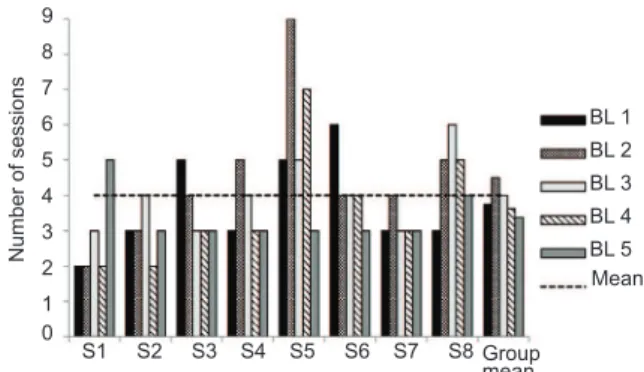
All of the dogs met the learning criteria established for each baseline training, with some variation in the total number of training sessions required for each animal. On average, it took four training sessions (SD = 3) in each training phase before the learning criterion was met. Only subjects S5 and S8 needed more training sessions than the group average (S5: = 6; S8: = 4.5). Figure 2 depicts the number of sessions performed by each subject in each baseline training individually, average number of baseline sessions for the group in each baseline training, and average number of sessions performed throughout all of the training for all the subjects as a group.
Figure 2. Total number of sessions per subject in each baseline training, group mean of sessions in each baseline training, and mean total training sessions. The dashed line represents the mean number of training sessions for all of the subjects considering all baseline trainings.
BL 1 BL 2 BL 3 BL 4 BL 5 9
8 7 6 5 4 3 2 1 0
Mean
Group mean
Number of sessions
The analysis of group performance in each baseline training showed that the average number of sessions needed to reach the learning criteria was very close to one another, varying from 3.5 to 4.5. Furthermore, from the second baseline training to the last baseline training, the group’s average number of sessions performed progressively dropped. The nonparametric
Kruskal-Wallis test revealed no statistically signiicant
differences in performance in each baseline training, with an α = .05 probability of error (H = 2.9, p = .565), indicating that learning all of the discriminations between different pairs of stimuli was similar to each other. In other words, the three simple discriminations required were not easier or harder to learn compared with one another, and performance did not differ as a function of the number of different simple discriminations present in the same session (i.e., one, two, or three).
Probe Sessions
Probe 1 consisted of the exclusion trials (S-/UnS),
and Probe 2 consisted of the novelty control trials (S+/UnS). Exclusion performance may be inferred by
choices of the UnSs in Probe 1 trials, excluding the familiar stimuli with a negative function. The possibility of responding to UnSs simply because of control by novelty may be rejected if the subjects responded to the
positive stimuli instead of the new undeined stimuli in Probe 2 trials. The results showed that in Probe 1, ive
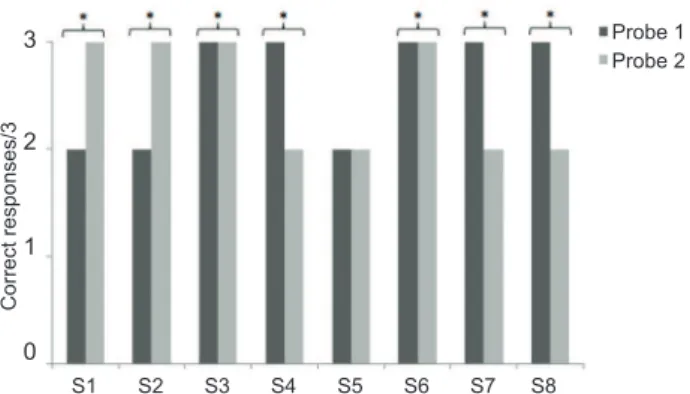
of eight subjects selected the UnSs in all three probe trials (100%), and the remaining three subjects did so in two of three trials (66%). As a group, the dogs chose the UnSs in 87.5% of the trials, compared with choosing the negative stimuli in 12.5% of the trials. In Probe 2, half of the dogs chose the positive stimuli in all of the probe trials (100%), and the other half did so in two of three trials (66%). As a group, the dogs responded to the positive stimuli in 83.5% of the trials, compared with choosing the UnSs in 16.5% of the trials.
The analysis of the subjects’ individual data showed that S3 and S6 obtained 100% correct responses in both probe types simultaneously. S1 and S2 committed only one mistake in an exclusion trial. S4, S7, and S8 made one mistake in one novelty control trial. S5 made one mistake in each of the two probes, presenting the poorest performance. Exclusion performance must only be considered a possibility when analyzing the pooled results from both probes. Correctly responding to the UnSs in Probe 1 trials (S-/UnS) might only be considered
evidence of choosing by exclusion if the subjects also
correctly responded in the Probe 2 trials, which were intended to investigate control by novelty. For example, correctly responding in all Probe 1 trials but having poor performance in Probe 2 trials would only indicate control by novelty. The subject was likely to respond to the novel stimuli despite previous experience with the different functions of the training stimuli. Binomial tests were conducted by considering the number of correct responses separately in each probe type for each subject.
The results were then pooled to estimate the probability of presenting a certain number of correct responses by chance in Probe 1 and Probe 2 simultaneously. Figure 3 presents subjects’ performances in both probes. Seven of
eight subjects presented a signiicant result in the pooled
probability (p < .05), meaning that performance in Probes
1 and 2 pooled was signiicantly greater than what would
be expected by chance, indicating exclusion performance. The only exception was S5 (p < .13). This dog also made more mistakes and needed more training sessions until the learning criterion was met during baseline training.
Figure 3. Number of correct responses in Probes 1 and 2 by each subject. * indicates binomial probability pooled with p < .05. Correct responses in Probe 1 corresponded of
choices of the undeined stimuli. Correct responses in Probe 2
corresponded to choices of the positive stimuli.
Discussion
The simple discrimination repertoire was rapidly acquired by the dogs. All of the subjects were able to learn the different functions (i.e., positive and negative) of the visual stimuli. These results corroborate
indings reported by other researchers that involved
three-dimensional objects as visual stimuli (Costa & Domeniconi, 2009) and two-dimensional images pictures presented on a computer screen (Aust et al., 2008). Considering exclusion performance, the pooled results from both probes showed that seven of eight dogs correctly made a choice between two stimuli by exclusion. This means that they excluded the already known S- alternatives that had a previous negative
function in training and chose the UnSs. Control by novelty could not account for this performance in which
the subjects signiicantly chose the previous positive
stimuli (S+) when presented with new UnSs. These
results conirm other results in the literature that showed
evidence of exclusion performance in non-human animals such as dogs (Aust et al., 2008), sea lions, harbor seals (Hanggi & Schusterman, 1995; Kastak & Schusterman, 1994; Pack, Herman, & Roitblat, 1991; Schusterman, Gisiner, Grimm, & Hanggi, 1993), chimpanzees (Cerutti & Rumbaugh, 1993; Tomonaga, 1993), and pigeons (Zentall, Edwards, Moore, & Hogan, 1981), although Aust et al. (2008) did not report positive results for pigeons using a different procedure.
S1 S2 S3 S4 S5 S6 S7 S8
Correct responses/3
Probe 1 Probe 2
3
2
1
Responding by exclusion may lead to errorless or almost errorless performance because it allows individuals to respond to novel stimuli based on preestablished relations or functions of the stimuli. This performance may be controlled by selecting the positive stimuli, rejecting the negative stimuli, or both simultaneously. For example, in a conditional
discrimination task, a subject may choose the undeined comparison upon an undeined sample by either
rejecting the already known alternatives or selecting
the undeined comparison. Deining which strategy was
used requires additional tests (Johnson & Sidman, 1993). In a simple discrimination context like the one proposed in this research, responding by exclusion depends on baseline training that attributes different functions to the training stimuli (S+ or S-). Therefore, responding by
exclusion can be assumed if the subjects differentially respond to the UnSs when they are required to make a choice between those and the previously trained S+ or S-.
Despite the strategy used (i.e., selection or rejection), exclusion trials generally lead to correct responses
without directly training speciic discriminations,
but learning outcomes and the stability of the novel association or functional discrimination may not always be produced without additional training (Kastak & Schusterman, 2002; Pilley & Reid, 2011). In the present study, we investigated the mere possibility that dogs can properly respond by exclusion in new simple discrimination trials. To achieve stability of the new simple discriminations, the dogs would likely require repeated exposure to exclusion trials.
With regard to the nature of the visual stimuli, we consider that using real three-dimensional objects as stimuli might have facilitated the discrimination tasks. The dogs in Aust et al. (2008) were able to use a
touch-screen device but required four to ive times more training
to reach the learning criterion compared with pigeons and humans. This may be attributable to at least two factors. First, the required response (i.e., touching the nose to
two-dimensional pictures on a lat screen) is a task with little
ethological relevance, which might hinder the subject’s performance, generate control by unprogrammed irrelevant variables, and produce more mistakes (e.g., Dube, McIlvane, Callahan, & Storddard, 1993; Sidman, 1994; Iversen, 1997; Iversen, Sidman, & Carrigan, 1986; Lionello-DeNolf & Urcuioli, 2000; Lionello & Urcuioli, 1998). Second, differences in visual acuity might exist. Comparative studies on visual perception between humans and pigeons under comparable conditions revealed that pigeons’ visual acuity is similar to but slightly poorer than humans’, although pigeons are very sensitive to hue, brightness differences, and wavelengths (Blough, 1971; Hodos, Leibowitz & Bonbright, 1976). The vision of dogs is less sensitive to detail, complex patterns, and colors because of an inferior sensitivity to brightness (for review, see Miklósi, 2008). Dogs also cannot see accurately at distances less than 33-50 cm because the images cannot be properly projected on their
retinas (Miller & Murphy, 1995). Although the learning criteria in our study were different from Aust et al. (2008), all of the subjects were able to discriminate between training stimuli well above chance levels in fewer trials and training sessions. This indicates that having a procedure with three-dimensional objects might facilitate visual discrimination by dogs and that research with this species should employ more naturalistic procedures (e.g., Kaminsky et al., 2004; Pilley & Reid, 2011).
Considering dogs’ sensitivity to human social cues and gestures, the arrangements made in the present
study were considered suficient to prevent them.
Studies have shown that the human social cue that dogs are most likely to follow is pointing with the index
inger (Agnetta, Hare, & Tomasello, 2000; Hare &
Tomasello, 1999; Lakatos, Soproni, Doka, & Miklósi, 2009; Miklósi, Pongracz, Lakatos, Topál, & Csányi, 2005; Miklósi et al., 1998; Soproni, Miklósi, Csányi, & Topal, 2001; Udell, Gligio, & Wynne, 2008; Udell, Hall, Morrison, Dorey, & Wynne, 2013). Although dogs are usually not as accurate as when following human pointing, evidence indicates that they are also able to follow the direction of a gaze (Agnetta et al., 2000; Miklósi et al., 1998; Soproni et al., 2001; Udell et al., 2008) and head turning (McKinley & Sambrook, 2000; Miklósi et al., 1998; Udell et al., 2008). During our procedure, these cues (i.e., pointing, gaze direction, and head turning) were controlled by keeping the hands behind the back, wearing sunglasses to avoid eye contact, and maintaining the head in a neutral straightforward position. Nonetheless, enhancing the control of social cues is possible by not having a human present while the subject makes a choice (e.g., by placing the stimuli in a separate room without visual access to the experimenters).
A inal topic to be discussed is the number of probe
trials per subject. Although they were reduced, it had the purpose of minimizing the effects of responding in the absence of reinforcement. Usually when investigating emergent behavior, exclusion performance included, no feedback is provided after the responses are emitted. However, it has been suggested that the interruption of reinforcement might interfere with performance when reinforcers are also not provided in cases of errors during training trials. This might cause the deterioration of stimulus control (e.g., Galvão, Calcagno, & Sidman 1992; Schusterman & Kastak, 1993; Sidman, Rauzin, Lazar, Cunningham, Tailby, & Carrigan, 1982) and an increase in behavioral variability (e.g., Antonitis, 1951; Lerman & Iwata, 1996). In this case, a greater number of non-reinforced exclusion trials may cause more variable responses because responses to particular stimuli were not reinforced in previous trials. An alternative to increasing the number of exclusion trials would be to train more simple discriminations between pairs of stimuli (e.g., pair A, pair B, pair C, pair D, and so on) and have one reinforced exclusion trial (S-/UnS)
In summary, evidence that non-human animals are able to properly respond by exclusion supports the premise that potentially symbolic behaviors do not necessarily depend on high cognitive abilities such as language, which would make symbolic behavior an exclusive feature of humans (for a discussion of the language hypothesis, see Horne & Lowe, 1996). In this case, the rudiments of symbolic behavior may rely on basic behavioral learning and conditioning principles.
Acknowledgements
Isabela Zaine was supported by a fellowship from Fundação de Amparo à Pesquisa do Estado de São Paulo (FAPESP; 2011/06288-0). Instituto Nacional de Ciência e Tecnologia sobre Comportamento, Cognição e Ensino (INCT-ECCE) is supported by CNPq (Grant 573972/2008-7) and FAPESP (Grant 08/57705-8). This study was conducted during the course “Basic Learning Principles” in the Psychology course at Universidade Federal de São Carlos. The authors thank the following students who assisted with data collection: Caio C. Ribeiro, Caio F. Yonezawa, Caroline P. Rodrigues, Daniela M. Fornaciari, DouglasF. Siqueira, Eduardo L. de Vasconcellos, Gabriela J. T. Silva, Giovan W. Ribeiro, Helena S. Galego, Isabella C. Palermo, Marcella M. Garcia, Maria C. M. Leal, Mariana G. Fabrício, Pamela V. dos Santos, Serguei Poussep, Stephanie Olivato, and Suellen R. da Silva.
References
Agnetta, B., Hare, B., & Tomasello, M. (2000). Cues to food location that domestic dogs (Canis familiaris) of different ages do and do not use. Animal Cognition, 3, 107-112.
Antonitis, J.J. (1951). Response variability in the white rat during conditioning, extinction, and reconditioning. Journal of Experimental Psychology, 42, 273-281.
Aust, U., Range, F., Steurer, M., & Huber, L. (2008). Inferential reasoning by exclusion in pigeons, dogs, and humans. Animal Cognition, 11, 587-597.
Blough, P.M. (1971). The visual acuity in the pigeon for distant targets. Journal of the Experimental Analysis of Behavior, 15, 57-67. Cerutti, D.T., & Rumbaugh, D.M. (1993). Stimulus relations in
comparative primate perspective. PsychologicalRecord, 43, 811-821.
Cooper, J.J., Ashton, C., Bishop, S., West, R., Mills, D.S., & Young. R.J. (2003). Clever hounds: social cognition in the domestic dog (Canis familiaris). Applied Animal Behaviour Science, 81, 229-244.
Costa, A.R.A., & Domeniconi, C. (2009). Análise do responder por exclusão em um cão treinado em tarefas de discriminação simples. [Analysis of exclusion responding in a dog trained in simple discrimination tasks]. Revista Brasileira de Análise do Comportamento, 5(1), 49-62.
de Rose, J.C., de Souza, D.G., Rossito, A.L., & de Rose, T. (1992). Stimulus equivalence and generalization in reading after matching to sample by exclusion. In: S.C. Hayes, & L.J. Hayes (Eds.), Understanding verbal relations (pp. 69-82). Reno, NV: Context Press. de Rose, J.C.C., de Souza, D.G., & Hanna, E.S. (1996). Teaching
reading and spelling: exclusion and stimulus equivalence. Journal of Applied Behavior Analysis, 29, 451-469.
Dixon, L.S. (1977). The nature of control by spoken words over visual stimulus selection. Journal of the Experimental Analysis of Behavior, 27, 433-442.
Dixon, M.H., & Dixon, L.S. (1978). The nature of standard control in children’s matching-to-sample. Journal of the Experimental Analysis of Behavior, 30, 205-212.
Domeniconi, C., Costa, A.R.A., de Souza, D.G., & de Rose, J.C. (2007). Responder por exclusão em crianças de 2 a 3 anos em uma situação de brincadeira. [Responding by exclusion in children of 2 to 3 years-old in a play situation]. Psicologia Relexão e Crítica, 20, 342-350.
Dorey, N.R., Udell, M.A.R., & Wynne, C.D.L. (2009). Breed differences in dogs sensitivity to human points: a meta analysis. Behavioral Processes, 81, 409-415.
Dube, W.V., McIlvane, W.J., Callahan, T.D., & Storddard, L.T. (1993). The search for stimulus equivalence in nonverbal organisms. Psychological Record, 43, 761-778.
Erdöhegyi, A., Topál, J., Virányl, Z., & Miklósi, A. (2007). Dog-logic: inferential reasoning in a two-way choice task and its restricted use.
Animal Behaviour, 74, 725-737.
Ferrari, C., de Rose, J.C., & McIlvane, W.J. (1993). Exclusion vs. selection training of auditory-visual conditional relations. Journal of Experimental Child Psychology, 56, 49-63.
Galvão, O.F., Calcagno, S., & Sidman, M. (1992). Testing for emergent performances in extinction. Experimental Analysis of Human Behavior Bulletin, 10, 18-20.
Hanggi, E.B., & Schusterman, R.J. (1995). Conditional discrimination learning in a male harbor seal (Phoca vitulina). In: R.A. Kastelein, J.A. Thomas, & P.E. Nachtigall (Eds.), Sensory systems of aquatic mammals (pp. 543-559). Woerden: De Spil Publishers.
Hare, B., & Tomasello, M. (1999). Domestic dogs (Canis familiaris)
use human and conspeciic social cues to locate hidden food. Journal of Comparative Psychology, 113, 173-177.
Hare, B., Call, J., & Tomasello, M. (1998). Communication of food location between human and dog (Canis familiaris). Evolution of Communication, 2, 137-159.
Hodos, W., Leibowitz, R.W. & Bonbright, J.C., Jr. (1976). Near-ield visual acuity of pigeons: effects of head location and stimulus luminance. Journal of the Experimental Analysis of Behavior, 25, 129-141.
Horne, P.J., & Lowe, C.F. (1996). On the origins of naming and other symbolic behavior. Journal of the Experimental Analysis of Behavior, 65, 185-241.
Horowitz, A. (2009). Attention to attention in domestic dog (Canis familiaris) dyadic play. Animal Cognition, 12, 107-118.
Ittyerah, M., & Gaunet, F. (2009). The response of guide dogs and pet dogs (Canis familiaris) to cues of human referential communication (pointing and gaze). Animal Cognition, 12, 257-265.
Iversen, I.H. (1997). Matching-to-sample performance in rats: a case of mistaken identity? Journal of the Experimental Analysis of Behavior, 68, 27-45.
Iversen, I.H., Sidman, M., & Carrigan, P. (1986). Stimulus deinition
in conditional discrimination. Journal of the Experimental Analysis of Behavior, 45, 297-304.
Johnson, C., & Sidman, M. (1993). Conditional discriminations and equivalence relations: control by negative stimuli. Journal of the Experimental Analysis of Behavior, 59(2), 333-347.
Kaminski, J., Call, J., & Fischer, J. (2004). Word learning in a domestic dog: evidence for “fasting mapping.” Science, 304, 1682-1683. Kastak, C.R., & Schusterman, R.J. (2002). Sea lions and equivalence:
expanding classes by exclusion. Journal of Experimental Analysis of Behavior, 78, 449-465.
Kastak, D., & Schusterman, R.J. (1994). Transfer of visual identity matching-to-sample in two California sea lions (Zalophus californianus). Animal Learning and Behavior, 22, 427-435.
Kaulfuß, P., & Mills, D.S. (2008).Neophilia in domestic dogs (Canis familiaris) and its implication for studies of dog cognition. Animal Cognition, 11, 553-556.
Lakatos, G., Soproni, K., Dóka, A., & Miklósi, Á. (2009). A comparative approach to dogs’ (Canis familiaris) and human infants’ comprehension of various forms of pointing gestures. Animal Cognition, 12, 621-631.
Lerman, D.C., & Iwata, B.A. (1996). Developing a technology for the use of operant extinction in clinical settings: an examination of basic and applied research. Journal of Applied Behavior Analysis, 29, 345-382.
Lionello, K.M., & Urcuioli, P.J. (1998). Control by sample location in pigeons’ matching to sample. Journal of the Experimental Analysis of Behavior, 70, 235-251.
McIlvane, W.J., Kledaras, J.B., Lowry, M.J., & Stoddard, L.T. (1992). Studies of exclusion individuals with severe mental retardation. Research in Developmental Disabilities, 13, 509-532.
McIlvane, W.J., Wilkinson, K.M., & de Souza D.G. (2000). As origens da exclusão [Origins of exclusion]. Temas em Psicologia, 8, 195-203.
McKinley, J., & Sambrook, T. (2000). Use of human-given cues by domestic dogs (Canis familiaris) and horses (Equus caballus). Animal Cognition, 3, 13-22.
Miklósi, Á. (2008). Dog behaviour, evolution, and cognition. Oxford: Oxford University Press.
Miklósi, Á., Polgárdi, R., Topál, J., & Csányi, V. (1998). Use of experimenter-given cues in dogs. Animal Cognition, 1, 113-121. Miklósi, Á., Pongracz, P., Lakatos, G., Topál, J., & Csányi, V. (2005).
A comparative study of the use of visual communicative signals in interactions between dogs (Canis familiaris) and humans and cats (Felis catus) and humans. Journal of Comparative Psychology, 119, 179-186. Miller, P.E., & Murphy, C.J. (1995). Vision in dogs. Journal of the
American Veterinary Medical Association, 207, 1623-1634. Pack, A.A., Herman, L.M., & Roitblat, H.L. (1991). Generalization
of visual matching and delayed matching by a California sea lion (Zalophus californianus). Animal Learning and Behavior, 19, 37-48.
Pilley, J.W., & Reid, A.K. (2011). Border collie comprehends object names as verbal referents. Behavioural Processes, 86, 184-195.
Riedel, J., Schumann, K., Kaminski, J., Call, J., & Tomasello, M. (2008). The early ontology of human-dog communication. Animal Behaviour, 75, 1003-1014.
Schusterman, R.J., & Kastak, D. (1993). A California sea lion (Zalophus californianus) is capable of forming equivalence relations. Psychological Record, 43, 823-839.
Schusterman, R.J., Gisiner, R., Grimm, B.K., & Hanggi, E.B. (1993). Behavior Control by exclusion and attempts at establishing
semanticity in marine mammals using match-to-sample paradigms. In: H.L. Roitblat, & L.M. Herman (Eds.), Language and communication: comparative perspectives (pp. 249-274). Hillsdale, NJ: Erlbaum.
Sidman, M. (1994). Equivalence relations and behavior: a research history. Boston: Authors Cooperative.
Sidman, M., Rauzin, R., Lazar, R., Cunninghan, S., Tailby, W., & Carrigan, P. (1982). A search for symmetry in the conditional discrimination of rhesus monkeys, baboons, and children. Journal of the Experimental Analysis of Behavior, 37, 23-44.
Soproni, K., Miklósi, A., Topál, J., & Csányi, V. (2001). Comprehension of human communicative signs in pet dogs (Canis familiaris). Journal of Comparative Psychology, 115(2), 122-126. Tomonaga, M. (1993). Tests for control by exclusion and negative
stimulus relations of arbitrary matching to sample in a “symmetry-emergent” chimpanzee. Journal of the Experimental Analysis of Behavior, 59, 215-229.
Udell, M.A.R., & Wynne, C.D.L. (2008). A review of domestic dogs’ (Canis familiaris) human-like behaviors: or why behavior analysts should stop worrying and love their dogs. Journal of the Experimental Analysis of Behavior, 89, 247-261.
Udell, M.A.R., Giglio, R.F., & Wynne, C.D.L. (2008). Domestic dogs (Canis familiaris) use human gestures but not nonhuman
tokens to ind hidden food. Journal of Comparative Psychology,
122, 84-93.
Udell, M.A.R., Hall, N.J., Morrison, J., Dorey, N.R., & Wynne, C.D.L. (2013). Point topography and within-session learning are important predictors of pet dogs’ (Canis lupus familiaris) performance on human guided tasks. Revista Argentina de Ciencias del Comportamiento, 5(2), 3-20.