inventory
High termite richness in an urban fragment of Atlantic Forest in northeastern Brazil
Matilde Vasconcelos Ernesto1,3, Elaine Folly Ramos1, Fla´via Maria da Silva Moura2&
Alexandre Vasconcellos3,4
1
Centro de Cieˆncias Aplicadas e Educac¸a˜o, Universidade Federal da Paraı´ba, 58297––000, Rio Tinto, PB, Brazil. e-mail:[email protected]:[email protected]
2
Unidade Acadeˆmica de Cieˆncias Biolo´gicas, Centro de Sau´de e Tecnologia Rural, Universidade Federal de Campina Grande, 58708––110, Patos, PB, Brazil. e-mail:[email protected]
3
Laborato´rio de Termitologia, Departamento de Sistema´tica e Ecologia, Centro de Cieˆncias Exatas e da Natureza, Universidade Federal da Paraı´ba, 58051-900, Joa˜o Pessoa, PB, Brazil.
e-mail:[email protected]
4
Corresponding author: Alexandre Vasconcellos, e-mail:[email protected]
ERNESTO, M.V., RAMOS, E.F., MOURA, F.M.S., VASCONCELLOS, A.High termite richness in an urban fragment of Atlantic Forest in northeastern Brazil. http://dx.doi. org/10.1590/1676-06032014005214
Abstract:Termites are very abundant in tropical ecosystems and have active roles in nutrient cycling and soil formation, but few studies of their assemblages have been undertaken in the Brazilian Atlantic Forest. The present study analyzed the composition of termite assemblages in a fragment of Atlantic Forest embedded within an urban matrix in northeastern Brazil. Five standardized sampling protocols of termites were applied, with a total sampling effort of 1500m2. We encountered 45 species of termites belonging to 25 genera and three families. The soil-feeders group demonstrated the greatest species richness, while wood-feeders species were the most abundant. The species richness of termite in the study area was the greatest yet recorded for an Atlantic forest site in Brazil, indicating the importance of urban fragments for conserving tropical biodiversity.
Keywords:Isoptera, Feeding Groups, Biodiversity, Neotropical Region.
ERNESTO, M.V., RAMOS, E.F., MOURA, F.M.S., VASCONCELLOS, A.Alta riqueza de te´rmitas em um fragmento urbano de Floresta Atlaˆntica do Nordeste Brasileiro. dx. doi.org/10.1590/1676-06032014005214
Resumo:Te´rmitas sa˜o muito abundantes em ecossistemas tropicais e possuem pape´is ativos na ciclagem de nutrientes e formac¸a˜o do solo, mas poucos estudos sobre suas taxocenoses teˆm sido realizados na Floresta Atlaˆntica. O presente estudo analisou a composic¸a˜o das taxocenoses de te´rmitas em um fragmento de Floresta Atlaˆntica inserida dentro de uma matriz urbana no Nordeste do Brasil. Cinco protocolos padronizados de amostragem de te´rmitas foram aplicados, o que totalizou um esforc¸o amostral de 1500m2. Foram encontradas 45 espe´cies de te´rmitas pertencentes a 25 geˆneros e treˆs famı´lias. O grupo alimentar dos humı´voros demonstrou a maior riqueza de espe´cies, enquanto as espe´cies xilo´fagas foram as mais abundantes. A riqueza de espe´cies de te´rmitas na a´rea de estudo foi a maior registrada ate´ o momento para uma a´rea de Floresta Atlaˆntica no Brasil, indicando a importaˆncia dos fragmentos urbanos para a conservac¸a˜o da biodiversidade tropical.
Palavras-chave:Isoptera, Grupo alimentar, Biodiversidade, Regia˜o Neotropical.
Introduction
The Atlantic Forest is one of the principal humid forests in South America. It is isolated from the Amazonian and Andean forests by a corridor of open and semi-open vegetation formations including Caatinga (dryland), Cerrado (neotropical savanna), and Chaco (arid lowland savanna) (Costa 2003, Pennington et al. 2006). More than 500 years of anthropogenic disturbances have caused the Atlantic Forest to lose more than 88.3% of its original cover (Ribeiro et al. 2009). Currently, the
Atlantic Forest is considered one of the priority areas for global biodiversity conservation (Myers et al. 2000).
Termites are eusocial insects that have important roles in ecosystem functioning by influencing the processes of nutrient cycling and altering the physical and chemical structures of the soil (Lee & Wood 1971, Wood & Sands 1978, Holt & Lepage 2000). More than 2,900 living species have been described globally (Krishna et al. 2013), and the greatest values of a
-diversity and biomass have been recorded in humid tropical forests (Vasconcellos 2010, Jones & Eggleton 2011). Up to 50%
Biota Neotropica. 14(3): e20140052.
of the decomposition of organic detritus of plant origin has been attributed to termite action in these forests (Bignell & Eggleton 2000).
In spite of the importance of termites to tropical and subtropical ecosystems, our knowledge of their diversity and functional roles in their respective ecosystems are still relatively scarce. Very few studies have been published concerning the structure of termite assemblages in northeastern Brazil, especially in the Caatinga and Atlantic Forest ecosystems (Bandeira et al. 1998, Bandeira et al. 2003, Me´lo & Bandeira 2004, Vasconcellos 2010, Vasconcellos et al. 2010). Furthermore, although some studies have been performed in fragments of Atlantic Forest in Brazil, including the study area of this work, the species richness of termites was clearly underestimated. Studies of termite assemblages are considered basic prerequisites for understanding the important functions of these insects in the ecosystem, and for identifying their patterns of diversity and endemism. The present study therefore sought to describe the composition of termite assemblages in a fragment of Atlantic Forest embedded within an urban matrix in northeastern Brazil with regard to their species richness, numbers of encounters, and feeding groups.
Materials and methods
Study sites
The present study was undertaken in the Mata do Buraquinho Permanent Protection Area (PPA) (07608’42’’S x 34651’54’’W) located within the urban perimeter of the municipality of Joa˜o Pessoa, Paraı´ba State, Brazil. The PPA occupies an area of 515 ha of a slightly rolling landscape, with altitudes varying from 35 to 85 m. The topsoilis sandy red-yellow podzol, and the climate there is hot and humid (classified as ‘‘As’’ in the Ko¨ppen [1936] system), with rainfall principally from March to August (Barbosa 2008). The average annual temperature and humidity are 276C and 80%, respec-tively, and the mean annual rainfall is 1,482 mm (Governo do Estado da Paraı´ba 1985). The regional vegetation is character-ized as Seasonal Semideciduous Forest (IBGE 1992), and this area is considered one of the largest and most important remnants of that domain in Paraı´ba State (Barbosa 2008; Oliveira & Melo 2009).
Sampling protocols
The termite assemblages were inventoried in December/ 2010 and from May through November/2012 using standard protocols for rapid evaluations of termite diversity. Each protocol was performed by establishing six 65 m x 2 m transects within forest areas without any apparent human impacts, at minimum distances of 50 m from the forest borders and from other transects. Five 5 m x 2 m plots were established 10 m one from the other in each transect, totaling 30 plots (300 m2) per protocol. The sampling effort in each plot was 1person-hour. During this period, the termites were searched in active and abandoned nests (up to 2 m above ground level), in tunnels and live and dead tree trunks, in the leaf litter and the interiors of fallen branches, in the soil (at depths up to 15 cm), under rocks, and in dead roots. The specimens collected were stored in labeled glass vials containing 75% alcohol and were subse-quently deposited in the Isopteran collection of the Federal University of Paraı´ba.
Feeding groups
Based onin situobservations of feeding and on information available in the literature concerning Neotropical termites (DeSouza & Brown 1994, Constantino 1999, Bandeira et al. 2003, Sena et al. 2003,Vasconcellos et al. 2005, Vasconcellos 2010), the species were classified as belonging to the following feeding groups: (i) wood-feeders, that consume the wood of live or dead trees in various stages of decomposition; (ii) soil-feeders, that feed on humus and generally live in the ground; (iii) wood/soil feeders, that consume humus as well as wood in different stages of decomposition, and usually carrying soil into the wood they are consuming; and (iv) wood/leaf feeders, that consume both wood in advanced stages of decomposition and leaf litter on the forest floor.
Analyses
Species accumulation curve was prepared using the Mao Tau method considering the 95%, confidence intervals for 1,000 randomizations without replacement the original data. These analyses were performed using Estimate S9.1.0 software (Colwell 2013).
Results
Forty-five species of termites (624 encounters), belonging to 25 genera and three families were recorded in the Mata do Buraquinho Permanent Preservation Area (Table 1). The family Termitidae was the best-represented in terms of the numbers of species (40; 88.9%), followed by Kalotermitidae (3; 6.7%) and Rhinotermitidae (2; 4.4%). The Termitidae were also dominant in terms of the frequencies of encounters (86.1%). In relation to subfamilies, Termitinae and Nasutitermitinae were the most representative in terms of the numbers of species (12; 30%, each) and Termitinae in terms of the frequencies of encounters (34.5%). The soil-feeders group was dominant in terms of the number of species (19; 42.2%) and the wood-feeders group in terms of the frequency of encounters (41.2%). The species that constructed conspicuous nests in the area were: Anoplotermes banksi Emerson, 1925, Embiratermes neotenicus(Holmgren, 1906),Labiotermes labralis (Holmgren, 1906), Microcerotermes indistinctus Mathews, 1977, M. strunckii(So¨rensen, 1884),Nasutitermes corniger(Motschulsky, 1855), N. ephratae (Holmgren, 1910), N. macrocephalus
(Silvestri, 1903), N. obscurus Holmgren, 1906, and
Silvestritermes holmgreni(Snyder, 1926).
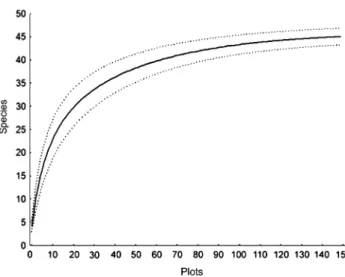
The species accumulation curve in the Mata do Buraquinho PPA is almost stabilized (Figure 1). The upper confidence level was 46.84 species and the lower 43.16, very close to the actual number observed in the field (45 spp.).
Discussion
Table 1. Termite species found in the Mata do Buraquinho Permanent Preservation Area in an Atlantic Forest fragment in northeastern Brazil. W, wood; S, subterranean; L, litter; A, arboreal; E, epigeal; I, inquiline.
Species Number of encounters Place of sampling Feeding group
KALOTERMITIDAE
Calcaritermes rioensisKrishna, 1962 8 W Wood
Neotermessp. 1 W Wood
Rugitermessp. 3 W Wood
RHINOTERMITIDAE
Coptotermes testaceus(Linnaeus, 1758) 19 S Wood
Heterotermes longiceps(Snyder, 1924) 56 S Wood
TERMITIDAE APICOTERMITINAE
Apicotermitinae sp. 1 4 S Soil
Apicotermitinae sp. 2 6 S Soil
Apicotermitinae sp. 3 19 S Soil
Apicotermitinae sp. 4 6 S Soil
Apicotermitinae sp. 5 3 S Soil
Anoplotermes banksiEmerson, 1925 19 A Soil
Anoplotermessp. 1 6 S Soil
Anoplotermessp. 2 25 W/S Soil
Anoplotermessp. 3 11 W/S Soil
Anoplotermessp. 4 18 S Soil
Ruptitermessp. 4 L Wood/Leaf
NASUTITERMITINAE
Atlantitermessp. 2 W Wood/Soil
Convexitermessp. 1 W Wood/ Soil
Diversitermes diversimiles(Silvestri, 1901) 4 L Wood/Leaf
Nasutitermes callimorphusMathews, 1977 24 W Wood
Nasutitermes corniger(Motschulsky, 1855) 15 A Wood
Nasutitermes ephratae(Holmgren, 1910) 16 A Wood
Nasutitermes gaigeiEmerson, 1925 25 W Wood
Nasutitermes jaraguae(Holmgren, 1910) 11 W Wood
Nasutitermes macrocephalus(Silvestri, 1903) 3 A Wood
Nasutitermes obscurusHolmgren, 1906 3 A Wood
Subulitermes microsoma(Silvestri, 1903) 3 S/I Soil
Velocitermes velox(Holmgren, 1906) 2 L Wood/Leaf
SYNTERMITINAE
Embiratermes neotenicus(Holmgren, 1906) 13 E Wood/ Soil
Embiratermes parvirostrisConstantino, 1992 55 S Soil
Ibitermes inflatusVasconcellos, 2002 2 S Soil
Labiotermes labralis(Holmgren, 1906) 19 A Soil
Silvestritermes holmgreni(Snyder, 1926) 33 A Wood/Soil
TERMITINAE
Amitermes amiferSilvestri, 1901 54 W Wood/Soil
Cavitermes tuberosus(Emerson, 1925) 7 I Soil
Cylindrotermes sapirangaRocha & Cancello, 2007 27 W Wood
Dentispicotermes conjunctusAraujo, 1969 1 S Soil
Microcerotermes indistinctusMathews, 1977 41 A Wood
Microcerotermes strunckii(So¨rensen, 1884) 5 A Wood
Neocapritermes opacusHagen, 1858 5 S Wood/Soil
Neocapritermes talpoidesKrishna & Araujo, 1968 14 S Soil
Orthognathotermes longilaminaRocha & Cancello, 2009 2 S/I Soil
Orthognathotermes tubesauassuRocha & Cancello, 2009 7 S/I Soil
Termes hispaniolae(Banks, 1918) 2 W/I Wood/Soil
Termes medioculatusEmerson in Snyder, 1949 20 W/I Wood/Soil
Total of species 45
Atlantic Forest have reported between 21% and 100% non-determined species (Bandeira et al.1998, Silva & Bandeira 1999, Branda˜o 1998, Vasconcellos et al. 2005, Reis & Cancello 2007, Vasconcellos 2010, Souza et al. 2012). The sampling effort used in this study was the highest ever made in a Brazilian Atlantic Forest fragment, which could partly explain the high species richness in relation to other studies in the same biome.
The termite fauna of the Mata do Buraquinho PPA has been previously investigated using various methodologies (Bandeira et al. 1998, Silva & Bandeira 1999, Vasconcellos 2010). The number of species collected in the present study (45 spp.) was greater than in any previous publication. In these earlier works, only 0% to 12% of the insects were identified to the species level (Bandeira et al. 1998, Silva & Bandeira 1999). More recently, Vasconcellos (2010) evaluated the biomass and abundance of termites and reported 29 species in the PPA.
The number of species of termites in the Mata do Buraquinho PPA was greater than reports from other Atlantic Forest fragments, where richness varied from 11 to 38 species (Bandeira et al. 1998, Silva & Bandeira 1999, Branda˜o 1998, Vasconcellos et al. 2005, Reis & Cancello 2007, Vasconcellos 2010, Souza et al. 2012). In terms of other Brazilian morphoclimatic domains, the number of species encountered here was within the amplitude reported for areas of Cerrado vegetation (30 to 70 species) (Constantino 2005) and for the Amazon region (11 to 88 species) (Bandeira & Macambira 1988, Bandeira 1989, Constantino 1992, De Souza & Brown 1994), but higher than the amplitude reported for Caatinga areas (10 to 26 species) (Me´lo & Bandeira 2004, Vasconcellos et al. 2010, Alves et al. 2011).
Equal numbers of species were found in the present study for the subfamilies Nasutitermitinae and Termitinae, with the Termitinae being more abundant. Other studies examining the termite fauna in Atlantic Forest areas have reported the subfamily Nasutitermitinae as dominant in terms of the numbers of species and relative abundance (Bandeira et al. 1998, Branda˜o 1998, Vasconcellos et al. 2005, Reis & Cancello 2007, Vasconcellos 2010, Souza et al. 2012). The low abundance observed for the family Kalotermitidae probably underesti-mates their true numbers, as most of the colonies of this termite
group are quite small and form inside pieces of dried wood or in the canopies of trees, making their collection much more difficult when using rapid survey collection techniques (Roisin et al. 2006, Reis & Cancello 2007).
The soil-feeders group demonstrated the largest number of species –– a pattern different from that observed in other studies conducted in the Atlantic Forest, where the wood-feeders group was responsible for from 39% to 64% of the total species richness (Bandeira et al. 1998, Branda˜o 1998, Vasconcellos et al. 2005, Reis & Cancello 2007, Souza et al. 2012). This fact is certainly associated with the huge sampling effort, which increases the sampling of rare soil-feeders species. In terms of abundance, on the other hand, the wood-feeders group dominated in the Mata do Buraquinho PPA. High species richness is therefore not always directly linked to high abundance and high biomasses in this ecosystem (Souza et al. 2012).
Approximately 35% of all termite species in humid tropical forests in South America construct conspicuous nests (Constantino 1992, Martius 1994, Bandeira & Vasconcellos 2002). All of the 10 species of termites known to construct conspicuous nests in Atlantic Forest sites north of the Sa˜o Francisco River were encountered in the Mata do Buraquinho PPA, including N. obscurus, which was identified in previous studies as Nasutitermes sp. (Vasconcellos et al. 2005, Vasconcellos et al. 2008, Vasconcellos 2010, Souza et al. 2012). Vasconcellos (2010) reported nine species that con-structed arboricolous nests in a previous study undertaken in the Mata do Buraquinho PPA. Additionally, the present study encountered a single species (E. neotenicus) that constructed epigeous nests.
The Mata do Buraquinho PPA contained an expressive number of termite species for an Atlantic Forest fragment embedded within an urban matrix. The effective conservation of many species will depend on their capacity to persist in fragmented habitats in the midst of modified landscapes (Holland & Bennett 2011). Extreme urbanization almost always reduces the species richness of vertebrates, invertebrates, and plants, although in cases of moderate urbanization these effects vary among the different taxonomic groups (Mckinney 2008). Brown (1997) reported that under conditions of low environ-mental disturbance termite species richness may even increase. The high diversity of the termite fauna in the Mata do Buraquinho PPA reinforces the importance of small forest fragments in conserving the biodiversity of the Atlantic Forest – even when these remnants sites are embedded within an urban matrix.
Acknowledgments
The authors would like to thank the directors of the Benjamin Maranha˜o Botanical Garden (located in the Mata do Buraquinho PPA) for their permission to undertake the termite collections; Reginaldo Constantino for the identification of some species; A Adriano M. Souza, Aline O. Lopes, Ana C.F. Alves, Carolina N. Liberal, Daniel D. Bo´, Dayse P. Nascimento, Everton P. Lorenzo, Gia´como R.P. Monteiro, Gindomar G. Santana, Jose´ R.C. Barbosa, Luiz P.A. Silva, Ricardo A. Nink, Rozzanna E.C.R. Figueireˆdo, Virgı´nia F.P. Arau´jo, and Wellington E. Santos for their help with the fieldwork; and CAPES for the Masters grant and financial support awarded to Matilde Vasconcelos Ernesto.
References
Alves, W.F., Mota, A.S., Lima, R.A.A., Bellezoni, R. & Vasconcellos, A. 2011. Termites as Bioindicators of Habitat Quality in the Caatinga, Brazil: Is There Agreement Between Structural Habitat Variables and the Sampled Assemblages? Neotrop. Entomol. 40(1):39-46,http://dx.doi.org/10.1590/S1519-566X2011000100006 Bandeira, A.G. & Macambira, M.L.J. 1988. Te´rmitas de Caraja´s,
Estado do Para´, Brasil: composic¸a˜o faunı´stica, distribuic¸a˜o e ha´bito alimentar. Bol. Mus. Para. Emı´lio Goeldi, Zool. 4(2): 175-190.
Bandeira, A.G. & Vasconcellos, A. 2002. A quantitative survey of termites in a gradient of disturbed highland forest in Northeastern Brazil (Isoptera). Sociobiology 39:429-439.
Bandeira, A.G. 1989. Ana´lise da termitofauna (Insecta:Isoptera) de uma floresta prima´ria e de uma pastagem na Amazoˆnia Oriental. Bol. Mus. Para. Emı´lio Goeldi, Zool. 5:225-241.
Bandeira, A.G., Pereira, J.C.D., Miranda, C.S. & Medeiros, L.G.S. 1998. Composic¸a˜o da fauna de cupins (Insecta, Isoptera) em a´rea de Mata Atlaˆntica em Joa˜o Pessoa, Paraı´ba, Brasil. Rev. Nordestina Biol. 12(1/2):9-17.
Bandeira, A.G., Vasconcellos, A., Silva, M.P. & Constantino, R. 2003. Effects of habitat disturbance on the termite fauna in a highland humid forest in the Caatinga domain, Brazil. Sociobiology 42(1):117-127.
Barbosa, M.R.V. 2008.Floristic composition of a remnant of Atlantic Coastal Forest in Joa˜o Pessoa, Paraı´ba, Bazil. In The Atlantic Coastal Forest of Northeastern Brazil (W.W. Thomas & E.G. Briton, eds). New York Botanical Garden Press, New York, p.439-457.
Bignell, D.E. & Eggleton, P. 2000. Termites in ecosystems. In Termites: Evolution, Sociality, Symbiosis, Ecology (T. Abe, D.E. Bignell & M. Higashi, eds.). Kluwer Academic Publications, Dordrecht, p.363-387.
Branda˜o, D. 1998. Patterns of termite (Isoptera) diversity in the Reserve Florestal de Linhares, state of Espı´rito Santo, Brazil. Rev. Bras. Entomol. 41:151-153.
Brown JR., K.S. 1997. Diversity, disturbance, and sustainable use of Neo-tropical forests: insects as indicators for conservation monitoring. J. Insect. Conserv. 1:25-42,http://dx.doi.org/10.1023/A:1018422807610 Colwell, R.K. 2013. EstimateS: Statistical estimation of species richness
and shared species from samples, Version 9.1.0. http://viceroy.eeb. uconn.edu/estimates/ (ultimo acesso em 15/08/2013).
Constantino, R. 1992. Abundance and diversity of termites (Insecta: Isoptera) in two sites of primary rain forest in Brazilian Amazonia. Biotropica 24(3):420-430.
Constantino, R. 1999. Chave ilustrada para identificac¸a˜o dos geˆneros de cupins (Insecta: Isoptera) que ocorrem no Brasil. Pap. Avulsos Zool. (Sa˜o Paulo) 40, 387-448.
Constantino, R. 2005. Padro˜es de diversidade e endemismo de te´rmitas no bioma Cerrado. In Biodiversidade, Ecologia e Conservac¸a˜o do Cerrado (A.O. Scariot, J.C.S. Silva & J.M. Felfili, eds.). Ministe´rio do MeioAmbiente, Brası´lia, p.319-333.
de Souza O.F.F, & Brown, V.K. 1994. Effects of habitat fragmen-tation on Amazonian termite communities.J. Trop. Ecol. 10:197-206.
Governo do Estado da Paraı´ba. 1985. Atlas Geogra´fico do Estado da Paraı´ba. Grafset, Joa˜o Pessoa.
Holland, G.J. & Bennett, A.F. 2011.Recolonization of forest fragments by a native rodent following experimental ‘‘extinctions’’. Austral Ecol. 36:521-529,http://dx.doi.org/10.1111/j.1442-9993.2010.02182.x Holt, J.A. & Lepage, M. 2000.Termites and soil properties. In Termites:
Evolution, Sociality, Symbiosis, Ecology (T. Abe, D.E. Bignell & M. Higashi, eds.). Kluwer Academic Publications, Dordrecht, p.389-407.
IBGE. Anua´rio estatı´stico do Brasil. 1992. 52 ed. Fundac¸a˜o Instituto Brasileiro de Geografia e Estatı´stica, Rio de Janeiro.
Jones, D.T. & Eggleton, P. 2011. Global Biogeography of Termites: A Compilation of Sources. In Biology of Termites: A Modern Synthesis (D.E. Bignell, Y. Roisin & N. Lo, eds.). Springer SBM, Dordrecht, p.477-498.
Ko¨ppen, W. 1936. Das geographische system der klimate. In Handbuch der Klimatologie, part C. (W. Ko¨ppen& R. Geiger, eds.). Verlag von Gebru¨der Borntraeger, Berlin, p.1-44.
Krishna, K., Grimaldi, D.A., Krishna, V. & Engel, M.S. 2013. Treatise on the Isoptera of the world. B. Am. Mus. Nat. Hist. 377:1-2704, http://dx.doi.org/10.1206/377.1
Lee, K.E. & Wood, T.G. 1971. Termites and soils. Academic Press, London and New York.
Martius, C. 1994. Diversity and ecology of termites in Amazonian forest. Pedobiology 38: 407-428.
Mckinney, M.L. 2008. Effects of urbanization on species richness: A review of plants and animals. Urban Ecosyst 11: 161-176. Me´lo, A.C.S. & Bandeira, A.G. 2004. A qualitative and quantitative
survey of termites (Isoptera) in an open shrubby Caatinga in Northeast Brazil. Sociobiology 44(3):707-716.
Myers, N., Mittermeier, R.A., Mittermeier, C.G., Fonseca, G.A.B. & Kent, J. 2000.Biodiversity hotspots for conservation priorities. Nature 403:853-858.
Oliveira, S.C.C. & Melo, R.S. 2009. As trilhas do Jardim Botaˆnico Benjamim Maranha˜o (Joa˜o Pessoa - PB) como recurso para interpretac¸a˜o ambiental. Cad. Virtual Tur. 9(2):113-125.
Pennington, R.T., Lewis, G.P. & Ratter, J.A. 2006. An overview of the plant diversity, biogeography and conservation of neotropical savannas and seasonally dry forests. In Neotropical savannas and dry forests: Plant diversity, biogeography, and conservation. (R.T. Pennington, G.P. Lewis, & J.A. Ratter, eds.). Taylor & Francis CRC Press, Oxford, p.1-29.
Reis, Y.T. & Cancello, E.M. 2007. Riqueza e diversidade de cupins (Insecta, Isoptera) numa a´rea de mata prima´ria e outra secunda´ria, na Mata Atlaˆntica do sudeste da Bahia. Iheringia, Zool. 97:229-234.
Ribeiro, M.C., Metzger, j.p., Martensen, A.C., Ponzoni, F.J. & Hirota, M.M. 2009. The Brazilian Atlantic Forest: How much is left, and how is the remaining forest distributed? Implications for conserva-tion. Biol. Conserv. 142:1141-1153,http://dx.doi.org/10.1016/j.biocon. 2009.02.021
Roisin, Y., Dejean, A., Corbara, B., Orivel, J., Samaniego, M. & Leponce, M. 2006. Vertical stratification of the termite assemblage in a Neotropical rainforest. Oecologia 149:301-311.
Sena, J.M., Vasconcellos, A., Gusma˜o, M.A.B. & Bandeira, A.G. 2003. Assemblage of termites in a fragment of cerrado on the coast of Paraiba State, Northeast Brazil (Isoptera). Sociobiology 42(3):753-760.
Silva, E.G. & Bandeira, A.G. 1999. Abundaˆncia e distribuic¸a˜o de cupins (Insecta, Isoptera) em solo de Mata Atlaˆntica, Joa˜o Pessoa, Paraı´ba. Rev. Bras. Biol. 13(1/2):13-36.
Souza, H.B.A., Alves, W.F. & Vasconcellos, A. 2012. Termite assemblages in five semideciduous Atlantic Forest fragments in the northern coastland limit of the biome. Rev. Bras. Entomol. 56(1):67-72,http://dx.doi.org/10.1590/S0085-56262012005000013 Vasconcellos, A. 2010. Biomass and abundance of termites in three
remnant areas of Atlantic Forest in northeastern Brazil. Rev. Bras. Entomol. 54(3):455-461, http://dx.doi.org/10.1590/S0085-56262010000300017
Vasconcellos, A., Bandeira, A.G., Almeida, W.O. & Moura, F.M.S. 2008. Te´rmitas construtores de ninhos conspı´cuos em duas a´reas de Mata Atlaˆntica com diferentes nı´veis de perturbac¸a˜o antro´pica. Neotrop. Entomol. 37:15-19, http://dx.doi.org/10.1590/S1519-566X2008000100003
Vasconcellos, A., Me´lo, C.A.S., Segundo, E.M.V. & Bandeira, A.G. 2005. Cupins de duas florestas de restinga do nordeste brasileiro. Iheringia, Zool. 95(2):127-131, http://dx.doi.org/10.1590/S0073-47212005000200003
Wood, T.G. & Sands, W.A. 1978.The role of termites in ecosystems. In Production Ecology of Ants and Termites (M.V. Brian, ed.). Cambridge University Press, Cambridge, p.245-292.