1 Siksha ‘O’ Anusandhan University, Centre of Biotechnology, Jagamara, Khandagiri, Bhubaneswar, Orissa, India
2 Regional Plant Resource Centre, Division of Plant Biotechnology, DNA Finger Printing Laboratory, Nayapalli, Bhubaneswar, Orissa, India 3 Regional Plant Resource Centre, Taxonomy and Conservation Division, Bhubaneswar, Orissa, India
4 Author for correspondence: [email protected]
Separation of the genera in the subtribe Cassiinae
(Leguminosae: Caesalpinioidae) using molecular markers
RESUMO
(Separação dos gêneros na subtribo Cassiinae (Leguminosae: Caesalpinioidae) utilizando marcadores mo-leculares). Técnicas de Random amplified polymorphic DNA (RAPD), Inter simple sequence repeat (ISSR) e
Amplified Fragment Length Polymorphismmarkers (AFLP) foram utilizadas para verificar a segregação do gênero Cassia L. senso lato em três diferentes gêneros, Chamaecrista Moench., Senna P. Mill. e Cassia L. senso stricto Dezoito representantes dos três táxons foram caracterizados com o uso de marcadores moleculares: 25 RAPD, seis iniciadores (“primers”) ISSR e seis AFLP combinações de iniciadores, resultando na amplifi-cação de 612, 115 e 622 bandas (loci), respectivamente. A maioria dos loci apresentou-se como polimórfico, mostrando um alto grau de diversidade genética entre os táxons estudados. O dendrograma construído com base nos dados de RAPD, ISSR e AFLP e agrupamento com procedimentos SHAN dividiu Cassia L. senso lato
em três diferentes agrupamentos, chamados de Chamaecrista Moench., Senna P. Mill. e Cassia L. senso stricto
Valores altos de bootstrap revelaram que todos os agrupamentos foram estáveis e robustos. Foi observado pela presente investigação que estes gêneros possuem identidade ao nível molecular, o que sustenta a elevação do genero Cassia L. senso lato para o nível de subtribo e a segregação dos três gêneros ao invés de formarem categorias infra-genéricas.
Palavras-chave: AFLP, Cassia, fi logenia molecular, ISSR, RAPD
Laxmikanta Acharya1, 4, Arup Kumar Mukherjee2 and Pratap Chandra Panda3
ABSTRACT
(Separation of the genera in the subtribe Cassiinae (Leguminosae: Caesalpinioidae) using molecular markers). Random amplified polymorphic DNA (RAPD), Inter simple sequence repeat (ISSR) and Amplified fragment length polymorphism (AFLP) markers were used to verify the segregation of the genus Cassia L. senso lato
into three distinct genera namely Chamaecrista Moench., Senna P. Mill. and Cassia L. sensostricto Eighteen representatives of the three taxa were characterized using the molecular markers. 25 RAPD, six ISSR primers and six AFLP primer combinations resulted in the amplification of 612, 115 and 622 bands (loci) respectively. Most of the loci are found to be polymorphic, showing high degrees of genetic diversity among the different taxa studied. The dendrogram constructed on the basis of the RAPD, ISSR and AFLP data using SHAN clustering, divided Cassia L. senso lato. into three different clusters as Chamaecrista Moench. Senna P. Mill. and Cassia L.
senso stricto High bootstrap value revealed that all the clusters were stable and robust. It was observed from the present investigation that these genera have their identity at molecular level, which supports the elevation of the genus Cassia L. senso lato to the level of subtribe Cassiinae and segregationinto three distinct genera instead of intrageneric categories.
Key words: AFLP, Cassia, ISSR, Molecular phylogeny, RAPD Recebido em 8/07/2009. Aceito em 1/03/2011
Acta Botanica Brasilica 25(1): 223-233. 2011.
Introduction
Cassia L. senso lato (Leguminosae: Caesalpinioideae) is one of the twenty-fi ve largest genera of dicotyledonous plants in the world. Th e genus extends in all terrestrial habitats from the equator to the edges of dry and cold deserts, but much of its diversity is centred in areas of
varied topography with seasonal climates. There has been considerable divergence of opinion concerning the delimitation and taxonomic status of its three constituent subgenera. Irwin & Barneby (1981, 1982) proposed an improved classifi cation and raised the genus
Senna P. Mill. and Chamaecrista Moench. Th is concept had found wide recognition in recent years (Randel 1988, 1989,1990; Lock 1988, 89; Larsen & Hou 1996). Despite several studies by taxonomists, either on the whole subfamily Caesalpinioideaein restricted areas or of certain genera throughout the world, there is still a great deal of taxonomic work to be done at the level of genus and tribe. Th e taxonomic treatment of the genus
Cassia L. senso lat. has been done in some countries in Asia, namely Malaysia (De Wit 1955) and Pakistan (Ali & Quraishi 1967). But nowadays taxonomy is not simply based on fl oral and vegetative characters but many other types of data, like anatomical, cytological, serological and molecular. Th ese are regarded as very important in determining relationships and affi nities of the plants. New trends and new information on various aspects had prompted modern taxonomists to propose a new system of classifi cation. Th ese have also led to some changes in the criteria for determining the evolutionary status of the various taxa in the subtribe Cassinae.
Irwin and Barneby (1981, 1982) raised the genus
Cassia L. sensu lato to the level of subtribe and elevated previous subgenera to generic rank viz. Senna Mill and
Chamaecrista Moench under the tribe Cassieae Bronn ex Irwin and Barneby of Caesalpiniaceae (today Leguminosae-Caesapinioideae). However there is little work done on the molecular phylogeny of this genus and conformation of the trifurcation of this group. Th ere are very few reports on other aspects like biochemical and cytological on this taxa. Th e reports that are present contradict each other in the cytological data (Singh 2001).
Keeping all these facts the present investigation was carried out with the objectives to derive an authentic relationship among the studied genera of the subtribe
Cassiinae. Justification of trifurcation of the subtribe into three distinct categories like Cassia, Senna and
Chamaecrista as suggested by Irwin and Barneby (1982), taking the molecular data obtained from RAPD, ISSR and AFLP analyses.
Material and methods
Plant material
All plants were raised from seed. Eighteen species of the genus Cassia were taken for the present study. Th eir taxonomic rank and changed names are given in Tab.1. Th ey were grown in the nursery of Regional Plant Resource Centre, Bhubaneswar, Orissa, India. Very young and tender leaves were taken for genomic DNA isolation. Vouchers were deposited at Herbarium of Regional Plant Resource Centre.
Molecular Analysis
DNA was isolated from young, fresh leaves using the CTAB method as described by Saghai-Maroof et al.
(1984). For RAPD analysis, PCR amplifi cation of 25ng of genomic DNA was carried out using standard 30 decamer oligonucleotide primers, out of which in 25 primers reproducible amplifi cation was found. So they are taken for the present RAPD analysis and those are OPA02, OPA03, OPA04, OPA10, OPA16, OPA18, AF14, OPC02, OPC05, OPD02, OPD03, OPD07, OPD08, OPD18, OPD20, OPN02, OPN04, OPN05, OPN06, OPN08, OPN10, OPN11, OPN12, OPN16 and OPN18 (Operon Tech. Alameda, CA. USA). The RAPD analysis was performed as per the standard methods of Williams et al. (1990). PCR products were separated on a 1.5% agarose gel containing ethidium bromide solution (@0.5µg/ml of gel solution). The size of the amplicons was determined using size standards (100bp ladder plus or DNA ladder mix, MBI Fermentas, Lithuania). DNA fragments were visualized under UV light, documented in Gel Doc (Bio-Rad, USA) and photographed. Inter-simple sequence repeats have recently been developed which access the variation in the numerous microsatellite regions distributed throughout different genomes (basically the nuclear genome) and bypass the challenges of characterizing individual loci that other molecular techniques require. Th e PCR products were separated in polyacrylamide gel. Amplifi ed fragment length polymorphism analysis was done as per the standard protocol of Vos et al. (1995) and the protocol supplied by the manufacturer (Invitrogen, USA). All the reagents and chemicals were procured from Invitrogen (Invitrogen life technology, CA, USA). Aft er the completion of the gel run it was stained with 0.0002% of ethidium bromide and destained in distilled water. Gel was documented in a gel doc (Gel Doc 2000, Bio Rad, USA).
Data analysis
The bands amplified from RAPD, ISSR and AFLP were scored as ‘1’ and ‘0’ for presence and absence of band respectively. All the bands whether monomorphic or polymorphic were used for similarity calculation in order to avoid over estimation of distance (Gherardi et al.
1998). Jaccard’s coeffi cient of similarity (Jaccard 1908) was calculated and a dendrogram based on similarity coeffi cient was obtained through unweighted pair group method using arithmetic averages (UPGMA) (Sneath & Sokal 1973) and SHAN clustering. All the analysis was done using the computer package NTSYS-PC-2.02e (Rohlf 1997). Resolving power (Rp) of the RAPD, ISSR and AFLP was calculated as per Prevost & Wilkinson (1999). Resolving power is: Rp=ΣIB (IB (Band informative ness)= 1-[2×(0.5-P)], P is the proportion of the 18 species containing the band. Primer Index (PI) was calculated from the polymorphic index. A polymorphic index (PIC) was calculated as PIC = 1-×P2
i, Pi
is the band frequency of the ith allele (Smith et al. 1997). In the case of RAPDs, ISSRs and AFLP the PIC was considered to be 1-p2-q2, where p is band frequency and q is no band
Acta bot. bras 25(1): 223-233. 2011.
Separation of the genera in the subtribe Cassiinae (Leguminosae: Caesalpinioidae) using molecular markers
225
Name of the species Chromosomenumber Habit Locality with fi eldcollection numberSenna tora (Linn.) Roxb.
(Cassia tora Linn.) 2n= 24, 26, 28, 52 Herb or under shrub
R.P.R.C., BBSR. LKA 7643
Senna occidentalis (Linn.) Link {Cassia occidentalis Linn. Senna occidentalis (Linn.) Roxb.}
2n= 28, n= 13,14
Erect herb or under shrub
R.P.R.C., BBSR. LKA 7650
Chamaecrista absus (Linn.) Irwin & Barneby
{Senna absus (Linn.) Roxb.} 2n= 26,28,56 Erect, viscid-hairy herb
R.P.R.C., BBSR. LKA 7652
Senna alexandrina Gars. ex Miller
(Cassia angustifolia Vahl) 2n= 26 Herbs or shrubs Keonjhar, Orissa.
Senna siamea (Lam.) Irwin & Barneby
(Cassia siamea Lam.) 2n= 28 Moderate-sized tree
R.P.R.C., BBSR. LKA 7625
Cassia fi stula Linn. 2n= 28, Small or medium-sized tree R.P.R.C., BBSR.
LKA 7644
Cassia javanica Linn. var. javanica
(Cassia nodosa Buch-Ham. Ex Roxb.) 2n= 28 Deciduous trees
R.P.R.C., BBSR. LKA 7630
Senna pallida (Vahl) Irwin & Barneby
(Cassia bifl ora Linn.) 2n= 28 Shrubs
R.P.R.C., BBSR. LKA 7631
Chamaecrista mimosoides (Linn.) Greene
(Cassia mimosoides Linn.) 2n= 16, 32
Prostrate or decumbent herbs or under shrub
R.P.R.C., BBSR. LKA 7626
Senna sulfurea (DC. ex Collad.) Irwin & Barneby
(Cassia glauca Lam. Senna glauca Roxb) 2n= 28, 56 Shrub or small tree
OUAT Campus, BBSR. LKA 7648
Cassia grandis Linn. 2n= 28 Trees R.P.R.C., BBSR.
LKA 7642
Cassia javanica Linn.var. indochinensis Gagne 2n= 28, n= 12, 14 Trees Governer’s House, BBSR. LKA 7633
Senna alata (Linn.) Roxb.
(Cassia alata Linn.) 2n= 12, 24, n= 12, 14 Shrubs or small trees
Dhauli, BBSR. LKA-7632
Senna spectabilis (DC.) Irwin & Barneby
(Cassia spectabilis DC.) 2n= 28 Evergreen trees
I.G. Park, BBSR. LKA 7649
Senna auriculata (Linn.) Roxb. (Cassia aruiculaia Linn.)
2n=14,16,28.
n = 14 Large shrub
Uppal, Hyderabad A.P. LKA 7641
Cassia roxburghii DC. 2n= 24, 28 Small tree Rajmahal Square, BBSR. LKA 7651
Chamaecrista pumila (Lam.) Singh
(Cassia pumila Lam.) 2n= 28 Diff use or prostrate herb
R.P.R.C., BBSR. LKA 7647
Senna septemtrionalis (Viv.) Irwin & Barneby
(Cassia laevigata Willd.) 2n=26,28 Shrubs
Dhauli, BBSR. LKA 7627 Table 1. Details of species with locality of collection, fi eld number, habit and chromosome number in Cassiinae*.
calculate the RAPD primer index (RPI). RPI is the sum of the PIC of all the markers amplifi ed by the same primer. Principal coordinate analysis (PCA) was used to retrieve information on the clustering pattern of the analyzed populations. PCA was performed based on the RAPD, ISSR and AFLP data, for all the primers.
Results
Random Amplifi ed Polymorphic DNA
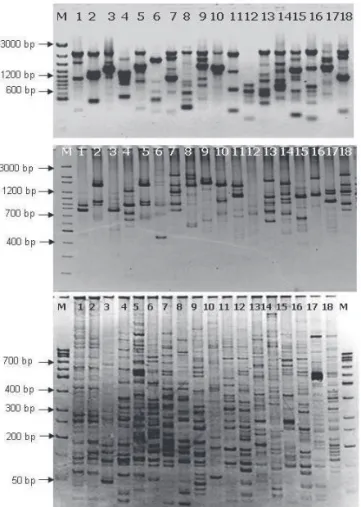
All the 18 species produced distinct reproducible amplifi cations. Th e DNA profi les as observed in RAPD are
there were highest unique bands (20), only two bands were found to be unique in the case of Ch. pumila as well as for C. grandis. Th e dendrogram constructed using SHAN clustering shows three major groups among the 18 studied taxa (fi gure not shown).
Inter Simple Sequence Analysis
Six ISSR primers resulted in the amplification of 115 fragments. The ISSR banding pattern in Cassiinae is represented in Fig. 1. The primer (CAA)5 and (GACA)4 produced maximum number of bands (21), while with the primer(GA)9T only 14 loci could be amplified. Of these, only 8 were found to be unique bands. The bands were amplified in the range of 200-3000 base pairs. All the loci amplified with the ISSR primers were polymorphic and prominent. Maximum number of unique bands were observed with primer T (GA)9 (4), while there was no unique band with the use of primer (AGG)6, (GTG)5 and (CAA)5. Among these ISSR primers, maximum resolving power was obtained for (AGG)6 (12) and the minimum Rp was for (CAA) (5.78). Maximum primer index was calculated for (GACA)4 and minimum for (CAA)5. Highest numbers of 36 bands were resolved for the species C. javanica and the least number of amplicons were amplified for the species Ch. mimosoides. Details of ISSR banding pattern and bands
amplified in different species with different primers have been represented in Tab. 3.
AFLP Analysis
Six AFLP primer combinations were used for the present work. This primer combination had amplified 622 loci among which five loci were found to be monomorphic in nature and the rest were polymorhic. Banding pattern in AFLP for 18 species of Cassiinae is shown in Fig. 1. From the 594 polymorphic bands amplified, only 28 were found to be unique that to in a single species. Maximum numbers of 139 bands were resolved for the primer combination EACA/MCAG and the minimum for EACCA/MCAT (62). The average numbers of bands amplified per primer combination was calculated to be as high as 103.6. The highest numbers of bands (65) were noted for C. javanica var. indochinensis
for primer combination EACT/MCAG and the lowest for the primer combination EACC/MCTC (19) in the case of the species C. javanica. Bands resolved between 1500bp to 20 bp were taken into consideration for the present investigation. Maximum numbers of 3 monomorphic bands were scored for the primer combination EACC/ MCAT, whereas no band was found to be common to all the species with the primer combinations EACC/MCTC, EACT/MCAG, EACA/MCAG and EAAG/MCAC. The resolving power was maximum for the primer combination EAAG/MCAG (78.889) and minimum for EACC/MCTC (42.778). However, the primer index was found to be highest for EACA/MCAG (46.944) and lowest for EACC/MCAT (22.895). The details of AFLP analysis are presented in Tab. 4.
Similarity for RAPD, ISSR and AFLP
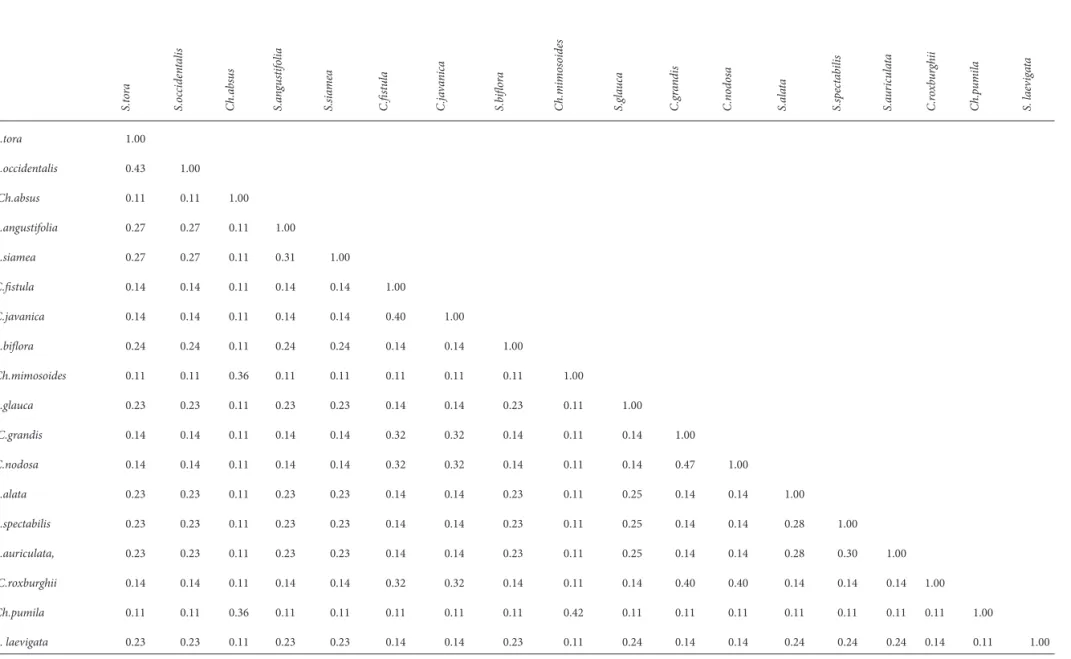
Jaccard’s similarity was calculated from the data generated from RAPD, ISSR and AFLP analysis. It was observed that C. grandis and C. javanica var. indochinensis
were most closely related with Jaccard’s similarity coeffi cient of 0.473, whereas Ch. mimosoides and S. sulfurea were distantly placed with the lowest Jaccard’s similarity coeffi cient of 0.064. Among all the species, there was average similarity of 0.1834. Jaccard’s similarity among the taxa is represented in Tab. 5.
Tree generated from the combined markers
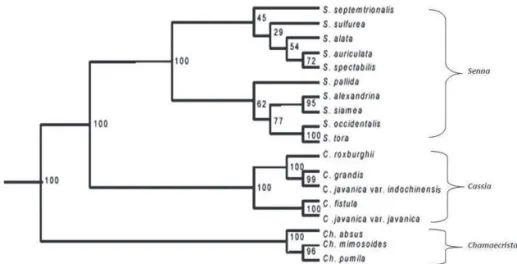
On the basis of the data obtained from all the molec u lar marker syste ms, a dendro gram w as constructed using UPGMA and SHAN clustering in NTSYS-pc 2.02e (Fig. 2). All the 18 taxa of Cassinae studied were separated into three different clusters each containing members of a particular genus. The species of Senna were further divided into two subclusters each containg 5 species. While the first subcluster contained
S. tora, S. occidentalis, S. alexandrina, S. siamea and S. pallida, the second had S. sulfurea, S. alata, S. spectabilis, Figure 1. Banding pattern in diff erent species of Cassiinae as seen in (from top
Acta bot. bras 25(1): 223-233. 2011.
Separation of the genera in the subtribe Cassiinae (Leguminosae: Caesalpinioidae) using molecular markers
227
Primer Sequence of oligonucleotide Approx. fragment size Total Unique Resolving RAPD primerbands bands power index
OPA02 5’TGCCGAGCTG3’ >3000bp-300bp 36 8 10.667 8.642
OPAO3 5’AGTCAGCCAC3’ >3000bp-230bp 36 7 13.222 9.8704
OPA04 5’AATCGGGCTG3’ >3000bp-350bp 26 3 8.222 6.6543
OPA10 5’GTGATCGCAG3’ >3000bp-300bp 28 4 10 7.8025
OPA16 5’AGCCAGCGAA3’ >3000bp-200bp 24 4 8.556 6.6358
OPA18 5’AGGTGACCGT3’ >3000bp-200bp 19 4 7.333 5.5802
OPAF14 5’GGTGCGCACT3’ >3000bp-200bp 23 7 5.889 4.821
OPC02 5’GTGAGGCGTC3’ >3000bp-300bp 17 4 5.667 4.4012
OPC05 5’GATGACCGCC3’ >3000bp-200bp 23 5 6.878 6.6111
OPD02 5’GGACCCAACC3’ >3000bp-300bp 25 2 9.778 7.1481
OPD03 5’GTCGCCGTCA3’ >3000bp-350bp 22 3 8.111 6.142
OPD07 5’TTGGCACGGG3’ >3000bp-350 bp 19 4 6.111 4.7222
OPD08 5’GTGTGCCCCA3’ 3000bp-300bp 24 4 8.222 6.3086
OPD18 5’GAGAGCCAAC3’ >3000bp-200bp 30 7 11.222 7.8457
OPD20 5’ACCCGGTCAC3’ 2000bp-300bp 19 2 8.111 5.4877
OPNO2 5’ACCAGGGGCA3’ 3000bp-200bp 27 7 8.667 6.7654
OPN04 5’GACCGACCCA3’ 3000bp-200bp 31 4 12.444 9.1235
OPN05 5’ACTGAACGCC3’ >3000bp-250bp 22 4 6.778 5.4753
OPN06 5’GAGACGCACA3’ >3000bp-100bp 28 10 8 6.321
OPN08 5’ACCTCAGCTC3’ >3000bp-400bp 20 9 5.778 3.8025
OPN10 5’ACAACTGGGG3’ 3000bp-200bp 23 6 7.556 5.9259
OPN11 5’TCGCCGCAAA3’ >3000bp-400bp 17 3 6.333 4.7593
OPN12 5’CACAGACACC3’ >3000bp-200bp 20 5 6.444 4.5556
OPN16 5’AAGCGACCTG3’ >3000bp-100bp 31 4 9.556 7.6914
OPN18 5’GGTGAGGTCA3’ >3000bp-400bp 22 4 7.222 5.7716
Table 2. Details of RAPD analysis in Cassiinae.
Primer Sequence of oligonucleotide Approximate Total Unique Resolving ISSR
fragment size bands bands power primer
index
(AGG)6 5’AGG AGG AGG AGG AGG AGG3’ 2700bp-300bp 19 0 13.33 7.2098
(GA)9T 5’GAG AGA GAG AGA GAG AGA T3’ 2500bp-300bp 14 3 7.8888 5.6419
(GACA)4 5’GAC AGA CAG ACA GAC A3’ >3000bp-400bp 21 1 10.8889 8.1667
T(GA)9 5’TGAG AGA GAG AGA GAG AGA3’ 2300bp-400bp 20 4 8.33333 6.006
(GTG)5 5’GTG GTG GTG GTG GTG3’ >3000bp-400bp 20 0 12 7.272
(CAA)5 5’CAA CAA CAA CAA CAA3’ >3000bp-100bp 21 0 5.78 4.969
Total 115 8
Primer Sequence ofPrimer bandsTotal Mnomorphicbands Uniquebands Resolvingpower primer indexAFLP
1 EACC/MCTC 104 0 12 42.778 31.3148
2 EACT/MCAG 98 0 2 60.111 37.10494
3 EAAG/MCAG 116 2 1 78.889 43.333
4 EACC/MCAT 62 3 1 45.889 22.89506
5 EACA/MCAG 139 0 10 71.222 46.9444
6 EAAG/MCAC 103 0 2 63.111 39.28395
Total 622 28
Table 4. Details of AFLP analysis in Cassiinae.
S. auriculata and S. septemtrionalis and both the subclusters shared a common node at approximately 23% level of similarity. All the species of Chamaecrista
had a similarity of nearly 35.5% among themselves and
Cassia at 32% similarity level. The tree had a common node at 11% similarity level for the three different genera in the subtribe Cassiinae.
Cophenetic correlation
Cophenetic correlation was calculated for diff erent phenograms generated from three different marker systems. It was found that the maximum cophenetic correlation existed between C. grandis and C. javanica
var. indochinensis (0.473). Th e cophenetic correlation for diff erent markers is represented in Tab. 6. Th e average cophenetic correlation between any two species was found to be 0.183392.
Bootstrap analysis
Bootstrap analysis revealed that all the clusters were stable and had bootstrap value of approximately 100. It indicates that the clades containing Cassia javanica and C. fi stula among the members of Cassia, Chamaecrista pumila
and Ch. mimosoides in Chamaecrista and Senna tora and
S. occidentalis in Senna were closely linked with bootstrap value of 100 or nearly 100. Th e bootstrap values among diff erent clusters and subclusters were presented in the bootstrap tree. (Fig. 2).
Principal coordinate analysis
In the PRINCORD analysis, all the species were separated in three diff erent plains each containing the representatives of a particular genus. All the species of
Chamaecrista were grouped together at a corner in the PCA fi gure while all the members of Cassia were grouped in the opposite corner in the fi gure. However, the elements of
Senna were found in the middle of the diagram maintaining equal distance from Cassia and Chamaechrista groups. Th e PCA diagram is represented in Fig. 3.
Discussion
The genomic relations among different taxa of Cassiineae were studied on the basis of RAPD, ISSR and AFLP fi ngerprinting. Th e relationship obtained among the different taxa of Cassinnae using RAPD was in agreement with the conventional taxonomic classifi cation of the subtribe. Th e trifurcation of Cassiinae into three distinct genera as suggested by Irwin and Barneby (1981) proved to be justifi ed. Whitty et al. (1994) worked on Cassiinae and justifi ed the grouping of Cassia, Senna
and Chamaecrista. We observed similar type of result. However, the intrageneric relationship among species of Senna does not follow the sequence that Irwin and Barneby (1981) worked out. Th e three species represented here of sect. Peiranisia namely, S. pallida, S. auriculata
and S. spectabilis formed a cluster. Similarly, S. tora, S. occidentalis, S. septemtrionalis and S. siamea all belonging to sect. Chamaefi stula, came together in a distinct clade. Non-inclusion of S. alexandrina in the above cluster could not be reasoned out. Of the three elements of the genus
Chamaecristra, the lone species of sect. Grimaldiai.e.Ch. absus got separated from the other two, which belong to sect. Chamaecrista. Th e infra-generic arrangement of species in Chamaecrista was in agreement with Irwin and Barneby (1981). Th e deviations with regard to intrageneric relationships may be due to selection of a small number of species from such a large taxon for the present investigation and amplifi cation a small portion of the entire genome. Souza & Benko-Iseppon (2004) found signifi cant diff erences in chromosome size, morphology and condensing behavior among members of the controversial tribe Cassieae (Cassia, Chamaecrista and
Senna), revealing the tribe to be a heterogeneous group from the karyological point of view.
In contrast, the species relationship in the genus Cassia
A
c
ta bo
t. br
as
25(1): 223-233. 2011.
Se pa ra tio n o f t h e g
enera in t
h e sub tr ib e C assiin ae (L eguminos ae: C aes al p inio idae) usin g mo lec u la r ma rk er s
229
S.t or a S.oc ciden ta lis Ch.a bs us S. ale xa nd ri na S.s ia m ea C.fi stul a C.ja va n ic a va r. ja va n ic a S.pa llida Ch.m im os oide s S.s ul fu re a C.g ra n d is C.ja va n ic a va r. i n doc h in ens is S.a la ta S.s pe ct ab il is S.a u ricula ta, C.r oxb u rgh ii Ch.p u m ila S. sep tem tr io n al isS.tora 1.000
S.occidentalis 0.434 1.000
Ch.absus 0.194 0.176 1.000
S.alexandrina 0.274 0.262 0.180 1.000
S.siamea 0.245 0.282 0.145 0.310 1.000
C.fi stula 0.165 0.178 0.132 0.164 0.246 1.000
C.javanica var. javanica 0.152 0.154 0.151 0.154 0.179 0.401 1.000
S.pallida 0.236 0.235 0.139 0.242 0.260 0.153 0.164 1.000
Ch.mimosoides 0.117 0.107 0.351 0.132 0.107 0.079 0.097 0.145 1.000
S.sulfurea 0.221 0.221 0.113 0.226 0.249 0.146 0.151 0.227 0.107 1.000
C.grandis 0.160 0.133 0.127 0.122 0.108 0.303 0.311 0.090 0.065 0.153 1.000
C.javanica var. indochinensis 0.152 0.135 0.118 0.129 0.151 0.357 0.334 0.135 0.079 0.136 0.473 1.000
S.alata 0.213 0.234 0.123 0.226 0.230 0.140 0.162 0.240 0.087 0.274 0.128 0.157 1.000
S.spectabilis 0.257 0.222 0.130 0.219 0.276 0.158 0.125 0.256 0.106 0.244 0.106 0.159 0.295 1.000
S.auriculata, 0.209 0.198 0.092 0.207 0.241 0.140 0.147 0.212 0.097 0.220 0.125 0.123 0.258 0.303 1.000
C.roxburghii 0.137 0.137 0.088 0.112 0.127 0.295 0.315 0.133 0.067 0.126 0.376 0.424 0.131 0.128 0.125 1.000
Ch.pumila 0.109 0.096 0.362 0.131 0.126 0.101 0.082 0.118 0.420 0.109 0.113 0.117 0.095 0.098 0.111 0.107 1.000
S. septemtrionalis 0.242 0.241 0.147 0.215 0.219 0.142 0.188 0.214 0.082 0.236 0.122 0.108 0.227 0.245 0.246 0.139 0.118 1.000
to other molecular techniques in conjunction with RAPD are likely to alter the arrangement of taxa under the genus and bring about the expected order.
The dendrogram obtained from the ISSR data segregated the subtribe into two clusters; the first with the three species of Chamaecrista and the second having all the species of Cassia and Senna. The second clade was further bifurcated to two subclusters; one with all 10 species of Senna and the second subcluster had five species belonging to the genus Cassia. Thus, broadly there was a segregation of the subtribe Cassiinae into three genera. This was in conformity with the classification proposed by Irwin & Barneby (1981). Though the division of the subtribe on the basis of ISSR data appears justified, the clustering and arrangement of species under Senna and Cassia were not at par with the traditional grouping made earlier. As in the case of RAPD, in the genus Chamaecrista, Ch. absus that comes under sect. Grimaldia got separated from the remaining two and Ch. mimosoides and Ch. pumila
formed a subcluster justifying their inclusion under sect.
Chamaecrista.
In the Cassia clade, C. javanica var. indochinensis and C. roxburghii, which are closely related came in a single cluster with distantly related C. grandis. But the other variety C. javanica var. javanica remained isolated and formed a clade with C. fi stula. Th e placement of the four species of Cassia
under the three series Cassia, Grandes and Obolospermae
was not possible. Similarly, from the dendrogram generated from ISSR data, segregation of species of Senna into traditionally recognized sections like Psilorhegma, Peiranisia, Chamaefi stula and Senna also could not be done. Th ough only six ISSR primers were used for the present investigation, the result was comparable with the RAPD.
As both RAPD and ISSR were dominant markers and arbitrarily amplified the loci the need for application of better marker system was felt and AFLP was used. Six
AFLP primer combinations were used for deciphering the genetic relationship among the 18 species of Cassiinae
and a total of 622 bands were obtained, most of which were polymorphic in nature. A high degree of genetic diversity among the species of Cassiinae was noted. The dendrogram constructed on the basis of the data obtained from the AFLP analysis segregated the subtribe into three distinct groups. As observed in RAPD and ISSR analysis, all members of Senna, Cassia and Chamaecrista formed distinct clusters. The arrangement of species under the genera Chamaecrista and Cassia was exactly similar as determined from RAPD and ISSR analysis and described earlier. However, the species of Senna were clustered in two groups; the first cluster containing S. tora, S. occidentalis, S. alexandrina, S. siamea and S. pallida and the second cluster with the remaining five species. All the five species of the first subcluster shared a common node at 34% similarity level; S. tora and S. occidentalis were the closest. The second subcluster consisted of S. sulfurea, S. alata, S. spectabilis, S. auriculata and S. septemtrionalis
and shared a node with the first subcluster at about 27% level of similarity. The species arrangement did not follow any logical pattern and the data obtained was not discernible.
Marazziet al.(2006) studied phylogenetic relationships
within Senna based on parsimony analyses of three
chloroplastregions (rpS16, rpL16, and matK) and provided new insights on theevolution of floral symmetry and extrafl oral nectaries. Th eir results supported the monophyly of only one sect. Psilorhegma of thesix currently recognized sections, while Chamaefi stula, Peiranisia,and Senna were paraphyletic and monotypic Astroites and Paradictyon were nested within two of the seven major clades identifi ed by molecular phylogeny. Th eir investigation further suggested that fl owers in Senna were ancestrally monosymmetricwith seven fertile stamens and three adaxial staminodes, switched to asymmetry later, and reverted to monosymmetry in most Figure 2. Dendrogram showing genomic relationship and bootstrap value among and within diff erent clusters in
A
c
ta bo
t. br
as
25(1): 223-233. 2011.
Se pa ra tio n o f t h e g
enera in t
h e sub tr ib e C assiin ae (L eguminos ae: C aes al p inio idae) usin g mo lec u la r ma rk er s
231
S.t or a S.oc ciden ta lis Ch.a bs us S.a n gus ti fo lia S.s ia m ea C.fi stul a C.ja va n ic a S.b ifl or a Ch.m im os oide s S.gla u ca C.g ra n d is C.n odo sa S.a la ta S.s pe ct ab il is S.a u ricula ta C.r oxb u rgh ii Ch.p u m ila S. la ev iga taS.tora 1.00
S.occidentalis 0.43 1.00
Ch.absus 0.11 0.11 1.00
S.angustifolia 0.27 0.27 0.11 1.00
S.siamea 0.27 0.27 0.11 0.31 1.00
C.fi stula 0.14 0.14 0.11 0.14 0.14 1.00
C.javanica 0.14 0.14 0.11 0.14 0.14 0.40 1.00
S.bifl ora 0.24 0.24 0.11 0.24 0.24 0.14 0.14 1.00
Ch.mimosoides 0.11 0.11 0.36 0.11 0.11 0.11 0.11 0.11 1.00
S.glauca 0.23 0.23 0.11 0.23 0.23 0.14 0.14 0.23 0.11 1.00
C.grandis 0.14 0.14 0.11 0.14 0.14 0.32 0.32 0.14 0.11 0.14 1.00
C.nodosa 0.14 0.14 0.11 0.14 0.14 0.32 0.32 0.14 0.11 0.14 0.47 1.00
S.alata 0.23 0.23 0.11 0.23 0.23 0.14 0.14 0.23 0.11 0.25 0.14 0.14 1.00
S.spectabilis 0.23 0.23 0.11 0.23 0.23 0.14 0.14 0.23 0.11 0.25 0.14 0.14 0.28 1.00
S.auriculata, 0.23 0.23 0.11 0.23 0.23 0.14 0.14 0.23 0.11 0.25 0.14 0.14 0.28 0.30 1.00
C.roxburghii 0.14 0.14 0.11 0.14 0.14 0.32 0.32 0.14 0.11 0.14 0.40 0.40 0.14 0.14 0.14 1.00
Ch.pumila 0.11 0.11 0.36 0.11 0.11 0.11 0.11 0.11 0.42 0.11 0.11 0.11 0.11 0.11 0.11 0.11 1.00
S. laevigata 0.23 0.23 0.11 0.23 0.23 0.14 0.14 0.23 0.11 0.24 0.14 0.14 0.24 0.24 0.24 0.14 0.11 1.00
advanced clade.Fertility of all 10 stamens was considered to be a derived state, characterizingthe Psilorhegma subclade. The phenogram constructed using combined data from RAPD, ISSR and AFLP analyses exhibited similar relationships among the genera and species. The bootstrap value obtained for different groups was fairly good which indicated that the branching in the tree was stable. When the correlation among all the markers was calculated it was highly encouraging and all markers showed high degree of correlation with each other and with the combined data.
Data obtained from analysis through molecular markers revealed high degree of genetic diversity among the diff erent taxa of Cassiinae. Similar observations were made by other authors who worked on the subtribe taking diff erent morphological markers (Bhattacharya & Maheshwari, 1971; Lasseigne 1979); Malik & Krishna 1978; Shyam et al.
1983; Mathur 1985; Shyam & Vartak, 1985; Bhattacharya & Saha, 1992; Sahai et al. 1997). In the present study taking the molecular markers into account the trifurcation of the subtribe Cassiinae could be re-established but the intra-generic classifi cation and phylogeny in diff erent genera of the subtribe needs to be worked out in detail taking large number of species and using sophisticated molecular marker systems such as SSR and sequence-based markers like cp-DNA, nr DNA and ITS regions.
References
Ali, S.I. & Quraishi, S. 1967. A taxonomic study of the genus Cassia L. from West Pakistani Sindh University Research Journal (Sciences series) 3: 1-13.
Bhattacharya, A. & Saha. P.K. 1992. SEM studies on the morphological diversities in the seeds of Cassia tara L. Seed Science and Technology 20: 85-91.
Bhattacharya, B. & Maheshwari J.K. (1971) Studies on extrafl oral nectaIies of the leguminales. Proceedings of the Indian Natural Science Academy37: 11-30.
De Wit, H.C.D. 1955. A revision of the genus Cassia (Caesal.) as occurring in Malaysia. Webbia11: 197-292.
Gherardi, M.; Mangin, B.; Goffi net, B.; Bonnet, D. & Huguet T. 1998. A method to measure genetic distance between allogamous populations of alfalfa (Medicago sativa) using RAPD molecular markers. Th eoretical and Applied Genetics 96: 406-412.
Ghislain, M.; Zhang D.; Fazardo D.; Huamann, Z. & Hismans, R.H. 1999. Marker-assisted sampling of the cultivated Andean Potato Solanum fureja collection using RAPD markers. GeneticResourcesand Crop Evolution46: 547-555.
Irwin, H.S. & Barneby, R.C. 1981. Tribe Cassieae Bronn. Pp. 97-106. In Polhill, R.M. & Raven, P.H. (Eds.) Recent Advances in Legume Systematics, pt 1. Kew, Royal Botanic Garden.
Irwin, H.S. & Barneby R.C. 1982. Th e American Cassiinae-a synoptical Revision of Leguminosae tribe Cassiae subtribe Cassiinae in the New World. Memoirs of the New York Botanical Garden 35: 1-918. Jaccard, P 1908. Nouvelles recherches sur la distribution fl orale. Bulletin
de la Société Vaudoise des Sciences Naturelles44: 223-270. Larsen, K. & Hou, D. 1996. Caesalpiniaceae. Pp. 556-570, 673-691. In
Hou, D.; Larsen, K. & Larsen, S.S. (Eds.) Flora Malesiana, v. 12, n. 2. Amsterdam, Foundation of Flora Malesiana.
Lasseigne, A. 1979. Studies in Cassia (Legume-Caesal.): External seed morphology. Iselya 1: 63-80.
Lock, J.M. 1988. Cassia senso lat. (Leguminosae-Caesalpinioideae) in Africa. Kew Bulletin43: 333-342.
Lock, J.M. 1989. Legumes of Africa: a check-list. Kew, Royal Botanic Gardens.
Malik, K.C. & Krishna, B. 1978. Identifi cation of seeds of Indian Senna of commerce. Bulletin of Botanical Survey of India 20: 113-116. Marazzi, B.; Endress, P.K.; Queiroz, L.P. & Conti, E. 2006. Phylogenetic
relationships within Senna (Leguminosae, Cassiinae) based on three chloroplast DNA regions: patterns in the evolution of fl oral symmetry and extrafl oral nectaries. American Journal of Botany 93: 288-303. Mathur, M. 1985. Comparative structure of epidermal structure and seed
analysis of two Cassia species. GeoBios new reports 4: 96-97. Prevost, A. & Wilkinson M.J. 1999. A new system of comparing PCR
primers applied to ISSR fi ngerprinting of potato cultivars. Th eoretical and Applied Genetics 98: 107-112.
Randel, B.R. 1988. Revision of the Cassiinae in Australia. 1. Senna Miller Sect. Chamaefi stula (Colladon) Irwin & Barneby. Journal of the Adelaide Botanic Garden11: 19-49.
Randel, B.R. 1989. Revision of the Cassiinae in Australia. 2. Senna Miller Sect. Psilorhegma (J. Vogel) Irwin & Barneby. Journal of the Adelaide Botanic Garden12: 165-270.
Randel, B.R. 1990. Revision of the Cassiinae in Australia. 1. Senna Miller Sect. Chamaefistula. Journal of the Adelaide Botanic Garden13: 1-16.
Rohlf, F.J. 1997. NTSYS-pc Numerical Taxonomy and Multivariate Analysis System. New York, USA, Exeter Soft ware, Set-auket. Saghai-Maroof, M.A.; Soliman, K.M.; Jorenson R.A. & Allard R.W. 1984.
Ribosomal DNA spacer length polymorphism in barley: Mendelian inheritance, chromosomal location and population dynamics. Proceedings of the Natural Academy of Science (USA)81: 8014-8018.
Sahai, K.; Kaur, H. & Pal, A. 1997. Macro and micro morphological seed characteristics of some Cassia species and their taxonomic signifi cance. Phytomorphology 47: 273-279
Shyam, A.K.; Vartak V.S. & Kumbhojkar, M.S. 1983. Observations on the seed morphology of Cassia L. Biooigyanum9: 39-46.
Shyam, A.K. & Vartak V.D. 1985. Seed morphology of Indian Caesalpinaceae; Cassia. Seed Science Technology13: 699-712. Singh, V. 2001. Monograph of Indian subtribe Cassiinae (Caesalpinaceae).
Journal of Economic and Taxonomic Botany, Additional series 18. Jodhpur India, Scientifi c Publisher.
Smith, J.S.C.; Chin, E.C.L.; Shu, H.; Smith, O.S.; Wall, S.J.; Senior, M.L.; Mitchell, S.E.; Kresovich, S. & Ziegle, J. 1997. An evaluation of the utility of SSR loci as molecular markers in maizes (Zea mays L.): Comparison of data from RFLPs and pedigree. Th eoretical and Applied Genetics 95:163-173.
Acta bot. bras 25(1): 223-233. 2011.
Separation of the genera in the subtribe Cassiinae (Leguminosae: Caesalpinioidae) using molecular markers
233
Sneath, P.H.A. & Sokal, R.R. 1973. Numerical Taxonomy. San Francisco, California, W.H. Freeman and Company.
Souza, M.G.C. & Benko-Iseppon A.M., 2004. Cytogenetics and chromosome banding patterns in Caesalpinioideae and Papilionoideae species of Pará, Amazonas, Brazil. Botanical Journal of the Linnean Society144: 181-191.
Vos, P.; Hogers, R.; Bleeker, M.; Reijans, M.; van de Lee, T.; Hornes, M.; Fritjers, A., Pot J.; Peleman, J.; Kuiper, M. & Zabeau, M. 1995. AFLP:
a new technique for DNA fi ngerprinting. Nucleic Acids Research 23: 4407-4414.
Whitty, P.W.; Powell & Sprent, J.L. 1994. Molecular separation of genera in Cassiinae(Leguminosae) and analysis of variation in the nodulating species of Chamaecrista. Molecular Biology 3: 507-515.
Williams, J.G.K.; Kubelik, A.R.; Livak, K.J.; Rafalski, J.A. & Tingey, S.V. 1990. DNA polymorphisms amplifi ed by arbitrary primers are useful as genetic markers. Nucleic Acids Research 18: 6531-6535.