Objective: To evaluate Bacterial Meningitis Score (BMS) on its own and in association with Cerebrospinal Fluid (CSF) lactate dosage in order to distinguish bacterial from aseptic meningitis.
Methods: Children diagnosed with meningitis at a tertiary hospital between January/2011 and December/2014 were selected. All data were obtained upon admission. BMS was applied and included: CSF Gram staining (2 points); CSF neutrophil count ≥1,000 cells/mm3 (1 point); CSF protein ≥80 mg/dL (1 point); peripheral blood neutrophil count ≥10,000 cells/ mm3 (1 point) and seizures upon/before arrival (1 point). Cutof value for CSF lactate was ≥30 mg/dL. Sensitivity, speciicity and negative predictive value of several BMS cutofs and BMS associated with high CSF lactate were evaluated for prediction of bacterial meningitis.
Results: Among 439 eligible patients, 94 did not have all data available to complete the score, and 345 patients were included: 7 in bacterial meningitis group and 338 in aseptic meningitis group. As predictive factors of bacterial meningitis, BMS ≥1 had 100% sensitivity (95%CI 47.3–100), 64.2% speciicity (58.8–100) and 100% negative predictive value (97.5–100); BMS ≥2 or BMS ≥1 associated with high CSF lactate also showed 100% sensitivity (47.3–100); but 98.5% speciicity (96.6–99.5) and 100% negative predictive value (98.3–100).
Conclusions: 2 point BMS in association with CSF lactate dosage had the same sensitivity and negative predictive value, with increased speciicity for diagnosis of bacterial meningitis when compared with 1-point BMS.
Keywords: Bacterial meningitis score; Meningitis; Lactate.
Objetivo: Avaliar o Escore para Meningite Bacteriana (EMB) isolado e associado ao valor do lactato no líquor para diferenciar meningite bacteriana (MB) e meningite asséptica (MA).
Métodos: Foram selecionadas crianças com meningite atendidas em hospital terciário privado entre janeiro de 2011 e dezembro de 2014. Os dados foram obtidos na admissão. Utilizou‑se o EMB com: coloração de Gram no líquor (2 pontos); neutróilos no líquor ≥1.000 células/mm3 (1 ponto); proteína no líquor ≥80 mg/ dL (1 ponto); neutróilos no sangue periférico ≥10.000 células/ mm3 (1 ponto); e convulsão durante/antes da chegada (1 ponto). Analisou‑se também o lactato no líquor (elevado: ≥30 mg/dL). Avaliaram‑se sensibilidade, especificidade e valor preditivo negativo de diversos valores de corte do EMB e do EMB associado ao lactato elevado para prever MB.
Resultados: Dos 439 pacientes elegíveis, 94 não tinham todos os dados necessários para o escore, sendo 345 pacientes selecionados: 7 no grupo de MB e 338 no de MA. Como preditivos de MB, o EMB ≥1 mostrou sensibilidade de 100% (intervalo de coniança de 95% – IC95% 47,3–100), especiicidade de 64,2% (58,8–100) e valor preditivo negativo de 100% (97,5–100), enquanto o EMB ≥2 ou EMB ≥1 associado a lactato liquórico ≥30 mg/dL mostrou sensibilidade de 100% (47,3–100), especiicidade de 98,5% (96,6– 99,5) e valor preditivo negativo de 100% (98,3–100).
Conclusões: O EMB com 2 pontos associado à dosagem de lactato no líquor manteve a sensibilidade e o valor preditivo negativo, ao passo que aumentou a especiicidade para identiicar meningites bacterianas em relação à utilização do EMB com 1 ponto. Palavras‑chave: Escore de meningite bacteriana; Meningite; Lactato.
ABSTRACT
RESUMO
*Corresponding author. E-mail: [email protected] (F.R. Pires). aHospital Israelita Albert Einstein, São Paulo, SP, Brazil.
bDepartment of Pediatrics, Medical School, Universidade de São Paulo, São Paulo, SP, Brazil.
Received on September 12, 2016; approved on February 3, 2017; available online on October 25, 2017.
USE OF SCORE AND CEREBROSPINAL FLUID
LACTATE DOSAGE IN DIFFERENTIAL DIAGNOSIS
OF BACTERIAL AND ASEPTIC MENINGITIS
Utilização de escore e dosagem de lactato no líquor para diagnóstico
diferencial entre meningite bacteriana e meningite asséptica
Frederico Ribeiro Pires
a,*, Andréia Christine Bonotto Farias Franco
a,
INTRODUCTION
Upon initial care of children with meningitis, distinction between bacterial and aseptic forms is fundamental.1
For bac-terial meningitis (BM), the immediate course of antibiotic therapy and hospitalization are paramount, whereas in asep-tic meningitis (AM, usually viral) only supportive measures are necessary.1-7 However, this distinction is not always easy
in daily practice, especially in cases of viral meningitis with predominance of neutrophils in first cerebrospinal fluid (CSF) collection. For this reason, many children with viral meningitis are hospitalized and receive antibiotics treatment until cultures are assessed, which may take a few days.8-10
As there is a need to reduce hospitalizations and the unnec-essary use of antibiotics, two scores were proposed: Bacterial Meningitis Score (BMS) was proposed by Nigrovic et al.11
and has shown sensitivity and negative predictive value close to 100%; Meningitest, proposed by European authors,12 was
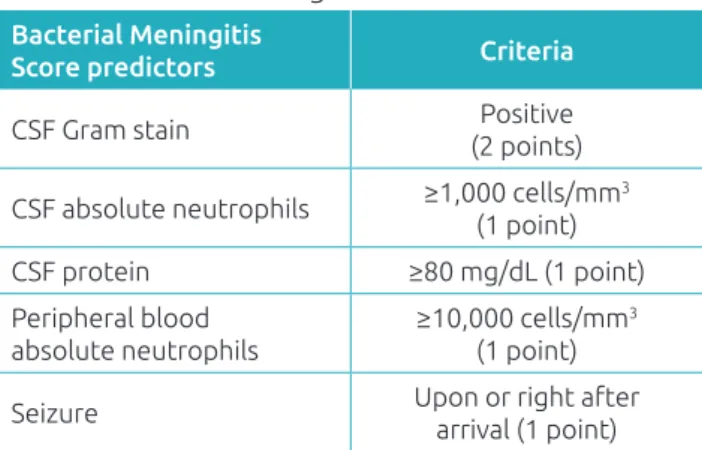
shown to be less speciic when compared BMS. he score of Nigrovic et al.11, shown in Table 1, uses one clinical and
four laboratorial criteria. Each criterion is assigned one point, while Gram criterion is assigned two. If all of them test negative, sensitivity and negative predictive value to rule out BM are 100%.11
Several studies have emerged after the publication of the study by Nigrovic et al.11 to evaluate this score.13,14 In 2012,
the same group of authors published a meta-analysis that conirmed the high sensitivity and high negative predictive value of the score.2 In Brazil, Mekitarian Filho and
cowork-ers found excellent results after applying the score in chil-dren with meningitis assisted at the University Hospital of Universidade de São Paulo (HU/USP), with 100% sensitiv-ity and negative predictive value.15 In addition to scores, one
can also use CSF lactate dosage in order to distinguish MB from MA. Cutof points in studies that showed the best sen-sitivity and speciicity values are not well established, ranging
from 2.1 to 4.4 mmol/L; however, a recent study conducted in Brazil used 30 mg/dL.16
he only Brazilian study that employed BMS was per-formed at one institution only. herefore, studies comprising more healthcare centers are necessary so that results can be val-idated. hus, our primary goal was to evaluate the discrimina-tory power of BMS to diferentiate MB and MA, in the context of a Brazilian tertiary, private hospital. Secondary purpose was to verify CSF lactate also for the distinction between bacterial and aseptic meningitis.
METHOD
All children aged 1 month and 14 years who were assisted at the emergency service of Hospital Israelita Albert Einstein (HIAE, São Paulo, SP) between January 1, 2011 and December 31, 2014, with meningitis-related International Classiication of Diseases (ICD) (A87, A87.0-9, G00, and G00.0-9) were ini-tially selected for the study.
his is a retrospective cohort study, carried out by medi-cal records data analysis and search for laboratory tests in the institution’s website. All data were collected at admission. Two authors (FRP and ACBFF) were responsible for collect-ing and compilcollect-ing data.
Inclusion criteria were: age between 1 month and 14 incomplete years on the day of medical assistance; Diagnosis of meningitis with CSF leukocyte >9 cells/μL (considering leukocytes-erythrocytes ratio of 1:500 for puncture acci-dent). Exclusion criteria were: hemodynamic instability, evi-dence of cerebral herniation, presence of ventricular shunt or recent neurosurgery; previous epilepsy occurrence, immu-nosuppression; other bacterial infection requiring parenteral antibiotics or having received antibiotics 72 hours prior to lumbar puncture.
he variables analyzed were gender, age, occurrence of seizures, absolute neutrophil and C-reactive protein (CRP), assessment of CSF glucose, lactate, neutrophils, protein and Gram, as well as blood and CSF cultures. All exams were collected at admission. Diferential cytology for CSF was performed with microscopic counting after cytospin con-centration and panchromatic staining. Biochemical features, lactate included, were processed by a dry-chemistry automated method (Fusion®
).
he outcomes analyzed were presence of BM or AM. In the bacterial meningitis group, children who had positive CSF cul-ture or pleocytosis (>9/mm3) associated with positive blood
culture for bacterial pathogen were considered. he aseptic meningitis group comprised all other children, who did not it the standards described.
Table 1 Bacterial Meningitis Score*.
Bacterial Meningitis
Score predictors Criteria
CSF Gram stain Positive
(2 points)
CSF absolute neutrophils ≥1,000 cells/mm3 (1 point)
CSF protein ≥80 mg/dL (1 point)
Peripheral blood absolute neutrophils
≥10,000 cells/mm3 (1 point)
Seizure Upon or right after
arrival (1 point)
he study sample (345 patients) was obtained for conve-nience in a 4-year period, which is suicient for the estima-tion of a 95% conidence interval (95%CI) and 65% accuracy measure, with 5% sampling error. As both primary and sec-ondary objectives of the study did not involve testing hypoth-eses, sample statistical power estimation was not applied.
In statistical analysis, the patients’ gender was described in groups as absolute frequencies and percentages and compared with by Fisher’s exact test. Numerical variables were described as medians and quartiles and compared with by the Mann-Whitney test. BMS power to distinguish children with BM and AM was assessed by measuring accuracy, sensitivity, speciicity, positive and negative predictive values; kappa coeicient was also used to compare agreement between score and cultures in BM scenario, all measures being accompanied by respective 95% intervals. he calculations were made in compliance with recommendations by Altman17 and aided by R packages 3.1.3
(R Foundation for Statistical Computing, Vienna, Austria) and Microsoft Excel 2010 (Microsoft Redmond, USA). he signif-icance level adopted in comparisons was 5%.
he project was approved by the Ethics Committee of HIAE and Platforma Brasil, under CAAE consubstantiate opinion: 46335015.2.0000.0071.
RESULTS
A total of 503 patients admitted to HIAE (SP) between 2011 and 2014 were identified and met the aforemen-tioned inclusion criteria. Among these, 64 were excluded due to the following conditions: previous use of antibiotic (n=26); no diagnosis of meningitis (n=29); two previous hospital admissions (n=8); previous occurrence of epilepsy (n=1). Among 439 children eligible for examination, 94 did not perform all tests required for BMS analysis, 90 were not submitted to blood count, and four did not have CSF Gram staining, so they were excluded afterwards. Thus, 345 patients fulfilled all prerequisites and were selected for the study (Flowchart 1): seven were allocated in BM group, and 338 in AM group.
he microorganisms isolated in cultures of patients in BM group were: Streptococcuspneumoniae (ive cases), Neisseria men-ingitidis (one case), and Enterococcusfaecalis (one case). In AM group, 292 had CSF investigated for polymerase chain reaction enterovirus and 237 tested positive (81%).
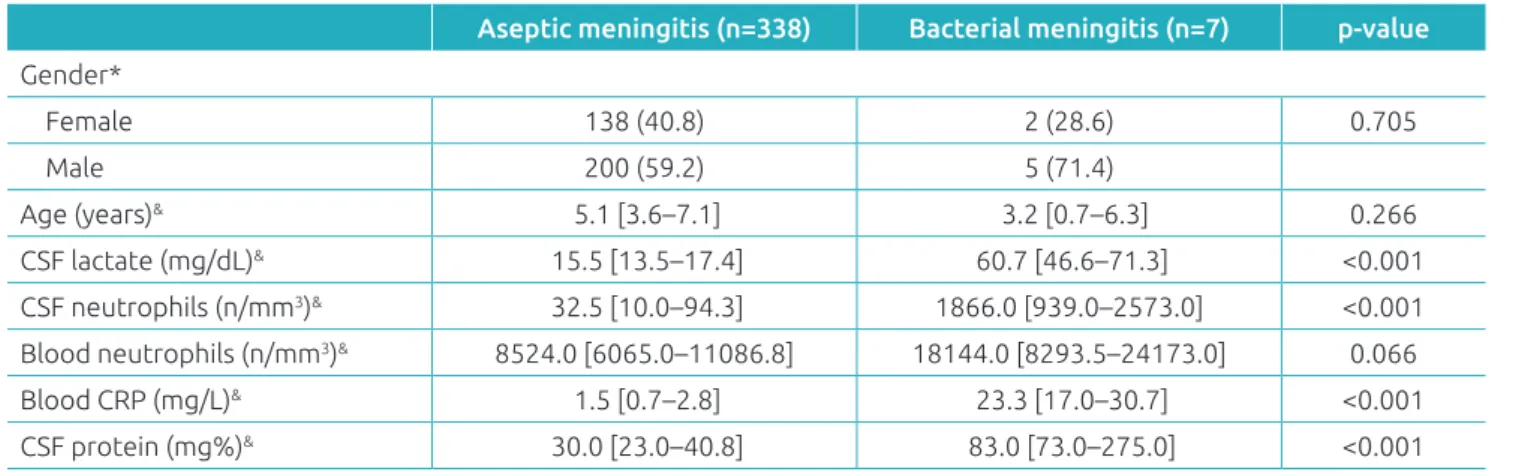
When comparing groups, no evidence of diference in age, gender, or blood neutrophils count was found (Table 2). he BM group had a higher CSF lactate value (60.7 versus 15.5 mg/dL in AM), CSF neutrophils count (1,866 versus 32.5/mm3 in AM),
Flowchart 1 Patients enrollment.
Patients (1 month old to 14 incomplete years old) with diagnosis of probable meningitis, admitted to
HIAE between 2011 and 2014 (n=503)
Excluded (n=64) Previous use of ATB (n=26) No meningitis diagnosis (n=29) Patient with two admissions (n=8)
Previous seizures (n=1)
Patients eligible for analysis of exams (n=439)
Excluded for not having all data for BMS assessment available (n=94) Not submitted to blood count (n=90) Not submitted to CSF Gram stain (n=4)
Patients with all BMS criteria assessed (n=345)
Patients with bacterial meningitis (n=7)
Patients with aseptic meningitis (n=338)
blood PCR (23.3 versus 1.53 mg/L in AM) and CSF protein (83 versus 30 mg% in AM), as shown in Table 2.
In BMS analysis, 1 point was the cutof for diferential diag-nosis of MB and MA; that is, if the patient scored 1 or more in BMS, it should be treated as probable MB. Results were: 100% sensitivity (95%CI 47.3–100), 64.2% speciicity (95%CI 58.8-69.3), 100% negative predictive value (95%CI 97.5-100), and kappa coeicient for score and CSF culture of 0.07 (95%CI -0.07 -0.2).
When using the 2 as cutof point in BMS and considering patients who scored 2 or more as BM, the same 100% sensi-tivity (95%CI 47.3-100) and negative predictive value were obtained (95%CI 98.3-100), but speciicity was increased to 98.8% (95%CI 97.0-99.7), and kappa coeicient for CSF score and culture was 0.77 (95%CI 0.55-0.99) (Table 3).
When using CSF lactate dosage with 30 mg/dL as cutof value for BM or AM diagnosis, results were: 85.7% sensitivity (95%CI 42.1-99.6), 99.1% speciicity (95%CI 97.4-99.8), 99.7% negative predictive value (95%CI 98.4-100.0), and kappa coeicient for CSF score and culture of 0.74 (95%CI 0.49-0.99).
Combining 2-point and 1-point BMS results and CSF lactate ≥30 mg/dL, findings were: 100% sensitivity (95%CI 47.3-100.0), 98.5% specificity (95%CI 96.6-99.5), 100% negative predictive value (95%CI 98.3-100.0), and kappa coefficient for CSF score and culture of 0.73 (95%CI 0.49 -0.96).
DISCUSSION
When analyzing 1-point BMS predictive value for BM, results were 100% sensitivity and negative predictive value, but speciicity was low (64.2%), which is in accordance with what has already been reported by other authors.11-15
In the present study, the wide range of sensitivity conidence (47 to 100%) draws attention. Such amplitude results from the small number of BM cases in our sample, compared to the large number of AM cases. Moreover, kappa coeicient was low in this analysis, 17 that is, the agreement between
score and the gold standard method (culture) is reduced, indicating that the BMS may not be the best choice for the population studied.
Table 2 Comparison between groups with bacterial and aseptic meningitis.
Aseptic meningitis (n=338) Bacterial meningitis (n=7) p‑value
Gender*
Female 138 (40.8) 2 (28.6) 0.705
Male 200 (59.2) 5 (71.4)
Age (years)& 5.1 [3.6–7.1] 3.2 [0.7–6.3] 0.266
CSF lactate (mg/dL)& 15.5 [13.5–17.4] 60.7 [46.6–71.3] <0.001 CSF neutrophils (n/mm3)& 32.5 [10.0–94.3] 1866.0 [939.0–2573.0] <0.001
Blood neutrophils (n/mm3)& 8524.0 [6065.0–11086.8] 18144.0 [8293.5–24173.0] 0.066
Blood CRP (mg/L)& 1.5 [0.7–2.8] 23.3 [17.0–30.7] <0.001
CSF protein (mg%)& 30.0 [23.0–40.8] 83.0 [73.0–275.0] <0.001
CSF: cerebrospinal luid; CRP: C‑reactive protein; *Expressed as n (%); &Expressed as median (interquartile range).
Table 3 Scores comparison.
Measures BMS≥1
% (95%CI)
BMS≥2
% (95%CI)
Lactate≥30 mg/dL
% (95%CI)
BMS+lactate* % (95%CI)
Sensitivity 100.0 (47.3–100.0) 100.0 (47.3–100.0) 85.7 (42.1–99.6) 100.0 (47.3–100.0)
Speciicity 64.2 (58.8–69.3) 98.8 (97.0–99.7) 99.1 (97.4–99.8) 98.5 (96.6–99.5)
Accuracy 64.9 (59.6–70.0) 98.8 (97.1–99.7) 98.8 (97.1–99.7) 98.6 (96.7–99.5)
Positive predictive value 5.5 (2.2–10.9) 63.6 (30.8–89.1) 66.7 (29.9–92.5) 58.3 (27.7–84.8)
REFERENCES
1. Kaplan SL. [homepage on the Internet] Bacterial meningitis in children older than one month: Treatment and prognosis Up to date. [cited 2015 Sep 24]. Available from: https://www. uptodate.com/contents/bacterial meningitis in children older than one month treatment and prognosis
2. Nigrovic L, Malley R, Kuppermann N. Meta analysis of bacterial meningitis score validation studies. Arch Dis Child, 2012;97:799‑805.
3. Schuchat A, Robinson K, Wenger JD, Harrison LH, Farley M, Reingold AL, et al. Bacterial meningitis in the United States in 1995: active surveillance team. N Engl J Med. 1997;337:970‑6.
4. Peltola H, Salo E, Saxen H. Incidence of Haemophilus inluenzae type b meningitis during 18 years of vaccine use: observational study using routine hospital data. BMJ. 2005;330:18‑9. 5. Black S, Shineield H, Fireman B, Lewis E, Ray P, Hansen JR,
et al. Eicacy, safety and immunogenicity of heptavalent pneumococcal conjugate vaccine in children. Northern California Kaiser Permanente Vaccine Study Center Group. Pediatr Infect Dis J. 2000;19:187‑95.
6. Black S, Shineield H, Baxter R, Austrian R, Bracken L, Hansen J, et al. Post licensure surveillance for pneumococcal invasive disease after use of heptavalent pneumococcal conjugate vaccine in Northern California Kaiser Permanente. Pediatr Infect Dis J. 2004;23:485‑9.
In the analysis of 2-point BMS, we found 100% sensitivity and a negative predictive value, besides speciicity being raised to 98.8%, which would generate low hospital admission rate, but still counting BM hospitalization cases. However, because of the small number of BM cases compared to AM, care should be taken when interpreting such data, since Nigrovic et al.11
reported an 87% sensitivity when the cutof point was increased to 2. hat is, 13% of children with BM were probably at risk of having been discharged from initial care if BMS was 2 points in the American study.
For CSF lactate with ≥30 mg/dL cutof, we found 85.7% sensitivity, 99.1% specificity, and 99.7% negative predic-tive value. Our results are in agreement with the literature, that is, this is a very speciic but not very sensitive criterion.16
herefore, using this method alone poses the risk of non-ad-mitting BM patients.
Since 2-point BMS did not individually demonstrate 100% sensitivity in another study11 and because CSF lactate alone was
also a speciic but not very sensitive criterion, we proposed the union of both parameters. When considering 2 or more points or 1-point BMS associated with CSF lactate value greater or equal to 30 mg/dL as predictive of BM, sensitivity was100%, speciicity was 98.5%, and negative predictive value was 100%. hose who did not meet these criteria were considered AM. Kappa coeicient of 0.73 shows good concordance17 between
this new score and conirmation of BM. Instead of applying only 1-point BMS, as already proposed in other studies, the advantage of this new approach is the signiicant increase in speciicity, without giving up high sensitivity.
In our study, the frequency of BM was 2% (95%CI 0.8-4.1). his data difers a lot from those obtained by Mekitarian Filho et al., who reported 9% of BM cases when analyzing
the clinical picture of 547 children between 2001 and 2012 in a public hospital of São Paulo.15 Diferences in
socioeco-nomic status and, especially, in vaccination history, may explain such results.18
Our study had, though, a few limitations. Being a ret-rospective survey may cause important information not to be obtained, especially regarding subjects’ general state and toxemia, or their vaccination history. Also, as the study was performed in one institution alone, it relects the reality of that place solely. In addition, the number of BM cases found was small, and this may have impaired the reproduc-ibility of the modiied score. he number of BM cases also explains the broad values in conidence intervals for sensi-tivity in all scores evaluated.
Bearing such limitations in mind, this is the irst Brazilian study to analyze accuracy of BMS in a private tertiary ser-vice which showed promising results like those reported in the literature and also conirmed previous indings of a Brazilian study conducted in a public hospital.15 he use of a
new criterion for initial diferentiation between BM and AM by combining CSF lactate and BMS is promising and had great sensitivity and speciicity in our series. However, fur-ther studies are needed, especially in institutions with large numbers of BM cases, so that the accuracy of this standard can be assessed and new tools can be provisioned for the care of children with meningitis.
Funding
his study did not receive funding.
Conflict of interests
© 2017 Sociedade de Pediatria de São Paulo. Published by Zeppelini Publishers.
This is an open access article under the CC BY license (http://creativecommons.org/licenses/by/4.0/).
7. Nigrovic LE, Kuppermann N, Macias CG, Cannavino CR, Moro Sutherland DM, Schremmer RD, et al. Clinical prediction rule for identifying children with cerebrospinal luid pleocytosis at very low risk of bacterial meningitis. JAMA. 2007;297:52‑60. 8. Alpern ER, Alessandrini EA, Bell LM, Shaw KN, McGowan KL. Occult bacteremia from a pediatric emergency department: current prevalence, time to detection, and outcome. Pediatrics 2000;106:505‑11.
9. McGowan KL, Foster JA, Coin SE. Outpatient pediatric blood cultures: time to positivity. Pediatrics. 2000;106:251‑5.
10. Neuman MI, Harper MB. Time to positivity of blood cultures for children with Streptococcus pneumoniae bacteremia. Clin Infect Dis. 2001;33:1324‑8.
11. Nigrovic LE, Kuppermann N, Malley R. Development and validation of a multivariable predictive model to distinguish bacterial from aseptic meningitis in children in the post Haemophilus inluenza era. Pediatrics. 2002;110:712‑9.
12. Dubos F, Korczowski B, Aygun DA, Martinot A, Prat C, Galetto Lacour A, et al. Distinguishing between bacterial and aseptic meningitis in children: European comparison of two clinical decision rules. Arch Dis Child. 2010;95:963‑7.
13. Agüero G, Davenport MC, Del Valle MP, Gallegos P, Kannemann AL, Bokser V, et al. Validación de una regla de predicción clínica para diferenciar meningitis bacteriana de meningitis aséptica. Arch Argent Pediatr. 2010;108:40‑4.
14. Tuerlinckx D, El Hayeck J, Van der Linden D, Bodart E, Glupczynski Y. External validation of the bacterial meningitis score in children hospitalized meningitis. Acta Clin Belg. 2012;67:282‑5.
15. Mekitarian Filho E, Horita SM, Gilio AE, Alves AC, Nigrovic LE. The bacterial meningitis score to distinguish bacterial from aseptic meningitis in children from São Paulo, Brazil. Pediatr Infect Dis J. 2013;9:1026‑9.
16. Mekitarian Filho E, Horita SM, Gilio AE, Nigrovic LE. Cerebrospinal luid lactate level as a diagnostic biomarker for bacterial meningitis in children. Int J Emerg Med. 2014;7:14.
17. Altman DG. Practical Statistics for Medical Research. London: Chapman & Hall; 1st edition. 1991.