www.reumatologia.com.br
REVISTA BRASILEIRA DE
REUMATOLOGIA
Review article
Evaluation protocols of hand grip strength in individuals with
rheumatoid arthritis: a systematic review
Ana Paula Shiratori, Rodrigo da Rosa Iop, Noé Gomes Borges Júnior,
Susana Cristina Domenech, Monique da Silva Gevaerd*
Postgraduate Program in Human Movement Sciences, Centro de Ciências da Saúde e do Esporte (CEFID), Universidade do Estado de Santa Catarina (UDESC), Florianópolis, SC, Brazil
a r t i c l e i n f o
Article history:
Received 20 November 2012 Accepted 14 May 2013
Keywords:
Rheumatoid arthritis Handgrip strength Measurement parameters Dynamometry
a b s t r a c t
Hand grip strength is a useful measurement for individuals with rheumatoid arthri-tis, since this disease is often associated with functional anomalies of the hands and a consequent reduction in muscular strength. Thus, the standardization of the test protocol is important in relation to make reproducible and reliable studies. The aim of this systematic review was to verify the parameters associated with the measure-ment of the hand grip strength in individuals with rheumatoid arthritis. The review was carried out according to the recommendations of PRISMA, based on the data-bases of the Web of Science and the Journals Website of the Brazilian governmen-tal agency CAPES. The following inclusion criteria were established: articles whose themes involved dynamometry to measure the hand grip in adult patients with rheumatoid arthritis, published in English between 1990 and 2012. The articles were selected by two independent reviewers. Initially, 628 articles were identiied, and in the inal review only 40 were included in the qualitative synthesis, that is, those in which the main tool used to evaluate the hand grip strength was the Jamar®. In relation to the hand grip strength parameters feedback type, hand dominance, rep-etitions, contraction intensity, acquisition time and rest period many data are impre-cise and were not detailed in the method description. It is clear that there is a need for the standardization of a protocol which establishes the type of dynamometer and the parameters to be evaluated and also takes into consideration the clinical conditions of patients with rheumatoid arthritis.
© 2014 Elsevier Editora Ltda. All rights reserved.
* Corresponding author.
E-mail: [email protected] (M.S. Gevaerd).
141
R E V B R A S R E U M A T O L . 2 0 1 4 ;5 4 ( 2 ): 1 4 0 – 1 4 7
Protocolos de avaliação da força de preensão manual em indivíduos com artrite reumatoide: uma revisão sistemática
Palavras-chave:
Artrite reumatoide Preensão manual Parâmetros de medida Dinamometria
r e s u m o
A força de preensão manual é uma medida útil nos indivíduos com artrite reumatoide, pois a doença está muitas vezes associada a anormalidades funcionais das mãos e consequente redução da força muscular. Dessa forma, a padronização do protocolo do teste é importante por tornar os estudos reprodutíveis e coniáveis. Essa revisão sistemática teve como inali-dade veriicar os parâmetros de medida da força de preensão manual em indivíduos com artrite reumatoide. A revisão foi realizada de acordo com as recomendações PRISMA, nas bases de dados web of science e no Portal de Periódicos da CAPES. Foram estabelecidos os seguintes critérios de inclusão: artigos cujos temas envolvessem a dinamometria de pre-ensão manual em pacientes adultos com artrite reumatoide, no idioma inglês, publicados entre 1990 e 2012. Os artigos foram selecionados por dois revisores independentes. Inicial-mente foram identiicados 628 artigos, sendo que na revisão inal apenas 40 artigos foram incluídos na síntese qualitativa; destes, veriicou-se que o principal instrumento utilizado para avaliação da força de preensão manual foi o Jamar®. Em relação aos parâmetros da força de preensão manual: tipo de feedback, dominância, repetições, intensidade da contra-ção, tempo de aquisição e tempo de descanso, muitos dados são imprecisos e não foram criteriosos na descrição do método. Evidencia-se a necessidade de padronização de um protocolo que estabeleça o tipo de dinamômetro, os parâmetros a serem avaliados e ainda leve em consideração as condições clínicas dos pacientes com artrite reumatoide.
© 2014 Elsevier Editora Ltda. Todos os direitos reservados.
Introduction
Rheumatoid arthritis (RA) is a major challenge to clinicians, rheumatologists, physiotherapists and researchers, not only because of its increasing long-term mortality, but also by work incapacitation, and the evidence of producing joint damage, weakness, fatigue, and general functional decline.1,2
In these individuals, handgrip is a useful parameter of eval-uation,3 since muscle weakness is a common symptom, of
dis-use atrophy, which results in systemic inlammation as well as of pain and joint stiffness.4
In the clinical context, handgrip strength serves several purposes, it is recommended for clinical diagnosis, for the evaluation and comparison of surgical techniques, for the doc-umentation of the progress during rehabilitation, the response to treatment and the level of disability after injury.5,6
Handgrip strength can also be used as an indicator of over-all strength and general health,7 commonly used in
profes-sional environments to evaluate the performance of athletes who depend on an adequate level of grip strength to maximize control and performance and to reduce possible injuries.8
Despite the handgrip being a routine measure in the evalu-ation of patients with RA, little attention has been paid to the importance of standardization of the test protocol for patients with this disease. The use of a standard protocol is important to improve the accuracy and consistency of the test, since dif-ferences in the protocols used can affect the reproducibility of measurements and the comparison of the absolute values to other studies .9
Given the importance of a standard protocol for the hand-grip test in patients with RA, our study aims to conduct a
sys-tematic review to investigate the disease’s treatment state-of-the-art, verifying which are the most used protocols for handgrip strength evaluation in RA patients .
Method
This systematic review was performed according to the rec-ommendations of the Preferred Reporting Items for System-atic Reviews and Meta-Analyses (PRISMA)10 which consists of
a checklist of 27 items and a low diagram and includes items deemed essential for a clear reporting of systematic reviews.
Eligibility criteria
The review included only observational and uncontrolled studies in English, encompassing adults with RA and hand-grip strength dynamometry, published between 1990 and 2012, available in complete form. Randomized clinical trials (RCTs) were not included, because in an initial search the terms associated with a sensible search list for RCTs devel-oped by Robinson and Dickersin (2002)11 did not yield any
re-sult.
Search strategy
The following electronic databases were searched: Web of Sci-ence and the online periodicals portal CAPES (Coordenação de Aperfeiçoamento de Pessoal de Nível Superior), using as search strategy the following combination of terms in Eng-lish: “(Grip strength maximal isometric* OR handgrip muscle strength* OR hand-grip dynamometry* OR handgrip strength* OR handgrip strength test contraction speed*)” AND “rheuma-toid arthritis”.
In sequence, with the aid of database tools, a search reine-ment was performed using the following keywords: “rheu-matoid arthritis”, “arthritis rheu“rheu-matoid”, “muscle strength”, “hand”, “hand strength”, “grip strength”, “isometric contrac-tion”, “mortality” and “grip”.
Study selection and data extraction
The irst selection of articles was carried out from title read-ing, and the second selection was conducted from the analy-sis of abstracts and keywords. To manage duplicate iles, we used EndNote Web (version 3.3), a management system of references. The titles and abstracts of all articles identiied by the search strategy were independently assessed by two of the authors of this paper (APS and RRI).
In this second phase the reviewers independently evalu-ated the full papers and made their selections, according to the eligibility criteria previously speciied. The outcomes were: pneumatic dynamometer, Jamar and digital dyna-mometer, measured in N (Newton) or kgf; in relation to the handgrip parameters; the outcomes were: type of feedback (visual or verbal), dominance (right or left), number of repeti-tions, intensity contraction (maximum strength), acquisition time and rest (in seconds or minutes, and the kind of strength analysis (best result or average).
Assessment of risk of bias
No method to assess the risk of bias in included studies was used for studies of different design.
Results
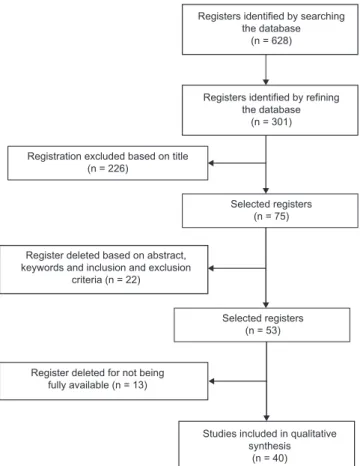
A total of 628 articles were identiied by the reviewers, and 420 were obtained from the CAPES website (SciVerse, Scien-ceDirect, MEDLINE, Science Citation Index Expanded, OneFile, SpringerLink, Oxford Journals, Social Sciences Citation Index, Future Science Medicine, PloS, American Psychological As-sociation, Karger Journals, Wiley, Bentham Science) and 208 from Web of Science. After reinement, the search was re-stricted to 301 articles, 93 of which were obtained from the Newsletters’ Website of CAPES and 208 from Web of Science. Initially, 75 articles were selected based on a title analysis; of these, only 22 articles were chosen because abstract and key-word analysis excluded several articles not meeting the inclu-sion criteria. Finally, 13 articles that were not available in its totality were excluded. Thus, 40 articles total were included in our qualitative synthesis, according to the low diagram pre-sented in Fig. 1.
Discussion
Equipment and techniques for measuring handgrip
For grip strength evaluation there are several devices avail-able, used both in clinical practice and in research. Main dynamometers are hydraulic, pneumatic, or digital.9 Table 1
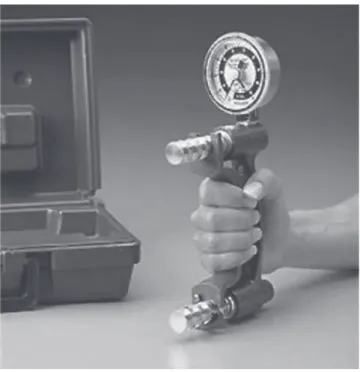
shows the main dynamometers and their characteristics. Among them, Jamar® hydraulic dynamometer (Fig. 2)12 is
the most mentioned in the literature, considered as the gold standard for the handgrip strength test.9 In this review, 19
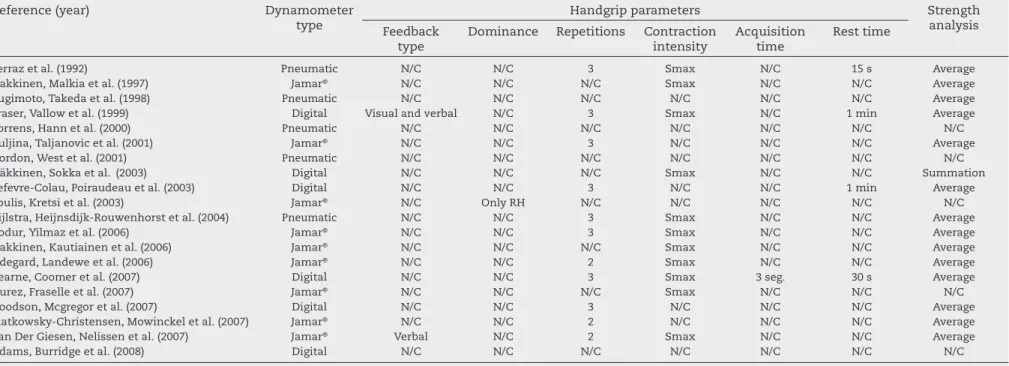
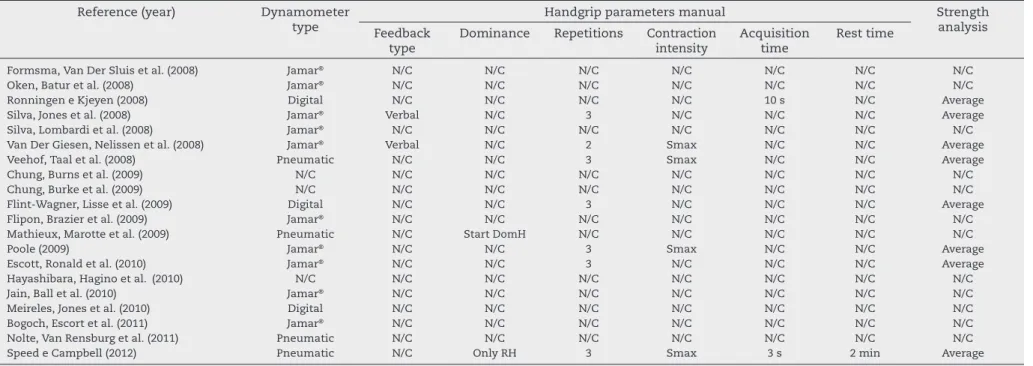
(47.5%) studies were found to include this device as an instru-ment for measuring handgrip strength. On the other hand, the use of a pneumatic dynamometer was reported in 10 (25%) studies, and the use of a digital dynamometer was reported in 8 (20%) studies. In only 3 (7.5%) articles the type of equipment used was not cited, as can be seen in Tables 2 and 3.
The Jamar® device enables a discrete handle
adjust-ment13,14 with 5 positions: I - 3.5 cm; II - 4.8 cm; III - 6.0 cm; IV
- 7.3 cm; and V - 8 6 cm.15 From the papers documenting the
use of Jamar® device, only three studies16-18 described the
po-sition adopted during the test application. Silva, Jones et al.16
standardized the position II for both genders; Escott, Ronald et al.17 and Bogoch, Escort et al.18 used positions II, III and IV
for testing. However, none of these studies justiied the crite-ria adopted for determining a position.
Studies were published19-21 that report the inluence of the
hand and handle sizes in the performance of grip strength.
Fig. 1 – Flow diagram of the steps for article selection.
Registers identified by searching the database
(n = 628)
Registers identified by refining the database
(n = 301)
Registration excluded based on title (n = 226)
Register deleted based on abstract, keywords and inclusion and exclusion
criteria (n = 22)
Register deleted for not being fully available (n = 13)
Studies included in qualitative synthesis
(n = 40) Selected registers
(n = 75)
143
R E V B R A S R E U M A T O L . 2 0 1 4 ;5 4 ( 2 ): 1 4 0 – 1 4 7
The American Society of Hand Therapy establishes the posi-tion II as the standard handle size.22
Pneumatic dynamometers are instruments that measure pressure, not manual strength. This pressure depends on the compression of air through a rubber bulb.22 This type of
dy-namometer lacks the feature of adjusting the grip, for com-pression. In this case, the pressure is dependent on the area where the strength is applied; thus, the size of the hand can inl uence the measurement.9 In the papers examined, three
studies regulated the initial cuff pressure at 20 mmHg,3,23,24
other two studies regulated the initial pressure at 30 mmHg25
or 40 mmHg2. The other i ve studies did not show this
infor-mation on the methodology session.
Digital dynamometers allow the evaluation of strength × time curve, providing other parameters for strength analy-sis, such as time to reach maximum strength, fatigue rate, and area under the curve, among others.26,27 This way of
analyzing the strength is advantageous in the evaluation of hand disorders,28 since one of the parameters considered as
an indicator of manual dysfunction is the rate of strength development.26
Regarding digital dynamometers, none of the studies (8 articles) presented the description of handle adjustment.
Some digital dynamometers feature continuous adjust-ment of the handle, allowing adaptation to the size of the hand and possible deformities present. This adjustment26 is
an important factor in strength performance, since the size of the hand inl uences the performance of the test.15
Protocols for handgrip measurement
Several aspects can affect the outcome of the handgrip test, and many of these are involved in dei ning the test applica-tion protocol, such as number of repetiapplica-tions performed, type of feedback,29 hand dominance, and fatigue.30
By setting the protocol to be applied to the handgrip strength test, the contraction intensity shall be established: maximum or submaximal. In special populations, such as arthritic people, there are factors that can inl uence the intensity of the con-traction election. The presence of pain, synovitis, erosion and joint deformity are direct factors; on the other hand, motiva-tion, pain tolerance and use of analgesics are indirect factors.31
The test of maximum strength in arthritic people is con-sidered a test of physical function based on individual perfor-mance, providing quantitative and reproducible information about the current state of patient and disease prognosis.32 This
test is also used as a predictive measure of nutritional sta-tus,33 morbidity and mortality.34 The evaluation of maximum
strength is well established in the literature, so that there is normative data for the healthy population.33,35 These data
may serve as a comparison parameter to arthritic individuals; thereby the use of the maximum contraction intensity param-eter has this advantage. Of the studies analyzed, 15 (37.5%) evaluated maximum strength only; the other studies did not present this information.
Regarding the number of test repetitions, 14 (35%) articles documented three attempts, 4 (10%) had only two repeats, and 22 (55%) did not report the number of repetitions performed. The recommendations of the American Society of Hand Thera-pistis36 and of the American Society for Surgery of the Hand37
are that three steps are performed. However, there is disagree-ment in the form of analysis of such measures, which can be made from a single trial,28 from the best obtained value,38 or
from values’ average.2 The average of three attempts has the
highest test-retest reliability. Therapists and physicians sug-gest this form of analysis, rather than just an attempt, or the analysis of the best value among three attempts, both for clin-ical assessment of the patient and for research purposes.22 In
the study from Haidar, Kumar et al.,39 it was found that both
the average of three attempts as the value of a single mea-surement showed high consistency, with no signii cant differ-ence between methods.
Table 1 – Types of dynamometers and their characteristics.
Type of dynamometer Measurement parameter Handhold grip Unit
Hydraulic Maximum strength With slight handle adjustment (5 different
positions)
Newton
Pneumatic Pressure Without handle adjustment mmHg
Digital Maximum strength, time to peak strength, fatigue rate, area under the curve, rate of strength
development
With or without continuous handle adjustment
Newton
N/C, Not cited; RH, Right hand; DomH, Dominant hand; Smax, Maximum strength.
Fig. 2 – Jamar dynamometer.
REV BRAS REUMA
T
OL.
2014;
54(2)
:140–147
Table 2 – Parameters of protocols for measuring handgrip in rheumatoid arthritis.
Reference (year) Dynamometer
type
Handgrip parameters Strength
analysis Feedback
type
Dominance Repetitions Contraction intensity
Acquisition time
Rest time
Ferraz et al. (1992) Pneumatic N/C N/C 3 Smax N/C 15 s Average
Hakkinen, Malkia et al. (1997) Jamar® N/C N/C N/C Smax N/C N/C Average
Sugimoto, Takeda et al. (1998) Pneumatic N/C N/C N/C N/C N/C N/C Average
Fraser, Vallow et al. (1999) Digital Visual and verbal N/C 3 Smax N/C 1 min Average
Torrens, Hann et al. (2000) Pneumatic N/C N/C N/C N/C N/C N/C N/C
Buljina, Taljanovic et al. (2001) Jamar® N/C N/C 3 N/C N/C N/C Average
Gordon, West et al. (2001) Pneumatic N/C N/C N/C N/C N/C N/C N/C
Häkkinen, Sokka et al. (2003) Digital N/C N/C N/C Smax N/C N/C Summation
Lefevre-Colau, Poiraudeau et al. (2003) Digital N/C N/C 3 N/C N/C 1 min Average
Poulis, Kretsi et al. (2003) Jamar® N/C Only RH N/C N/C N/C N/C N/C
Zijlstra, Heijnsdijk-Rouwenhorst et al. (2004) Pneumatic N/C N/C 3 Smax N/C N/C Average
Bodur, Yilmaz et al. (2006) Jamar® N/C N/C 3 Smax N/C N/C Average
Hakkinen, Kautiainen et al. (2006) Jamar® N/C N/C N/C Smax N/C N/C Average
Odegard, Landewe et al. (2006) Jamar® N/C N/C 2 Smax N/C N/C Average
Bearne, Coomer et al. (2007) Digital N/C N/C 3 Smax 3 seg. 30 s Average
Durez, Fraselle et al. (2007) Jamar® N/C N/C N/C Smax N/C N/C N/C
Goodson, Mcgregor et al. (2007) Digital N/C N/C 3 N/C N/C N/C Average
Slatkowsky-Christensen, Mowinckel et al. (2007) Jamar® N/C N/C 2 N/C N/C N/C Average
Van Der Giesen, Nelissen et al. (2007) Jamar® Verbal N/C 2 Smax N/C N/C Average
Adams, Burridge et al. (2008) Digital N/C N/C N/C N/C N/C N/C N/C
145
REV BRAS REUMA
T
OL.
2014;
54(2)
:140–147
Table 3 – Parameters of protocols for measuring handgrip in rheumatoid arthritis.
Reference (year) Dynamometer
type
Handgrip parameters manual Strength
analysis Feedback
type
Dominance Repetitions Contraction intensity
Acquisition time
Rest time
Formsma, Van Der Sluis et al. (2008) Jamar® N/C N/C N/C N/C N/C N/C N/C
Oken, Batur et al. (2008) Jamar® N/C N/C N/C N/C N/C N/C N/C
Ronningen e Kjeyen (2008) Digital N/C N/C N/C N/C 10 s N/C Average
Silva, Jones et al. (2008) Jamar® Verbal N/C 3 N/C N/C N/C Average
Silva, Lombardi et al. (2008) Jamar® N/C N/C N/C N/C N/C N/C N/C
Van Der Giesen, Nelissen et al. (2008) Jamar® Verbal N/C 2 Smax N/C N/C Average
Veehof, Taal et al. (2008) Pneumatic N/C N/C 3 Smax N/C N/C Average
Chung, Burns et al. (2009) N/C N/C N/C N/C N/C N/C N/C N/C
Chung, Burke et al. (2009) N/C N/C N/C N/C N/C N/C N/C N/C
Flint-Wagner, Lisse et al. (2009) Digital N/C N/C 3 N/C N/C N/C Average
Flipon, Brazier et al. (2009) Jamar® N/C N/C N/C N/C N/C N/C N/C
Mathieux, Marotte et al. (2009) Pneumatic N/C Start DomH N/C N/C N/C N/C N/C
Poole (2009) Jamar® N/C N/C 3 Smax N/C N/C Average
Escott, Ronald et al. (2010) Jamar® N/C N/C 3 N/C N/C N/C Average
Hayashibara, Hagino et al. (2010) N/C N/C N/C N/C N/C N/C N/C N/C
Jain, Ball et al. (2010) Jamar® N/C N/C N/C N/C N/C N/C N/C
Meireles, Jones et al. (2010) Digital N/C N/C N/C N/C N/C N/C N/C
Bogoch, Escort et al. (2011) Jamar® N/C N/C N/C N/C N/C N/C N/C
Nolte, Van Rensburg et al. (2011) Pneumatic N/C N/C N/C N/C N/C N/C N/C
Speed e Campbell (2012) Pneumatic N/C Only RH 3 Smax 3 s 2 min Average
The resting time interval between trials inluences the performance of the strength, because this variable is directly related to muscle fatigue. Of the articles analyzed, 35 (87.5%) studies did not show the break time allowed in their meth-odology. Other authors have used intervals of 15s;40 30s;24 1
minute;41,42 and 2 minutes.2 When comparing the resting time
at 15 s, 30 s and 60 s, it was found that there was no signiicant difference between the three breaks in strength application , however, the decline in strength was lower at 60 s.43 It is
con-sidered cautious a rest period of at least 1 minute, to counter-act the effects of fatigue.28,31,39,43,44
By analyzing the acquisition time of the handgrip strength test, it was found in 37 (92.5%) articles there was no descrip-tion of this variable; in the remaining articles, three sec-onds,3,24 and ten seconds were used.45 According to Kamimura
and Ikuta,28 there are few studies that focus on the inluence
of sustained strength time in the results. In a study compar-ing the contraction time of six vs. ten seconds, it was found that both showed a signiicant interclass correlation coefi-cient using a conidence interval of 95%.28
It is known that there are differences in grip strength be-tween the dominant and non-dominant hand. Studies reveal that the dominant hand has higher strength compared with the non-dominant hand;30 there is also a relationship with
gender, so that men have higher strength compared to wom-en.46 This difference between hands is about 10%.44 In some
handgrip protocols, hand dominance is considered and usu-ally the test begins with the dominant hand.39 Of the studies
surveyed, 37 (92.5%) articles did not consider the hand domi-nance at the beginning of the test. Only Mathieux, Marotte et. al.47 specify that the participants must start the test with the
dominant hand. Two studies evaluated the test on only one side – determining the protocol with only the right hand.2,14
The last parameter analyzed refers to the feedback at the moment of the strength accomplishment, and that can con-tribute to achieve the best performance from the individual under consideration. Some authors adopted into their proto-col the use of verbal feedback16,38,48 and others have adopted
both verbal and visual feedback.42 Other studies (36 articles
– 90%) reported no information about feedback. The use of feedback is a variable not well established in the literature involving individuals with arthritis, and also in other types of populations. There is a gap regarding the use of any type of feedback during handgrip strength tests; in this sense, Ma-thiowetz, Weber et al.22 raise the question of the inluence of
feedback on the outcome of grip strength.
Conclusion
Jamar dynamometer stands out as the most widely used type of dynamometer. As for the protocol, three repetitions at maximum intensity of contraction were reported. As for strength analysis, both average and best result were observed. From this review, a great variability of handgrip protocols between studies was perceived, and in many of these studies the protocol used was not fully disclosed.
Conlicts of interest
The authors declare no conlicts of interest.
R E F E R E N C E S
1. Oken O, Batur G, Gunduz R, Yorgancioglu RZ. Factors associated with functional disability in patients with rheumatoid arthritis. Rheumatol Int. 2008;29:163-6. 2. Speed CA, Campbell R. Mechanisms of strength gain in
a handgrip exercise programme in rheumatoid arthritis. Rheumatol Int. 2012;32:159-63.
3. Ferraz MB, Ciconelli RM, Araujo PMP, Oliveira LM, Atra E. The effect of elbow lexion and time of assessment on the measurement of grip strength in rheumatoid-arthritis. J Hand Surg. 1992;17:1099-103.
4. Hakkinen A, Kautiainen H, Hannonen P, Ylinen J, Makinen H, Sokka T. Muscle strength, pain, and disease activity explain individual subdimensions of the Health Assessment Questionnaire disability index, especially in women with rheumatoid arthritis. Ann Rheum Dis. 2006;65:30-4.
5. Rosén B. Recovery of sensory and motor function after nerve repair. A rationale for evaluation. J Hand Ther. 1996;9:315-27. 6. MacDermid JC, Kramer JF, Woodbury MG, McFarlane RM,
Roth JH. Interrater reliability of pinch and grip strength measurements in patients with cumulative trauma disorders. J Hand Ther. 1994;7:10-4.
7. Massy-Westropp N, Health M, Rankin W, Ahern M, Krishnan J, Hearn TC. Measuring grip strength in normal adults: Reference ranges and a comparison of electronic and hydraulic instruments. J Hand Sur. 2004;29:514-519. 8. Blackwell JR, Kornatz KW, Heath EM. Effect of grip span
on maximal grip force and fatigue of lexor digitorum supericialis. Appl Ergon. 1999;30:401-5.
9. Roberts HC, Denison HJ, Martin HJ, Patel HP, Syddall H, Cooper C, et al. A review of the measurement of grip strength in clinical and epidemiological studies: Towards a standardised approach. Age Ageing. 2011;40:423-9.
10. Liberati A, Altman DG, Tetzlaff J, Mulrow C, Gøtzsche PC, Ioannidis JP, et al. The PRISMA statement for reporting systematic reviews and meta-analyses of studies that evaluate healthcare interventions: Explanation and elaboration. BMJ. 2009;339:b2700.
11. Robinson KA, Dickersin K. Development of a highly sensitive search strategy for the retrieval of reports of controlled trials using PubMed. Int J Epidemiol. 2002;31:150-3.
12. Escalona DP, Naranjo OJ, Lagos SV, Solis FF. Parámetros de normalidad en fuerzas de prensión de mano en sujetos de ambos sexos de 7 a 17 anos de edad. Rev Chil Pediatr. 2009;80:435-43.
13. Buljina AI, Taljanovic MS, Avdic DM, Hunter TB. Physical and exercise therapy for treatment of the rheumatoid hand. Arthritis Care Res. 2001;45:392-7.
14. Poulis S, Kretsi Z, Apostolopoulos L, Zeeris H, Vagenas G. Functional and isokinetic assessment of hands with early stage of Rheumatoid Arthritis. Isokinet Exerc Sci. 2003;11:225-30.
15. Ruiz-Ruiz J, Mesa JL, Gutiérrez A, Castillo MJ. Hand size inluences optimal grip span in women but not in men. J Hand Surg Am. 2002;27:897-901.
16. Silva AC, Jones A, Silva PG, Natour J. Effectiveness of a night-time hand positioning splint in rheumatoid arthritis: a randomized controlled trial. J Rehabil Med. 2008;40:749-54. 17. Escott BG, Ronald K, Judd MGP, Bogoch ER. NeuFlex and
Swanson metacarpophalangeal implants for rheumatoid arthritis: Prospective randomized, controlled clinical trial. J Hand Surg. 2010;35:44-51.
147
R E V B R A S R E U M A T O L . 2 0 1 4 ;5 4 ( 2 ): 1 4 0 – 1 4 7
with metacarpophalangeal joint arthroplasty for rheumatoid arthritis. J Hand Surg. 2011;36:1007-14.
19. Ruiz JR, España-Romero V, Ortega FB, Sjöström M, Castillo MJ, Gutierrez A. Hand span inluences optimal grip span in male and female teenagers. J Hand Surg Am. 2006;31:1367-72. 20. Boadella JM, Kuijer PP, Sluiter JK, Frings-Dresen MH. Effect
of self-selected handgrip position on maximal handgrip strength. Arch Phys Med Rehabil. 2005;86:328-31. 21. Dias JA, Ovando AC, Külkamp W, Junior NGB. Hand grip
strength: Evaluation methods and factors inluencing this measure. Rev Bras Cineantropom Desempenho Hum. 2010;12:209-16.
22. Mathiowetz V, Weber K, Volland G, Kashman N. Reliability and validity of grip and pinch strength evaluations. J Hand Surg Am. 1984;9:222-6.
23. Nolte K, Van Rensburg DCJ, Kruger PE. Land- and water-based exercises in rheumatoid arthritis patients: A series of case reports. SAJSM. 2011;23:84-88.
24. Bearne LM, Coomer AF, Hurley MV. Upper limb sensorimotor function and functional performance in patients with rheumatoid arthritis. Disabil Rehabil. 2007;29:1035-9. 25. Zijlstra TR, Heijnsdijk-Rouwenhorst L, Rasker JJ. Silver ring
splints improve dexterity in patients with rheumatoid arthritis. Arthritis Care Res. 2004;51:947-51.
26. Helliwell P, Howe A, Wright V. Functional assessment of the hand: Reproducibility, acceptability, and utility of a new system for measuring strength. Ann Rheum Dis. 1987;46:203-8.
27. Shechtman O, Sindhu BS, Davenport PW. Using the force-time curve to detect maximal grip strength effort. J Hand Ther. 2007;20:37-47.
28. Kamimura T, Ikuta Y. Evaluation of grip strength with a sustained maximal isometric contraction for 6 and 10 seconds. J Rehabil Med. 2001;33:225-9.
29. Innes E. Handgrip strength testing: A review of the literature. Aust Occup Ther J. 1999;46:120-40.
30. Incel NA, Ceceli E, Durukan PB, Erdem HR, Yorgancioglu ZR. Grip strength: Effect of hand dominance. Singapore Med J. 2002;43:234-7.
31. Grindulis KA, Calverley M. Grip strength: Peak or sustained pressure in rheumatoid arthritis? J Chronic Dis. 1983;36:855-8. 32. Escalante A, Haas RW, del Rincón I. Measurement of global
functional performance in patients with rheumatoid arthritis using rheumatology function tests. Arthritis Res Ther. 2004;6:315-25.
33. Günther CM, Bürger A, Rickert M, Crispin A, Schulz CU. Grip strength in healthy caucasian adults: Reference values. J Hand Surg Am. 2008;33:558-65.
34. Angst F, Drerup S, Werle S, Herren DB, Simmen BR, Goldhahn J. Prediction of grip and key pinch strength in 978 healthy subjects. BMC Musculoskelet Disord. 2010;11:94.
35. Peters MJ, van Nes SI, Vanhoutte EK, Bakkers M, van Doorn PA, Merkies IS, et al. Revised normative values for grip strength with the Jamar dynamometer. J Peripher Nerv Syst. 2011;16:47-50.
36. Fess E. Grip strength. In: Casanova JS, editor. Clinical assessment recommendations. 2 ed. Chicago: American Society of Hand Therapists; 1992. p. 41-5.
37. American Society Hand Therapy. The hand: Examination and diagnosis. 3 ed. New York: Churchill Livingstone; 1983. 38. van der Giesen FJ, Nelissen RGHH, Rozing PM, Arendzen JH, de
Jong Z, Wolterbeek R, et al. A multidisciplinary hand clinic for patients with rheumatic diseases: A pilot study. J Hand Ther. 20:251-61.
39. Haidar SG, Kumar D, Bassi RS, Deshmukh SC. Average versus maximum grip strength: Which is more consistent? J Hand Surg Br. 2004;29:82-4.
40. Ferraz MB, Oliveira LM, Araujo PMP, Atra E, Tugwell P. Crosscultural reliability of the physical ability dimension of the Health Assessment Questionnaire. J Rheumatol. 1990;17:813-7.
41. Lefevre-Colau MM, Poiraudeau S, Oberlin C, Demaille S, Fermanian J, Rannou F, et al. Reliability, validity, and responsiveness of the modiied Kapandji index for assessment of functional mobility of the rheumatoid hand. Arch Phys Med Rehab. 2003;84:1032-8.
42. Fraser A, Vallow J, Preston A, Cooper RG. Predicting ‘normal’ grip strength for rheumatoid arthritis patients. Rheumatol. 1999;38:521-8.
43. Trossman PB, Li PW. The effect of the duration of intertrial rest periods on isometric grip strength performance in young-adults. Occup Ther J Res. 1989;9:362-78.
44. Watanabe T, Owashi K, Kanauchi Y, Mura N, Takahara M, Ogino T. The short-term reliability of grip strength measurement and the effects of posture and grip span. J Hand Surg Am. 2005;30:603-9.
45. Ronningen A, Kjeyen I. Effect of an intensive hand exercise programme in patients with rheumatoid arthritis. Scand J Occup Ther. 2008;15:173-83.
46. Nicolay CW, Walker AL. Grip strength and endurance: Inluences of anthropometric variation, hand dominance, and gender. Int J Ind Ergonom; 2005;35(7):605-18.
47. Mathieux R, Marotte H, Battistini L, Sarrazin A, Berthier M, Miossec P. Early occupational therapy programme increases hand grip strength at 3 months: results from a randomised, blind, controlled study in early rheumatoid arthritis. Ann Rheum Dis. 2009;68:400-3.