충격 신호 분석에 기반한 우적의 운동 에너지율
마르시아 모라에스
*ㆍ히까르도 테노리오
**ㆍ엘사 삼파이오
***ㆍ움베르또 바르보사
****ㆍ
까를로스 산또스
*****ㆍ윤홍주
******ㆍ권병혁
*******Kinetic Energy Rate of the Rain Drops Based on the Impact Signal Analysis
M. C. da S. Moraes*ㆍR. S. Tenório**ㆍE. Sampaio***ㆍH. A. Barbosa****ㆍC. A. C. dos Santos*****ㆍHong-Joo Yoon******ㆍByung-Hyuk Kwon******* 요 약 지표면 침식 잠재력은 비가 내린 영향으로 토양에 전달 된 운동 에너지로 평가할 수 있다. 충격 신호를 분 석할 수 있는 디즈드로미터로 우적 에너지율 관계식을 산출하였다. 대륙 강수의 97%와 해양 강수의 95%가 강우량과 강우율의 관계로 이루어진 이 지수 방정식으로 설명되었다. 이 관계식의 지수는 강우 유형에 의존하 지 않지만 계수는 강우 사건에 따라 조정될 수 있는 변동을 나타냈다. 이 관계식은 결정 계수, 평균 절대 오차 및 신뢰 오차에 의해 검증되었다. 특정 유형의 토양과 관련된 강수의 운동 에너지는 강우로 인한 침식의 가능 성을 결정할 수 있다. ABSTRACT
The erosive potential of precipitation can be evaluated by the kinetic energy transferred to the soil by the impact of the rain drop. A kinetic energy rate of the rain drops was estimated by the disdrometer classifying impact signals. This equation in the form of power presented an adjustment measure between the rain rate and rainfall quantity of 97% and 95% for continental and maritime rains, respectively. The exponent of the power equation, initially, shows no dependence on the type of rainfall. However, the multiplicative factor presented variation, which can be adjusted according to rainfall events. This equation was validated by the coefficient of determination, the average absolute error and the confidence error. The kinetic energy of precipitation, associated to certain types of soil, will allow the determination of the potential of the erosion caused by the rains.
키워드
Kinetic Energy Rate, Disdrometer, Drop Size Distribution, Erosion, Continental Rainfall 역학 에너지율, 디즈드로미터, 우적 분포, 침식, 내륙성 강우
* CAPES/UFAL-Pró-Alertas Project([email protected])
** SIRMAL/Institute of Atmospheric Science, UFAL([email protected]) *** Geosciences Department, University of Évora([email protected])
**** LAPIS/CAT/UFAL([email protected]) ***** UFCG/CTRN/UACA([email protected]) ****** 부경대학교 공간정보시스템공학과([email protected]) ******* 교신저자 : 부경대학교 지구환경시스템과학부 ㆍ접 수 일 : 2019. 07. 10 ㆍ수정완료일 : 2019. 07. 28 ㆍ게재확정일 : 2019. 08. 15
ㆍReceived : Jul. 10, 2019, Revised : Jul. 28, 2019, Accepted : Aug. 15, 2019 ㆍCorresponding Author : Dept. of environmental atmospheric sciences, Pukyong
National University. Email : [email protected]
Ⅰ. Introduction
Rainfall stands out among the most important meteorological elements, since it presents the greatest variation in terms of seasonal changes, and is the main factor in the use of the climate division in the region. The rains that happen at the state of Alagoas in Brazil are directly related to the atmospheric and oceanic circulation configurations. There are several precipitating systems at different spatial scales, according to Molion and Bernardo[1], which make up the synoptic scale, accounting for 40% to 60% of total rainfall observed in the northeast region of Brazil, are the Intertropical Convergence Zone (ITCZ). The front systems (SF) and the east-northeast convergence zone (ZCLN), are fed by the South Atlantic humidity. High-level cyclonic vortices (VCAN) are also large-scale rainfall systems, its performance on the northeast of Brazil is during spring, summer and fall (September to April), with maximum occurrence in the month of January, Kousky and Gan[2]. In the same scale, convective complexes and the wave perturbations in the field of the trade (POA) stand out. orographic circulations and small convective cells constitute micro-scale phenomena.
The kinetic energy of rainfall is the product of the mass of the raindrop and its rate of falling squared, this variable has often been suggested as an indicator of erosivity, e.g. rainfall capacity to cause erosion. According to Brady and Weil there are three stages of the process of soil erosion[3]. Starting with the impact of rainfall drops on moist soil. Then, the splashes resulting from the impact of the droplets on wet and uncovered soil. Therefore, the raindrops disintegrate the soil particles, which are then transported and finally deposited in places further down. Researches, such as Wischmeier and Smith, and Hudson, are the most cited when questioning the kinetic energy of
the raindrop[8-9]. These authors affirm and prove in their works that the impact of the raindrops is the main cause of the laminar erosion, and that the erosivity of the rain is a function of the kinetic energy caused by the impact of the drops on the soil.
This study is mainly aimed at the improvement in the mitigation of the effects caused by extreme meteorological events, and at the importance to understand the kinetic energy of the rain in relation to the loss of soil.
Ⅱ. Theory
2.1 Kinetic energy of rainfall
The kinetic energy of rainfall is related to the movement of the raindrops. This type of energy is a scalar quantity that depends on the mass and the modulus of the velocity of the drop in question. The higher the velocity of the droplet, the higher the kinetic energy. Kinnell shows that the kinetic energy of rain can be expressed as a rate, energy units per unit area per unit time [J(m2h)-1][4]. Researchers such as Kinnell and Steiner, and Smith, describe ERR, as the potential energy of the
rain. Several mathematical expressions described in the literature define the relation between kinetic energy rate and rain intensity, mainly linear relations and power relations[4-5]. Rosewell proposed a linear relationship whereas Steiner and Smith presented a power relation[5-6]. For Salles et al, the ERR is more appropriate when the data
collected from the DSD are through automatic measurement, and that a discussion based on DSDs models demonstrates that the most appropriate function that relates its power relations[7]. Rosewell proposed a linear relationship[6] whereas Steiner and Smith presented a power relation[5]. For Salles et al, the ERR is more appropriate when the data
measurement, and that a discussion based on DSD models demonstrates that the most appropriate function that relates a law of power[7]. The equation that represents the relation between amount of energy and intensity of rainfall was proposed by several researchers with diverse types of mathematical expressions.
2.2 Analysis of rainfall
Moraes analyzed the rainfall size distribution in classes of rain intensity according to the origin (maritime and continental) to the east of Alagoas-Brazil, verified that the rainfall rates below 10 mmh-1 represents the greater part of the rainfall intensity[8]. The number of drops of rainfall of marine origin is twice as great as that obtained for the rains originated in the continent. The average size of the drop (Dg) and the standard
deviation (σ) of DSDs is lower for maritime rains (approximately 11% for Dg and 8% for the σ).
Fig. 1. Distribution of rainfall drop size according to the origin (maritime or continental) and classes of R
(D = Diameter and R = rainfall).
However, it is observed that the differences between the parameters of the DSDs decrease as the rainfall (R) rate increases above approximately 10 mmh-1, (Fig. 1).
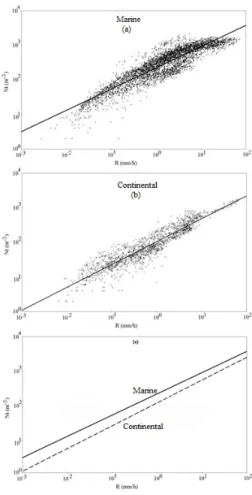
To emphasize the difference in the number of drops, Fig. 2 shows the NT (total number of drops)
and precipitation rate R according to their origin. The rain of the marine type presents higher values of NT when compared to continental precipitation
for intensities less than 40 mmh-1. Tenório et al show in Fig. 2 (a), (b) than the data points for the individual DSDs and adjusted curves (separate for the two subsets for better view of the points)[16]. In Fig. 2 (c), the two adjusted curves are compared.
Fig. 2. Total number of drops (NT) and
In the continental subset, the curve adjusted the points for all observed values of rain intensity, R, was between 10 and 100 mmh-1.
It is noted that for the marine type subset the quantity N(Di), number of drops whose diameter
corresponds to class (i) per unit volume for high values of R (≥ 40 mmh-1) doubles downward as opposed to the larger NT number for the
continental subset with high values of R. A quantitative correspondence is evident. Parallelism between the two universes leads to have the same response in terms of precipitation rate for the number of different drops, that is, to consider when we study the kinetic energy of the rains with origin of different formation.
Ⅲ. Materials and Methods
3.1 Instrument and data
The disdrometer RD-69 made by DISDROMET LTD, has a sampling area of 50 cm2 and it is sensitive to raindrop diameter ranging from 0.3 mm to 5.3 mm. The disdrometer measures the raindrop size and distribution by converting the impact of the raindrop into electrical pulses, whose amplitude is proportional to the drop size. The RD-69 is connected to an ADA-90 analyzer and to a PC. The part exposed to rain was installed on the roof and the reaming within the building. The disdrometer has two parts: the transducer transforms the mechanical impulse of drop that arrives in the pecker into the electric pulsation, whose amplitude is proportional to the mechanical impulse, and the processor is composed of circuits to eliminate non desired signs mainly the acoustic noise and to reduce 90 dB the detected dynamic sign of the transducer. Its main functions are: to provide electric information, to process the sign and to test through a circuit the performance of the instrument.
Data were collected from 2003 to 2006 with 26889 min DSDs. A total of 680 rainfall events were recorded, 40 propitious rainfall events leading to erosion, generated by rainfall of marine formation origin, and 7 of continental type. In order to classify the erosive rainfall event, was used the criteria suggested by Wischmeier and Smith and Cabeda[9,10]. The meteorological systems responsible for the formation of rain of continental origin were VCAN (with the center located on the Atlantic Ocean and western border on the interior of the Northeast) and the local convection itself and the arrival of disturbances were provoked by the passage of frontal systems on the state of Alagoas. Weather Radar images were used to observe the evolution of rainfall of continental and marine origin on the state of Alagoas. According to Tenório et al, this instrument is the most appropriate for rainfall observation in the tropics, especially along coastal regions[11]. The characteristics of the continental rains were as follows: the first rainfalls began to appear around 15 UTC in the regions between the Sertão and Zona da Mata alagoana, intensifying in the afternoon and losing strength in the early hours of the night. In general, the rains of continental origin are formed during the austral summer. The rains of marine origin were provoked by frontal systems, breezes, wave disturbances of the trade winds and the zone of humidity East northeast. This type of rain is frequently observed in the months of May, June, July and August, considered the rainy season of the State of Alagoas. However, rainfall of marine origin can occur at any time of the year, at any time of the day, and may present a short or long duration, varying from weak to strong, reaching any region of the state of Alagoas, mainly the coastal strip and zone of Mata[8].
3.3 Kinetic energy of rainfall
For Tenório et al., the equations (1), (2) and (3) estimate the intensity of the rain intensity R, the kinetic energy EK and the drop kinetic energy rate ERR are as follows[12]:
(1)
(2) (3) where ni is number of drops measured in size class i, Di mean diameter of the drops of class i, F sensitive surface area of the disdrometer, t time interval between measurements (1 minute) and V(Di) is drop velocity of one drop with diameter Di. First, we sought to understand the relationship between kinetic energy and rainfall intensity. For this, 15 classes of precipitation were stratified, defined from the percentile of the variable R. The percentile is defined from the ordering of the database with respect to precipitation, hence we use the 5% lower values of the dependent variable and we call the group of Pct 5% (percentile), then we use the next 5% lower values and we call Pct 10% and so on up to Pct 95%. Subsequently, we obtained the mean values of the variable ERR, ERAand R for each class. A threshold of R ≥ 0.2 mm was applied to eliminate possible undesirable errors at very small intensities. The approximation for power law, represented by equation (4), it was possible to determine an equation capable of estimating the kinetic energy rate, ERR in J(m2h)-1
from the rain intensity, R.
or
(4)
where Y=ERR (dependent variable), X=R
(independent variable), a intercept and b slope. To transform the power function in the linear function we have ln ln ln . The relationship between ERR-R in the form of potency was also
proposed by Yu et al.[13].
Ⅳ. RESULTS AND DISCUSSION
To describe and summarize the information contained in a large sample, Table 1 presents mean values of the physical variables of the rain, such as maximum drop diameter (Dmax) rain intensity
and kinetic energy of the rain of continental and marine origin. Measures of central tendency such as the mean, median, and fashion translate the value information around which the data are positioned. The standard deviation and variation are scatter measures allow to evaluate the variability of the data set. The standard error other than the standard deviation is the estimate of the variability of the mean as a function of sample size.
The balance of the sample for each type of rainfall (maritime and continental) shows that maritime rainfall presented higher mean values for R and ERR when compared to the continental rains.
The rains that formed on mainland presented Dmax
greater when compared with the rains of the marine type. The standard error of the mean determined the accuracy of how much the sample mean estimated the population mean for the variables Dmax and R (maritime and continental) the
values were quite low. The low values of the standard error indicate more accurate estimates of the population mean. The kinetic energy rate for continental rainfall presented higher values of standard deviation, normally, when the standard deviation is higher, a less accurate estimate. The values of the mode show the highest frequency in the continental type rainfall, when bought with the
Measures Dmax [mm] R [mmh
-1
] ERR [J(m-2h)-1]
Maritime Continental Maritime Continental Maritime Continental
Average 1.64 2.07 3.90 3.56 61.81 60.64 Default error 0.00 0.01 0.05 0.21 0.89 4.31 Medium 1.51 1.91 0.98 1.34 8.93 19.13 Mode 1.12 2.25 0.01 0.47 0.08 17.44 Standard deviation 0.62 0.44 7.41 7.61 145.25 155.53 Minimum 0.46 1.11 0.18 0.20 0.005 1.14 Maximum 5.37 5.37 73.4 71.06 1654.80 1482.74
Table 1. Static characteristics of rainfall. ones of marine origin in all the variables. The
rainfall intensity was the variable that exhibited the greatest dispersion in relation to its mean.
4.1 Determinations of ERR
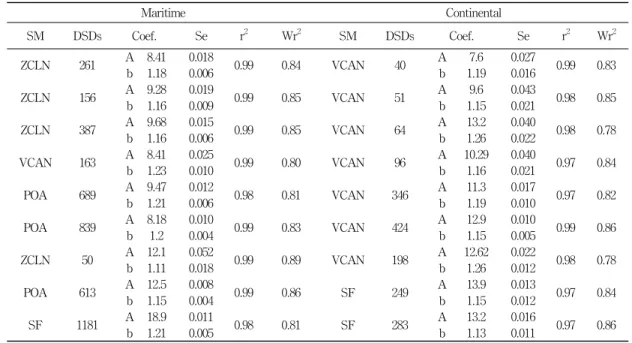
We selected nine meteorological systems responsible for continental and maritime rain that were located in the east of Alagoas. For each system, an equation in the form of power was determined from the data of rain intensity and kinetic energy rate.
The coefficients A and b of the resulting equations are presented in Table 2. The equations found in the power form represent the best fit of the DSD data sample for each type of rain weather system. The verified values A and b for each meteorological system corresponds to the parameters of the regression equation that minimizes the differences between ERR observed
and ERR* estimated by regression.
We can observe slight variation in exponent b, that is, there was minor change in the mean of the probability distribution of ERR when a unit change
in R. This slight variation was observed in either types of rainfall (maritime and continental), showed little or no relation to the sample size or meteorological system, but it was related exclusively to the average of the possible values that the variable ERR can assume when a variation
in the rainfall rate occurs.
The coefficient A that represents the mean value
of the distribution in ERR shows in the analyzed
cases (meteorological systems/rainfall type) presented significant variation, mainly by the
rainfall provoked by the frontal systems (SF), with higher values, being able to be associated to the size and number of drops produced by the system. The coefficients A and b are acceptable according to the values of the standard error (Se) and coefficient of determination (r2). The standard error represents the mean deviation between the actual ERR values and the probable (estimated) values of
ERR*, whose accuracy depends on population
dispersion and sample size.
This deviation roughly informs the extent of the error between the values obtained from the estimates and the ERR values provided by the
sample. The larger the sample size, the lower the standard error, and the closer the values of the two means will be to each other, this influence can be observed in the SF (maritime type) with 1181 DSDs and in the VCAN rain (continental type), with 424 DSDs. The Se found for both types of rain are considered acceptable.
However, the value of the error means that there are other factors that interfere in the behavior of ERR sides the variable of rain intensity,
but cannot be explained in this article. The coefficient of determination r2 in percentage explains how much the equation found can explain the values found and the observed values. All the cases studied from the maritime and continental
Maritime Continental SM DSDs Coef. Se r2 Wr2 SM DSDs Coef. Se r2 Wr2 ZCLN 261 A 8.41 0.018 0.99 0.84 VCAN 40 A 7.6 0.027 0.99 0.83 b 1.18 0.006 b 1.19 0.016 ZCLN 156 A 9.28 0.019 0.99 0.85 VCAN 51 A 9.6 0.043 0.98 0.85 b 1.16 0.009 b 1.15 0.021 ZCLN 387 A 9.68 0.015 0.99 0.85 VCAN 64 A 13.2 0.040 0.98 0.78 b 1.16 0.006 b 1.26 0.022 VCAN 163 A 8.41 0.025 0.99 0.80 VCAN 96 A 10.29 0.040 0.97 0.84 b 1.23 0.010 b 1.16 0.021 POA 689 A 9.47 0.012 0.98 0.81 VCAN 346 A 11.3 0.017 0.97 0.82 b 1.21 0.006 b 1.19 0.010 POA 839 A 8.18 0.010 0.99 0.83 VCAN 424 A 12.9 0.010 0.99 0.86 b 1.2 0.004 b 1.15 0.005 ZCLN 50 A 12.1 0.052 0.99 0.89 VCAN 198 A 12.62 0.022 0.98 0.78 b 1.11 0.018 b 1.26 0.012 POA 613 A 12.5 0.008 0.99 0.86 SF 249 A 13.9 0.013 0.97 0.84 b 1.15 0.004 b 1.15 0.012 SF 1181 A 18.9 0.011 0.98 0.81 SF 283 A 13.2 0.016 0.97 0.86 b 1.21 0.005 b 1.13 0.011
Table 2. Values A and b of the equations. Power for systems of rainfall production of the marine and continental type.
rains presented very good values of determination, thus providing values above 97% of acceptance, however, for the validation of these equations it
was necessary to calculate the r2 weighted (Wr2), where its values remain acceptable to estimate the value ERR*.
4.2 ERR for continental and maritime rainfall
Equations (5) and (6) estimate the kinetic energy rate for continental and maritime rainfall, respectively. Samples of 25159 min (DSDs) for maritime rain and 1730 min (DSDs) for continental rain were used, with a threshold of R ≥ 0.2 mmh-1, where R presents rain intensity between 0.2 mmh-1 ≤ R ≤ 71.06 mmh-1. Equation (5) represents the rate of kinetic energy of the continental type rainfall with r2=0.97.
(5) The coefficients A=13 and b=1.11 are close to
the values found in Table 2. The standard error of coefficients A and b, r2 and Wr2 are considered to be reliable, with 0.006, 0.005, 97% and 87%
respectively. Yu et al. determined an equation in the form of power to the southwest of France, used rain gauge and optical OTD Parsivel, and with R ≥ 0.5 mmh-1[13]. Equation (6) represents the kinetic energy rate of marine type rainfall with r2=0.95.
(6) For the coefficients A and b of the equation that represents the rain of the marine type the standard error for coefficient were A=0.002 and for the exponent, b=0.001, with coefficient of determination of 95% and Wr2 with 80%, considered statistically acceptable values for calculating the kinetic energy rate for rain of the marine type. It can be concluded that 97% and 95% of the ERR variations
occur as a function of the rain intensity variation R. The researchers Steiner and Smith, observed the
R Class N° DSDs min (mmh-1) max (mmh-1) (mmh-1) N°gt (total) max (mm) (Jm-2h-1) (Jm-2h-1) (Jm-2h-1) (%) EAM (Jm-2h-1) RQEM (Jm-2h-1) Class 1 91 0.18 0.27 0.22 3890 1.588 2.251 2.509 0.258 11.46 0.504 0.612 Class 2 92 0.27 0.34 0.30 4113 1.706 3.420 3.523 0.103 3.01 0.618 0.796 Class 3 88 0.34 0.44 0.39 4522 1.760 4.673 4.659 -0.014 -0.29 1.014 1.542 Class 4 93 0.44 0.56 0.49 5599 1.920 6.413 5.979 -0.434 -6.76 1.303 2.020 Class 5 91 0.56 0.73 0.64 6177 1.951 9.046 8.140 -0.906 -10.01 1.599 2.404 Class 6 93 0.73 0.90 0.81 8157 1.981 10.718 10.472 -0.246 -2.29 1.763 2.457 Class 7 90 0.90 1.10 0.99 9442 2.066 13.975 13.003 -0.972 -6.95 3.047 4.395 Class 8 88 1.10 1.39 1.89 13855 2.203 28.815 26.472 -2.343 -8.13 5.504 6.845 Class 9 90 1.39 1.78 1.57 11715 2.154 23.746 21.505 -2.241 -9.43 4.306 5.216 Class 10 92 1.78 2.45 2.09 16039 2.201 31.593 29.453 -2.14 -6.77 6.253 7.657 Class 11 91 2.45 3.35 2.81 20431 2.212 67.755 67.176 -0.579 -0.85 10.473 12.858 Class 12 92 3.35 4.37 3.90 26515 2.235 59.224 58.530 -0.694 -1.17 9.497 11.156 Class 13 91 4.37 5.45 4.87 31938 2.217 74.370 74.704 0.334 0.44 11.654 14.136 Class 14 91 5.45 8.14 6.52 40062 2.267 100.789 102.88 2.092 2.07 16.202 19.611 Class 15 92 8.14 71.06 24.24 80814 2.470 468.206 447.49 -20.709 -4.42 31.878 43.114
Table 3. Relative error of the power equation analysis in different classes of rain intensity to determine the approximate value of the kinetic energy rate for the continental type rainfall.
variability of the coefficients of a power law ratio with data from the JWD in northern Mississippi concluded that exponent b shows little variation and can be used as fixed exponents whereas
multiplicative factor A should normally be adjusted according to the rainfall event[4].
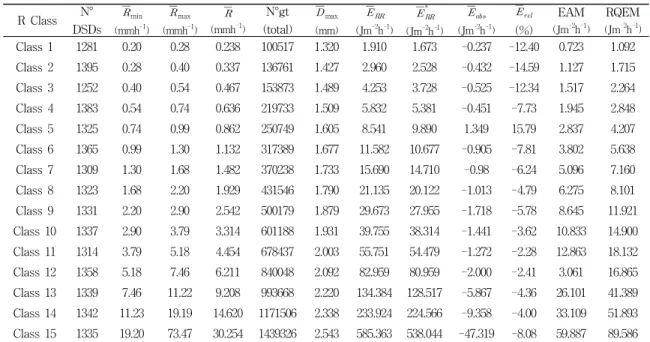
Tables 3 and 4 characterizes continental and maritime rainfall which were separated by intensity range. These tables present information on the maximum, average and minimum intensities of rainfall, as well as maximum diameter and total number of drops per rain intensity range. We can find a direct relation between the increase in average rainfall intensity with increasing mean number of drops, with mean maximum diameter and the rate and amount of kinetic energy (observed and estimated). We calculated the mean absolute errors, percentage relative error, mean absolute error and square root mean error per class. In this way, it is possible to verify how the potential equation estimate the ERR* of maritime
and continental rains for each rain intensity range. When we compared the kinetic energy rate observed by the continental and maritime rainfall disdrometer, it was found that the kinetic energy
rate of the continental rain drop was higher between classes 1 to 12 (0.22 ≤ R < 4.37 mmh-1), in relation to the marine type rainfall classes. This high rate of kinetic energy can be justified by the maximum diameter recorded during the rainfall distribution being higher in the same classes. It is observed that from class 13 (R ≥ 4.37 mmh-1) the kinetic energy rates increase in the marine type rainfall, the maximum diameters recorded are higher for marine type rainfall (Table 4).
The difference between estimated and observed values was lower in the low intensity rainfall and kinetic energy rates, and more significant in the rain intensity range (8.14 mmh-1 ≤ R < 71.06 mmh-1), with a value of 20.709 J(m2h)-1 for continental rainfall and (19.20 mmh-1 ≤ R < 73.47 mmh-1), with a value of 47.319 J(m2h)-1, that is, the
R Class N° DSDs min (mmh-1) max (mmh-1) (mmh-1) N°gt (total) max (mm) (Jm-2h-1) (Jm-2h-1) (Jm-2h-1) (%) EAM (Jm-2h-1) RQEM (Jm-2h-1) Class 1 1281 0.20 0.28 0.238 100517 1.320 1.910 1.673 -0.237 -12.40 0.723 1.092 Class 2 1395 0.28 0.40 0.337 136761 1.427 2.960 2.528 -0.432 -14.59 1.127 1.715 Class 3 1252 0.40 0.54 0.467 153873 1.489 4.253 3.728 -0.525 -12.34 1.517 2.264 Class 4 1383 0.54 0.74 0.636 219733 1.509 5.832 5.381 -0.451 -7.73 1.945 2.848 Class 5 1325 0.74 0.99 0.862 250749 1.605 8.541 9.890 1.349 15.79 2.837 4.207 Class 6 1365 0.99 1.30 1.132 317389 1.677 11.582 10.677 -0.905 -7.81 3.802 5.638 Class 7 1309 1.30 1.68 1.482 370238 1.733 15.690 14.710 -0.98 -6.24 5.096 7.160 Class 8 1323 1.68 2.20 1.929 431546 1.790 21.135 20.122 -1.013 -4.79 6.275 8.101 Class 9 1331 2.20 2.90 2.542 500179 1.879 29.673 27.955 -1.718 -5.78 8.645 11.921 Class 10 1337 2.90 3.79 3.314 601188 1.931 39.755 38.314 -1.441 -3.62 10.833 14.900 Class 11 1314 3.79 5.18 4.454 678437 2.003 55.751 54.479 -1.272 -2.28 12.863 18.132 Class 12 1358 5.18 7.46 6.211 840048 2.092 82.959 80.959 -2.000 -2.41 3.061 16.865 Class 13 1339 7.46 11.22 9.208 993668 2.220 134.384 128.517 -5.867 -4.36 26.101 41.389 Class 14 1342 11.23 19.19 14.620 1171506 2.338 233.924 224.566 -9.358 -4.00 33.109 51.893 Class 15 1335 19.20 73.47 30.254 1439326 2.543 585.363 538.044 -47.319 -8.08 59.887 89.586
Table 4. Relative error of the power equation analysis in different classes of rain intensity to determine the approximate value of the kinetic energy rate for the maritime type rainfall.
equation (15) underestimates in absolute values 47.319 J(m2h)-1. The equation (5) underestimates in absolute values 47.319 J(m2h)-1 for high marine type rain intensities. The relative error gives the difference between the approximate values and the exact value, helping to find how close to the equations is of the exact value. This difference represents a percentage of 8.08% (maritime rainfall) and 4.42% (continental). With the analysis of the mean difference of the possible errors between estimated and observed values (EAM) by the disdrometer it was verified that in all classes errors occur. These errors were increasing with increasing rainfall intensity and with the kinetic energy rate, mainly in class 15 of both types of rain. This behavior was also observed when analyzing the degree of scattering obtained in the comparison with estimated values.
V. CONCLUSIONS
The kinetic energy of rain was predicted in its form of rain rate (units of energy per unit area per unit time) derived directly from DSDs. The equation in the form of power showed an excellent adjustment measure between the dependent (ERR)
and independent (R) variables. This means that the dependent variable can be explained through the regressions of this equation. When analyzing the variation of the coefficients A and b among the meteorological systems, it was found that the variability of exponent b has no great dependence on the type of rain. The multiplicative factor A presented variation, mainly in the maritime rain, being able to be adjusted depending on the type of rain. By analysing the performance indicators of the power equation by class, it can be concluded that the ERR* equation underestimates the rate of
several classes of rain intensity, and that the errors increase with increasing intensity of the rain. As rainfall of continental origin has Dmax and NT
greater than those of marine origin, it can be concluded that the rainfall drops forming over continent should cause greater impact on the soil, especially at higher intensity. All the information about the kinetic energy of the precipitation, being associated to certain types of soil of interest, allows the determination of the erosive potential of the rain. Thus it is able to help to take preventive measures that can mitigate the effects caused by the erosion.
Acknowledgement
This work was funded by the Korea Meteorological Administration Research and Development Program under Grant KMIPA 2018-06310 and by the BK21 plus Project of the Graduate School of Earth Environmental Hazard System.
References
[1] L. Molion and S. Bernardo, “Uma revisão da dinâmica das chuvas no Nordeste Brasileiro,”
Revista Brasileira Meteorologia, vol. 17, no. 1,
2002, pp. 1-10.
[2] V. Eousky and M. Gan, “Upper tropospheric cyclonic vortices in the tropical South Atlantic,”
Tellus, vol. 33, no. 6, 1981, pp. 538-551.
[3] N. Brady and R. Weil, Elements of the nature and
properties of soils. Porto Alegre-RS: Bookman,
2013.
[4] P. I. A. Kinnell, “Rainfall intensity-kinetic energy relationships for soil loss prediction,” Soil Science
Society of America, vol. 45, no. 1, 1981, pp.
153-155.
[5] C. Rosewell, “Rainfall kinetic energy in Eastern Australia,” J. Appl. Meteorol. Climatol., vol. 25, no. 11, 1986, pp. 1695-1701.
[6] M. Steiner and J. A. Smith, “Reflectivity, Rain Rate and Kinetic Energy Flux Relationships Based on Raindrop Spectra,” J. Appl. Meteorol.
Climatol., vol. 39, no. 11, 2000, pp. 1923-1940.
[7] C. Salles, J. Poesen, and D. Sempere-Torres, “Kinetic energy of rain and its functional relationship with intensity,” J. of Hydrology, vol. 257, no. 1-4, 2002, pp. 256-270.
[8] M. C. da Silva Moraes, “Parâmetros de radar e distribuição do tamanho de gotas de chuva continental e marinha no leste do nordeste do Brasil: sua influencia na estimativa da vazão na Bacia do Rio Mundaú,” Doctoral Thesis,
Universidade Federal de Campina Grande, 2011.
[9] W. Wischmeier and D. Smith, “Rainfall energy and its relation to soil loss,” Transactions of the
American Geophysical Union, vol. 39, no. 2, 1958,
pp. 285-291.
[10] M. S. V. Cabeda, Computation of storm EI values. West Lafayette: Purdue University, 1976. [11] R. Tenório, B. Kwon, L. Molion, and D.
Quintão, “Radar Rainfall Studies over Eastern Coast of Northeast Brazil,” J. of the Kor.
Meteorol. Soc., vol. 39, no. 6, 2003, pp. 699-707.
[12] R. Tenório, M. Moraes, and H. Sauvageot, “Raindrop Size Distribution and Radar Parameters in Coastal Tropical Rain Systems of Northeastern Brazil,” J. Appl. Meteorol. Climatol., vol. 51, no. 11, 2012, pp. 1960-1970.
[13] N. Yu, B. Boudevillain, G. Delrieu, and R. Uijlenhoet, “Estimation of rain kinetic energy from radar reflectivity and/or rain rate based on a scaling formulation of the raindrop size distribution,” Water Resources Research, vol. 48, no. 4, 2012, pp. 1-13.
저자 소개
Macia C. da S. Moraes
Coordination for the Improvement of Higher Education Personnel Federal University of Alagoas Pró-Alertas Project
※ Field of interest : Hydrology
Ricardo S. Tenório
1984 B.S Federal University of Alagoas, Brazil 1989 M.S University of Reading, England 1996 Ph.D University of Toulouse III, FranceCoordinator, Weather Radar System of Alagoas State & Institute of Atmospheric Science
Professor, Dept. of Meteorology in Federal University of Alagoas
※ Field of interest : Radar Meteorology
Elsa Sampaio
Geosciences Department,
Institute of Mediterranean Agrarian and Environmental Sciences in University of Évora Development and Research in Environment, Applied Management and Space in Lusófona University of Humanities and Technologies ※ Field of interest : Geosciences
Humberto A. Barbosa
Laboratório de Processamento de Imagens de Satélites
Institute of Atmospheric Science in Federal University of Alagoas ※ Field of interest : Remote sensing
Carlos A. C. dos Santos
Universidade Federal de Campina Grande
Centro de Tecnologia e Recursos Naturais
Unidade Acadêmica de Ciências Atmosféricas ※ Field of interest : Atmospheric sciences