The impact of acceleration programs on
early-stage tech-startups considering the
founders’ background
João Pedro Prazeres Ramadas
152116004
Dissertation written under the supervision of Professor Cláudia Costa
Dissertation submitted in partial fulfillment of requirements for the IMSc in Management with Major in Entrepreneurship & Innovation, at Universidade Católica
Acknowledgments
First of all, I would like to thank every startup and founder who put aside his busy life for a little while in order to participate in this study. Thank you for sharing the stories, lessons and outcomes from the acceleration programs, as without all of you, this work would not be possible and we would not be able to achieve the results we did.
Second, I would like to thank my supervisor Professor Cláudia Costa for her need ending patience, interest, feedback, encouragement and for believing constantly that I could deliver better and better work. Without her, the work presented in this report would not be at this level and for that I will always be grateful.
Third, my family deserves my fully and everlasting appreciation. Without them, I would not be able to reach this point in my academic and professional career. A special thanks to my mother for supporting me while I studied, for paying for my bachelor and my master and for always opening every door she could in order to provide me with all the opportunities she never had.
Fourth, I am grateful to my friends, who were always by my side and helped in during the time I felt more stressed and believed in me. Another special thanks to my girlfriend Bárbara Reis who played a big role during the last few months. She helped me to keep my spirits up, reviewed every word in this document to make sure I had the best grade possible and for always believing in me, no matter what.
Lastly, a general thanks to everyone who was a part of my academic journey and, in some way, helped me to reach this point in my academic, personal and professional life.
Abstract
Title: The impact of acceleration programs on early-stage tech-startups considering the founders’ background.
Author: João Pedro Prazeres Ramadas
Keywords: Entrepreneurship; Early-stage startups; Tech-based startups; Acceleration programs; Entrepreneurial learning, Exploitative and explorative learning.
The growth of tech-startups such as Airbnb and Uber into multibillion-dollar companies has a strong impact on the economy. Yet, 50% of startups close the business within 5 years, which makes it crucial to have support organizations, such as accelerators, to mitigate these failure rates. Accelerators help new ventures with a pre-defined business support. Nonetheless, this business support will be absorbed and implemented at different speeds since founding team members usually have different areas of expertise. Thus, we aim at uncovering the benefits of acceleration programs, what drives those benefits and if the outcomes differ according to the founder’s background – considering their opposite learning types (exploitative vs exploratory). Data was collected through 14 semi-structured interviews and analyzed using inductive thematical analysis. Results suggest that most benefits are business model improvement, key project modifications and business/entrepreneurial knowledge and the drivers are time compression, networking, mentoring and training/curriculum. Concerning the differences related to their backgrounds, views on exploitative and explorative learning find echo in our results as business founders benefit more from networking and only fine-tune their business, while technical founders benefit mainly from mentoring and incur in bigger and more important changes. Further findings indicate accelerators can improve their impact by selecting participants based on their value proposition, focusing on knowledge transferring and in one sector/industry, leveling the startup's stages in each cohort and following-up after the programs. For founders, we recommend a thorough screening of accelerators before applying and a preparation before-hand to get the most value from the programs.
Resumo
Título: O impacto dos programas de aceleração em startups tecnológicas na fase inicial considerando a experiência dos fundadores.
Autor: João Pedro Prazeres Ramadas
Palavras-chave: Empreendedorismo; Startups na fase inicial; Startups tecnológicas; Programas de aceleração; Aprendizagem empreendedora; Aprendizagem exploratória e explorativa.
O crescimento de startups como o Airbnb e a Uber tem um impacto comprovado na economia. No entanto, 50% das startups fecham nos primeiros 5 anos, o que dá importância a organizações de apoio como aceleradoras, que mitigam o insucesso com programas focados em gestão. Contudo, este conhecimento é absorvido a velocidades diferentes devido às diferentes áreas de conhecimento dos empreendedores. Este estudo identifica os benefícios destes programas, as causas desses benefícios e se os resultados diferem conforme o conhecimento dos fundadores – sendo que teriam aprendizagens distintas (explorativa/exploratória). Para tal, foram realizadas e analisadas 14 entrevistas. Os resultados sugerem que os benefícios mais comuns são a melhoria do modelo de negócios, mudanças estratégicas e aquisição de conhecimento empresarial/empreendedor e que os condutores dos benefícios são a limitação temporal, os contactos obtidos, a mentoria e o currículo. A ligação entre o conhecimento dos fundadores e uma aprendizagem exploratória e explorativa está espelhada nos resultados. Os fundadores de gestão beneficiam mais dos contactos obtidos e são mais propensos a melhorar o modelo de negócios, enquanto os fundadores técnicos beneficiam principalmente da mentoria e fazem mais mudanças estratégicas. Outros resultados indicam que as aceleradoras podem melhorar o seu impacto se selecionarem fundadores de acordo com a proposta de valor, focarem na transferência de conhecimento e num sector/industria, nivelarem o estado das startups em cada edição e fizerem follow-up. Para os fundadores, as recomendações são que façam uma triagem das aceleradoras antes da candidatara e preparação prévia para poderem retirar mais valor dos programas.
Table of Contents
1. Introduction ... 8
1.1. Academic & Managerial Relevance ... 10
1.2. Problem Statement & Research Questions ... 11
2. Literature Review ... 13
2.1. Startups & Startups Development Stages ... 13
2.2. Accelerators ... 15
2.3. Accelerators’ Program Package ... 17
2.4. Entrepreneurial Learning ... 19
3. Research & Data Methodology ... 22
3.1. Research Design ... 22
3.2. Sampling ... 22
3.3. Data collection ... 23
3.4. Data Analysis ... 23
4. Results’ Analysis ... 25
4.1. What are the benefits of acceleration programs? ... 25
4.1.1. Business/Entrepreneurial Knowledge ... 25
4.1.2. Business Validation ... 26
4.1.3. Key Project Modification ... 26
4.2. How are acceleration programs beneficial? ... 27
4.2.1. Networking ... 27
4.2.2. Mentoring ... 27
4.2.3. Training/Curriculum ... 28
4.2.4. Time Compression ... 28
4.3. Who benefits the most from acceleration programs? ... 29
5. Conclusions ... 32
5.1. Managerial Implications ... 35
5.1.1. Acceleration Programs ... 35
5.1.2. Founders ... 36
5.2. Academic Implications ... 36
5.3. Limitations & Future Research ... 37
6. Appendixes ... 39
6.1. Appendix A - Founders information ... 39
6.2. Appendix B – Interview Guidelines ... 40
6.3. Appendix C – Sources of evidence ... 41
6.4. Appendix D - Reasons for startup failure (CBINSIGHTS) ... 42
6.5. Appendix E – Evidence & Coding ... 43
List of Figures
Figure 1 - Relationship between Learning Opportunities & Outcomes ... 19 Figure 2 - Proposed Research Framework ... 21 Figure 3 - Relationship between Benefits & Acceleration Program Elements ... 29 Figure 4 - Proposed Framework for the relation between Founders’ Backgrounds, Acceleration Program Features and Outcomes ... 34
1. Introduction
The impressive growth of tech-startups such as Airbnb and Uber into multibillion-dollar companies – evaluated at 30 and 68 billion dollars respectively – led researchers to focus on understanding the impact of entrepreneurship by linking it to job creation (Baldwin & Picot, 1995; Birch, 1979, 1987; Davidsson, Lindmark, & Olofsson, 1998; Decker, Haltiwanger, Jarmin, & Miranda, 2014; Wong, Ho, & Autio, 2005), economic growth (Minniti & Lévesque, 2010) and GDP (Acs, 2006).
Surprisingly, these are not exceptions, as each year more and more unicorns1 are born. In 2015, TechCrunch analyzed the US “Unicorn Club” and found that there were 84 unicorns founded since 2005, with an impressive 115% increase in a year-and-a-half period. According to CBINSIGHTS, today there are 232 unicorns spread all over the world with a total valuation of roughly 797 billion dollars.
Analyzing the top 10 unicorns (CBINSIGHTS, 2018), there is, at least, two clear common elements: technology and a complementary team. We found that all of them utilize technology as the basis for business and that every team has at least one technical and one business founder, which leads us to believe these might be highly influential factors for firm growth and overall success. In fact, previous research already supports that heterogeneous and complementary teams are linked with higher performance (Amason, Shrader, & Tompson, 2006; Beckman, Burton, & O ’Reilly, 2007; Ensley & Hmieleski, 2005).
Yet, despite the success of these unicorns and their impact, the fact is that 50% of startups fail within 5 years. Taking an inside look at why startups fail, the top twenty reasons, collected from a sample of 101 failed startups, point to “No market need” (42%), “Ran out of cash” (29%), “Product without a business model” (17%), “Poor Marketing” (14%), “Ignore customers” (14%), amongst others, mostly business related issues (CBINSIGHTS, 2018) (for the complete table, see Appendix D), which reinforced the need to find measures for policymakers and other stakeholders to boost entrepreneurial activity, especially in the early stages.
The answer to how can entrepreneurs and policymakers avoid these high failure rates and accelerate/support the growth of these new ventures, particularly in the earlier stages of development, to reach such valuations was an increase in the number of support organizations, which are believed to play a crucial role in the growth of startups, such as incubators, angel investors, accelerators and “hybrids” (Hathaway, 2016).
On a closer look to accelerators – the most recent model – there is evidence pointing to a positive effect on seed and early-stage financing (Fehder et al., 2014) and the speed of exit, either by acquisition (Hallen, Bingham, & Cohen, 2014) or quitting (Yu, 2016). These findings indicate that such business support can assist entrepreneurs by helping them to succeed or move on faster to their next project.
Although the impact of acceleration programs on growth has been well researched, there are still areas that deserve further investigation. In particular, Lyons & Zhang (2018), who studied the relation between the acceleration program’s impact and previous entrepreneurial experience of the founders, argues there is still a lack of empirical evidence that would allow for a better understanding of the acceleration program’s impact.
Given that managerial and technical expertise is amongst the criteria for startup selection to acceleration programs (B. Yin & Luo, 2018), the chances of a cohort having participants with different backgrounds – and, consequently, different expertise and perspectives – is extremely high. Nonetheless, acceleration programs have a pre-defined business support structure supposed to speed the entrepreneurial learning process, regardless of this different expertise. Considering the business support offered, business founders will most likely experience an exploitative learning, while technical founders an explorative one and the likelihood is that this difference will affect the acceleration program’s outcomes and, consequently, the success of the venture.
1.1. Academic & Managerial Relevance
The importance of understanding the value that accelerator’s offer to founders is to uncover if the core objective of this support organization is being fulfilled – helping startups to avoid failure, which has a high relevance due to the importance of entrepreneurship on economic growth – and the reasons that justify the results. There is still a lack of consensus in the literature as there are few studies researching the impact of accelerators – either highly focused on financial outcomes (Cohen & Hochberg, 2014; Fehder et al., 2014; Hallen et al., 2014; Smith & Hannigan, 2015; Yu, 2016), either on the fostering of entrepreneurial activity or entrepreneurial skills (Fairlie, Karlan, & Zinman, 2015; Huber, Sloof, & Van Praag, 2014; Oosterbeek, van Praag, & Ijsselstein, 2010; von Graevenitz, Harhoff, & Weber, 2010).
Considering the several factors involving creating – and, consequently, accelerating – a new venture, the variables studied so far are still the tip of the iceberg, leaving many factors to take in consideration that might help to explain the extremes common outcomes – quitting or growing fast. We are building on top of previous studies by addressing a new variable – founder’s backgrounds and experiences –, which, to our knowledge, research has only addressed based on previous entrepreneurial experience (Lyons & Zhang, 2018).
Further, understanding is important for managers since it can help tech-based early-stage startups and entrepreneurs, accelerators and policymakers. To the startups and founders, it will help (i) to decide if these programs are worthy of their time and, even more, their money; (ii) understand the most impactful program features and, as such, have more informed choices on which programs to choose; (iii) to align expectation before considering and entering the programs; and (iv) inform founders about the impact of the person who attends such programs.
The accelerators’ market is becoming more saturated, which leaves a margin for startups to choose from accelerators that best fit their requirements, which increases the need for accelerators to show results in order to be competitive. In 2016, 76 new incubators were created totaling 579 accelerators that invested $206 740 005 in 11 305 startups. This represents an increase of 49,61% from the previous year (Global Accelerator Report, 2015; 2016).
The accelerators will gain a better understanding of (i) the program’s impact on early-stage tech-based startups; (ii) the program features that impact the most the acceleration of new ventures; (iii) their impact on founders with different profiles, assisting the selection process; and (iv) the founders’ views on the acceleration programs.
Public funding to promote entrepreneurship has been increasing. According to the U.S Small Business Administration, the Growth Accelerator Fund Program, in the course of 4 years, has invested about $11 850 000. Also, the Australian Federal Government opened in 2016 application to the Incubator Support Initiative, which will grant within another 4 years, $23 000 000.
Great policymaking is based on data and information, which means that policymakers can also draw important benefits from our results. Our study might (i) shed more light on the acceleration phenomena; (ii) highlight the factors influencing the outcome – such as program features and the founders background; and (iii) be of service to a better public funding distribution. One example might be to help create funding regulations based on best practices – observed through studies such as ours – that accelerators must follow to be eligible for public funding.
1.2. Problem Statement & Research Questions
This dissertation focuses on the impact of acceleration programs on early-stage tech-based startups considering the founder's background – business vs non-business. This focus on early-stage and tech-based startup are chosen in order to maximize the utility of our findings – it is in the early-stages that startups have a higher chance of failing and tech-based ventures have a predominance in the top-10 unicorns, which leads us to believe they are the most likely to have an impact. To better understand this relation, we will strive to understand if an acceleration program actually accelerates the development of startups or entrepreneurial learning, what are the benefits drawn from the acceleration, what elements account for the bigger part of that acceleration/learning and if there is a difference considering the background of the founders involved in the acceleration. For research purposes, our study is divided into several research questions:
a) What are the benefits of acceleration programs to early-stage tech-based startups? At this stage, we are answering the initial – and critical – question for our hypothesis. The objective is to understand if there is an acceleration of the venture’s development by undergoing an acceleration program and if yes, what are the benefits that startups take from it.
b) Why are acceleration programs beneficial?
Considering the answers obtained from our sample to the first research question, we will strive to understand which features were the most important to reach the obtained results from the acceleration process.
c) Who benefits the most from acceleration programs?
Considering the results from our two previous research questions, we aim at finding out if there are significant differences – regarding the benefits and impactful features of the acceleration program – depending on which type of founder – business or non-business – went through the program.
This thesis will be organized in the following matter. On a 1st chapter, an introduction where the topic is introduced and managerial and academic relevance, problem statement and research questions will be defined. Next, in the 2nd chapter, there will be a deep literature review relating to our topic in order to better understand the topic and past research. Then, in the 3rd, there will be the methodology and data collection method used to reach the results. This data will be analyzed in the 4th chapter, where the result from this dissertation will be presented. Finally, in the last and 5th chapter, conclusions, recommendations for future research and limitations.
2. Literature Review
2.1. Startups & Startups Development Stages
Given the focus of this thesis on startups, it is important to clarify its meaning. Erroneously, it is common to confuse small business from startup development. While there is an overlap – they are both entrepreneurial activities –, the difference is in the long term and the two-main differentiation factors are growth and innovation. A small business has little potential to grow far beyond in terms of location and revenue and/or it is non-innovative. Innovation can be achieved in many ways, such as product, process, strategy and it is highly related to growth and, consequently, it is highly correlated to opportunity driven entrepreneurship (Carland et al., 1984).
In order for us to have a clear focus on early-stage, it is important to be able to identify their stage of development. Research points to two main approaches to explain the development of new firms: stages models and dynamic stages models. Stages models view firm development as organismic development, going through the pre-defined, predictable and sequential stages and problems. It combines five theoretical frames: Evolution/Revolution, Organizational Life-Cycle, Morphogenesis and Product Life Cycle (Levie & Lichtenstein, 2010). According to Levi & Lichtenstein (2010), from 1962 up to 2006 there were 50 “universal” stages of growth models published, having very little consensus or coherency, for example, regarding the number of stages a firm goes through. Models range from 3 to 11 stages, most having 3 (Sahlman, Stevenson, Roberts, & Bhide, 1999), 4 (Timmons & Spinelli, 2003) and 5 (Kuratko & Hodgetts, 2007).
On the other hand, dynamic stages model views organizations as organismic development and changes two of the main assumptions of stages model. In this view, businesses have a specific number of stages with a pre-defined sequence and structure. Dynamic stages are open-ended (Ashmos & Huber, 1987), complex (Dooley, 1997) and operate in environments without equilibrium (Mckelvey, 2004; Meyer, Gaba, & Colwell, 2005; Prigogine & Stengers, 1984). Nonetheless, dynamic stages model agrees with the stages model approach when it regards to growing firms: when growing, it is likely that a firm will follow a linear and predictable set of configurations (Levie & Lichtenstein, 2010)
We follow the of Lewis & Churchill (1983) because it combines the robust stages model – which is highly appropriate for research, given the categorization of the stages – and the
flexibility of dynamics stages models. In it, there are five stages of small business growth defined as Existence, Survival, Success, Take-off and Resource Maturity. Lewis & Churchill (1983) characterize each stage by an index of size, diversity, complexity and stressed out in each stage the managerial style, organization structure, extent of formal systems, major strategic goals and the founder’s involvement in the core of the business.
On the initial stage, Existence, the business’ main issue is getting customers and delivering what they promised. The main issue might be separated into different questions such as (i) Can we get enough customers?; (ii) Can we deliver with enough quality to satisfy the customer?; (iii) Can we expand our customers?; (iv) Can we expand production?; and (v) Do we have enough money to expand?. At this stage, the company is the owner, everything is done by the founder and only direct supervision is happening, systems and formal planning are almost non-existent and the strategy is to survive and find product-market fit.
To reach the Survival stage, the results have shown that there is a real viable business. The business has customers and is able to satisfy them. Reached this point, the main issue changes to the relation revenue-cost, which can be divided into two smaller questions: (i) Can we reach breakeven? and (ii) Can we organically finance our growth?. The organization is still very simple, with a small number of employees supervised by a middle manager, nonetheless, these managers and employees do not make decisions, only follow strict tasks and orders. Systems are more developed, but still rudimental and the planning is still just cash forecasting. Strategically, the goal is still to survive, very dependent on the founder. Companies might be at this stage for years before advancing and it is normally where “corner shop” businesses stagnate.
Given that both small business and startup go through these stages, on the Success one, there is a branch-like-effect. The founder might choose to use what was accomplished so far and boost the company to keep growing – startup mindset – or keep it stable and as a source of income for the owners and not much else – small business mindset.
Depending on the success of the Success stage, companies might remain in it for a long period of time, even shifting to a small business mindset, or evolve to the fourth stage, Take-off. At this stage, the questions are focused also on growth: (i) How to grow rapidly?; (ii) How to finance that growth?; (iii) Can the owner truly delegate responsibility to increase efficiency? and (iv) Can the company keep up with increased demand?
Assuming the company is able to grow, the fifth stage is Resource Maturity, where the focus is to consolidate financial gains and retain the flexibility and innovation associated with startups. In the case that the company loses its entrepreneurial mindset, based on innovation, risk and flexibility, the author adds a sixth stage: Ossification.
The road from stage one to five – or six – is not linear. Companies might stay several years in one single stage, might go back and forth between stages and, at some point, fail or have to pivot, which is why in each stage there are several ramifications related to, for example, success or managerial decisions (Lewis & Churchill, 1983).
For the purpose of this study, in order for the model to fit the startup and acceleration program context, we consider the early-stage phase as Existence and Survival and add an earlier stage when there is no actual business, which we will call Ideation. The need to add an earlier stage is related to the entrepreneurs and startups that might apply and enter acceleration programs, which can also be non-operating businesses or even just ideas on a piece of paper. On these three stages is where most startups are accelerated, where most businesses fail and, consequently, where we believe our findings can have a bigger impact.
Building on the growth and worldwide impact of unicorns and the high failure rate for startups, the most recent accelerator phenomena began to support and accelerate these new ventures in the hope to reach unicorn status.
2.2. Accelerators
Accelerators are one of the many support organizations in which a startup or entrepreneur can rely on to help them go from idea to growing business (Hathaway, 2016). Accelerators are seen as an evolution of the incubation model but have differences that make it a whole new type of support organization (Isabelle, 2013; Wise & Valliere, 2014). Acceleration programs have a wide range of characteristics similar to incubators as a workspace, business connections and financing (Fishback, Gulbranson, Litan, Mitchell, & Porzig, 2007). Nonetheless, accelerators differ from incubators concerning their focus on intangible resources – formal and informal education, partnerships to offer their companies and mentoring (Fishback et al., 2007) –, higher involvement in each business and their time-limited approach (Pauwels, Clarysse, Wright, & Hove, 2016).
Historically, accelerators began in the late 1980’s and 1990’s known as research laboratories (O’Connell, 2011). These businesses experienced increased popularity after 2000
due to the reluctance of venture capital to invest after the “dot-com” bubble, which left many ventures without access to funds to launch their businesses (Hoffman & Radojevich-Kelley, 2012). This new type of accelerator is run by experienced and successful entrepreneurs who mentor these new businesses with the goal of reducing the high failure rates (O’Connell, 2011). The first known accelerator was Y Combinator, which started in 2005 with Paul Graham and his partners, former internet entrepreneurs, in Boston and Silicon Valley (Miller & Bound, 2011), but in a short-time span others started to appear being the second most important TechStars, which started in 2007 by David Cohen and Brad Feld, also former internet entrepreneurs. In the upcoming years, the phenomena became global, reaching an estimated total of + 2000 programs in six continents (Fehder et al., 2014).
Miller & Bound (2011) provided the first attempt to define accelerators defining them as an open, yet very competitive, application process, providing pre-seed investment in exchange for equity (between 5-10 percent), focusing on small teams, time-limited (between 3-6 months), incorporating events and intense mentoring, working on a cohort basis and finishing with a graduation event or Demo Day, where startups could pitch to investors. Nowadays, accelerators also might offer office space, access to legal advice, internet access, access to the entrepreneurial network, contribute to team recruitment, idea perfecting, prototype creating and product development on the same boot-camp-like experience, comparable to entrepreneurship classes (Fishback et al., 2007).
More recently, Dee et al., (2015) agreed with such definition, but positioned accelerators, in regard to other support organizations, being oriented for a founders in specific stages: startup or early-stage, which, along with their growth, makes it a very relevant support organization to study regarding their impact on early-stage startups.
Accelerators can be described and characterized using 5 components, according to the research conducted by Pauwels and his colleagues (2016). The 5 distinct components are (i) Strategic focus; (ii) Selection process; (iii) Funding structure; (iv) Alumni relations and (v) Program package.
The first component, strategic focus relates to the choice of industry, sectors and geographic in which to concentrate on. The choice regarding industry and sector ranges from having a very focused niche to accepting startups from most industries, sectors and countries. The current trend is to become more specific in order to add more value to startups. Geographically
speaking, it connects to the location of such accelerators – stay local or have multiple branches spread out (Salido, Sabás, & Freixas, 2013).
Second, there are different ways to make the selection process that distinguish accelerators. The first step for most of them is to have an open call, during which startups can apply online on or a software platform such as F6S.com, Fundacity or Angel.co. Following the open call, there is normally a standardized screening process, with the involvement of several external stakeholders who are asked to participate in selection committee or to do interviews. At this stage, founders of startups have to argue their value. Even though the idea is key, at this stage most accelerators focus on the founding team, accepting single founders only as an exception (Miller & Bound, 2011; Pauwels et al., 2016). Some accelerators go a step forward and try to matchmake teams or offer an entrepreneur in residence that will work closely with the team and/or even join it.
Third, the accelerator funding structure is a key element that can influence its survival. Most accelerators report not being able to get a return on investment from startups, which means they depend on financing from shareholders and other sources such as events and workshops (Pauwels et al., 2016).
Fourth, there are alumni relations. It is seen as important to keep graduates close, either with events or as mentors for new batches (Dempwolf, Auer, & D ’ippolito, 2014). Accelerators have incentives to continue supporting alumni in the hope of a future financial return, to build a reputation and network.
Lastly, there is the program package, which involves all the services the accelerator has to offer to startups. The program package is one element of the structure of the accelerator, but to startups is everything they get from joining such programs and, consequently, are what might have a benefit for them, which makes it highly relevant for this study and is to be explored in detail in the next subtopic.
2.3. Accelerators’ Program Package
The elements of the program package define the program structure and, therefore, is what most likely will directly influence the startups and founders. There is a wide range of elements, mostly business related, including mentoring and counseling, curriculum, customer and investor feedback, office space and funding (Cohen & Hochberg, 2014; Pauwels et al., 2016).
Mentoring is normally provided by successful and experienced entrepreneurs, which are assigned to the startup based on match-making process. Their goal is to provide help defining the business model, give feedback based on their expertise/experience and, if possible, facilitate networking that might prove to be valuable for the startups (S. Cohen & Hochberg, 2014).
Very similar to mentoring, there is normally counseling, which is done by the accelerators’ management team and happens mostly via “office hours” or evaluation sessions. Both are helping the startups to define their business model, giving feedback, advice on everything business relating, facilitating connections to stakeholders and, in the case of counseling, controlling the development (Pauwels et al., 2016).
On a more formal education method, the accelerator has a mandatory curriculum or training program that the startup must go through, which is pre-defined and covers a wide range of topics such as finance, marketing and management. Depending on the length/intensity of the program and expertise, the accelerator has access to, there might be more specific courses, such as user design, PR or legal (S. Cohen & Hochberg, 2014; Pauwels et al., 2016).
Regarding networking, besides the provided by mentoring and counseling, the startups have informal networking moments where they can get to know the startups in their batch, might have to reach out to possible clients during the program – depending on the curriculum – and normally, at the end, have demo days or investor days, in which they can collect feedback from investors (S. Cohen & Hochberg, 2014; Pauwels et al., 2016).
Office space is the most tangible element and it is offered in the form of a co-working space to foster collaboration and peer-to-peer learning. Finally, there is a financial side on which most accelerators exchange money for equity on an early-stage and might even be involved in follow-up investments (Cohen & Hochberg, 2014; Isabelle, 2013; Pauwels et al., 2016; Salido et al., 2013).
Considering that the relevance of the program package is related to its influence on the benefits withdrawn from the acceleration, it becomes crucial to mention on recognized phenomena that affect startups performance and possible outcomes: time compression economies (S. L. Cohen, 2013; Stayton & Mangematin, 2018). Being time bounded and having to manage multiple tasks and learning very quickly might enhance performance, translating into including an economic value (Schoonhoven, Eisenhardt, & Lyman, 1990), higher quality deliverables (Kessler & Bierly, 2002) and revenue (Markman, Gianiodis, Phan, & Balkin, 2005).
Having a deep understanding of what might influence startups and founders, it becomes crucial to understand the learning process in an entrepreneurial scenario in order to be able to make the connections between the acceleration programs’ offer and the learning and growth achieved by startups.
2.4. Entrepreneurial Learning
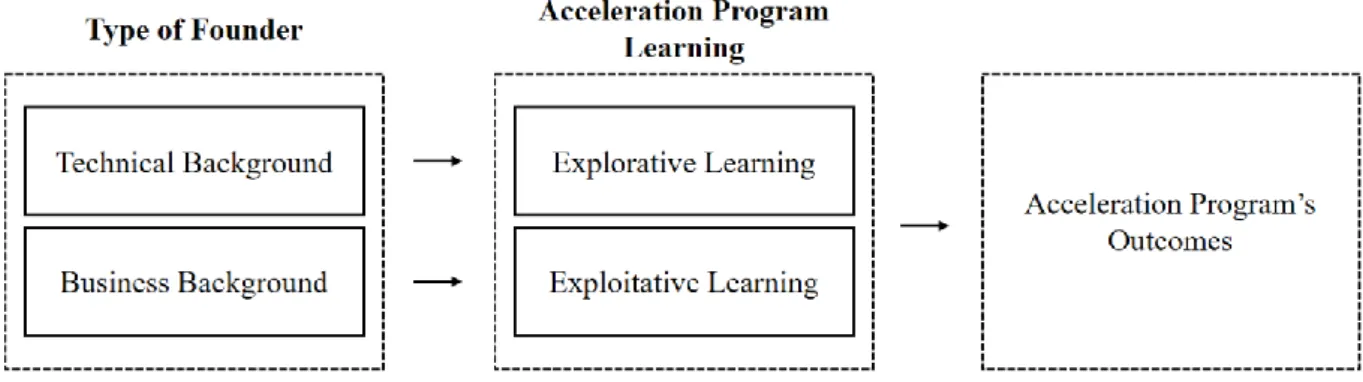
Accelerators are support organizations designed to help entrepreneurs change from idea to growing a business (Hathaway, 2016). This is mainly achieved by providing learning opportunities such as mentoring session, formal education, training and networking with clients, partners and investors (Pauwels et al., 2016). The connection between the acceleration programs’ features and the outcomes is explained by the way entrepreneurs absorb information and translate that into an actionable decision regarding their business (See Figure 1) (Corbett, 2005). This process of learning is often called entrepreneurial learning due to the situation in which it happens, the purpose and the type of learning. In the words of Corbett (2005), ‘how
individuals acquire and transform information during the process of opportunity identification and exploitation’. Thus, it becomes important to understand how and when entrepreneurs learn
(Cope, 2005).
Entrepreneurial learning has been studied by several authors, each with different approaches and perspectives, which leads us to have several entrepreneurial learning types (Harrison & Leitch, 2005). Most of the research trying to explain how the learning happens in the entrepreneurial context draws from the literature on individual and organizational learning (Wang & Chugh, 2014).
Individual learning applied to entrepreneurial learning is based on theories of learning from others (Bandura, 1977) and experiential learning (Kolb, 1984), which might be detailed into learning-by-doing (Argote, 2013; Cope, 2003), trial-and-error learning (Lant & Mezias, 1990), learning by experimentation (Pisano, 1994), learning from past experience (Minniti & Bygrave, 2001), learning from failure (Cope, 2011) and learning from the experience of others (Lévesque, Minniti, & Shepherd, 2009). Experiential learning is defined as “the process whereby
knowledge is created through the transformation of experience. Knowledge result from the combination of grasping and transforming experience” (Kolb, 1984) whereas learning from
other derives from social learning theory, is highly linked to intense mentorship, through which entrepreneurs can learn (Swap, Leonard, Shields, & Abrams, 2001), without the need for actually having the experiential learning (Ingram, 2002) and with the networking effect of working closely with industry peers (Zuckerman & Sgourev, 2006).
On the other hand, organizational learning is mostly explained by the single-loop and double-loop learning (Argyris & Schön, 1978) and lower and higher level learning (Fiol & Lyles, 1985). Single-loop learning is a simpler learning process that does not question the foundations of the organization or knowledge base, while double-loop learning allows the individual to question and change fundamental aspects (Argyris, 1977). Similarly, lower level learning leads to the development of rudimental associations necessary for the activity/task with little impact, while higher level learning aims at modifying the overall key rules and assumptions, which produces higher impact (Fiol & Lyles, 1985).
Previous research connects acceleration programs with the entrepreneurial learning process arguing that the programs accelerate the learning process by (i) being time compressed; (ii) having mentors expanding the strategic options; (iii) directors expertise to help narrow those strategic options; (iv) dividing teams during the programs; and (v) the networking with cohort peers that might classify as competition or partners (Cohen, 2013). Nonetheless, there is no mention of what might explain different levels of learning. How founders go through entrepreneurial learning can be influenced by many factors such as past experiences and
background. This last factor – founders’ background – is very important in the entrepreneurial learning context given the diversity within founding teams. Founders normally have differing and complementary backgrounds – business and/or technical – and acceleration program focus on business knowledge – it has been described as entrepreneurship educational programs (S. Cohen & Hochberg, 2014) –, which means that each type of founder will go through the entrepreneurial learning process at a different pace – due to their previously obtain knowledge. This translates into two different types of learning: either explorative or exploitative (Stevenson & Jarillo, 1990). Exploratory learning is the process of learning something completely new – associated with technical founders in the acceleration context –, while exploitative learning is focused on utilizing and implementing existing knowledge (Kreiser, 2011; Zhao, Li, Lee, & Chen, 2011) – linked to business founders in the same context.
This difference in the way they will interpret, absorb and, consequently, implement the knowledge being provided to them leads us to believe there might be a link between the founders’ backgrounds and the acceleration program results, which we intend to research and explain (See Figure 2). Understanding how the founder's background influence their participation – more specifically, the benefits withdrawn from the acceleration program and the causes of such benefits – will allow us to shed some light on what influences acceleration programs’ outcomes and how to improve and modify based on the body of knowledge.
3. Research & Data Methodology
3.1. Research Design
This dissertation makes use of primary data sources, which comes to interviews with startup founders. To complement and better understand the concept and results from the direct data collection, we use appropriate academic article and books from the literature review chapter. This approach is considered the most appropriate for this dissertation since it uses an in-person research to get the most up-to-date and study specific data from direct contact with the startup founders and has a solid theoretical basis.
Regarding our primary data source, given our focus on understanding the impact of the acceleration program and the main drivers of such effect, namely by exploring differences between the founders’ background, a multi-case study analysis was chosen. A case study analysis is the preferred choice when the objective of the study is to explain and find, in a contemporary context, links between elements, events or outcomes and there is no need for control over behavioral events (Yin, 2009). Moreover, the multiple-case study is specifically suitable when the research is set on exploring differences and comparing two or more different individuals or cases, which is exactly our case and, consequently, makes it the best fit for the dissertation. Having a multiple-case study provides us with more compelling and, in the end, robust result when comparing with other methods (Herriott & Firestone, 1983).
3.2. Sampling
Careful consideration was taken in selecting the sample so to correctly apply a multiple-case study. The sample was selected in order to find (i) predictable similar outcomes; or (ii) contrasting justifiable results (R. K. Yin, 2009). Each case in our sample is a startup founder that has gone through an acceleration program. For feasibility reasons, Portugal based startups were chosen. To assure the compliance with our target results, the following selection criteria were used: (i) tech-based startups; (ii) startups that went through an acceleration program; (iii) accelerated no more than 2 years ago; and (iv) accelerated in the early-stage of the venture.
Using personal contacts, social media, such as LinkedIn and Facebook, direct contact with accelerators and web crawling, a pool of 40 startups were selected for participation in the study as they fitted our criteria. In order to increase our sample, each founder was asked at the end of their interview to indicate another founder whom he/she knew went through an acceleration
program and would be willing to help. Using e-mail, personal messaging and phone calls, a total of 14 interviews were scheduled.
Previous to the interview and initial contact, we gathered information regarding (i) the startup; (ii) the founder’s background; and (iii) the acceleration program in which they had participated. Each founder was categorized based on their background as “business” or “non-business”, with the goal to have a 50/50 split between both. In the end, a total of 6 business founders and 8 non-business founders were interviewed.
3.3. Data collection
Most of the information was collected in the interviews which were carried out either face to face or via video call, according to the interviewee’s availability and preference. Interviews are a common practice when gathering data for a multiple-case study and allow the research to get an in-depth understanding of the phenomena at hand (R. K. Yin, 2009). The interview process followed a semi-structured guideline (See Appendix B), which covered information regarding (i) the founders; (ii) the startup; (iii) the acceleration program; and (iv) their views on the acceleration program. The interview is composed of open-ended questions, previously defined and maintained during all the interviews in order to have a clear line of comparison between the startups in our sample. Interviews had between 16 and 49 minutes, with an average of 27 minutes (See Appendix C). All the interviews were conducted by the author and audio recorded, with the consensus of the interviewee, and later transcribed for analysis.
3.4. Data Analysis
The interviews analysis method chosen for this dissertation was thematic analysis, which is described by Braun and Clarke (2006) as “a method for identifying, analyzing, and reporting patterns (themes) within data”. This method of analyzing is then divided into two branches: (i) inductive – or “bottom-up” – analysis; and (ii) deductive – or “top-down” – analysis. An inductive analysis implies a freedom from the researcher’s theoretical interest and is considered more data-driven. On the other hand, the deductive analysis is considered analyst-driven and it tends to have a higher emphasis on some aspects of the data. For this study, a deductive analysis was chosen in order to increase comparability among the sample and to achieve a clear conclusion regarding or target analysis.
After listening carefully for several times the interviews, they were transcribed. Based on these transcripts, passages from the interviews were categorized relating to subjects that might
help to answer our research questions and, later on, made consistent throughout the sample. After a careful iteration and perfecting process, the categories were explained in detail.
4. Results’ Analysis
In this chapter, we are using the result of the inductive thematic analysis of the interviews to answer the questions raised earlier in this thesis. All the answers were categorized. Further evidence and its coding are specified in Appendix E.
4.1. What are the benefits of acceleration programs?
During the interview process, it was possible to identify that acceleration programs are, in fact, beneficial. This statement is based on the recommendation of, at least, one acceleration program to every entrepreneur by the founders in our sample (14/14) and by their testimony that there was, at least, one improvement of them and/or the startup between the beginning and end of the acceleration program, related to their participation. It was also possible to identify that some founders reported not having time to “accelerate” their business during the program and that the expect growth only came afterward.
"During the program, we tested so many hypotheses that it was impossible to implement. After the program ended we set down, thought about what happen and started to implement one by one."
"Now, two and a half months after the program, I am launching the business" "When the program ended was when we actually started to grow a lot"
Regardless of growth and intensity, there were significant benefits withdrawn from the acceleration program which are categorized in: (i) Business/Entrepreneurial knowledge, (ii) Business validation; and (iii) Key Project Modification.
4.1.1. Business/Entrepreneurial Knowledge
The benefits in this category are mostly related to (i) methodologies and knowledge on how to conduct a business or company:
"During the program, we approached several thematic like sales, customer development, fundraising, etc. which was great because we manage to get a lot of information, from people with expertise that you would not normally get."
"At the end of the acceleration program, we had a clear understanding of what being an entrepreneur was, which we did not at the beginning. Before we were very focused on the theory and afterward we were more focused on the practice."
"We did not know how to communicate with the client, which was why we had low conversion rates, but that all changed because of the acceleration program."
and (ii) knowledge regarding entrepreneurship and the entrepreneurial ecosystem:
"The contact we had with other startups, from our batch and from the outside, warned us to a lot of the pitfalls that startups face and helped us to avoid some failures."
"We went there to learn and we felt like we had a master in Entrepreneurship in a few weeks" "The program gave us an understanding of all the dynamics in the entrepreneurial ecosystem, for example in terms of funding."
4.1.2. Business Validation
Business validation was something very common within our sample in which participants were supposed to do several tasks during the program and based on the feedback from potential customers, partners, mentoring and others, would better shape their business and validate some assumptions they had previously.
"In about 8 weeks we validated a bunch of scenarios, implemented improvements to our product according to the validation and feedback."
"We started to better model our business, to have a better understanding of who was our customer, what were their needs, etc."
"We used the people from the accelerator to test our first product, be close to it and get feedback and validation of what we were planning to do."
4.1.3. Key Project Modification
A key project modification, or pivoting, is the process in which a startup incurs a big change in their business model, idea, technology or any other key element of the project. Given the early-stage of the startups in our sample and the knowledge/validation obtain, there were also several cases in which the acceleration program was key to change something that might prove to be important for the startups’ success.
"We started the program thinking our client was the tourist and throughout we discovered that our real customer was the accommodation provider."
"During the program, there was one big specificity of our business that changed: we added payments on the platform based on the feedback we received."
"We used the acceleration program to validate our assumption, to change our product and refine our strategy, which changed in one big way, so we could afterward launch."
4.2. How are acceleration programs beneficial?
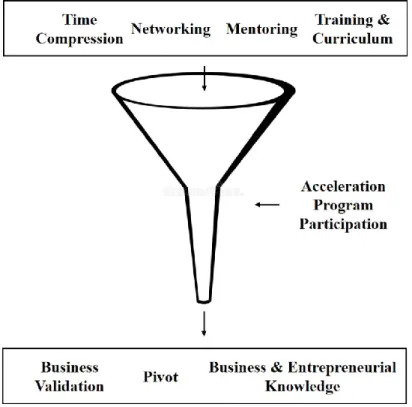
Having a clear understanding that the acceleration program was beneficial and what were those benefits, our next objective was to understand what was causing those benefits. We were able to identify 4 big conductors of the benefits: (i) Networking; (ii) Mentoring; (iii) Training/Curriculum; and (iv) Time compression.
4.2.1. Networking
Networking was an important part of the acceleration program because participants had the opportunity to know the entrepreneurial ecosystem, get feedback and important contacts for their businesses.
"The access was the greatest thing. Access to entrepreneurs that had gone through the process we were going through, access to investors, to lawyers, etc."
"It was great to have so many startups within the same sector. We left the program with several partners, suppliers and even customers."
“We got contact with big players in the technological environment, which was great for us to see what technologies were coming into the market and how we could eventually incorporate them into our product.”
4.2.2. Mentoring
The mentoring offered by the programs was mentioned constantly as a way to get a more experienced perspective and feedback on their business, having a great impact on the acceleration program outcomes.
"The mentors we had access to were amazing. The feedback they gave me, session after session, was the biggest contributor to my evolution."
"Mentoring was good for us because we had no experience in creating a business at this scale and related to technology. A few hours of talking with mentors gave us leaps of
"We would never have gotten the contact of our mentor without the acceleration program and he then became one of our first testers. Also, his honest feedback was one of the things that made us improve our offer."
4.2.3. Training/Curriculum
The training or curriculum is the formal educational aspect of the acceleration programs in which entrepreneurs are taught several topics to improve their business. Founders in our samples found benefits in this especially to improve their presentation or pitch to partners, investors and other stakeholders.
"They had pitch training session with very strict rules about how they wanted us to present and it was amazing to see how we evolved from one session to the other"
"During the first few weeks we had a really intense boot camp experience with workshops and they were extremely useful. I felt like I had a sort of entrepreneurship faculty"
"Having the whole program around workshops based on lean business canvas allowed us to structure our business."
4.2.4. Time Compression
Time compression was mentioned by our sample as an unconscious element of the program, because of its time limitation and amount of knowledge, as being very important to boost their work rhythm.
"Every day 2/3 teams presented and we almost always presented, because we would go the extra mile on the homework in order to go to the stage and get feedback on what we had done." "Having to work for your project on so many topics in such a short time is important to "accelerate" your evolution."
"Every week we approached 2/3 different topics and the next week 2/3 new ones, there was no going back and you needed to keep up."
Utilizing the funnel analogy as in the entrepreneurial learning section, we are able to connect the program acceleration elements with the benefits taken by the startups and founders.
Figure 3 - Relationship between Benefits & Acceleration Program Elements
4.3. Who benefits the most from acceleration programs?
The information gathered from the interviews allowed us to understand some differences in terms of the benefits withdrawn from the acceleration and what cause those benefits considering the founders’ background.
Regarding the benefits withdrawn from the acceleration, we founded that both business and technical founders feel an impact regarding their business/entrepreneurial knowledge having twelve out of fourteen mentioned it as beneficial. Even though the effect was significant in both, business founders reported it more as a benefit – 100 % business versus 84% non-business founders.
Regarding bigger differences related to the benefits, we found that business founders are less likely to incur in pivots when compared to business founders. While 75% of the non-business founders incurred in pivots, only 33% of the non-business founders did the same. Technical founders were most inclined to include words such as “discovered” and “completely”.
“We completely changed our business model during the program.”
"I discovered that a product was not enough, you need to have a value proposition in order to actually have a business""
Business founders, on the other hand, were more likely to improve their business model with smaller adjustments – as 50% of the business founders mentioned doing. Words such as “improving” and “better” were common amongst business founders.
“We improved our product, created a better communication, solved growth issues, among others.”
As with the benefits, regarding which elements were beneficial in the acceleration program, there was also common ground amongst our sample. Founders have reported benefiting from time compression – 50% of business and technical founders – and mentoring – 67% of business founders and 63% of technical founders.
Nonetheless, there was also some significant differing depending on the founders’ background. We found that training/curriculum and networking were more mentioned in our sample by business founders than non-business founders. Networking was the biggest differing point with 83% of business founders reporting it as beneficial and only 25% of technical. In terms of training/curriculum, we had 67% of business founders mentioning it against only 25% of technical founders.
4.4. Further Results
During the interview process, it was not only gathered information regarding the benefits and elements of the acceleration programs but also what went wrong and could be improved – previously defined in our interview guidelines (See Appendix B) –, which allows us to highlight what acceleration programs are doing that is not according to the founders’ expectations. The first reason for complaints from the founders was a poor leveling of the founders and startups in the batch, which decreased the potential benefit of the program.
"There were moments that were useless for us because we had already gone through that process, such as landing page or flyer creations."
"Having startups in similar stages would have been better, we would have been able to get more synergies"
"When you have startups in very different stages, you either raise the bar to match the expectation of more evolved startups, or you lower the bar so you do not lose the earlier-stage startups, which means someone will be unsatisfied."
Secondly, even though mentorship is one of the biggest drivers of benefits, our sample suggests that there is still room for improvement regarding their match with startups.
"Starting a marketplace is not the same as a SaaS and because of that the mentors need to be well matched to you and some just were not."
"There were some mentors that did not bring value and we "wasted" time with them. Maybe it would be better to focus more on the quality of the mentors, instead of quantity."
"We did not have a mentor that could help us. One of them actually said "I am sorry, but I can not help you, you know more than me, you are teaching me."
Last, considering that the founders in our sample went through the program at least a few months ago, there is a reported lack of follow-up after the program.
"Afterwards, I missed follow-up from the accelerator which I asked for and never happened."
"It does not make sense for them to have 4% of my company and we do not talk regularly." "The accelerator did not keep in contact with us, at all, which we found to be very odd. They would have all the benefits, either for future synergies, selling their services or of partners, among others!"
5. Conclusions
This work aims to understand the role of founder’s background on the impact of acceleration programs. Based on the results, the relation is now clearer and we are able to draw a conclusion and connect our initial arguments with the theoretical framing that helps to justify some of the differences found in our sample.
On our first research question, whether or not acceleration program is beneficial, we find that, as expected, acceleration programs are beneficial to early-stage new ventures (Fehder et al., 2014; Hallen et al., 2014). Nonetheless, we found through our sample that some founders had difficulties related to the intensity of the program and reported to only being able to grow significantly afterward. When connecting these results with the highly mentioned effect on the founders entrepreneurial/business knowledge, it is reasonable to consider the acceleration program not as a direct business accelerator, but as an entrepreneurial learning accelerator – in agreement with the findings of Cohen (2013) – in which founders have an introduction to entrepreneurship and a preparation for, later on, being able to accelerate their business with better methodologies, validated assumptions, better networking and an understanding of how entrepreneurs must act in order to be successful.
Regarding our second research question, related to what was creating the benefits, it was possible to understand that the impact was created mostly through networking, mentorship, time compression and training/curriculum. Our findings regarding networking, mentoring and training/curriculum are in accordance with the findings of Pauwels and her colleagues (2016), while the effect of time compression adds to the theory of time compression economies (S. L. Cohen, 2013; Stayton & Mangematin, 2018). When comparing the identified elements to what we considered to be the program package in our literature review (Cohen & Hochberg, 2014; Pauwels et al., 2016), not all of the program features offered by most accelerators were reported by our sample as being impactful, specifically missing the funding and working space.
Lastly, on the main focus topic of our research – whether there is a difference in the benefits between business and non-business founders –, our results point to a significant difference considering the founders background which, in our view, can be explaining using our point of argumentation: exploitative and explorative learning (Stevenson & Jarillo, 1990). As mentioned before, acceleration programs are mostly business related which means they will most likely lead to an exploitative learning - utilization and implementation of existing knowledge (Kreiser, 2011; Zhao et al., 2011) – for business founders, given that they would already have a formal
education in the topics approached during the acceleration program. Given the results of our research, it is plausible to conclude that business founders, being the ones who will most likely implement and deal daily with the topics approached during the program, are more aware of their importance, relevance and, consequently, mention them more as being impactful and beneficial. Also, the big gap regarding the networking effect is in accordance with our expectation. Even tough business founders claim training/curriculum and mentoring as beneficial, there is only so much knowledge they can withdraw from topics they have already encountered multiple times and from mentors with similar backgrounds to theirs. This leads them to benefit more from networking opportunities – to which they might not have had access to without the acceleration program – that could prove to be directly beneficial to their business growth and overall success.
On the benefits that business founders believe they have retrieved, there is a bigger focus on business validation, which, once again, comes to justify our argument of exploitative learning. As they are more aware of the process of creating a business and everything it involves, they have things better structured/defined and will mostly only fine-tune some minor aspects of their business according to feedback from more experienced people, potential partners and customers.
On the other hand, there is non-business founders, that go through an exploratory learning – process of learning something completely new (Kreiser, 2011; Zhao et al., 2011) – which leads them to have difficulties in benefiting from training/curriculum. The formal education part of the program tends to be more generic and, therefore, less practical and directly applicable to each startup due to their industry/sector, product/service and/or other specificities. This increases the difficulty for non-business founders who have to first deeply understand the topic outside of their area of expertise and only afterward try to apply it to their business. On the opposite side of formal education is mentorship, which is where non-business founders find the most benefits due to the contact with mentors who have been through that process and can provide practical feedback and insight drawn from personal experience directly applicable to the startup to which they are providing mentorship.
Regarding the benefits, unlike the business founders, non-business founders will incur more pivots – core changes to their business – which is the last piece providing validation to our exploitative/explorative learning justification. As their business knowledge is inferior, they will most likely be more product oriented and have less focus on the business model and market fit
of their offer. This leads them, when confronted with validation exercises, to realize their misdoing and incur big changes to their business in order to make them fit the business environment.
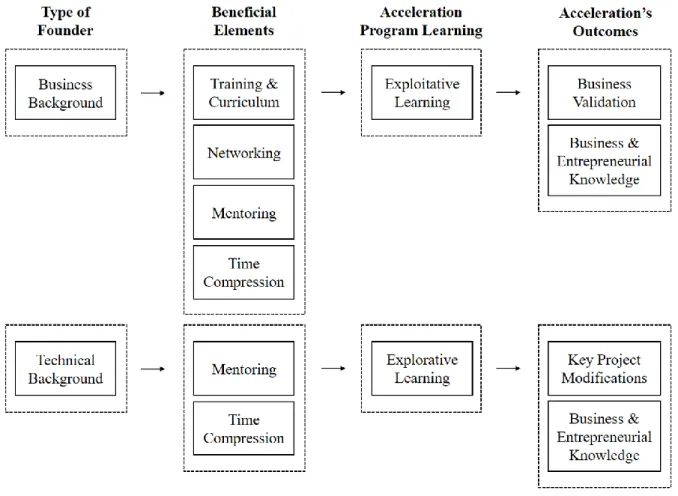
According to our findings and based on the exploitative and explorative learning theory, it is possible to draw a framework linking the impactful program features and the outcomes for each type of founder (See Figure 4)
Figure 4 - Proposed Framework for the relation between Founders’ Backgrounds, Acceleration Program Features and Outcomes
5.1. Managerial Implications
All the information retrieved from our research allows us to highlight some recommendations towards the evolution of the acceleration programs and to founders that consider participating in such programs that might influence their outcomes.
5.1.1. Acceleration Programs
Firstly relating to the conclusions obtained from the answers to our research questions, it is possible to first conclude that are some program features that are proving to be more beneficial than others. According to our sample, there was little to no benefit withdrawn from the co-working space included and the financing, which leads us to believe the focus of the managerial team of acceleration programs should be on intangible assets – such as knowledge, networking and people – and not on the physical resources mentioned earlier. Further, there is a difference of the features’ impact considering the founders background, which leads to the recommendation that acceleration could most likely improve their impact if they advise the startups on which founders should be more involved – if not possible for all to be involved –, based on what they consider to be their biggest value.
In regard to the results from our further analysis section, which goes into what founder have felt could be improved or was not ideal, the first recommendation is related to two key structural elements of this new support organizations’ model: strategic focus and startup selection process. There is no indication that the current standardized approach to startups is not the best option, but there are some insights that lead to the belief that there is a need for a more specific focus of acceleration programs regarding industries and startup stages. In order to improve the output of the program for founders, there is a need to select startups that are more leveled in terms of development – for the standardized content of the training/curriculum and for the mentoring to add value to all the participants – and more homogeneous in regard to their industry/sector – to allows more synergies between the participants, an easier mentor selection, recruitment and, consequently, a better match between mentors and startups. Even though mentorship was one of the biggest drivers of benefits, our sample shows that there is room for improvement related to the matching with startups and the strategic focus.
The last recommendation to the accelerators is related to another core components of the organization: alumni relations. It seems that Portuguese accelerators are not doing an appropriate follow-up after the program, which is something that startups and founders in our
sample believe is missing and might be mutually beneficial. Our recommendation is for accelerators to build a package of product/services – which might be provided by them or by partners – that startups can benefit from after the program, which increases their perceived value to startups, allows them to keep supporting their growth and, most importantly, to monetize them while adding value.
5.1.2. Founders
Regarding founders, our recommendations are mostly applied to the preparation of the acceleration programs. In the same way, accelerators might benefit by rethinking their strategic focus, startups and founders should also do some due diligence before applying to acceleration programs in order to evaluate the fit between them, their objectives and what the programs have to offer regarding mentorship, training/curriculum and networking. On top, getting feedback from startups that had previous contact with the programs might prove beneficial in the end.
Secondly and lastly, we found that the same founders in our sample reported not being prepared for the acceleration program or being in a cohort with unprepared startups. This preparation comes in the form of knowing the program they are accepted in, reading through the content, creating a business model, assumption to be tested during the program and/or trying to create something testable. Testing might happen through an MVP or something even some simple, but it has been recurrently mentioned that being able to test their business allows startups to have a greater benefit from the acceleration process.
5.2. Academic Implications
Acceleration programs have been linked with the startups’ ability to get seed and early-stage financing (Fehder et al., 2014), speed of exit – by acquisition (Hallen et al., 2014) or quitting (Yu, 2016) – and with accelerated entrepreneurial learning (Cohen, 2013). Future research on what affects such outcomes has been conducted, specifically to our knowledge by Lyons & Zhang (2018), connecting the accelerations program’s impact with previous entrepreneurial experience of the founders and opening the door for the exploration of other moderating factors such as the one address in this study: founders backgrounds. Using exploitative and explorative learning as a moderator, we were able to provide evidence that the founders’ background influences the acceleration programs outcomes and further build the notion that the effect of acceleration programs is not universal and depends on situational