Jacolina Leite dos Santos1 Thaís da Conceição Pereira2 Joyce Viviane Cavalcanti Cruz3
RESUMO
O processo de globalização ocasionou grandes mudanças nos hábitos de vida da população, trazendo alterações do perfil nutricional e aumentando o número de casos de obesidade, em especial a infantil. Os pais são os principais responsáveis pela alimentação da criança e por isso devem saber fazer boas escolhas e reconhecer alterações do estado nutricional de seus filhos. O presente estudo visou compreender a percepção e o conhecimento dos pais/responsáveis acerca da obesidade infantil. Tratou-se de um estudo exploratório, transversal, de abordagem qualitativa, realizado em 10 domicílios familiares, por meio de uma entrevista com os responsáveis da criança. Foram utilizados dois questionários: um semi-estruturado, um socioeconômico e uma escala de silhuetas. Foi verificado pouco conhecimento e/ou dificuldade por parte dos entrevistados em definir o conceito de obesidade, causas e riscos que essa condição nutricional pode trazer a saúde. Para uma estratégia de prevenção é necessário o reconhecimento do estado nutricional dos filhos por parte dos pais dentro dos critérios clínicos, para que assim, possam contribuir com a prevenção e/ou identificação precoce ou até mesmo um tratamento apropriado, evitando futuras complicações à saúde da criança.Palavras chaves: Obesidade pediátrica. Imagem corporal. Comportamento alimentar.
ABSTRACT
The process of globalization has occasioned several changes in the habits of life of the population, bringing alterations of the nutrional profile and increasing the number of cases of obesity, specially the child one, being it considered one of the major problems of public health of the current days, affecting children of all ages, social classes, races and ethnicity. Parents are the most responsible for the nourishment of the child and because of that they should know how to make good decisions and recognize alterations of the nutritional status of their children. This study aimed at understanding the perception and the knowledge of the parentes/responsible about the child obesity. It was an exploratory, transversal study whose approach was qualitative, held in 10 family houses through an interview with the responsible people of the children. Two questionnaires were used: a semistructured , a socioeconomical end a silhouettes scale. It was verified low knowledge and/or difficulty of the intwerviewees to define the concept of obesity, causes and risks that such nutritional condition can bring to the health. For a strategy of prevention it is necessary the recongnition of the nutriotinal status of the children by the parentes within the clinical criteria, so that, they can contribute with the prevention and/or early indentification or even a proper treatment, avoiding future complications to the health of the child.Key words: Pediatric obesity. Body image. Feeding behavior.
1 Graduanda em nutrição, Faculdade de Juazeiro do Norte – FJN. Autora para correspondência: [email protected]
ORIGINAL
OBESIDADE INFANTIL A PARTIR DE UMA
PERCEPÇÃO FAMILIAR
CHILDHOOD OBESITY FROM A FAMILY
PERCEPTION
INTRODUCTION
Obesity affects people of all ages and social classes, becoming increasingly evident and growing each decade after the process of nutritional transition, a fact that was characterized by a quick modification of the nutritional profile of the population, occurring reduction in the prevalence of nutritional deficits and higher occurrence of overweight and obesity. This process was influenced by the development and globalization is associated with the inadequate habits of life, in which people do not practice physical activity and seek a more practical and fast food with the aim of facilitating their daily routine1.
Several etiological factors may imply in the genesis and maintenance of obesity, such as biological, social, cultural, environmental and anthropological2. Other factors that also have an influence on childhood obesity include the practice of watching television for several hours per day, electronic games, early termination of breastfeeding, incorrect usage of food formulated and replacement of processed foods at home by industrialized countries. The childhood obesity is considered a nutritional problem of ascension in the world, and Brazil is among the countries that have 4 more rapid elevation of rates of obesity in children3.
Various complications are related to obesity, such as diabetes mellitus, cardiovascular diseases, orthopedic complications and psychosocial problems4. Scientific evidence shows that typical diseases of adults, in many cases, they begin to develop in childhood, due to errors in life habits, which make a sum for future problems. Then, healthy life habits, such as the practice of regular physical activity and proper nutrition since childhood, are important strategies for the prevention of chronic-degenerative diseases in adult life5.
The rates of overweight and obesity in childhood have to be high, being that this excess weight, many times, is not identified or recognized by their family members, including parents. They consider their children with adequate weight for stature or age, or even see the child with overweight, but does not take into account the complications resulting from their nutritional status.
Parents have a fundamental role in the prevention or treatment of childhood obesity, because if they do not recognize their children in this condition, therefore do not bother to seek expert help, nor adopt or invest in a new standard of food behavior, modifying their style of life6. Misunderstanding in the perception of the nutritional status of the child by the parents, affects in future problems associated with this initial state of health.
Thus, it is essential that parents will be able to identify the excess weight and understand the possible complications arising from this problem, becoming even essential, they understand the importance of doing a child’s nutritional monitoring to prevent or treat obesity already installed, reducing the probability of the same come to develop some pathology secondary to this problem, avoiding future expenses for the family and the public sector, providing better quality and greater life expectancy for this population.
The objective of this study was to understand the perception and knowledge of the parents/guardians about childhood obesity, analyzing, so if these are able to identify their
children with obesity, the comorbidities resulting from this nutritional status and beliefs related to weight.
METHODOLOGY
It was an exploratory study, cross-sectional, of a qualitative approach, conducted in the municipality of Juazeiro do Norte, in selected households.
In accordance with the Secretariat of Health of the municipality, Juazeiro do Norte has 46 Basic Health Units (UBS), 67 Family Health Strategy (FHS), and the UBS João Cabral I and III (ESF 9 and 39) showed the highest number of cases of obesity, accounting for a total of 60 children classified with obesity and overweight, being 20 and 40 children, respectively. In virtue of the objective of the study dealing only with children with obesity, we decided to work only with the 20 children who presented this nutritional condition.
Of the 20 previously selected households that had at least one child classified with obesity, in only 10 it was possible to interview the parents/guardians, the rest was not the addresses repassed.
The study population for this research were the parents or legal guardians of the child, having as inclusion criterion for application of the questionnaire: parents or legal guardians of children aged between 7 and 10 years old, classified with obesity (BMI/Age: z-score >+2)7 met in the UBS João Cabral I and III. As exclusion criteria: children classified in malnutrition, eutrophic and overweight; Infeasibility of contact for conducting the interview; Children younger than 7 and older than 10; Children with diseases or deformities that could hinder the nutritional diagnosis or interfere with the perception of parents. The study was approved by the Research Ethics Committee (CEP) of the Faculty of Juazeiro do Norte (FJN), under the number of the opinion 2,058.305, which is in accordance with the resolution N 510/2016 and N 466/2012 of the National Health Council8, 9.
After the authorization from the Secretariat of Health, by means of a letter, and approval by the Comitee, we conducted a pre-test to check the understanding of the questions, soon after, it was possible to realize that there was no need for changes in the tool. Subsequently, the questionnaire was applied to parents/guardians of children who met the above criteria.
The data collection was carried out through visits to households, with application of a socioeconomic questionnaire to outline the profile of this population and a structured, composed by guiding questions open and closed, which assessed the understanding of the interviewees about the concept of childhood obesity, food consumption and influence within the family, the health conditions of the child and determinant factors for obesity.
After the application of the questionnaires, there was presented a scale of silhouettes for children with the objective of the responsible select the figure which most resembled with body image of the child. This scale is a tool for evaluation and perception of body image developed by Kakeshita10, which is composed of 11 figures for each gender, with an average BMI corresponding to each figure varying from 12 to 29 kg/m². The figures were constructed from photographs of children, and then designed and passed to graphic computing, thus forming the 11 figures.
The interviewees non literate or carriers of some motor disabilities who were unable to answer the questionnaires were aided by the researcher, which has collected all the answers given by respondents to the questionnaire and transcribed, respecting the integrity of the discourse of the subjects.
The data were drawn up through the program Microsoft Word 2007, strictly adhering to the integrity of the discourse of the subjects, as well as tabulated and analyzed through the Software Microsoft Office Excel 2007.
For data analysis, we used the technique of saturation of speech11, forming a pattern of responses of the topic, in which they were generated 7 categories (Concept of obesity; knowledge about the risks caused by obesity; Most foods consumed within the family; health condition of the child; level of health; family influence in obesity; Determinants of obesity) and then corroborated the data together with those of other authors. Each interviewee was named by an identification code (CI) and in accordance with the order of the interviewees were classified as IC1, IC2, and so forth.
RESULTS AND DISCUSSION
The 10 respondents showed an average of 38 years of age, there was a predominance of females, that is, it was mainly for mothers of children diagnosed with obesity. The largest percentage of interviewees females occurred due to the time that the interviews were carried out (8h00min to 12h00min and 14h00min to 17h00min), in which the majority of women presented themselves as “home owner” and most of the men (parents or guardians of the children), was in his work, these being the providers of their homes.
The socioeconomic characteristics of the interviewees, there was a greater prevalence of mixed people, with low schooling, monthly income below one minimum wage and users of the Family Grant Program. Despite being classified in an area of social vulnerability, 70% of respondents reported owning their own house.
Although the population interviewed possessed a relatively low monthly income, it was possible to observe a high consumption of foods high caloric content and low nutritional quality, presenting a situation of food insecurity and nutritional status.
A study conducted in 2011 showed that 62% of beneficiaries of the Family Grant Program are in a situation of food insecurity and nutritional insecurity in the territory studied, showed that the excess weight, both overweight and obesity, a problem is more comprehensive than the low molecular weight, being 3.38% of the population studied were in malnutrition, 31% overweight and 21% with obesity12.
In another study, with the objective to evaluate the habits of low-income families, identified that the main criterion for choice of food, in this population, is the price, arguing that families were aware that it is necessary to purchase foods that do well to health, but the family income did not allow for such choices, leaving as well, the cheapest food and most of the times also the more calories13.
The child since very early learned to make their choices based on who observes in the attitudes of their relatives, especially parents, therefore, it is likely that the child will want to eat the same food consumed by them. In this way, the poor choices on the part of those who live in the same family
environment that the child will influence it to opt for the same choices, resulting in a poor diet and excess weight14.
The profile of the children according to gender and age range, showed a higher prevalence of obesity in female children with an average age of 9.5 years old (N=6), followed by male children with an average age of 9.7 years old (N=4). These findings differ from a study conducted in Marialva-Pernambuco State, in which it was observed a higher prevalence of obesity in males in all age groups15.
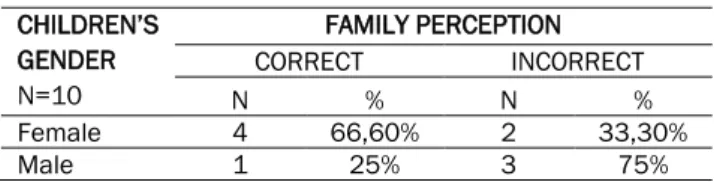
When asked about the perception of the nutritional status of children, all parents/guardians reported that their children were above the ideal weight. Already in the perception of body image through the scale of silhouettes, the results showed a variation in relation to the actual nutritional status of children. The parents/guardians of male children classified improperly over the child's nutritional status when compared to parents/guardians of children of the female sex (Table 1), corresponding to an error in the perception of body image of 75% (male) and 33.3% (female), tending to underestimate the weight of the child.
Table 1: Family perception of body image of the child in accordance with the scale of silhouettes.
CHILDREN’S GENDER N=10 FAMILY PERCEPTION CORRECT INCORRECT N % N % Female 4 66,60% 2 33,30% Male 1 25% 3 75%
This has also been reported in another study, showing that gener is one of the factors that can affect the maternal perception about the nutritional status of the child. In this same study, it was found a variation in both visual response as well as in verbal response, being that in 87.5% visual scale of mothers of boys and 66.7% of mothers of girls rated the wrong way the nutritional status of their children, already in the verbal scale 44.7% of mothers of male children and 22.2% of mothers of female children erroneously classified the child’s weight16.
This relationship between incorrect maternal perception and the gender of the child was also identified in another study, showing that 59.1% boys and 44.3% girls had their weight underestimated by mothers17, confirming a trend of mothers of boys improperly classify the nutritional status of their children, underestimating the weight of the child.
This error in perception may be associated with greater attention that mothers give the weight of daughters since children by the value that society imposes on body image of women, whereas in men a body more “robust” is a synonym of masculinity4.
In this study no relationship was found between error in perception and economic class, as pointed out by a study conducted in 2013, in which the maternal perception both visual and verbal was not associated with economic classification16. This may have occurred due to the fact that the study population belong to one and the same territorial area and homogeneity in terms of income.
Of the 9 questions applied, some do not know how to answer regarding the concept of obesity, comment on the nutritional status and health condition of the child, as well as the level of health of obese children. Of those who answered
the questions, the answers were short and without much explanation, showing limited knowledge about the topic addressed.
In relation to the concept of obesity (Category 1), they defined it as:
“Person too fat, that eats a lot” (CI-3).
“Is when a person is overweight, well higher than normal” (CI-4).
“It's a disease, because the person suffers with fatness” (CI-5).
“Excess fat” (CI-6).
These concepts of obesity defined by the interviewees were also described by other studies, where mothers have defined obesity as eating too much and being overweight and excess fat, may observe a limited knowledge of the subject by family members18,19.
When asked if obesity could bring risks to health and what would these risks (Category 2), the majority showed insecurity to respond, citing as harmful to health:
“Shortness of breath and pains in legs” (CI-1). “Diabetes, high cholesterol and depression because of bullyng at school” (CI-4).
“Diabetes, high blood pressure, high cholesterol, heart problems” (CI-10).
Some parents/guardians reported feelings of anguish and concern in relation to their children, due to the constant change of humor related to the suffering endured in the school environment, because they are the victims of bullyng.
These results corroborate those found by other studies, in which the mothers reported feelings of fear, sadness and concern in relation to the nutritional status of children, referring are common pejorative nicknames such as “whale”, “chubby” and “obese” at school, causing emotional instability in the same, and yet, they tended to exclude themselves socially, and with it the parents suffered together with the son20,21.
Despite the knowledge of parents/guardians, despite being somewhat limited in respect of the risks/harm that obesity can cause, even so, do not seek care in UBS’s to be helped and/or targeted19.
Still on obesity, there was asked if they knew what the possible factors that could trigger this pathology (Category 7). All included the supply as a predictive factor in the development of obesity, still being cited by some lack of physical exercise. Despite mentioning the power, some do not know for sure what type and/or characteristics of the foods were involved in the appearance of this pathology.
Other studies also discussed the relationship between diet and sedentary lifestyle, stating that in a general way, the tendency toward a sedentary lifestyle among the population is increasingly common, resulting from technological advances and the conditions of modern life, causing accommodation in these individuals, thus, a facilitating factor for the development of obesity22,23.
When asked if the child's feeding was similar to that of the family (Category 3), stated that yes, and in relation to the foods consumed within the family, the answers, regardless of the degree of kinship, were similar, such as: "Salted, chocolate, soda, milk with nescau, bread, biscuit stuffed biscuit, cracker, fried foods, instant noodles, artificial juice, sausages".
The foods consumed within the family, described by the interviewees, there is a high calorie content, mainly because they are fried foods in general and soft, stuffed cookie and bread. These foods have high amounts of carbohydrates and saturated fats, being that the excessive consumption may result in weight gain and the development of diseases associated or not with obesity.
The household food behavior serves as a model for the formation of habits of the child. Thus, the example promoted by parents in the family environment can cause positive or negative effects on the child’s feeding. When parents have erroneous habits, these provide bad examples for their children24.
It is during childhood that children have parents or caregivers as models, which may represent significant changes to its development, and that the food mistakes committed by parents may influence the formation of habits and quality of life of children not only in childhood as well as in adulthood25.
The interviewees were asked if the family had some influence on childhood obesity (Category 6). From the discourse of the subjects were found answers as causes of obesity being considered: genetics/heredity, parents as responsible for the purchase of food, lack of incentive to good habits, and permissiveness/doing the will of the child.
In relation to genetic factors, permissiveness and power as the responsibility of parents, these same results were observed by other researchers, in which the family influence appears linked to the genetic component in the discourse of the subjects, as well as the question of food supply and the permissiveness of the mother in relation to the intentions of the children20,18.
The physical absence on the part of parents, causes a feeling of guilt and thus may trigger a relationship of permissiveness as a compensatory factor, and thus the father tries to approximation with the son involving the supply. This situation can have a negative influence on the formation of the child, because children of parents more permissive tend to have inadequate eating habits21,26.
When you talked about the current health condition of the child (Category 4), parents responded with clarity and some have been shown not to give importance to certain signs presented by the child, not making a correlation with obesity:
“Hard to get sick, but it's hard to focus on school and feel leg pain and shortness of breath” (CI-1).
“Get tired when you do something, sweats a lot and now it’s with small balls on the skin, I’m going to take her to the doctor to see what is it” (CI-2).
“Miss very much when you play” (CI-6). “It’s a healthy child, feels nothing” (CI-7). “It’s healthy, but easily gets cold” (CI-9). Parents, in their majority, considered the child of a generally healthy, but in their speeches have reported some symptoms presented by their children. The main symptom mentioned was the difficulty in breathing when doing any type of physical activity, and may observe the sedentary lifestyle associated to obesity among children.
There were not described pathologies such as hypertension, diabetes, depression. However, the results found
in a cross-sectional study 27, the mothers reported the presence of these pathologies in their children, as well as the use of medications to control the disease. Also mentioned that in his study found a significant relationship between obesity and low health-related quality of life, reporting that obese children had lower scores when compared with children classified as eutrophic.
Diseases that were once considered and only diagnosed in the adult population, currently have been observed and diagnosed with frequency in children28.
When asked about the level of health (Category 5), if they thought that children who had higher weight were more healthy and why, some responded that their child was not healthy because presenting obesity and felt routinely “mood change”, “lack of air”, “tiredness fast when playing”, since other replied that they thought that the excess weight influence on the child’s health, but could not explain why.
From the statements of the interviewees, were not found cultural beliefs related to the child’s weight, differing from other studies, in which there was a relationship between excess weight and better health level and low weight with situation of poor child nutrition, in that mothers/family believed that the excess weight left the child stronger, helping to recover faster from diseases and that children thinner were poorly fed by the parents, and that would be more susceptible to diseases18,29.
In a study of literature review30, there were also found beliefs related to weight, as “the weight normalizes with growth”, “more robust children are more well fed and endowed with more health” and even belief related to religion, as the “obesity is a divine determination”, and so the parents refuse to make the treatment.
The present study had some limitations as a reduced sample and limited to a specific territorial area, preventing a more substantial results, as was also not evaluated the relationship between obesity and quality of life, as well as the pathologies presented by children and if the same sought/made some specialized monitoring for treatment of obesity.
Despite these limitations, the study has brought important findings and confirmed what had already been shown in studies carried out by other authors: a flawed family perception related to body image and pathology presented by the child. It is recommended that the continuity of this type of research using this theme involving the family environment and, subsequently, the development of interventions, along with the population addressed (parents or guardians), so that you can help them and/or stir them to recognize correctly the nutritional status of their children, as well as inform them about risks and harms, helping in the prevention, and, consequently, reduction of cases of childhood obesity.
FINAL NOTES
The family plays a role of paramount importance and responsibility in the life of the child, may have positive or negative effects in the formation of habits of the same, mainly because it is at this stage that occurs the construction of these habits. In this way, the family should not only offer, as well as consume foods that provide a balanced nutrition and healthy, encouraging a positive contribution in food choices for the child.
The reason for the none or little knowledge of parents/guardians to identify the child with obesity contributes to the high rate of children with this nutritional condition. This failure in recognition can be a major obstacle in the quest for a suitable treatment and also on the accession of new habits in favor of the health of their children.
With regard to the processing, should involve the whole family and not only the child and its nutritional disorder, highlighting the importance of an adequate approach to the issue of health professionals with families, emphasizing the importance of the nutritionist in the UBS, being responsible for promoting nutritional education and dietary reeducation. It is necessary, even in the preventive measures include the school environment beyond the family and the multidisciplinary team, in order to promote better quality of life for children, reducing the rates of childhood obesity.
REFERENCES
1.Fagundes ALN. et al. Prevalência de sobrepeso e obesidade em escolares da região de Parelheiros do município de São Paulo.Rev. paul. pediatr., São Paulo, 2008;26(3):212-217, DOI: 10.1590/S0103-05822008000300003
2.Rodrigues L. Obesidade Infantil. IN: Accioly, E.; Saunders, C.; Lacerda, E. M. A. Nutrição em Obstetrícia e Pediatria. 2. ed. Rio de Janeiro: Guanabara Kooogan, 2009. Cap. 24, p. 377. 3.Novaes JF.; Rocha DS; Netto MP. Hábito alimentar e obesidade. IN: LAMOUNIER, J. A; WEFFORT, V. R. S. Nutrição em Pediatria - da neonatologia à adolescência. 1. ed. São Paulo: Manole, 2009. Cap.7, p. 345-346.
4. Ney et al. Maternal perceptions and self-perception of the nutritional status of children and adolescents from private schools. J. Pediatr. (Rio J.), Porto Alegre, 2007;83(4):349-356. DOI: 10.2223/JPED.1678
5.Lamounier JA; Lamounier FB; Weffort VRS. Aspectos gerais da obesidade na infância e na adolescência. IN: LAMOUNIER, J.A; WEFFORT, V.R.S. Nutrição em Pediatria - da neonatologia à adolescência. 1ed. São Paulo: Manole, 2009. Cap.7, p. 328-336.
6.Franescatto C. et al. Mothers' perceptions about the nutritional status of their overweight children: a systematic review. J. Pediatr. (Rio J.), Porto Alegre, 2014;90(4):332-343. DOI: 10.1016/j.jped.2014.01.009
7.Brasil. Ministério da Saúde. Orientações para a coleta e análise de dados antropométricos em serviços de saúde: Norma Técnica do Sistema de Vigilância Alimentar e Nutricional - SISVAN. Brasília: Ministério da Saúde, 2011. (Série G. Estatística e informação em saúde).
8.BRASIL. Conselho Nacional de Saúde. Resolução n° 510, de 07 de abril de 2016. Trata das especificidades éticas das pesquisas nas ciências humanas e sociais e de outras que utilizam metodologias próprias dessas áreas. Brasília: Diário Oficial da União, 2016.
9.BRASIL. Conselho Nacional de Saúde. Resolução n° 466, de 12 de dezembro de 2012. Aprovar as diretrizes e normas regulamentadoras de pesquisas envolvendo seres humanos. Brasília: Diário Oficial da União, 2012.
10.Kakeshita IS. Adaptação e validação de Escalas de Silhuetas para crianças e adultos brasileiros. 2008. 121f. Tese (Doutorado em Psicobiologia) - Faculdade de Filosofia, Ciências e Letras de Ribeirão Preto, Universidade de São Paulo, Ribeirão Preto, 2008. DOI: 10.11606/T.59.2008.tde-25052008-170240
11.Bardin L. Análise de conteúdo. São Paulo: Edição 70; 2011. 12.Oliveira LDS.; Lima DF. O. Modelo de segurança alimentar e nutricional e seus determinantes socioeconômicos e comportamentais. Cadernos Gestão Pública e Cidadania, v. 16, n. 59, art. 47, p. 1-20, 2011. DOI: 10.1590/1415-52732014000400001
13.Defante LR.; Nascimento LDO; Lima, DOF. Comportamento de consumo de alimentos de famílias de baixa renda de pequenas cidades brasileiras: o caso de Mato Grosso do Sul. Interações (Campo Grande), Campo Grande, 2015;16(2):265-276.
DOI:10.1590/151870122015203
14.Pereira MM., Lang RMF. Influência do ambiente familiar no desenvolvimento do comportamento alimentar. Rev. UNINGÁ, Maringá, 2014;41:86-89.
15.Mello ADM. et al. Prevalência de sobrepeso e obesidade em crianças de seis a dez anos de escolas municipais de área urbana. Rev. paul. pediatr., São Paulo, 2010;28(1):48-54. DOI: 10.1590/S0103-05822010000100009
16.Nunes GDS. Percepção Materna do estado nutricional dos filhos. 2013. 41f. Trabalho de conclusão de Curso (Graduação em nutrição) - Universidade Federal do Rio Grande do sul, Porto Alegre. DOI: 10183/87091
17.Antunes T. Percepção materna do estado nutricional de crianças matriculadas no ensino fundamental de escolas municipais de Porto Alegre/RS. 2014. 31f. Trabalho de conclusão de Curso (Graduação em nutrição) - Universidade Federal do Rio Grande do sul, Porto Alegre. DOI: 10183/108991
18.Silva JPC. Concepção materna sobre excesso de peso infantil e o estado nutricional seus filhos de. 2013. 118f. Tese (Doutorado em Saúde Materno Infantil) – Faculdade de Saúde Pública, Universidade de São Paulo, São Paulo, 2013. DOI:10.11606/T.6.2013
19.Silva KS, Costa MCM. Assistência de enfermagem à criança obesa: um estudo de caso. Revis. Enfermagem Integrada. Ipatinga, 2008;1(1):68-79.
20.Nunes MCA, Morais NA. As relações familiares de crianças obesas: uma análise dos discursos maternos. Clínica & Cultura, 2012;1(1):68-82.
21.Santos LRC., Rabinovich, EP. Situações familiares na obesidade exógena infantil do filho único. Saúde soc., São Paulo, 2011;20(2):507-521. DOI: 10.1590/S0104-12902011000200021
22.Bayer A. et al. Intervenção grupal em pacientes com obesidade e seus familiares: relato de experiência. Psicol. cienc. prof., Brasília, 2010;30(4):868-881. DOI: 10.1590/S1414-98932010000400015
23.Lopes PCS, Prado SRLA.; Colombo P. Fatores de risco associados à obesidade e sobrepeso em crianças em idade escolar. Rev. bras. enferm., Brasília, 2010;63(1):73-78. DOI: 10.1590/S0034-71672010000100012
24.Abreu JCR., Sousa BLF. Obesidade infantil: abordagem em contexto familiar. 2010. 44f. Trabalho de conclusão de Curso (Graduação em nutrição) - Faculdade de Ciências da Nutrição e Alimentação/Universidade do porto, Funchal.
25.Linhares, FMM. obesidade infantil: influência dos pais sobre alimentação e estilo de vida dos filhos. Temas em saúde, João pessoa, 2016;16(2):460-481.
26.Rodrigues VM, Fiates GMR. Hábitos alimentares e comportamento de consumo infantil: influência da renda familiar e do hábito de assistir à televisão. Rev. Nutr., Campinas, 2012;25(3):353-362. DOI: 10.1590/S1415-52732012000300005
27.Poeta, LS, Duarte, MFS.; Giuliano ICB. Qualidade de vida relacionada à saúde de crianças obesas. Rev. Assoc. Med. Bras., São Paulo, 2010;56(2):168-172. DOI: 10.1590/S0104-42302010000200014
28.Valentini MP. Obesidade: causas e consequências em crianças e adolescentes. Conexões, Campinas, SP, 2010;8(3):47-63.
29.Camargo APPM. et al. A não percepção da obesidade pode ser um obstáculo no papel das mães de cuidar de seus filhos. Ciênc. saúde coletiva, Rio de Janeiro, 2013;18(2):323-333. DOI: 10.1590/S1413-81232013000200004
30.Tenório AS, Cobayashi F. Obesidade infantil na percepção dos pais. Rev. paul. pediatr. São Paulo, 2011;29(4):634-639. DOI: /10.1590/S0103-05822011000400025