Double surface-renewal model for the prediction
of mass transfer rates during bubble formation
with instantaneous reaction on the liquid side
F. XAVIER MALCATA
Escola Superior de Biotecnologia, Universidade Católica Portuguesa, Rua Dr. António Bernardino de Almeida, 4200 Porto, Portugal
(Received 30 October 1986 and infinalform 6 July 1987)
Abstract-Desorption of a component from a gas mixture being injected through a submerged nozzle, during the bubble formation stage, is tlieoretically studied. The solute is assumed to suffer an instantaneous reaction on the liquid side, the reaction plane being on the liquid/gas interface. The volume elements on the gas bubble are assumed to result from a forced surface renewal coupled with a natural surface renewal, both achieved via gas elements with fresh composition. A surface residence time distribution is thus obtained, and desorption rates are calculated fram the relevant variables, assuming non-steady state, unidimensional diffusion in a semi-infinite medium as the main mass transfer mechanism. Comparison of the model with experimental data is reported, physical evidence being predicted better than with previous
models.
INTRODUCTION
THEDESORPTIONof a component from a gas mixture by bubbling the gas through a reacting liquid has been widely used in chemical engineering practice, for the mass transfer rates are very high. This phenomenon is mainly due to the absence of mass transfer resistance on the liquid side, provided the reaction is assumed instantaneous [1] and the reaction plane lies on the gas/liquid interface.
As pointed out by Rocha and Guedes de Carvalho [2], the mass transfer from bubbles occurs mainly during bubble formation, the contributions for mass transfer arising from the bubble rise stage and the bubble staying in the surface foam being usually neg-ligible. Therefore, mathematical simulation of the gas bubble behaviour during formation will enable the global mass transfer to be predicted in an approximate way. In typical systems, e.g. NHlair)/HCI(water), formation ofthe bubble accounts for over 95% ofthe total desorption.
Until the present time, some theoretical studies on the mass transfer from bubbles, when the resistance to mass transfer is in the liquid phase, have been presented: Calderbank and Patra [3] measured trans-fer rates during bubble formation, providing a simple theory for mass transfer based on the idea of Beek and Kramers [4]. An alternative theory, leading to very similar results, was presented by Sherwood et ai. [5], based on an analysis by Levich [6]. Rocha and Guedes de Carvalho [2]attempted a simulation of the bubble with no resistance to mass transfer on the liquid side, using first principIes in a way similar to Sherwood et ai. [5]. Bird et ai. [7] worked examples of gas absorption from rising bubbles, a similar
approach having been successfully used to predict the mass transfer rates during drop formation.
Very little theoretical work has, indeed, been devoted to the understanding of bubble behaviour during formation, from the gas side point ofview.
It is the purpose of this paper to develop a mathe-matical approach to the phenomena occurring dur-ing gas bubble growth usdur-ing some simple postulates. The concept of two kinds of surface elements is intro-duced, both of them being generated directly from the gas input stream. Such an assumption leads to an etfective desorption surface area greater than the actual bubble surface area. A residence time dis-tribution can then be obtained which, together with the assumption of non-steady state, unidimensional ditfusion in a semi-infinite medium as the mass trans-fer mechanism, leads to an analytical formula, quite useful as a tool for the computation ofboth the rate of desorption and the number of moles desorbed during bubble formation.
FORMULATION OF THE PROBLEM
To approach the phenomena existing during bubble birth and growth some postulates are assumed to describe the bubble behaviour. The most important of them are presented as follows.
When gas is injected through a nozzle submerged in a quiescent liquid, a bubble is formed, the gas stream being divided into two portions. ane of them pushes the already existing gas elements on the gasj liquid interface, so making the actual surface area grow; meantime, the other gets mixed with the remaining gas in the bulk of the bubble. The former portion ensures a continuous forced surface renewal, 567
NOMENCLATURE A C D g K area
entering gas solute concentration diffusivity of the solute
acceleration of gravity proportionality constant
total number of moles desorbed during a certain time interval
solute molar flux by diffusion
number of moles desorbed per unit area during a certain time interval
molar flow rate of desorption interpolating polynomial operating parameter volumetric flow rate
cumulative surface residence time distribution
time elapsed since bubble birth volume renewal speed. n N N' n' p Po Q
s
t
V
v Greek symbols.5 gas bubble surface film thickness 4> time elapsed since a gas element arrived
at the surface. Subscripts
O entering conditions
Superscripts
since bubble birth until bubble release
dimensionless, normalization having been made using the conditions at bubble release
dimensionless, normalization having been made using the conditions at bubble birth average. 1 2 3 bub f gas i
first discrete point second discrete point third discrete point bubble final conditions gaseoús phase initial conditions second order maximum value
continuous natural surface renewal elapsed at surface
bubble surface
ever occupied by gas elements actually desorbing. 11 max ren s surf tot *
t
**and it increases the total number of gas elements on the surface.
The gas elements on the surface undergo a con-tinuous toroidal movement in the direction of the gas flow lines, which causes the older elements to leave the surface and go into the bulk, while new ones, with fresh composition, arrive at the surface. This can be called a continuous natural surface renewal, and it does not modify the total number of gas elements on the surface.
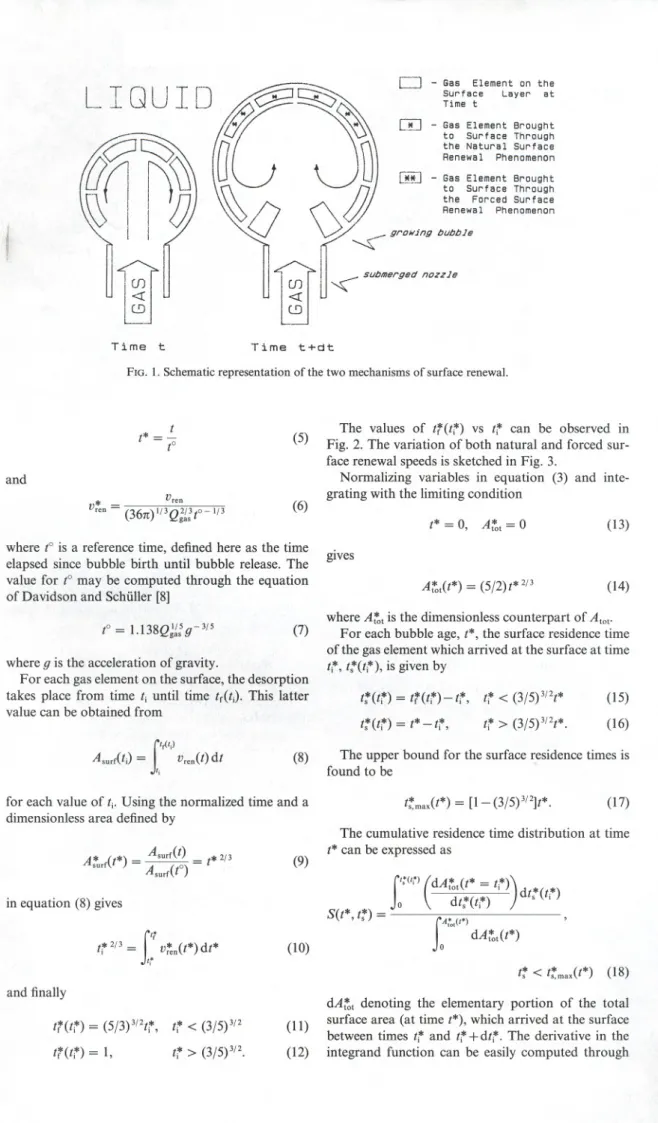
These two kinds of surface renewal mechanisms are depicted in Fig. 1.
The speed at which continuous natural surface renewal occurs must be proportional to the ratio between the volume occupied by the surface film and the total volume of the bubble, for this ratio is a statistic measure of the gas availability to exist on the surface. This fact can be expressed as
bAsurf
-K-Vren- Vbub
where Vrenis the continuous natural surface renewal speed (dimension: area/time), K a proportionality constant, Asurfthe area of the bubble surface, Vbubthe bubble volume and 15the thickness ofthe gas film over the bubble interface.
When the bubble starts to form, its volume is
prac-tically nil, so the existing volume corresponds only to the bubble surface film on the gas side; therefore, the gas elements on the surface are removed at the same speed at which new gas elements arrive. Assuming the constant K does not depend on the bubble volume then equation (1) can be written as
QgaSASurf
Vren
=
Vbub(2)
where Qgasis the gas volumetric flow rate.
The elementary variation of the area occupied by gas elements actually desorbing on the surface, dAtot, is then given by summing up the elementary variation of the bubble surface area due to forced renewal, dAsurf,and the elementary variation of the area due to natural surface renewal, dAren.Using the definition of the continuous surface renewal speeds yields
(1)
~
(
dAsurf)
dAtot=
~
dt+vrendt (3)where t is the time elapsed since bubble birth. Assuming the spherical shape for gas bubbles allows one to write
V;';n
= t*
- 1/3 (4)Time t Time t+dt
- Gas Element on the Su~face Laye~ at Timet
-
Gas Element B~ought to Su~face Th~ough the Natu~al Su~face Aenewal Phenomenon- Gas Element Brought to Su~face Th~ough the Forced Surface Aenewal Phenomenon
FIG. I. Schematic representation of the two mechanisms of surface renewal.
t*
=
!.-tO
and
* - Vren
Vren- (36n) I/3Q;~!t°-=I73
where tOis a reference time, defined here as the time
elapsed since bubble birth until bubble release. The
value for tOmay be computed through the equation of Davidson and SchüIler [8]
tO= 1.l38Q~~; g- 3/5
where g is the acceleration of gravity.
For each gas element on the surface, the desorption takes place from time ti until time tr(t;). This latter value can be obtained from
r,,(t;)
Asurr(ti)= 1 Vren(t)dt
for each value of ti, Using the normalized time and a dimensionless area defined by
Asurr(t) = t* 2/3 A~urf(t*) = Asurr(t°) in equation (8) gives rI' tf 2/3 =
1:
V~n(t*) dt* and finaIly tt(tf)= (5/3)3/2tf,
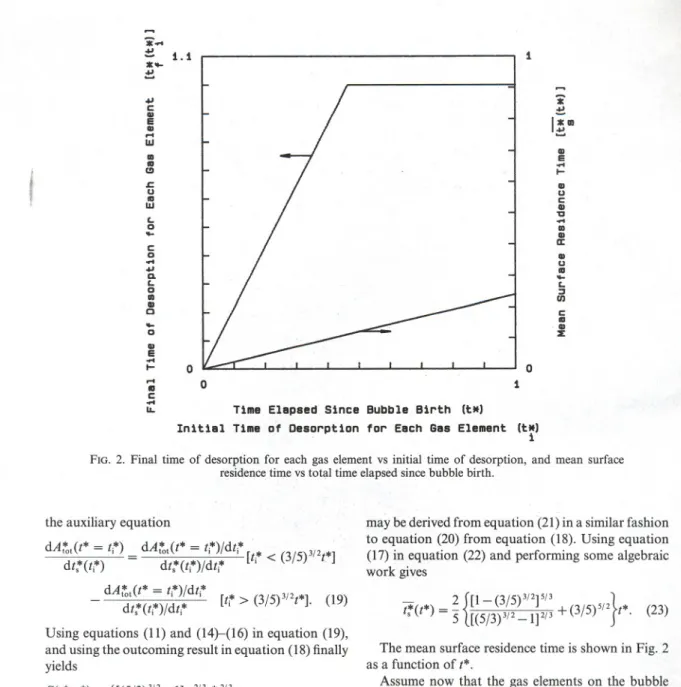
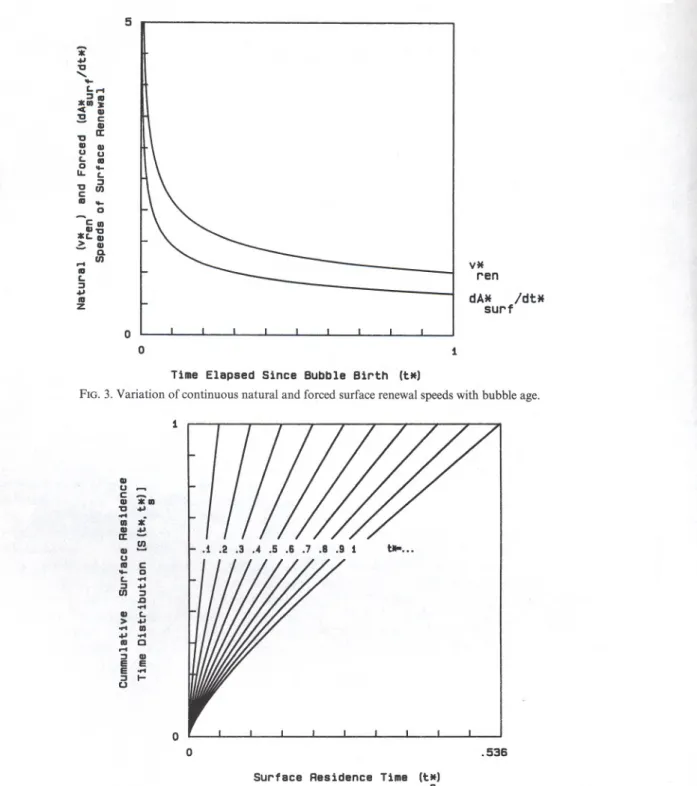
tt(tf) = I, tf < (3/5)3/2 tf > (3/5)3/2.(5) The values of tt(tf) vs tf can be observed in Fig. 2. The variation of both natural and forced sur-face renewal speeds is sketched in Fig. 3.
Normalizing variables in equation (3) and inte-grating with the limiting condition
(6)
t* = O, A;';,t= O (13) gIves
A;';,t(t*) = (5/2)t* 213 (14)
(7)
where A;';,tis the dimensionless counterpart of Ato\" For each bubble age, t*, the surface residence time of the gas element which arrived at the surface at time
ti*, ts*(tn, is given by
t~(tf) = tt(tf)-tf, tj*< (3/5)3/2t* t~(tf) = t*-tf, tf > (3/5)3/2t*.
(15) (16) (8) The upper bound for the surface r.esidence times is
found to be
tt,max(t*) = [1- (3/5)3/2]t*. (17)
(9)
The cumulative residence time distribution at time
t* can be expressed as (10)
f
"(I.*)"(
dA;';,t(t* = t*) S(t*, tn = o dt;"(tn I)
dt;"(tn
rA;:,,(t.)
Jo
dA;';,t(t*)
,
t~ < tt,max(t*) (18) (11) (12)dA;';,tdenoting the elementary portion of the total
surface area (at time t*), which arrived at the surface between times tf and tj*+ dtf. The derivative in the integrand function can be easily computed through
....
~
*--
1.1
~
... c:: QJ E QJ ... UJ 10 10 C!I .c:: u li! UJ ~ O --c:: O ... ... a. ~ O 10 11 O --O QJ E ... I-o
... 11 c:: ... ...o
Time Elepsed Since Bubble Birth (tM)
Initiel Time Df Desorption for Eech Ges Element (tM)
1
4
FIG. 2. Final time of desorption for each gas element vs initial time of desorption, and mean surface residence time ys total time elapsed since bubble birth.
the auxiliary equation
dA;';,t(t*= ti*)= dA;';,t(t*= tn/dti* [t* < (3/5)3/2t*] dts*(tn dt:'(tn/dti* I
dA* (t*
-
t*)/dt*- tot - i i [t:l' > (3/5)3/2t*]. (19)
dt:'(tn/dti* I
Using equations (11) and (14}-(16) in equation (19), and using the outcoming result in equation (18) finally yields
S(t*, tn = {[(5/3)3/2- W2/3t:' 213
+
t* 2/3- (t* - t*)2/3}
t* - 2/3 t* < t* (20), " ',max'
The cumulative surface residence time distribution is shown in Fig, 4 for several bubble ages.
The mean surface residence time, tf(t*), can be calculated as follows:
[i
t:m,,(t')(
dA * (t*-
t*))
JI
t*(t*)=
' t* tot-
i dt*(t*) , o' dt,*(ti*) 'I[
r
A,~,(t')J
Jo
dAt~t(t*)
(21)
the definition being apparent from equation (18). The following equationtf(t*)
=
(2/5)[(5/3)3/2- W2!3t* -2/3t~~;x- t~max(t*- t~max)2/3t*- 2/3
- (3/5)[(t* - t~maY/3 - t* 5/3]t*-2/3 (22)
may be derived from equation (21) in a similar fashion to equation (20) from equation (18), Using equation (17) in equation (22) and performing some algebraic work gives tf(t*)
=
~
{
[1- (3/5)3/2]513 } 5 [(5/3)3/2-lF/3+
(3/5)512 t*, (23) The mean surface residence time is shown in Fig. 2 as a function of t*.Assume now that the gas elements on the bubble surface remain in a non-steady state of desorption, being described by the equation of diffusion in a semi-infinite medium. Assuming the solute concentration on the liquid side of the gas/liquid interface is nil and the bulk solute concentration in the gaseous phase is the input gas concentration, C o, enables the solute molar flux by diffusion, N, to be calculated via
.
N = Co(Dga,/mp)1!2 (24)
where Dga,is the diffusivity ofthe solute in the gaseous phase and 4>the time elapsed after arrival of the gas element at the surface. The number ofmoles desorbed per unit area, after a time interval of amplitude t, is computed after integratiol). of equation (24), accord-ing to
N'(t,) = 2Co(Dga,/n)1/2t,l/2. (25)
Nor:malizing the integrated molar flux by the inte-grated molar flux after a time equal to the global
J
1 i' ... IIJ 11 E ... I-ai U c:: 11 'O ... 10 11 11: 11 U Ia --::I I/) c:: Ia QJ :E O 1I
*'
..
'ti "'-... c.,.., ::JIII *CII:a <I: IIJ 'ti c:-
Q)a::
'ti Q) Q) U U L 111 O ... IL L ::J 'ti li) c: 111 ... O -c: CII Q)'tI *L Q) > Q)- a.
li)
,.., 111 L ::J .. 111 Z 5o
v*
ren
dM/dt*
surfo
1Time Elapsed Since Bubble Birth (t*J
FIG. 3. Variation of continuous natural and forced surface renewal speeds with bubble age.
Q) u
-c -Q) * CII 'ti .... . CII * Q) .. a:: -li) Q) -u lU C...
o L .... ::J .... li) ::J .a .... Q) L > .. CII .. .... lU C ... ::J Q) E E E .... ::J t-U 1.1 .2 .3 .4 .5 .6 .7 .8 .9 1
t...
o
o
.536Surface Residence Time (t*J
s
FIG. 4. Cumulative surface residence time distribution vs surface residence time, between zero and the maximal surface residence time, for various values of time elapsed since bubble birth.
growth time ofthe bubble, allows N'* to be obtained, defined by
N' (t )
N'* (t*) = '= t* 1/2
, N' (t, = tO) S .
The total number of moles desorbed, n*, since the initial time of bubble formation until bubble age, t*, can be obtained from
(26) (3/5)'12,.
n*(t*) = Jo
N'*{t~ = [(5/3)3/2-1]tn
dA* (t* - t*)
i
,'
X to! *-j dt;*+
N'*{t~ = t*-tn
dtj (3/5)312,.,
dA
*
(t* = tj*) dt * to! i . X dtj* (27)1.3
:-*.s
QI .... 111 tI: S O roO U. L li roO O Z C O .... .... 11 L O 10 c! O 1Time Elapsed Since BUbble Birth (t*J
FIG. 5. Total number ofmoles desorbed and desorption molar flow rate vs time elapsed since bubble birth.
Using equation (26) together with equations (15) and (16) in equation (27) gives
n*(t*) = (1O/7)[(5/3)3/2-ljI/2(3/5r/4t* 7/6
+(5/3) r/' (t*-tnI/2ti*-1/3dtr (28) J(3/5)3/2/.
According to Piskounov [9], the defined integral stated above is not expressible as a finite combination of elementary functions. Besides the expansion as a Taylor series about any point within the working interval is not convergent. A reasonable way of over-coming the problem is by expressing (t* - tn 1/2by means of a second-order interpolating polynomial,
P,,(t*, tn using three equally spaced interpolating points, t~, t~ and t~, detined by
t~ = (3/5)3/2t*
* - [(3/5)3/2+ l]t*
ti2-~
t~ = t*.
The following equation is then obtained:
P,,(t*, tn = 0.3836t* 1/2+1.7320t* -1/2t~
-2.1156t* -3/2t~ 2. (32)
Using equation (32) in equation (28) and per-forming the integration leads to
n*(t*) = 1.1088t* 7/6. (33) The dimensionless molar flow rate of desorption,
n*', is then given by
n*'(t*) = 1.2936t* 1/6. (34) The variation of both n* and n*' vs t* may be observed in Fig. 5. Using equations (7), (9), (25) and (26), it can be verified that
4
n* = n
6.3452CoDi~;Q:~:0 g-7/10 (35) which means n* is the total number ofmoles desorbed after a given time since bubble birth, normalized by the total number of moles that would be desorbed since bubble birth until bubble release if all the effec-tive desorption area were constant and equal to the actual surface area of the bubble at bubble release, and if the molar flux were the same for all gas surface elements, at each time.
The detinition of n* is a natural consequence of the steps followed in the derivation. Nevertheless, the number of moles desorbed is often normalized by the number of moles fed to the forming bubble, since bubble birth until bubble release. Using the notation
n** for this dimensionless variable, it follows that
(29) (30) n n** = C Qo gastO
.
4
(36) (31) Using equations (7) and (35) in equation (36), itcan be stated that
n**(n*) = 5.5757Pon*
where Po is an operating parameter defined by (37) DI/2 gas Po
=
Q
gas3/10g1/10. (38) Replacing equations (33) and (38) in equation (37), and putting t* equal to unity, yields** - Di~;
n - 6.1823
Qgas 93/10 1/10 (39)
which might be useful for design purposes. Parameter
Po is a measure of the ratio of the solute molar flow
572 1.2 *'
.s
'C QI .a c.. o 10 QI C 10 QI roO o Z 00-o c.. QI .a E :J Z roO 111 .... O O OI 'C GI .a "" o 11) GI C UJ GI .... o % 1
Po-.. .
'*
*
oS .15 ..-o L GI .ae :J z .... lU +I oI-o
o
1FIG. 6. Total number of moles desorbed vs time elapsed since bubble birth, for various values of Po.
Time Elapsed Sinee Bubble Birth (tM)
... 'C
.
8* .a... L-0* UI* GIl: C Ulr: Q/O...
O...
%11 e "'"L 00 li. L Q/GI .a.... e.o :J.o Z:J 111 .... lUa +lI: O'" I-L :J C 1 (eQn.39) theoret1cal pred1ct1on {21 oo
1000
3Volumetric Gas Flow Rate [Q /Iem /s)1 gas
FIG. 7. Theoretical predictions and empirical correlated data of the fractional number of moles desorbed, for various volumetric gas flow rates.
due to diffusion flow, to the bulk solute molar flow. The variable n** is plotted vs t* in Fig. 6.
The values for n** as predicted by the developed theory, and via a previous theory and an empirieal correlation [2] are plotted in Fig. 7, as n** vs Qg.., assuming Dgas= 0.222 em2 S-1 andg = 980 em S-2.
BHT 31: 3-B
CONCLUSIONS AND DISCUSSION
For bubbles of moderate size growing at a nozzle tip submerged in a liquid, with no surfaee-aetive agents, the gas in the bubble undergoes a toroidal circulation, as suggested by Bird et ai. [7].Sueh surface
gas streams get mixed in the bulk of the bubble after completion of the to roidaI surface movement, so the concentration gradient in the bulk tends to be negli-gible when compared to the concentration gradient on the surface filmo It should be noted that the diffusion layer near the bubble surface is relative1y thick on the gas side; also, significant gas circulation is present inside the bubble, so the gas elements remain on the surface for short times [2]. Diffusion in
non-J
steady state conditions is, thus, likelyto be the most
, important contribution to the overall mass transport phenomenon. Besides, the surface gasfilm remains relatively stagnant [7], so it can be assumed to be in laminar flow and to maintain its identity.
Dilute gas mixtures are"usually used in industrial practice, so the molar flux of solute resulting from the bulk motion of the fluid remains at very low leve1s [10], even if the solute is totally removed by chemical reaction. Therefore, the model developed does not fail for only considering Fick's law in its simplest expression.
The mass transfer rate between adjacent gas elements on the surface is negligible, due to the very small contacting area and concentration gradient, when compared to the mass transfer rate in the radial direction, where the largest contacting areas and steepest gradients occur. The assumption of a unidi-mensional field of concentrations is then acceptable.
The equation ofDavidson and Schüller [8]was used because it approximates experimental data reported elsewhere [2] c1ose1yenough and it has a physical basis.
A generallook over equations (37) and (38) shows that the larger the volumetric flow rate or the lower the solute diffusivity in the gas mixture, the less the fractional solute desorption achieved, which agrees with physical evidence. However, very large values for
Po would lead to amounts of solute desorbed higher
than those fed to the nozzle, as stressed by extra-polation on Fig. 6. This drawback in the predic-tion procedure has been reported elsewhere [2], but is as low as about 5 cm3 s- I for the system
NH/air)jHCI(water), being mostly accounted for by the lack of validity of the assumptions made (especially the non-steady state for diffusion in a semi-infinite medium).
The increase of desorption due to a larger number of elements on the surface tends to be balanced by the decrease of the continuous natural surface renewal speed. In fact, the mean surface residence time tends to get larger as the bubble grows (see equation (23)), and larger desorption times mean lower desorption rates, as emphasized by equation (24).
It can be stated from equation (14) that the effective area that suffered desorption for any time interval during the bubble growth is two and a half times larger than the actual bubble surface area: This larger
area of desorption, which is not apparent from pre-vious models, may help to account for the enhanced rates of mass transfer. In fact, the simple theory developed predicts accurately the desorption at not too low gas flow rates, but underpredicts the rates of transfer for higher gas flow rates, according tothe empirical correlation presented elsewhere for the sys-tem NH/air)jHCI(water) [2]. It leads, however, to theoretical values for the fractional number of moles desorbed (n**) c1oser to the experimental values than the ones obtained from the simulation using first prin-cipIes, as reported by Rocha and Guedes de Carvalho [2] (see Fig. 7). The high deviations found for large gas flow rates are mainly due to the disruptive presence of the injection nozzle and bubble formation with tearing, the turbulence resulting from the strong coalescence during continuous bubbling; these phenomena are not easy to simulate. The decrease of mass transfer rate with the increase of gas flow rate or the decrease of solute diffusivity in the gas phase is, nevertheless, qualitatively predicted. The fact that larger effective desorption areas lead to results c1oser to experimental data, coupled with the same func-tional relationship found using two different methods ~
of derivation, suggests that more involved patterns for the gas circulation inside the bubble will eventually be able to predict the overall behaviour for instan-taneous chemical absorption from bubbles. Enhanced rates of mass transfer are then understood as a result of extended areas available for mass transfer. Acknowledgements- The author is grateful to Dr F. A. N.
Rocha for his availability to discuss some details of this research.
REFERENCES
1. P. V. Danckwerts, Gas-Liquid Reactions, p. 133. McGraw-Hill, New York (1970).
2. F. A. N. Rocha and J. R. F. Guedes de Carvalho, Absorption during gas injection through a submerged nozzl~Part I: gas side and liquid side transfer coefficients, Chem. Engng Res. Des. 62, 303-314 (1984). 3. P. H. Calderbank and R. P. Patrã, Mass transfer in the
liquid phase during the formation of bubbles, Chem.
Engng Sei. 21, 719-721 (1966). 4
4. W. J. Beek and H. Kramers, Mass transfer with a change in interfacial area, Chem. Engng Sei. 16,909-921 (1962). 5. T. K. Sherwood, R. L. Pigford and C. R. Wilke, Mass
Transfer, p. 73. McGraw-Hill, New York (1975). 6. V. G. Levich, Physicochemical Hydrodynamics.
Prentice-Hall, Englewood Cliffs, New Jersey (1962).
7. R. B. Bird, W. E. Stewart and E. N. Lightfoot, Transport Phenomena, pp. 537-542. Wiley, New York (1960). 8. J. F. Davidson and B. O. G. Schüller, Bubble formation
at an orifice in a viscous liquid, Trans. Instn Chem. Engrs 38, 144-154 (1960).
9. N. Piskounov, Cálculo Diferencial e Integral, Portuguese translation from the Russian Edition, pp. 405-408. Edições Lopes da Silva, Porto (1983).
10. R. B. Bird, Theory of diffusion. ln Advances in Chemical Engineering, VoI. 1. Academic Press, New York (1956).
MODELE A DOUBLE RENOUVELLEMENT DE SURFACE POUR LA PREDICTION DU TRANSFER THERMIQUE PENDANT LA FORMATION DE BULLE AVEC
REACTION INSTANTANEE DU COTE DU LIQUIDE
Résumé-On étudie théoriquement Ia désorption d'un composant d'un mélange gazeux injecté à travers un orifice submergé, pendal).t I'étapede formationde Ia bulle. Le soluté est supposé subir une réaction instantanée du coté du liquide,'la réaction' étant à l'interface liquide/gaz. Les éléments de volume sur Ia bulle de gaz sont supposés résulter d'un renouvellement forcé de Ia surface couplé avec un renouvellement ? naturel. Une distribuÍion de temps de résjdence' àla surface est obtenue et les flux de désorption sont calculés à partir des variables actives en supposant une diffusion variable unidimensionnelle dans un milieu semi-infini, comme mécanisme principàl 'dl1' transfert de masse. On compare le modéle aux données
expérimentales et ori constàte une ineilleure prédiction qu'avec les modéles antérieurs.
EIN MODELL MIT ZWEIFÁCHER OBERFLÃCHENERNEUERUNG ZUR ... BERECHNUNG DES STOFFÜBERGANGS WÃHREND DER BLASENBILDUNG
MIT GLEICHZEITIGER REAKTION AUF DER FLÜSSIGSEITE
Zusammenfassung-Es wurde die Desorption einer Komponente aus einer Gasmischung, die durch eine eingetauchte Düse eingeblasen wird, theoretisch für die Blasenbildungsphase untersucht. Es wird angenommen, daB sich der gelaste Stoff sofort an einer Reaktion auf der Flüssigseite beteiligt. Die Reaktionsebene liege dabei in der Flüssig/Gas-Grenzflãche. Weiter wird angenommen, daB die Volumenelemente der Gasblase aus einer gemischten Oberflãchenerneuerung (erzwungene und natür-liche) resultieren. Beide Effekte werden mit Hilfe von Gaselementen frischer Zusammensetzung ermittelt. Die Oberflãchen-Verweilzeit-Verteilung und die Desorptionsstrame werden aus den maBgebenden Variablen berechnet, wobei instationãre, eindimensionale Diffusion im halbunendlichen Medium ais bestirnrnender Stofftransportmechanismus angenommen wird. Ein Vergleich des Modells mit experimentellen Daten wird durchgeführt. Die physikalische Aussagekraft ist besser ais mit anderen
Modellen.
MO,lJ;EJIb ,lJ;BoAHOrO OBHOBJIEHI1R ITOBEPXHOCTI1 ,lJ;JIR PACtIETA I1HTEHCI1BHOCTI1 MACCOITEPEHOCA ITPI1 3APO:>K,lJ;EHI1I1ITY3bIPbKOB 11
MrHOBEHHOA XMMl1tIECKOA PEAKQI1I1 B :>K11,lJ;KOCTI1
AmtoTaQHII- TeopeTH'IeCKH HCCJIe,!{yeTclI ,!{ecOp6l\HII KOMnOHeHTa H3 ra30Boií CMeCH, B,!{YBaeMOií 'Iepe3 3aTOnJIeHHOe conJIO, B peJKHMe o6pa30BaHHII nY3blpbKOB. ITpe,!{nOJIaraeTCII, 'ITO pacTBopeHHoe BeweCTBO MrHOBeHHO BCTynaeT B JKH,!{KOCTH B XHMH'IecKyiO peaKl\HIO, npH'IeM nJIOCKOCTb peaKl\HH HaXO,!{HTCII Ha rpaHHl\e pa3,!\eJIa ra3-JKH,!\KOCTb. ITpe,!\noJIaraeTclI, 'ITO Ha ra30BOM nY3blpbKe nOIlBJIlllOTCII 06'beMHble o6pa30BaHHII íl3-3a npHHY,!\HTeJIbHOrO 06HOBJIeHHII nOBepXHOCTH, KOTopoe npOHCXO,!\HT O,!\HoBpeMeHHo c aHaJIorH'IHblM ecTecTBeHHblM npOl\eCCOM 06HOBJIeHHII, npH'IeM B 060HX CJIY'lallx ra3 B TaKHX 06pa30BaHHllx HMeeT HOBblií COCTaB. TaKHM 06pa30M nOJIY'leHO pacnpe,!\eJIeHHe BpeMeHH npe6b1BaHHII 06'beMHblX 06pa30BaHHií Ha nOBepxHocTH nY3blpbKa. CKOpOCTb ,!\ecOp6l\HH pacc-'IHTblBaeTCllno COOTBeTCTBYIOWHM nepeMeHHblM B npe,!{nOJIOJKeHHH, 'ITO OCHOBHblM MexaHH3MOM nepe-Hoca MaCCbl IIBJIlleTCII HeYCTaHOBHBwallCII O,!\HOMepHall '!\HclJclJY3HII B nOJIy6ecKoHe'lHoií cpe,!\e. ITpHBe,!\eHo conOCTaBJIeHHe pe3YJIbTaTOB paC'IeTa no Mo,!\eJIH c 3KcnepHMeHTaJIbHblMH ,!\aHHblMH. ITo