DOES MORAL BRANDING ON THE ORGANIC
COSMETICS’ MARKET INFLUENCES
SELF-LICENSING EFFECTS ON CONSUMER’S
CHOICE AND ANTICIPATED GUILT?
PILAR MATEOS RODRIGO
Dissertation written under the supervision of João P. Braga
Dissertation submitted in partial fulfilment of requirements for the MSc in Business, at the Universidade Católica Portuguesa, 22nd December 2017.
Abstract
The present study examines the effect of brand morality and self-affirmation on the
purchasing decision of an organic cosmetic product in order to prove if a marketing approach based in this two concepts could be effective in this industry. We have seen in literature that individuals on a self-affirmation position usually license themselves to commit a less moral action of purchase that they would normally do in no self-affirmation conditions. We study this effect further adding a possible effect regarding brand morality in the organic cosmetic sector. Results from one study manipulating self-affirmation and brand morality failed to show licensing effects on individuals when choosing either moral (organic) or immoral cosmetic products in participants’ choice between utilitarian or hedonic products, anticipated guilt and regret and expected hedonic experience. Only brand morality influenced
participants choice between the purchase of a utilitarian or hedonic product and lead to higher levels of anticipated guilt and regret. Despite of our study registered no influence from the self-affirmation task on participants, it is a fact that this effect was working on the results from the manipulation check. As a conclusion, we could affirm that on the organic cosmetic sector having a brand with a higher morality would influence consumer behavior.
Key-words: Cosmetic, hedonic, anticipated guilt, positive self-image, utilitarian, licensing.
Resumo
O presente estudo examina o efeito da moral de uma marca e autoafirmação na tomada de decisão de compra de um cosmético orgânico de forma a verificar se uma campanha de marketing baseada nestes dois conceitos pode ser eficiente na industria.
A literatura demonstra que os indivíduos que tomam uma posição de autoafirmação tendem a praticar uma ação menos moral no momento da compra do que aquela que normalmente fariam. Este efeito é estudado ao adicionarmos outro possível efeito relacionado com a
moralidade da marca no sector dos cosméticos orgânicos. Os resultados de um estudo baseado na manipulação da autoafirmação e da moral de uma marca falharam ao demonstrar efeitos de licença nos participantes quando confrontados com a escolha entre produtos cosméticos morais e não morais, sendo a escolha entre os dois produtos com diferente percentagem hedónico/utilitário, na culpa antecipada e no arrependimento da escolha.
Apenas a moralidade da marca influenciou a escolha dos participantes entre um produto utilitário ou hedónico, o que levou a um maior nível de culpa e remorsos antecipados. Apesar do nosso estudo não registar qualquer influencia de autoafirmação nos participantes, é um facto que o efeito resultou quando manipulado. Em conclusão, podemos afirmar que no sector de cosmética orgânica, uma marca com maior moralidade influencia o comportamento do consumidor.
Palavras-chave: Cosmética, hedónico, culpa antecipada, autoafirmação, utilitário, auto licencia.
Acknowledgments:
During my academic studies I became interested in marketing and sustainability and how consumers make choices, especially in situations when a hedonic product is involved along with moral concepts. As we can no longer deny the harmful impact of human consumption on our environment, I am convinced that understanding consumers’ sustainable decision-making will be the challenge for marketers on the near future. Therefore I enjoyed working in a project which personally concerns and interests me.
First of all I would like to express my gratitude to my thesis director João P. Braga for his availability, interest for the subject and motivation on helping with my study.
Further I am thankful for my friends and family for their unconditional support in every matter all my life, even when my decisions were a bit crazy. I promise, I will always do it the other way around. Studying and working international, meeting amazing people and living in some of the most beautiful cities around the world would have not being possible without you.
Table of contents:
Abstract ... 2
Table of contents: ... 4
1. Introduction ... 6
1.1. Hedonic consumption ... 7
1.2. Natural and Organic cosmetics market in Europe. ... 9
1.3. Consumption and ethical products ... 10
1.4. Social conscious consumption and self-identity ... 11
1.1. The need of the individuals to see themselves as good people ... 11
1.2. Self-licensing effects and anticipated-guilt reduction ... 12
2. Method ... 13
3. Results ... 17
1. Choice task ... 17
a. Anticipated guilt on the choice task results. ... 19
2. Ranking task ... 20
3. Manipulation check ... 23
4. General Discussion ... 24
4.1. Theoretical discussion ... 24
4.2. Marketing implications ... 26
4.3. Directions for further research ... 26
5. References ... 28
6. Appendix ... 30
6.1. Appendix I: Surveys ... 30
a. Condition: With self-affirmation and high moral brand 1 (++) ... 30
b. Condition 2: With self-affirmation and less moral brand (+) ... 34
c. Condition 3: Without self-affirmation and high moral brand ( +) ... 38
List of tables
Table 1: Conditions of the study ... 16 Table 2: Percentage of participants from the choice task results on self-affirmation conditions
(N = 145) ... 17 Table 3: Percentage of participants from the choice task results on brand morality conditions
(N = 145) ... 18 Table 4:Participants’ percentage under the four conditions of Choice task preferred product.18 Table 5: Means of the Choice task results on the different conditions. ... 19 Table 6: Means of anticipated guilt taking into account self-affirmation and product choice on
the different conditions. ... 20 Table 7: Means of pleasure form smell on the ranking product task on the different conditions.
... 20 Table 8: Means of the pleasure from how the product felt on the participant’s skin on the
ranking product task on the different conditions. ... 21 Table 9: Means for pleasure from comfort of the product on the different conditions. ... 21 Table 10: Means from anticipated guilt the participant was feeling after choosing a product
from the ranking task on the different conditions. ... 22 Table 11: Means of participants’ regret after choosing on the ranking product task on the
different conditions. ... 22 Table 12: Mean self-assessment for all conditions (N=128). ... 23 Table 13: Means of participants’ regret after choosing on the ranking product task for all
1. Introduction
This thesis examines the hypothesis that prior expression of a virtuous action that helps establish an altruistic self-concept is subsquently more likely to influence the person to make self-indulgent choices and reduce anticipated guilt. We tried to demonstrate our hypothesis by examining the choice between two organic cosmetic products that are relative hedonic and utilitarian and how this choice can be influenced by brand morality. More specifically, we suggest that the preference for a luxury option will be higher if people’s are positioned on a self-positive position prior to choosing between both products seeing if participants would license themselves on the choice.
Over the last decade, Europe is seeing a swift on consumer behavior among personal care and cosmetic market. With consumers looking for sustainable and environmental friendly
products, companies have seen a new need that has to be covered. But the question lies on how marketing departments can focus on the communication of this organic beauty
movement without betraying brand’s image and negatively affecting consumer’s beliefs. This organic boom is part of how easy it is for consumer to get access to any information of any brand online, which leads to raise awareness about health and wellness. . In Europe, these products are regulated to ensure consumer safety and to secure an internal market for
cosmetics (Regulation (EC) N° 1223/2009). Everyone can have access to list of ingredients that are allowed to be in the composition of the cosmetic products and its packaging with one click, and this is enough to build a moral opinion about an specific brand which will influence in the accomplishment or not of a future purchase. Knowing what variables influence
consumers mind when they consider purchasing an organic cosmetic product would make easier for brands to focus their investments and workforce on what the consumer really needs. More specifically in what regards the choice of ethical or moral behavior, recent research has found interesting self-licensing effects on moral behavior. As Rockeach and his associates have alraedy found; culture, society and personality are the major causes of a specific attitude and behavior on individuals. If a consumer has a good moral image about him/herself, there would be room for a non-morally good purchase because of his/her previous positive image. As a consequence, morality has a powerful influence in everyone’s purchase decision process, this could be translated as a possible tool to use on a marketing campaign, for example
This behavior becomes even stronger when we talk about hedonic products where an important part of the decision process it is based in consumer’s own positive or negative image (Dunning D. , 2007). Be seen as a good person would allow an individual to spend money in a less morally good product because of that positive image (Khan & Dhar, 2006). The aim of our research is to investigate more deeply how the ethical behavior of a brand influences on the consumer purchase decision on an specific market which is the organic cosmetic products market. In particular, we would like to explore how consumers would behave when taking a purchase decision between two cosmetic products which involves a brand with dubious morality while presenting a hedonic product.
Moreover, we are interested in better understanding which are the dimensions related to the consumers feeling, self-positive esteem, moral-esteem, the product features and function, price levels, and substitute products, to which their behavior seems to be more sensitive when addressing ethical issues in purchasing.
In order to answer our research questions we focus our study in a specific market and type of goods: organic cosmetic market in Europe. According to Organic Monitor, ethical cosmetics products can be defined as environmental friendly, respectful of animals and labor conditions; in addition, they embrace also natural and organic features (Maggioni, Montagnini, &
Sebastiani, 2012).
In Europe not only there is a considerable products offer which is translated to an important market share, but also it is surprising the consumers’ knowledge about this specific product categories. Of course this perception changes among countries, Germany has one of the most extended market not only in cosmetic but also in organic food along with Sweden (Statista, 2016).
1.1. Hedonic consumption
As seen in the literature, we can understand a hedonic product purchase as a pleasure-oriented consumption which is motivated mainly by the desire for sensual pleasure, fantasy and fun. On the other hand, an utilitarian product is based on a goal-oriented consumption, is
motivated mainly by the desire to fill a basic need or accomplish a functional task (Strahilevitz & Myers, 1998). Normally, every product has both qualities but in different percentages. It is known that, nowadays, beauty and physical attractiveness are constantly emphasized as desirable and admirable characteristics that, as has been mention before, is one of the main reasons why hedonic products are being used for (A. Picot-Lemasson, 2002).
In order to understand why cosmetic products in general could be seen much as hedonics products rather that utilitarian it is needed to define those two terms. Sometimes, a
prototypically hedonic product may be used because of its utilitarian characteristics (Alba & Williams, 2013) as when a shampoo could be used as a dandruff control taking in
consideration only its utilitarian purpose or as a merely beauty tool making it totally hedonic. In our research we will test how participants will react to two cosmetic products with different hedonic/utilitarian percentage: a perfume, which is almost 100% utilitarian for being used as an accessory to enhance one’s self-confidence, social status and as a symbol of luxury, and a sun cream which in many cases is used with a therapeutically used or preventive of future damage on the skin.
The observation that hedonic products consumption often leads to feelings of guilt has interesting implications for the bundling of hedonic products with moral incentives related to sustainability and self-positive image. Numerous marketing studies have focus their research in understanding what drives a consumer to make purchase from one brand or another in several market such as Organic Food and Beverages or how organic brands are seen by young people. Induction of negative emotions can change consumer behavior but little has been said about moral aspects of a brand, we would like to know if influencing morality we can
influence consumer’s opinion (Maggioni, Montagnini, & Sebastiani, 2012). However, barely nothing has been done about cosmetics and how feeling morally good or bad with one self can influence on a consumer decision and building brand loyalty.
Similarly, it has been found that reminding people of their humanitarian traits reduced their charitable donations. Because purchasing green products affirms individuals’ values of social responsibility and ethical consciousness, we predicted that purchasing green products would establish moral credentials, ironically licensing selfish and morally questionable behavior (Sachdeva, Iliev, & Medin, 2009). Overview studies suggest that consumption is more tightly connected to the social and moral self than previously thought (Mazar & Zhong, 2010). Green products embody social considerations, so that mere exposure to them increases subsequent prosocial behavior. Given the growth of the green-product market and the interconection of people’s everyday behavior, it is important to determine the limits of such a licensing effect (Mazar & Zhong, 2010).
1.2. Natural and Organic cosmetics market in Europe.
In order to understand better what is an organic product and what is the difference between them and natural products because the marketing perspective would be different and the consumers behavior as well.
First of all, the main difference relies on the ingredients or the composition of the product. Some details on how plants are cultivated and treated could determine if they would lead to natural extracts or organic extracts. On one hand, natural beauty products should contain a certain amount of natural ingredients, but the term 'natural' isn't regulated at all. On the other hand, organic products have to contain mostly natural ingredients that, in addition, are organically farmed (Statista, 2016).
The amount of consumers that are becoming aware of our ecological impact on the environment and the consequences controversial ingredients have on our health is considerable growing on recent years.
To better understand if this market is large enough to focus our research in, we went trhough the most recent data on its value worldwide first and focusing in Europe afterwards. Globally it is forecasted that the Natural and organic beauty industry will increase its value in 20 billion U.S dollars from 2016 until 2024. Statistical facts are showing that consumers’ concern about the environment and harmful chemicals it is translated on their purchase trends and behavior. According to Statista, Europe is the second largest market for natural cosmetics € 2.8 billion euros, in 2013 (Colombini, 2016). Europe represents 33% of the organic cosmetic market demand, respectively. Germany and France are the main markets for organic products. In France, the sales value of natural and organic products has increased continuously between 2010 and 2014, with a 2016 survey showing that a total of 80 % of French women buy or have already bought natural and/or organic beauty products.
Natural, organic and ethical cosmetics are traditionally sold in developed countries through several market channels such as specialized shops, drugstores and pharmacies. However, during recent years this market is opening its offer also to conventional cosmetic stores reaching out to a growing number of consumers, as a consequence. Hence, we are at the moment where companies and brands which are operating in this market need to focus an find relevant target groups as well as develop adequate marketing plans, offering systems and distribution channels (Maggioni, Montagnini, & Sebastiani, 2012).
After all, and based on what previous research and consumer trends showed, certainly they advance towards healthier lifestyles and the search for products which have a low impact on the environment, are among the main conductors of the growth in natural cosmetics.
1.3. Consumption and ethical products
Since the end of the last century, ethical consumption has received growing attention by researchers, due to the increasing ethical sensitivity shown by consumers while defining their shopping strategies. The ethical consumer expresses his/her awareness through his/her
purchasing behavior as he/she prioritizes ethical concerns when choosing products that take into consideration of environmental harm, labor conditions and animal welfare (Maggioni, Montagnini, & Sebastiani, 2012). Variables such as personality and self-regulation; hedonic experiences as shopping enjoyment, emotional state and mood; and situational variables as available time and money to impulse behavior are some of the most important ones to see how hedonic products can influence or modify consumer’s perception of an specific product and for this reason we included some of them in our experimental study (Park, Kim, & Forney, 2006). This relationship suggests that hedonic consumption propped by other emotional factors encourages impulse buying behavior (Koparal & Çalık, 2015).
As consumers are willing to change their behaviour to follow their concern about the earth and its environment, companies has a new need to fulfill. This rising of global environment and social concern has made companies think about strategies to become “greener” and therefore more socially acceptable. Efficient utilization of plants to develop more eco-friendly products is certainly one possible and efficient approach. Taking this into account, an
environmentally friendly product can be defined as a product that reduces in some way its negative environment impact (Mohammad & Baharun, 2016).
Considering cosmetic products as hedonic and focusing on the organic ones, brands should consider nowadays, how reviews can influence the consumer’s willigness to buy and if having an specific moral pre disposition would end up in a purchase. Nowadays, consumers are more influenced by reviews for utilitarian products than for hedonic ones. More specifically, they rely on reviews when evaluating utilitarian ambiguous properties such as anti-aging
properties, which are difficult to judge on their own. On the other hand, while judging the same kind of properties, individuals are more resistant to a persuasive effect of reviews when a product has been made under a sustainable production or using eco-friendly materials (Carey & Cervellon, 2014).
With all, some consumers’ main motivation of purchase and use organic cosmetic products comes from health and safety, followed by a strong ethical concern related to standards of animal welfare (Mohammad & Baharun, 2016) and sustainable packaging.
1.4. Social conscious consumption and self-identity
As a new trend, social consumption can be defined in many ways and as a consequence there are different perspectvies to take t into account when thinking about a marketing approuch. Some researchers have defined the socially conscious consumer as an individual who base his or her purchase decisions after taking in consideration the public consequences of his or her action and if that purchase would bring a social change from the brand he is she is buying from (Webster, 1975). In particular, Webster (1975) in order to understand this knid of consumer, we need to consider that they strongly believe they have the power to positively influence issues related to ethics and morality. However, while Webster’s definition of the socially conscious consumer is inclusive of both social and environmental issues, his measure, the Socially Conscious Consumer Index, focuses almost entirely on the environmental
dimension of consumers’ social responsabile consumer behaviour (Webb & Harris, 2008). Previous research found a relationship between social conscious self-identity and individual values such as general principles that people achieve for in life (Hitlin, 2003;Werff & Keizer, 2013). Individuals who think their lifes are guided by these values would tend to think they can act above their values. Therefore, they see themselves as socially responsible and, thus, have a socially conscious self-identity (Hitlin, 2003;Van der Werff & Keizer, 2013)
1.1. The need of the individuals to see themselves as good people
People are overconfident in their judgments and think of themselves as better than their colleages (Dunning, 2005). They also overpredict the likelihood that they will engage in generous and altruistic acts such as volunteering for a charity activity to help another person, and cooperating with other participants (Dunning D. , 2007). However, not everyone holds such flattering opinions of themselves; but, in the main, people hold impressions that are positive despite the existent evidence from a lifetime of experience that they are not necessarily such positive forces of nature (Dunning, 2005).
As the evidence shown in Dunning (2005), people hold favorable impressions of their
devoted much effort toward showing not only that people have upbeat self-images but that those self- images are upbeat to an unrealistic degree in that no evidence or statistical analysis can justify the flattering opinions that people tend to hold about themselves (Dunning, D.; Heath, C.; Suls, J., 2004).
1.2. Self-licensing effects and anticipated-guilt reduction
As Khan and Dhar (2006) suggested, the expression of an intention to act virtuously in a prior task can license the subsequent preference for hedonic items. As a consequence, if individuals are engaged or committed to a virtuous act on the first place, this positive act can lead to an increase in their positive self-concept, which decreases the negative self- attributions
associated with a hedonic item and thus increases its choice likelihood. We suggest that being in a positive self-concept position prior to choosing between an organic and a non-organic cosmetic brand would affect consumers’ behavior and thus, their final purchase choice. Our study examines the effect of a prior intent to be participate in a virtuous action on the subsequent preference between two organic cosmetic products, one of which is more self- indulgent (i.e., hedonic) and one of which is more utilitarian (i.e., seen as a need). .(Khan & Dhar, 2006) We predict that participants will be more likely to choose the hedonic and luxury option when their prior decision provides them with an opportunity to appear altruistic and commit a less virtuous action such as buying a non-organic cosmetic product.
Similar to this effect we suggest as well that the anticipated guilt will be reduced on those conditions where this virtuous action is presented to the individuals because they are already positioned in a positive self-concept state.
However, we predict that these effects should only happen when the brand is not morally acceptable. That is, self-licencing effects are not expected when the brand already carries moral value. Following the work on licensing effects from Khar & Dhar we try to see if that effect is present on the organic cosmetic market.
Hypothesis:
Having a prior affirmation position will make indivuduals to have an altruistic self-concept is subsquently more likely to influence the person to make self-indulgent choices such as choosing a hedonic product from a low moral brand and reduce anticipated guilt and regret after commiting that action.
2. Method
Main paradigm. How feeling or not in a good morality position and having or not a
self-positive image can influence consumers purchase decisions among organic cosmetics products?
Participants. A convenience sample of hundred and forty-seven participants (94 females, 47
males, 6 unspecified; mean age = 25,13 years, SD = 5,92; being the most representative European nationalities are the following: 19% Portuguese, 12% Germans, 9,5% Spanish, 6% French, 5,4% Dutch, 5,4% Italian, 4,8% British, 3,4% Swiss and 2% Austrian) completed the online survey.
Materials.
Independent variables:
We manipulated self-affirmation and brand-morality in an orthogonal design.
Self-Affirmation: The present study manipulated self-affirmation using the same procedure of Khan and Dhar (2006) study 1. Half of the participants were asked to imagine that they had to choose between two volunteer programs proposing them to imagine they had to choose between helping in a social lunchroom for homeless people or teaching English to orphan children. We also asked them to give reasons on their choice in order to make them commit to this task and influence on their self-affirmation position. We expected that participants who took part on the self-licensing task would become in a self-positive position after taking the voluntary task when compared to the control group who did not had the chance for self-affirmation.
Brand Morality: Participants were then asked to imagine they were shopping and were asked to make judgments about an hypothetical cosmetic and pharmaceutical company. We manipulated whether this alleged pharmaceutical company was perceived as having moral or immoral production practices. The high morality company was described as an organic cosmetics with good eco-friendly practices reasons, we added that the brand was receiving great feedback from its products on any type of skin and also that their production defends animal and human rights. The immoral or low morality brand was described as a company which produces the same products as the high moral brand but with different characteristics. We mention that there were some concerns about if the land where the brand was doing the recollecting is supposed to be a Natural Reserve. Regarding consumers opinion we mention also that they were asking themselves if the production was following basic principles as animal and human rights. The output from the products themselves was the same as the high
moral brand but related to a products which consumers could see as risky, that their baby care line is working in all type of skins. We proposed participants to imagine they planned to buy both, a sun cream and a perfume, each priced 40€, however, they could only afford one of the two products and they have to choose which product they will buy.
Dependent variables
Choice task: the two products we propose the participants to choose has a different utilitarian/hedonic percentage, with this we expected participants under self-affirmation to license themselves and choose the one with higher hedonic percentage (“perfume”) rather that the utilitarian product (“sun cream”). We indicated that they can only afford one of them, that both products had the same price and there were no budget constrictions.
Ranking task: Following choice task, we proposed participants to rank a list of five products (“hand cream”, “daily hydrating cream”, “foot cream”, “hair shampoo” and “foundation”) form the same brand on a willingness to buy order (1= more willingness to buy and 5= less willingness to buy). On the ranking task we did not choose products depending on their hedonic/utilitarian percentage, we treated all of them as products with similar percentages. Guilt and regret: After each task where participants had to imagine they would buy products from the presented cosmetic company, participants were asked to rate how guilty they felt after buying the selected product from that brand on a scale from “not guilty at all” to “very guilty” on slider scale (0 = “not guilty at all,” 9 = “very guilty”) after buying the product they have chosen in the choice task and raking task. Only for the ranking task we asked participants how much regret would they feel after choosing their first option (0 = “not at all regretful,” 9 = extremely regretful”).
Pleasure: We also asked them after the ranking task how much pleasure did they get in terms of smell, feeling on their skin and comfort on a slider (0 = “no pleasure at all,” 100 = “extreme pleasure”).
We predicted that participants who were under self-affirmation would feel less guilt and regret after buying a hedonic product or a product from a less moral brand, in the case of the ranking task.
Demographics: Following this two main task, we asked participants how were they likely to buy the brand’s products in the future, when they would need a beauty product (0 = “extremely unlikely,” 9 = “extremely likely”).
In order to get some information about our participants’ real consuming habits on this type of products we asked them to indicated if they buy organics products, in case they responded “yes”, a different block of questions were displayed. They had to choose some of the reasons
why they buy organic cosmetic products (“Because they work better than regular ones on myself”, “Because they are sustainable”, “Because I like them and they take care of the environment” I feel happy when I buy them” and “Because those products are high quality products”) Then, they had to state, how happy they are when buying an organic brand (1 = “not happy at all” and 10 = “extremely happy”); which kind of organic products they buy (“All my personal care products are organic”, “Body products: shampoo, shower gel, body lotion, etc.”, Facial products: anti-aging cream, moisturizing cream, etc.” and “Others. Indicate which ones”); how likely they are to change to a non-organic brand on the future (0 = “not at all likely,” 9 = “extremely likely”). When they case was the opposite and they did not buy organic products the questions I have explained before were not displayed for them, just to know the reason we asked them the reasons why they don’t buy (“Because they don't work on me”, “Because it is easy to buy normal products”, “Because organic products are too expensive”, “Because organic products are too expensive” and “Because I don't think they help saving the environment”). General questions about cosmetic products: how much they spend in personal care products per month approximately in euros (“<20”, “20-50”, “50-80”, “80-100”, “>100”); where they buy cosmetics (“Online”, “Local shop”, “Supermarket”, “Brand shop”)
Manipulation check: Consecutively, we conducted them through a manipulation check in the conditions where the voluntary program was present which started asking the participants how much they enjoyed being part of the voluntary program they chose (0 = “Dislike very much”, 10 = “Like very much”) and how they felt after which was presented on a matrix table (“Sad-Happy”, “Bad mood- Good mood”, “Irritable-Pleased” and “Depressed-Cheerful”). Prior research have used self-evaluations to obtained results related to changes in the participant’s self-concepts (Heatherton & Polivy, 1991). Likewise, we did a manipulation check to collect participants’ self-assessments based on four personality states that as Khan and his associates affirmed on their study were the most representatives (“I am compassionate “, “I am sympathetic”, “I am warm”, “I am helpful” evaluating them on a scale from “strongly disagree” to “strongly agree”) (Khan & Dhar, 2006). One last question was asked related to participants’ opinion on how related were the tasks (0 = “Not at all related” to 10 = “totally related”), in order to see how engaged the participants were with the voluntary program we asked them to do previously (on some of the conditions) and how much did they enjoyed being part of it (Lee & Sternthal, 1999).
The study was distributed on an online version using Facebook, LinkedIn and Student forums. On the introduction of the study participants were made clear their participation was
volunteer, their responses were completely anonymous and that there were no right or wrong answers to the different tasks. Participants were then randomly assigned to one of four experimental conditions.
Organic cosmetic company
High morality Low morality
Voluntary program
With + + +
Without +
Table 1: Conditions of the study
First they were either assigned to the self-affirmation task or not. Those participants in the self-affirmation condition were then asked to participate in a task where they had to imagine they were participating in a volunteer program as described in the materials. After completing the self-affirmation task, we drove them through a distractor task which will avoid the
participants to associate the first task (voluntary program) and the following tasks. In this way we will avoid affecting participants’ performance in the second task which could affect the way they respond and our results as a consequence. All participants were then asked to participate in a task where they had to imagine they were shopping for cosmetic products and were considering to buy a target brand. They were then assigned to either the moral or
immoral brand condition. They were also asked to indicated how guilty and regretful they would feel after choosing the preference product, the results from this two questions would be affected by the fact that, in some conditions, individuals will be under self-affirmation effect and they will license themselves to choose, as a consequence they will feel less guilty if they chose a hedonic product or a cosmetics product from a less moral brand. The same effect will appear on the questions related to regret.
DESDE AQUI FALTA FEEDBACK DE METHODS
Experimental design. This study used an experimental design 2 self-affirmation
(present/absent) X 2 brand morality (high/low). Each condition was assigned randomly to every participant.
Analysis. We used SPSS to perform our analyses. For the choice and ranking tasks’
between the expected guilt, regret, pleasure on smell, feeling on their skin and comfort. We used correlation to analyze the effect of mood scores. We used a Cronbach alpha analysis to measure the reliability of the manipulation checks suggested by Khan and Dhar (2006) and also the task related to mood suggested by Lee and Sternthal (1999).
3. Results
1. Choice task
The preferred choice between sun cream and perfume analysis showed that there is no a significant difference between participants who have the opportunity to appear altruistic by committing to a charitable act in a prior task and the ones who didn’t because on both cases the choices were similar among the products with different percentage hedonic/utilitarian. As a conclusion, being part of a charitable event prior making a hedonic purchase decision does not make the participants feel licensed to subsequently choose a luxury item.
Self-affirmation
With voluntary task Without voluntary task
Sun cream 54,2% 52,7%
Perfume 45,8% 47,3%
Table 2: Percentage of participants from the choice task results on self-affirmation conditions (N = 145)
We predicted that participants on the conditions with the voluntary task would be in a self-affirmation position and would feel less guilt while buying a product with a higher hedonic percentage.
There are no self-affirmation effects on choosing between a hedonic or utilitarian product (2
< 1). Being under the self-affirmation condition 54,2% chose the sun cream and under no
self-affirmation condition was a 52,7%. Regarding the perfume, 45,8% of the participants chose the hedonic option under self-affirmation almost the same percentage of participants chose this option, (47,3%) under no self-affirmation (see Table 2). On the analysis we did for the utilitarian product (sun cream) we obtained the same results, both percentages on the affirmation (54,2 %) and no affirmation (52,7 %) conditions concluding that
self-affirmation has no significant effect on the participants choosing between hedonic and utilitarian organic cosmetic products.
Brand morality
High morality Low morality
Sun cream 60,0% 46,5%
Perfume 40,0% 53,5%
Table 3: Percentage of participants from the choice task results on brand morality conditions (N = 145)
The effect of brand morality on participants’ choice was not significant either (2 = 2,68; p =
0,102). However, it could be a tendency for participants to choose the utilitarian product (sun
cream) when the brand has a higher moral position rather than the hedonic product. As seen in Table 3, 60,0% of participants chose the sun cream over 40,0% who chose the perfume, but as we mention before this effect is not significant.
Table 4 shows the percentage of participants choosing the hedonic and utilitarian product under the different conditions of self-affirmation and brand morality. The effects of both variables was not significant either. The percentage of participants choosing on the self-affirmation (51,4 %) and no self-self-affirmation conditions were similar on participants who chose the hedonic product from a low morality brand (55,6 %) neither from a high moral brand (see Table 4). There is not a significant difference for the utilitarian product (sun cream) on the self-affirmation (59,5 %) and no self-affirmation (48,6 %) conditions and from a high morality brand neither from a low moral brand. Eventually, we could find a tendency for individuals to choose a higher hedonic option (Perfume) under no self-affirmation when the brand is less moral and to choose the utilitarian option (sun cream) under no self-affirmation when the brand has a higher morality.
Choice Self-affirmation and high morality brand
No Self-affirmation and high morality
brand
Self-affirmation and low morality
brand No Self-affirmation and low morality brand Sun cream (utilitarian product) 59,5% 60,5% 48,6% 44,4% Perfume (hedonic product) 40,5% 39,5% 51,4% 55,6%
a. Anticipated guilt on the choice task results.
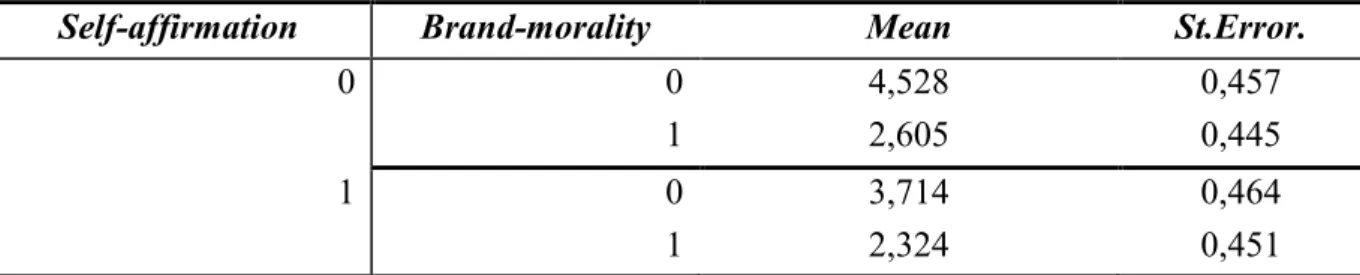
We run ANOVA analysis of the results from the question about the anticipated guilt the participants would feel after choosing. We found that there is only a main effect of brand-morality (F (1, 142) = 13.284; p < .001; hp2 = .086) suggesting that participants anticipated more guilt for the low moral brand (M = 4,121; SE = 0.317) than for the high moral brand (M = 2,465; SE = 0,326).
The ANOVA did not reveal a significant effect of self-affirmation manipulations on
anticipated guilt (F (1, 142) = 1,405; p = 0.231; hp2 = .010). Nonetheless participants on the
self-affirmation conditions (M = 3,019; SE = 0.324) revealed a tendency to show less anticipated guilt than participants without self-affirmation (M = 3,767; SE = 0.319). The participants didn’t license themselves to choose the product with a higher hedonic percentage after having a self-affirmation position and as a consequence they didn’t expect to feel guilt afterwards.
No other effects from the interaction between the variables were found (see Table 4 for
descriptive data). We analyze if there was a significant difference on the condition with a
higher moral brand between the participants under affirmation and without self-affirmation but it was no significant (t < 1).
Results showed that there is no significant effect neither if both independent variables are present (F < 1).
Self-affirmation Brand-morality Mean St.Error.
0 0 4,528 0,457
1 2,605 0,445
1 0 3,714 0,464
1 2,324 0,451
Table 5: Means of the Choice task results on the different conditions.
We also compared among the two self-affirmation conditions whether participants experienced anticipated more guilt after choosing between two products with a different hedonic/utilitarian percentage on the brand morality condition. Although, there is a tendency for participants to expect a higher anticipated guilt after choosing the perfume, a hedonic product rather the sun cream, an utilitarian product (see Table 5) this difference was no significant (t = 1,473; p = 0.143).
Choice With self-affirmation Without self-affirmation
Mean SE Mean SE
Sun Cream (N = 78) 2.85 2,401 2.97 2,738
Perfume (N = 67) 3,18 3,225 4,00 2,871
Table 6: Means of anticipated guilt taking into account self-affirmation and product choice on the different conditions.
2. Ranking task
We run another ANOVA to know how much pleasure the participants would expect to get from the preferred product’s smell after completing the ranking task. Again, we found a significant effect on brand morality (F (1, 138) = 3.580; p = .061; hp2 = .025). Contrary to our prediction, participants thought they would feel higher pleasure from smell when choosing a product from a less moral brand (M = 73,283; SE = 2,707) than from a high moral brand (M = 66,188; SE = 2,595). No other effects were statistically significant. There were no differences between the expected pleasure for from smell between participants on self-affirmation
conditions (M = 66,774; SE = 2,689) and participants who were without a self-affirmation procedure (M = 72,697; SE = 2,614, F (1, 138) = 2.495; p = .117; hp2 =.018). The interaction between these two independent variables and the pleasure form the smell was also not
significant (F < 1).
Self-affirmation Brand-morality Mean St.Error.
0 0 75,657 3,772
1 69,737 3,620
1 0 70,909 3,884
1 62,639 3,719
Table 7: Means of pleasure form smell on the ranking product task on the different conditions.
The data showed that there were no significant effects regarding the pleasure the participants would expect to get on how the product would feel on their skin/hair after completing the ranking task. We run another ANOVA and didn’t find any significant effect of brand morality (F (1, 137) = 1.156; p = .284; hp2 = .008). Participants judging products from high moral brand (M = 78,303; SE = 2,348) did not differ from participants judging a less moral brand (M = 74,668; SE = 2,434). The effect of self-affirmation was also non-significant (F (1, 137) = 0.061; p = .805; hp2 < .001). Indeed, the means from both conditions, with self-affirmation
(M = 76,904; SE = 2,417) and without self-affirmation (M = 76,904; SE = 2,365) were very similar. The interaction between the two independent variables and the pleasure from the feeling on skin/hair was also not significant (F < 1)).
As a consequence, self-affirmation and brand-morality do not have a significant effect on how the individuals’ feel the product on their skin/hair.
Self-affirmation Brand-morality Mean St.Error.
0 0 73,971 3,391
1 78,162 3,298
1 0 75,364 3,492
1 78,444 3,344
Table 8: Means of the pleasure from how the product felt on the participant’s skin on the ranking product task on the different conditions.
The same analysis was done for the comfort, participants thought they would get from the preferred product. The results from an ANOVA showed there was no significant differences on comfort between affirmation influence (M = 71,953; SE = 2,345) and no
self-affirmation influence (M = 71,014; SE = 2,294; F (1, 137) = 0.082; p = 775; hp2 = .001). Regarding brand morality, the effects were also no significant (F (1, 137) = .014; p = 905; hp2 < .001) on both conditions: high moral brand (M = 71,681; SE = 2,277) and low moral brand (M = 71,287; SE = 2,361). As a consequence, and contrary of what we had predicted, self-affirmation and brand-morality do not influence on how much comfort the participants expect to get from their preferred product. The interaction between the two independent variables and the pleasure from the comfort they expect to get was also not significant (F < 1).
Self-affirmation Brand-morality Mean St.Error.
No-self-affirmation Low morality 71,029 3,289
High morality 71,000 3,199
Self-affirmation Low morality 71,545 3,387
High morality 72,361 3,243
Table 9: Means for pleasure from comfort of the product on the different conditions.
The same analysis was done for estimations of guilt after choosing the preferred product on the ranking task. This ANOVA analysis showed that there is a significant effect of brand morality (F (1, 139) = 11.508; p < .001; hp2 = .076) on anticipated guilt. Participants on the less-moral brand condition felt more anticipated guilt (M = 3,441; SE = 0,314)than the ones
under the condition with a high moral brand (M = 1,969; SE = 0,299). There is no significant effect of self-affirmation on participants’ anticipated guilt (F (1, 139) = .082; p >.05; hp2 <
.001), such that conditions with self-affirmation (M = 2,643; SE = 0,312) did not differ from conditions without self-affirmation (M = 2,767; SE = 0,301). The interaction between the two independent variables and the anticipated guilt the participants were expecting to get after choosing a product was also not significant (F <1).
Self-affirmation Brand-morality Mean St.Error.
0 0 3,457 ,438
1 2,077 ,415
1 0 3,424 ,451
1 1,861 ,432
Table 10: Means from anticipated guilt the participant was feeling after choosing a product from the ranking task on the different conditions.
An ANOVA analysis on how much regret the participants thought they would get after choosing the preferred product on the ranking task was also performed. Similar to the predicted guilty, these results showed that there is a significant effect of brand morality on expected regret (F (1, 139) = 6.241; p <.05; hp2 = .043). Participants that were choosing from a less moral brand felt higher regret (M = 2,876; SE = 0,282) that those who were choosing from a high moral brand (M = 1,904; SE = 0,268). On the contrary, there is no significant effect of self-affirmation manipulation on regret (F (1, 139) = .518; p = 473; hp2 = .004), that is, conditions with self-affirmation (M = 2,250; SE = 0,280) did not differ from conditions without self-affirmation (M = 2,530; SE = 0,270). The interaction between both independent variables, self-affirmation and brand-morality, has no significant effect on how much regret the individuals would feel after choosing a product from an organic brand (F <1).
Self-affirmation Brand-morality Mean St.Error.
0 0 3,086 ,393
1 1,974 ,372
1 0 2,667 ,404
1 1,833 ,387
Table 11: Means of participants’ regret after choosing on the ranking product task on the different conditions.
3. Manipulation check
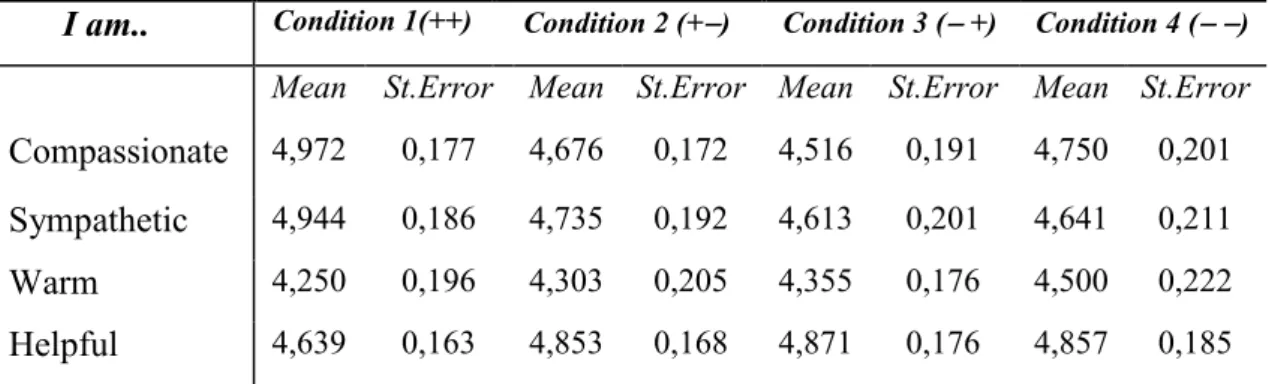
Following the work of Khan and Dhar (2006), we run a reliability analysis in order to prove our prediction: participants under the self-affirmation condition will license themselves and rate them higher than in the other conditions. These four items we use in our manipulation task exhibited a high degree of reliability in terms of coefficient alpha (Cronbach’s α = .774; see Table 9). Consistent with self-affirmation theory, participants rated themselves
significantly more positively on the four attributes in the self-affirmation condition (M = 18,106; SE = 0.790) than in condition with no self-affirmation influence (M = 14,587; SE = 0.774; F (1, 143) = 10,134; p = .002; hp2 = .066). After the analysis of this manipulation
check we can affirm that the self-affirmation task was effective.
I am.. Condition 1(++) Condition 2 (+) Condition 3 ( +) Condition 4 ()
Mean St.Error Mean St.Error Mean St.Error Mean St.Error
Compassionate 4,972 0,177 4,676 0,172 4,516 0,191 4,750 0,201
Sympathetic 4,944 0,186 4,735 0,192 4,613 0,201 4,641 0,211
Warm 4,250 0,196 4,303 0,205 4,355 0,176 4,500 0,222
Helpful 4,639 0,163 4,853 0,168 4,871 0,176 4,857 0,185
Table 12: Mean self-assessment for all conditions (N=128).
Regarding to the mood task results, their ratings on the four items were summed to form a single index that was reliable ( = 0,929). An ANOVA was performed to assess if the effect of self-affirmation was significant on influencing the participants’ mood significantly.
Participants who were on the self-affirmation condition reported feeling happier (M = 15,864;
SE = .737) than those who did not perform this task (M = 12,837; SE = .723; F (1, 143) =
8,606; p = .004; hp2 = .057). This suggests that the self-affirmation manipulation made
participants license themselves which was the effect we expected to see on participants’ mood.
As expected, there was no significant effect of brand morality on the mood of participants (F (1, 143) = 1,203; p = .275; hp2 = .008). That is, participants’ mood on the high moral brand condition (M = 14,916; SE = .717) did not differ from participants’ mood on the low moral brand condition (M =13,875; SE = .742).
We can take as a conclusion that there is a self-affirmation effect on both tasks from the manipulation check. However, results from the tasks related to choose and rank products showed that the participants were not influence by this self-affirmation manipulation.
Self-affirmation Brand-morality Mean St.Error.
0 0 12,083 1,042
1 13,590 1,001
1 0 15,486 1,057
1 16,243 1,028
Table 13: Means of participants’ regret after choosing on the ranking product task for all conditions.
4. General Discussion
4.1. Theoretical discussion
As seen on the literature, being under a self-affirmation condition can have a licensing effect at the time of making purchasing decisions. Against this literature, our study predicted that participants being under a self-affirmation condition don’t license themselves to choose a product with a higher hedonic percentage even if it was from a less moral brand. However, we noticed a tendency on participants from the self-affirmation condition to choose the most hedonic product when the brand had lower morality than when the brand has higher morality. We could explain this behavior taking as an hypothetical fact that, when participants accept a brand that may not be morally accepted, they license themselves to choose a hedonic option because the situation can’t get worst that what it is. A hedonic product is defined as an item which has a strong relationship with luxury and pleasure, furthermore, from classical
traditions, luxury and pleasure has been seen as a unnecessary and a violation of God’s Law being judged from a moral criticism perspective (Mizukoshi, 2001). Applying this theory on our study, participants chose the hedonic product from a low moral brand because they were already in a non-virtuous position and they did not mind having more pleasure choosing the perfume.
We were expecting participants to feel less guilty and regretful after buying a cosmetic product with high hedonic percentage under the self-affirmation condition. What results showed is that participants didn’t license themselves and they only took into account brand morality, feeling higher anticipated guilt when choosing products form a less moral brand. With our study, we found that only brand-morality can influence consumers’ purchasing
decisions on the cosmetic sector. The difference between the results obtained by Khar and Dhar (2006) and the ones obtained in our study can be explained perhaps focusing on the type of product we use and the market we were testing, participants didn’t license themselves when choosing between organic cosmetic products as they did on the studies from literature (Khan & Dhar, 2006). WE saw from literature that the products they used were related to daily life with a lower difference between hedonic and utilitarian percentages than ours (pair of jeans, vacuum cleaner) or they presented directly two different amounts of money they could either donate or keep to buy a pair of sunglasses which could be seen as hedonic and utilitarian (Khan & Dhar, 2006).
If anything, results from anticipated guilt showed a tendency for participants to have a higher sensibility to choose the hedonic product when they are under self-affirmation which goes along with previous research on this subject.
Following this line of behavior, participants don’t consider brand morality or self-affirmation when deciding what kind of pleasure, they would get from a specific product. However, there is a slight tendency to expect higher pleasure when the product is from a less moral brand under no self-affirmation effect. This behavior could be related to the first conclusion on the choice task, participants license themselves when the brand has a dubious morality and choose the hedonic product because they are not concern anymore since the brand is not acceptable already. Another difference with literature is that the products they used didn’t have a clear moral position whereas ours are clearly morally acceptable or not, this detail could have affected our participants in a way we didn’t expect based on the literature (Khan & Dhar, 2006). On the other hand, from the results obtained on the mood manipulations we can conclude that there is indeed a self-affirmation effect when individuals rated themselves with a higher positive score under this condition. As seen on the results from the manipulation check, participants were under self-affirmation effects on the conditions which included the voluntary task and likewise our study is proving previous research evidence. Perhaps, because the type of products we chose were taking into consideration personal opinions and
experimental evidence that could not be related with licensing effects we did not see these effects on our results.
The expected effects we consider in our hypothesis related to brand morality were no present. Participants did not feel neither in good nor bad after buying products from a low-moral cosmetic brand. Nevertheless, we found, as predicted, a main effect from brand morality on guilty and regret evaluations after choosing organic cosmetic products. The highest scores we analyzed were coming from conditions where the brand has low moral values meaning that
participants were feeling regretful and guilty when buying organic products from a brand with a dubious morality. This could be explained by the increase of consumers’ awareness of the moral responsibility they have as consumers in this society and though, they behave in a different way that 20 years ago, trying to choose brands with a good moral position. However, we should remark that an effect on self-affirmation was found but only on participants’ mood and not on the variables we expected to influence on.
To conclude, our findings suggest that guilt and regret are dominated by brand morality and there is nothing self-licensing can influence on to change consumers behavior while
purchasing an organic cosmetic product. 4.2. Marketing implications
Results showed that consumers have considerable concerns about brand morality and they are sensible about how an organic cosmetic brand produces their goods. This would be translated on their purchase behavior and, as a consequence, has to be taken into account when
developing a marketing plan. However, influencing on self-image and self-affirmation could not get good results on products that have a higher personal component or could depend on an specific consumer type.
Apart from the moral image of a brand, consumers engaged the most when they see good moral acts as a part of the real brand ethical values. Companies should be more transparent on the way they produce, pack and develop their cosmetic products in order to allow the
consumers to trust them because consumers have access to their information and will base their purchase decisions on what they read.
4.3. Directions for further research
Based on the results obtained from our study, we could do a further research adding other types of organic cosmetic products on the ranking task classifying them depending on their hedonic/utilitarian percentage. In this way, we would be able to see if participants license themselves on purchasing a hedonic product from a good moral brand and analyzing also the rest of the products they ranked, we could interpret information related on when this licensing effect stops. Individuals can buy a second product which has a higher utilitarian percentage after licensed themselves on buying a first one which is hedonic.
Furthermore, we can not only add more products but also analyze deeply how having two products with different hedonic/utilitarian percentage can affect to participants who has a
previous experience, positive or negative, with a high moral organic cosmetic brand the same study could analyze as well the results from participants who had an experience with a low moral brand. This could help us understanding why the effect we found on brand morality was higher and significant than the non-significant effect we found on self-affirmation. Another possible study could be based on which self-affirmation tasks may affect participants significantly and in a higher proportion than the ones we used (voluntary program). Perhaps, other activities such as the ones related to nature disasters, for example, could affect and impact participants in a way that we can measure better their self-licensing on this kind of choice.
5. References
A. Picot-Lemasson, G. D. (2002). Influence of hairdressing on the psychological mood of women. International Journal Cosmetic Science, 23(3), 161-164.
Alba, J. W., & Williams, E. F. (2013). Pleasure principles: A review of research on hedonic consumption. Journal of Consumer Psychology, 23(1), 2-18.
Carey, L. I., & Cervellon, M.-C. (2014). Sustainable, hedonic and efficient: Interaction effects between product properties and consumer reviews on post-experience responses.
European journal of Marketing, 48(7/8), 1375-1394.
Colombini, M. (2016). Kosmetica World. Obtenido de
http://www.kosmeticaworld.com/2016/04/03/new-trend-in-natural-cosmetics/ Cosmetic Legislation. (s.f.). Obtenido de European Commission:
https://ec.europa.eu/growth/sectors/cosmetics_en
Dunning, D. (2005). Self insight: Roadblocks and detours on the path to knowirzg thyself New. Psychology Press, 153-182.
Dunning, D. (2007). Self-image motives and consumer behavior: How sacrosanct self-beliefs sway preferences in the marketplace. Journal of Consumer Psychology, 17(4), 237-249.
Dunning, D.; Heath, C.; Suls, J. (2004). Flawed self-assessment: Implications for health, education, and the workplace. Psychological Science in the Public Interest,, 5, 69-106. Heatherton, T. F., & Polivy, J. (1991). Development and validation of a scale for measuring
state self-esteem. Journal of Personality and Social Psychology, 60(6), 895-910. Hitlin, S. (2003). Values as the Core of Personal Identity: Drawing Links between Two
Theories of Self. American Sociological Association, 66(2), 118-137.
Khan, U., & Dhar, R. (2006). Licensing effect in consumer choice. Journal of Marketing
Research, 43(2), 259-266.
Koparal, C., & Çalık, N. (2015). Hedonic Consumption Characteristics Related to Products and Services where Fashion Involvement Plays an Important Role , A Field Study from Eskisehir , Turkey. International Journal of Social Science, IV(1), 14-39. Lee, A. Y., & Sternthal, B. L. (1999). The effects of positive mood on memory. Journal of
Consumer Research, 26(2), 115-127.
Maggioni, I., Montagnini, F., & Sebastiani, R. (January de 2012). Young adults and ethical consumption: an exploratory study in the cosmetics market. 12th International
Marketing Trends Conference, 1-23.
Mazar, N., & Zhong, C.-B. (2010). Do Green Products Make Us Better People?
Psychological Science, 21(4), 494-498.
Mizukoshi, A. (2001). Keats, Hunt and the Aesthetics of Pleasure. Palgrave Mcmillan. Mohammad, N., & Baharun, R. (September de 2016). Effect of Perceived Value and Personal
Value in Affecting the Attitude To Purchase Organic Product : a Literature Value in Affecting the Attitude To Purchase Organic Product : a Literature Review.
Park, E. J., Kim, E. Y., & Forney, J. C. (2006). A structural model of fashion‐oriented impulse buying behavior. Journal of Fashion Marketing and Management: An
International Journal, 10(4), 433-446.
Rockeach, M. (1973). The Natura of Human Values. Free press, 438.
Sachdeva, S., Iliev, R., & Medin, D. (2009). Sinning saints and saintly sinners: The paradox of moral self-regulation. Psycho-. Psychological Science, 20, 523–528.
Statista. (2016). Obtenido de
Strahilevitz, M., & Myers, J. G. (1998). Donations to Charity as Purchase Incentives: How Well They Work May Depend on What You Are Trying to Sell. Source Journal of
Consumer Research, 24(4), 434-446.
Van der Werff, E., & Keizer, L. a. (2013). The value of environmental self-identity: The relationship between biosphere values, environmental self-identity and environmental preferences, intentions and behavior,. Journal of Environmental Psychology, 34, 55-63.
Webb, D. J., & Harris, L. A. (2008). A Re-examination of Socially Responsible Consumption and its Measurement. Journal of Business Research, 61(2), 91-98.
Webster, F. E. (1975). Determining Characteristics of the Socially Conscious Consumer.
6. Appendix
6.1. Appendix I: Surveys
a. Condition: With self-affirmation and high moral brand 1 (++) Q1:You will take part in different unrelated tasks. The first two tasks will ask you to think about social scenarios. The second task will ask you to imagine a purchase situation. We ask you to read the case carefully and answer according to your opinion. There are no wrong answers. Please, do not to interrupt your participation on this study and answer individually each question.
Q2 First, imagine the following two scenarios. Imagine you have to choose between these two volunteering programs: helping in a social lunchroom for homeless people or teaching
English to orphan children. Which of these volunteering programs would you choose? Can you give us some reasons on your choice? Explain the reasons why you chose it.
“Helping in social lunchroom for homeless people” or “Teaching English to orphan children” (Distractor high)
Q3: In the following task we want you to imagine you are working on a multinational
company with approximately 100 employees. This company ranks their employees according to their performance and every year awards the 3 best employees with a desirable financial prize. Imagine one co-worker from your company that you don't know very well. You never talked to each other you don't know much about this person. You only know it is someone who works on the same company you do. This co-worker is one of the best workers of the company and has been placed on the top 10 every year.
In 2014 this person got the 6th place, in 2015 a 4th place and last year, 2016, this co-worker got the 5th position. Every trimester the performance ranking is updated until November when the final ranking for the year is released. You will now see this person's ranking position over the 4 trimesters of the current year. You will then be asked to judge how satisfied is this person with the final ranking position this year.
Q4: First trimester: 5th place Q5: Second trimester: 3rd place Q6: Third trimester: 3rd place
Q7: Final trimester and final ranking position: 4th place
Q8: How satisfied is your co-worker with the final ranking for this year?. “Not satisfied at all” = 1 to “Totally satisfied” = 9
Q9: How happy was your co-worker after finding out the final ranking for this year?. “Not happy at all” = 1 to “Totally happy” = 9
(Distractor Low)
Q10: In the following task we want you to imagine you are working on a multinational company with approximately 100 employees. This company ranks their employees according to their performance and every year awards the 3 best employees with a desirable financial prize. Imagine one co-worker from your company that you know very well and is a very close friend of you. You talk frequently about personal and professional issues. You know
everything about each other and you really wish all the best for your friend and colleague. Your friend is one of the best workers of the company and has been placed on the top 10 every year. In 2014 your friend got the 6th place, in 2015 a 4th place and last year, 2016, your friend got the 5th position. Every trimester the performance ranking is updated until
November when the final ranking for the year is released. You will now see your close friend's ranking position over the 4 trimesters of the current year. You will then be asked to judge how satisfied is your friend with the final ranking position this year.
Q11: First trimester: 5th place Q12: Second trimester: 3rd place Q13: Third trimester: 3rd place
Q14: Final trimester and final ranking position: 4th place
Q15: How satisfied is your friend with the final ranking for this year? “Not satisfied at all” = 1 to “Totally satisfied” = 9
Q16: How happy was your friend after finding out the final ranking for this year? “Not happy at all” = 1 to “Totally happy” = 9
Q17: Imagine you are at a beauty and care shop that has a sale. Imagine you want to buy a couple of products, both from Muraven. Muraven is an organic cosmetic company that has been trying new hydrating formulas based on a plant from the Swiss Alps. Based on a
sustainable production all the packaging is made with eco-friendly materials. What is a fact is that they are receiving great feedback on any type of skin and also that their production defends animal and human rights. Imagine you planned to buy both, a sun cream and a
perfume, each priced 40€. However, this time you can only afford one of the two products and you have to choose which product you will buy.
Q18: Imagine you have to choose one between these two Muraven's products. Take into account that the price is the same. Choose which product you would buy: Sun Cream (1) or Perfume (2)
Q19: How guilty would you feel after buying your preferred product? “Not guilty at all” = 0 to “Extremely guilty” = 10
Q20: Again, imagine you want to buy a short list of products from Muraven, the organic cosmetic company that we presented before. We now ask you to rank these products
according to your preference. Rank the products from the one you have more willingness to buy (in the first position) to the last one you would like to buy (in the last position).
In this case, please consider you can afford to buy all of them: Hand cream (1); Daily hydrating cream (2); Foot cream (3); Hair Shampoo (4); Foundation (5)
Carry Forward Choice With Lowest Numeric Value from "Again, imagine you want to buy a short list of products from Muraven, the organic cosmetic company that we presented before. We now ask you to rank these products according to your preference. Rank the products from the one you have more willingness to buy (in the first position) to the last one you would like to buy (in the last position). In this case, please consider you can afford to buy all of them. "
Q21: As your preference, you selected: Hand cream (1); Daily hydrating cream (2); Foot cream (3); Hair Shampoo (4); Foundation (5)
Q22: How much pleasure do you think you would get from the product of your preference on the following aspects?: Smell 100%); Feeling on my skin/hair (100%); Comfort (0-100%)
Q23 How guilty would you feel after buying your preferred product? “Not guilty at all” = 0 to “Extremely guilty” = 10
Q23 How much regret would you feel after buying your preferred product? “Not regretful at all” = 0 to “Extremely regretful” = 10
Q24 Imagine, again, that you need to buy beauty and care products.
How likely are you to choose and buy a product from Muraven? “Extremely unlikely” = 1 to “Extremely likely” = 10
Q25 Do you use organic cosmetic products? “Yes” = 1 or “No” = 2 Display This Questions: