EUROPEAN ORGANISATION FOR NUCLEAR RESEARCH (CERN)
CERN-PH-EP-2012-259
Submitted to: Physics Letters B
Search for long-lived, heavy particles in final states with a muon
and multi-track displaced vertex in proton-proton collisions at
√
s = 7 TeV
with the ATLAS detector
The ATLAS Collaboration
Abstract
Many extensions of the Standard Model posit the existence of heavy particles with long lifetimes. In
this Letter, results are presented of a search for events containing one or more such particles, which
decay at a significant distance from their production point, using a final state containing charged
hadrons and an associated muon. This analysis uses a data sample of proton-proton collisions at
√
s = 7 TeV
corresponding to an integrated luminosity of 4.4 fb
−1collected in 2011 by the ATLAS
detector operating at the Large Hadron Collider. Results are interpreted in the context of R-parity
violating supersymmetric scenarios. No events in the signal region are observed and limits are set on
the production cross section for pair production of supersymmetric particles, multiplied by the square
of the branching fraction for a neutralino to decay to charged hadrons and a muon, based on the
scenario where both of the produced supersymmetric particles give rise to neutralinos that decay in
this way. However, since the search strategy is based on triggering on and reconstructing the decay
products of individual long-lived particles, irrespective of the rest of the event, these limits can easily
be reinterpreted in scenarios with different numbers of long-lived particles per event. The limits are
presented as a function of neutralino lifetime, and for a range of squark and neutralino masses.
Search for long-lived, heavy particles in final states with a muon and multi-track
displaced vertex in proton-proton collisions at
√
s = 7 TeV with the ATLAS detector
The ATLAS Collaboration
Abstract
Many extensions of the Standard Model posit the existence of heavy particles with long lifetimes. In this Letter, results are presented of a search for events containing one or more such particles, which decay at a significant distance from their production point, using a final state containing charged hadrons and an associated muon. This analysis uses a
data sample of proton-proton collisions at√s = 7 TeV corresponding to an integrated luminosity of 4.4 fb−1collected in
2011 by the ATLAS detector operating at the Large Hadron Collider. Results are interpreted in the context of R-parity violating supersymmetric scenarios. No events in the signal region are observed and limits are set on the production cross section for pair production of supersymmetric particles, multiplied by the square of the branching fraction for a neutralino to decay to charged hadrons and a muon, based on the scenario where both of the produced supersymmetric particles give rise to neutralinos that decay in this way. However, since the search strategy is based on triggering on and reconstructing the decay products of individual long-lived particles, irrespective of the rest of the event, these limits can easily be reinterpreted in scenarios with different numbers of long-lived particles per event. The limits are presented as a function of neutralino lifetime, and for a range of squark and neutralino masses.
1. Introduction
Several extensions to the Standard Model predict the production of heavy particles with lifetimes that may be of order picoseconds up to about a nanosecond [1], at the Large Hadron Collider (LHC). One such scenario is gravity-mediated supersymmetry (SUGRA [2]) with R-parity violation (RPV) [3, 4]. If the results of R-R-parity conserving supersymmetry searches at the LHC (see, for example, Refs. [5, 6]) continue to disfavour light super-partners, then scenarios in which R-parity is violated may be required if supersymmetry is the solution to the hi-erarchy problem [7]. The present (largely indirect) con-straints on RPV couplings [3, 4] would allow the decay of the lightest supersymmetric particle as it traverses a par-ticle detector at the LHC. Signatures of heavy, long-lived particles also feature in models of gauge-mediated super-symmetry breaking [8], split-supersuper-symmetry [9], hidden-valley [10], dark-sector gauge bosons [11] and stealth su-persymmetry [12] though some of these models are dis-favoured [13] by the recent results on the search for the Higgs boson [14, 15].
This Letter presents the results of a search for the de-cay of a heavy particle, producing a multi-track vertex
that contains a muon with high transverse momentum (pT)
at a distance between millimetres and tens of centimetres from the pp interaction point. As in the earlier ATLAS
work [16], the results are interpreted in the context of an R-parity violating supersymmetric scenario. In this model, the signature under consideration corresponds to the de-cay of the lightest supersymmetric particle, resulting in a
muon and many high-pT charged tracks originating from
a single displaced vertex (DV). This can arise from a dia-gram such as that shown in Fig. 1, where the decay occurs
due to the non-zero RPV coupling λ02ij.
The CMS collaboration has performed a search for a re-lated signature, where a long-lived neutral particle decays
to a final state containing two leptons, using 5pb−1 of pp
collisions at√s = 7 TeV [17]1. Similar searches have also
been performed by the DØ collaboration at the Tevatron
with √s = 1.96 TeV p¯p collisions [18], who also study
decays to a b¯b pair [19], and at LEP [20]. The result
re-ported here improves on the previous ATLAS search for this signature [16] in several ways. The dataset is around 100 times larger, corresponding to an integrated
luminos-ity of 4.4 fb−1 [21]. Furthermore, the signal efficiency is
increased by improving the reconstruction efficiency for reconstructing tracks that do not originate from the pri-mary vertex. The dependence on simulation to estimate background levels is also removed. Finally, while the
pre-1Following submission of our paper, this paper was submitted addressing the same physics, but for a different final state.
vious analysis did not require muons to be associated ver-tices, this association requirement is now imposed, which greatly simplifies both the analysis itself, and also the re-interpretation of these results for scenarios containing dif-ferent numbers of long-lived particles.
Figure 1: Diagram of the massive lightest neutralino ˜χ0 decaying into a muon and two jets via a virtual smuon, with lepton-number and R-parity violating coupling λ02ij.
2. The ATLAS detector
The ATLAS detector [22] is a multipurpose apparatus at the LHC. The detector consists of several layers of sub-detectors. From the interaction point (IP) outwards there is an inner detector (ID), measuring the tracks of charged particles, electromagnetic and hadronic calorimeters, and an outer muon spectrometer (MS).
The ID is immersed in a 2 T axial magnetic field, and
extends from a radius2 of about 45 mm to 1100 mm and
to |z| of about 3100 mm. It provides tracking and vertex information for charged particles within the pseudorapid-ity region |η| < 2.5. At small radii, silicon pixel layers and stereo pairs of silicon microstrip detectors provide high res-olution pattern recognition. The pixel system consists of three barrel layers, and three forward disks on either side of the interaction point (the beam pipe envelope is at a ra-dius of about 30 mm). The barrel pixel layers, which are positioned at radii of 50.5 mm, 88.5 mm, and 122.5 mm are of particular relevance to this work. The silicon microstrip tracker (SCT) comprises four double layers in the barrel, and nine forward disks on either side. A further tracking system, a transition-radiation tracker (TRT), is positioned at larger radii. This device is made of straw-tube elements interleaved with transition-radiation material; it provides coverage within the region |η| < 2.0.
The calorimeter provides coverage over the pseudora-pidity range |η| < 4.9. It consists of a lead/liquid-argon
2ATLAS uses a right-handed coordinate system with its origin at the nominal IP in the centre of the detector and the z-axis along the beam pipe. The x-axis points from the IP to the centre of the LHC ring, and the y-axis points upward. Cylindrical coordinates (r, φ) are used in the transverse plane, φ being the azimuthal angle around the beam pipe. The pseudorapidity is defined in terms of the polar angle θ as η = − ln tan(θ/2).
electromagnetic calorimeter, a hadronic calorimeter com-prising a steel and scintillator-tile system in the barrel re-gion and a liquid-argon system with copper and tungsten absorbers in the end-caps.
Muon identification and momentum measurement is provided by the MS. This device has a coverage in pseu-dorapidity of |η| < 2.7 and is a three-layer system of gas-filled precision-tracking chambers. The pseudorapidity re-gion |η| < 2.4 is additionally covered by separate trigger chambers, used by the hardware trigger for the first level of triggering (level-1). The MS is immersed in a magnetic field which is produced by a set of toroid magnets, one for the barrel and one each for the two end-caps. Online event selection is performed with a three-level trigger sys-tem. It comprises a hardware-based level-1 trigger, which uses information from the MS trigger chambers and the calorimeters, followed by two software-based trigger lev-els.
3. Data and simulation
The data used in this analysis were collected between March and October, 2011. After the application of beam, detector, and data-quality requirements, the integrated
lu-minosity considered corresponds to 4.4 fb−1, with an
un-certainty of ±3.9% [21].
Signal Monte Carlo (MC) events are generated with Pythia 6 [23], using the MRST LO** [24] set of parton distribution functions (PDFs). Processes are simulated in
which a ˜q ˜q, ˜q ˜q, or ˜q ˜q pair is produced in the pp collision,
with each squark (antisquark) decaying into a long-lived lightest neutralino and a quark (antiquark). Degeneracy of the first and second generations and for the left-handed and right-handed squarks is assumed. The masses of the gluino, sleptons and third-generation squarks are set at such a high value (5 TeV) that they are not directly pro-duced in the supersymmetry scenario considered here.
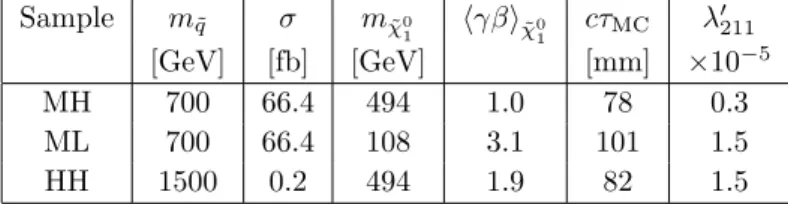
The parameter settings for the samples of signal MC
events are summarised in Table 1. The chosen values
of squark and neutralino masses correspond to a wide range in the quantities to which the signal efficiency is most sensitive: neutralino speed and final-state multiplic-ities (see Section 5). The Higgsino-gaugino mixing deter-mines the neutralino mass values. The signal MC samples are labelled in Table 1 according to the squark mass and neutralino mass, respectively: MH (medium-mass squark, heavy neutralino), ML (medium-mass squark, light neu-tralino), and HH (heavy squark and heavy neutralino). It
is assumed that all RPV couplings other than λ0211 are
zero. This leads to each neutralino decaying to µ−u ¯d (or
the charge-conjugate state). Decays of neutralinos to a neutrino and jets final state, which would also occur via a
non-zero λ0211, are not considered in this work.
The PROSPINO [25] program is used to calculate the signal cross section (hereafter referred to as the supersym-metry production cross section) at next-to-leading order; cross section values are listed in Table 1. The CTEQ6.6
Sample mq˜ σ mχ˜0 1 hγβiχ˜01 cτMC λ 0 211 [GeV] [fb] [GeV] [mm] ×10−5 MH 700 66.4 494 1.0 78 0.3 ML 700 66.4 108 3.1 101 1.5 HH 1500 0.2 494 1.9 82 1.5
Table 1: The parameter values for the three signal MC samples used in this work: the assumed squark mass, production cross section (calculated with PROSPINO), neutralino mass, average value of the Lorentz boost factor (from Pythia), average proper decay length, and value of λ0211 coupling used in the generation of the signal MC samples.
PDF set [26] is used. Owing to differences in the
pre-dicted cross sections for the ˜q ˜q and ˜q¯˜q processes from
Pythia and PROSPINO, and the possible sensitivity of the neutralino-speed distribution to the assumed pro-cess, signal samples are generated for each process sepa-rately with Pythia and reweighted according to the rela-tive cross sections of the two processes as estimated with PROSPINO. The reweighting procedure, however, has a minimal effect on the distributions of physical quantities used in this work and typically leads to changes of much less than 1%.
Each generated event in the signal samples is pro-cessed with the Geant4-based [27] ATLAS detector sim-ulation [28] and treated in the same way as the collision
data. The samples include a realistic modelling of the
effects of multiple pp collision per bunch crossing (pile-up) observed in the data, obtained by overlaying simu-lated Minimum Bias events generated using Pythia, on top of the hard scattering events, and reweighting events such that the distribution of the number of interactions per bunch crossing matches that in the data..
4. Vertex reconstruction and event selection It is required that the trigger identifies a muon candidate
with transverse momentum pT > 40 GeV and |η| < 1.05,
i.e., in the barrel region of the MS. The latter selection is necessary since there is no ID track requirement in the trigger, and the trigger rate arising from muons with badly measured momenta in the (larger |η|) end-cap re-gion, where the magnetic field is highly complex, would have consumed too much bandwidth to be viable in the 2011 running conditions.
Owing to the higher instantaneous luminosity of the LHC in 2011 compared to that in 2010, most events contain more than one primary vertex (PV). The PV
with the highest sum of p2
T of the tracks associated to
it is required to have at least five tracks and a z
posi-tion in the range |zPV| < 200 mm. In order to reduce
cosmic-ray background, events are rejected if they con-tain two muons which appear back-to-back. A selection
p(π − (φ1− φ2))2− (η1+ η2)2> 0.1 is applied where φ1,
φ2, η1 and η2 are the azimuthal angles and
pseudorapidi-ties of the two reconstructed muons.
A muon candidate is required to have been recon-structed in both the MS and the ID with transverse
mo-mentum pT > 50 GeV (which is well into the region
where the trigger efficiency is approximately independent
of the muon momentum) and |η| < 1.07. The impact
parameter relative to the transverse position of the
pri-mary vertex (d0) is required to satisfy |d0| > 1.5 mm.
To ensure that the muon candidate is associated with the muon that satisfied the trigger requirement, the selection
p(∆φ)2+ (∆η)2< 0.15 is imposed, where ∆φ (∆η) is the
difference between the azimuthal angle (pseudorapidity) of the reconstructed muon and that of the muon identified by the trigger. The ID track associated with the muon candi-date is required to have at least six SCT hits, and at most one SCT hit that is expected but not found i.e. in an ac-tive detector element with no known read-out problems. Furthermore, the track must satisfy an |η|-dependent quirement on the number of TRT hits. No pixel-hit re-quirements are applied to the muon track. The combina-tion of requirements described above is referred to as the muon-selection criteria.
In order to reconstruct a DV it is first necessary to se-lect high quality tracks. This is done by requiring that candidate tracks have two or more associated SCT hits
and a value of |d0| greater than 2 mm. Studies made
with the MC simulation show that 98% of all tracks orig-inating from the primary pp interaction are rejected by
the selection on |d0|. Standard ATLAS tracking [22] is
based on three passes in which the initial track candidates are formed in different ways: initially found in the silicon detectors, initially found in the TRT detector, and only found in the TRT detector. The algorithms all assume that tracks originate from close to the PV, and hence have reduced reconstruction efficiency for signal tracks which originate at a DV. To counter this problem and recover some of these lost tracks, the silicon-seeded tracking al-gorithm is re-run with looser requirements on the radial and z impact parameters, and on the number of detector hits that can be shared among more than one seed track. To reduce the rate of false seed tracks, it is required that
these additional tracks have pT> 1 GeV, which is greater
than the standard-tracking requirement of pT> 400 MeV.
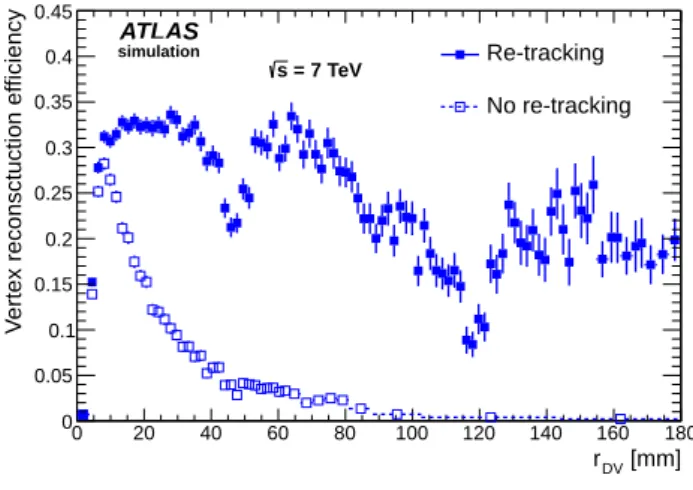
This procedure is termed “re-tracking”. Fig. 2 shows the efficiency for vertex reconstruction (described later) as a
function of the radial position of the vertex rDV when
us-ing standard trackus-ing and re-trackus-ing for sample MH. As can be seen, there is a substantial improvement due to
re-tracking at values of rDV greater than about 10 mm. The
dips in the plot correspond to losses in efficiency for de-cays immediately before a pixel layer, where many tracks from the vertex have shared pixel hits and therefore fail the selection.
Using an algorithm based on the incompatibility-graph approach [29], DVs are sought with the selected tracks. The method adopted is similar to that used in Ref. [30].
[mm] DV r 0 20 40 60 80 100 120 140 160 180 V e rt e x r e c o n s c tu c ti o n e ff ic ie n c y 0 0.05 0.1 0.15 0.2 0.25 0.3 0.35 0.4 0.45 Re-tracking No re-tracking ATLAS simulation = 7 TeV s
Figure 2: The vertex reconstruction efficiency as a function of rDV for the MH sample, with and without re-tracking. All selection cri-teria, except for the material veto, have been applied.
The algorithm starts by finding two-track seed vertices
from all pairs of tracks; those that have a vertex-fit χ2
of less than 5.0 per degree of freedom are retained. A seed vertex is rejected if at least one of its tracks has hits between the vertex and the PV. Multi-track vertices are formed from combinations of seed vertices in an iterative process. The following method is used to do this. If a track is assigned to two different vertices, the action taken
de-pends on the distance D between the vertices. If D < 3σD,
where σDis the estimated uncertainty on D, a single vertex
is formed from the tracks of the two vertices. Otherwise, a track is associated with that vertex for which the track
has the smaller χ2value. In the event of the χ2 of a track
relative to the resulting vertex exceeding 3.0 per degree of freedom, the track is removed from the vertex, and the vertex is refitted. This process continues until no track is associated with more than one vertex. Finally, vertices are combined and refitted if they are separated by less than 1 mm.
To ensure a good quality DV fit, the χ2 per degree of
freedom of the fit must be less than 5. Furthermore, the DV position is required to be in the fiducial region,
de-fined as |zDV| < 300 mm and rDV < 180 mm, where
rDV and zDV are the radial and longitudinal vertex
po-sitions with respect to the origin. To minimise
back-ground coming from the PVs, the transverse distance
p(xDV− xPV)2+ (yDV− yPV)2 between any of the PVs
and the DV must be at least 4 mm. Here x and y are the transverse coordinates of a given vertex, with the sub-scripts PV and DV denoting the type of vertex. The
num-ber of tracks Ntrk
DVassociated with the DV is required to be
at least five. This reduces background from random com-binations of tracks and from material interactions. Back-ground due to particle interactions with material is
sup-pressed by requiring mDV > 10 GeV. Here, mDV is the
invariant mass of the set of tracks associated with the DV, using the charged-pion mass hypothesis for each track.
Candidate vertices which pass (fail) the mDV > 10 GeV
requirement are hereafter referred to as being high-mDV
(low-mDV) vertices.
The typical position resolution of the DV in the signal
MC samples is tens of microns for rDV and about 200 µm
for zDV near the interaction point. For vertices beyond
the outermost pixel layer, which is located at a radius of 122.5 mm, the typical resolution is several hundred mi-crons for both coordinates.
Low-mDV (mDV< 4GeV) vertices from particle–
material interactions are abundant in regions in which the
detector material is dense. High-mDV background may
arise from the random spatial coincidence of a
material-interaction vertex with a high-pT track, especially when
this track and the particle that initiated the material-interaction vertex originate from different primary interac-tions, resulting in a large angle between their momentum vectors.
To reduce this source of background, vertices that are reconstructed in regions of high-density material are re-moved. The high-density material was mapped using
low-mDV material-interaction candidate vertices in data and
true material-interaction vertices in minimum-bias MC
events. The zDV and rDV positions of these vertices are
used to make a two-dimensional material-density
distribu-tion with a bin size of 4 mm in zDV and 1 mm in rDV.
It has been demonstrated [30] that the detector simula-tion describes the posisimula-tions of pixel layers and associated material reasonably well, while the simulated position of the beampipe is shifted with respect to the actual posi-tion. The use of data events to construct the material map therefore ensures that the beampipe material is cor-rectly mapped, while the use of the simulation provides a high granularity of the map at the outer pixel layers, where material-interaction vertices in the data are comparatively rare. Material-map bins with vertex density greater than
an rDV- and zDV-dependent density criterion are
charac-terised as high-density-material regions. These make up
34% of the volume at |zDV| < 300 mm, rDV< 180 mm.
To ensure that the muon candidate is associated with the reconstructed DV, the distance of closest approach of the muon with respect to the DV is required to be less than 0.5 mm. This requirement ensures that the vertex that we reconstruct gave rise to the muon that triggered the event, and so the selection efficiency for each neutralino decay is independent of the rest of the event. This facilitates a straightforward calculation of the event selection efficiency for scenarios with different numbers of long-lived neutrali-nos in the event. The aforementioned selections are collec-tively referred to as the vertex-selection criteria. Events containing one or more vertices passing these criteria are accepted.
5. Signal efficiency
The signal efficiency depends strongly on the efficien-cies for track reconstruction and track selection, which are
affected by several factors: (1) The number of tracks orig-inating from the DV and their total invariant mass in-crease with the neutralino mass. (2) More tracks fail the
|d0| > 2 mm requirement for small rDV or if a neutralino
with large pT has a small decay length, thereby leaving
its daughters pointing back closer to the PV. (3) The effi-ciency for reconstructing tracks decreases with increasing
values of |d0|. Because the MH and HH samples have the
same neutralino mass, but different boosts, a cross–check of the efficiency estimation procedure can be made. The HH sample is reweighted vertex-by-vertex such that the βγ versus η distributions match the MH sample. It was checked that they have the same efficiency as a function of decay position.
The total efficiency for each of the signal MC samples is shown in Fig. 3 as a function of cτ . This is an overall event efficiency, derived from the determination of (the single) vertex efficiency, and is based on having two displaced ver-tices per event in the signal MC. This efficiency as a func-tion of cτ is calculated from the samples generated with a single-cτ value (see Table 1) using a two-dimensional map
in (|zDV|, rDV) (Fig. 4) and distributions of decay positions
for different values of cτ . Events are reweighted according to their probability of being found at different positions in the map, where the probability depends on cτ . Figure 3 includes systematic corrections and uncertainties that are discussed in Section 7. [mm] τ c 1 10 102 3 10 E v e n t s e le c ti o n e ff ic ie n c y 0 0.1 0.2 0.3 0.4 0.5 0.6 MH ML HH ATLAS simulation = 7 TeV s
Figure 3: The event selection efficiency as a function of cτ for the three signal samples. The total uncertainties on the efficiency are shown as bands; the estimation of the uncertainties is discussed in Section 7.
6. Background estimation
Spurious high-mDV, high-multiplicity vertices in
non-material regions could come from one of two sources: (1) Purely random combinations of tracks (real or fake). This type of background is expected to form the largest con-tribution at small radii where the track density is high-est. (2) Vertices from real hadronic interactions with gas
| [mm] DV |z 0 50 100 150 200 250 300 [mm] DV r 0 20 40 60 80 100 120 140 160 180 0 0.1 0.2 0.3 0.4 0.5 0.6 ATLAS simulation s = 7 TeV
Figure 4: The efficiency as a function of rDV and zDVfor vertices in the signal MC sample MH. The blank areas represent regions of dense material which are not considered when looking for DVs. Bin-to-bin fluctuations due to limited MC sample size are compensated for by recalculating this map many times, varying each bin content within its statistical uncertainty.
molecules. Although most of these events will have masses below the 10 GeV requirement, the high-mass tail of the distribution indicates a potential background, in particu-lar if the vertex is crossed by a random track (real or fake) at large crossing angle.
The first source of background mentioned above gives rise to displaced vertices inside the beampipe (where there are few real hadronic interactions due to the good vac-uum, but where random combinations are expected to dominate). The expected contribution from this source of background is evaluated using a large sample of jet-triggered events, and examining the ratio of the number
of vertices with mDV > 10GeV to the number in a mass
control region, 4GeV < mDV < 10GeV. Since the number
of random combinations of tracks depends primarily on the pile-up conditions, and is therefore independent of the type of event that fired the trigger, this ratio can also be applied to the number of vertices in the mass control region in muon-triggered events. All of this information is used as input to a simple maximum likelihood fit, which yields
a background expectation of 0.00+0.06−0 vertices passing our
cuts, that arise from random combinations of tracks. To estimate the second source of background i.e. ver-tices arising from real hadronic interactions, including
those crossed by tracks from different PVs, two mDV
-distributions are constructed. One distribution is formed from vertices which do not include a so-called large-angle track, i.e. the average angle between a constituent track and the rest of the tracks in the vertex must be less than one radian. The four-momentum of a randomly-selected track in the event is added to the vertex to build the second distribution. Both of these distributions are taken from a large control sample of jet-triggered events. The relative normalisations of these distributions are determined using
an estimate of the “crossing probability”. This is obtained
by fitting a function representing a KS mass peak to the
invariant mass distribution of all two-track combinations within three-track vertices, and comparing the integral of
this function (which is a measure of how many real KS
were crossed by a random track to form a three-track
ver-tex), to the number of two-track KS mesons observed.
With the shape of the mDV-distribution determined in
this manner, the absolute normalisation for the
muon-triggered sample can be found. It is extracted from a
maximum likelihood fit, which takes as input the num-bers of vertices in each material layer (i.e., the beam pipe
and three pixel detector layers3), and the numbers of
low-track-multiplicity vertices in the regions in which there is no material, which are termed “air gaps”. It has been em-pirically observed that in each material layer or air gap, the relation between the numbers of n-track, (n + 1)-track, (n + 2)-track vertices etc., is well modelled by an exponetial function. Furthermore, the ratio of the number of n-track vertices in a material layer to the number in the air gap immediately outside it, is consistent between several different control samples. These relations can therefore be used in the fit to predict the number of vertices with at least five tracks in the air gaps. This procedure was tested on various control samples, giving consistent results for the
mDV < 10GeV control region in all cases. For instance,
in events that fail the muon trigger requirement, the fit predicted 105.4 ± 5.7 events, whereas 110 events were
ob-served. The mDV distribution, scaled by the prediction,
is then integrated to obtain an estimate of the number of
vertices with mDV > 10 GeV, and a final scale factor is
ap-plied, based on the fraction of events in our muon-triggered sample that pass the offine muon requirements. System-atic uncertainties are evaluated by varying the relevant in-put parameters (the crossing probability, the parameters of the exponential function and material-to-airgap ratio, and the final scale factor) within their respective uncertainties, and taking the largest deviation. Finally, the background from hadronic interactions in the air gaps is estimated to
be 3.7+4.4−3.7× 10⁻³ vertices. Note that this is somewhat
conservative, as the “crossing probability” used here is
de-rived from tracks crossing KS vertices, which have worse
position resolution than vertices with four or more tracks. The total background estimate is therefore taken to be
4+60−4 × 10⁻³ vertices.
7. Systematic corrections and uncertainties Several categories of uncertainties and corrections are considered. The values of the uncertainties depend on the neutralino lifetime and the signal sample under investi-gation. However, they can be ordered in approximately decreasing size. Uncertainties on the muon reconstruction
3A detailed study of the material distribution within the ID is provided in Ref. [30].
efficiency are largest (typically ≈ 7%), followed by trig-ger (≈ 6%) and tracking (≈ 4%) efficiency uncertainties. The relative luminosity uncertainty is 3.9%, while the un-certainty due to limited numbers of events in the signal samples is around 1.5%. Other systematic effects, such as the uncertainty on the modelling of pile-up, contribute less than 1% to the total uncertainty. The effect on the efficiency associated with PDF uncertainties is negligible. To estimate the uncertainty on the efficiency as a func-tion of cτ (Fig. 3) from finite MC sample size, the effi-ciency in each bin of the two-dimensional effieffi-ciency map (Fig. 4) was varied randomly within its statistical uncer-tainty and the total efficiency was repeatedly re-measured. The spread in those results is taken as the contribution to the systematic uncertainty on the efficiency at each cτ value.
To compensate for the different z-distributions of the primary vertices in data and MC simulation, a weight is applied to each simulated event such that the reweighted
zPV distribution matches that in data. This weight is
ap-plied to both the numerator and denominator in the effi-ciency calculation.
Similarly, a weight is applied to each simulated event such that the distribution of hµi, the average number of interactions per bunch-crossing, matches that in data. An uncertainty associated with this procedure is estimated by scaling the hµi values used as input to this correction cal-culation by a factor 0.9 (motivated by taking the differ-ence between scaling the MC simulation by hµi calculated from luminosity measurements and by using the number of reconstructed PVs in data and MC simulation). The difference in the efficiency is evaluated as a function of cτ , and is applied as a symmetric systematic uncertainty.
A trigger efficiency correction and its associated
system-atic uncertainty are derived from a study of Z → µ+µ−
events in which at least one of the muons was selected with a single-muon trigger. The trigger efficiency for selecting a signal event is about 90%. The ratio of the trigger effi-ciencies in data and simulation is applied as a correction
factor. Furthermore, the statistical uncertainty on this
ratio is added in quadrature to the differences in trigger
efficiency between the Z → µ+µ− sample and the signal
samples to estimate a systematic uncertainty.
The modelling of track reconstruction efficiency for prompt tracks has been extensively studied in ATLAS [31]. In order to estimate the systematic uncertainty on the track reconstruction for secondary tracks, a study is
per-formed where the number of KS vertices in data and
sim-ulation are compared over a range of radii and η-values. Based on the outcome of this study, some fraction of tracks in the signal MC are randomly removed from the input to the vertexing algorithm, and the same procedure is used to obtain efficiency-vs-cτ is performed. The difference be-tween this and the nominal efficiency at each cτ point is taken as the systematic uncertainty.
Since the distribution of the true values of d0for
as predicted by cosmic-ray simulation, the shapes of the
measured (and simulated) d0-spectra of such muons are
used to determine the accuracy to which the simulation
reproduces the muon-finding efficiency as a function of d0.
The ratio of the number of observed cosmic-ray muons (recorded during 2011) and the simulated muon-finding
efficiency is studied as a function of d0. The degree to
which the distribution is not flat is used to estimate the
d0-dependent muon-finding efficiency, which is used for the
results in Figs. 3 and 4. The uncertainties on the effi-ciency (largely due to the limited statistical precision of the cosmic-ray background sample) are propagated to un-certainties of between ±3.5% (MH) and ±8% (ML) on the signal reconstruction efficiency, depending on the signal sample.
8. Results
Figure 5 shows the distribution of mDV vs. NDVtrk for
vertices in the selected data events, including vertices that
are rejected by the selection on mDV and NDVtrk. The
sig-nal distribution for the MH sample is also indicated. The signal region, corresponding to a minimum number of five tracks in a vertex and a minimum vertex mass of 10 GeV, is also shown. No events are observed in the signal region.
Figure 5: Vertex mass (mDV) vs. vertex track multiplicity (NDVtrk) for DVs in events with no muon requirements other than the trigger, and all other selection criteria except the mDV and NDVtrk require-ments. Shaded bins show the distribution for the signal MC MH sample (see Table 1), and data are shown as filled ellipses, with the area of the ellipse proportional to the number of vertices in the cor-responding bin.
Given the lack of candidate events in data, upper limits are evaluated on the supersymmetry production cross
sec-tion (σ) times the square of the branching ratio (BR2)
for produced squarks to decay via long-lived neutrali-nos to muons and quarks. The limits are presented for different assumed values of squark and neutralino mass
and cτ , where τ is the neutralino lifetime. Based on
the efficiency, background estimate, and luminosity of
4.4 fb−1(with the uncertainties on each of these treated
as nuisance parameters), the CLs method [32] is used
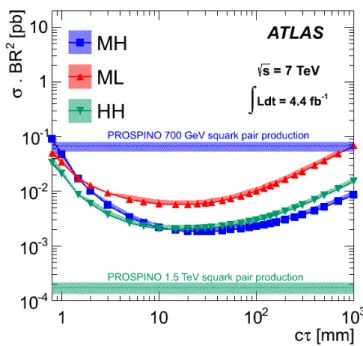
to set limits on the plane of σ · BR2 versus cτ . The
re-sulting limits are shown in Fig. 6, with the PROSPINO-calculated cross sections for squark masses of 700 GeV and 1500 GeV. The PROSPINO predictions are shown as a band which represents the variation in predicted cross sec-tion when using two different sets of PDFs (CTEQ6.6 and MSTW2008NLO [33]) and varying the factorisation and renormalisation scales each up and down by a factor of two. Since essentially no background is expected and no events are observed, the expected and observed limits are indistinguishable. Based on the observation of no signal
events in a data sample of 4.4 fb−1, a 95% confidence-level
upper limit of 0.68 fb is set on σ · BR2 multiplied by the
detector acceptance and the reconstruction efficiency for any signal vertex.
Figure 6: Upper limits at 95% confidence level on σ · BR2 vs. the neutralino lifetime for different combinations of squark and neu-tralino masses, based on the observation of zero events satisfying all criteria in a 4.4 fb−1 data sample. The shaded areas around these curves represent the ±1σ uncertainty bands on the expected limits. The horizontal lines show the cross sections calculated from PROSPINO for squark masses of 700 GeV and 1500 GeV. The shaded regions around these lines represent the uncertainties on the cross sections obtained from the procedure described in the text.
9. Summary and conclusions
An improved search is presented for new, heavy par-ticles that decay at radial distances between 4 mm and 180 mm from the pp interaction point, in association with a high-transverse-momentum muon. This search is based on data collected by the ATLAS detector at the LHC at a center-of-mass energy of 7 TeV. Fewer than 0.06
back-ground events are expected in the data sample of 4.4 fb−1,
and no events are observed. Limits are derived on the product of di-squark production cross section and decay chain branching fraction squared, in a SUGRA scenario where the lightest neutralino produced in the primary-squark decay undergoes an R-parity violating decay into a muon and two quarks. The limits are reported as a func-tion of the neutralino lifetime and for a range of neutralino masses and velocities, which are the factors with greatest impact on the reconstruction efficiency. Limits for a vari-ety of other models can thus be approximated from these results, based on the neutralino mass and velocity distribu-tion in a given model. Comparing to the results of the pre-vious analysis reported in [16], for lifetimes cτ < 100mm, the limits presented here are somewhat less stringent than could be expected from the factor ≈ 130 increase in inte-grated luminosity, as a result of tighter trigger and offline muon selection requirements. For longer lifetimes, these factors are more than outweighed by the increase in effi-ciency afforded by re-tracking, so the limits are somewhat better than would be expected by simple scaling according to the integrated luminosity of the data samples.
We thank CERN for the very successful operation of the LHC, as well as the support staff from our institutions without whom ATLAS could not be operated efficiently.
We acknowledge the support of ANPCyT, Argentina;
YerPhI, Armenia; ARC, Australia; BMWF, Austria;
ANAS, Azerbaijan; SSTC, Belarus; CNPq and FAPESP, Brazil; NSERC, NRC and CFI, Canada; CERN; CONI-CYT, Chile; CAS, MOST and NSFC, China; COLCIEN-CIAS, Colombia; MSMT CR, MPO CR and VSC CR, Czech Republic; DNRF, DNSRC and Lundbeck Founda-tion, Denmark; EPLANET and ERC, European Union; IN2P3-CNRS, CEA-DSM/IRFU, France; GNAS, Georgia; BMBF, DFG, HGF, MPG and AvH Foundation, Ger-many; GSRT, Greece; ISF, MINERVA, GIF, DIP and Benoziyo Center, Israel; INFN, Italy; MEXT and JSPS, Japan; CNRST, Morocco; FOM and NWO, Netherlands; RCN, Norway; MNiSW, Poland; GRICES and FCT, Por-tugal; MERYS (MECTS), Romania; MES of Russia and ROSATOM, Russian Federation; JINR; MSTD, Serbia; MSSR, Slovakia; ARRS and MVZT, Slovenia; DST/NRF, South Africa; MICINN, Spain; SRC and Wallenberg Foundation, Sweden; SER, SNSF and Cantons of Bern and Geneva, Switzerland; NSC, Taiwan; TAEK, Turkey; STFC, the Royal Society and Leverhulme Trust, United Kingdom; DOE and NSF, United States of America.
The crucial computing support from all WLCG partners is acknowledged gratefully, in particular from
CERN and the ATLAS Tier-1 facilities at TRIUMF (Canada), NDGF (Denmark, Norway, Sweden), CC-IN2P3 (France), KIT/GridKA (Germany),
INFN-CNAF (Italy), NL-T1 (Netherlands), PIC (Spain), ASGC (Taiwan), RAL (UK) and BNL (USA) and in the Tier-2 facilities worldwide.
References
[1] M. Fairbairn, A. C. Kraan, D. A. Milstead, T. Sj¨ostrand, P. Z. Skands and T. Sloan, “Stable massive particles at colliders”, Phys. Rept. 438, 1 (2007) [hep-ph/0611040]. [2] A. H. Chamseddine, R. L. Arnowitt and P. Nath, “Locally
Supersymmetric Grand Unification”, Phys. Rev. Lett. 49 (1982) 970; R. Barbieri, S. Ferrara and C. A. Savoy, “Gauge Models with Spontaneously Broken Local Supersymmetry”, Phys. Lett. B 119 (1982) 343; L. E. Ibanez, “Locally
Supersymmetric SU(5) Grand Unification”, Phys. Lett. B 118 (1982) 73; L. J. Hall, J. D. Lykken and S. Weinberg,
“Supergravity as the Messenger of Supersymmetry Breaking”, Phys. Rev. D 27 (1983) 2359; N. Ohta, “Grand Unified Theories Based On Local Supersymmetry”, Prog. Theor. Phys. 70 (1983) 542.
[3] R. Barbier et al., “R-parity violating supersymmetry”, Phys. Rept. 420 (2005) 1 [hep-ph/0406039].
[4] B. C. Allanach, M. A. Bernhardt, H. K. Dreiner, C. H. Kom and P. Richardson, “Mass Spectrum in R-Parity Violating mSUGRA and Benchmark Points”, Phys. Rev. D 75 (2007) 035002 [hep-ph/0609263].
[5] ATLAS Collaboration, “Search for top and bottom squarks from gluino pair production in final states with missing transverse energy and at least three b-jets with the ATLAS detector”, [hep-ex/1207.4686]; ATLAS Collaboration, “Hunt for new phenomena using large jet multiplicities and missing transverse momentum with ATLAS in 4.7 fb−1 of√s = 7 TeV proton-proton collisions”, JHEP 1207 (2012) 167
[hep-ex/1206.1760].
[6] CMS Collaboration, “Search for new physics in events with opposite-sign leptons, jets, and missing transverse energy in pp collisions at sqrt(s) = 7 TeV,” [hep-ex/1206.3949]; CMS Collaboration, “Search for new physics in the multijet and missing transverse momentum final state in proton-proton collisions at√s = 7 TeV,” [hep-ex/1207.1898].
[7] P. W. Graham, D. E. Kaplan, S. Rajendran and P. Saraswat, “Displaced Supersymmetry,” JHEP 1207 (2012) 149
[hep-ph/1204.6038].
[8] S. Dimopoulos, M. Dine, S. Raby and S. D. Thomas, “Experimental signatures of low-energy gauge mediated supersymmetry breaking”, Phys. Rev. Lett. 76 (1996) 3494 [hep-ph/9601367].
[9] J. L. Hewett, B. Lillie, M. Masip and T. G. Rizzo, “Signatures of long-lived gluinos in split supersymmetry”, JHEP 0409 (2004) 070 [hep-ph/0408248].
[10] M. J. Strassler and K. M. Zurek, “Echoes of a hidden valley at hadron colliders”, Phys. Lett. B 651 (2007) 374
[hep-ph/0604261].
[11] P. Schuster, N. Toro and I. Yavin, “Terrestrial and Solar Limits on Long-Lived Particles in a Dark Sector”, Phys. Rev. D 81 (2010) 016002 [hep-ph/0910.1602].
[12] J. Fan, M. Reece, J. T. Ruderman, “Stealth Supersymmetry”, JHEP 1111 (2011) 012 [hep-ph/1105.5135].
[13] A. Arbey, M. Battaglia, A. Djouadi, F. Mahmoudi and J. Quevillon, Phys. Lett. B 708 (2012) 162 [hep-ph/1112.3028]. [14] ATLAS Collaboration, “Observation of a new particle in the
search for the Standard Model Higgs boson with the ATLAS detector at the LHC,” Accepted by Phys.Lett.B
[hep-ex/1207.7214].
125 GeV with the CMS experiment at the LHC,” Accepted by: Phys.Lett.B [hep-ex/1207.7235].
[16] ATLAS Collaboration, “Search for displaced vertices arising from decays of new heavy particles in 7 TeV pp collisions at ATLAS”, Phys. Lett. B 707 (2012) 478 [hep-ex/1109.2242]. [17] CMS Collaboration, “Search in leptonic channels for heavy
resonances decaying to long-lived neutral particles”, arXiv:1211.2472
[18] D0 Collaboration, V. M. Abazov et al., “Search for neutral, long-lived particles decaying into two muons in p ¯p collisions at √
s = 1.96-TeV”, Phys. Rev. Lett. 97 (2006) 161802 [hep-ex/0607028].
[19] D0 Collaboration, V. M. Abazov et al., “Search for Resonant Pair Production of long-lived particles decaying to b anti-b in p anti-p collisions at s**(1/2) = 1.96-TeV”, Phys. Rev. Lett. 103 (2009) 071801 [hep-ex/0906.1787].
[20] ALEPH Collaboration, A. Heister et al., “Search for gauge mediated SUSY breaking topologies in e+e−collisions at center-of-mass energies up to 209-GeV,” Eur. Phys. J. C 25 (2002) 339 [hep-ex/0203024].
[21] ATLAS Collaboration, “Luminosity Determination in pp Collisions at sqrt(s) = 7 TeV using the ATLAS Detector in 2011”, ATLAS-CONF-2011-116 (2011),
URL:http://cdsweb.cern.ch/record/1376384.
[22] ATLAS Collaboration, “The ATLAS Experiment at the CERN Large Hadron Collider”, JINST 3 (2008) S08003. [23] T. Sj¨ostrand, S. Mrenna and P. Z. Skands, “PYTHIA 6.4
Physics and Manual,” JHEP 0605 (2006) 026 [hep-ph/0603175].
[24] A. Sherstnev and R. S. Thorne, “Parton distributions for LO generators”, Eur. Phys. J C55 (2008) 553 [hep-ph/0711.2473] [25] W. Beenakker, R. Hopker and M. Spira, “PROSPINO: A
Program for the production of supersymmetric particles in next-to-leading order QCD”, hep-ph/9611232.
[26] P. M. Nadolsky, H. -L. Lai, Q. -H. Cao, J. Huston, J. Pumplin, D. Stump, W. -K. Tung and C. -P. Yuan, “Implications of CTEQ global analysis for collider observables”, Phys. Rev. D 78 (2008) 013004 [hep-ph/0802.0007].
[27] S. Agostinelli et al. [GEANT4 Collaboration], “GEANT4: A Simulation toolkit”, Nucl. Instrum. Meth. A 506 (2003) 250. [28] ATLAS Collaboration, “The ATLAS Simulation
Infrastructure”, Eur. Phys. J. C 70 (2010) 823 [physics.ins-det/1005.4568].
[29] S. R. Das, “On a new approach for finding all the modified cut-sets in an incompatibility graph”, IEEE Transactions on Computers v22(2) (1973) 187.
[30] ATLAS Collaboration, “A study of the material in the ATLAS inner detector using secondary hadronic interactions”, JINST 7 (2012) P01013 [hep-ex/1110.6191].
[31] ATLAS Collaboration, “Measurement of charged-particle event shape variables in sqrt(s) = 7 TeV proton-proton interactions with the ATLAS detector” arXiv:207.6915 [hep-ex]
[32] A. L. Read, “Presentation of search results: The CL(s) technique”, J. Phys. G 28 (2002) 2693.
[33] A. D. Martin, W. J. Stirling, R. S. Thorne and G. Watt, “Parton distributions for the LHC”, Eur. Phys. J. C 63 (2009) 189 [hep-ph/0901.0002].
The ATLAS Collaboration
G. Aad48, T. Abajyan21, B. Abbott111, J. Abdallah12,
S. Abdel Khalek115, A.A. Abdelalim49, O. Abdinov11,
R. Aben105, B. Abi112, M. Abolins88, O.S. AbouZeid158,
H. Abramowicz153, H. Abreu136, B.S. Acharya164a,164b,
L. Adamczyk38, D.L. Adams25, T.N. Addy56,
J. Adelman176, S. Adomeit98, P. Adragna75, T. Adye129,
S. Aefsky23, J.A. Aguilar-Saavedra124b,a, M. Agustoni17,
M. Aharrouche81, S.P. Ahlen22, F. Ahles48, A. Ahmad148,
M. Ahsan41, G. Aielli133a,133b, T. Akdogan19a,
T.P.A. ˚Akesson79, G. Akimoto155, A.V. Akimov94,
M.S. Alam2, M.A. Alam76, J. Albert169, S. Albrand55,
M. Aleksa30, I.N. Aleksandrov64, F. Alessandria89a,
C. Alexa26a, G. Alexander153, G. Alexandre49,
T. Alexopoulos10, M. Alhroob164a,164c, M. Aliev16,
G. Alimonti89a, J. Alison120, B.M.M. Allbrooke18,
P.P. Allport73, S.E. Allwood-Spiers53, J. Almond82,
A. Aloisio102a,102b, R. Alon172, A. Alonso79, F. Alonso70,
A. Altheimer35, B. Alvarez Gonzalez88,
M.G. Alviggi102a,102b, K. Amako65, C. Amelung23,
V.V. Ammosov128,∗, S.P. Amor Dos Santos124a,
A. Amorim124a,b, N. Amram153, C. Anastopoulos30,
L.S. Ancu17, N. Andari115, T. Andeen35, C.F. Anders58b,
G. Anders58a, K.J. Anderson31, A. Andreazza89a,89b,
V. Andrei58a, M-L. Andrieux55, X.S. Anduaga70,
S. Angelidakis9, P. Anger44, A. Angerami35,
F. Anghinolfi30, A. Anisenkov107, N. Anjos124a,
A. Annovi47, A. Antonaki9, M. Antonelli47,
A. Antonov96, J. Antos144b, F. Anulli132a, M. Aoki101,
S. Aoun83, L. Aperio Bella5, R. Apolle118,c,
G. Arabidze88, I. Aracena143, Y. Arai65, A.T.H. Arce45,
S. Arfaoui148, J-F. Arguin93, E. Arik19a,∗, M. Arik19a,
A.J. Armbruster87, O. Arnaez81, V. Arnal80,
C. Arnault115, A. Artamonov95, G. Artoni132a,132b,
D. Arutinov21, S. Asai155, S. Ask28, B. ˚Asman146a,146b,
L. Asquith6, K. Assamagan25, A. Astbury169,
M. Atkinson165, B. Aubert5, E. Auge115, K. Augsten127,
M. Aurousseau145a, G. Avolio30, R. Avramidou10,
D. Axen168, G. Azuelos93,d, Y. Azuma155, M.A. Baak30,
G. Baccaglioni89a, C. Bacci134a,134b, A.M. Bach15,
H. Bachacou136, K. Bachas30, M. Backes49,
M. Backhaus21, J. Backus Mayes143, E. Badescu26a,
P. Bagnaia132a,132b, S. Bahinipati3, Y. Bai33a,
D.C. Bailey158, T. Bain158, J.T. Baines129,
O.K. Baker176, M.D. Baker25, S. Baker77, P. Balek126,
E. Banas39, P. Banerjee93, Sw. Banerjee173, D. Banfi30,
A. Bangert150, V. Bansal169, H.S. Bansil18, L. Barak172,
S.P. Baranov94, A. Barbaro Galtieri15, T. Barber48,
E.L. Barberio86, D. Barberis50a,50b, M. Barbero21,
D.Y. Bardin64, T. Barillari99, M. Barisonzi175,
T. Barklow143, N. Barlow28, B.M. Barnett129,
R.M. Barnett15, A. Baroncelli134a, G. Barone49,
A.J. Barr118, F. Barreiro80,
J. Barreiro Guimar˜aes da Costa57, P. Barrillon115,
R. Bartoldus143, A.E. Barton71, V. Bartsch149,
A. Basye165, R.L. Bates53, L. Batkova144a, J.R. Batley28,
A. Battaglia17, M. Battistin30, F. Bauer136,
H.S. Bawa143,e, S. Beale98, T. Beau78,
P.H. Beauchemin161, R. Beccherle50a, P. Bechtle21,
H.P. Beck17, A.K. Becker175, S. Becker98,
M. Beckingham138, K.H. Becks175, A.J. Beddall19c,
A. Beddall19c, S. Bedikian176, V.A. Bednyakov64,
C.P. Bee83, L.J. Beemster105, M. Begel25,
S. Behar Harpaz152, P.K. Behera62, M. Beimforde99,
C. Belanger-Champagne85, P.J. Bell49, W.H. Bell49,
G. Bella153, L. Bellagamba20a, M. Bellomo30,
A. Belloni57, O. Beloborodova107,f, K. Belotskiy96,
O. Beltramello30, O. Benary153, D. Benchekroun135a,
K. Bendtz146a,146b, N. Benekos165, Y. Benhammou153,
E. Benhar Noccioli49, J.A. Benitez Garcia159b,
D.P. Benjamin45, M. Benoit115, J.R. Bensinger23,
K. Benslama130, S. Bentvelsen105, D. Berge30,
E. Bergeaas Kuutmann42, N. Berger5, F. Berghaus169,
E. Berglund105, J. Beringer15, P. Bernat77,
R. Bernhard48, C. Bernius25, T. Berry76, C. Bertella83,
A. Bertin20a,20b, F. Bertolucci122a,122b,
M.I. Besana89a,89b, G.J. Besjes104, N. Besson136,
S. Bethke99, W. Bhimji46, R.M. Bianchi30,
L. Bianchini23, M. Bianco72a,72b, O. Biebel98,
S.P. Bieniek77, K. Bierwagen54, J. Biesiada15,
M. Biglietti134a, H. Bilokon47, M. Bindi20a,20b,
S. Binet115, A. Bingul19c, C. Bini132a,132b, C. Biscarat178,
B. Bittner99, K.M. Black22, R.E. Blair6,
J.-B. Blanchard136, G. Blanchot30, T. Blazek144a,
I. Bloch42, C. Blocker23, J. Blocki39, A. Blondel49,
W. Blum81, U. Blumenschein54, G.J. Bobbink105,
V.B. Bobrovnikov107, S.S. Bocchetta79, A. Bocci45,
C.R. Boddy118, M. Boehler48, J. Boek175, N. Boelaert36,
J.A. Bogaerts30, A. Bogdanchikov107, A. Bogouch90,∗,
C. Bohm146a, J. Bohm125, V. Boisvert76, T. Bold38,
V. Boldea26a, N.M. Bolnet136, M. Bomben78, M. Bona75,
M. Boonekamp136, S. Bordoni78, C. Borer17,
A. Borisov128, G. Borissov71, I. Borjanovic13a, M. Borri82,
S. Borroni87, J. Bortfeldt98, V. Bortolotto134a,134b,
K. Bos105, D. Boscherini20a, M. Bosman12,
H. Boterenbrood105, J. Bouchami93, J. Boudreau123,
E.V. Bouhova-Thacker71, D. Boumediene34,
C. Bourdarios115, N. Bousson83, A. Boveia31, J. Boyd30,
I.R. Boyko64, I. Bozovic-Jelisavcic13b, J. Bracinik18,
P. Branchini134a, A. Brandt8, G. Brandt118, O. Brandt54,
U. Bratzler156, B. Brau84, J.E. Brau114, H.M. Braun175,∗,
S.F. Brazzale164a,164c, B. Brelier158, J. Bremer30,
K. Brendlinger120, R. Brenner166, S. Bressler172,
D. Britton53, F.M. Brochu28, I. Brock21, R. Brock88,
F. Broggi89a, C. Bromberg88, J. Bronner99,
G. Brooijmans35, T. Brooks76, W.K. Brooks32b,
G. Brown82, H. Brown8, P.A. Bruckman de Renstrom39,
D. Bruncko144b, R. Bruneliere48, S. Brunet60,
A. Bruni20a, G. Bruni20a, M. Bruschi20a, T. Buanes14,
Q. Buat55, F. Bucci49, J. Buchanan118, P. Buchholz141,
R.M. Buckingham118, A.G. Buckley46, S.I. Buda26a,
I.A. Budagov64, B. Budick108, V. B¨uscher81, L. Bugge117,
H. Burckhart30, S. Burdin73, T. Burgess14, S. Burke129,
E. Busato34, P. Bussey53, C.P. Buszello166, B. Butler143,
J.M. Butler22, C.M. Buttar53, J.M. Butterworth77,
W. Buttinger28, M. Byszewski30, S. Cabrera Urb´an167,
D. Caforio20a,20b, O. Cakir4a, P. Calafiura15,
G. Calderini78, P. Calfayan98, R. Calkins106,
L.P. Caloba24a, R. Caloi132a,132b, D. Calvet34,
S. Calvet34, R. Camacho Toro34, P. Camarri133a,133b,
D. Cameron117, L.M. Caminada15,
R. Caminal Armadans12, S. Campana30,
M. Campanelli77, V. Canale102a,102b, F. Canelli31,
A. Canepa159a, J. Cantero80, R. Cantrill76,
L. Capasso102a,102b, M.D.M. Capeans Garrido30,
I. Caprini26a, M. Caprini26a, D. Capriotti99,
M. Capua37a,37b, R. Caputo81, R. Cardarelli133a,
T. Carli30, G. Carlino102a, L. Carminati89a,89b,
B. Caron85, S. Caron104, E. Carquin32b,
G.D. Carrillo-Montoya173, A.A. Carter75, J.R. Carter28,
J. Carvalho124a,g, D. Casadei108, M.P. Casado12,
M. Cascella122a,122b, C. Caso50a,50b,∗,
A.M. Castaneda Hernandez173,h,
E. Castaneda-Miranda173, V. Castillo Gimenez167,
N.F. Castro124a, G. Cataldi72a, P. Catastini57,
A. Catinaccio30, J.R. Catmore30, A. Cattai30,
G. Cattani133a,133b, S. Caughron88, V. Cavaliere165,
P. Cavalleri78, D. Cavalli89a, M. Cavalli-Sforza12,
V. Cavasinni122a,122b, F. Ceradini134a,134b,
A.S. Cerqueira24b, A. Cerri30, L. Cerrito75, F. Cerutti47,
S.A. Cetin19b, A. Chafaq135a, D. Chakraborty106,
I. Chalupkova126, K. Chan3, P. Chang165, B. Chapleau85,
J.D. Chapman28, J.W. Chapman87, E. Chareyre78,
D.G. Charlton18, V. Chavda82, C.A. Chavez Barajas30,
S. Cheatham85, S. Chekanov6, S.V. Chekulaev159a,
G.A. Chelkov64, M.A. Chelstowska104, C. Chen63,
H. Chen25, S. Chen33c, X. Chen173, Y. Chen35,
Y. Cheng31, A. Cheplakov64,
R. Cherkaoui El Moursli135e, V. Chernyatin25, E. Cheu7,
S.L. Cheung158, L. Chevalier136, G. Chiefari102a,102b,
L. Chikovani51a,∗, J.T. Childers30, A. Chilingarov71,
G. Chiodini72a, A.S. Chisholm18, R.T. Chislett77,
A. Chitan26a, M.V. Chizhov64, G. Choudalakis31,
S. Chouridou137, I.A. Christidi77, A. Christov48,
D. Chromek-Burckhart30, M.L. Chu151, J. Chudoba125,
G. Ciapetti132a,132b, A.K. Ciftci4a, R. Ciftci4a,
D. Cinca34, V. Cindro74, C. Ciocca20a,20b, A. Ciocio15,
M. Cirilli87, P. Cirkovic13b, Z.H. Citron172,
M. Citterio89a, M. Ciubancan26a, A. Clark49,
P.J. Clark46, R.N. Clarke15, W. Cleland123,
J.C. Clemens83, B. Clement55, C. Clement146a,146b,
Y. Coadou83, M. Cobal164a,164c, A. Coccaro138,
J. Cochran63, L. Coffey23, J.G. Cogan143,
J. Coggeshall165, E. Cogneras178, J. Colas5, S. Cole106,
A.P. Colijn105, N.J. Collins18, C. Collins-Tooth53,
J. Collot55, T. Colombo119a,119b, G. Colon84,
G. Compostella99, P. Conde Mui˜no124a, E. Coniavitis166,
M.C. Conidi12, S.M. Consonni89a,89b, V. Consorti48,
S. Constantinescu26a, C. Conta119a,119b, G. Conti57,
F. Conventi102a,i, M. Cooke15, B.D. Cooper77,
A.M. Cooper-Sarkar118, K. Copic15, T. Cornelissen175,
M. Corradi20a, F. Corriveau85,j, A. Cortes-Gonzalez165,
G. Cortiana99, G. Costa89a, M.J. Costa167,
D. Costanzo139, D. Cˆot´e30, L. Courneyea169, G. Cowan76,
C. Cowden28, B.E. Cox82, K. Cranmer108,
F. Crescioli122a,122b, M. Cristinziani21, G. Crosetti37a,37b,
S. Cr´ep´e-Renaudin55, C.-M. Cuciuc26a,
C. Cuenca Almenar176, T. Cuhadar Donszelmann139,
J. Cummings176, M. Curatolo47, C.J. Curtis18,
C. Cuthbert150, P. Cwetanski60, H. Czirr141,
P. Czodrowski44, Z. Czyczula176, S. D’Auria53,
M. D’Onofrio73, A. D’Orazio132a,132b,
M.J. Da Cunha Sargedas De Sousa124a, C. Da Via82,
W. Dabrowski38, A. Dafinca118, T. Dai87,
C. Dallapiccola84, M. Dam36, M. Dameri50a,50b,
D.S. Damiani137, H.O. Danielsson30, V. Dao49,
G. Darbo50a, G.L. Darlea26b, J.A. Dassoulas42,
W. Davey21, T. Davidek126, N. Davidson86,
R. Davidson71, E. Davies118,c, M. Davies93,
O. Davignon78, A.R. Davison77, Y. Davygora58a,
E. Dawe142, I. Dawson139, R.K. Daya-Ishmukhametova23,
K. De8, R. de Asmundis102a, S. De Castro20a,20b,
S. De Cecco78, J. de Graat98, N. De Groot104,
P. de Jong105, C. De La Taille115, H. De la Torre80,
F. De Lorenzi63, L. de Mora71, L. De Nooij105,
D. De Pedis132a, A. De Salvo132a, U. De Sanctis164a,164c,
A. De Santo149, J.B. De Vivie De Regie115,
G. De Zorzi132a,132b, W.J. Dearnaley71, R. Debbe25,
C. Debenedetti46, B. Dechenaux55, D.V. Dedovich64,
J. Degenhardt120, J. Del Peso80, T. Del Prete122a,122b,
T. Delemontex55, M. Deliyergiyev74, A. Dell’Acqua30,
L. Dell’Asta22, M. Della Pietra102a,i,
D. della Volpe102a,102b, M. Delmastro5, P.A. Delsart55,
C. Deluca105, S. Demers176, M. Demichev64,
B. Demirkoz12,k, J. Deng163, S.P. Denisov128,
D. Derendarz39, J.E. Derkaoui135d, F. Derue78,
P. Dervan73, K. Desch21, E. Devetak148,
P.O. Deviveiros105, A. Dewhurst129, B. DeWilde148,
S. Dhaliwal158, R. Dhullipudi25,l, A. Di Ciaccio133a,133b,
L. Di Ciaccio5, C. Di Donato102a,102b, A. Di Girolamo30,
B. Di Girolamo30, S. Di Luise134a,134b, A. Di Mattia173,
B. Di Micco30, R. Di Nardo47, A. Di Simone133a,133b,
R. Di Sipio20a,20b, M.A. Diaz32a, E.B. Diehl87,
J. Dietrich42, T.A. Dietzsch58a, S. Diglio86,
K. Dindar Yagci40, J. Dingfelder21, F. Dinut26a,
C. Dionisi132a,132b, P. Dita26a, S. Dita26a, F. Dittus30,
F. Djama83, T. Djobava51b, M.A.B. do Vale24c,
A. Do Valle Wemans124a,m, T.K.O. Doan5, M. Dobbs85,
D. Dobos30, E. Dobson30,n, J. Dodd35, C. Doglioni49,
T. Doherty53, Y. Doi65,∗, J. Dolejsi126, I. Dolenc74,
Z. Dolezal126, B.A. Dolgoshein96,∗, T. Dohmae155,
M. Donadelli24d, J. Donini34, J. Dopke30, A. Doria102a,
A. Dos Anjos173, A. Dotti122a,122b, M.T. Dova70,
A.D. Doxiadis105, A.T. Doyle53, N. Dressnandt120,
M. Dris10, J. Dubbert99, S. Dube15, E. Duchovni172,
M. D¨uhrssen30, I.P. Duerdoth82, L. Duflot115,
M-A. Dufour85, L. Duguid76, M. Dunford58a,
H. Duran Yildiz4a, R. Duxfield139, M. Dwuznik38,
F. Dydak30, M. D¨uren52, W.L. Ebenstein45, J. Ebke98,
S. Eckweiler81, K. Edmonds81, W. Edson2,
C.A. Edwards76, N.C. Edwards53, W. Ehrenfeld42,
T. Eifert143, G. Eigen14, K. Einsweiler15,
E. Eisenhandler75, T. Ekelof166, M. El Kacimi135c,
M. Ellert166, S. Elles5, F. Ellinghaus81, K. Ellis75,
N. Ellis30, J. Elmsheuser98, M. Elsing30,
D. Emeliyanov129, R. Engelmann148, A. Engl98,
B. Epp61, J. Erdmann54, A. Ereditato17, D. Eriksson146a,
J. Ernst2, M. Ernst25, J. Ernwein136, D. Errede165,
S. Errede165, E. Ertel81, M. Escalier115, H. Esch43,
C. Escobar123, X. Espinal Curull12, B. Esposito47,
F. Etienne83, A.I. Etienvre136, E. Etzion153,
D. Evangelakou54, H. Evans60, L. Fabbri20a,20b,
C. Fabre30, R.M. Fakhrutdinov128, S. Falciano132a,
Y. Fang173, M. Fanti89a,89b, A. Farbin8, A. Farilla134a,
J. Farley148, T. Farooque158, S. Farrell163,
S.M. Farrington170, P. Farthouat30, F. Fassi167,
P. Fassnacht30, D. Fassouliotis9, B. Fatholahzadeh158,
A. Favareto89a,89b, L. Fayard115, S. Fazio37a,37b,
R. Febbraro34, P. Federic144a, O.L. Fedin121,
W. Fedorko88, M. Fehling-Kaschek48, L. Feligioni83,
D. Fellmann6, C. Feng33d, E.J. Feng6, A.B. Fenyuk128,
J. Ferencei144b, W. Fernando6, S. Ferrag53,
J. Ferrando53, V. Ferrara42, A. Ferrari166, P. Ferrari105,
R. Ferrari119a, D.E. Ferreira de Lima53, A. Ferrer167,
D. Ferrere49, C. Ferretti87, A. Ferretto Parodi50a,50b,
M. Fiascaris31, F. Fiedler81, A. Filipˇciˇc74, F. Filthaut104,
M. Fincke-Keeler169, M.C.N. Fiolhais124a,g, L. Fiorini167,
A. Firan40, G. Fischer42, M.J. Fisher109, M. Flechl48,
I. Fleck141, J. Fleckner81, P. Fleischmann174,
S. Fleischmann175, T. Flick175, A. Floderus79,
L.R. Flores Castillo173, M.J. Flowerdew99,
T. Fonseca Martin17, A. Formica136, A. Forti82,
D. Fortin159a, D. Fournier115, A.J. Fowler45, H. Fox71,
P. Francavilla12, M. Franchini20a,20b,
S. Franchino119a,119b, D. Francis30, T. Frank172,
M. Franklin57, S. Franz30, M. Fraternali119a,119b,
S. Fratina120, S.T. French28, C. Friedrich42,
F. Friedrich44, R. Froeschl30, D. Froidevaux30,
J.A. Frost28, C. Fukunaga156, E. Fullana Torregrosa30,
B.G. Fulsom143, J. Fuster167, C. Gabaldon30,
O. Gabizon172, T. Gadfort25, S. Gadomski49,
G. Gagliardi50a,50b, P. Gagnon60, C. Galea98,
B. Galhardo124a, E.J. Gallas118, V. Gallo17,
B.J. Gallop129, P. Gallus125, K.K. Gan109, Y.S. Gao143,e,
A. Gaponenko15, F. Garberson176, M. Garcia-Sciveres15,
C. Garc´ıa167, J.E. Garc´ıa Navarro167, R.W. Gardner31,
N. Garelli30, H. Garitaonandia105, V. Garonne30,
C. Gatti47, G. Gaudio119a, B. Gaur141, L. Gauthier136,
P. Gauzzi132a,132b, I.L. Gavrilenko94, C. Gay168,
G. Gaycken21, E.N. Gazis10, P. Ge33d, Z. Gecse168,
C.N.P. Gee129, D.A.A. Geerts105, Ch. Geich-Gimbel21,
K. Gellerstedt146a,146b, C. Gemme50a, A. Gemmell53,
M.H. Genest55, S. Gentile132a,132b, M. George54,
S. George76, P. Gerlach175, A. Gershon153,
C. Geweniger58a, H. Ghazlane135b, N. Ghodbane34,
B. Giacobbe20a, S. Giagu132a,132b, V. Giakoumopoulou9,
V. Giangiobbe12, F. Gianotti30, B. Gibbard25,
A. Gibson158, S.M. Gibson30, M. Gilchriese15,
D. Gillberg29, A.R. Gillman129, D.M. Gingrich3,d,
J. Ginzburg153, N. Giokaris9, M.P. Giordani164c,
R. Giordano102a,102b, F.M. Giorgi16, P. Giovannini99,
P.F. Giraud136, D. Giugni89a, M. Giunta93, P. Giusti20a,
B.K. Gjelsten117, L.K. Gladilin97, C. Glasman80,
J. Glatzer21, A. Glazov42, K.W. Glitza175, G.L. Glonti64,
J.R. Goddard75, J. Godfrey142, J. Godlewski30,
M. Goebel42, T. G¨opfert44, C. Goeringer81,
C. G¨ossling43, S. Goldfarb87, T. Golling176,
A. Gomes124a,b, L.S. Gomez Fajardo42, R. Gon¸calo76,
J. Goncalves Pinto Firmino Da Costa42, L. Gonella21,
S. Gonz´alez de la Hoz167, G. Gonzalez Parra12,
M.L. Gonzalez Silva27, S. Gonzalez-Sevilla49,
J.J. Goodson148, L. Goossens30, P.A. Gorbounov95,
H.A. Gordon25, I. Gorelov103, G. Gorfine175, B. Gorini30,
E. Gorini72a,72b, A. Goriˇsek74, E. Gornicki39,
B. Gosdzik42, A.T. Goshaw6, M. Gosselink105,
M.I. Gostkin64, I. Gough Eschrich163, M. Gouighri135a,
D. Goujdami135c, M.P. Goulette49, A.G. Goussiou138,
C. Goy5, S. Gozpinar23, I. Grabowska-Bold38,
P. Grafstr¨om20a,20b, K-J. Grahn42, E. Gramstad117,
F. Grancagnolo72a, S. Grancagnolo16, V. Grassi148,
V. Gratchev121, N. Grau35, H.M. Gray30, J.A. Gray148,
E. Graziani134a, O.G. Grebenyuk121, T. Greenshaw73,
Z.D. Greenwood25,l, K. Gregersen36, I.M. Gregor42,
P. Grenier143, J. Griffiths8, N. Grigalashvili64,
A.A. Grillo137, S. Grinstein12, Ph. Gris34,
Y.V. Grishkevich97, J.-F. Grivaz115, E. Gross172,
J. Grosse-Knetter54, J. Groth-Jensen172, K. Grybel141,
D. Guest176, C. Guicheney34, S. Guindon54, U. Gul53,
J. Gunther125, B. Guo158, J. Guo35, P. Gutierrez111,
N. Guttman153, O. Gutzwiller173, C. Guyot136,
C. Gwenlan118, C.B. Gwilliam73, A. Haas108, S. Haas30,
C. Haber15, H.K. Hadavand8, D.R. Hadley18,
P. Haefner21, F. Hahn30, S. Haider30, Z. Hajduk39,
H. Hakobyan177, D. Hall118, K. Hamacher175,
P. Hamal113, K. Hamano86, M. Hamer54,
A. Hamilton145b,o, S. Hamilton161, L. Han33b,
K. Hanagaki116, K. Hanawa160, M. Hance15, C. Handel81,
P. Hanke58a, J.R. Hansen36, J.B. Hansen36,
J.D. Hansen36, P.H. Hansen36, P. Hansson143,
K. Hara160, G.A. Hare137, T. Harenberg175,
S. Harkusha90, D. Harper87, R.D. Harrington46,
O.M. Harris138, J. Hartert48, F. Hartjes105,
T. Haruyama65, A. Harvey56, S. Hasegawa101,
Y. Hasegawa140, S. Hassani136, S. Haug17,
M. Hauschild30, R. Hauser88, M. Havranek21,
C.M. Hawkes18, R.J. Hawkings30, A.D. Hawkins79,
T. Hayakawa66, T. Hayashi160, D. Hayden76,
C.P. Hays118, H.S. Hayward73, S.J. Haywood129,